If you are moving to Singapore with children, two names come up in almost every conversation with colleagues, relocation agents and other parents: UWC South East Asia (UWCSEA) and Tanglin Trust School. Both are long-established, both are run by registered charities, and neither keeps a simple waitlist. So the real question is rarely “which is better?” It is “which one fits our child, our budget and our timeline?”
This guide puts UWCSEA vs Tanglin Trust side by side using only each school’s official 2026-27 fee schedules and admissions pages: annual fees by year group, one-off entry charges, first-year totals, curriculum pathways, English support and how places are allocated. All amounts are in Singapore dollars (S$) and include 9% GST. Figures were checked on 16 November 2026. We do not rank the schools; the aim is to help you see which trade-offs matter for your family.
UWCSEA vs Tanglin Trust: the short answer
- Annual fees: in the early years (UWCSEA K1–G1 and Tanglin Reception–Year 2) the two schools are almost level. From there, in continuing years, Tanglin costs roughly S$1,500–3,500 more per year. UWCSEA charges a higher development levy in a student’s first year, so in some year groups UWCSEA is actually the more expensive school in year one.
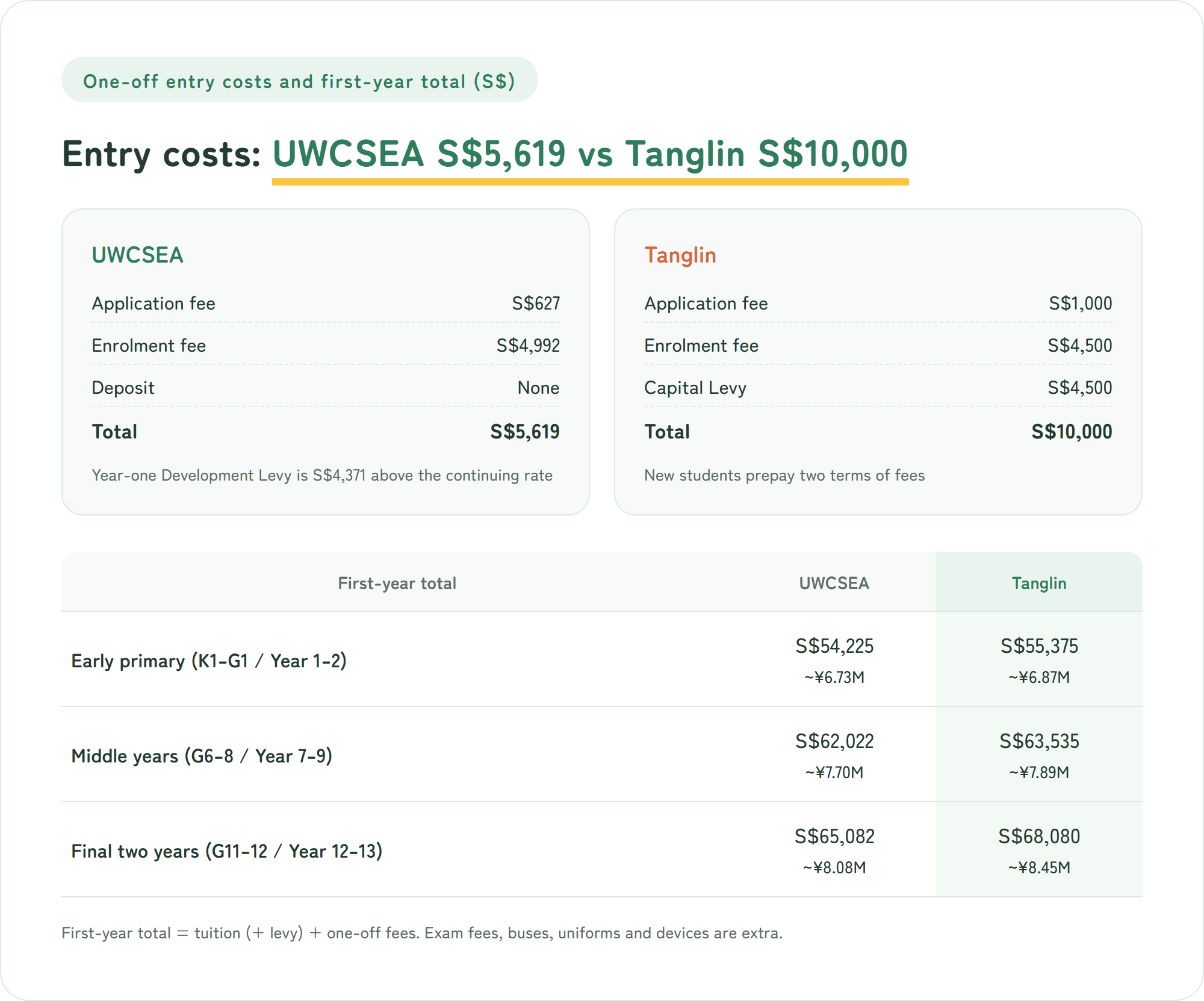
- One-off entry costs: S$5,619 at UWCSEA (application plus enrolment fee) versus S$10,000 at Tanglin (application fee, enrolment fee and capital levy).
- First-year total: about S$54,225–65,082 at UWCSEA and S$54,490–68,080 at Tanglin from Reception upwards, before exam fees, buses, uniforms, devices and trips.
- English support: UWCSEA offers English as an Additional Language (EAL) in every grade. Tanglin has no EAL provision and asks for age-appropriate English fluency, plus at least one parent who is fluent in English.
- Curriculum: UWCSEA runs its own K–12 programme, with (I)GCSE options in Grades 9–10 and the IB Diploma in Grades 11–12. Tanglin follows the English National Curriculum through (I)GCSE and then offers both A Levels and the IB Diploma in the Sixth Form.
- Admissions: neither school keeps a waitlist. UWCSEA allocates places from an application pool in deadline rounds; Tanglin uses an Applicant Pool (Waitpool) and also sells a limited number of Guaranteed Placement Rights.
UWCSEA vs Tanglin Trust School at a glance
The table below summarises the official information. If you are still building a longlist, our overview of international schools in Singapore covers the wider market.
| Topic | UWCSEA | Tanglin Trust School |
|---|---|---|
| Background and campus | Opened in 1971; run by the UWCSEA Foundation, a registered charity. Two campuses, Dover and East, on a single fee table | Founded in 1925; non-profit, registered educational charity. One campus on Portsdown Road, about 2,850 students from 55+ nationalities |
| Year groups | K1 to Grade 12 (ages 4–18 per the school) | Nursery (age 3) to Year 13 (age 18) |
| Curriculum | Own K–12 programme; Grade 9/10 Programme and/or (I)GCSE; IB Diploma in G11–12 | English National Curriculum with an international perspective to (I)GCSE; A Levels and IB Diploma in the Sixth Form |
| Annual fees (continuing years) | S$44,235 (K1–G1) to S$55,092 (G11–G12) | S$36,300 (Nursery) to S$58,080 (Years 12–13) |
| One-off entry costs | S$5,619; plus S$4,371 extra levy in year one | S$10,000 |
| First-year total | S$54,225–65,082 | S$46,300–68,080 (including Nursery) |
| English support | EAL in every grade | No EAL; at least one parent fluent in English |
| Japanese and home languages | Japanese first language from Grade 6 at Dover; IB Japanese A and B at Dover; Home Languages Programme from K1 | Not listed on official pages |
| Admissions model | Application pool, deadline rounds, not first come first served | Applicant Pool/Waitpool; date of application is one criterion; GPRs available |
| Recent results | IB average 36.4 in 2025 (world 30.6) | IB average 39.1 in 2026; A Level A*–A 63% in 2026 |
UWCSEA vs Tanglin Trust fees by year group
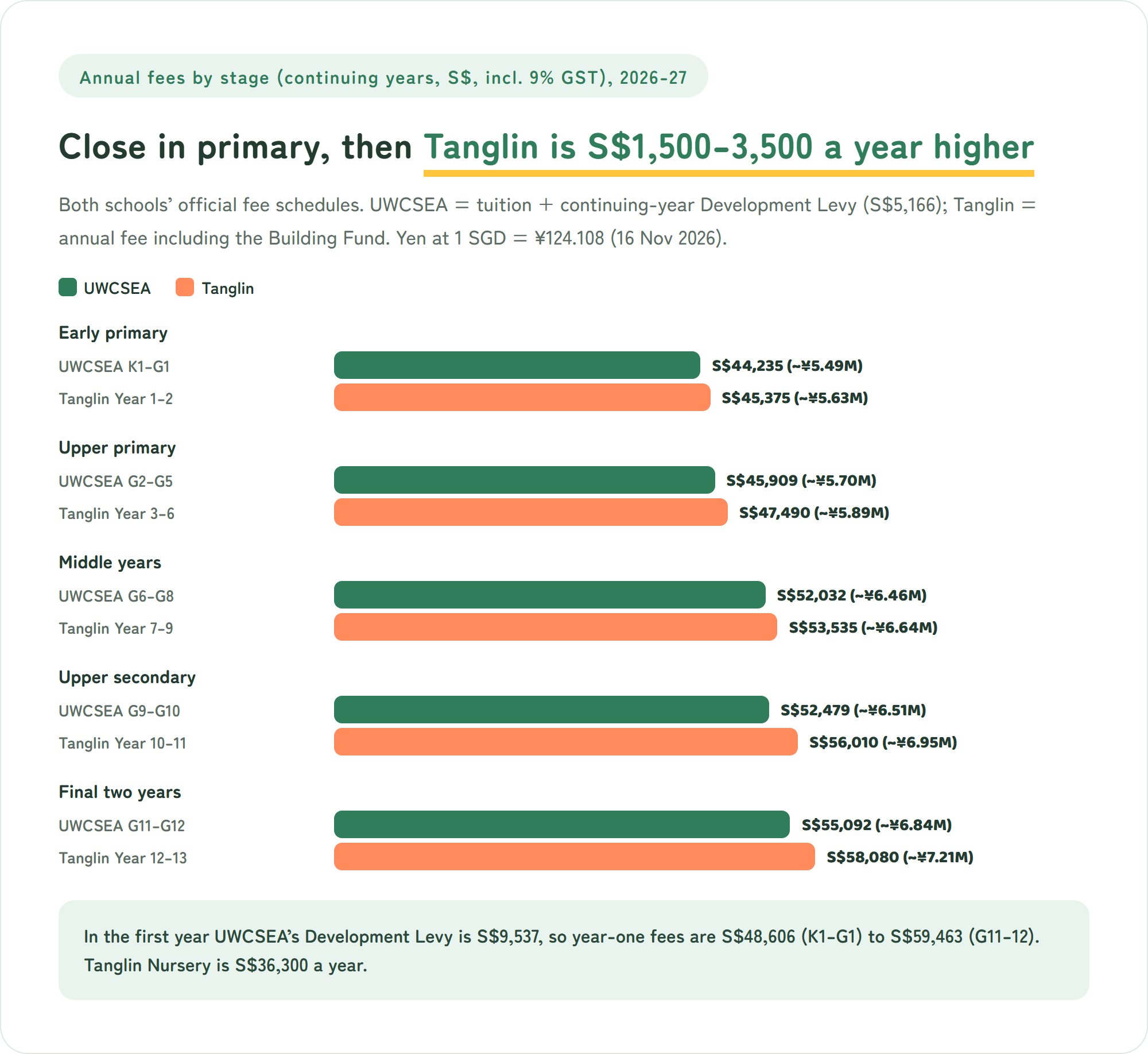
The two schools name their year groups differently. UWCSEA uses K1 to Grade 12; Tanglin uses the British Nursery to Year 13. The table pairs the fee bands as they appear on each official schedule, matching stages of schooling rather than exact ages. Some bands are offset by a year, and each school decides which year group your child joins, so check placement directly with admissions.
| UWCSEA band | Annual fees (continuing) | Tanglin band | Annual fees |
|---|---|---|---|
| K1–G1 | S$44,235 | Reception / Years 1–2 | S$44,490 / S$45,375 |
| G2–G5 | S$45,909 | Years 3–6 | S$47,490 |
| G6–G8 | S$52,032 | Years 7–9 | S$53,535 |
| G9–G10 | S$52,479 | Years 10–11 | S$56,010 |
| G11–G12 | S$55,092 | Years 12–13 | S$58,080 |
UWCSEA’s figures combine tuition with a development levy charged to every student. The levy is S$9,537 in a student’s first year and S$5,166 in later years, billed in three termly instalments. That makes first-year school fees S$48,606 for K1–G1, S$56,403 for G6–G8 and S$59,463 for G11–G12. Tanglin’s annual fees already include a Building Fund of S$6,270 a year and do not change between the first and later years. Tanglin also has a Nursery class, which UWCSEA does not, at S$36,300 a year.
Read across the table and the pattern is clear. In the youngest bands the gap is a few hundred dollars. It widens to about S$1,500 in the middle years and peaks at S$3,531 between UWCSEA G9–G10 and Tanglin Years 10–11, the (I)GCSE years, before settling at S$2,988 in the final two years. Over a long stay, those differences add up. Over a short posting, the first-year picture may matter more, because UWCSEA’s higher first-year levy means G6–G8 at UWCSEA (S$56,403) costs more in year one than Years 7–9 at Tanglin (S$53,535). For a fuller fee breakdown of each school on its own, see our UWCSEA tuition review and Tanglin Trust School fees guide.
One-off costs and the real first-year bill
Annual fees are only part of the story. Entry charges and payment timing can make a bigger difference to your cash flow in the first few months.
UWCSEA: S$5,619 up front, no deposit
UWCSEA charges a non-refundable application fee of S$627 per campus, so applying to both Dover and East costs S$1,254. On accepting an offer you pay a non-refundable enrolment fee of S$4,992. The school states clearly that there is no deposit. Remember, though, that the first-year development levy is S$4,371 higher than in later years, so the effective first-year premium is closer to S$9,990. For families with three or more children, UWCSEA lists an enrolment fee discount of 25% for the third child and 50% for the fourth and subsequent children (for August 2026 entry).
Tanglin: S$10,000 up front, two terms in advance
Tanglin’s entry costs are a S$1,000 application fee, a S$4,500 enrolment fee and a S$4,500 capital levy, all non-refundable. The enrolment fee is due on accepting a place, together with the first term’s fees; the capital levy is due before the first term starts, together with the second term’s fees. In other words, new students pay two terms in advance before they start. In Years 7–9, where a term costs S$17,845, that means about S$45,690, including the application fee, leaves your account before your child’s first day. If your employer reimburses fees, check how quickly it pays out.
First-year totals
Adding entry costs to first-year school fees gives S$54,225 at UWCSEA K1–G1, S$62,022 at G6–G8 and S$65,082 at G11–G12. At Tanglin it is S$55,375 for Years 1–2, S$63,535 for Years 7–9 and S$68,080 for Years 12–13. Exam fees come on top: UWCSEA estimates S$1,200–1,800 for IB and IGCSE, Tanglin S$1,000–2,500 for GCSE, IGCSE, A Level or IB. Buses, uniforms, devices and trips are also extra at both schools.
Tanglin’s Guaranteed Placement Rights
Tanglin offers a small number of Guaranteed Placement Rights (GPRs), which the school describes as instruments offering accelerated access to a limited number of places. A GPR costs S$165,000 before GST (S$179,850 including GST), runs for seven years and can be bought by companies or individuals, first come first served. Sibling priority does not extend to siblings of children admitted through a GPR. If you are relocating with an employer, ask HR whether your company already holds one.
Curriculum and results
UWCSEA builds its K–12 programme around five elements: academics, activities, outdoor education, personal and social education, and service. In Grades 9–10 students take ten courses a year, choosing the UWCSEA Grade 9/10 Programme, (I)GCSE courses or a combination; we could not confirm on official pages which (I)GCSE courses each campus currently runs. Grades 11–12 follow the IB Diploma. The 2025 IB average was 36.4 against a world average of 30.6. In 2026, a cohort of 642 students achieved a 98.9% pass rate, compared with 82.6% worldwide.
Tanglin teaches the English National Curriculum with an international perspective through to (I)GCSE. In the Sixth Form it offers both A Levels and the IB Diploma, and describes itself as the only school in Singapore offering both. A Levels allow intensive study of three or four subjects. Tanglin’s 2026 IB average was 39.1 (39.6 in 2025), 63% of A Level grades were A*–A and 77% of (I)GCSE grades were A*–A.
These numbers come from different years, cohort sizes and qualifications, so they cannot settle which school is “stronger”. The more useful question is whether your teenager would thrive in the broad IB Diploma or prefer to specialise through A Levels. Families arriving at secondary level may also want to compare international secondary schools in Singapore more widely.
English support and home languages
For many relocating families, this is the deciding factor. Tanglin’s admissions policy states that there is no provision to teach students for whom English is an additional language. Applicants need age-appropriate English fluency, and at least one parent must be fluent in English. Year 7 and above sit diagnostic assessments, and interviews may be held for any year group.
UWCSEA offers EAL in every grade. The school notes that EAL applicants for K1–G8 are more likely to be considered in Round 2, and that high school EAL learners take an English proficiency assessment that guides subject choices. All high school and boarding applicants are interviewed.
Home languages differ too. UWCSEA Dover teaches Japanese as a first language from Grade 6 and offers IB Japanese A Literature and Japanese B; East offers Japanese as a first language, subject to numbers, and IB Japanese A Literature. A Home Languages Programme runs from K1 outside the timetable. Tanglin teaches Mandarin in the Infant and Junior schools and Chinese, French and Spanish in the Senior School, with Mandarin, Spanish, French and Latin in the IB Diploma.
Which school suits which family?
UWCSEA may suit you if your child is still building their English, you want a home language supported in school, or you are drawn to a programme where service and outdoor education sit alongside academics. The catch is timing. For August 2027 entry, Round 1 closed on 2 November 2026; the Round 2 deadline is 1 February 2027 for day students and 8 January 2027 for boarding, with offers in March 2027. Late offers between May and July are rare, and January entry is open to day students in K1–G10 only.
Tanglin may suit you if your child is already fluent in English and at least one parent is comfortable working with the school in English, you want a British pathway with the option of A Levels, or you plan to stay for many years starting from Nursery. Applications open from 1 September up to three years before entry, and the deadline for 2027/28 is 15 February 2027. Apart from the main Nursery intake of 160 and 32 extra places at Reception, places depend on withdrawals, so applying early matters.
If you are also weighing American-curriculum options, our Singapore American School vs Stamford American comparison uses the same format.
When neither school works out
Sometimes the deadlines have passed, the English requirement is not yet within reach, the posting is short, or you simply do not know where you will be in two years. You do not have to force a fit with either school.
NIJIN GLOBAL ACADEMY (NGA) is an online international school without a physical campus, planning to open in September 2027, with trial classes planned for April–May 2027. Children can learn in English wherever they live and whatever school they attend now, so a move or a wait for a place does not have to interrupt their learning. It is one more option to consider, not a replacement for choosing well in Singapore. You can read about how learning works at NGA and decide in your own time.

Frequently asked questions
UWCSEA vs Tanglin Trust: which is more expensive?
In continuing years, Tanglin is slightly higher from Years 3–6 upwards, by about S$1,500–3,500 a year. In the youngest bands the two are almost equal. In the first year, UWCSEA’s higher development levy can make it the more expensive option in some year groups, while Tanglin’s one-off entry costs are higher (S$10,000 vs S$5,619).
Do UWCSEA Dover and East charge different fees?
No. UWCSEA publishes a single fee table for both campuses. The application fee is charged per campus, so applying to both costs S$1,254.
Can my child join Tanglin without fluent English?
Tanglin has no EAL provision and requires age-appropriate English fluency, with at least one parent fluent in English. UWCSEA offers EAL in every grade.
Do UWCSEA and Tanglin have waitlists?
Neither does. UWCSEA allocates places from an application pool and is not first come first served. Tanglin uses an Applicant Pool, also called the Waitpool, and lists the date of application among several selection criteria.
Is there a corporate or priority route?
Tanglin sells a limited number of Guaranteed Placement Rights (S$179,850 including GST, seven years). We could not confirm the details of any UWCSEA corporate scheme on official pages, so ask the school or your employer directly.
Choosing for the child, not the spreadsheet
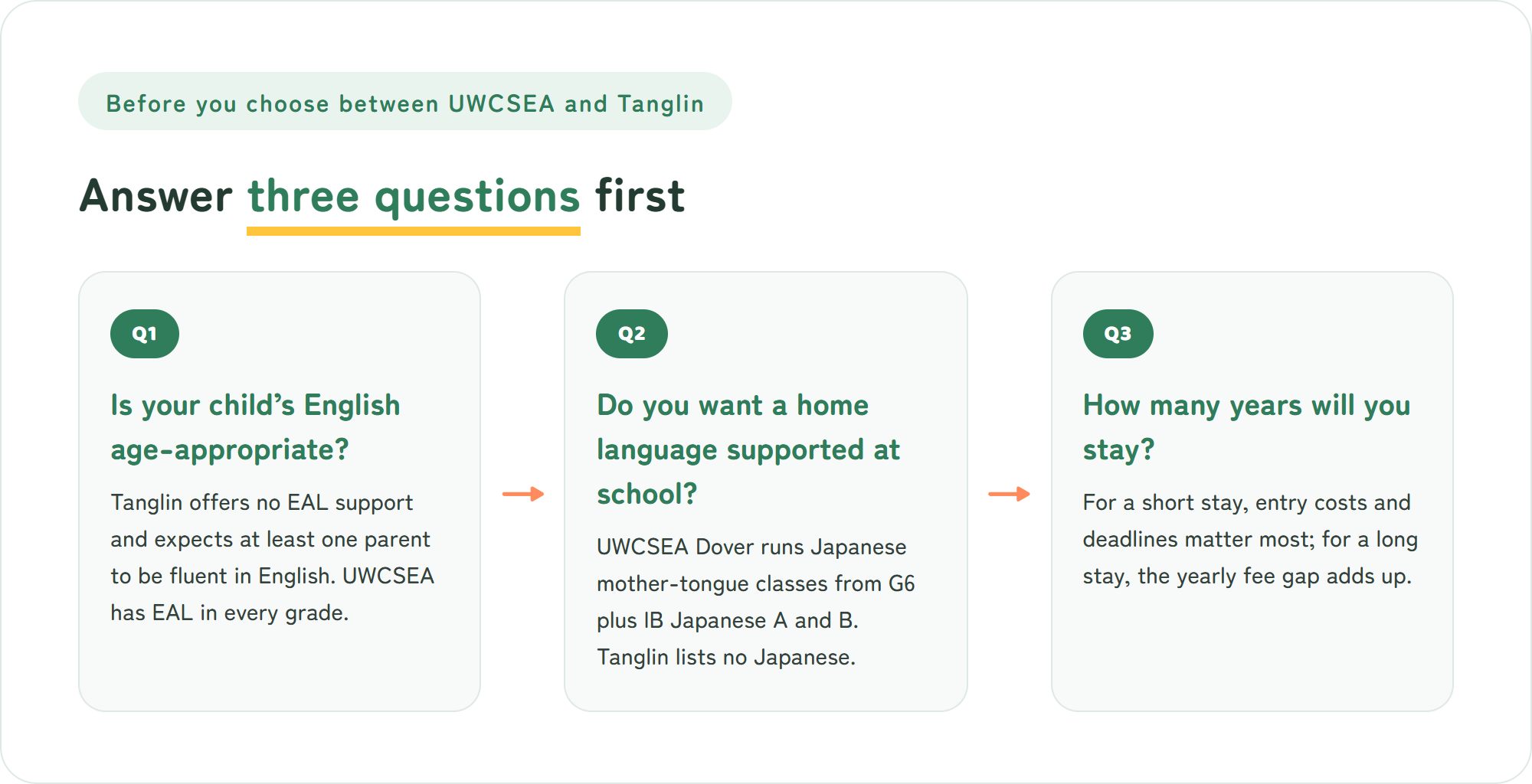
On paper, UWCSEA vs Tanglin Trust comes down to similar fees in the early years, a modest premium at Tanglin later on, and higher entry costs at Tanglin. In practice, the decision usually turns on three things: your child’s English today, how much you want a home language supported, and how long Singapore will be home.
Whichever way you go, a child starting school in a new country is already doing something brave. Take your time, ask both schools the hard questions, and keep your child’s day-to-day experience at the centre. If you would like to hear when NGA’s trial classes and opening plans are confirmed, we will keep you posted.