If you are moving to Singapore and want an American-style school, two names come up again and again: Singapore American School (SAS) and Stamford American International School (SAIS). The names are close, and both teach to American standards, but the two schools are built differently. They structure their fees differently, treat children who are still learning English differently, and decide who gets an offer first in different ways. This guide sets Singapore American School vs Stamford American side by side using only what each school publishes: the official 2026-27 fee schedules, the admissions pages, the curriculum and the campuses.
All amounts are in Singapore dollars and, as both schools state, include GST at 9%. Approximate conversions use the European Central Bank reference rate of 30 October 2026 (S$1 = US$0.78224 = JPY 123.01). Everything was checked on the schools’ websites on 1 November 2026. If you only need the full SAS fee table, grade by grade, our Singapore American School fees review covers it in detail; this page focuses on the differences between the two schools.
The short answer: Singapore American School vs Stamford American comes down to year one, English support and priority lanes
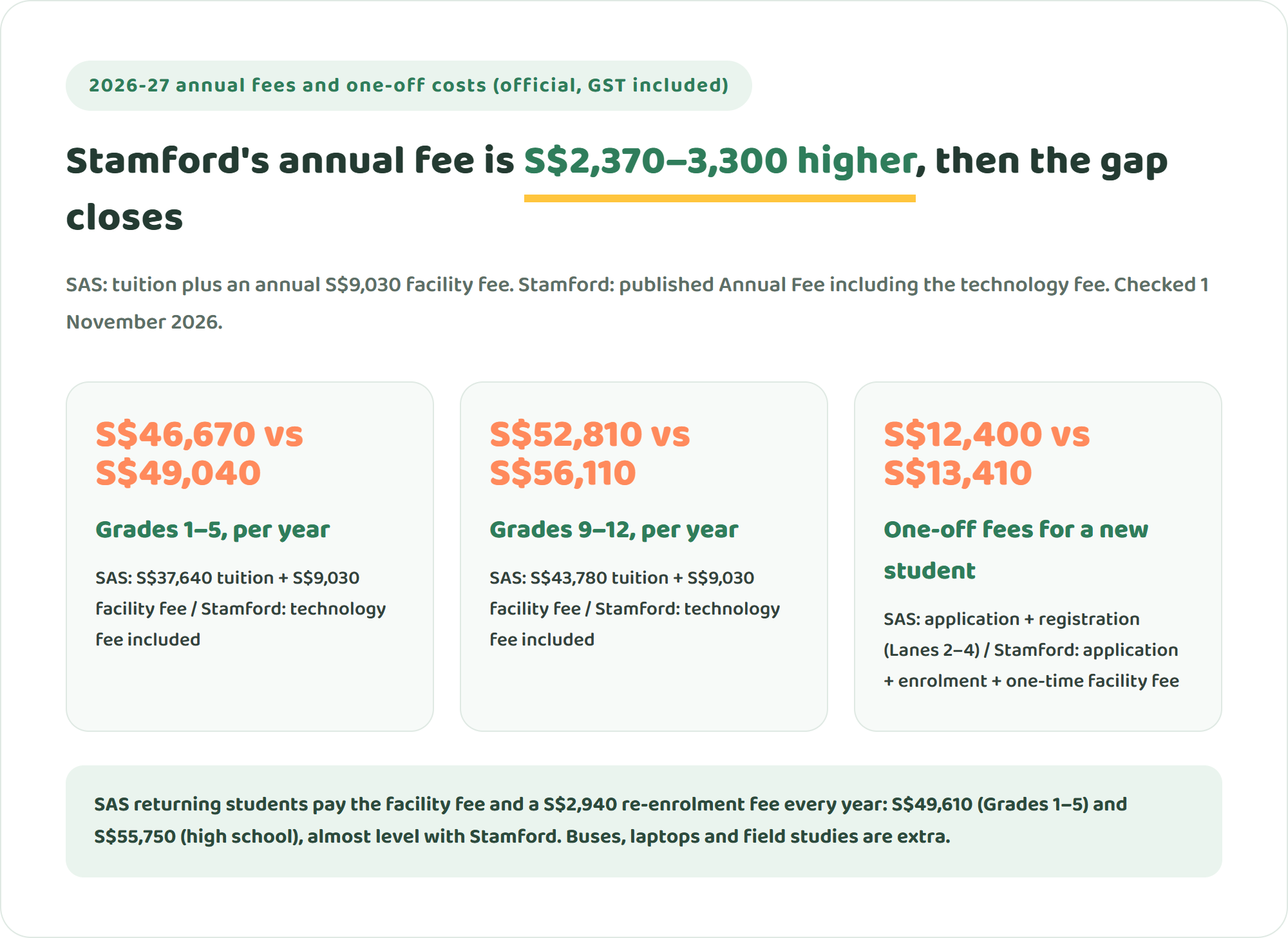
- Annual fees: in Grades 1–5, SAS charges S$37,640 tuition plus a S$9,030 annual facility fee, or S$46,670 (about US$36,500). Stamford’s annual fee is S$49,040 (about US$38,400). In high school (Grades 9–12) the figures are S$52,810 and S$56,110. Stamford’s annual fee is S$2,370–3,300 higher.
- One-off fees on entry: at SAS, a S$2,500 application fee plus a S$9,900 registration fee for families without a US passport or Green Card, or S$12,400 in total. At Stamford, a S$950 application fee, a S$4,140 enrolment fee and a one-time S$8,320 facility fee, or S$13,410.
- From year two the gap almost disappears: SAS charges returning students the S$9,030 facility fee every year plus an annual S$2,940 re-enrolment fee, so a returning student pays S$49,610 in Grades 1–5 and S$55,750 in high school. Against Stamford’s S$49,040 and S$56,110, the difference is only S$360–570.
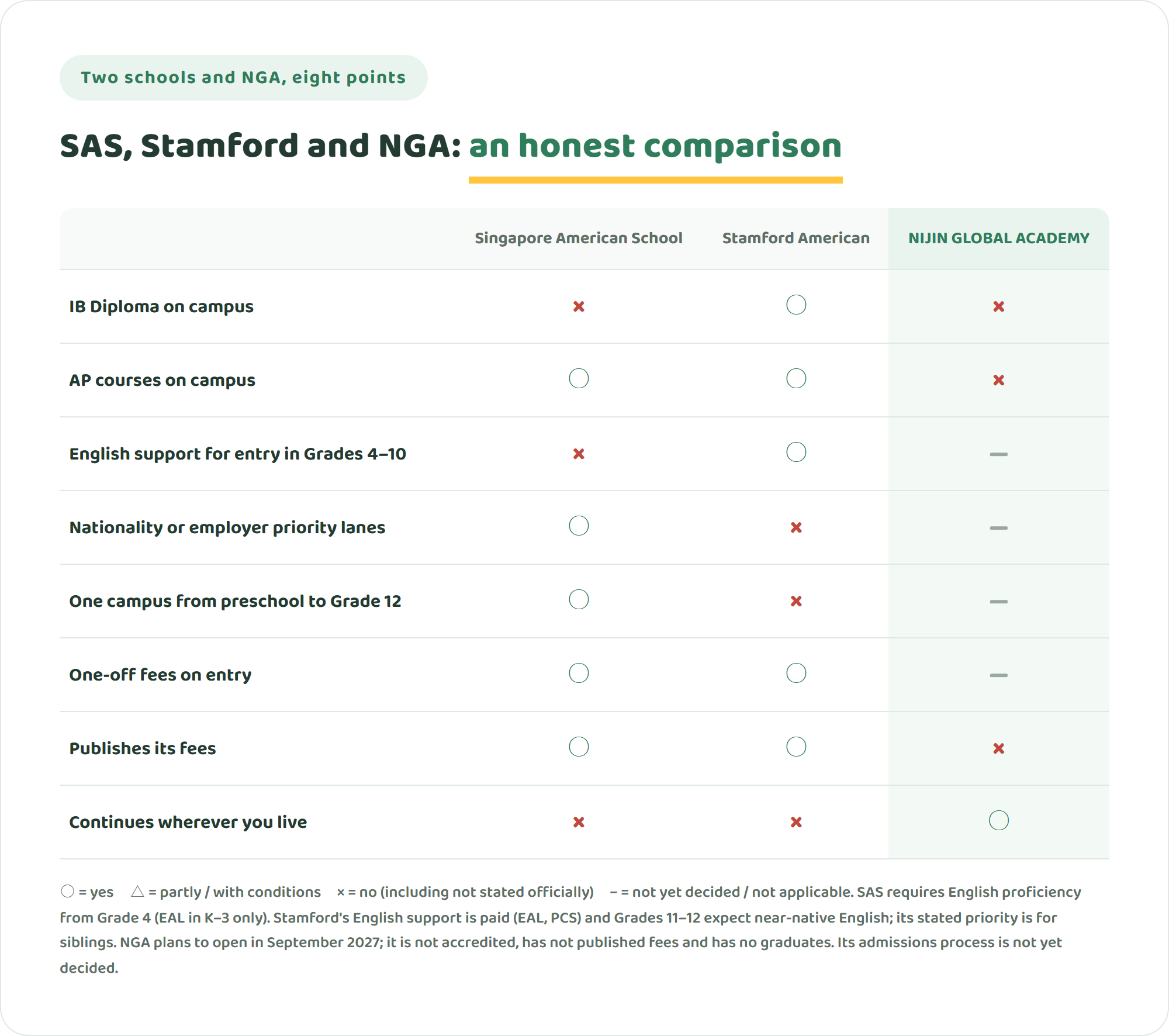
- English: SAS requires English proficiency from Grade 4 and has no EAL programme beyond that grade. Stamford offers paid EAL support and an intensive Preparatory Course for Secondary School (PCS) up to Grade 10.
- Who gets an offer first: SAS uses four Priority Lanes, and US citizens and Green Card holders hear first. Stamford publishes no nationality-based lanes; the priority it describes is for siblings.
- Curriculum: SAS is American throughout, with more than 25 AP courses and no IB listed. Stamford combines American standards with the IB PYP and MYP, then lets Grade 11–12 students choose the full IB Diploma or a mix of AP, BTEC and IB courses.
In practice: if your child already learns comfortably in English and you are aiming at US universities through AP, SAS is the natural first look. If your child is in Grade 4 or above and still building English, or you want to keep the IB Diploma open, Stamford is usually the more realistic option. Either way, a new high school student’s first year costs roughly S$64,000–70,000 (about US$50,000–54,000), so check what your employer’s education allowance covers before you compare anything else.
Singapore American School vs Stamford American fees for 2026-27
The two schools define their “annual fee” differently. SAS lists tuition plus an annual facility fee (S$9,030). Stamford’s published Annual Fee is tuition plus a technology fee (S$1,020 in Grades 1–5, S$1,270 in Grades 6–12). The table shows only the grades and lines you need to compare the two, exactly as published.
| 2026-27 | Singapore American School | Stamford American International School |
|---|---|---|
| Grades 1–5, per year | S$37,640 + S$9,030 facility fee = S$46,670 | S$49,040 (technology fee included) |
| Grades 6–8, per year | S$41,560 + S$9,030 = S$50,590 | S$53,210 |
| Grades 9–12, per year | S$43,780 + S$9,030 = S$52,810 | S$56,110 |
| One-off fees for a new student | Application S$2,500 + registration S$9,900 (Lanes 2–4) = S$12,400; Lane 1 registration is S$8,660 (total S$11,160) | Application S$950 + enrolment S$4,140 + facility fee S$8,320 = S$13,410 |
| First year, new high school student | S$65,210 (Lanes 2–4) / S$63,970 (Lane 1) | S$69,520 |
| Returning student, per year | S$49,610 (Grades 1–5) / S$55,750 (Grades 9–12), including the S$2,940 re-enrolment fee | Annual fee only; we found no re-enrolment fee in the fee schedule |
| English support (EAL) | Foundational EAL S$7,230 a year, Kindergarten to Grade 3; no EAL from Grade 4 | EAL Level B S$9,100 / Level A S$14,900 a year; PCS for Grades 6–10 S$71,050 a year |
The SAS first-year totals are printed on the school’s own fee schedule. The Stamford total is our own sum of the published annual fee and the three one-off fees. One trap to avoid: Stamford’s Annual Fee already contains the technology fee (in high school, two semester instalments of S$27,420 plus S$1,270 make S$56,110), so adding the technology fee again counts it twice.
Sources: SAS “Fixed Fee Schedule and Policy 2026-27”; Stamford “SAIS AY26/27 Fee Schedule (effective April 15 2026)” and “Admissions Handbook 2026-2027”. All checked 1 November 2026.
Why Stamford costs more in year one but not after
For a new student in Grades 1–5, year one costs S$59,070 at SAS (Lanes 2–4) and S$62,450 at Stamford, a gap of S$3,380. In high school it is S$65,210 against S$69,520, a gap of S$4,310. But SAS bills its facility fee every year and adds a re-enrolment fee for every returning student, while Stamford’s facility fee is a one-time charge. From year two, the two schools cost almost the same. For a student joining Grade 9 and staying four years, and assuming 2026-27 fees stayed flat, SAS totals S$232,460 and Stamford S$237,850, a difference of S$5,390 over four years. So which school is cheaper depends on the grade your child enters and how long you expect to stay. For a wider explanation of what fee lines usually cover, see how much international school really costs.
What sits outside the annual fee
SAS lists its “other possible costs” on the fee schedule: the school bus (two ways, per semester) at S$1,320–3,500, a high school laptop at S$1,500–2,800, AP exams at S$220 each, and the high school Interim Semester at S$1,200–5,000 for overseas trips. At Stamford, tuition includes textbooks, workbooks, stationery and selected after-school activities, and the technology fee covers a one-to-one MacBook for Grades 6–12 (it remains school property). On the other hand, Academic Field Studies are a mandatory extra for Grades 3–12, and buses are invoiced separately; neither amount appears in the fee schedule. Ask for the figure for your child’s grade when you visit.
Admissions: Priority Lanes at SAS, English assessments and sibling priority at Stamford
Applying to Singapore American School: the day you pay is the day you applied
- Submit the online application form.
- Pay the non-refundable S$2,500 application fee. The payment date is recorded as your official application date, and SAS says applying as early as possible is likely to improve your child’s chance of admission.
- Complete every item on the checklist, including school reports and recommendation forms. Only complete applications are reviewed.
- On accepting an offer, pay the S$5,500 confirmation payment within seven days. It is credited against school fees.
Offers follow the Priority Lanes. Lane 1 covers US citizens, Green Card holders, Guaranteed Placement Program participants and SAS legacy families; Lane 2 is non-US citizens working for an American company; Lane 3 is applicants currently at an international school; Lane 4 is everyone else. For an August start, Lane 1 offers begin in mid-February and Lanes 2–4 in mid-March. If your child is currently at a national or Japanese-language school, ask admissions which lane applies before you pay. Admissible applicants without a seat go into the waitpool, and an application stays active for two years from the fee date. Grades 9–12 can only start in August or January.
SAS updates its grade-by-grade availability on its website. On 1 November 2026, Grades 7 and 8 showed “Waitpool Forming”, Grade 12 was no longer accepting applications for 2026-27, and Grade 6 and Grades 9–11 required a consultation with admissions before applying.
Applying to Stamford American: documents, and an English assessment where needed
- Enquire and book a school tour.
- Apply online and pay the S$950 application fee. You will need your child’s passport, birth certificate, a passport-style photo and reports for all terms of the previous and current school year (notarised and translated into English where required). Grade 9–12 applicants also indicate their preferred courses.
- Application review and assessment. An English assessment may be required if English is not your child’s first language, if their current school does not teach in English, or if they already receive EAL support. Stamford uses WIDA for KG2 to Grade 5 and SLATE Plus for Grades 6–10.
- Receive the Offer Letter, sign the Student Contract and pay the enrolment and facility fees. If the facility fee is not paid within seven days of the invoice, priority passes to other applicants.
Stamford accepts applications throughout the year, subject to space. If a grade is full, your child may join the waitlist, but holding a waitlist position requires paying the enrolment fee. It is refunded if you withdraw from the waitlist and becomes non-refundable if you are offered a place and decline it. Siblings receive priority both for admission and on the waitlist. Stamford also says it may request standardised test scores or specialist reports where relevant.
If your child is still learning English, the grade decides the route
For many relocating families, this is the biggest difference between the two schools. At SAS, Preschool and Pre-K have no minimum English requirement, and Kindergarten to Grade 3 applicants should talk to admissions about EAL before applying. From Grade 4, English proficiency is required, and SAS has no EAL programme beyond Grade 4. At Stamford, if the assessment shows your child needs English support, EAL becomes a mandatory extra (S$9,100 or S$14,900 a year), but children can still enter with that support up to Grade 10. The more intensive PCS for Grades 6–10 costs S$71,050 a year, well above the standard fee. Grades 11 and 12 expect near-native English. Our guide to preparing English before international school sets out what you can do in the months before an assessment.
Curriculum: AP at SAS, the IB and AP at Stamford
Singapore American School: American college preparation
SAS opened in 1956 and is a non-profit school. It had more than 4,000 students in 2024-25 holding 72 different passports, and it is accredited by the Western Association of Schools and Colleges (WASC). The high school is American throughout, with more than 25 AP courses and AP Capstone, plus the school’s own project-based Catalyst and Quest programmes. The website makes no mention of the IB. If the plan is a US university with strong AP results, it is a very clear route.
Stamford American: the IB continuum with a choice at Grade 11
Stamford combines American AERO standards with the International Baccalaureate: the PYP from Pre-K to Grade 5 and the MYP in Grades 6–10. In Grades 11 and 12, students either take the full IB Diploma or build an individual pathway from AP courses, BTEC International Level 3 qualifications, individual IB courses and Stamford courses. Both routes lead to Stamford’s US-accredited High School Diploma. It is an IB World School and names the IBO, CIS, WASC and EduTrust as its accrediting and quality bodies, with students from more than 75 nationalities. A Mandarin–English bilingual programme runs from Pre-K to Grade 5 at no extra cost, with a Mandarin proficiency test from Grade 2. If the IB is new to you, our guide to what the International Baccalaureate is explains how the PYP, MYP and Diploma fit together.
Campuses and the school run: one campus in Woodlands, or two
SAS has a single 36-acre campus in Woodlands (40 Woodlands Street 41), in the far north of the island, for students from age 3 to Grade 12. It includes a two-acre rainforest and four swimming pools, one of them a 50-metre pool. The wide range in the bus fee (S$1,320–3,500 per semester for a two-way service) reflects how far families live from the campus; if your housing is in the centre or the east, budget for the bus and the commute from the start.
Stamford runs two campuses. Children from Pre-Nursery to KG2 learn at the purpose-built Early Learning Village (3 Chuan Lane), and Grades 1–12 at the Woodleigh Campus (1 Woodleigh Lane, nearest MRT: Woodleigh). Woodleigh has three swimming pools, two air-conditioned indoor sports arenas and the 500-seat Reagan Theater. Your child changes campus between KG2 and Grade 1, and siblings in the early years and the main school mean two drop-offs. Both points are worth knowing before you sign a lease. For the wider field, including UWCSEA, Tanglin and Dulwich College (Singapore), see our overview of international schools in Singapore.
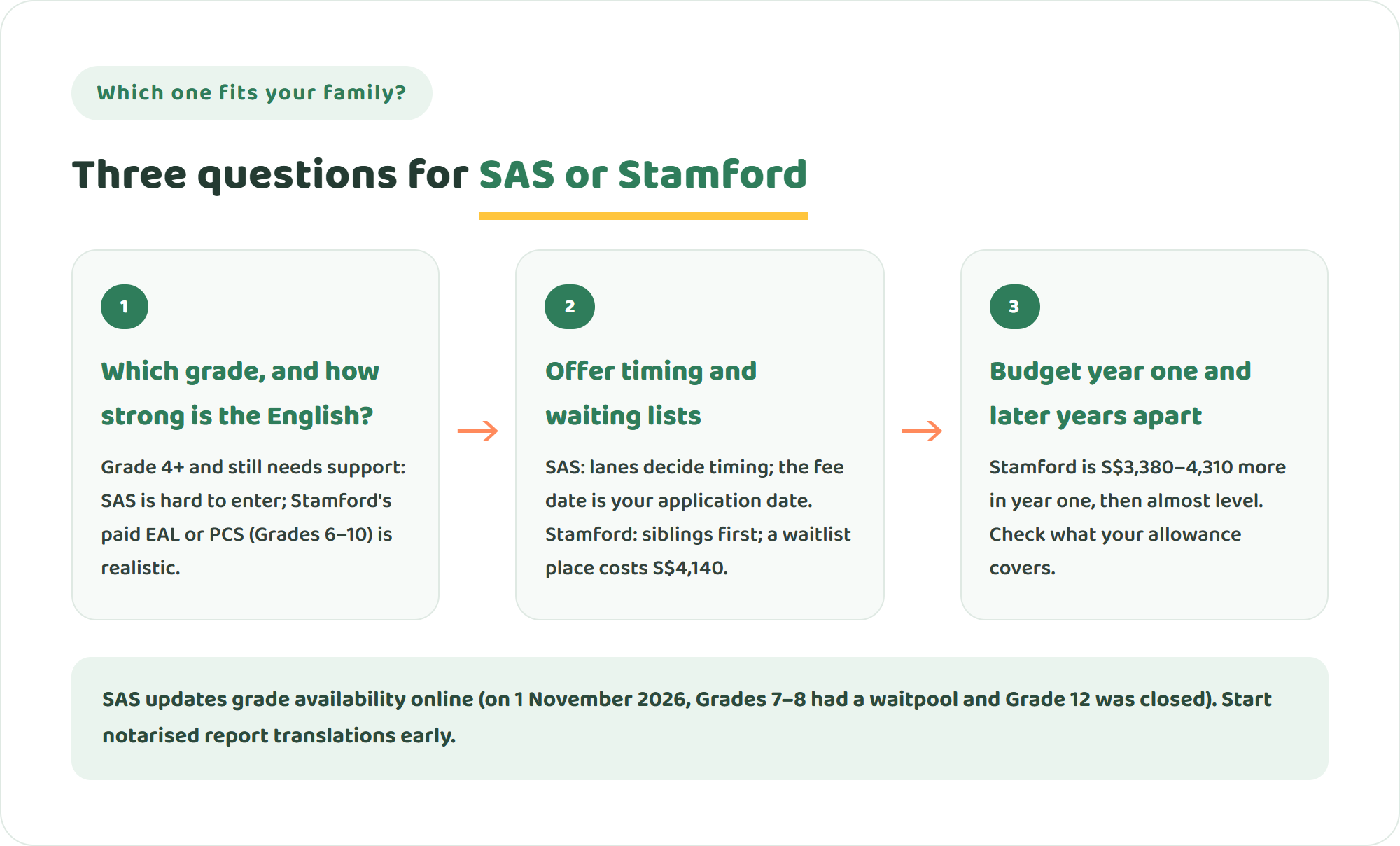
Which one fits your family? Three questions
1. Which grade will your child join, and how strong is their English?
If your child is in Grade 4 or above and still needs English support, SAS’s published requirements make entry difficult, and Stamford’s paid EAL or PCS is the more realistic route. If your child can already follow lessons in English, both schools are open to you.
2. How will you handle offer timing and waiting lists?
At SAS, your lane decides when offers arrive, and an early fee date helps. At Stamford, siblings come first and a waitlist place costs the enrolment fee, refundable if you withdraw. If your start date is fixed, applying early to both is one way to keep options open.
3. Can you budget year one and the following years separately?
Stamford costs S$3,380–4,310 more in year one, then the two schools are almost level. Check whether your allowance covers one-off fees, the SAS facility fee, buses and laptops, and read the refund rules: SAS never prorates its registration or facility fees, and Stamford’s application, enrolment and facility fees are non-refundable.
A second option for the waiting months
Waiting in the SAS waitpool, holding a place on Stamford’s waitlist, or giving your child time to build English before an assessment: many families have a gap to bridge. For Japanese families, one option is the Japanese School Singapore (see our comparison of Japanese school abroad tuition); another is to look beyond campus schools altogether, as in our guide to cheaper alternatives to Singapore international schools. An online international school does not depend on your address. You can see how classes work at NGA in our online school curriculum overview.
Where NIJIN GLOBAL ACADEMY fits
NIJIN GLOBAL ACADEMY (NGA) is an online international school for ages 6–18, planned to open in September 2027. It is run by NIJIN Inc., which operates NIJIN Academy in Japan, an online school for children who do not attend school, where more than 1,000 children have studied. Its guiding ideas are learning beyond test-score rankings and “coming to love yourself and the world”. NGA plans small live classes, with bilingual Japanese–English mentors supporting subjects taught in English, and admission that is not based on test-score rankings.
To be clear about the limits: NGA has not opened yet, is not accredited, has not published its fees and has no graduates. If your child needs AP courses, the IB Diploma or a US-accredited high school diploma, NGA does not replace SAS or Stamford. Where we hope to help is as a place to keep learning in English while you wait for a seat, or as continuity for families who may move to another posting in a few years.
FAQ
How much does Singapore American School cost compared with Stamford American?
For 2026-27, SAS charges S$46,670 a year in Grades 1–5 and S$52,810 in Grades 9–12 (tuition plus the S$9,030 facility fee). Stamford charges S$49,040 and S$56,110 (technology fee included). New students also pay one-off fees of S$12,400 at SAS (Lanes 2–4) or S$13,410 at Stamford.
Which is cheaper over several years?
SAS is cheaper in year one by S$3,380–4,310. From year two, SAS’s annual facility fee and re-enrolment fee bring the two within S$320–570 a year. Over four years of high school at flat 2026-27 fees, SAS totals S$232,460 and Stamford S$237,850.
Does Singapore American School offer the IB?
The SAS website describes an American curriculum with more than 25 AP courses, AP Capstone, Catalyst and Quest, and makes no mention of the IB. Stamford offers the full IB Diploma and also AP and BTEC courses in Grades 11–12.
Can a child who is still learning English get into either school?
At SAS, Preschool and Pre-K have no minimum English requirement and Kindergarten to Grade 3 may receive EAL support; from Grade 4, English proficiency is required. At Stamford, children assessed with WIDA or SLATE Plus may be admitted with paid EAL support or the PCS course up to Grade 10.
What are the SAS Priority Lanes?
Lane 1 is US citizens, Green Card holders, Guaranteed Placement Program participants and SAS legacy families; Lane 2 is non-US citizens working for an American company; Lane 3 is applicants currently at an international school; Lane 4 is all others. Lane 1 also pays a lower registration fee (S$8,660 rather than S$9,900).
Choose by your child’s grade and English, not by the similar names
Singapore American School and Stamford American are both large schools teaching to American standards in Singapore, but they differ on almost everything that matters to a relocating family: AP only or the IB as well, English support beyond Grade 4 or not, nationality-based lanes or sibling priority, one campus or two. On fees, SAS is lower in year one and the two are nearly level after that. What usually decides it is your child’s grade and how far they can already learn in English. Settle those two questions as a family, then book tours at both schools.
While you compare schools in Singapore, you are welcome to keep NIJIN GLOBAL ACADEMY on the list too. Ahead of its planned September 2027 opening, we expect to run trial classes in April–May 2027.