
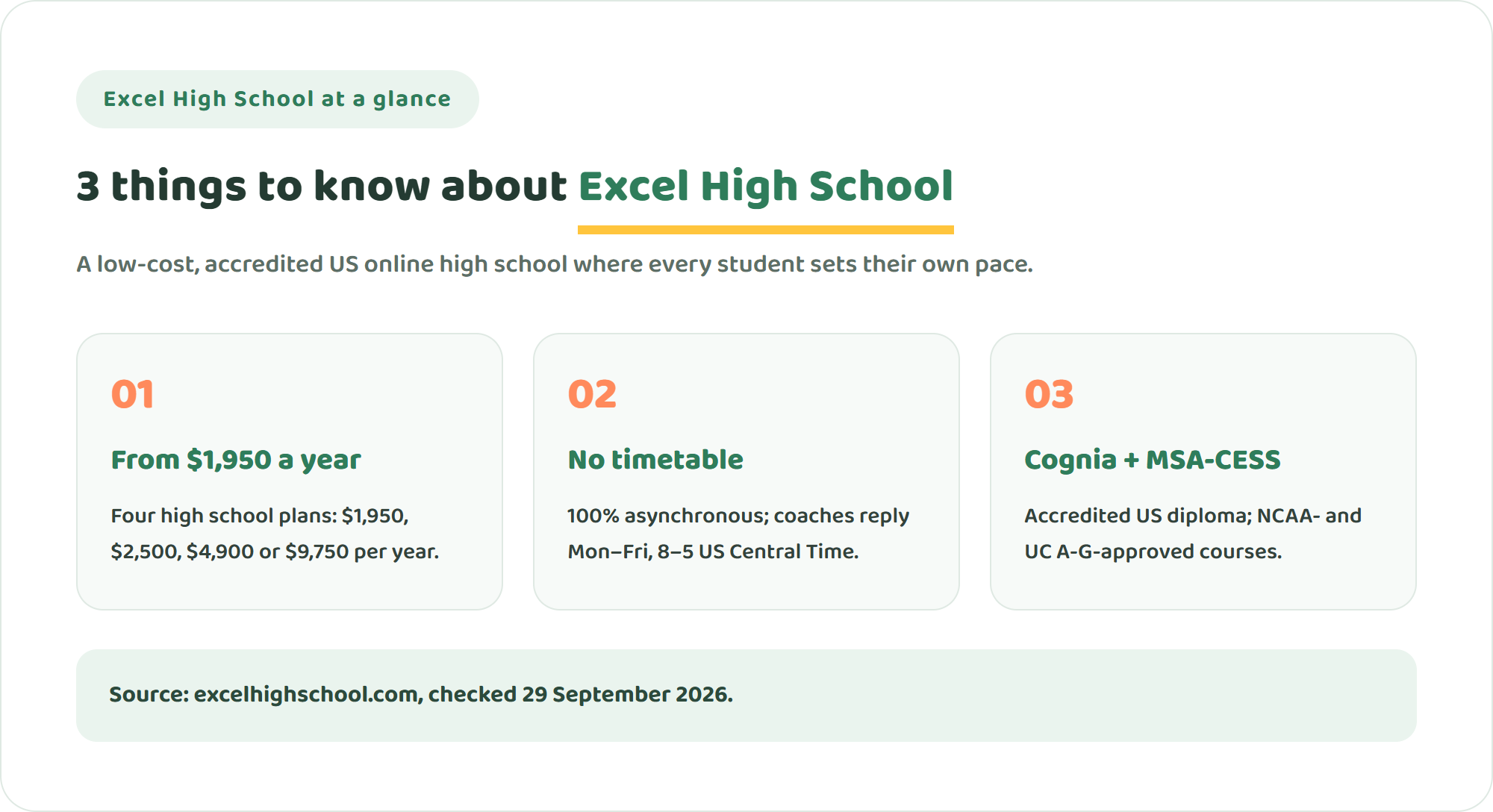
Excel High School tuition for 2026–27 is $1,950 a year for the Silver high school plan (grades 9–12, six credits a year), $2,500 a year for Gold (up to eight credits, Honors or California A-G courses) and $4,900 a year for Platinum (up to ten credits, AP courses), with a premium “Future Ready” plan at $9,750 a year (official tuition page, checked 29 September 2026). Every annual plan can be paid in ten or five interest-free monthly instalments, a single semester costs half the annual rate, and individual courses start at $325. Middle school (grades 6–8) starts at $1,690 a year. The page labels these as “2026/27 High School Tuition Options”, so these are the prices for the current school year.
If you searched “Excel High School tuition”, “Excel High School review” or “is Excel High School legit”, you probably want three things answered: which of the four price tiers your teen actually needs, what the diploma is worth (accreditation, college and military recognition), and what day-to-day life looks like in a school with no timetable. This page answers all three from Excel High School’s own website and student handbook, adds the extra costs most summaries leave out (extensions, refunds, the homeschool credit pathway), and then compares Excel fairly with Forest Trail Academy, Penn Foster High School and NIJIN GLOBAL ACADEMY — a different kind of online school that opens in 2027.
The short answer: who Excel High School suits — and who it doesn’t
- Suits: teens (ages 14–18) who want an accredited US high school diploma at a low, published price. At $1,950 a year for the Silver plan, Excel is one of the lower-cost private online options that states full prices openly.
- Suits: self-motivated students who like to work at their own pace. Excel describes its model as “100% asynchronous”: no timetable, courses open 24 hours a day, and up to 12 months to finish a full-year standard or honors course.
- Suits: students who need to catch up or finish quickly — transfer students, credit recovery, athletes with travel schedules. Up to 75% of the required credits can be transferred in, and single courses can be bought one at a time.
- Suits: families in states where Excel is an approved ESA or voucher provider; the school lists 11 states, and tuition can be partly or fully covered there.
- Harder fit: children who need a teacher in front of them every day. Support comes through a help-desk ticket system, coaches during US business hours and an AI tutor; the student handbook says parents play a vital role in keeping a self-paced learner on track.
- Harder fit: younger children. Excel starts at grade 6 (age 11+), so it is not an option for primary-school years.
- Harder fit: students still learning English. International applicants need English roughly at a US 8th-grade level, because all courses are taught in English (no TOEFL score is required).

What Excel High School is
According to its About page, Excel High School was founded in 2004 by a group of educators and business professionals and is based in Minnetonka, Minnesota, with a second office in Allen, Texas. It is part of Excel Education Systems, which also runs Northgate Academy (a Christian online high school) and Washington Technical Institute (online career certificates). Excel describes itself as a tuition-based private school that does not receive state or federal funding — which is why it is not free the way a US public virtual school can be.
The school serves three groups: middle school (grades 6–8), high school for teens aged 14–18 (grades 9–12) and an adult diploma program for people over 18 who have been out of school for at least six months. Courses run on its own learning platform, Learn Stage, with an AI tutor called BRYTE built in. The high school catalogue offers standard, honors and Advanced Placement (AP) courses, more than 70 University of California A-G approved courses, dual-enrollment college courses and English Language Learning courses for non-native speakers.
| Basic facts | Excel High School (official) |
|---|---|
| Founded / base | 2004 · Minnetonka, Minnesota (also Allen, Texas) |
| School type | Private, tuition-based online school (Excel Education Systems) |
| Grades / ages | Middle school 6–8 (age 11+); high school 9–12 (ages 14–18); adult diploma 18+ |
| Learning model | 100% online and asynchronous; self-paced; enrol any day of the year |
| Accreditation | Cognia (Accredited with Distinction, cycle through 2032) and MSA-CESS (through 1 January 2030) |
| Diploma tracks | 21.5-credit standard diploma or 24-credit college-prep diploma |
| Academic year | 1 August – 31 July (student handbook) |
| Support hours | Monday–Friday, 8 a.m.–5 p.m. US Central Time; help-desk tickets open 24/7 |
Excel High School tuition and fees (2026–27, official)
Excel prices the high school by plan, not by grade. Each plan includes a set number of credits per year and a level of curriculum and coaching. A typical US high school year is about six credits, so the Silver plan covers a normal year of standard courses; the higher plans add more credits, harder course levels and more human support. All figures below are in US dollars, from the official Tuition & Program Cost page, checked 29 September 2026.
| Plan (2026/27) | Per year | 10 monthly payments | 5 monthly payments | What’s included |
|---|---|---|---|---|
| High School Silver | $1,950 | $195 | $390 | 6 credits/year; standard curriculum; BRYTE AI tutor; academic coach help desk |
| High School Gold | $2,500 | $250 | $500 | Everything in Silver + up to 8 credits/year; 24-credit graduation track; Honors curriculum or California A-G |
| High School Platinum | $4,900 | $490 | $980 | Everything in Gold + up to 10 credits/year; AP curriculum; Success Coach Pro |
| Future Ready – High School | $9,750 | $975 | $1,950 | Up to 12 credits/year; standard, honors, AP and college courses; 24/7 academic support; frequent live counseling/academic support sessions; ElevatED coaching and career planning |
| Future Ready – Middle School | $7,750 | $775 | $1,550 | Up to 8 credits/year; all middle school Future Ready courses; Success Coach Pro |
| Middle School Silver | $1,690 | $169 | $338 | Standard middle school program |
| Single course – standard / honors / AP | $325 / $370 / $699 | No instalment plan for individual courses (handbook) | 6 months per course; middle school single course $325 | |
| Future Ready single course – standard / honors / AP | $625 / $670 / $999 | — | Adds BRYTE 24/7 support and Success Coach Pro | |
Semester-only enrolment is available and, in the school’s words, “automatically calculated at half the annual rate” — so a Silver semester is $975. Every plan on the page is marked “Tuition Free With State Voucher”, which applies only to families using an approved state program (see below). For adults, the traditional diploma track costs $99 a month for as many months as needed (maximum 10 months), and the competency-based track costs $495 for the first five months plus $70 a month for extra time, up to a stated maximum of $985.
Extra costs, payment plans and refunds
- Course extension: $200 for a one-time, two-month extension if a student runs out of time (student handbook). Standard and honors students get 12 months per full-year course; AP and middle school students get 10 months.
- Homeschool Credit Transfer Pathway: a one-time, non-refundable $500 fee for students who want credit for previous homeschool or unaccredited coursework through a credit-by-examination process. It must be chosen at initial enrolment.
- Adult reengagement fee: $200 for paid-in-full adult students who have been inactive for six months or more.
- Late payment and administrative fees: mentioned on the tuition page, amounts not published on the official site.
- Transcript and diploma reprint fees: ordered through the school’s online store; amounts not published on the pages we checked.
- Payment plans: interest-free, charged automatically to a card. The handbook states that after three missed payments the remaining balance becomes due in full.
- Refunds: within 10 calendar days of the initial enrolment date, a full refund minus a 3% transaction fee; after 10 days, no refunds (student handbook; the enrolment agreement has full details and exceptions for voucher-funded students).
- Credit transfer guarantee: if a college refuses Excel credits and the school cannot resolve it, Excel says it refunds the tuition paid for the non-accepted credits. This does not apply to single, summer or part-time courses.
- Discounts and financial aid: sibling or military discounts are not published on the official site. The main form of help is state ESA/voucher funding in Alabama, Arizona, Arkansas, Georgia, Louisiana, New Hampshire, South Carolina, Texas, Utah, West Virginia and Wyoming (per the School Choice page). Excel also says its adult diploma is free in Arkansas and Arizona through partnerships.
One small warning: Excel’s FAQ page still quotes older figures (“the standard diploma for high schoolers is $1,900 annually, and the honors diploma is $2,200 per year”, and $99.90 a month for adults). The dedicated tuition page, labelled 2026/27, shows $1,950 and $2,500. Use the tuition page and your enrolment agreement as the reference.
A worked example using only official numbers
One teen, grades 9–12 on the Silver plan: 4 years × $1,950 = $7,800 in tuition for a 24-credit path (6 credits a year × 4). On Gold, which the school ties to the 24-credit college-prep track and honors courses, the same four years cost 4 × $2,500 = $10,000.
Two children, four years each on Silver: 2 × $7,800 = $15,600, before any extension fees ($200 each time) and with no published sibling discount.
A transfer student entering 12th grade: Excel requires at least 6 credits completed at Excel, which matches one Silver year — $1,950, or $195 a month for ten months — provided the previous school’s credits cover the rest (up to 75% can be transferred in).
For context on how these numbers compare with bricks-and-mortar schools, see our guide to online vs in-person international school costs, and for another US provider with a published price list, Pearson Online Academy tuition.
How a school day works: schedule, live classes and time zones
There is no school day in the traditional sense. Excel’s “How it works” page describes a “100% asynchronous model”: students log into Learn Stage whenever they like — mornings, evenings or weekends — and move through lessons, assignments and exams in order. At enrolment a student starts with two courses; once previous transcripts are reviewed, the remaining grade-level courses open. Final exams and some writing tasks must be done on a laptop or desktop computer rather than a phone.
Support is layered. The AI tutor BRYTE answers questions inside each course at any hour. Human academic and success coaches respond to help-desk tickets during office hours — Monday to Friday, 8 a.m. to 5 p.m. US Central Time; the office is closed at weekends and on national holidays. Excel states that AI handles routine grading, with experienced educators doing spot checks, and the handbook explains how a student can ask for a grade review. Live contact is optional rather than scheduled: the handbook mentions optional synchronous support sessions several times a week, and the Platinum and Future Ready plans add Success Coach Pro, with the Future Ready plan listing “frequent live counseling/academic support sessions”.
For families outside the US, the time-zone question is mostly about support, not classes. Because nothing is timetabled, a student in London, Sydney or Tokyo can study during their own daytime; the only constraint is that replies from the Minnesota office come during US Central business hours, which may be evening or early morning elsewhere. The handbook also says high-school-age students are expected to engage daily, and students under state compulsory-attendance laws (including voucher students) must meet their state’s participation rules. If you want to see how this compares with schools that do have live lessons, our explainer on how an online international school works day to day walks through both models.
Accreditation, diploma and college recognition
This is where Excel is strongest on paper. According to its accreditation page, Excel High School is accredited by Cognia — which in December 2025 gave it “Accredited with Distinction” status for a seven-year cycle valid through 2032 — and by the Middle States Association Commission on Elementary and Secondary Schools (MSA-CESS), accredited since 2022 and valid through 1 January 2030. The school links to the Cognia Registry and the MSA-CESS directory so families can look it up; both are searchable databases, and we recommend searching them yourself before enrolling.
Excel also lists state recognitions: an accredited non-public school in Minnesota; accreditation by the Texas Private School Accreditation Commission (TEPSAC) for grades 6–12; recognition by the Virginia Council for Private Education; more than 70 University of California A-G approved courses; and approved-provider status in Washington State. Its CEEB school code is 240707 (used for the SAT, ACT and FAFSA), and the school states that its academic courses are approved by the NCAA Eligibility Center — with the handbook adding that final eligibility is always decided by the NCAA for each athlete.
To graduate, a student completes either the 21.5-credit standard track (4 English, 3 maths, 3 science, 3.5 social studies, 8 electives) or the 24-credit college-prep track (more maths plus two world-language credits). Courses need an average of 60% or higher; AP courses need 70%. Excel says its diploma is recognised by colleges, employers and the military. As with any online school, acceptance is ultimately each college’s decision — ask the universities your teen is considering, especially highly selective ones or universities outside the US, how they view an asynchronous online diploma.
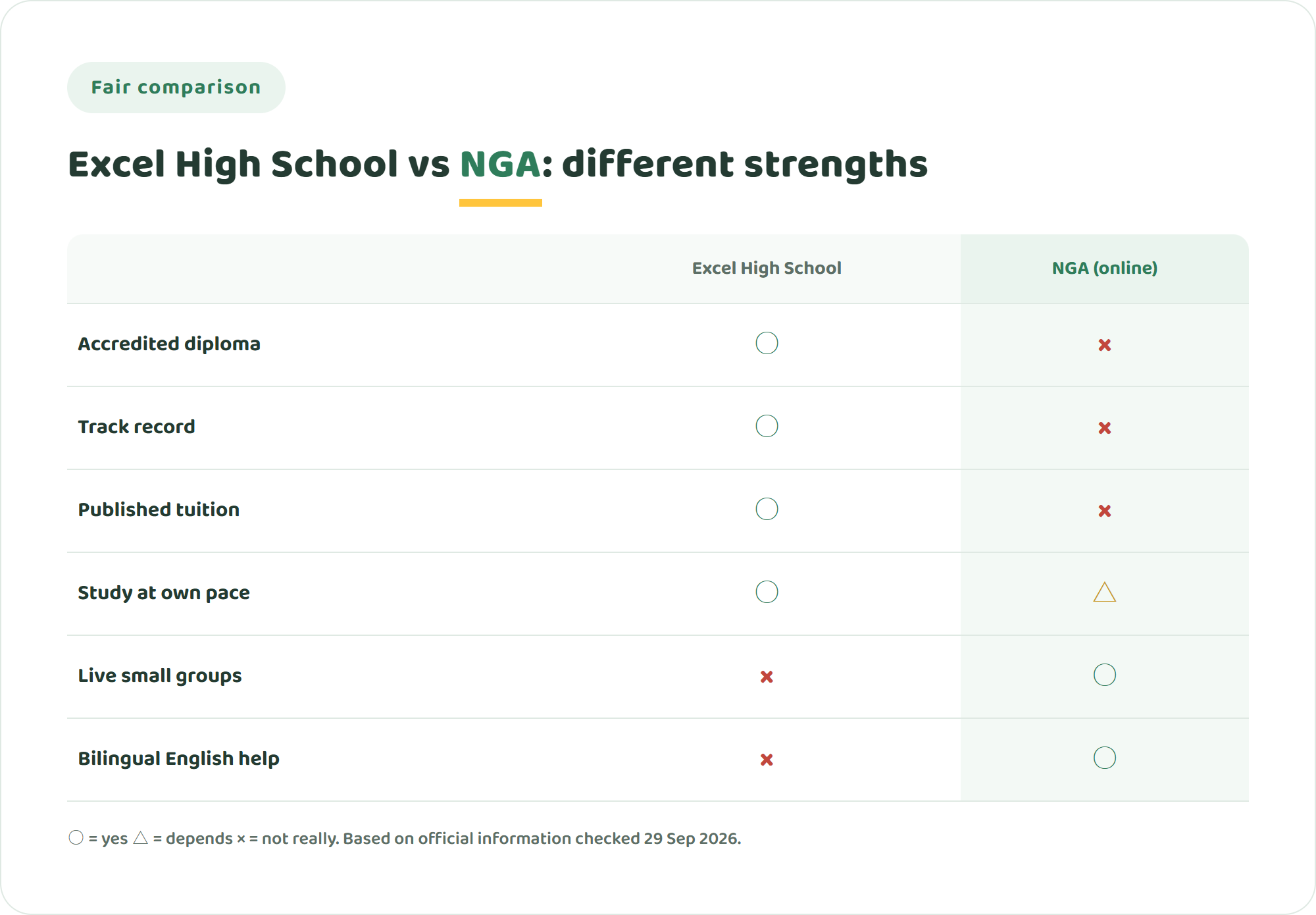
Excel High School vs NIJIN GLOBAL ACADEMY vs two other options (official data)
| Excel High School | NIJIN GLOBAL ACADEMY | Forest Trail Academy | Penn Foster High School | |
|---|---|---|---|---|
| School type | Private, tuition-based online school (Minnesota) | Online international school (Asia & Oceania focus), operated by NIJIN Inc., Japan | Private accredited online K–12 school | Private online high school diploma program |
| Grades / ages | Grades 6–12 (age 11+); adult diploma 18+ | Ages 6–18 | K–12 | High school; age 13+ with 8th grade completed |
| Tuition (2026–27) | High school $1,950 / $2,500 / $4,900 / $9,750 a year by plan; single courses from $325 | Not yet published — “far more affordable than a typical international school”; no enrolment, facility or uniform fees; materials included; sibling discounts | Full-time high school $4,269 per grade level (American program); $4,995 (international program); $750 per individual course | Program cost $1,639 (time-limited pay-in-full promotions are sometimes offered — see official site); from $55/month |
| Curriculum | US standard, honors, AP, UC A-G, dual enrollment | Subjects in English with a bilingual mentor; CEFR-based English levels; projects with companies and governments; optional Cambridge IGCSE / A-Level pathway | US curriculum; American and international programs; dual enrollment | US high school diploma; career-focused elective pathways |
| Live classes & time zone | None required (asynchronous); support Mon–Fri 8–5 US Central | Small live dialogue groups (about 8); timetable built for Asia & Oceania daytime — may fall outside daytime in the Americas or Europe | Self-paced and asynchronous | Self-paced online; phone support 9 a.m.–10 p.m. ET |
| Accreditation / diploma | Cognia and MSA-CESS; US diploma (21.5 or 24 credits) | Not yet accredited; no graduates yet (opens 2027) | Cognia (NCA CASI, NWAC, SACS CASI), MSA-CESS and others; US diploma | DEAC and Cognia; US diploma |
| Admission | Online enrolment (~10 minutes); transcripts; international students need ~8th-grade English | No entrance exam; no English requirement | Application; see official site | Age 13+ and 8th grade completed; transcripts for transfer credit |
| Start dates | Any day of the year | Opening September 2027 (planned); free trial classes monthly from September 2026; pre-opening trials April–May 2027 | Rolling enrollment, any time of year | Enrol online; see official site |
Sources: Excel High School Tuition & Program Cost, Excel High School Accreditation, Forest Trail Academy Tuition, Forest Trail Academy Accreditation, Penn Foster High School Tuition — checked 29 September 2026. For more on similar schools, see our Forest Trail Academy tuition review and The Keystone School tuition review, or the wider online international schools comparison.

Reviews and common concerns, answered honestly
Search results for “Excel High School review” mix student testimonials, forum threads and ranking sites. The same few questions come up again and again. Here they are, with what the school officially says.
“Is Excel High School legit, or a diploma mill?”
This is the most searched worry, and Excel addresses it directly with a blog post on how to verify it. The verifiable facts: accreditation by Cognia and MSA-CESS (both searchable online), a Minnesota non-public school listing, TEPSAC accreditation in Texas, a CEEB code, UC A-G course approval and NCAA course approval. A diploma mill typically sells a diploma for little or no coursework; Excel requires completed courses with minimum grades and at least six credits earned at the school. Check the registries yourself — it takes five minutes.
“Is it too easy — or too hard — without teachers?”
Excel says its courses meet or exceed the expectations of traditional schools and include projects, essays and final exams. The honest trade-off is structure: without a timetable, some teens thrive and some drift. The handbook asks parents to be “active partners”, and Excel offers a self-assessment (“Is online learning right for me?”) before enrolment. If your teen needs a daily routine set by someone else, a school with scheduled live classes may suit better.
“How much human help will my child actually get?”
On the Silver and Gold plans, help comes through help-desk tickets answered during US Central business hours, plus the AI tutor at any time. Platinum and Future Ready add Success Coach Pro, and Future Ready lists frequent live counseling and academic support sessions. If one-to-one human contact matters to you, that is the main reason to look at the higher tiers — and the price rises considerably at each step (from $1,950 to $4,900 to $9,750 a year).
“What about AI grading?”
Excel is open about it: approved AI-assisted grading tools score certain assignments against a rubric, educators do spot checks, and students can request a review of a grade. Some families welcome the fast feedback; others prefer a teacher reading every piece of work. It is worth knowing before you enrol.
“What if it doesn’t work out?”
The refund window is short: 10 calendar days from initial enrolment for a full refund minus a 3% fee, and no refunds after that. Payment plans are convenient but binding. Take the self-assessment, read the enrolment agreement, and consider starting with a single semester (half the annual price) if you are unsure.
“Will colleges accept the credits and diploma?”
Excel states its diploma is accepted by colleges, employers and the military, and backs this with a credit transfer guarantee for full-time programs (refund of tuition for credits a college ultimately refuses). Selective universities look at the whole application, so pair the diploma with strong test scores, AP courses or dual-enrollment credits if your teen aims high.
Alternatives to Excel High School worth comparing
Forest Trail Academy. Another private, accredited, self-paced online school, but covering K–12 and noticeably more expensive at high school level ($4,269 per grade level in the American program, per its official tuition page). Its homepage emphasises that assignments are graded by certified teachers rather than software, which some families will weigh against Excel’s AI-assisted grading. See our Forest Trail Academy review.
Penn Foster High School. A self-paced online diploma program aimed at teens and adults, accredited by DEAC and Cognia, with a single program price ($1,639, with pay-in-full promotions) instead of tiers. Compare its course list with Excel’s honors, AP and A-G options if college admission is the goal. Families also often compare The Keystone School — see our Keystone School review.
NIJIN GLOBAL ACADEMY (NGA). A different kind of option. NGA is an online international school for ages 6–18 focused on Asia and Oceania, opening in September 2027 (planned), with free monthly trial classes from September 2026. Instead of self-paced modules, it uses small live dialogue groups of about eight students, teaches subjects in English with a bilingual (English–Japanese) mentor, sets English levels using the CEFR and adds social co-creation projects with companies and governments. There is no entrance exam and no English requirement, and it can run alongside a local school. Tuition has not been published yet; NGA says it will be far more affordable than a typical international school, with no enrolment, facility or uniform fees. Be clear about the limits: NGA is not yet accredited, has no graduates or track record, and its timetable is built for Asia–Oceania daytime, so for families in the Americas or Europe live classes may fall outside local daytime. You can read more about why families choose an online international school and NGA’s curriculum and timetable.
FAQ
How much does Excel High School cost per year?
For 2026–27, the high school plans cost $1,950 (Silver), $2,500 (Gold), $4,900 (Platinum) and $9,750 (Future Ready) per year, payable in 10 or 5 interest-free monthly instalments. Middle school Silver is $1,690 a year. Single courses cost $325 (standard), $370 (honors) and $699 (AP). A semester costs half the annual rate. Source: official tuition page, checked 29 September 2026.
Is Excel High School accredited?
Yes. The school states it is accredited by Cognia (Accredited with Distinction, cycle valid through 2032) and by MSA-CESS (valid through 1 January 2030), and holds state recognitions including Minnesota, TEPSAC in Texas and VCPE in Virginia. Its courses are NCAA-approved and more than 70 are UC A-G approved.
Can international students enrol?
Yes. High school applicants must be at least 14 and have completed 8th grade (middle school: 11+ and 5th grade completed), with English roughly at a US 8th-grade level; no TOEFL is required. Non-US transcripts need a course-by-course evaluation from Scholaro, and a government ID is required. Coursework is asynchronous, so students can study in their own time zone.
Is Excel High School worth it?
For a motivated teen who wants an accredited US diploma at a low, clearly published price and can work independently, it can be good value — four years on the Silver plan total $7,800 in tuition. It is a weaker fit for students who need daily live teaching, close teacher contact on the lower tiers, or a longer refund window.
What are the alternatives to Excel High School?
Forest Trail Academy (accredited, self-paced, K–12, higher high school tuition), Penn Foster High School (accredited self-paced diploma program with a single program price) and, for families in Asia and Oceania, NIJIN GLOBAL ACADEMY (live small-group classes with bilingual support, opening September 2027, not yet accredited).
Choosing calmly
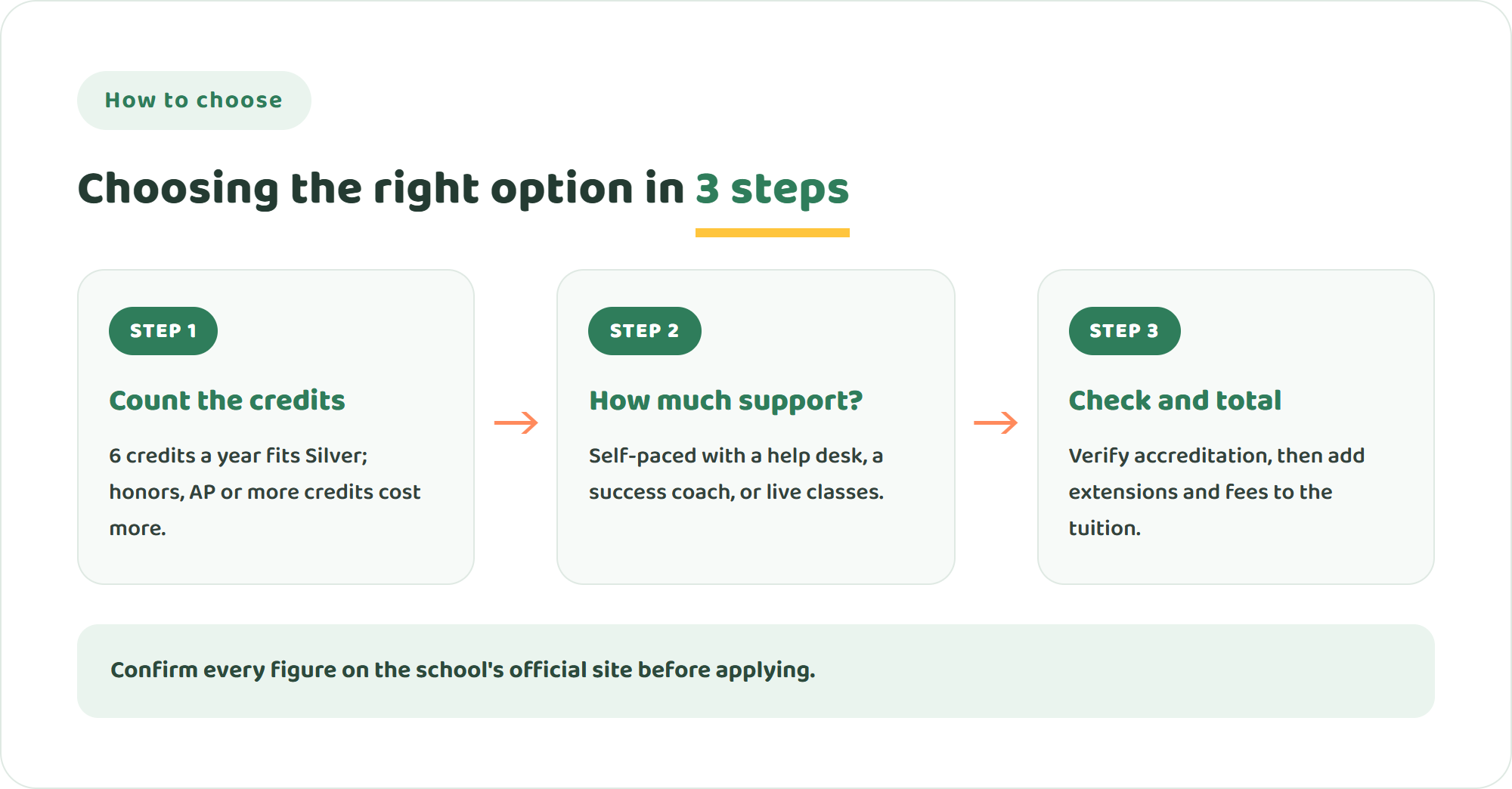
Excel High School’s pricing is easier than it looks once you ask two questions: how many credits does my teen need this year, and how much live human support do they need to succeed? A student who works well alone may only need the Silver plan; one who needs honors, AP or regular coaching will land higher up the table. Whatever you choose, match the learning model to your child first — self-paced or live, independent or coached — and compare prices second.
Tuition and admissions details were checked on the official websites on 29 September 2026. Schools revise fees every year — always confirm on the official site before applying.