If you are settling into Kameari, Kanamachi or Shin-Koiwa — or weighing up a flat in Tokyo’s far north-east before you move — you will quickly notice how thin the information is on international schools in Katsushika. Search in English and you get listing sites recycling addresses from years ago. Search in Japanese and you mostly get conversation schools. So we checked every candidate against each provider’s official website and the ward’s own facility records. The answer is short and worth knowing before you sign a lease: four places in Katsushika teach in English on a daily basis, and exactly one of them is a full-day international school that takes children of primary and junior-high age. That single school is more than neighbouring Sumida or Taito can offer, and almost nobody outside the ward knows it exists. Below is what genuinely operates here, what it costs, which nearby options fill the gaps, and one route that removes the commute altogether.
Quick Answer: Your Options in Katsushika
- Tokyo IQRA International School (Hosoda) | kindergarten through Grade 9 (roughly ages 4–15 per the official admissions guide) | fees published as an image only; enquire directly | the ward’s only full-day school. Cambridge International in the primary years, Montessori in kindergarten, ESL support for children arriving from Japanese-medium schools
- BINGO International Kindergarten (Kamakura) | pre-school ages | ¥68,000/month tuition, plus ¥50,000 signup and ¥50,000 utility fee (official) | Montessori-led, English-medium, open 51 weeks a year with early drop-off from 8:30 and an after-school club to 18:00
- Shin-Koiwa Sakura International Nursery (three sites, Shin-Koiwa and Higashi-Shin-Koiwa) | ages 0–5 | licensed nursery, so fees are set by the ward on household income | native-speaker teachers spend the full day with the 3–5 classes. A licensed nursery with strong English, not an international school
- Kids Duo Kameari (Kameari) | ages 3 to grade 6 | depends on days per week; enquire | English-immersion after-school with pick-up from nine local primary schools. Not a day school
- Aloha International Preschool Kita-Senju (Adachi ward) | 9 months to primary age (after-school) | fees not published; enquire | authorised as an IB Primary Years Programme school in January 2025. Reachable on the Joban and Chiyoda lines
- GIIS Tokyo (Edogawa ward, four campuses around Nishi-Kasai) | ages 3–18 (K–12) | roughly ¥1.05m–¥2.33m a year, tuition plus facility fee (official fee schedule) | kindergarten to Grade 12 in one place, on either a CBSE or an IB/Cambridge track
- India International School in Japan, Tokyo campus (Sengoku, Koto ward) | kindergarten to grade 12 | ¥600,000/year to junior high, ¥1,200,000/year for high school (Tokyo Metropolitan schools portal) | the affordable full-day route, but check the admissions criteria first
- NIJIN GLOBAL ACADEMY (online, opening September 2027, ages 6–18, aiming for roughly one-fifth of in-person fees, Japanese-language support built in) | no commute, no ward boundary. Still pre-launch; you can register for opening updates now
International schools in Katsushika: the real landscape and what it costs
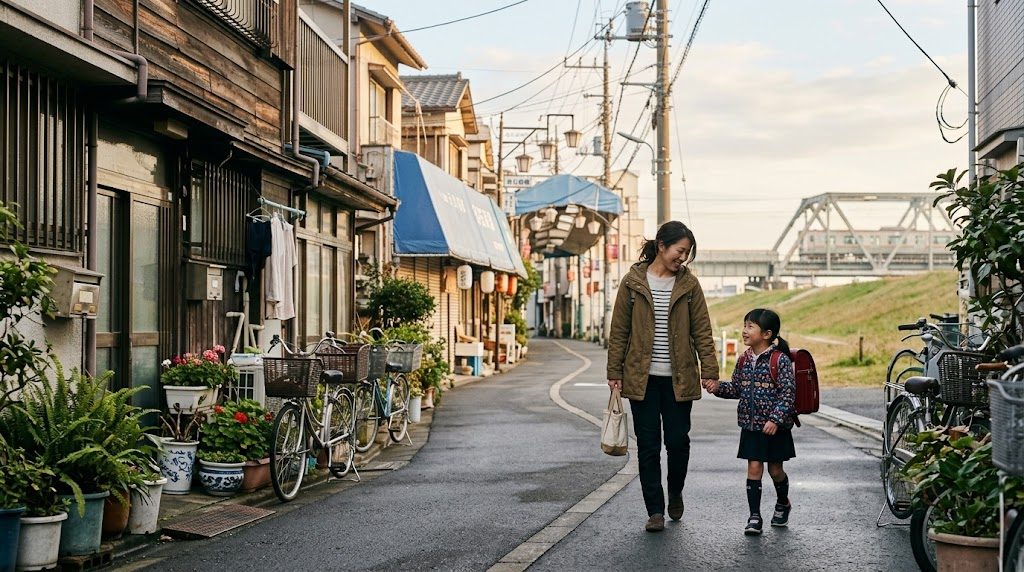
Katsushika sits at the far north-eastern corner of Tokyo’s 23 wards. The Arakawa and Sumida rivers separate it from Adachi and Sumida to the west; the Edogawa river separates it from Matsudo in Chiba to the east; Edogawa ward lies to the south. Four rail lines cross it — the JR Joban line at Kameari and Kanamachi, the JR Sobu line at Shin-Koiwa, and the Keisei main and Kanamachi lines through Aoto, Takasago and Tateishi — so central Tokyo and Chiba are both easy to reach. What the ward does not have is an office district or a cluster of foreign firms, and on the map of international education that places it a long way from Minato or Shibuya.
That does not mean Katsushika has no international families. Around 29,000 foreign residents are registered here — roughly one in sixteen people, well above the national average. The schools that carry the word “international” in this ward grew out of that population rather than out of corporate relocation packages. Tokyo IQRA International School, the ward’s only full-day school, opened in 2014 to serve Tokyo’s Muslim community. It was built for families who live here, not for expatriates on three-year postings, and that difference shapes everything about how it feels.
Laid out by age, the structure of international schooling in Katsushika looks like this:
- Ages 0–2: Shin-Koiwa Sakura International Nursery. A licensed nursery, so fees follow the ward’s income-based scale
- Ages 3–5: BINGO International Kindergarten, Sakura’s 3–5 annex, and IQRA’s kindergarten. This is the widest band
- Primary, ages 6–12: one full-day school (IQRA). Otherwise it is public primary school plus after-school English at Kids Duo Kameari
- Junior high, ages 13–15: IQRA’s published admissions guide runs to Grade 9. Nothing else in the ward
- High school, ages 16–18: no options inside Katsushika. You either travel out or learn without a commute
Fees follow the same shape. For a full-day pre-school place inside the ward, the going rate is around ¥68,000 a month plus one-off signup and facility fees, based on BINGO’s published price list. Compare that with the ¥150,000–¥200,000 a month that English pre-schools in Minato or Shibuya routinely charge and the difference is stark. Choose the licensed Sakura nursery instead and your fee is set by the ward on household income, which brings it down further again.
The moment you look outside the ward for a full-day school, though, the numbers change scale. GIIS Tokyo in Edogawa runs roughly ¥1.05m to ¥2.33m a year; K. International School Tokyo in Koto charges ¥2.85m–¥3.02m in tuition for August 2026 to June 2027. Two schools that share the same label can differ by more than ¥10m across six years. If you want to understand what sits inside those numbers before you compare, our breakdown of international school tuition costs is the place to start, and the wider picture is in our guide to international schools in Tokyo.
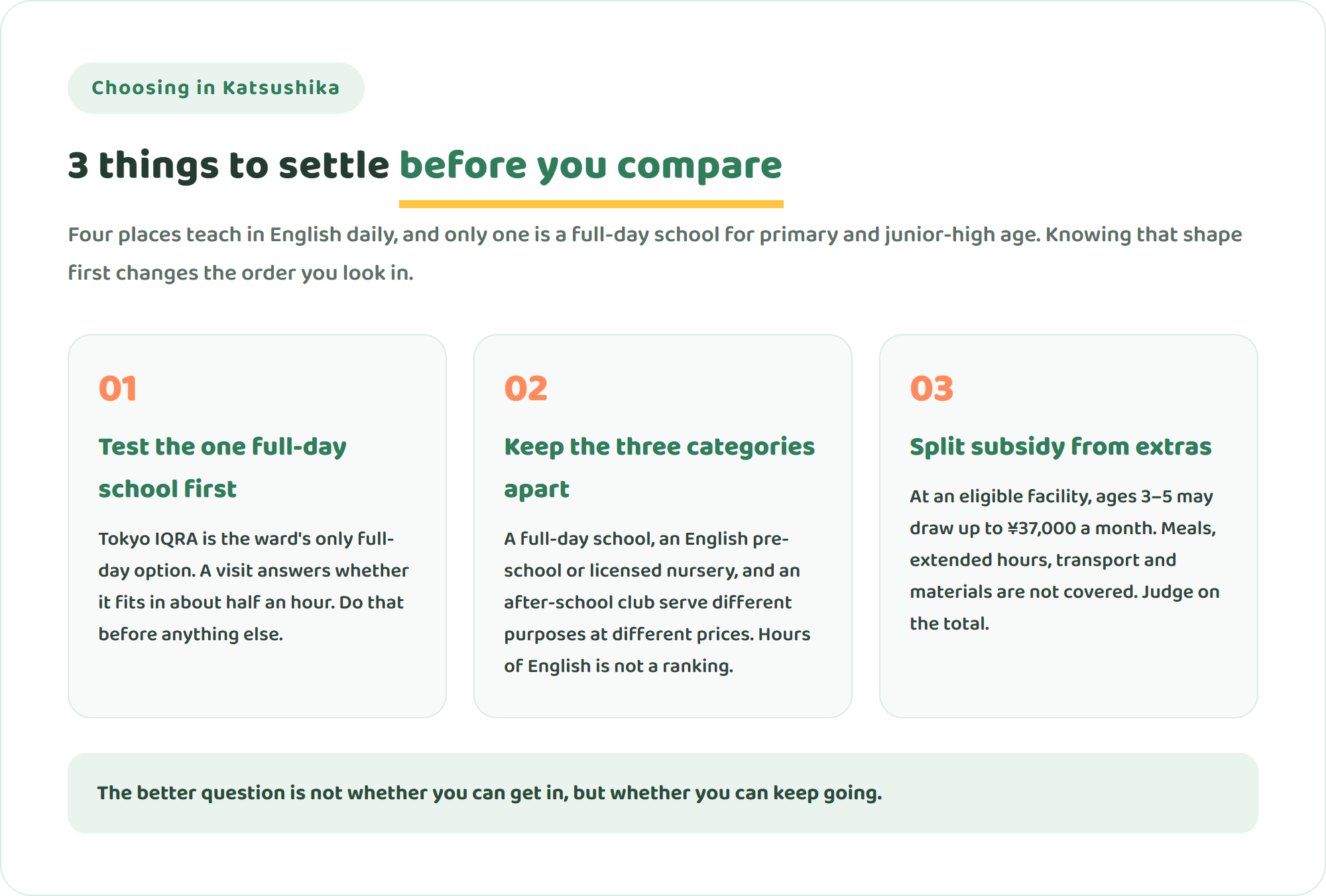
One more thing that moves the household budget more than most families expect: Japan’s free early childhood education and care scheme. Even an unlicensed facility can qualify, provided it has filed with the prefectural governor, holds the certificate confirming it meets the national standards for unlicensed childcare, and appears on the ward’s published list of eligible facilities. Where all that holds, a certified 3–5 place can draw up to ¥37,000 a month (¥42,000 for a 0–2 place in a tax-exempt household). Eligibility varies facility by facility, so confirm it with both the school and the Katsushika ward office.
All four international schools in Katsushika, by age range and fees
Here are the four places we could verify as operating in 2026, in order of age range, fees, and who each one suits. They all carry the word “international” somewhere, and they are not the same kind of thing at all. That difference matters more than anything else on this page.
1. Tokyo IQRA International School (Hosoda) — the ward’s only full-day school
Tokyo IQRA International School is at 4-38-8 Hosoda, about an eleven-minute walk from Keisei-Koiwa station and eighteen minutes from Keisei-Takasago. It opened in 2014 as the first Islamic school in Tokyo, serving the city’s Muslim community. Teaching is in English throughout, within a school culture grounded in Islamic values.
The kindergarten follows a Montessori programme; the primary years follow the Cambridge International curriculum from the UK. The official admissions guide sets out expected ages from kindergarten (4–5) through to Grade 9 (14–15), with class sizes capped at twenty. Crucially for local families, the school states that it provides English as a Second Language support for students transitioning from Japanese-medium education — the single most common worry for a family in this part of Tokyo. Applications are accepted year-round, and the admissions office keeps weekend hours.
- Curriculum: Montessori in kindergarten, Cambridge International in the primary years. English-medium, with Islamic values throughout. ESL support available
- Ages: kindergarten (4–5) to Grade 9 (14–15) per the official admissions guide. Which grades actually run varies by year, so confirm directly
- Fees: the school publishes a fee structure page, but the figures appear only as an image and cannot be read as text. Enquire directly (info@iqra.jp, 03-6458-9852)
- Best for: families who need a full-day school for a primary or junior-high aged child without leaving the ward; Muslim families; children moving from a Japanese-medium school who need language support during the transition
2. BINGO International Kindergarten (Kamakura) — Montessori in English, ¥68,000 a month
BINGO International Kindergarten at 4-28-15 Kamakura is an English-medium kindergarten built around Montessori methods, extended with reading and writing, numeracy, cooking and practical life skills, gardening, physical education, arts, sciences and music. Hours are 9:30 to 17:00 on weekdays, running 51 weeks a year with breaks in winter, spring and summer.
What makes this school unusually easy to plan around is that it publishes its prices. Tuition is ¥68,000 a month, with a ¥50,000 signup fee and a ¥50,000 utility fee. Early drop-off from 8:30 is ¥10,000 a month or ¥1,000 a day; the after-school club from 14:30 to 18:00 is the same; the bus is ¥11,000 a month, ¥6,000 one way, or ¥1,000 for a single trip. You can work out your real annual total before you ever pick up the phone, which is rarer than it should be.
- Curriculum: Montessori-led, English-medium, covering literacy, numeracy, cooking, gardening, PE, art, science and music
- Ages: pre-school, mainly kindergarten age, with nursery provision also mentioned. Confirm class bands directly
- Fees: ¥68,000/month plus ¥50,000 signup and ¥50,000 utility; early drop-off ¥10,000/month, after-school club ¥10,000/month, bus ¥11,000/month (all official)
- Best for: families who want a genuinely full English day before primary school, and who would rather see the full cost up front than negotiate it later
3. Shin-Koiwa Sakura International Nursery (Shin-Koiwa, Higashi-Shin-Koiwa)
Shin-Koiwa Sakura International Nursery runs three sites in the ward: the first at 1-42-10 Shin-Koiwa (small-scale licensed), the second main site at 1-2-11 Higashi-Shin-Koiwa for ages 0–2 (capacity 20), and its annex at 1-40-3 Shin-Koiwa for ages 3–5 (13 places per year group, 39 in total). Together they cover birth to school entry without a break. Opening hours run 7:15 to 19:15 including the extended session.
The word “international” is in the name, but the category is a licensed Japanese nursery, and it is worth being clear about that. The English provision, though, is substantial: in the 0–2 classes children listen to native-speaker teachers and get used to sounds that do not exist in Japanese, and from age three a native-speaker teacher is with the class all day. The curriculum is built on New Zealand’s Te Whāriki framework, with Montessori materials used in play.
- Curriculum: Te Whāriki-based, with all-day native-speaker involvement from age three and Montessori materials. English and Chinese provision
- Ages: 0–5 across the three sites
- Fees: as a licensed nursery, fees are set by Katsushika ward on household income. The 3–5 classes fall under the national free early childhood education scheme
- Best for: dual-income families who want a licensed nursery place first and English second, and who want to keep costs on the public scale
4. Kids Duo Kameari (Kameari) — English after school
Kids Duo Kameari at 5-12-12 Kameari, five minutes’ walk from Kameari station on the JR Joban line, is an English-immersion after-school programme. The primary course runs 13:30 to 19:30 on weekdays; the pre-school course runs 14:30 to 18:30 or 15:00 to 17:00. Everything inside those hours happens in English, and the centre runs pick-ups from nine local primary schools including Otanida, Kamesei, Higashi-Fuchie, Nagato, Michinoue, Kitamitani, Nakanodai, Aoto and Nishi-Kameari.
- Curriculum: English-immersion after-school care, not subject teaching in English
- Ages: 3 to grade 6
- Fees: vary with days per week; enquire directly
- Best for: families using the local public primary school who want the after-school hours spent in English, and who need childcare cover at the same time
Fees and details above reflect information published as of September 2026. Always confirm the current position on each school’s own website.
Three things called “international school” in Katsushika, and why they are not the same
The most exhausting part of searching in this ward is that one phrase covers three completely different products. This is not a criticism of anyone — it is a practical sorting exercise that will save you weeks.
- A full-day international school: subject teaching in English during school hours. In Katsushika, that is IQRA alone. Note that international schools are not ichijoko under Japan’s School Education Act, so if your child holds Japanese nationality you should discuss compulsory-schooling status with the Katsushika board of education before enrolling
- An English pre-school or English-medium nursery: pre-school children spending the day in English. BINGO belongs here, and so does Sakura, though Sakura is formally a licensed nursery. Either way you will need a plan for age six
- After-school English and conversation schools: a few hours a week or a few afternoons. Kids Duo Kameari and the ward’s conversation schools sit here. Round-up articles list all three together as if they were interchangeable. They are not — the purpose and the price are different
“The listicle had seven schools; only one of them was somewhere my child could actually go every day.” That gap is the real story of searching in Katsushika. One question at the start of a phone call — which of these three are you? — removes most of the wasted trips.
When the ward is not enough: schools within reach of Katsushika
Depending on your child’s age and the curriculum you want, four options may not be enough. Katsushika is bordered by Adachi, Edogawa, Koto and Matsudo in Chiba, so the commuting map is better than the ward’s own list suggests. Three realistic options follow. For the fuller picture nearby, see our guides to international schools in Edogawa and international schools in Sumida.
5. Aloha International Preschool, Kita-Senju campus (Adachi ward)
Aloha International Preschool Kita-Senju at 1-3-11 Adachi (with an annex at 1-29-3) covers an unusually wide age range: parent-and-child classes from nine months, pre-kindergarten, kindergarten, and after-school plus learning support for primary-age children. The school announced that it became an authorised IB Primary Years Programme school in January 2025. From the western side of Katsushika, Kita-Senju is a straightforward run on the Joban or Chiyoda lines. Fees are not published, so you will need to ask.
6. GIIS Tokyo (Global Indian International School, Edogawa ward)
GIIS Tokyo operates four campuses around Seishincho, Kita-Kasai, Nishi-Kasai and Higashi-Kasai in Edogawa, covering ages 3 to 18 on two parallel tracks: India’s CBSE curriculum, or IB and Cambridge. On the official fee schedule, tuition plus facility fee runs to roughly ¥1.25m a year in the CBSE primary years and ¥1.70m in the CBSE senior years; on the IB and Cambridge track it is roughly ¥1.64m in the primary years and ¥2.33m for the IB Diploma. A one-off registration fee of ¥40,000–¥50,000 applies, and the school publishes sibling discounts of 25% on tuition for a second child and 50% for a third. From Shin-Koiwa or Takasago the journey is straightforward on the Sobu and Keisei lines.
7. India International School in Japan, Tokyo campus (Sengoku, Koto ward)
India International School in Japan (IISJ) Tokyo at 3-1-4 Sengoku is a kindergarten-to-grade-12 school following India’s CBSE curriculum. According to the Tokyo Metropolitan Government’s international schools portal, tuition is ¥600,000 a year through junior high and ¥1,200,000 for high school. It has around 1,400 students, emphasises mathematics, science and IT, and uses Montessori methods in kindergarten. It holds MEXT designation, so graduates can apply to Japanese universities. One important caveat: admission prioritises Indian and other foreign nationals, and Japanese nationals are considered only as returnees. Check this before you invest time in an application.
Worth knowing too: K. International School Tokyo in Shirakawa, Koto ward, offers all three IB programmes for ages 3 to 18. Tuition for August 2026 to June 2027 is ¥3,020,000 for K1–K3, ¥2,850,000 for Grades 1–9 and ¥2,970,000 for Grades 10–12, with a ¥300,000 enrolment fee, ¥700,000 capital fee, ¥30,000 application fee and ¥200,000 annual building maintenance fee on top. Expensive, but not out of reach on the Toei Shinjuku or Hanzomon lines.
Comparing the options honestly
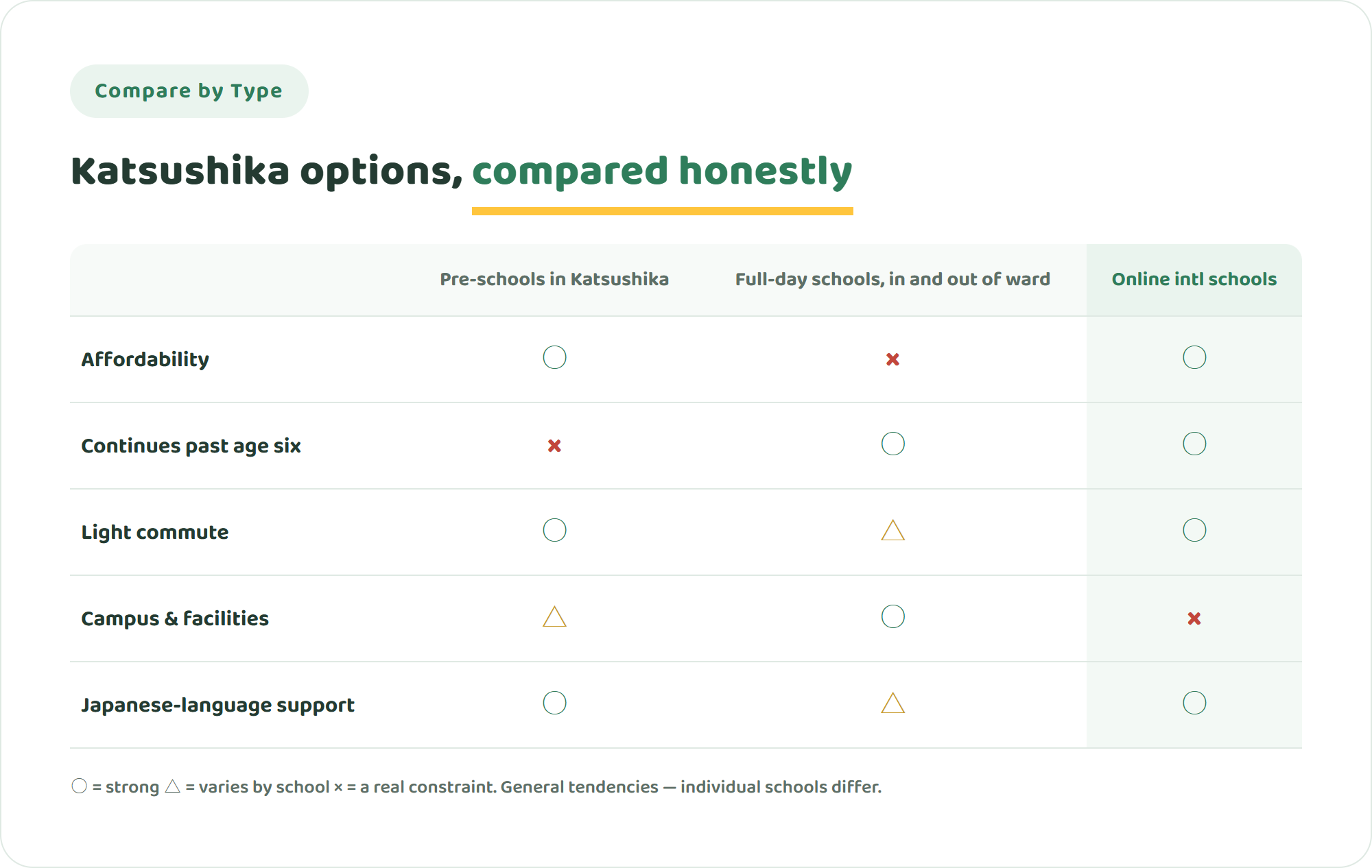
In Katsushika, the highest-value move is to find out early whether the one full-day school in the ward fits your family. IQRA takes primary and junior-high ages and sits inside the ward, which changes both the commute and the cost in ways no other option can match. If its religious grounding or its curriculum does not match how you want your child educated, that is completely legitimate — but you want to know it now, not in the spring before school entry. A visit usually answers the question in half an hour.
The second thing that matters is not conflating the categories. The four places in the ward are a full-day school, an English kindergarten, a licensed nursery and an after-school club. Ranking them by “hours of English” produces a meaningless list. Ranking them by the question of where your child will be enrolled at seven, and what happens between three and six o’clock, produces a real comparison.
The third, and the one families consistently underestimate, is counting the commute as a family cost. Kanamachi to Nishi-Kasai is around forty minutes with a change. A six-year-old doing that twice a day is a different proposition from an adult measuring it on a map, and if the trip needs an escort, that hour belongs to a parent — every school day, for six years. Fees decide whether you can start. The commute usually decides whether you can keep going.
See how learning works online →
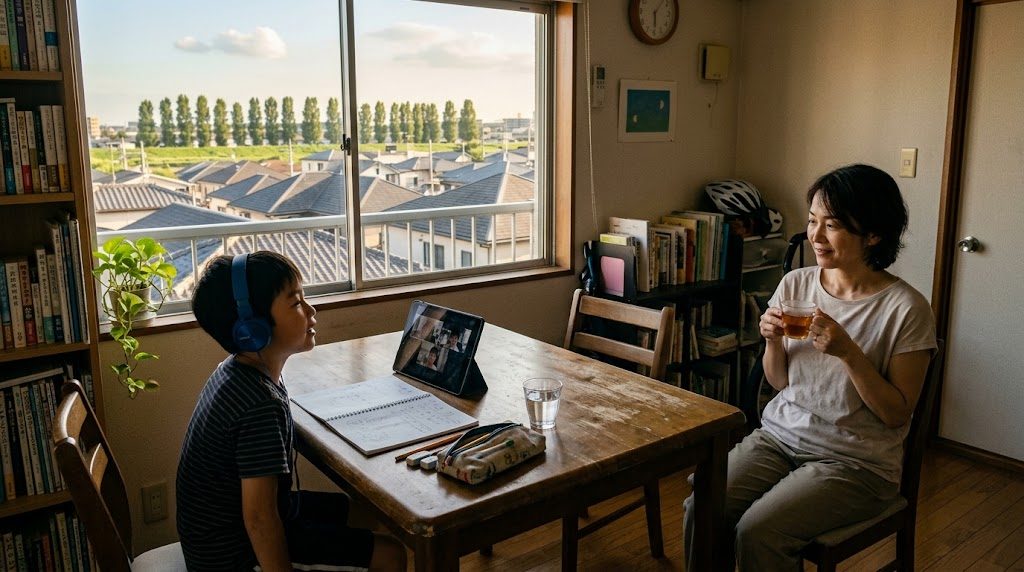
When fees or the commute are the obstacle: an eighth option
If you have read this far and thought, “fine, there is one school in the ward, but it is not right for us — and the schools in Edogawa and Koto cost more than we can carry, and I am not putting a six-year-old on two trains every morning,” that reaction is entirely reasonable. There is one more route worth knowing about.
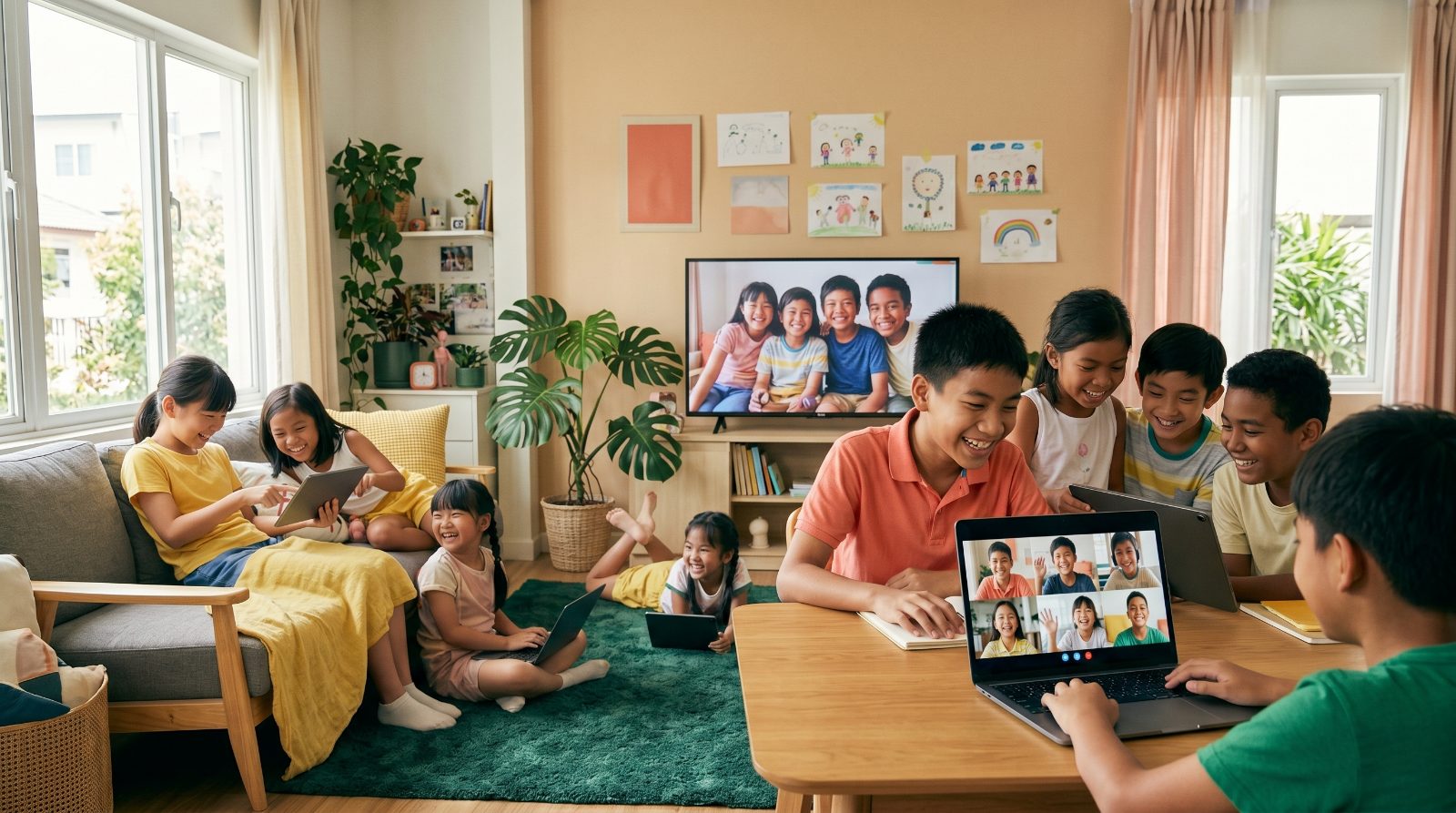
NIJIN GLOBAL ACADEMY is an online international school opening in September 2027. It is run by NIJIN Inc., a Japanese company that already operates NIJIN Academy, an alternative school in Japan with more than 1,000 children enrolled. It serves ages 6 to 18 across Asia and Oceania, and because it is online, a family in Katsushika joins from home.
What the school is built on is a rejection of ranking children by test scores. Learning happens in small groups built around dialogue, and the curriculum is organised around a simple aim: that children come to like themselves and the world. Fees are targeted at roughly one-fifth of an in-person international school, and the design assumes Japanese-language support as a foundation, so children move towards English gradually rather than being dropped into an all-English environment on day one.
Two honest caveats. First, the school has not opened yet. There is no track record to show you and no graduate destinations to point at. Second, it is not the same experience as a physical school. Nothing online replaces a playground, or eating lunch beside a classmate. Even so, for families in a ward where the in-person choices are this narrow, the ability to reach a genuinely international classroom with a commute of zero has real weight.
Frequently asked questions
Q. From what age can my child start at an international school in Katsushika?
For pre-school, Shin-Koiwa Sakura International Nursery accepts children from birth, although as a licensed nursery, places are allocated through the ward’s admissions process. BINGO International Kindergarten is mainly kindergarten age, with nursery provision also mentioned. The full-day school, Tokyo IQRA, sets out expected ages from kindergarten (4–5) in its official admissions guide. So there are places available from age zero — but which classes run, and where the spaces are, changes year to year. Contact any school you are serious about early.
Q. Can a primary or junior-high aged child attend an international school in Katsushika? What about Japanese-language support?
Yes. Tokyo IQRA International School publishes expected ages through Grade 9 (14–15) and is the ward’s only full-day option for school-age children. It also provides ESL support for children arriving from Japanese-medium schools. Two things to plan for. First, international schools are not ichijoko under Japan’s School Education Act, so if your child holds Japanese nationality, speak to the Katsushika board of education about compulsory-schooling status before you enrol. Second, the longer a child spends in an English environment, the more deliberately you need to support Japanese reading and writing — it does not develop on its own. Reading at home, or a structured Japanese programme alongside school, is worth building in from the start rather than adding later. If that is a worry for your family, our sister service Tomodachi Japan (online Japanese for children, also run by NIJIN) is worth a look.
Q. Can we transfer mid-year?
Tokyo IQRA states that applications are accepted year-round and that the admissions office is open at weekends. With classes capped at twenty, individual year groups can still be full. Unlicensed pre-schools like BINGO can usually discuss a mid-year start if there is space. Full-day schools outside the ward are a different matter: GIIS Tokyo and KIST assess by year-group capacity and by your child’s English level, and their calendars differ — GIIS runs a three-term year starting in April, KIST starts in August. If you are planning a transfer, contact schools six to twelve months before your target date. Capacity, entry requirements and fees all change, so verify everything directly.
A narrow set of choices is still a set of choices
Searching for an international school in Katsushika is genuinely hard. One full-day school in the whole ward, listicles that file conversation classes under the same heading, and the verification work landing squarely on you.
But a short list has one real advantage: it makes the decision axis obvious. Does the ward’s one full-day school fit your family, or not? Settle that and everything downstream gets lighter. Families who enrol locally while touring schools in Edogawa are doing it right. So are families combining the local public primary school with English in the afternoons. So are families who drop the commute entirely and go online. What you want to avoid is arriving at the spring before school entry with the question still open.
The time you are spending on this is time spent taking your child seriously. Please don’t let it turn into time spent blaming yourself. The fact that you are researching at all is already the work.
International Schools in Other Cities
- International Schools in Tsukuba: Fees
- International Schools in Sendai: 7 Picks and Fees
- International Schools in Shinjuku: Fees
- International Schools in Karuizawa: All 4 Schools
- International Schools in Sapporo: Fees
- International Schools in Dubai: Fees
- International Schools in Yokohama: Full Comparison
- International Schools in Adachi, Tokyo
- International Schools in Tokyo
- International Schools in Minato: Fees
- International Schools in Shibuya, Tokyo
- International Schools in Setagaya: All 14 Schools
- International Schools in Koto, Tokyo
- International Schools in Shinagawa, Tokyo