You keep running into those two letters. IB. They’re in the open-day brochure, on every international school website, in the conversations other parents are having. It’s globally recognised, apparently. It’s inquiry-based and genuinely interesting, apparently. And it’s brutally hard work, apparently. Sooner or later you type the same question into a search box: what is the International Baccalaureate, exactly? The fragments pile up, but what it would actually mean for your child stays stubbornly out of focus — and the alternatives keep multiplying, from Cambridge International to the national school your child already attends.
So let’s slow it down. This article starts with a plain-language answer to what is the International Baccalaureate, written for parents rather than admissions officers. Then it compares three real paths — the IB, Cambridge International (IGCSE and A Level), and a mainstream national curriculum — on what actually decides the outcome: university access, subject choice, workload, and whether the cost is realistic. We won’t skip the downsides, and we’ll finish with a three-step way to decide what fits your own child.

What is the International Baccalaureate, in plain terms?
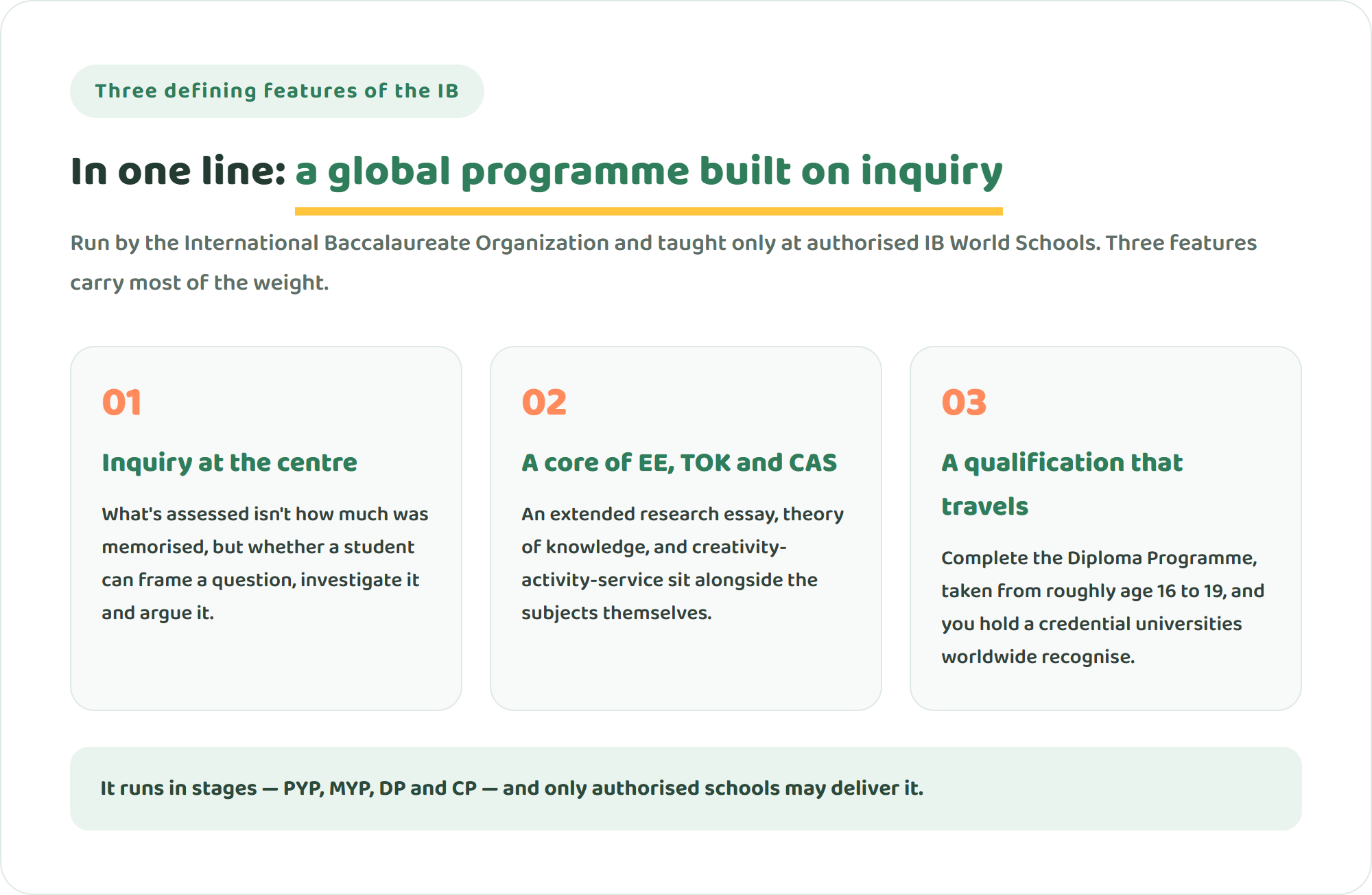
So, what is the International Baccalaureate? In plain terms, it is an international education programme run by the International Baccalaureate Organization (IBO), headquartered in Geneva, Switzerland. It is not the name of a school. It is a shared framework — a philosophy plus a curriculum — and only schools that have completed its authorisation process — and are therefore called IB World Schools — may deliver it. That single fact shapes everything else: choosing the IB means choosing from the schools authorised to teach it.
The programme comes in four stages, by age: the PYP for primary years, the MYP for the middle years, the DP — the Diploma Programme — for students aged roughly 16 to 19, and the CP, a career-related route for the same age band. When parents say “the IB,” they usually mean the DP. Complete it and your child holds an internationally recognised qualification for applying to universities around the world. That, more than anything, is the IB’s headline value.
What sets the DP apart is what sits alongside the subjects. Students take courses from six subject groups while working through three elements known as the core: the Extended Essay (EE), independent research on a question the student chooses; Theory of Knowledge (TOK), which asks how we know what we claim to know; and CAS — creativity, activity, service. What’s assessed is not how much your child memorised, but whether they can frame a question, investigate it, and say something of their own.
IB vs Cambridge vs a national curriculum — an honest comparison
In practice, most families weigh the IB against two things: Cambridge International (IGCSE and A Level) and the national curriculum their child is already in. It helps to remember, when reading about what an international school is, that the curriculum a school adopts changes its character far more than the label on the gate.
Cambridge International is taught in more than 160 countries and over 10,000 schools, and is recognised by more than 500 universities in the United States alone. Its defining feature is structural: it is built subject by subject. A student sits the subjects they need and leaves the rest, which makes it easy to build around a child’s strengths or a specific destination. The IB Diploma, by contrast, is a package: six subjects plus the three core elements, taken and completed together. That guarantees breadth and depth — and removes the option of taking only the parts you want. Neither design is better, but this is the most consequential difference between them.
Then there is the national curriculum. It leads directly into your own country’s entrance system, costs far less, and keeps your child inside the community they already live in. The trade-off is that assessment often leans on written exams and ranked scores, which can leave a genuinely curious child feeling the interesting questions never get asked. The three aren’t ranked against each other; they are measuring different things.
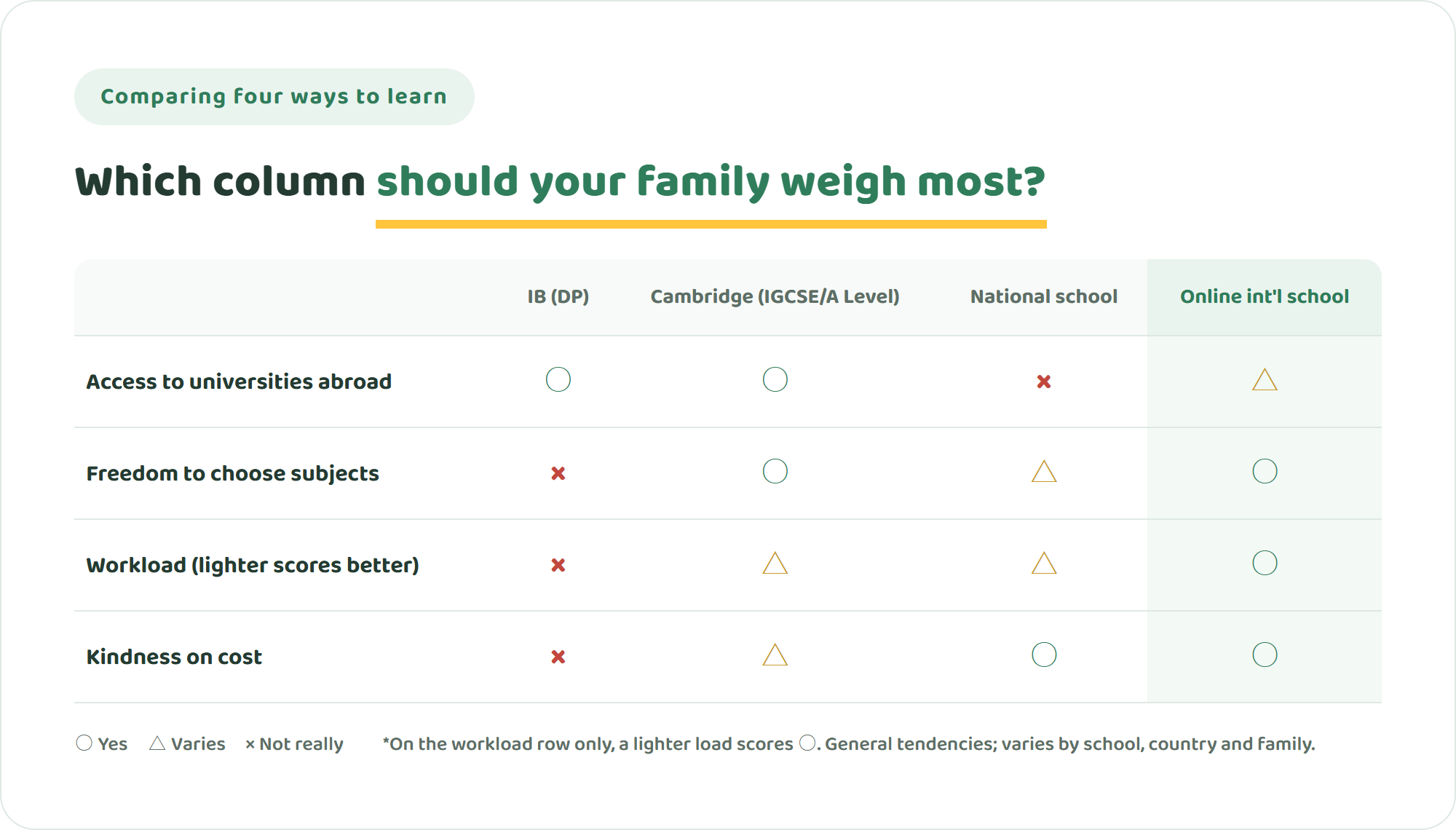
Side by side, the strengths separate cleanly. For universities abroad, both the IB and Cambridge are strong, while a purely national route is the weakest fit. For subject choice, Cambridge stands out. On workload, the Diploma is unavoidably the heaviest. On cost, a national school wins comfortably. The useful question isn’t which is best — it’s which column your family should weigh most.
See how learning works at NGA →
The honest downsides of the International Baccalaureate
The IB’s reputation is deservedly good, which is why the difficult parts deserve airtime. The first is how much work it is. DP students carry six subjects at once while writing a research essay of several thousand words, wrestling with abstract questions in TOK, and documenting CAS activity throughout. It assumes a student who can manage their own time, and the “it’s brutal” reputation is not exaggerated. The second is availability and cost. Because only authorised schools can offer it, many families have no IB school within reach. Fees vary enormously by country and school and sit well above a local school’s, so treat any figure you read as a rough indication and check each school’s official published fees before planning around them.

The third is that subject choice can be narrower than the brochure suggests. The six-group structure looks generous, but each school only runs the courses it actually staffs, and language options in particular vary widely. The fourth is that joining partway through is hard. The Diploma is a continuous two-year course, so missing the start date usually means waiting. Ask about entry points early — it’s the kind of detail that quietly closes doors.
Which children thrive on the International Baccalaureate — and which struggle
This part rarely makes the prospectus. The children who flourish tend to ask “but why?” without being prompted, don’t mind turning research into written argument, and feel something click when they defend an idea in a seminar. Add the ability to manage a deadline without an adult standing over them, and the IB becomes a genuinely liberating place to learn.
The children who struggle are usually the ones who end up buried. The volume of reading and writing rises sharply, and a student without steady study habits can end up learning to dislike learning itself. The same applies to a child recovering from a hard time at school: if what they need first is a place where they feel safe, starting with a high-load programme is the wrong order. Fit the curriculum to the child, not the child to the curriculum — of everything here, that’s the line worth keeping.
How to choose the right curriculum for your child — three steps
Here is a sequence to come back to whenever the options start blurring.
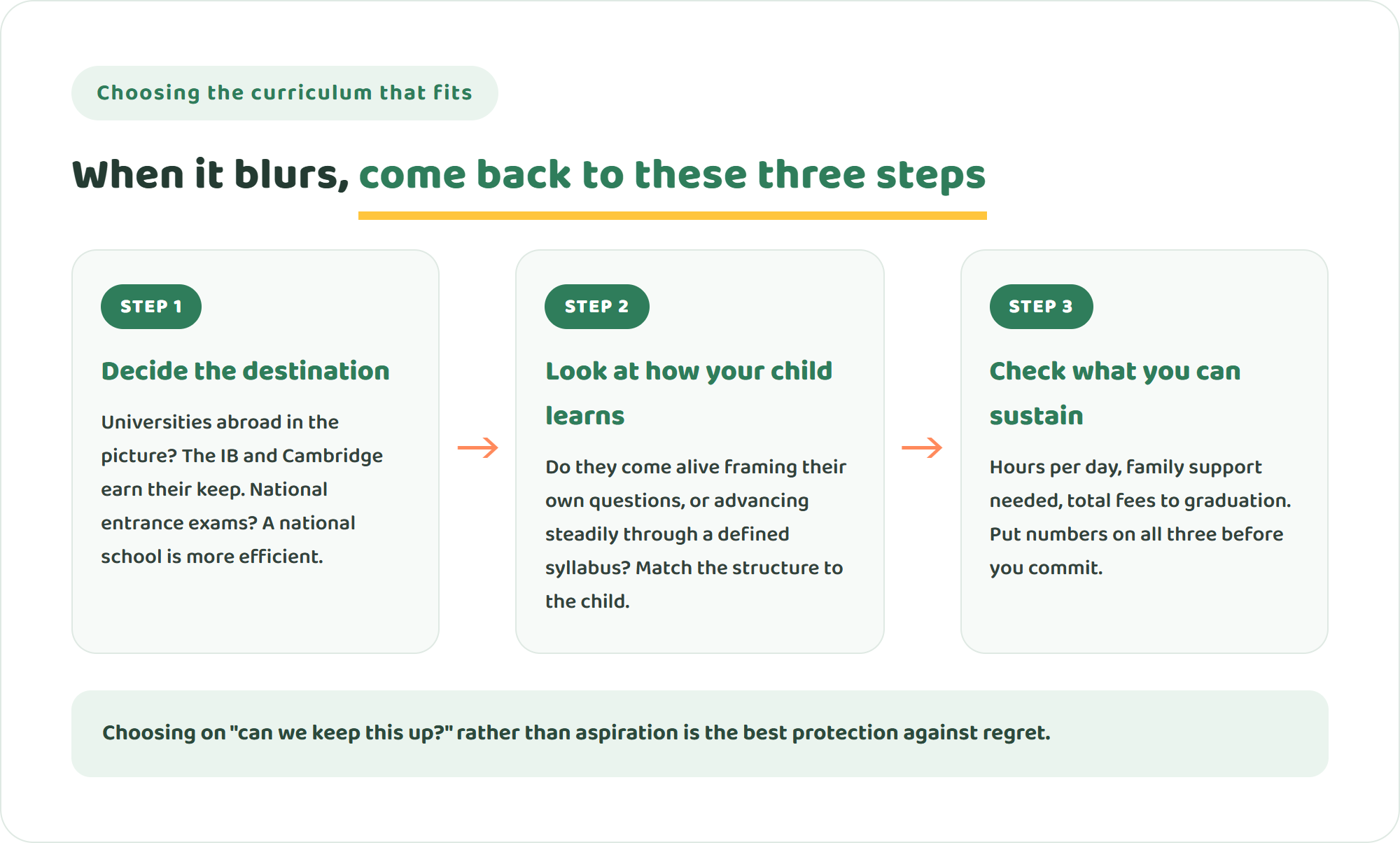
Step 1 — decide the destination. If universities abroad are in the picture, the IB and Cambridge both earn their keep. If your own national entrance system is the realistic target, a national school is more efficient by some distance. If it’s genuinely undecided, look at where international school graduates go; seeing the range makes an abstract question concrete. Step 2 — look at how your child learns. Do they come alive framing their own questions, or do their best work advancing steadily through a defined syllabus? The first points toward the IB; the second toward Cambridge or a national curriculum.
Step 3 — check what you can sustain. A brilliant curriculum abandoned in year two helps nobody. Put real numbers on three things: hours of study per day, the support your family will need to give, and total fees across the whole period rather than the annual figure. Choosing on “can we keep this up?” rather than on aspiration is the best protection against regret there is.
Where NGA sits among these
With all of that on the table, here is where we stand. NIJIN GLOBAL ACADEMY (NGA) is an online international school beyond the exam race, opening in September 2027 and operated by NIJIN Inc. We already run NIJIN Academy, one of Japan’s largest alternative schools, where over 900 children are currently learning.
To be straightforward: NGA is not an IB World School. We are currently preparing our curriculum around the Cambridge framework, precisely for the subject-by-subject flexibility described above — it is in development ahead of our 2027 opening. What we care about most sits underneath any qualification — the foundation of coming to love yourself and the world. Not ranking children by test scores, but learning through small-group dialogue with the whole world as the material; a psychologically safe place where each child chooses how many people they learn with and how they take part. On fees, we’re aiming for around one-fifth of an on-campus international school. Families who choose the IB are making a good decision, and so are families who stay with their national school. Compare us fairly, and consider us when the fit feels right for your child.
Frequently asked questions
Does the IB Diploma replace a national high school leaving qualification?
They are separate things. The Diploma is an international qualification used for university applications; a leaving certificate is issued under your own country’s system. That said, where a national high school is also an authorised IB World School, students can often work toward both at once. Arrangements differ by school and country, so check each school’s official information directly.
IB or Cambridge — which is better for university admission?
Neither is categorically better. Both are widely recognised, and what a given university asks for varies by country and faculty. The practical questions are what your target institutions actually require, and which structure suits your child: a broad, integrated package points to the IB, while building up a chosen set of subjects points to Cambridge.
Can a child who isn’t strong in English still take the IB?
Sometimes — but choose the school carefully. Some schools offer certain subjects in languages other than English, and the options differ school by school. Bear in mind that the real demand of the IB is the sheer volume of reading, thinking and writing rather than language alone. Building confidence in a supportive environment first, then moving to the Diploma, is a perfectly sound sequence.
The qualification matters less than whether they come to love learning.
The International Baccalaureate is a very well-designed programme. But it isn’t the world’s best education — it is one considered answer to the question of how children should learn, and Cambridge and national systems carry answers of their own. What decides the outcome isn’t the name on the flag. It’s whether your child can raise their head and learn underneath it. A curriculum should be the ground they stand on, not the ruler they’re measured against.
NIJIN GLOBAL ACADEMY opens in September 2027. We’ll show you how our learning works — small-group dialogue that connects your child to the world — along with news about our first cohort, straight to your inbox. Whichever route you choose, your child’s learning is something you and your child can grow together. Start here.
Get opening updates by email →
More on choosing an international education
- Starting International School in the Elementary Years——What changes, and what it costs
- How Much Does an International Preschool Cost in Japan?——Fees, subsidies, and the step after kindergarten
- Minerva Virtual Academy Fees for Families in Asia——Paid upfront, taught on UK hours
- American Online Schools for International Students——5 compared on tuition, time zones and eligibility
- Stanford OHS vs Laurel Springs——Live seminars or self-paced, read from Asia
- Alpha School vs Sora vs Primer——Which new school model a family in Asia can use
- Can You Raise a Bilingual Child Without Speaking English?——What parents can realistically do at home
- School Refusal? An Online International School Can Reopen Learning——A route back into learning
- How Do You Nurture the Skills Standardized Tests Cannot Measure?——Beyond exam scores
- The Best Age to Start Learning English for Kids——Too early? Too late?