If you have been searching for international schools in Tochigi Prefecture and keep landing on English-language preschools, you are not searching badly — you are seeing the market accurately. Tochigi is home to roughly 1.9 million people, with about half a million in Utsunomiya alone, yet as of 2026 only two full-time schools in the entire prefecture accept children at elementary age or above. Of those two, just one actually teaches through English, and there is no International Baccalaureate authorised school anywhere in Tochigi. This guide separates the layers honestly: the schools that continue past kindergarten, and the English-immersion preschools mapped area by area. It then walks through the three routes families here genuinely take when nothing local fits — commuting into neighbouring Gunma, Ibaraki or Saitama, choosing a Japanese private school with a strong English or inquiry-based programme, and learning online without commuting at all.
Quick Answer: Your Options in Tochigi Prefecture
If you only read one section, read this. Below are the schools covered in this guide, plus the online option — so you can see every route side by side before the details.
- SANO International School (Sano City) — Ages: Preschool and kindergarten (kindergarten entrants must be five by 1 September)… / Fees: Published annual tuition of ¥700,000 (kindergarten–elementary) or ¥750,000 (Grade 7…
- Commute to a school in a neighbouring prefecture
- Utsunomiya International Christian School (UICS, Utsunomiya) — Ages: Kindergarten (K1) through Grade 12, coeducational / Fees: Published entrance fee ¥50,000; tuition ¥30,000 per month for elementary through…
- Choose a Japanese private school with a strong English or inquiry programme
- Keep your local school and add international education online
- NIJIN GLOBAL ACADEMY (online) — Ages 6–18 / opening September 2027, currently taking opening-update registrations / fees around one-fifth of a typical campus international school / Japanese-language support. An option when commute or fees are the wall.
International schools in Tochigi Prefecture: the landscape and fee ranges
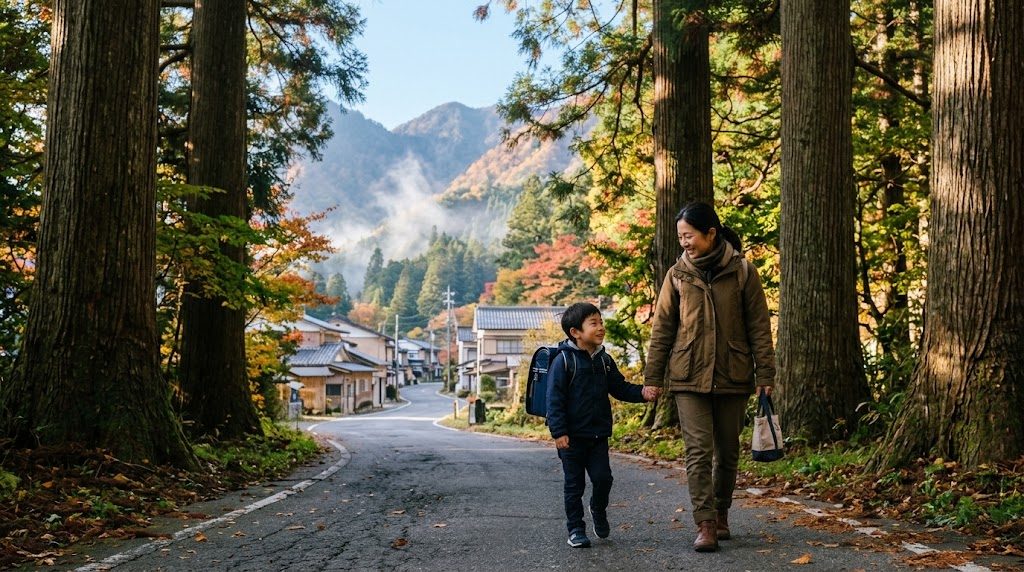
Tochigi is internationalising steadily. According to the prefectural government’s survey of foreign residents, 60,645 foreign nationals were living in Tochigi as of 31 December 2025 — an increase of 4,883 in a single year, the highest figure on record, and 3.21% of the prefecture’s population, also a record. International families are spread across the prefecture: the automotive and machinery belt around Oyama, Moka and Kaminokawa, and the agricultural districts of the Nasu highlands. What has not kept pace at all is the supply of schools where a child can keep learning in English year after year. That gap is the single most important fact about international education in Tochigi.
The schools divide cleanly into two layers. The first is the preschool layer — around ten English-immersion nurseries and kindergartens for children roughly aged one to six, found in Utsunomiya, Oyama, Ashikaga, Nasushiobara and Kaminokawa. The second layer, schools accepting elementary-age children and older, contains exactly two: SANO International School in Sano City and Utsunomiya International Christian School (UICS) in Utsunomiya. And UICS states plainly on its own admissions page that it is not an international school where daily conversation and lessons happen in English. So if you need English as the language of learning, the in-prefecture shortlist is effectively one school long.
Fee levels differ sharply between the layers. Preschools generally run about ¥30,000–90,000 per month, landing somewhere around ¥400,000–1,300,000 a year once entrance fees and materials are added — though children aged three to five often qualify for Japan’s early-childhood education subsidy, which can cut the effective cost substantially. Of the two full-time schools, SANO International School publishes annual tuition of ¥700,000–750,000 (roughly ¥760,000–810,000 once the sports and building fees are included), while UICS publishes ¥30,000 per month in tuition, putting a year at around ¥400,000. Set against the ¥2–3 million a year typical of major Tokyo international schools, Tochigi’s profile is distinctive: very few options, but comparatively affordable ones.
Note: fees reflect publicly available information as of July 2026 and are subject to revision. Always confirm current figures directly with each school.
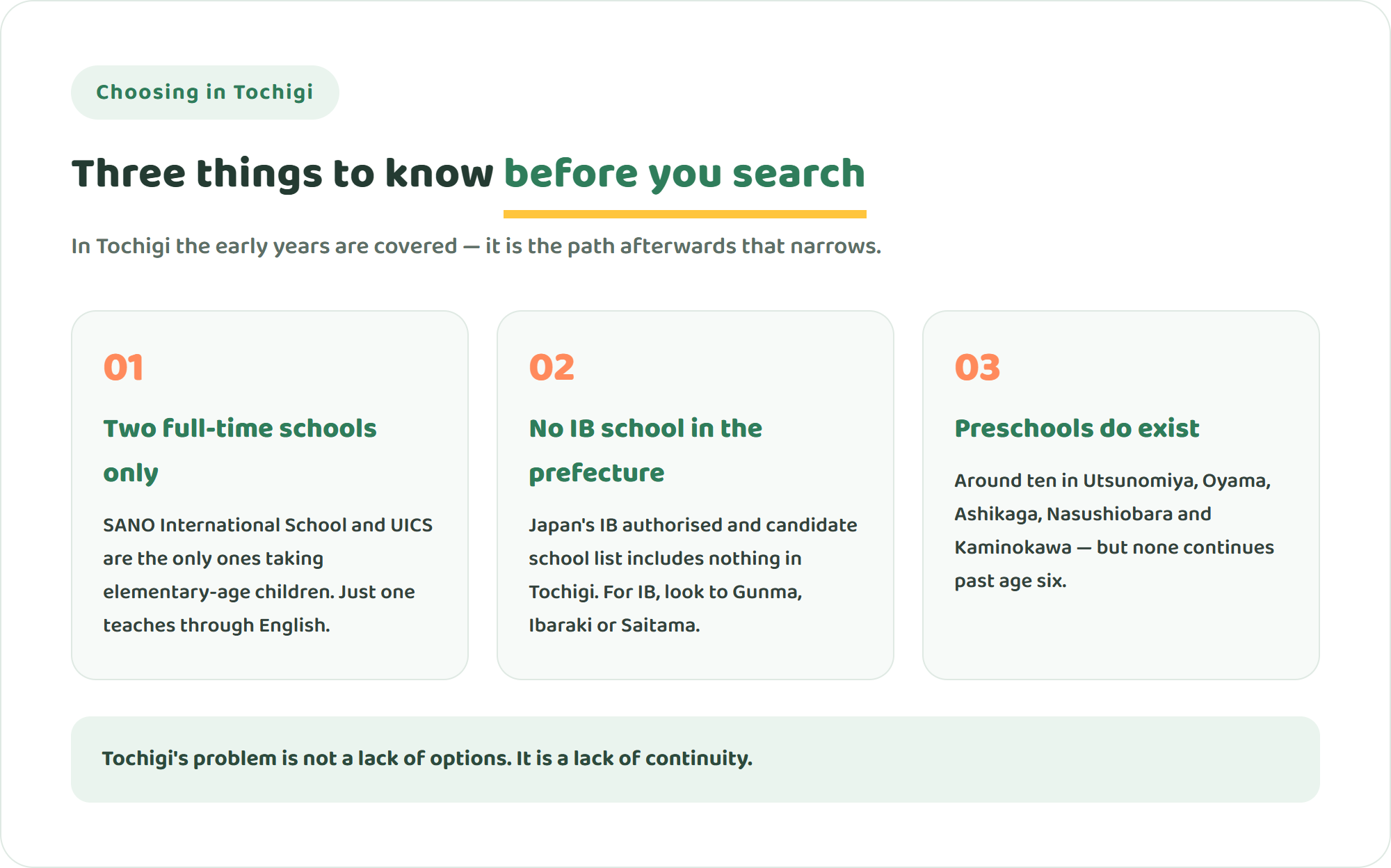
Both international schools in Tochigi that continue past kindergarten
Here are the schools in Tochigi Prefecture that accept students at elementary age or above, as far as public information allows. There is no padding to reach a round number. There are two, and they are nothing alike.
1. SANO International School (Sano City)
Opened in 2006, this is the only genuine English-immersion school in Tochigi. Its campus in Ohashicho, Sano, houses kindergarten, elementary and junior high through Grade 9, delivering US and Singapore curricula at grade level in a full-immersion English environment. It is a Christian school and has been ACSI accredited (Association of Christian Schools International) since 2024. Teachers come from Japan, the USA, the UK, Malaysia and the Philippines, and students represent six or more nationalities. Classes are small, built around four skills the school names explicitly: critical thinking, communication, collaboration and creativity. Japanese-language instruction continues through Grade 8, and all school communication is available in both Japanese and English — which matters if one parent is not a confident English speaker. If your goal is for your child to learn in English while staying in Tochigi, this is where the search begins and, realistically, ends.
- Curriculum: Full-immersion English using US and Singapore curricula; ACSI accredited since 2024
- Ages: Preschool and kindergarten (kindergarten entrants must be five by 1 September) through junior high Grade 9
- Fees: Published annual tuition of ¥700,000 (kindergarten–elementary) or ¥750,000 (Grade 7 and above), plus a ¥10,000 annual sports fee and ¥50,000 annual building fee — around ¥760,000–810,000 a year. Entrance fee ¥200,000 (kindergarten–Grade 6) or ¥100,000 (Grades 7–8), plus a ¥5,000 processing fee per family at interview (2026; confirm directly)
- Good fit for: Families in the Ryomo area (Sano, Ashikaga, Tochigi City) who want English-medium elementary education at a manageable cost
2. Utsunomiya International Christian School (UICS, Utsunomiya)
Founded in 2003 and based at Minecho Christian Church in Mine, Utsunomiya, UICS is a full-time Christian school taking students from kindergarten (K1) all the way to Grade 12 — the only place in Tochigi where a child can stay enrolled to high-school age. Some students attend every day, others on set days of the week, and the school provides individual support for children with learning differences and developmental disabilities. A 30-minute daily chapel and three weekly Bible classes sit at the centre of the programme, alongside English conversation with native-speaker teachers and preparation for the Eiken and TOEFL exams.
One point deserves to be stated plainly. UICS writes on its own admissions page that it is not an international school where daily conversation and lessons are conducted in English, and asks that enquiries be sent in Japanese for that reason. In regulatory terms it operates as a free school, not an English-medium school. Because the word “International” sits in the name, this is easy to misread, so it is worth understanding before you book a visit. Families choose UICS for its small scale, its Christian formation and its individual support — not for English immersion.
- Curriculum: Bible-based Christian education plus English study; lessons are not in English, and the school operates as a free school
- Ages: Kindergarten (K1) through Grade 12, coeducational
- Fees: Published entrance fee ¥50,000; tuition ¥30,000 per month for elementary through high school (discounted for students not attending full time); materials ¥30,000 per year; accident insurance about ¥9,000 per year — roughly ¥400,000 a year (2026; confirm directly)
- Good fit for: Families near Utsunomiya who prioritise a small, values-centred setting with individual support
English-immersion preschools in Tochigi Prefecture, by area
For children under six the picture opens up considerably. Here are the main English kindergartens and international preschools by area — with the caveat that these serve early years and do not continue into elementary school.
Utsunomiya and central Tochigi
The densest cluster in the prefecture. i Kids Star Utsunomiya, an eight-minute walk from JR Utsunomiya Station and right by Higashi-Shukugo LRT stop, is a bilingual kindergarten for ages three to six combining English, cognitive activities and physical education, open 9:00–17:00 with extended hours from 7:30 to 20:00. Published monthly tuition is around ¥89,250, with families eligible for the ¥37,000 monthly subsidy paying roughly ¥52,250. iLY International Kindergarten, Utsunomiya Naka-Imaizumi campus takes children from age two in mixed-age groups with English childcare led by foreign teachers, and runs an English after-school programme for elementary students. Platinum International School in Shimotosai, Utsunomiya, focuses on conversational English through songs and games. All are solid early-years environments — but none of them is a bridge into elementary school, so plan the next step early.
Oyama and southern Tochigi
Oyama City has iLY International Kindergarten, Oyama main campus: five hours of English childcare a day with American and Canadian teachers, adding up to roughly 1,000 hours of English exposure a year. Daily attendance starts from ¥29,000 a month, among the most accessible price points in the prefecture. The school also runs an all-English after-school programme for elementary students up to grade six, plus summer school and Saturday classes. Oyama is a Tohoku Shinkansen stop, which makes it a natural base for the out-of-prefecture commutes described below.
Ashikaga and Sano (the Ryomo area)
The southwest corner is comparatively well served. American Preschool (JaPaM Associates) in Ashikaga has operated since 1999, supporting children aged three to six plus elementary students across three subjects — English, Japanese and mathematics — with native-speaker teachers from the United States. As an unlicensed childcare facility it qualifies for Japan’s early-childhood education subsidy, and it also runs after-school and school-holiday programmes. Also in Ashikaga, in Yahata-cho, Fifth Preschool runs an all-English day of roughly seven hours, five days a week, for children aged three to five; third-party databases list ¥58,000 per month excluding meals. With SANO International School in the same area, this is the one part of Tochigi where a preschool-to-elementary path can realistically be drawn without leaving the prefecture.
Nasu and northern Tochigi
ABC International School (Active Learning Center) in Nangoya, Nasushiobara, serves children from 15 months to nine years old. It draws on Montessori and Reggio Emilia thinking in what it calls its own ABC Method, with small groups and learning that starts from the child’s interests. Short Day and Long Day schedules are available, and since July 2023 a Full Day option of eight hours in an all-English environment. Third-party databases list the five-day kindergarten course at ¥91,000 per month. For families in Nasu, Otawara or Yaita, this is the first place to look.
Kaminokawa and elsewhere
In Kaminokawa Town, Kawachi District, Sunnyside International YASHIO Kindergarten, run by Inose Gakuen, provides English education from around age two through the final kindergarten year, built around nature experiences with forests and animals and supplemented by extracurricular English, piano, football and ballet. Third-party databases list ¥40,700 per month, which the childcare subsidy can bring down to roughly ¥15,000 for eligible families. Elsewhere, we could not confirm any permanent international school or English-immersion preschool in Tochigi City, Nikko, Moka or Otawara as of July 2026. Large parts of the prefecture genuinely have nothing — that is the honest picture.
Three options when nothing in the prefecture fits
The wall most Tochigi families hit is the same one: preschool is manageable, but the path stops at age six. Here are the three routes that actually work.
1. Commute to a school in a neighbouring prefecture
Tochigi is landlocked and borders Gunma, Ibaraki and Saitama. The strongest option is Gunma Kokusai Academy (GKA) in Ota City, Gunma — an English-immersion school inside the Japanese system, teaching almost every subject except Japanese in English across a continuous 12-year programme. It is authorised for the IB Middle Years Programme at junior high and the Diploma Programme at high school, and the school states it is the only Japanese-system school where every student studies MYP and DP in English. Its published figures for April 2026 show elementary at a ¥400,000 entrance fee plus ¥80,000 monthly tuition (¥960,000 a year) and a ¥110,000 annual facility fee, totalling about ¥1.33 million a year; high school, including a ¥40,000 monthly IB fee, comes to about ¥1.71 million. From Ashikaga-shi Station, Ota Station is roughly ten minutes on the Tobu Isesaki Line — closer, for some families, than schools inside Tochigi.
Tsukuba International School (TIS) in Tsukuba, Ibaraki is the other serious candidate: an IB World School taking students from age three to Grade 12 and offering all three programmes (PYP, MYP, DP), with students from around 25 countries and research partnerships including JAXA and AIST. Its published 2026-27 fees (August 2026 to June 2027) are ¥1,560,000 in tuition, a one-time ¥300,000 registration fee and a ¥20,000 application fee, with discounts for paying in full and for younger siblings — though the school has signalled a tuition increase from 2027-28.
Towards Saitama, Columbia International School in Tokorozawa offers an English-medium path all the way to a high school diploma; Oyama to Omiya is just 17 minutes on the Tohoku Shinkansen. See our guide to international schools in Saitama Prefecture for the full picture. Tokyo is not out of reach either — Utsunomiya to Tokyo Station is about 50 minutes by Shinkansen. The honest counterweight is that Shinkansen commuting runs to several hundred thousand yen a year in fares, and a young child travelling that far daily costs energy and a parent’s time. Before you shortlist, multiply the door-to-door time by six years and see how it feels. You can compare neighbouring prefectures through our guide to international schools across all 47 prefectures.
2. Choose a Japanese private school with a strong English or inquiry programme
You do not have to attend an international school to get an international education — but here the honest answer has limits. The list of IB authorised and candidate schools published by Japan’s MEXT-affiliated IB Education Promotion Consortium contains no school in Tochigi Prefecture. Ibaraki has Kaichi Nozomi Elementary, Kaichi Nozomi Secondary, Meikei Gakuen and TIS; Gunma has Gunma Kokusai Academy. Attending an IB school while living in Tochigi is simply not possible as of July 2026.
Within the prefecture, the school drawing the most attention is Hoshinomori Junior and Senior High School in Utsunomiya — the former Utsunomiya Kaisei Girls’ Academy, a Catholic school founded in 1954 that became coeducational and was renamed in April 2023, now built around inquiry and student-led projects. Large private schools such as Sakushin Gakuin High School and Bunsei University of Art Affiliated High School also invest in English and university preparation. None of them, however, is an English-immersion track where subjects are taught in English. If you want to keep Japanese school enrolment while deepening English and intercultural learning, this route is practical. If your goal is learning subjects in English, it will not get you there.
3. Keep your local school and add international education online
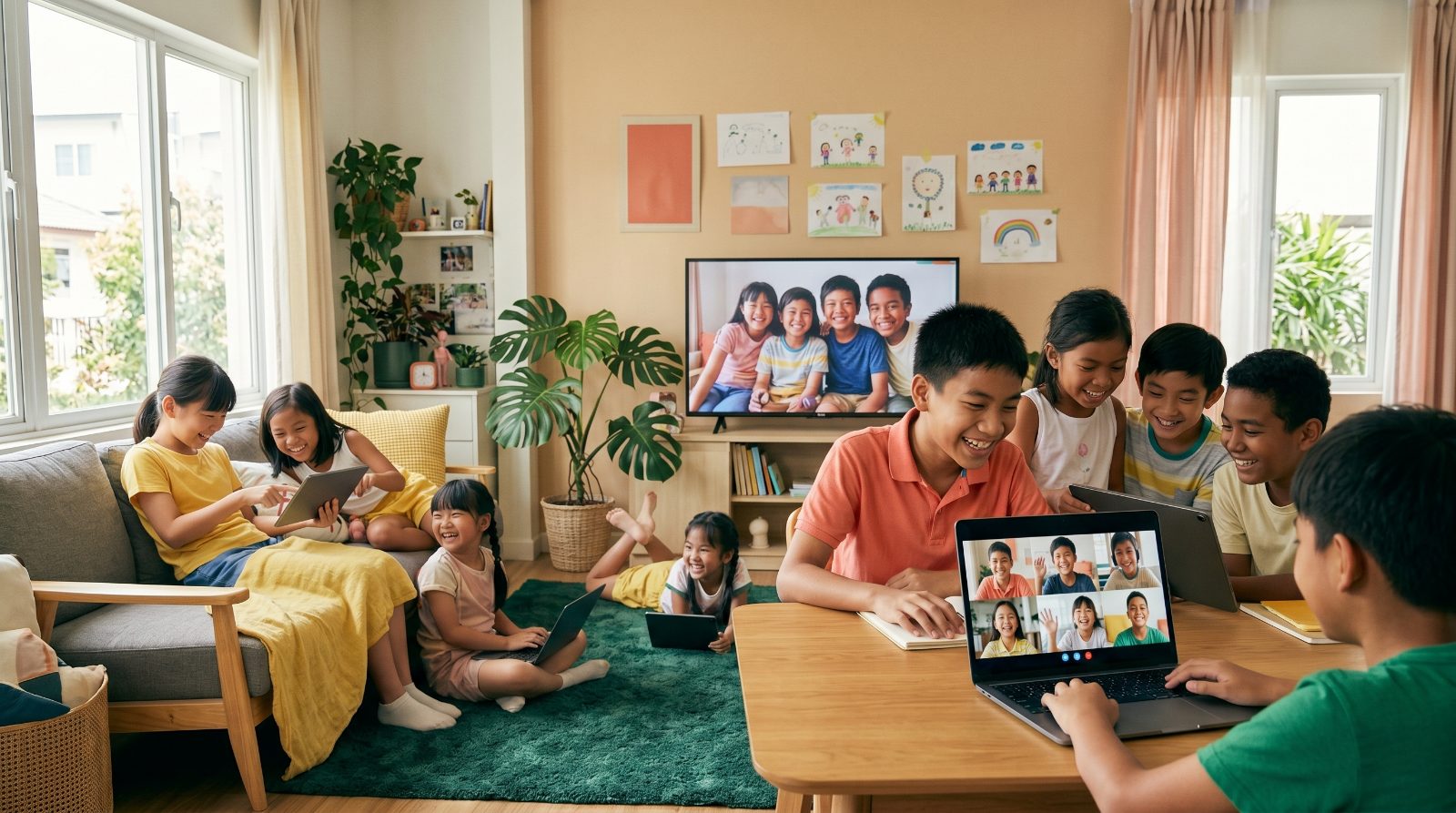
The third route takes the commute out of the equation. Some families keep their child enrolled at the local public school and study subjects in English online after school or at weekends; others make an online international school the centre of learning instead. In a prefecture like Tochigi, where there is often simply no reachable school nearby, this has quietly become the most realistic third path. More on that below.
Comparing the options: what actually fits your family
Tochigi’s full-time schools, schools in neighbouring prefectures, and online international schools are not ranked best to worst — they fit different constraints. Lay them against five criteria and the decision gets much clearer: affordability, ease of admission, commute burden, in-person campus experience, and whether the path can continue through high school.
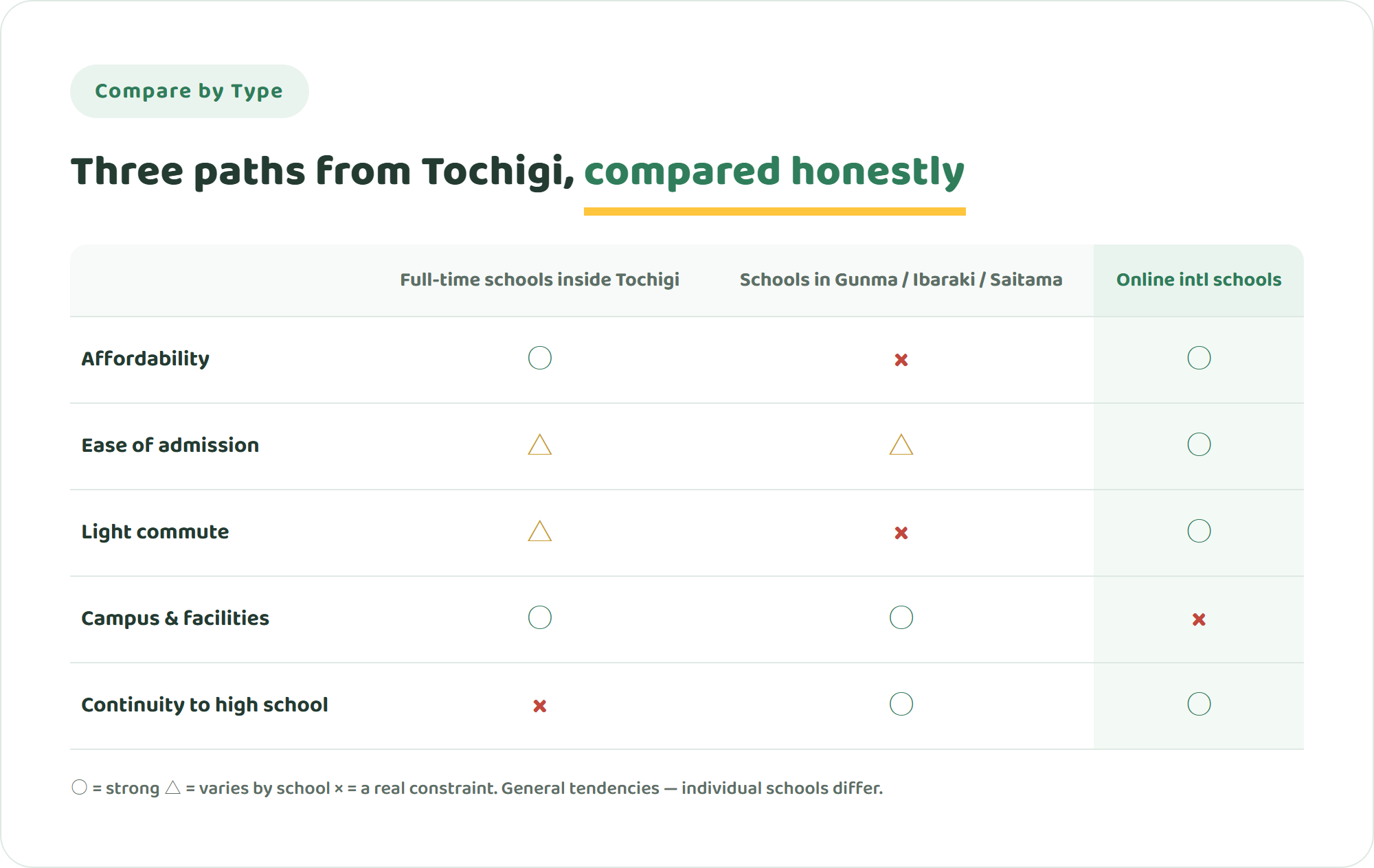
In Tochigi, the row that catches most families is the last one. SANO International School, the only English-medium option in the prefecture, ends at Grade 9 — meaning that at high school age you will be choosing again, either outside Tochigi or in a different format entirely. GKA and TIS do continue to graduation, but fees rise into the ¥1.3–1.6 million range and the commute gets heavier. If you want the cost picture in more detail, our breakdown of what international school actually costs covers the fees beyond tuition that catch families out.
See how learning works online →
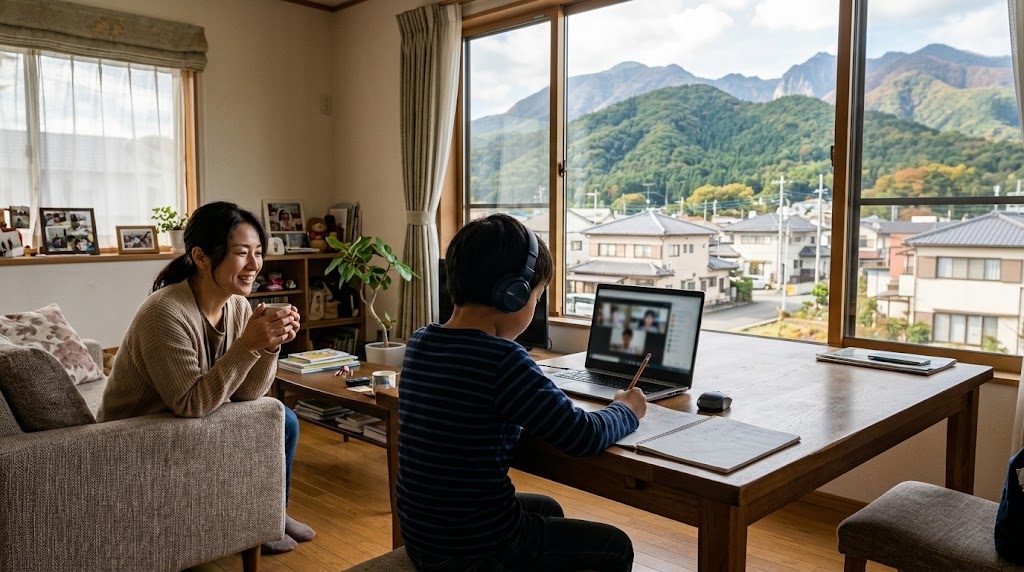
When nothing is within reach — the online option
Some readers will finish the list above thinking: there is no school here that continues, and a daily trip to Ota, Tsukuba or Tokyo is not workable. That is precisely the family NIJIN GLOBAL ACADEMY (NGA) is being built for. We are an online international school opening in September 2027.
NGA is run by NIJIN Inc., the Japanese company behind NIJIN Academy, an alternative school with over 1,000 students enrolled. What we care about is moving away from ranking children by test scores. Learning happens in small, dialogue-centred groups, built around a simple aim: helping children come to like themselves and the world. We serve ages 6 to 18 across Asia and Oceania, and because location is irrelevant, a family in Utsunomiya, Nikko or Nasu has exactly the same access as one in a major city. Japanese-language support underpins the programme so children can move into English gradually. Our goal is to make tuition roughly one-fifth of a bricks-and-mortar international school.
The honest caveats: we have not opened yet, so our track record is still ahead of us. And an online school cannot reproduce a playground, a school field, or the feeling of sitting shoulder to shoulder in the same room. Even so, for a good number of Tochigi families, this is what turns “there is nothing near us, so we will give up” into “we do not need to get there at all”.
Frequently asked questions
Q. Can families anywhere in Tochigi reach these schools?
A. Not evenly, unfortunately. The two full-time schools sit in Sano and Utsunomiya, and the preschools cluster in Utsunomiya, Oyama, Ashikaga, Nasushiobara and Kaminokawa. From Nikko, Tochigi City, Moka, Otawara or Nasukarasuyama, even an in-prefecture school typically means around an hour each way. Map the actual route and travel time first, then ask whether your family can sustain that every morning for six years.
Q. Do families commute from Tochigi to schools in Gunma, Ibaraki or Saitama?
A. In some areas, yes. From Ashikaga and Sano, Ota Station is only about ten minutes on the Tobu Isesaki Line, which puts Gunma Kokusai Academy well inside a realistic commuting range. Oyama to Omiya is 17 minutes by Shinkansen, and Utsunomiya to Tokyo about 50 minutes, so on time alone an out-of-prefecture commute is not impossible. But school bus coverage varies enormously between schools, and Shinkansen season tickets are a substantial annual cost. Check both the bus routes and the fares before you shortlist.
Q. What about Japanese-language support?
A. It depends on the school. SANO International School continues Japanese-language instruction through Grade 8, while some environments are almost entirely English. Many parents worry their child will end up strong in neither language. Whatever you choose, put “how is Japanese maintained?” on your list of questions at every school visit, and ask to see the actual weekly timetable rather than the brochure description.
Choose what you can sustain, not just what you can reach
Finding an international school in Tochigi Prefecture is genuinely hard. Two full-time schools, no IB authorised school, and depending on where you live, the answer may not lie inside the prefecture at all. But that is not the same as saying international education is out of reach for your child. There are four routes here, not one: a school in Tochigi, a commute into a neighbouring prefecture, a Japanese private school with a strong English or inquiry programme, or learning online.
The better question is not which school will accept your child, but which kind of learning your family can keep going for years. There is no need to rush. Start today by checking one commute route. Even that will change how the map looks.
International School Guides for Other Prefectures
- International Schools in Kanagawa Prefecture
- International Schools in Chiba Prefecture
- International Schools in Saitama: All 34 Listed
- International Schools in Ibaraki Prefecture
- International Schools in Gunma Prefecture
- International Schools in Hokkaido Prefecture
- International Schools in Aichi Prefecture
- International Schools in Tokushima Prefecture
- International Schools in Tottori Prefecture
- International Schools in Toyama Prefecture
- International Schools in Wakayama Prefecture
- International Schools in Yamagata Prefecture
- International Schools in Yamaguchi Prefecture
- International Schools in Yamanashi Prefecture
- Browse all 47 prefectures of Japan