If you searched for the pros and cons of international school, you are probably not looking for a reason to say no. More likely, you want the whole picture — the glossy brochures already sold you on the upside, and now you want the honest downside before you commit real money and real years of your child’s life. That caution is not cynicism. It is exactly the mindset that leads to a choice you won’t regret.
This article weighs international school fairly, the way families who actually chose one talk about it in hindsight. No naming and shaming of specific schools, no fear-mongering — just the genuine pros, the real cons weighed by age, who it fits and who it doesn’t, and the question underneath it all: is it worth it for your child? We’ll draw on the Asian context too — Singapore, Malaysia, the Philippines — where the local-versus-international debate is especially live. For the upside in full, our overview of what an international school actually is lays out the benefits.

The pros of international school (kept honest)
Let’s give the upside its due, because the cons only matter relative to it. International schools genuinely offer strong English immersion, globally recognized curricula (IB, British, American), small-to-mid class sizes at many schools, and a diverse, multicultural peer group. For internationally mobile families, they offer continuity: a child can move from Kuala Lumpur to Singapore to London and stay in a comparable system. And the pedagogy often prizes discussion, inquiry, and independent thinking over rote memorization — a real draw for parents disillusioned with high-pressure local exams.
These are not small benefits. For the right child and the right family, they can be transformative. The honest question is never “are these good things?” — they are. It’s “do they outweigh the costs, for us?”
The cons of international school, weighed fairly
Now the part the brochures skip. Most downsides are not about a “bad school” — they are trade-offs that hurt when they don’t match your family. Here are the ones families most often wish they’d weighed sooner.
1. The cost — and whether you can sustain it
Tuition is the headline con, but the real trap is the total. Published fee schedules and independent tuition surveys put top-tier annual tuition across Asian hubs like Singapore and Hong Kong in the range of roughly US$20,000–40,000 a year, rivaling Western private-school pricing — and that is before enrollment, facilities, materials, transport, and, at some schools, capital levies or building fund contributions and the cost of trips and sport. International schools also sit outside the national system, so public subsidies rarely apply. Always confirm the current figures against each school’s own fee table, since numbers shift by grade, school, and currency. The honest question is not “can we afford year one?” but “can we sustain year twelve, with annual increases?” If cost is your pressure point, our companion piece on whether international school is too expensive breaks the numbers down.
2. English may grow less than you expect
“Enroll and they’ll be fluent” has a catch. In schools with a high share of same-language local families, playground conversation can drift back to the home language, and English input falls short of the hope. Outcomes vary widely with the school’s native-speaker ratio and your support at home. Treat English as something the environment and family grow, not something enrollment automatically delivers.
3. The mother tongue can slip
Time spent in English is time not spent in the home language. Children can end up behind age level in reading and writing their mother tongue — and when neither language is fully strong (sometimes called being “in-between” in both), the foundation for abstract thinking wobbles, since deep reasoning tends to build on a secure first language. This worries parents most in the early years. The fix is deliberate home-language exposure and choosing a school that actively supports the mother tongue rather than sidelining it.
4. The exit — university eligibility and pathways
Because many international schools sit outside the national system, graduating does not automatically confer local qualifications. What matters is accreditation: a school accredited by a recognized body such as WASC, CIS, ACSI, or NEASC, and an IB-authorized diploma, generally map more cleanly onto university admission at home and abroad. Without that, families may need alternative routes — national high-school equivalency exams, or applying through overseas universities. More local universities now accept IB scores, but subjects and grading differ from the national curriculum, so eligibility varies by school, destination, and year. Left vague, this narrows options in the upper years. Our piece on whether international school is worth it for pathways digs into the exit in detail.
5. Children who don’t fit can get lost
A culture that rewards speaking up and presenting is a gift for outgoing children — and a strain for quiet or slow-to-warm ones. In larger settings, a struggling child can quietly slip through the cracks. “Not fitting” is a mismatch with the environment, not a flaw in the child. Ask concretely how a school supports children who fall behind before you assume yours will thrive.
6. Transferring back — or across — can be bumpy
Moving from an international school into a local system (or between British, American, and IB streams) often means reconciling different curricula and language expectations. Families who relocate underestimate this. Build a Plan B into your criteria: how hard is it to leave partway and re-enter another system?
7. The early years carry extra weight
Kindergarten and lower primary shape both language and self-esteem, and the fees start early and run long. Because parents decide before the child can, this is where later second-guessing concentrates. Before school age, weigh “can they feel safe and grow their mother tongue?” above “how early can English start?” Starting sooner is not always the shortcut it seems.
One more the brochures rarely mention: the load on parents. When newsletters, meetings, and homework support all run in English, parents need a working command of the language too — and volunteering, events, and fundraising can ask real time of the family. Dual-income households, in particular, are often surprised by how much parental presence is expected. Worth asking about on a visit.
Cons by age — preschool, primary, and secondary
The same school produces different downsides depending on your child’s age. Here is how the cons shift across the stages, so you can weigh the ones that actually apply to you.
Preschool and kindergarten
The core risk here is entering an English environment before the mother tongue has taken root. Immersion sounds ideal, but with thin home-language support at this age, both languages can stay shallow — the “in-between” outcome. Fees also start high for what is still pre-academic learning, and overstretching the budget now can mean you can’t sustain the years that matter most later. Before school age, prioritize feeling safe and growing the home language over starting English as early as possible.
Primary years
Primary is when literacy in the home language becomes serious. An English-dominant day can leave a child behind local peers in home-language reading and writing, making any later transfer into the national system harder. With instruction in English, parents who can’t easily support the work feel the strain too. The fix: reinforce home-language literacy deliberately (at home or a supplementary school), and decide early, as a family, whether you’re keeping a foot in the local system or committing to an international pathway.
Secondary years
The older the child, the closer the pathway reality. National-exam entry, IB, or overseas applications each demand different preparation, and transferring gets harder just as the stakes rise. Confirm accreditation and IB status, look hard at where graduates actually landed, and choose by working backward from the exit — keeping both local qualifications and overseas options in view.
Why these cons happen — the structure underneath
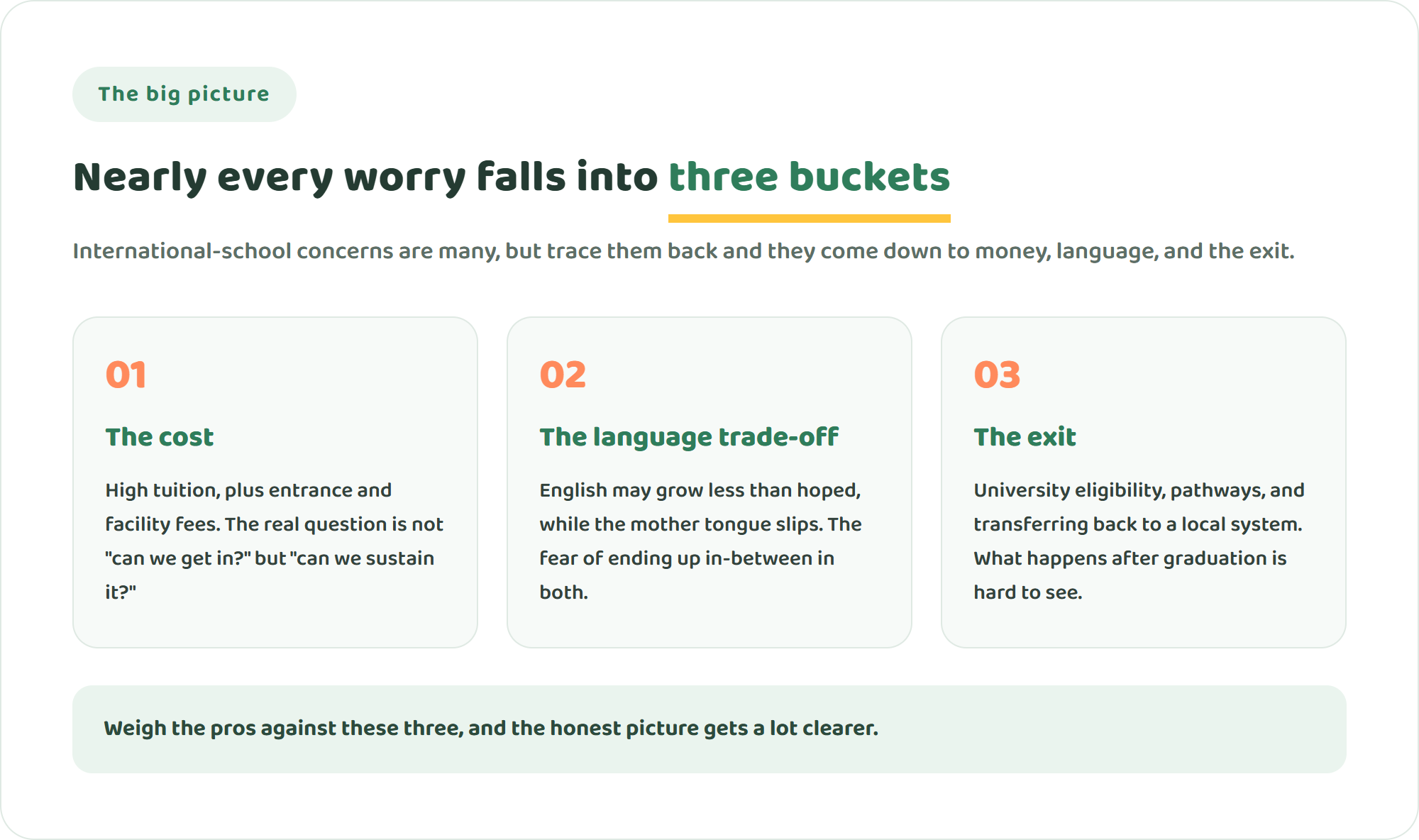
Seven downsides sound like a lot, but as 脱偏差値のオンラインインターナショナルスクール NIJIN GLOBAL ACADEMY frames it, they collapse into three: money, language, and the exit. Cost is structurally high because small classes, native-speaker staff, and international curricula are expensive to run. Language turns in-between because limited hours get split between English and the mother tongue. The exit feels risky because the join between national systems and international curricula differs school by school. Crucially, how these weaknesses show up depends on the type of school.
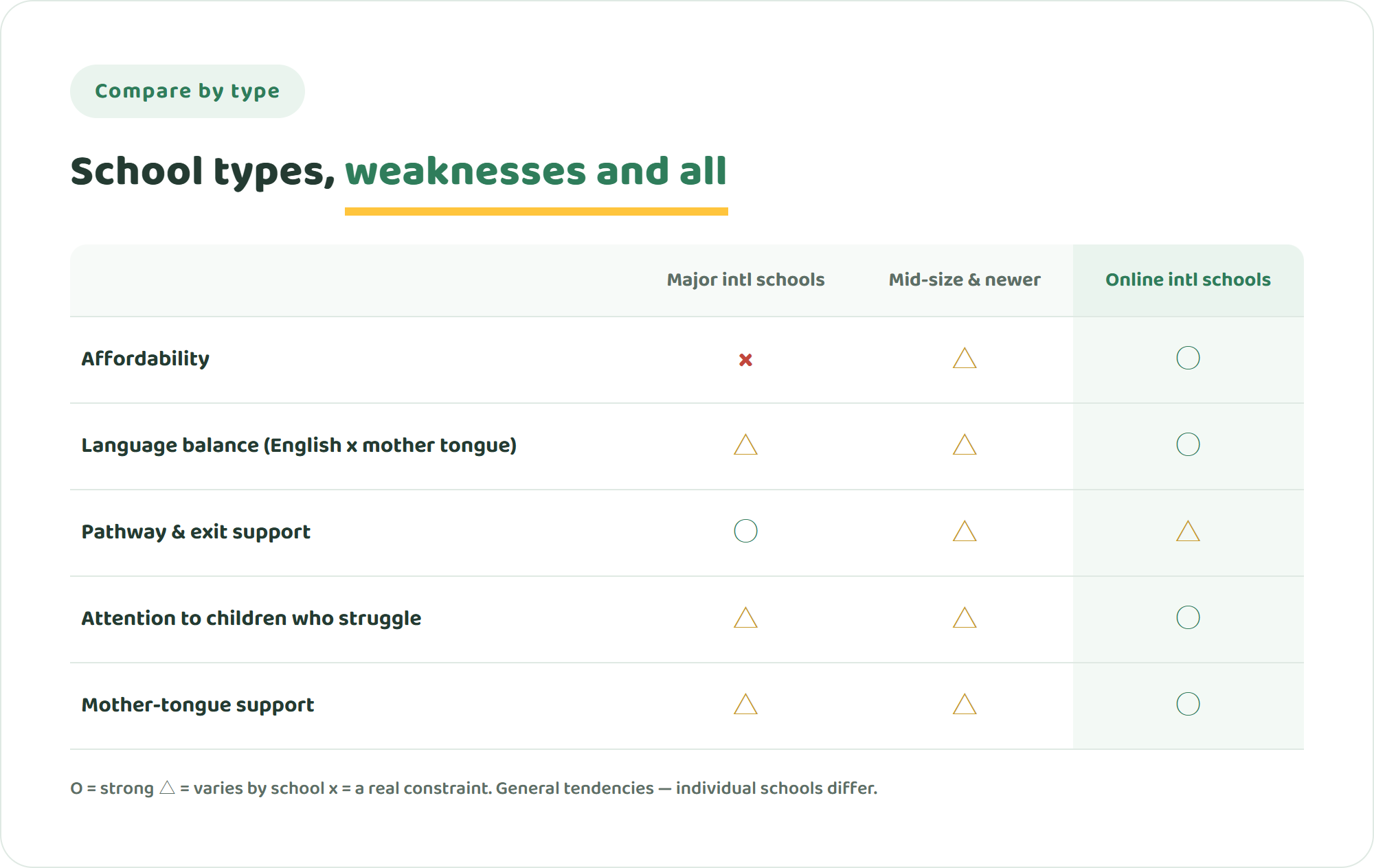
Major schools tend to be strong on pathways but steep on cost; mid-size and newer schools are balanced but harder to read on track record; online international schools help on affordability and mother-tongue support while their pathway record is still being built. There is no single “right” type — only the question of which type’s weaknesses your family can live with.
A no-regret way to weigh it (3 steps)
This is the practical heart of the article. Decide on the pros alone and regret tends to follow; fold in the cons first and the post-enrollment “this isn’t what we pictured” shrinks dramatically. Order matters, so here it is in three steps.
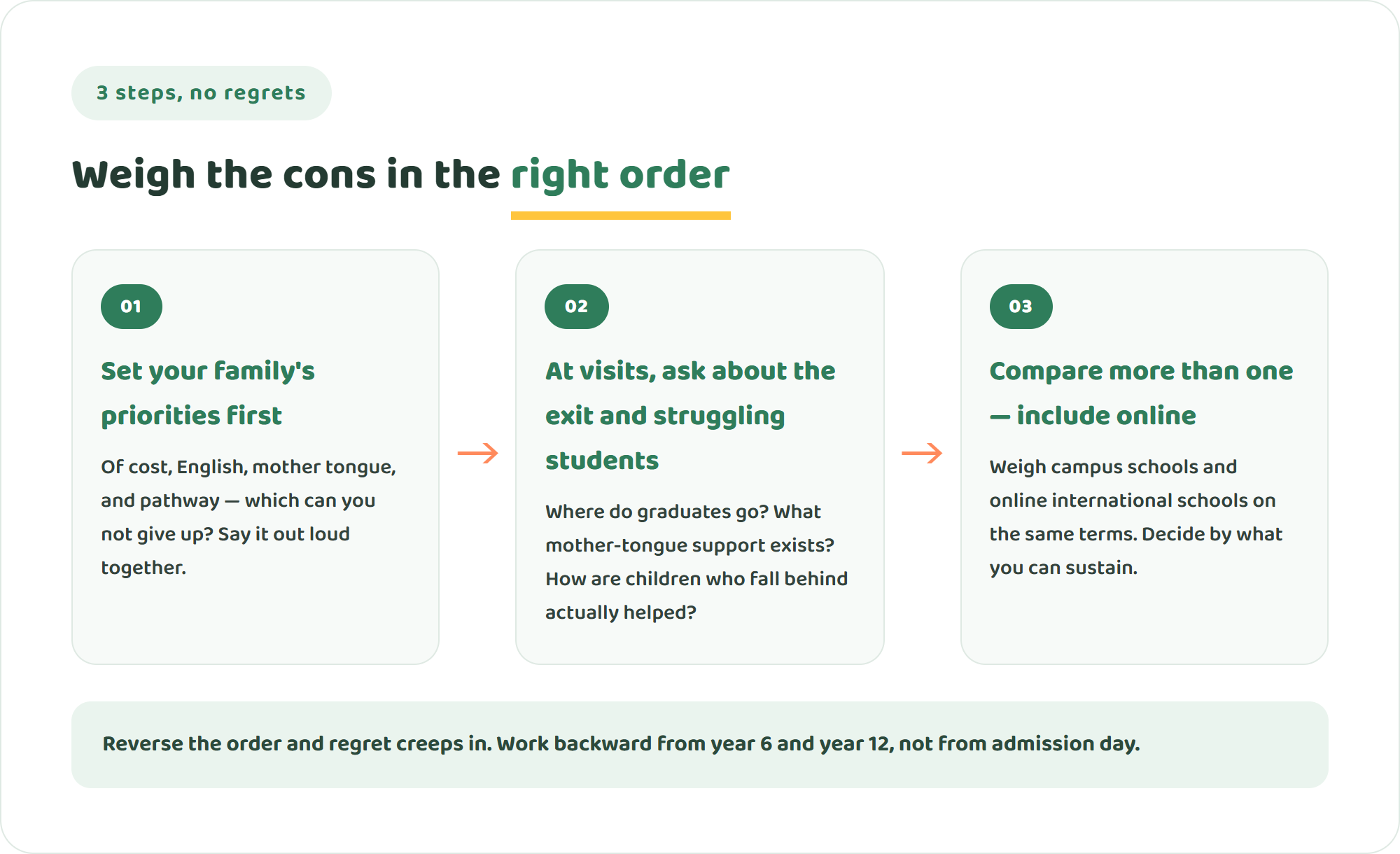
Step 1: set your family’s priorities first. Of cost, English, mother tongue, and pathway, which can you not give up? No school scores full marks on all four, so naming your axis keeps the brochure’s shine from steering you. Step 2: at visits, ask about the exit and struggling students. Where did graduates actually go? What mother-tongue support exists? How, concretely, is a child who falls behind helped? Reviews won’t tell you — ask in your own words. Step 3: compare more than one, including online. Put campus schools and online international schools on the same terms, and decide by what you can genuinely sustain.

Weighing pros against cons: who it fits, who it doesn’t
Look only at the cons and every option looks like a “no.” The real task is to put the pros and cons on the same scale and ask which weighs more for your family. The strengths — genuine English immersion, inquiry-led learning, a diverse peer group, globally-facing pathways — are real. The question isn’t whether they’re good, but whether, given your circumstances, they outweigh the weak spots.
International school tends to fit families who can sustain the cost over the long run, keep the mother tongue alive at home, are genuinely open to overseas or global pathways, and have a child who enjoys self-expression and new environments. It calls for more caution when the budget is a stretch year on year, when the plan centers on the local system and national exams, when there’s little bandwidth to support the home language, or when the child is easily overwhelmed by large, high-assertion rooms. Neither profile is “wrong” — the cons simply land differently. And even if a campus school doesn’t fit, the next option may bridge the gap.
A third option — softening the cons by design
Weighed inside the campus-only frame, money, language, and the exit tend to become a trade-off where you sacrifice one for another. So, not as a hard sell but as one more option worth weighing, here is where we sit. NIJIN GLOBAL ACADEMY (NGA) is a de-emphasized-ranking online international school opening in September 2027, run by NIJIN Inc. Its Japan-based alternative school, NIJIN Academy, already serves over 1,000 children.
Laid against the cons one by one: on cost, having no campus lets us aim for roughly a fifth of typical in-person international tuition. On language, the design respects the mother tongue rather than going English-only, easing the in-between worry. For children who don’t fit a large room, small-group learning that starts from “what do you think?” keeps them from getting lost. On the exit, we help map each child’s pathway without leaning on rankings. It is not a cure-all — campus life and in-person facilities are real things online can’t fully replace — so weigh it fairly against the rest, and choose it only if it fits your child.
Frequently asked questions
Is international school actually worth it?
It depends on fit. For the right child and family the value is real; for others the cost, language trade-off, or pathway risk outweighs it. “Worth it” is not a property of the school — it’s whether that school’s weaknesses are ones your family can carry.
Are there only disadvantages, or are there real benefits too?
There are real benefits: genuine English immersion, inquiry- and discussion-led learning, a diverse peer group, and globally-facing pathways. This article dwells on the downsides because the upside gets marketed while the cons tend to surface only after enrolling. Read the pros in our overview of what an international school is and weigh both sides together.
Is international school better than local school?
Neither is universally better. In Singapore and Malaysia, strong local and international systems each suit different goals: international for global mobility and English immersion, local for national qualifications, cost, and mother-tongue depth. Match the choice to your priorities, not to prestige.
Will my child lose their mother tongue?
It can happen if the home language isn’t actively supported. The fix is choosing a school that backs the mother tongue and reinforcing it at home. Aim to grow both languages rather than trading one for the other.
What if my child struggles or doesn’t fit?
Ask, before enrolling, exactly how a school supports children who fall behind — small-group attention, counseling, extra help. Fit is a mismatch with the environment, not a flaw in the child, and smaller settings usually catch a struggling learner sooner.
Knowing the cons is how you protect your child.
Weighing the downsides doesn’t make you a pessimist — it makes you a careful parent. Wanting to see both the light and the shadow before deciding is exactly what leads to a choice you can stand behind years later. Every school has weak spots. Rather than hunting for a flawless one, choose the school whose weaknesses fit your family’s priorities. That is the most realistic — and most protective — way to choose.
NIJIN GLOBAL ACADEMY opens in September 2027. We’ll share how the learning works — beyond rankings, affordable, small-group dialogue that connects children to the world — and first-intake news, straight to your inbox. Having been honest about the cons too, we’d be glad to be one of the options you weigh.
Honest Answers to Your Worries — related reading
- Will My Child Lose Their Mother Tongue?
- Disadvantages of Bilingualism in Childhood: Myths vs Research
- Who Regrets International School — and Who Doesn’t
- International School Special Needs: What to Look For
- International School vs Local School: How to Decide
- Does International School Hurt Your Child’s Home Language?
- When Your Child Is Struggling at International School
- Do International Schools Make Children Fluent in English?
- Is International School Worth It? What Happens to Graduates
- Should I Send My Child to International School?
- Transfer From a Local School to an International School
- Disadvantages of Early English Education: What Research Says
- What Happens to International School Graduates