“We’d love our child at an on-campus international school, but the tuition is just too heavy.” “If it costs this much every year, will we even be able to keep it up?” Standing in front of international school fees, many parents pause and wonder the same thing: aren’t there any subsidies or public support for this? If you searched for international school subsidies and landed here, you’re far from alone.
Here’s the honest headline: whether public support or free-education schemes apply to an international school depends heavily on how the school is accredited, where you live, and the year in question — and it’s not unusual for a school to fall outside them. That doesn’t mean giving up, though. This piece lays out how public support generally works, why international schools often aren’t covered, and — most usefully — realistic ways to lower the cost. Because eligibility and amounts vary by country, year and accreditation, always confirm the details with official sources at the end.

How international schools and “subsidies” actually relate
Start with the basics. In Japan, for example, free-education schemes and tuition-support programmes are designed around nationally recognised, standard schools — and both the schemes and who qualifies differ greatly from one country or region to the next. International schools frequently sit outside that category — accredited differently, or as a “miscellaneous” or private institution — which is exactly why they often fall outside public support. That’s a general tendency, not a rule. How a specific school is accredited, whether the stage is early years or upper secondary, and which local authority you’re under all change the picture, and exceptions exist. Rather than assuming “an international school is never eligible,” the surest path — however roundabout it looks — is to check your own case, one item at a time.
The kinds of public support worth checking
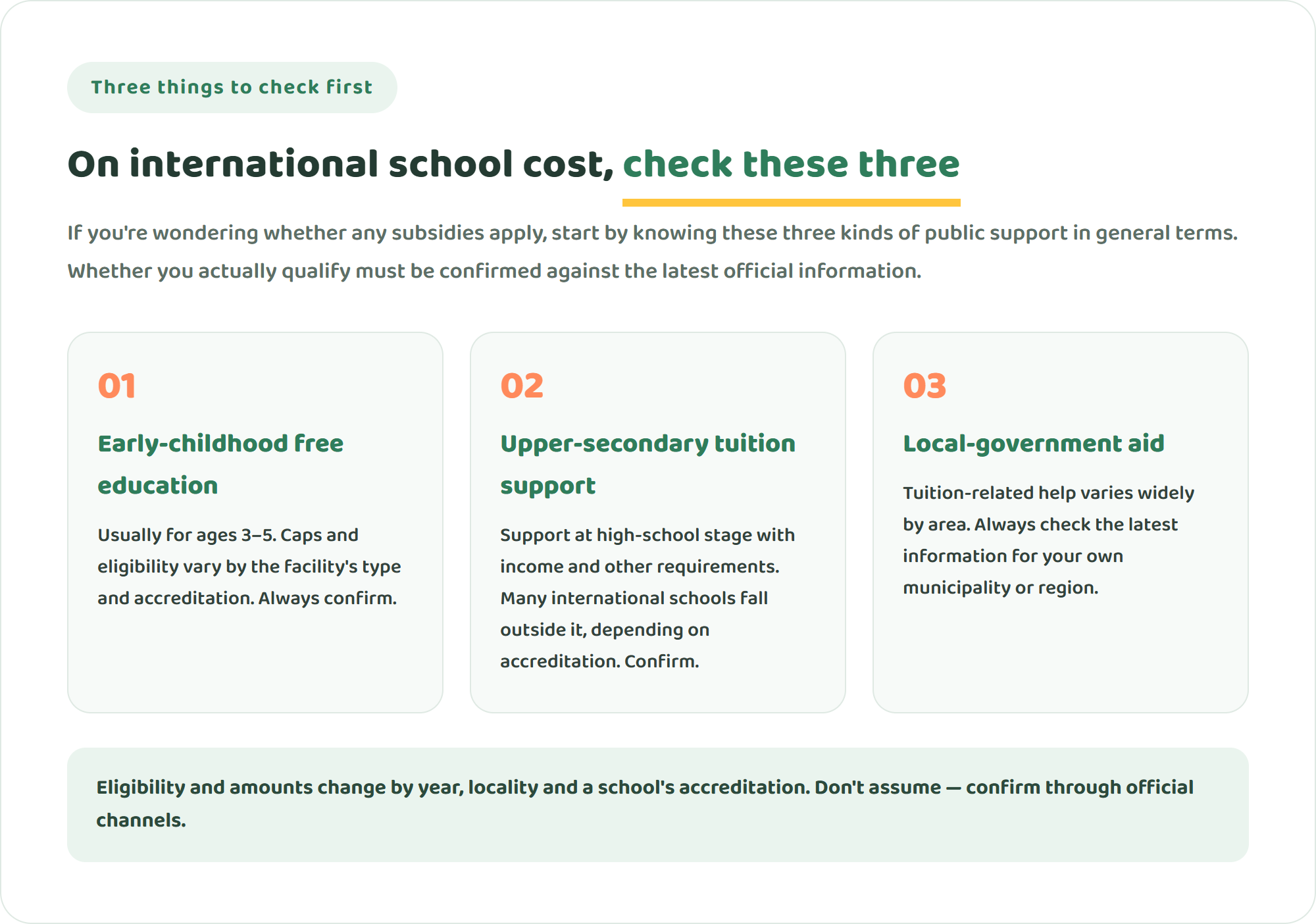
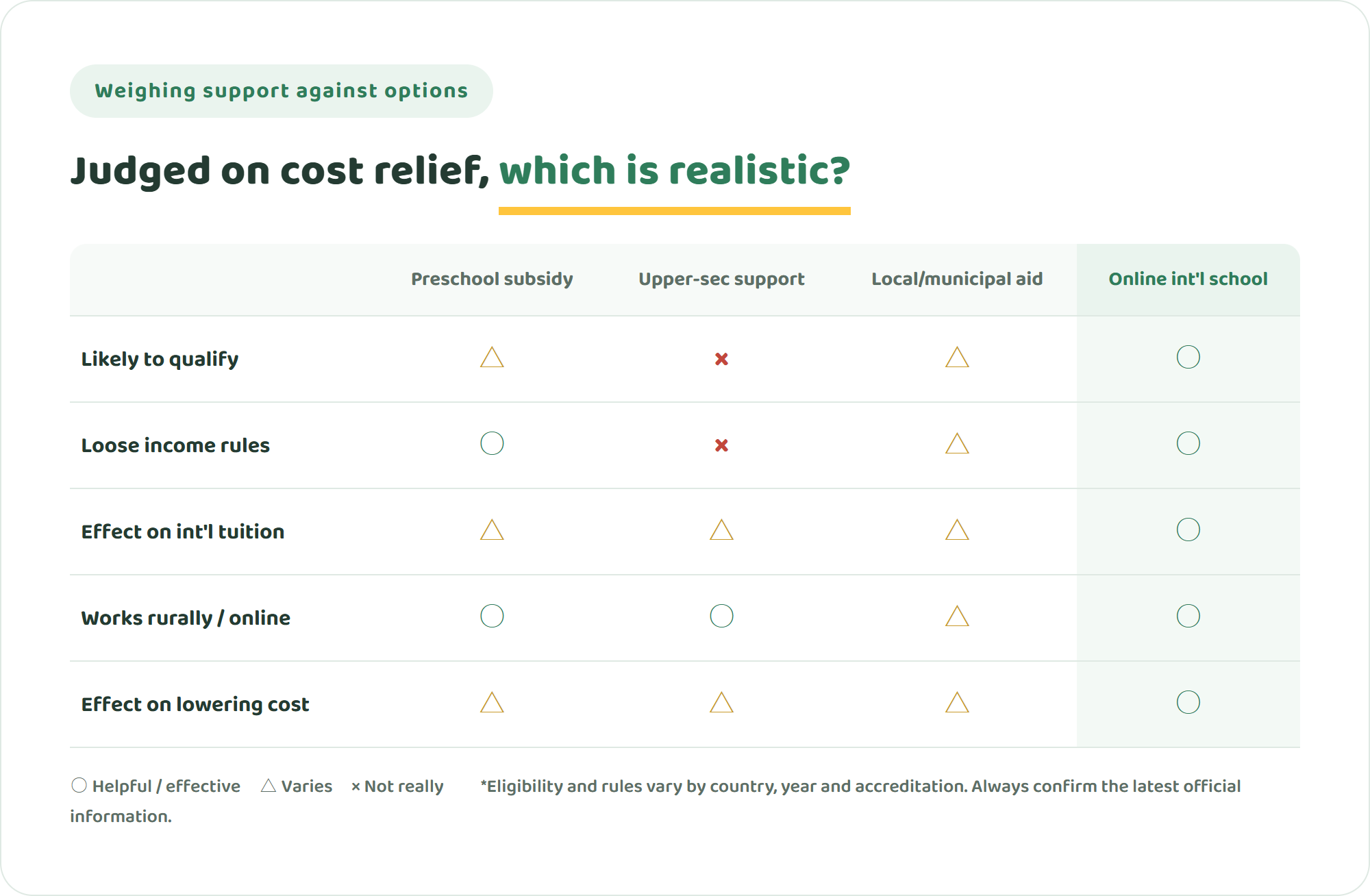
When people research international school subsidies, three kinds of public support tend to come up. Because whether you qualify varies by country, year, local authority and a school’s accreditation, we describe them only in general terms here. We won’t state amounts or a definite yes/no — please confirm the specifics through official channels.
1. Early-childhood free education or subsidies
Many countries offer some support for early-childhood education and care, typically around ages 3–5. Treatment usually differs by the type and accreditation of the facility, and non-accredited settings often come with caps or conditions. Whether an international school’s kindergarten or preschool section qualifies depends on how that facility is accredited, so it must be confirmed with the setting and your local authority. The safe reading: “part of the early years may be eligible, but nothing can be assumed.”
2. Upper-secondary tuition support
Support at the high-school stage typically comes with income and other requirements. The key point is that eligibility usually hinges on whether the school counts as a recognised upper-secondary institution. Because many international schools are accredited differently, there’s a general tendency for them to fall outside such support. Even so, treatment varies by accreditation, and some local authorities run their own arrangements. We won’t quote specific income thresholds here, so whether you qualify and meet the requirements must be confirmed against the latest official information.
3. Local or municipal tuition aid
Separately from national schemes, regional and municipal governments sometimes offer their own tuition help or grants. The defining feature here is that it varies enormously by area — a neighbouring district may have a scheme yours doesn’t. Whether it can be used for an international school again depends on the locality, and the contents are often revised year to year. The reliable move is to check the latest eligibility and conditions with your local education office or authority.
Why international schools can be “hard to cover”
As we’ve seen, the main reason an international school can be hard to cover is that many are accredited outside the standard, nationally recognised category. National free-education and tuition-support schemes are generally built around standard schools, so sitting outside that can mean sitting outside the support. On top of that, the available schemes differ by stage (early years versus upper secondary), and local differences pile on further. That’s why you shouldn’t decide on rumour alone that “it’s probably not eligible” — it’s essential to confirm the trio of your school, your locality, and that year together. For the wider picture, see How much is international school tuition? A breakdown of the yearly cost.
Realistic ways to lower the cost
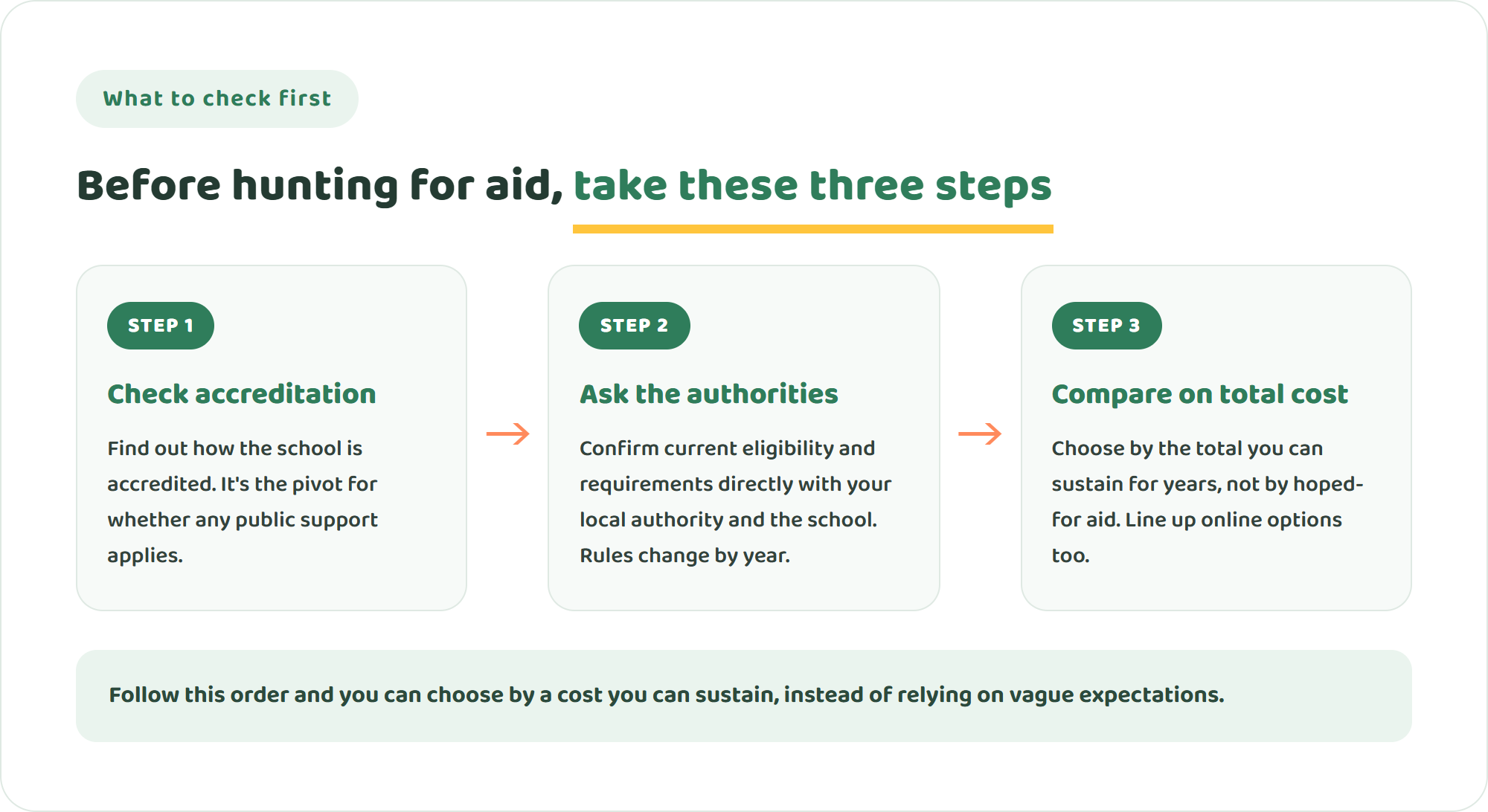
Even when public free-education is hard to lean on, there are ways to lighten the load. The key is to act on what you can confirm, in order, rather than relying on vague hopes. First, check how your school is accredited; next, ask your local authority and the school about current eligibility; and then compare options by “the total you can sustain for years,” not by hoped-for aid. That order looks roundabout but is the sure one.
On top of that, there are concrete ways to bring the cost itself down. First, choose online international education rather than an on-campus school — with no campus or commuting costs, it’s structurally easier to keep the price below an on-campus international school. Second, check each school’s own arrangements, such as sibling discounts or early enrolment. Third, set priorities on “what to spend on” — rather than meeting every need through an on-campus school, a realistic mix is to cover English or global exchange online. Learning can’t continue if the burden can’t. Choosing by “can we keep it up?” rather than “can we get in?” is what keeps you from taking the long way round.
See how online learning works →

Another path — a within-reach online international school
For families who can’t lean on public free-education, there’s a third path: choosing learning whose tuition is kept within reach in the first place. Our NIJIN GLOBAL ACADEMY (NGA) is an online international school beyond the exam race, opening in September 2027, operated by NIJIN Inc. NIJIN Academy, the alternative school we run in Japan, already has over 1000 children learning with us.
What NGA aims for is learning that doesn’t rank children by test scores, together with tuition within reach — around one-fifth of an on-campus international school. It’s a price band made possible precisely because it’s online, with no campus; children learn from wherever they live and connect with the world through small-group dialogue. “We weren’t eligible for any subsidy, and on-campus was too expensive to choose.” For exactly those families, we want to be a realistic other option. It isn’t a cure-all, of course — compare it fairly with public support and the other options, and choose it only when it feels right for your child.
Frequently asked questions
Are international schools eligible for free-education or tuition-support schemes?
It varies by how the school is accredited, the stage, and where you live. There’s a general tendency for many international schools to fall outside such schemes because they’re accredited differently, but exceptions exist and treatment is revised year to year. Nothing can be stated definitively, so always confirm with the school, your local authority, and the relevant official sources.
Can early-childhood free education be used for an international preschool?
It depends on the facility’s type and accreditation. Non-accredited settings often come with caps and conditions, and whether a given preschool qualifies must be checked with that setting and your local authority. Treat it as “part may be eligible, but nothing is certain,” and confirm the latest details with the facility and the authorities.
If no aid applies, are there ways to lower the cost?
Yes. Options include choosing online international education instead of an on-campus school, checking each school’s own arrangements such as sibling discounts or early enrolment, and setting priorities — covering English or global exchange online. Rather than starting from “which aid can we get,” comparing options by “the total you can sustain for years” tends to lead to a more manageable choice.
Beyond “aren’t there any subsidies?” — learning you can keep up.
The honest answer to “aren’t there any subsidies for an international school?” is that we can’t promise support will always apply. But if you check eligibility one item at a time, combine realistic ways to lower the cost, and choose by a total you can sustain, a path opens up. Eligibility and amounts change by country, year, locality and a school’s accreditation — so please make your final decision only after confirming the latest official information.
NIJIN GLOBAL ACADEMY opens in September 2027. We’ll share how our learning works — beyond the exam race, within-reach pricing, and connection with the world through small-group dialogue — along with first-cohort enrolment news, straight to your inbox. A global education, within reach for your child.
Get opening updates by email →
More on choosing an international education
- A Cheaper Alternative to a Singapore International School——Affordable online options
- Affordable International Schools in Bangkok——Fees, and an online alternative
- 10 Ways to Help Your Child Learn English at Home——What parents can do
- Online High School for Expat and Globally Mobile Families——Learning that moves with you
- How to Choose an International School——7 questions to ask before you enrol
- 6 International Qualifications You Can Earn Online——An honest guide
- When Your Child Does Not Want to Go to School——How to respond, and 5 real options
- How Much Household Income Do You Need for an International School?——Budgeting so it lasts
- What Is the International Baccalaureate?——IB vs Cambridge, honestly compared
- Starting International School in the Elementary Years——What changes, and what it costs