If your child has stopped wanting to go to school in Japan, two options tend to surface within the first hour of searching: a free school and a tsūshinsei kōkō, usually translated as a distance learning high school. They appear side by side in almost every guide, described in almost the same language — a place for children who cannot manage a mainstream classroom. So it is entirely reasonable to assume they are two flavours of the same thing, and that the job is to pick the better one.
Before anything else, then, the thing worth knowing. When you weigh a free school vs distance learning, the difference is not one of quality or teaching style. The two sit in completely different places in Japanese law. They serve different ages, they treat your child’s school registration differently, and they leave you holding different things at the end. This article draws that line first, compares the two honestly point by point, and then says plainly which families each one suits. It will not quote fee ranges. Costs vary so widely between providers that any average would mislead you.
Free school vs distance learning: one of them is a school, the other is not
Start with the outermost line. A distance learning high school in Japan is a fully accredited upper secondary school under the School Education Act. It sits alongside full-time and part-time courses as one of the recognised forms of high school, and a student who completes the required course receives a Japanese high school graduation qualification. There is no ambiguity here: it is a school, in the legal sense of the word.
A free school, by contrast, is not a school under that Act. It is a privately run space — a centre, a community, a place to be — operated by an NPO, a company or an individual, and it is not organised into a single legal framework at all. That is why no two are alike in philosophy, daily rhythm or staffing. And here is the part that matters most for planning: attending a free school does not itself produce any graduation qualification, because a free school is not a body that awards one. That is not a flaw. It is simply a different job.
The reason the two are so easily confused is that they are aimed at different ages. Children at free schools are mostly of primary and lower secondary age — in other words, they are in the compulsory education years. A distance learning high school, as the name says, is upper secondary, and is normally entered after lower secondary school has been completed. Two options answer the same worry, but they belong to different chapters of a child’s life. Of course they are hard to compare.
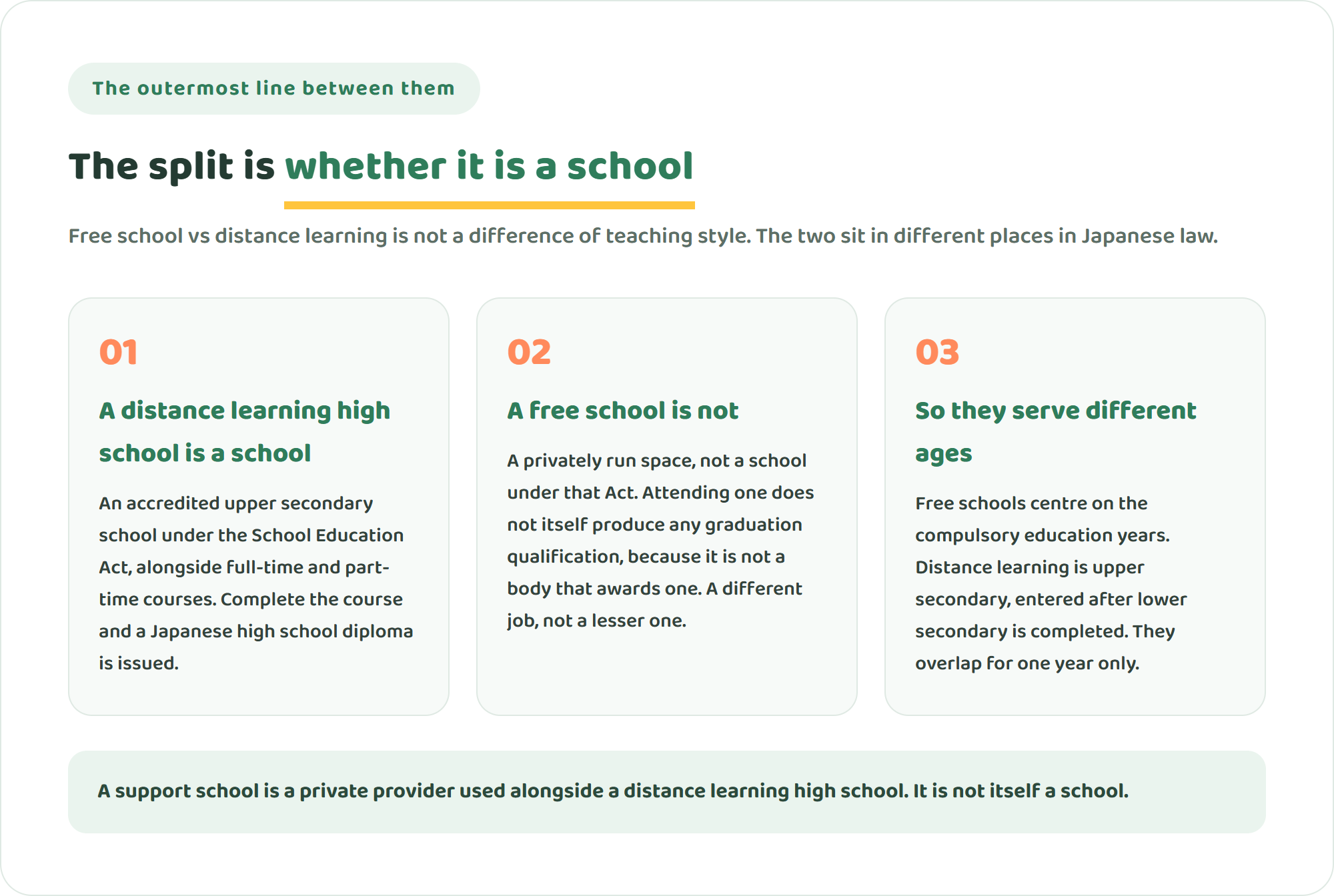
There is a third term that muddies the water further: the support school (sapōto-kō). These are private providers that help students keep up with the reports and scheduled attendance that a distance learning high school requires. A support school is not itself a school — the qualification is issued by the distance learning high school the student is enrolled in. So whenever you see the word in a brochure, ask directly which high school the enrolment actually sits with. Fees also work in two layers, one for the high school and one for the support school, so ask which of the two layers a quoted figure covers.
Comparing them properly: age, registration, qualification, learning, cost, destination
With the premise settled, here are the six angles that explain almost all of it. Age: free schools centre on the compulsory education years, though some accept high-school-aged students; distance learning is upper secondary. Registration and attendance: the decisive point during compulsory education, covered in detail below. Qualification: a high school diploma from one, none from the other. What the learning looks like: a distance learning high school follows the national upper secondary curriculum, while a free school’s programme is defined entirely by that provider’s philosophy. Cost and where it leads each get their own section.
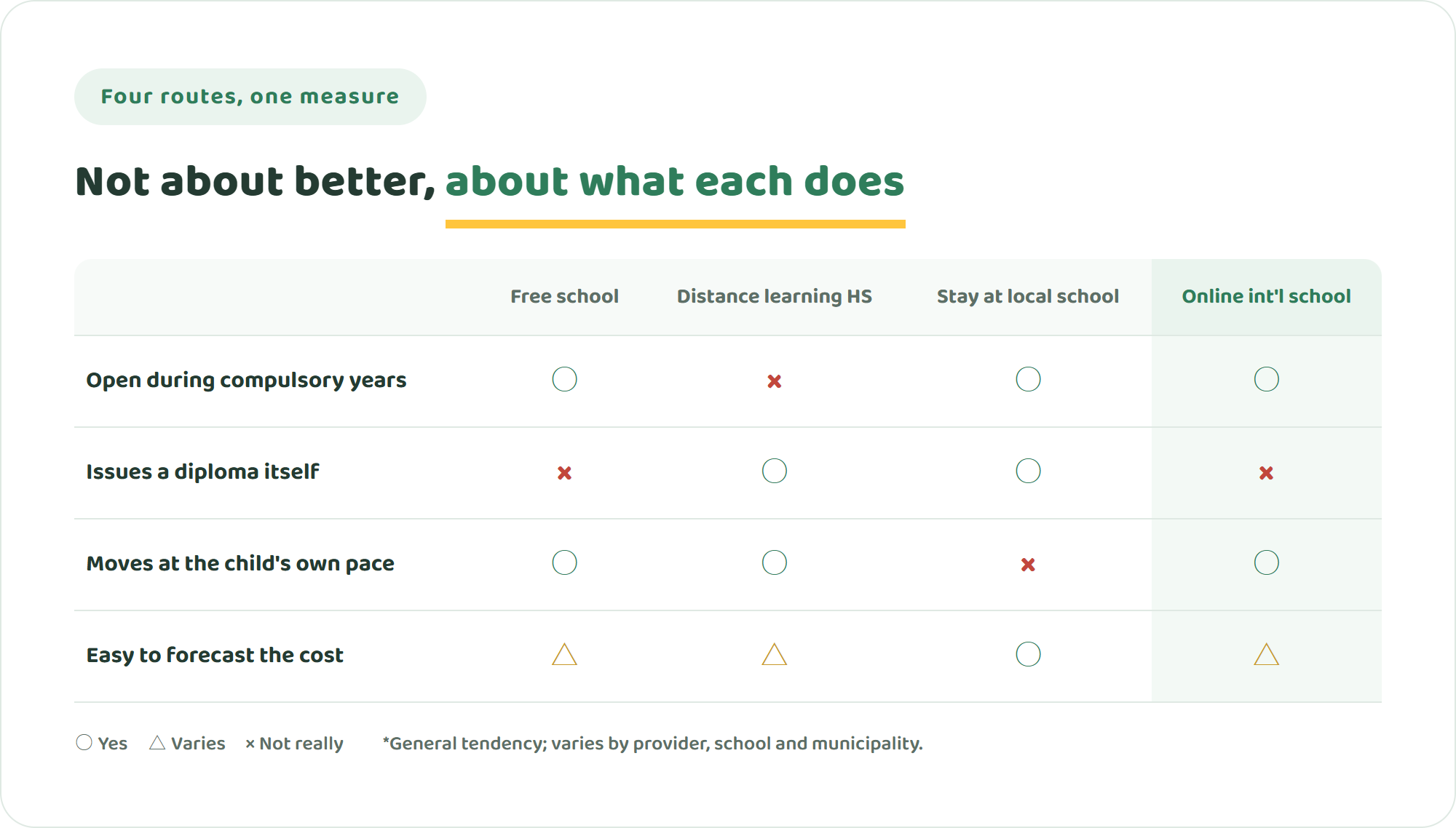
The registration point deserves more space. During the compulsory education years, a child attending a free school remains registered at their assigned local public school. Nothing transfers; the registration does not move the way it would in a school change. On top of that, where certain conditions are met, the principal may decide to record the child’s attendance at the free school as attendance on the official school record. This is an established practice based on guidance issued by Japan’s Ministry of Education, and some families do have it applied.
But this has to be said honestly. That judgement varies between municipalities and between schools. Two children attending in much the same way can be treated differently in different places. So please do not assume that how it went for someone else in a blog post is how it will go for you. There are exactly two people to ask: the leadership of your child’s registered school — not only the class teacher — and your municipal board of education. Ask them before you choose a provider, not after. Doing it in the other order is how families discover, weeks in, that the terms are not what they understood.
On cost, there is no standard rate to quote. Both free schools and distance learning high schools are run in such varied ways that an average figure would carry no information. We leave the numbers out not because we lack them, but because printing them would mislead you. What to do instead is simple: on every visit, ask what it comes to across a full year. Monthly figures quietly omit joining fees, materials, the travel and accommodation that scheduled attendance sessions can require, and the second layer of fees if a support school is involved. For a distance learning high school, ask the school directly whether it qualifies for Japan’s high school tuition support payment.
Which one suits which family
Read only the part that describes you.
Primary or lower secondary age, and what you need first is somewhere safe to be. Then a free school is the option on the table, and a distance learning high school is not — it belongs to a later stage. What matters at this point is usually not catching up academically but recovering a daily rhythm and the feeling that there is somewhere they are allowed to go. If the term itself is new to you, our guide to what an alternative school actually is covers how these places differ from one another.
Final year of lower secondary, with a decision to make. This is the one year in which the two genuinely overlap. A distance learning high school becomes a realistic destination after graduation, while a free school can carry the months that remain before it. The pressure to settle everything at once is intense, but the order is: first, how these last months are spent; second, which upper secondary course comes next. Trying to decide both in one conversation exhausts everyone.
Already left high school, or struggling to continue in one. This is distance learning territory. A free school will not issue the qualification, so if the diploma is what you need, the distance learning high school — with a support school alongside it if useful — is what to plan around.
Not unable to attend, but poorly matched to how school teaches. Where the difficulty is the pace of whole-class instruction or being ranked by test score rather than bullying or health, a change of location alone may not be enough. As we wrote in our piece on turning time away from school into real learning, what such a child often needs is both a place to rest and somewhere to keep moving forward.
See how learning works at NGA →
A third option — learning online, connected to the world
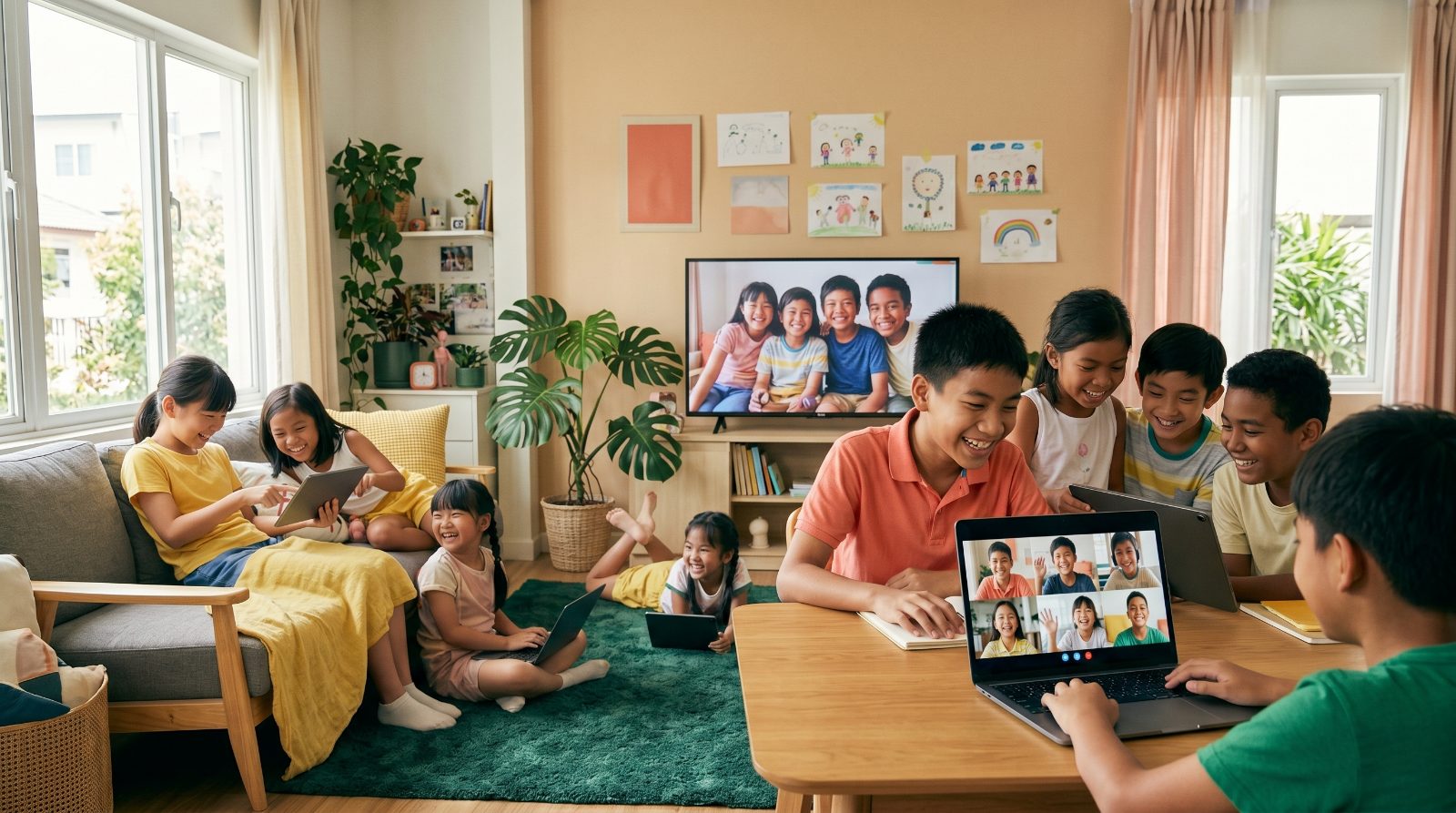
Having written a comparison of two things, we should admit that there are not only two. Here is our own position, stated plainly. NIJIN GLOBAL ACADEMY (NGA) is an online international school beyond the exam race, scheduled to open in September 2027, with pre-opening trial classes planned for April and May 2027. It is operated by NIJIN Inc., whose already-running sister school NIJIN Academy — an online free school for children not attending mainstream school — has over 900 children enrolled.
The caveats belong here rather than at the end. NGA is not an Article 1 school under Japanese law. A child in the compulsory education years therefore studies with us while remaining registered at their local public school — structurally the same arrangement as a free school, and whether the time counts as attendance rests with that school and the municipal board of education exactly as it does there. Nor do we issue a Japanese high school diploma. Those are real limitations, and we would rather you weighed them before anything else.
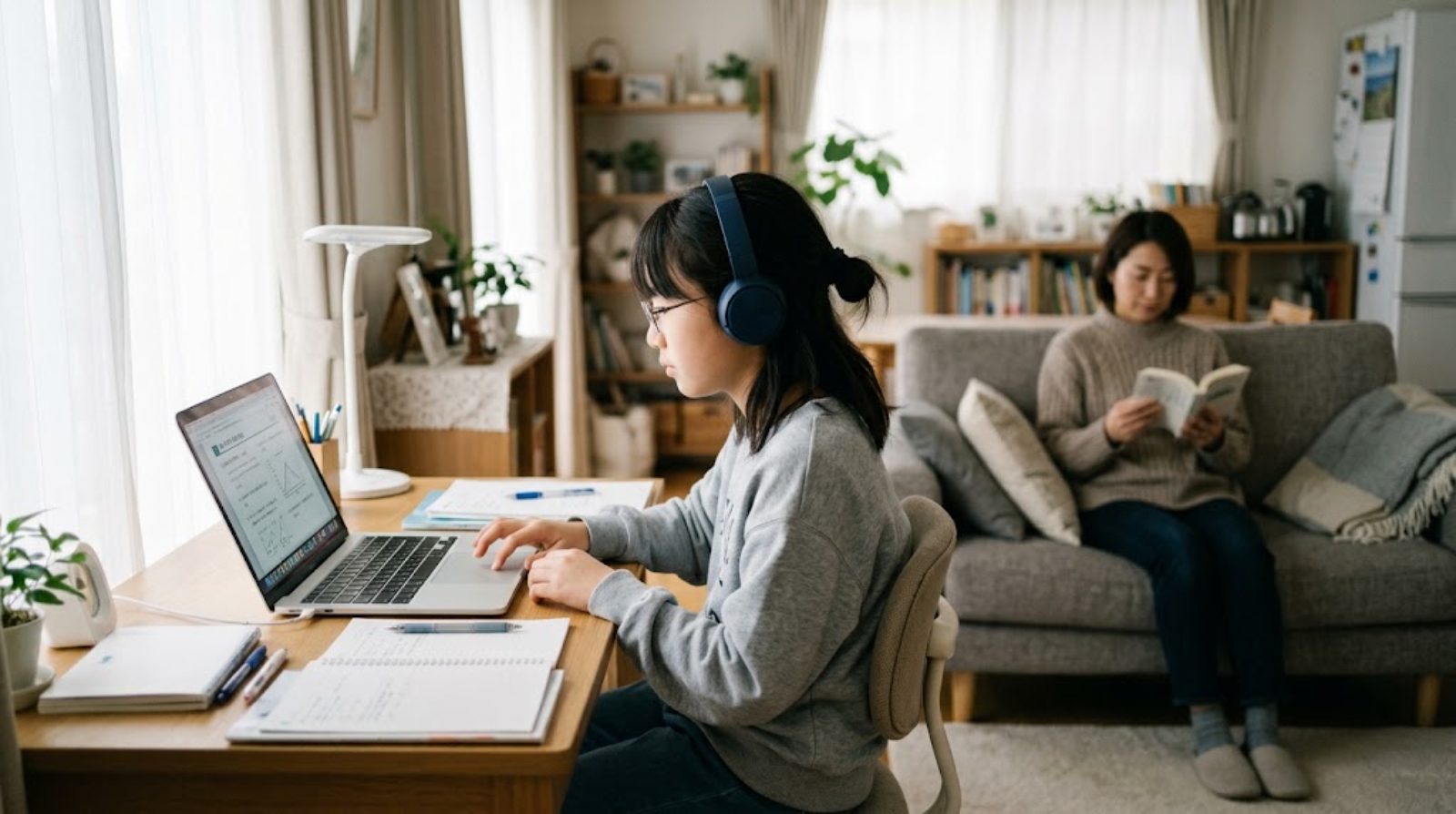
What online does suit is a child who finds leaving the house hard but still wants contact with people, and for whom English and a wider world restore some forward motion. What it does not suit is a period when rest is the priority; adding a learning environment then is simply another weight. Building a daily rhythm asks something of parents too. Compare us against the alternatives and choose us only if it genuinely fits.
Three steps when you cannot decide
When there is too much information to move, fixing the order of operations is usually faster than reading more. There are three.
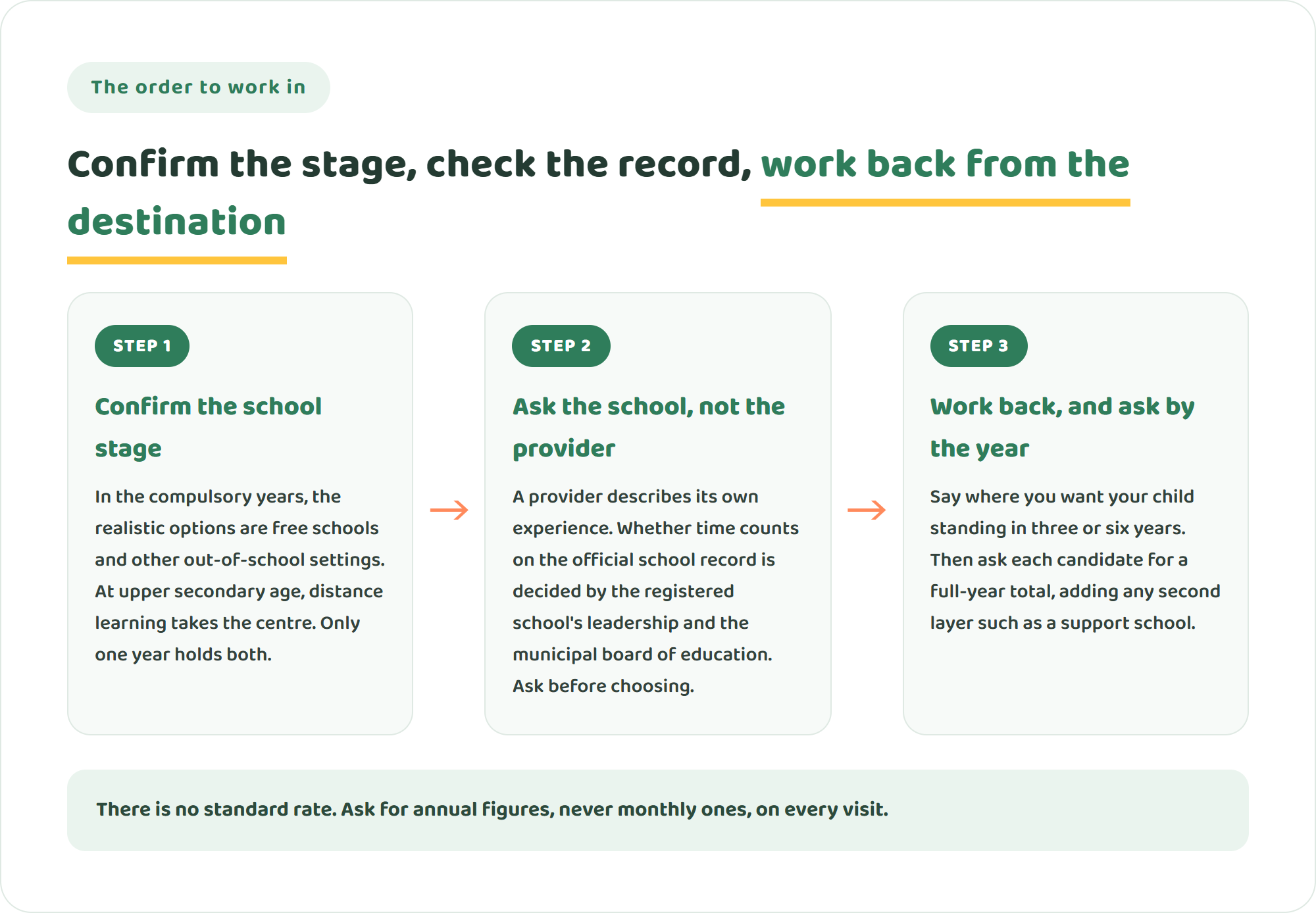
Step 1: confirm which school stage your child is in. It sounds too obvious to write down, and it resolves most of the confusion. In the compulsory years, today’s realistic options are free schools and other out-of-school learning environments. At upper secondary age, distance learning high schools take the centre. Only the final year of lower secondary requires holding both in mind at once. Naming your stage narrows both what to read and whom to ask.
Step 2: check registration and attendance with the school and the board of education, not the provider. A provider can only describe its own experience, which may not reflect how your municipality decides. Ask the leadership of the registered school and the municipal board directly: would attendance in this form be recorded on the official school record, and what documentation or contact would be required? Those two conversations beat any comparison site.
Step 3: work back from the destination, and ask for annual figures. Say out loud where you want your child to be standing in three or six years. Is a high school qualification required? Is recovery required first? Is the missing piece the feeling of learning something well again? Then ask every candidate for a full-year total, adding any second layer such as a support school. Monthly figures alone leave out too much to compare fairly.
Frequently asked questions
Does attending a free school count as school attendance in Japan?
It can. During the compulsory education years, where certain conditions are met, the principal may decide to record it as attendance on the official school record, following guidance issued by the Ministry of Education. It is not automatic, however, and the judgement differs between municipalities and schools. Ask both the leadership of your child’s registered school and your municipal board of education — including what records and contact they would expect — before you commit to a provider.
My child is in lower secondary. Can we move to a distance learning high school now?
A distance learning high school is an upper secondary school, so it is entered after lower secondary school is completed. What you can do meanwhile is attend information sessions to understand how the system works, and separately decide how the remaining months are spent. Keeping those two questions apart makes both of them lighter.
Which costs less, a free school or a distance learning high school?
There is no standard rate for either, so neither answer would be honest. Free schools differ enormously by how they are run, distance learning high schools set fees on different principles, and adding a support school changes the total again. Compare annual figures that include joining fees, materials, and the travel or accommodation that attendance sessions may require. For a distance learning high school, ask directly about eligibility for Japan’s high school tuition support payment.
Will attending a free school make high school entry harder later?
This cannot be generalised. Admissions to upper secondary school are handled by prefecture and by school, and how attendance records and school reports are weighted is not uniform. The reliable route is to ask the careers staff at your child’s registered lower secondary school, and to ask the high schools you are considering at their information sessions. Asking is faster and more accurate than continuing to guess.
Not to rank them, but to choose.
Most parents researching free school vs distance learning are not really trying to work out which is better. They are trying to work out where the next step is for this particular child. Knowing the legal line is not about narrowing your options; it is about not spending months agonising in the wrong place. If that line is clearer now than it was an hour ago, you have already moved.
NIJIN GLOBAL ACADEMY is scheduled to open in September 2027, with pre-opening trial classes planned for April and May 2027. We will send you news of our first cohort, along with how the learning works — small-group dialogue, a school without a campus, and a classroom connected to the world. Nothing needs deciding today. Just hold on to this: there is more than one road.