If you have spent any time looking for an online school your child could join from Asia, you have probably come across Pearson Online Academy. It is run by Pearson — the same name on a great many textbooks and English exams — and that familiarity is reassuring. Then you open the site. Everything is in English, the phone number is a US toll-free line, and the one thing you actually need is buried: what is Pearson Online Academy tuition for our child’s grade, and can we even enrol from here?
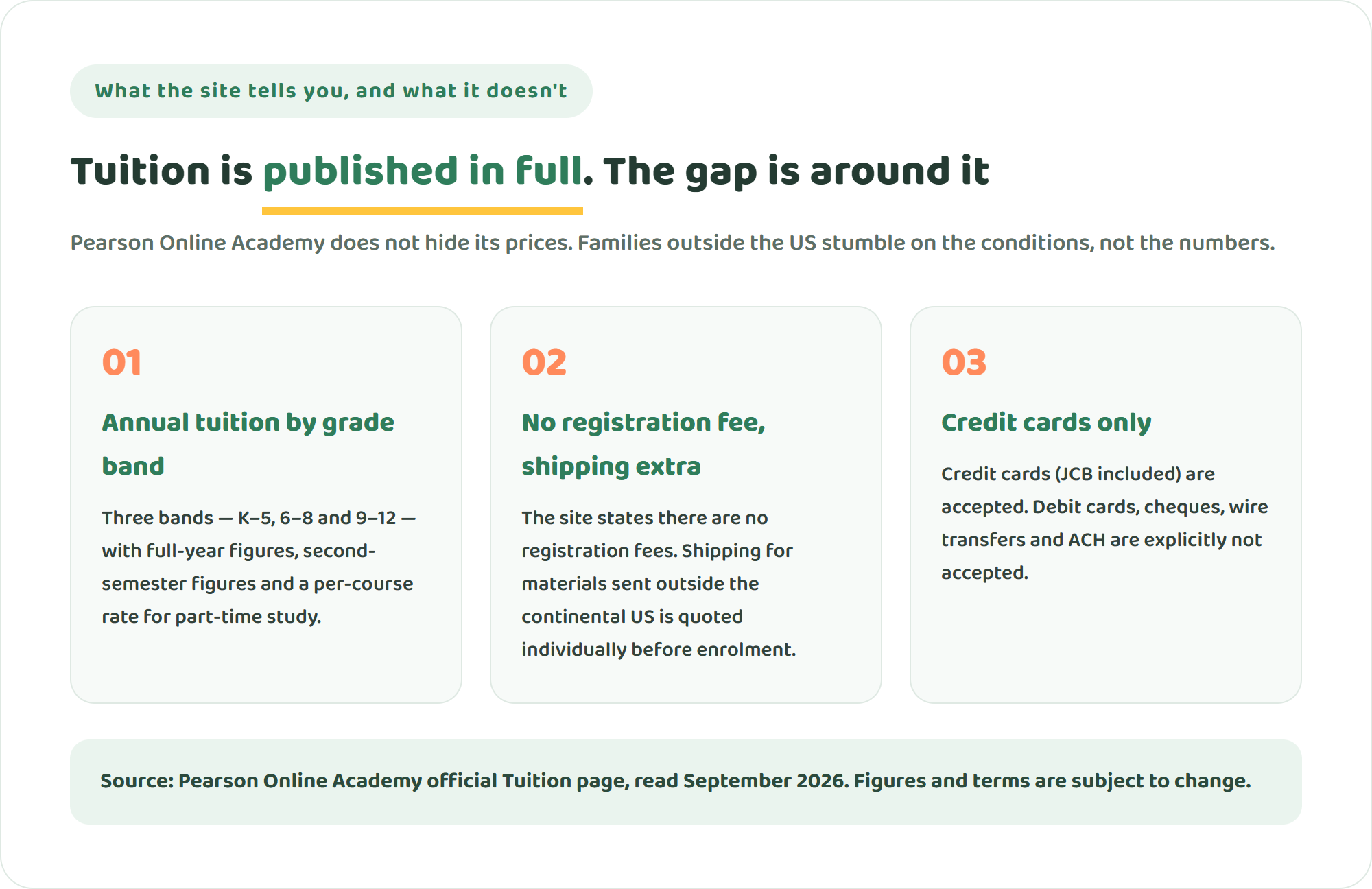
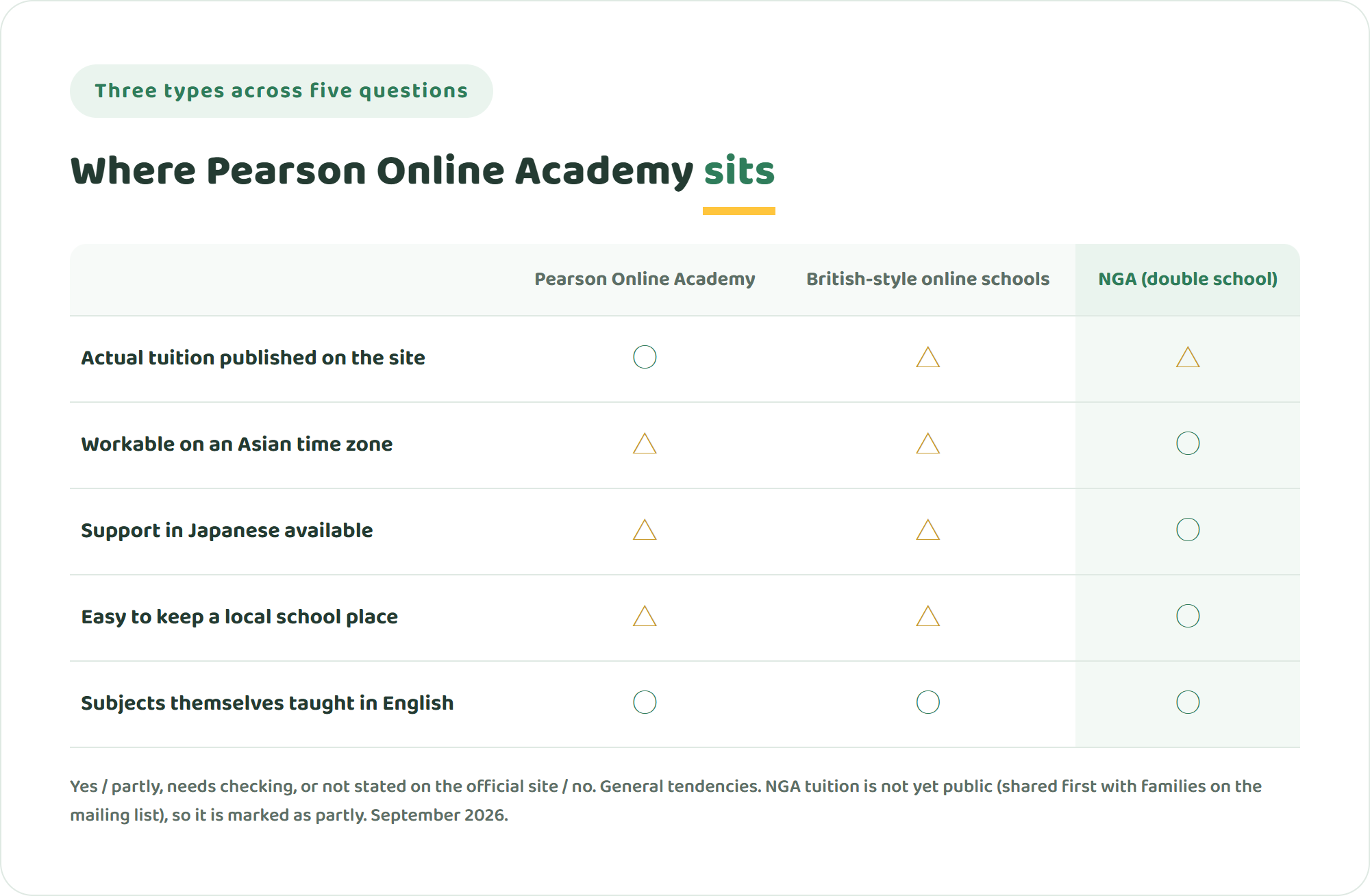
Here is the short answer. Pearson Online Academy publishes its tuition openly, with real figures, by grade band. That part is easy to find. What decides affordability for a family outside the United States is everything sitting around that table: shipping for physical materials, a payment rule that rules out bank transfers, and the time-zone question. This article works only from what the school itself publishes. Where the official pages are silent, it says so and tells you what to ask.

What Pearson Online Academy actually is
Pearson Online Academy is a private online school for kindergarten through grade 12, run by Pearson. The address on its site is Baltimore, Maryland, and the programme follows the American school model. That is the first real fork in the road: if you were comparing it with schools that lead to IGCSEs and A Levels, you are comparing two different systems, not two versions of the same one.
On accreditation, the site lists its accrediting bodies in the footer: the Southern Association of Colleges & Schools Council on Accreditation and School Improvement, the Northwest Accreditation Commission, the North Central Association Commission on Accreditation and School Improvement (NCA CASI), and the Middle States Association of Colleges & Schools. Write those names down — accreditation is what matters later, when a university asks what your child’s final credential is worth.
Learning happens inside the school’s own online classroom: a learning-management platform that holds the lessons, assignments, message boards and internal mail, with teachers working alongside students there. The site does not publish a live-class timetable. That is not a criticism — it is a gap, and since we will not guess at it, it becomes one of the four questions below.
Pearson Online Academy tuition is published, in dollars, by grade band
This is the most honest thing about the school. Where many online international schools stop at “contact us”, Pearson Online Academy puts the numbers on the page. As published in September 2026:
Full-time, full academic year (USD)
・Elementary, K–5: $5,450 (pay in full: $5,178)
・Middle, grades 6–8: $7,050 (pay in full: $6,698)
・High school, grades 9–12: $8,250 (pay in full: $7,838)
The middle and high school figures are noted as including the College and Career Readiness programme.
Starting in the second semester
・K–5: $3,050 ・6–8: $4,100 ・9–12: $4,850 (each with the same 5% pay-in-full saving)
Taking a single course (part-time)
・K–8 core and elective courses: $335 per course
・Grades 9–12, including credit recovery, Honors/AP and NCAA-eligible courses: $435–$850 per course
・Summer school: $230 for K–8 maths and reading, $335 for core and electives, $435 for high school
That single-course option matters more than it looks. It means a family can keep their child in their current school and add one subject studied in English, without committing to a full year’s fee. Whether a school gives you a small door as well as a big one often decides whether the arrangement survives past term one.
Discounts and payment: read this part twice
Three discounts are listed. Five per cent for paying the year in full; five per cent per household where two or more children are enrolled full-time (the site states the saving is per household); ten per cent for active-duty or veteran military families, on production of an LES or DD-214. They cannot be combined — the site says so directly. Paying in full with two children enrolled does not add up to ten per cent.
Then the part that catches families outside the US. The accepted payment methods are credit cards only: Visa, American Express, Mastercard, Diners Club International, Discover, Maestro and JCB. Debit cards, cheques, wire transfers and ACH are listed as not accepted. If your plan was an international bank transfer once a year, that plan needs rebuilding before you apply, not after.
An interest-free monthly plan is offered to full-time families paying by credit card: a 15% deposit at enrolment, the next payment on 15 September, monthly instalments on the 15th thereafter, everything settled by the end of May.
One more layer belongs on top of all of this: currency. Every figure is in US dollars. If your household budget is in yen, baht, ringgit or rupees, your real cost moves with the exchange rate. Do not convert once and file the number away. Convert at today’s rate, then again at ten per cent weaker, and plan inside that band. Our wider breakdown of school costs is in how international school fees actually add up.
Three costs that are not in the fee table
1. Shipping materials overseas
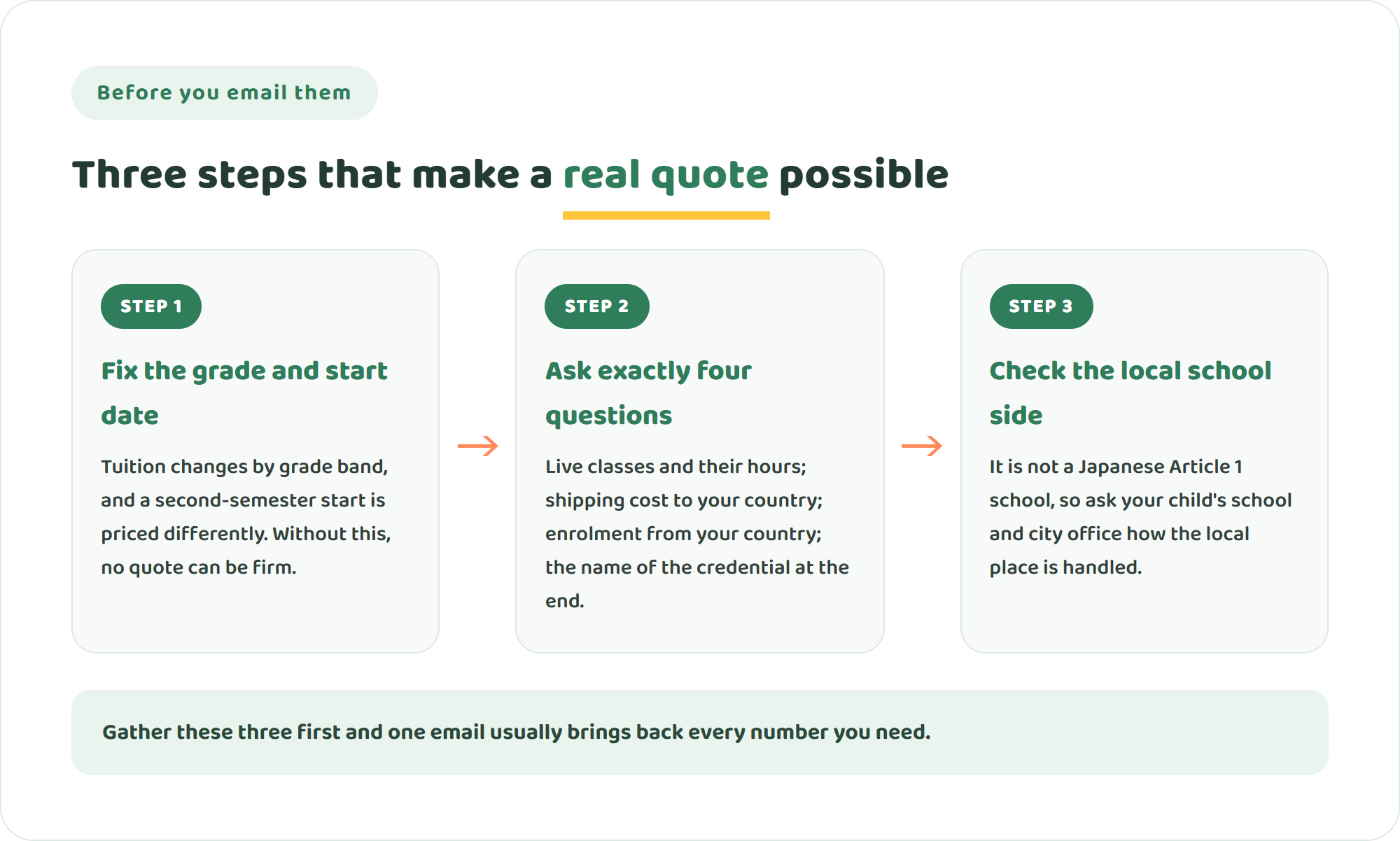
The Fees section states plainly that there are no registration fees. In the same breath it says that for materials shipped outside the continental United States and to international locations, a shipping fee will be determined before enrolment is completed. So the figure exists, but it is quoted case by case and is not published. You will be budgeting with one open line item until you ask. Ask first.
2. Time zone, and whether classes are live at all
The school runs on US Eastern time. If live attendance is required, that lands in the small hours across most of Asia. As noted, the site describes an online classroom rather than a timetable, so we cannot tell you either way. “Are live classes required, optional, and at what hours?” is the question to ask right after price. Families rarely stop because the curriculum disappoints them. They stop because nobody can keep waking at 2am.
3. How it sits alongside your local school
For families living in Japan, enrolling in an overseas online school does not by itself satisfy the country’s compulsory-education requirement. Most families keep their child registered at the local school and add the online school alongside it, and the treatment varies between municipalities. Similar questions exist elsewhere in Asia. Settle this before you pay a deposit, not after.
How to read the reviews
Search in English and you will find plenty of parent reviews. Nearly all of them are written by families in the United States, and — as the site’s own mention of state-funded assistance suggests — a meaningful share of those families are using public funding to pay. Their sense of “affordable” is not built from the same inputs as yours if you are paying the full amount, in dollars, from Asia. Reviews are context, not evidence.
These four questions are worth more than any review, and they let you compare schools side by side:
1. Are live classes required, and at what local time? 2. What is the shipping cost to your country? 3. Do they enrol students resident in your country, and have they done so before? 4. What is the exact name of the credential issued at the end — a diploma, a certificate of completion, or a transcript only?
Question four is the one families skip and later regret. “Your child can graduate” is not the same as knowing what the paper says. If a British pathway is what you are weighing instead, see taking IGCSEs online from Japan.
Who it suits, and who should think twice
It suits families who want the American system specifically, children who already read and write comfortably in English, parents who are happy handling school correspondence in English, and anyone who wants to start with a single course. And because the prices are public, it is genuinely easier to plan around than most of its peers.
Think carefully if your child still needs language support to access the subjects, if you want to be able to discuss problems in your own language (the site does not say whether support in languages other than English is available — ask), or if protecting your family’s sleep and evenings is non-negotiable. You should also expect the school calendar to sit at an angle to your local one.
If the thing you actually want is English-medium learning without giving up the school your child already belongs to, then the design question is not which school to switch to — it is what to add. That is the approach we take; you can see how it works in how we learn.
Questions families ask
Can we enrol from outside the United States?
The site’s reference to shipping materials to international locations indicates that enrolment from abroad is contemplated. Whether they currently accept students resident in your country, and on what terms, can change year to year — confirm it with the school directly. We will not state it as fact here.
So what should we budget for the year?
The published annual figure for your child’s grade band, plus international shipping (quoted individually), plus a band for currency movement. Budget on the first number alone and you will come up short.
Does my child have to leave their current school?
Usually not. Most families run the two in parallel. How attendance and assessment are recorded is a decision for the local school, so speak to the class teacher and head before you commit.
How should I compare it with other online schools?
Line them up on three axes: which national system the curriculum follows, what hours live classes fall in locally, and how openly fees are published. See online international schools compared and the list of online international schools in Asia.
A school that publishes its prices is a useful yardstick
The fact that Pearson Online Academy’s tuition is public, in real numbers, is worth something on its own. Once you hold one honest figure, you can finally interpret every other school’s “contact us for pricing”. Use it as your reference point.
Then close the three gaps that the table leaves open: overseas shipping, the hours live classes fall in, and how your child’s local school place is handled. With those three filled in, you have enough to decide.
NIJIN GLOBAL ACADEMY opens in September 2027 (planned), with a pre-opening term of trial classes in April–May 2027. We are an online international school with no campus, built so that children can keep the school they already belong to and still learn subjects in English, in small, talk-based classes. Join the mailing list and we will send fees, trial-class dates and first-intake details before they go public.