You are paying international school fees in Singapore, Kuala Lumpur, Manila, Bangkok or Tokyo, and somewhere behind the tuition invoice sits a question nobody at the open day answers directly: what actually happens to these children afterwards? Not which universities appear on the wall of the admissions office — what they do at twenty-five, whether the money bought a career or only a very good accent.
Here is the honest starting point. No government anywhere publishes a statistic called “career outcomes of international school graduates.” Any article that gives you one is inventing it. So this piece does something else: it uses published research and official data to show you what can be verified, what genuinely favours these graduates, where the real friction sits, and — the part that matters most — what a family can build during the school years so that the exit is not left to chance.
Quick Answer: Where International School Graduates Actually End Up
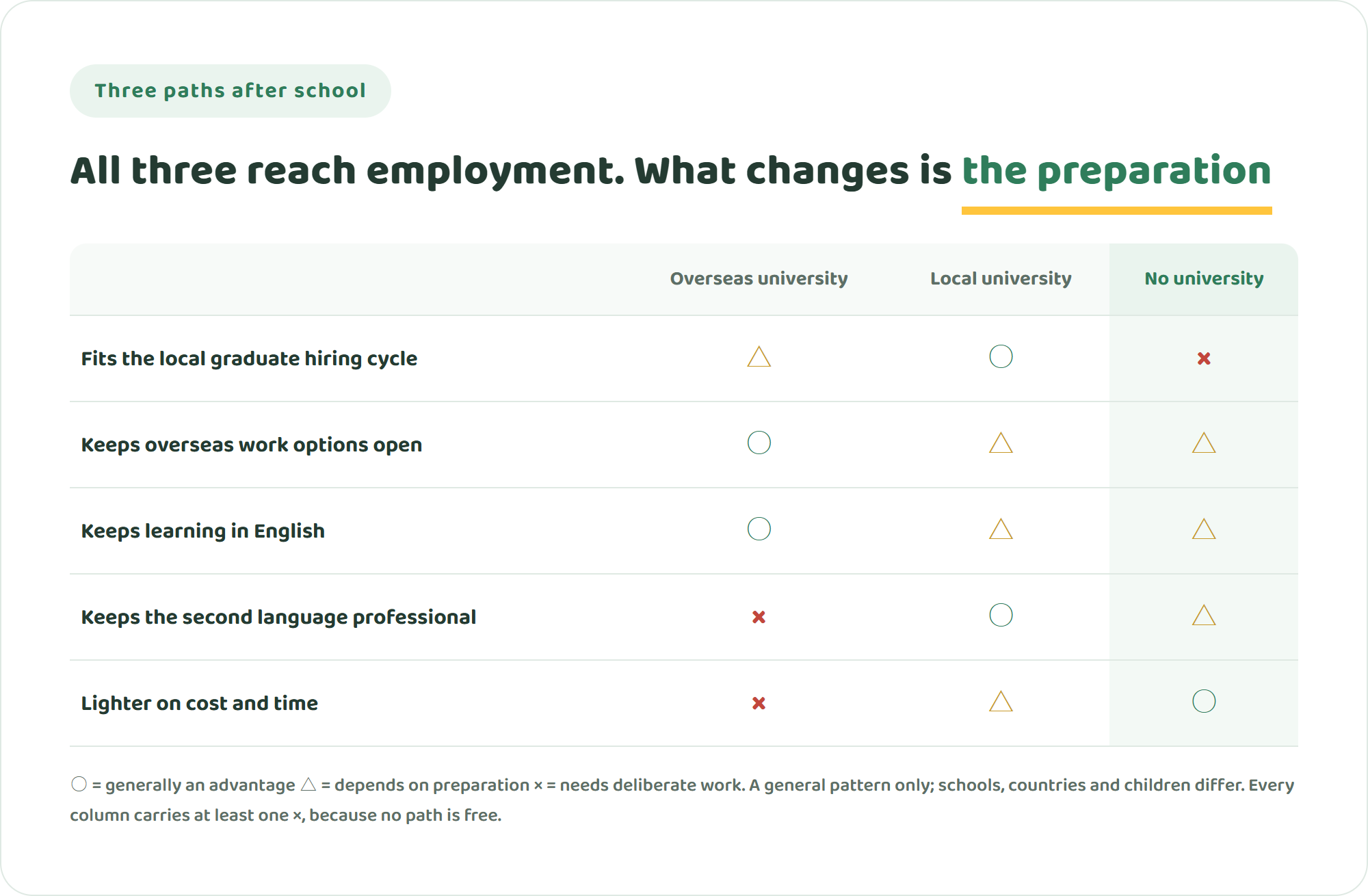
- Three broad paths, not one: an overseas university, a university in the home or host country, or a route that skips university entirely. Employment is reachable from all three — what differs is how much preparation each needs.
- Research favours the further-study route. The IB Organization’s UK higher education study found IB Diploma students were significantly more likely than matched A level students to attend a top-20 university, graduate with honours and continue into further study — while A level students were more likely to go straight into work.
- Employers are asking for what these schools already teach. Analytical thinking is the top core skill, named as essential by 70% of employers worldwide (World Economic Forum, Future of Jobs Report 2025).
- Recognition keeps widening. In Japan alone, 78 universities used IB scores in admissions as of January 2024, and there were 273 IB World Schools and candidate schools as of 30 June 2026 (MEXT).
- The real friction is calendars and language, not ability. Local graduate hiring cycles are built around local university calendars, and interviews are usually conducted in the local language.
- What decides the outcome: one thing finished properly, and two languages kept alive. Neither is bought with tuition — both are built at home, starting years earlier than most families think.

Why career outcomes for international school graduates are so hard to pin down
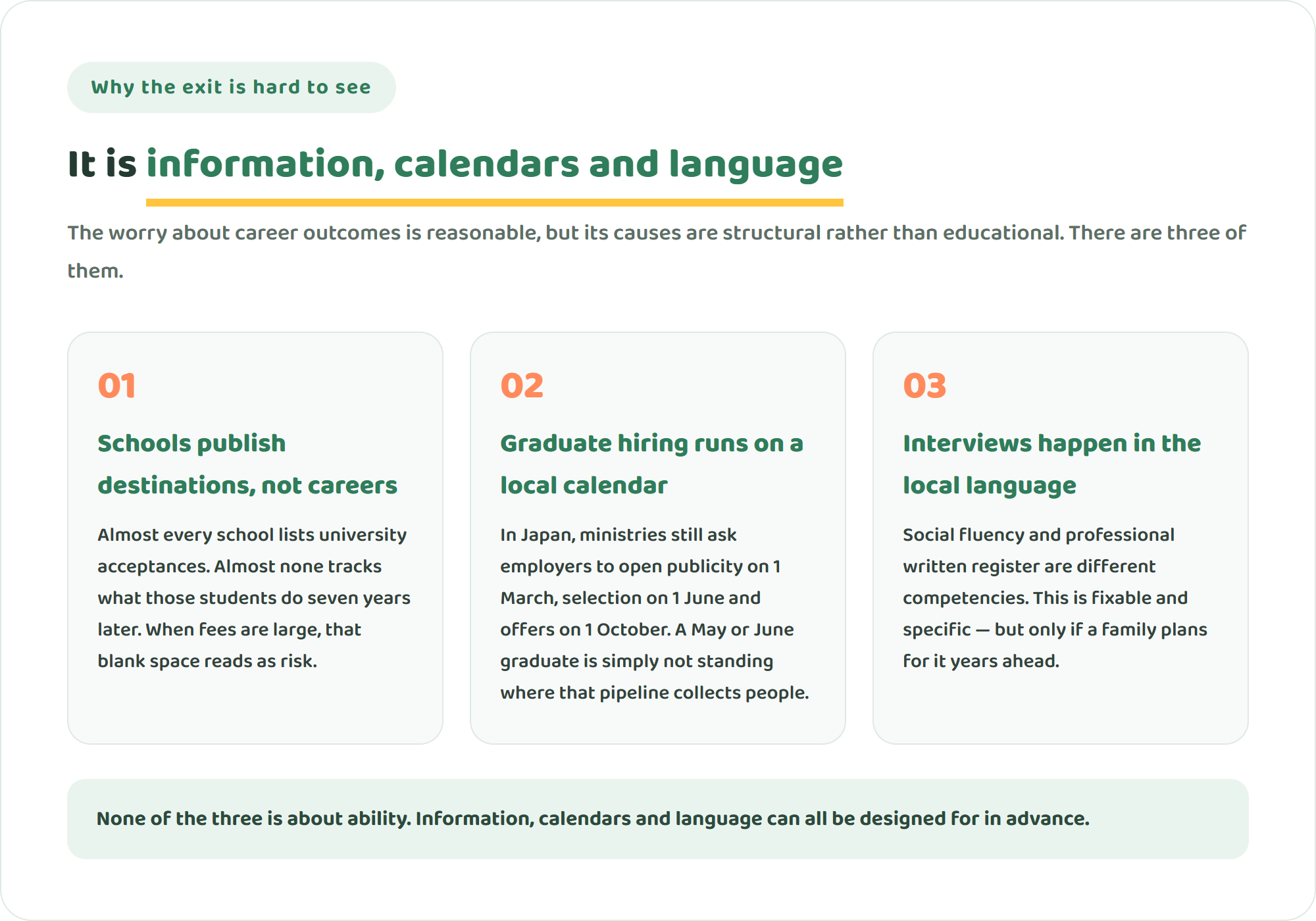
The anxiety is reasonable, but its causes are not the ones most parents assume. Three of them, and none is about the quality of teaching.
Schools publish destinations, not careers
Almost every international school lists university acceptances. Almost none tracks what those students are doing seven years later. Local schools do not either — but when fees are the size of a mortgage, the blank space feels different. The first cause of the worry is missing information, not missing ability. That gap is worth naming, because families often mistake it for evidence.
Graduate hiring runs on a local calendar your child may not be on
This is the friction that surprises people. Take Japan, where many families in Asia eventually return. Government ministries formally ask employers to start recruitment publicity no earlier than 1 March of the year before graduation, begin selection from 1 June, and issue formal offers from 1 October (joint request from the Cabinet Secretariat, MEXT, MHLW and METI, 21 March 2025). That schedule assumes a March graduation and an April start.
A child finishing an IB Diploma in May, or a degree at a UK or Australian university in June or November, is simply not standing where that pipeline collects people. Hiring calendars also differ from country to country, so check the one that applies where you are. The problem is a timetable mismatch, and timetables can be planned around once you know they exist.
Interviews happen in the local language
Fluent conversation and professional written register are different competencies. A graduate who can debate in English but cannot write a formal application letter in Japanese, Mandarin or Bahasa is not weak — they are unprepared in one specific, fixable way. Families who plan for this early rarely hit it. Families who assume the school will handle it usually do.
If you are still weighing the decision itself rather than the exit, whether an international school is worth it depends on the pathway you are actually buying — that piece covers the trade-off in more detail.
What the evidence actually shows
Now the other side of the ledger, with sources.
The research points towards more study, not less employment
The IB Organization’s study of UK higher education outcomes, using Higher Education Statistics Agency data and matched samples of IB Diploma and A level students, found that IB students were significantly more likely to attend a top-20 institution, to graduate with honours, and to go on to further study after graduating — while A level students were significantly more likely to enter the workforce directly (IB Organization, UK higher education outcomes, 2021).
Read that carefully, because it cuts both ways. It is good news about academic trajectory. It also means an international school education tends to route children towards more education, which is another few years before earnings begin. That is a real financial consideration, and it is one reason to keep fee levels sustainable rather than maximal.
Employers are describing the international school skill set
The World Economic Forum’s Future of Jobs Report 2025 found analytical thinking remains the top core skill, named as essential by 70% of employers, followed by resilience, flexibility and agility; leadership and social influence; creative thinking; and motivation and self-awareness (World Economic Forum, Future of Jobs Report 2025).
Inquiry projects, extended essays, group work across four nationalities, presenting a defensible argument to a room — that list is not a coincidence. The gap between what these schools build and what employers say they want is narrower than the worry suggests.
Single-track hiring is loosening, at least in Japan
Keidanren, Japan’s main business federation, surveyed 381 companies in late 2021 and reported that among new graduates, the share of firms using the traditional single-intake system was expected to fall from 90.5% to 78.7% within about five years, year-round hiring to rise from 32.7% to 55.2%, and job-based hiring from 3.8% to 18.8% (Keidanren, survey on recruitment and university reform, January 2022). Its joint council with universities went further in its 2024 report, published 9 May 2025, committing to expand autumn and winter intakes and hiring of candidates who job-hunt after graduating (Council on the Future of Recruitment and University Education, 2024 report).
The same survey asked what employers actually want from graduates: initiative (84.0%), problem-setting and problem-solving ability (80.1%), and broad knowledge across arts and sciences (84.7%). School name does not appear on the list.
Formal recognition keeps expanding
Japan is a useful test case because it was long considered the hardest re-entry market. MEXT’s IB Education Promotion Consortium records 273 IB World Schools and candidate schools in Japan as of 30 June 2026, including 80 authorised Diploma Programme schools (MEXT IB Education Promotion Consortium), and 78 Japanese universities were using IB scores in admissions as of January 2024 (MEXT, use of the International Baccalaureate in university admissions). Requirements vary by institution, so verify with each one.
What to build during the school years
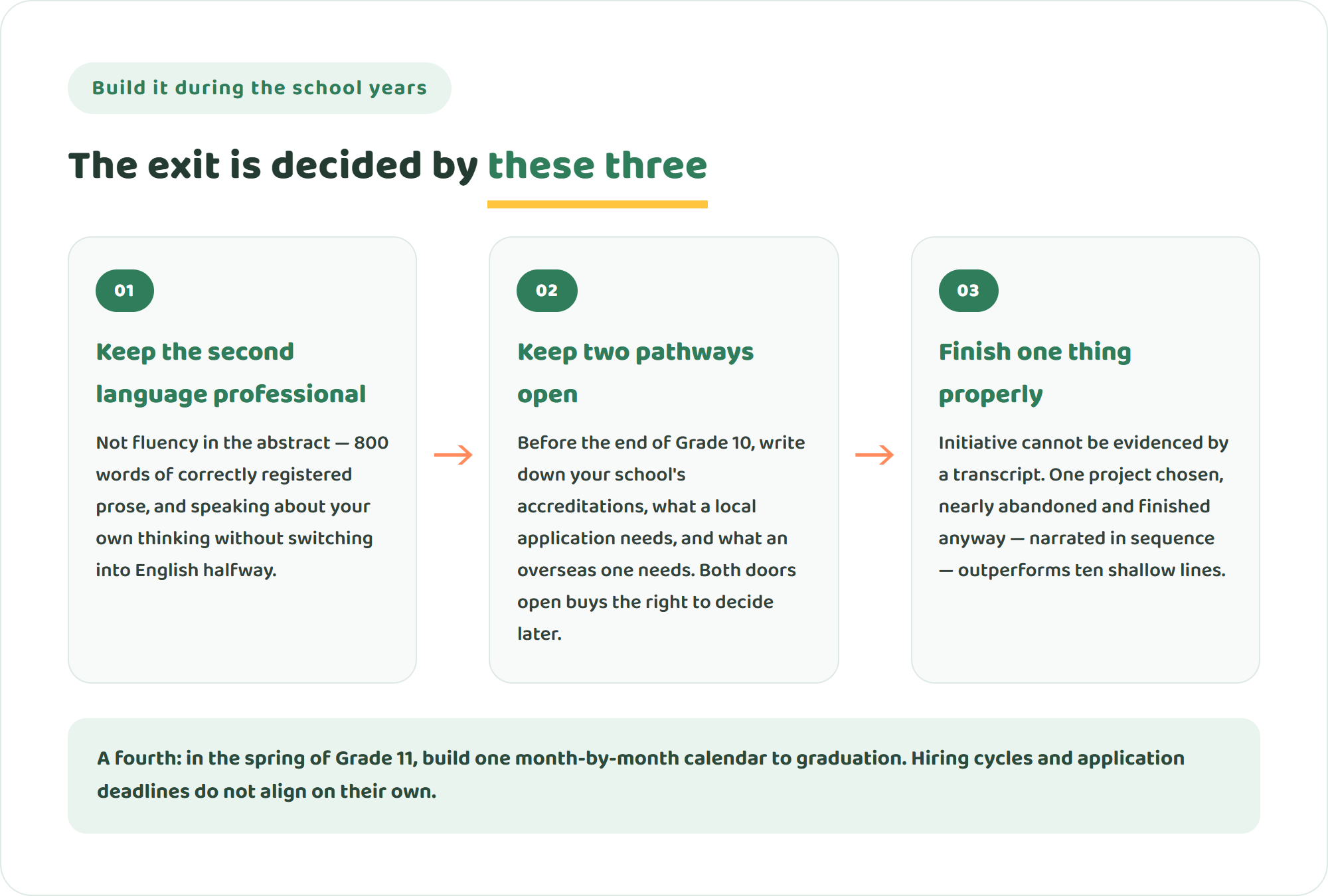
If school name does not decide the exit, something else does — and that something is built while your child is still in Year 8, not in the panic of the final year. Four things, all designed at home rather than bought from the school.
1. Keep the second language professionally alive
Whichever language your family may one day work in — Japanese, Mandarin, Bahasa Melayu, Tagalog, Korean — conversational ability at home will not carry a job interview. The target is not fluency in the abstract. It is being able to write 800 words of motivated, correctly registered prose in that language, and to speak about your own thinking without switching into English halfway. Left until age seventeen, this collides with exams. Started at twelve, it is unremarkable.
2. Keep two pathways genuinely open
Betting everything on overseas admission, or everything on a local one, is fragile design — because a sixteen-year-old’s plan is rarely still optimal at eighteen. Before the end of Grade 10, write down three things on one page: which accreditations your school holds, what a local university application would require, and what an overseas application would require. Keeping both doors open buys you the right to decide later.
It is also the honest counter-argument to spending every available yen, ringgit or dollar on fees. A family with nothing left cannot fund a foundation year, a gap-year internship or a change of direction. The pros and cons of international school are worth revisiting specifically through that lens.
3. Finish one thing properly
Initiative and problem-solving cannot be evidenced by a transcript. They are evidenced by one project the student chose, wanted to abandon, and finished anyway. A research extension, a community programme, running a club’s finances, a small business, a long internship, a competition entry — the category is irrelevant.
What matters is that they can narrate it in sequence: why they started, where it broke, what they changed, what resulted. In every hiring market surveyed above, one deep story outperforms ten shallow lines. This is the single highest-return use of the years you are already paying for.
4. Reverse-engineer the calendar
Local hiring cycles and overseas application deadlines do not align, and nobody will align them for you. In the spring of Grade 11, build one month-by-month table running to graduation, with both sets of deadlines on it. Then, if returning to work in Japan is even a possibility, identify employers running year-round, autumn or post-graduation intakes — the direction of travel documented above means that list gets longer each year.
See how learning works online →

A third option: a school that does not narrow the exit
Put the evidence together and it says something uncomfortable for the marketing of expensive schools: the exit is decided by finished experience and two working languages, not by the name above the gate. And the thing that most often blocks a family from building those two assets is the fee itself. Spend everything, and there is nothing left for the exchange year, the foundation course, or the change of mind.
NIJIN GLOBAL ACADEMY (NGA) is being designed against exactly that constraint, opening in September 2027. It is online, so location is not a requirement. It deliberately does not rank children by test scores, and it puts small-group dialogue at the centre of learning — which means choosing something, defending it and finishing it becomes ordinary weekly work rather than an annual event. The language design assumes Japanese as a support while English exposure grows gradually, for students aged 6 to 18 across Asia and Oceania. Fees are targeted at roughly one-fifth of in-person international school rates, precisely so that a family’s options are not spent before the child needs them.
NGA is run by NIJIN Inc., whose alternative school in Japan, NIJIN Academy, enrols over 900 students. To be straightforward with you: NGA has not opened yet, so it has no graduate outcomes at all. We are not going to imply otherwise in an article about outcomes. Trial classes run as a pre-opening in April and May 2027, which is the sensible point to judge the substance for yourself. If you are weighing a change because something is already not working, who actually regrets choosing an international school is a more useful place to start than any prospectus.
Frequently asked questions
What jobs do international school graduates actually get?
There is no published dataset that answers this by school type, and anyone quoting one is guessing. What the evidence does show is that IB Diploma graduates are more likely than matched peers to continue into further study before entering work. Employment follows from the degree and the experience, not from the secondary school, which is why the four items above matter more than the school’s brochure.
What are the options after primary school at an international school?
Generally three: continue into the same school’s secondary section, move to another international school, or transfer into the local system. Not every international school runs a full secondary programme, and admission to its own secondary section is not always automatic — so ask about the route after primary school before you enrol, not in the final year. Keeping the local language’s reading and writing strong through these years is what keeps all three options open.
Will my child be at a disadvantage applying to local employers?
Not inherently. Employers surveyed by Keidanren named initiative, problem-solving and broad cross-disciplinary knowledge as what they want — not the school attended. The genuine disadvantages are practical: an out-of-sync graduation date and an interview conducted in a language the student only uses socially. Both can be prepared for years in advance.
Is an overseas university necessary to get value from an international school?
No. Recognition of international qualifications in local systems has widened considerably — 78 Japanese universities were using IB scores in admissions as of January 2024, for example. The stronger design is to keep both options open until the student has enough information to choose, rather than committing at fifteen.
Is English alone enough to get hired?
Rarely. In many employer markets English now sits closer to a baseline than to a differentiator. What converts it into an advantage is evidence of something substantial done in English — a research project, a role held, a problem solved — that the candidate can narrate properly.
The exit is still being written
The question underneath the search — will this money turn into a life he can support himself with — deserves better than reassurance. What the published evidence supports is narrower and more useful: hiring markets are opening more entry points than they used to, employers describe what they want in terms of thinking rather than pedigree, and formal recognition of international qualifications keeps widening.
The rest is yours to build. Keep the second language professional. Keep two pathways open. Finish one thing properly. Build the calendar early. A young person carrying those four is hard to place at a disadvantage, whatever the name on the certificate.
NIJIN GLOBAL ACADEMY opens in September 2027, with pre-opening trial classes in April and May 2027. We will send you how the learning works online, and news about the first intake.
Honest Answers to Your Worries — related reading
- Will My Child Lose Their Mother Tongue?
- The Honest Pros and Cons of International School
- Disadvantages of Bilingualism in Childhood: Myths vs Research
- Who Regrets International School — and Who Doesn’t
- International School Special Needs: What to Look For
- International School vs Local School: How to Decide
- Does International School Hurt Your Child’s Home Language?
- When Your Child Is Struggling at International School
- Do International Schools Make Children Fluent in English?
- Is International School Worth It? What Happens to Graduates
- Should I Send My Child to International School?
- Transfer From a Local School to an International School
- Disadvantages of Early English Education: What Research Says