“Can you actually take IGCSE online?” The most accurate answer is half yes, half no. The studying is genuinely online, start to finish. But the examination itself is sat at an approved centre. There is no at-home exam route.
The distinction sounds small and turns out to be enormous. Families choose a school first, and only then discover they have nowhere within reach to sit the papers. This article compares the three routes to IGCSE from Japan on the things that actually decide it: paperwork, how the money is structured, and how each option interacts with the local school system.

First, briefly: what IGCSE is
The IGCSE (International General Certificate of Secondary Education) is an international secondary qualification for roughly ages 14 to 16 (source: Cambridge International, Cambridge IGCSE). In Japanese terms, that spans the last year of junior high into the first year of high school.
The part that matters most is that it is taken subject by subject. Unlike a Japanese high school diploma, it is not awarded in one piece: you choose English, maths, a science, a second language and so on, and build the qualification by passing each paper. Which means the cost moves with the number of subjects. That fact returns later with force.
IGCSE typically leads on to A Levels or the IB Diploma. Nobody enters university on IGCSE alone — it is best understood as the foundation for the course that follows.
Why “you can do it online” is only half true
The learning is fully online. Here the answer is simply yes. UK online schools run genuine IGCSE and GCSE courses: King’s InterHigh runs a Senior School covering GCSEs, and states that its Sixth Form offers A Levels alongside a fully online IB Diploma. Crimson Global Academy states that it teaches ages 7-18 across International GCSE, International A Level, AP and the US Diploma. Lessons, coursework and marking all work through a screen.
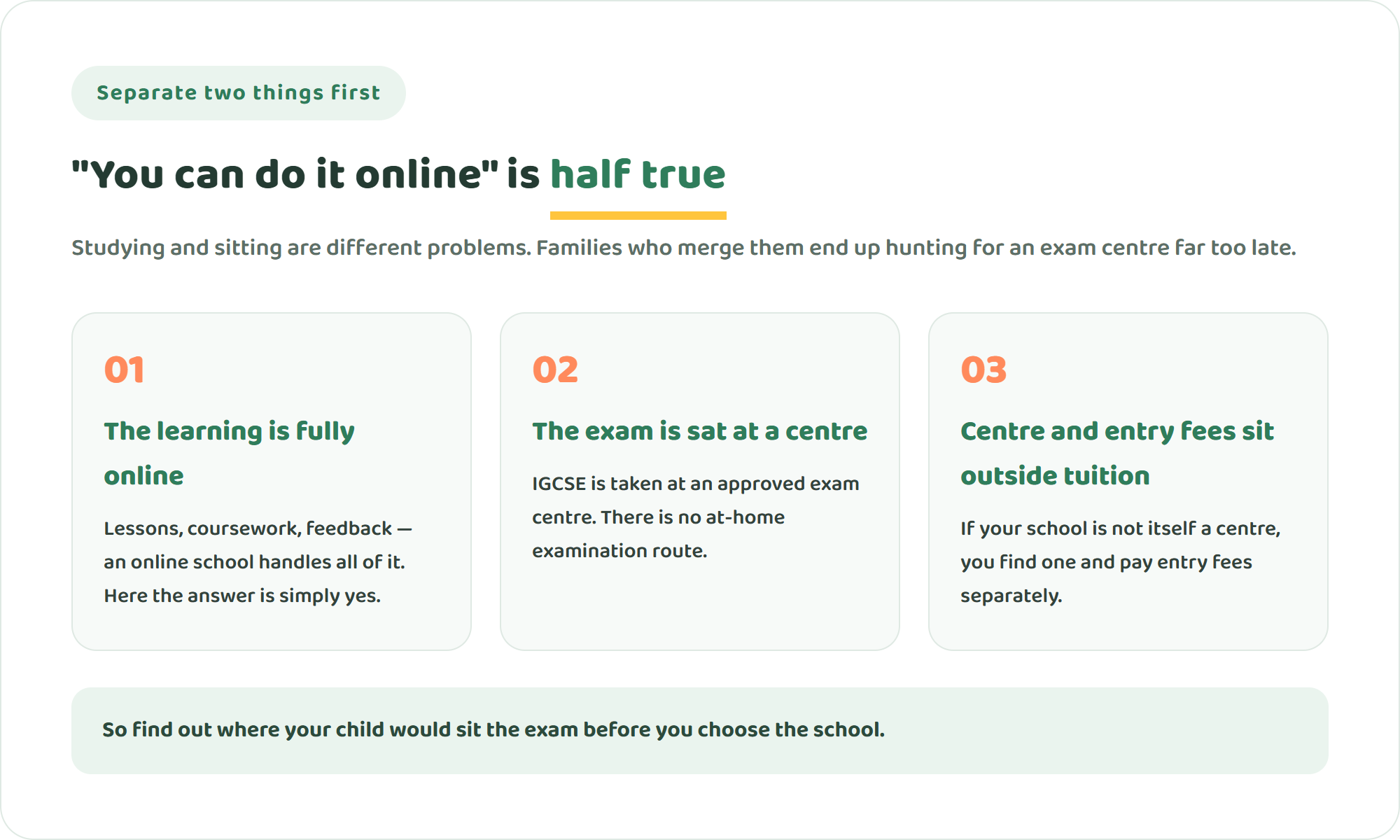
But the exam is sat in a room. IGCSE is examined at an approved exam centre. Cambridge International publishes a search tool for finding those centres, and separately explains how to register as a private candidate (sources: Approved exam centres / Private candidates).
One consequence follows, and it is the practical heart of this article. If your online school is not itself an exam centre, finding one is your job, not theirs. Entry fees usually sit outside tuition as well. So check what is within travelling distance before you choose a school, not after. Families who do it the other way round pay for it later.
Three routes from Japan, compared
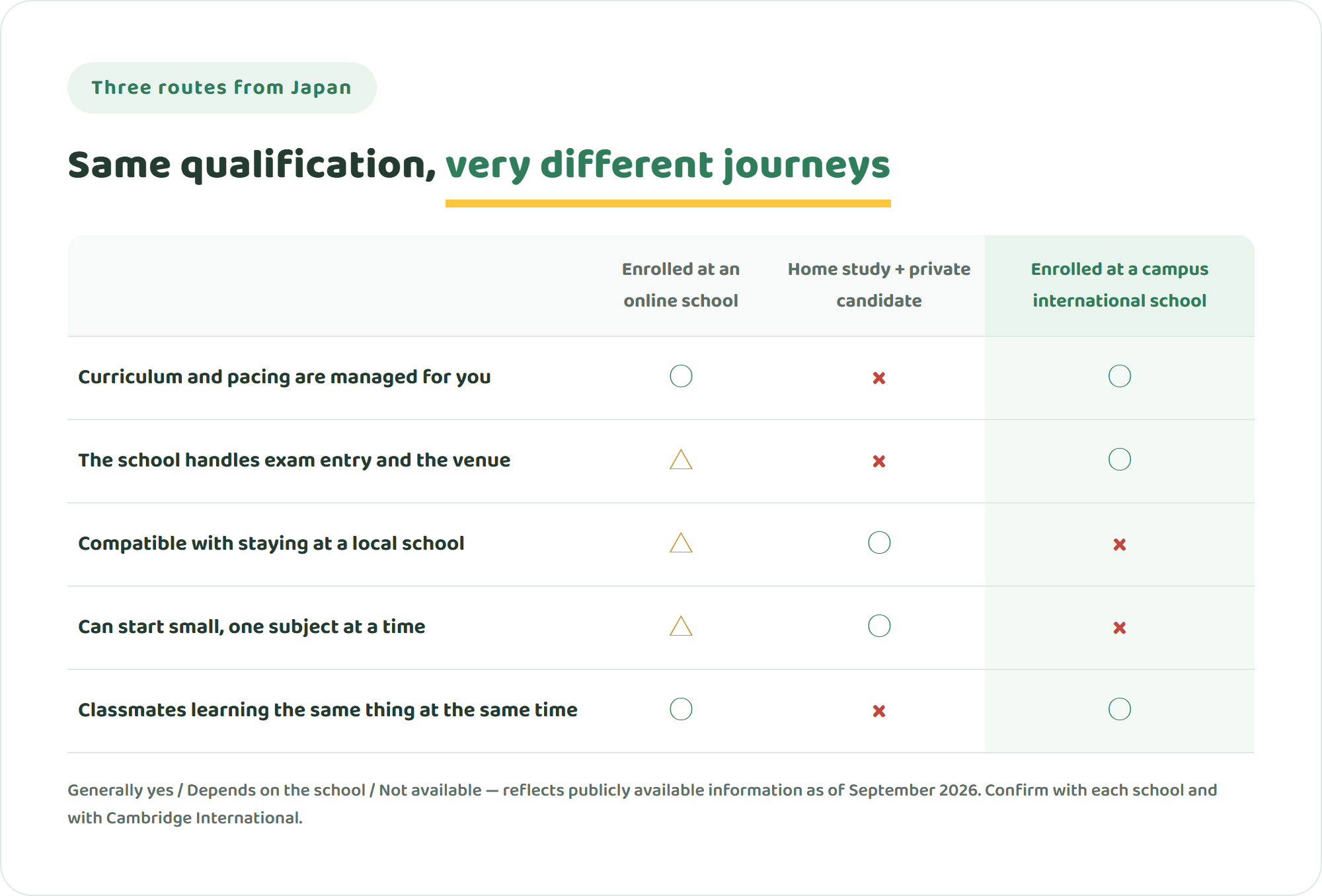
Route 1: Enrol at an online school and take its IGCSE courses
The most straightforward option. The school owns the curriculum and the pacing, and your child has classmates working towards the same papers. Not running alone is the real benefit here.
Costs vary by school but the structure rarely does. King’s InterHigh publishes 2026/27 annual contracts from £4,395 (£5,995 at the next stage up), plus a one-off £100 registration fee, a deposit of £1,000 for students outside the UK, and additional subjects at £405-£435 per year (source: King’s InterHigh Fees, checked September 2026). Budget from the headline annual figure alone and you will come up short — that breakdown is exactly why.
Two cautions. How much of the exam entry and venue arrangement a school handles varies enormously. And a UK school’s timetable lands in the late afternoon and evening in Japan (covered in detail in a day at an online international school).
Route 2: Study at home and sit as a private candidate
No enrolment: you prepare with materials or a tutor, then register at an approved centre as a private candidate. It is the cheapest route to start, and you can try a single subject. It also runs happily alongside a local school.
Honestly, though: this route puts the heaviest load on the parent. Checking the syllabus, choosing materials, managing pace, handling entry. Some centres do not accept private candidates at all. Treat it as an option for a child old enough to work independently, in a household with the capacity to walk alongside them.
Route 3: Enrol at a campus international school
These schools are frequently exam centres themselves, so entry and venue are handled for you. Administratively it is by far the easiest. The daily environment and the classmates come in person.
The trade-off is that fees are the highest of the three. And in Japan, moving to an international school that is not an ichijoko (a school accredited under Article 1 of the School Education Act) means your child does not receive a Japanese junior high graduation certificate. The interaction with compulsory schooling is more tangled than most families expect.
The point that gets missed: IGCSE is not a Japanese qualification
Get this one straight early, because it is expensive to discover late. Passing IGCSEs does not mean your child has graduated from a Japanese junior high school. It is a different country’s qualification in a different system.
If there is any chance of applying to a Japanese high school, decide first how the Japanese graduation certificate will be secured. Study alongside a local school and the question never arises. Move full-time to an overseas online school and you need to confirm the position with your municipality and current school.
One more thing that is rarely said out loud. IGCSE is examined in English. The distance between holding a conversation in English and writing a reasoned answer in English about photosynthesis or the causes of a war is considerable. This is where families consistently find it takes longer than planned — which is the argument for accumulating hours of studying subjects in English early, rather than starting English in the exam year.
Conversely, if your child is currently struggling to attend school at all and what is needed first is somewhere to be during the day, there is something to look at before IGCSE. NIJIN Academy, run by the same company, NIJIN Inc., is an online free school for children who have stopped attending. Taking things in the right order is usually the fastest route.
How learning works at NIJIN GLOBAL ACADEMY
How we build the habit of studying subjects in English, rather than practising English by itself.
How to think about cost: price per subject, not tuition
Because the qualification is built subject by subject, so is the bill. Count these four separately:
- Annual school tuition, if enrolled. Usually includes a base number of subjects.
- Additional subject charges. Some schools publish these plainly — King’s InterHigh lists £405-£435 a year. They stack up fast.
- Up-front costs. Registration and deposit. One-off, but not small in year one.
- Entry and centre fees. Charged per subject, normally outside tuition, and varying by centre.
Compare schools on “what does it cost to reach six subjects”, not “what is the annual fee”. That single change reorders the list more than anything else you can do. Other schools publish their own fees — always confirm against the primary source.
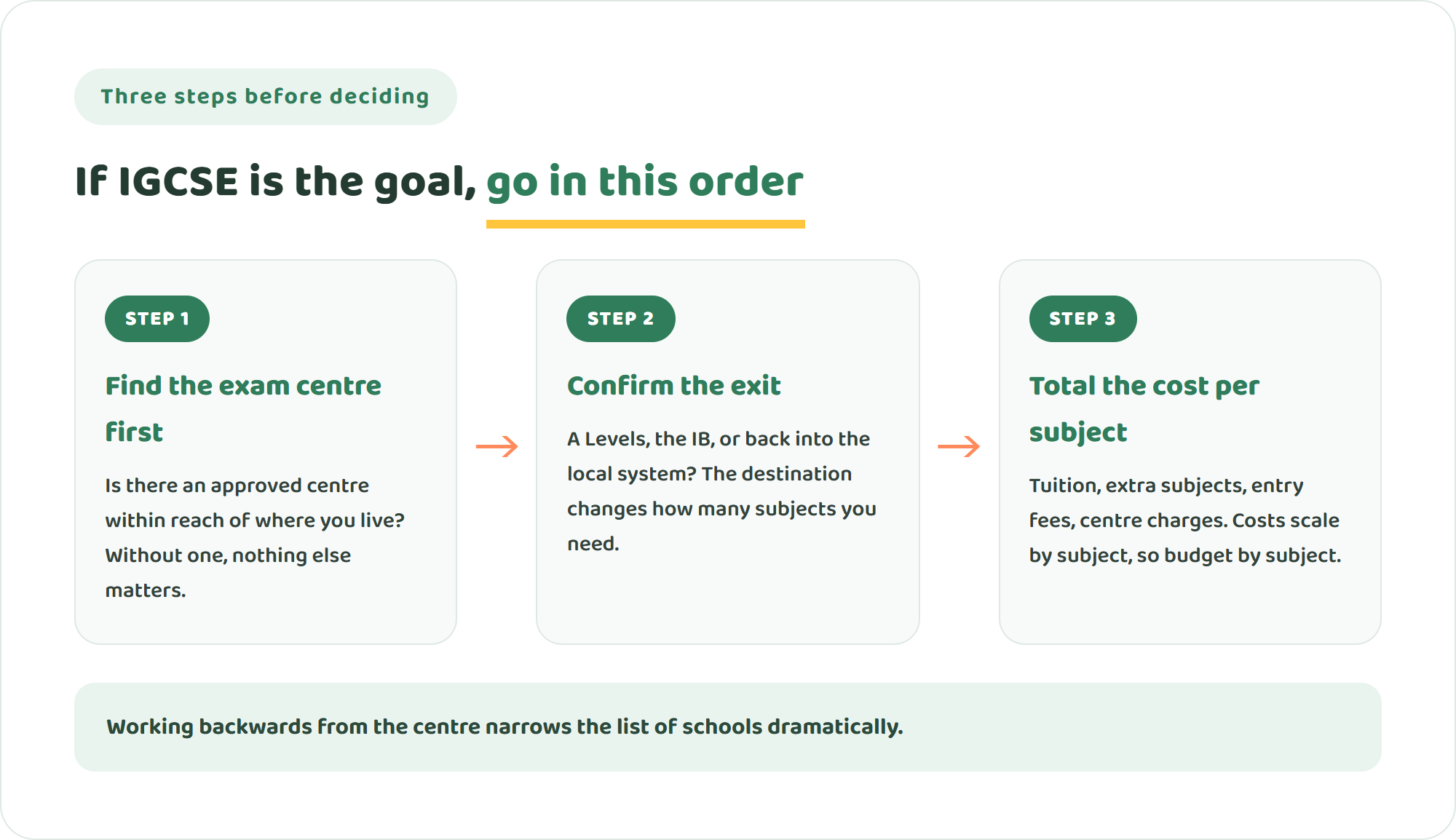
Three steps before you decide
Step 1: find the exam centre first. Use Cambridge International’s approved-centre search and confirm there is one you can actually travel to. Without that, nothing else you research matters. Check too whether it accepts private candidates.
Step 2: confirm the exit. A Levels, the IB, or back into a Japanese high school? The destination determines how many subjects you need and which ones. Fix the exit and the subject list follows automatically.
Step 3: total the cost per subject. Tuition, extra subjects, up-front fees, entry fees — using only figures published on official pages — up to six subjects. Do that and you have everything you need to choose.
Common questions
Can the IGCSE exam be sat at home on a computer?
No. IGCSE is examined at an approved centre. The learning happens online; the exam happens in a room. If your school is not itself a centre, you find one and register as a private candidate. Centres and sitting windows are limited, so research this before choosing a school.
Can we do this while staying at a Japanese school?
Yes. Stay enrolled locally, study online after school or at weekends, and sit as a private candidate. This keeps the Japanese junior high graduation certificate intact, so no doors close. Pacing falls to the household, so starting small with a limited number of subjects is the realistic approach.
How much English is needed?
Considerably more than conversational fluency. Science and humanities papers require constructing an argument in written English. As a rough guide, build in one to two years of studying subjects in English before the exam year. Conversation practice alone does not develop this.
A qualification is a tool, not a destination
If you have read this far, you probably do not want the certificate as such. You want your child’s options not to be confined to one country — and this qualification is a tool for that.
If so, the real question is not “can we get it” but “what does it open”. Confirm the centre, fix the exit, total the cost per subject. With those three done, the rest is just walking.
NIJIN GLOBAL ACADEMY is an online international school planning to open in September 2027, built around studying subjects in English after school while remaining at a local school. It is a place to build the foundation for learning in English — it is not an IGCSE exam-preparation school, and we would rather say so plainly. Trial classes are planned as a pre-opening in April-May 2027.
You do not have to decide today. Start by looking up one exam centre.
Opening updates, by email
Curriculum, timetable and our approach to fees — registered families hear each decision first, as it is made.