
If you are deciding whether to change schools, it probably started at night. Your child is asleep, and you are wondering whether tomorrow brings the same words again — the flat voice at the door, the stomach ache that appears at seven and is gone by ten. A different school might make things easier. Or it might be running away — or your own impatience, asking a tired child to build a social world from scratch all over again.
Here is the first thing worth saying: you do not have to decide today. This is not a decision that has to be made on the night it occurs to you. What follows is not an answer to whether to move your child, but an order to think in. Take apart what is actually not working. Then try, properly, what can still be adjusted where your child already is. Only then weigh a move against clear criteria. Families who follow that order can say, whichever way it goes, that they chose it rather than fled into it.

Before deciding whether to change schools, separate what is not working
The phrase “school isn’t working” holds several different problems inside it, and left mixed together the responses get mixed too. Try sorting it into four kinds.
1. Relationships — one particular child, the atmosphere of the class, the fit with a teacher. 2. Pace and content of learning — lessons too fast to follow, or so far below your child that the hours are empty. Opposite states, and both come out as the same sentence: “it’s boring.” 3. Culture and values — how loud it is, how competition is handled, what the school makes a big deal of. 4. Physical and sensory strain — noise, smells, lighting, food, sport, a body that cannot get up. The hardest for a child to put into words, and the easiest for adults to read as attitude.
Sorted, the next move changes. A relationship problem may soften with a seat change, or simply by involving more adults. A pace problem needs the workload or the level adjusted. A culture problem rarely shifts without a change of place. And physical strain may need a doctor before it needs a change of school.
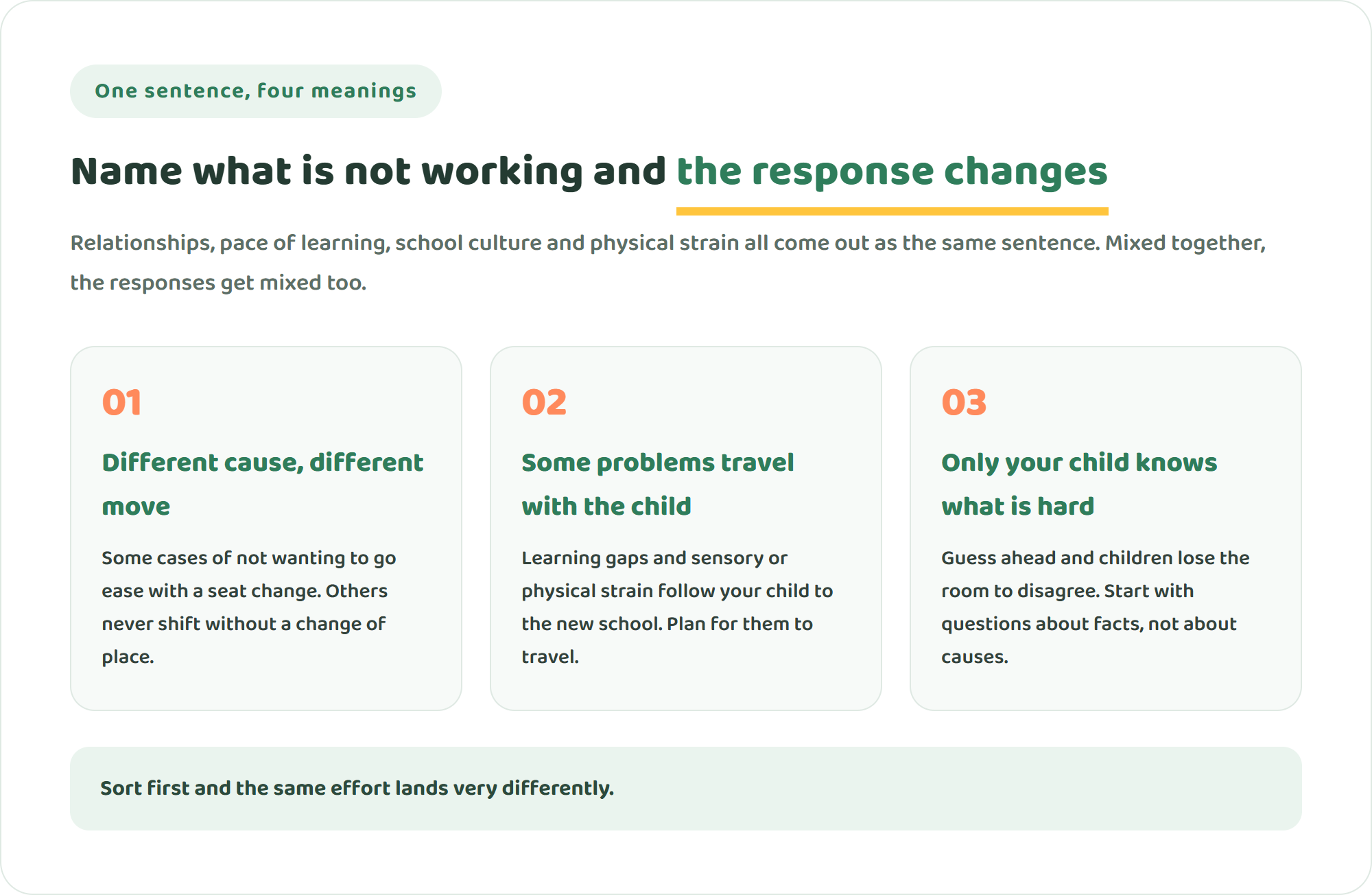
One more thing, and it matters most. Only your child knows what is actually hard. When adults guess ahead, children lose the room to say “no, that’s not it.” Questions that hunt for causes (“why don’t you want to go?”) are harder to answer than questions about facts (“which lesson is the worst?”). If your child has stopped going altogether, read supporting a child who refuses school first.
What you can still try where your child already is
More is usually available at the current school than parents realise, and the class teacher is not the only door. When a conversation stalls there, it can feel like the school will not move. In practice there is often a year-level lead or deputy head, a school counsellor, a learning-support coordinator and a school nurse — and outside the building, your local education authority has its own advisory service. Change the door and the possibilities change with it.
Adjustments families do get, in one form or another: a different seat or working group, a quieter room to start the day in, a later arrival or earlier finish, attending some lessons and not others, a reduced homework load, a different way of taking part in lunch or events. What is available varies enormously between systems, countries and individual schools, so treat none of this as a promise — check with your local education authority and the school itself.
Two rules make these conversations land. First, ask for one thing, and make it concrete: not “something has to change,” but “could we try two weeks where they start in the nurse’s room and join the class afterwards?” Second, put a date on it. Saying “may we speak again in three weeks?” keeps the request from quietly evaporating. Time off is not a failure either; it is often the treatment.
Five signs that changing schools is worth considering
Sometimes you do all of that and nothing moves. These five are reasonable indications that changing the environment itself belongs on the table.
- Three months of conversations with nothing concrete changing. Sympathy is offered; the daily arrangement stays as it was.
- The exhaustion no longer lifts at weekends. Even the recover-Saturday, dread-Sunday rhythm is gone, and sleep does not return on days off.
- Your child says clearly that they want something different. Not agreement with your suggestion — their own words.
- Gaps in learning are stacking up. The time away matters less than how far away the way back begins to feel.
- Family conversation has narrowed to school and nothing else. Home has become a second classroom, and nobody is resting.
There is deliberately no threshold here — no “three out of five means move.” With the same three ticked, one family is right to stay and another right to go. Use the list as shared language, not as a score.
If you move, where to? Four options against one set of criteria
Comparison only works when the options sit side by side. Realistically there are four: adjust things where you are (that is, stay), transfer to another local school, move to a private or alternative school, or move to an online international school.
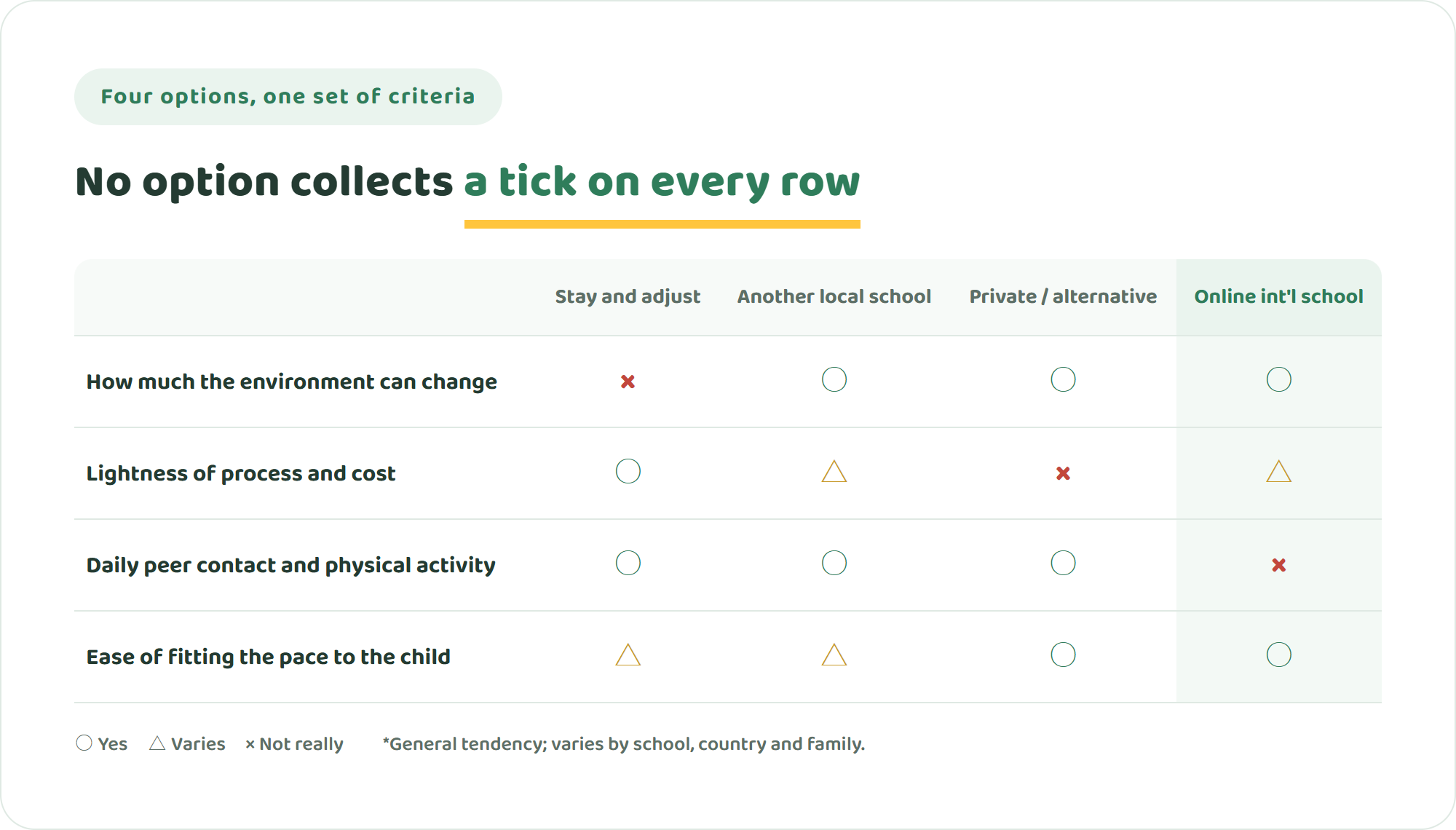
The table makes plain that nothing scores well everywhere. Keep the process light and the environment barely changes; change the environment and paperwork and cost go up. To be honest about our own end of it: an online school cannot hand a child the bike ride to a friend’s house, or the out-of-breath hour on a field. So decide first which single row your family cannot compromise on. Once that is settled, four options usually collapse to two. For a wider view, see learning options when school doesn’t fit and how to choose an international school.
For families living outside their home country, deciding whether to change schools is often tangled up with a lease, a visa category, an employer’s relocation timing, or a curriculum that numbers year levels differently. A child who moves mid-year can land a grade above or below the one they were in before, and returning to a home-country system later can hinge on which curriculum they followed. The questions are simply wider than the classroom. Ask each school how they place mid-year arrivals and where their leavers go.
See how learning works at NIJIN GLOBAL ACADEMY →
The order to decide in: three steps
Turned into something you can start this week, the whole thing comes down to three moves.
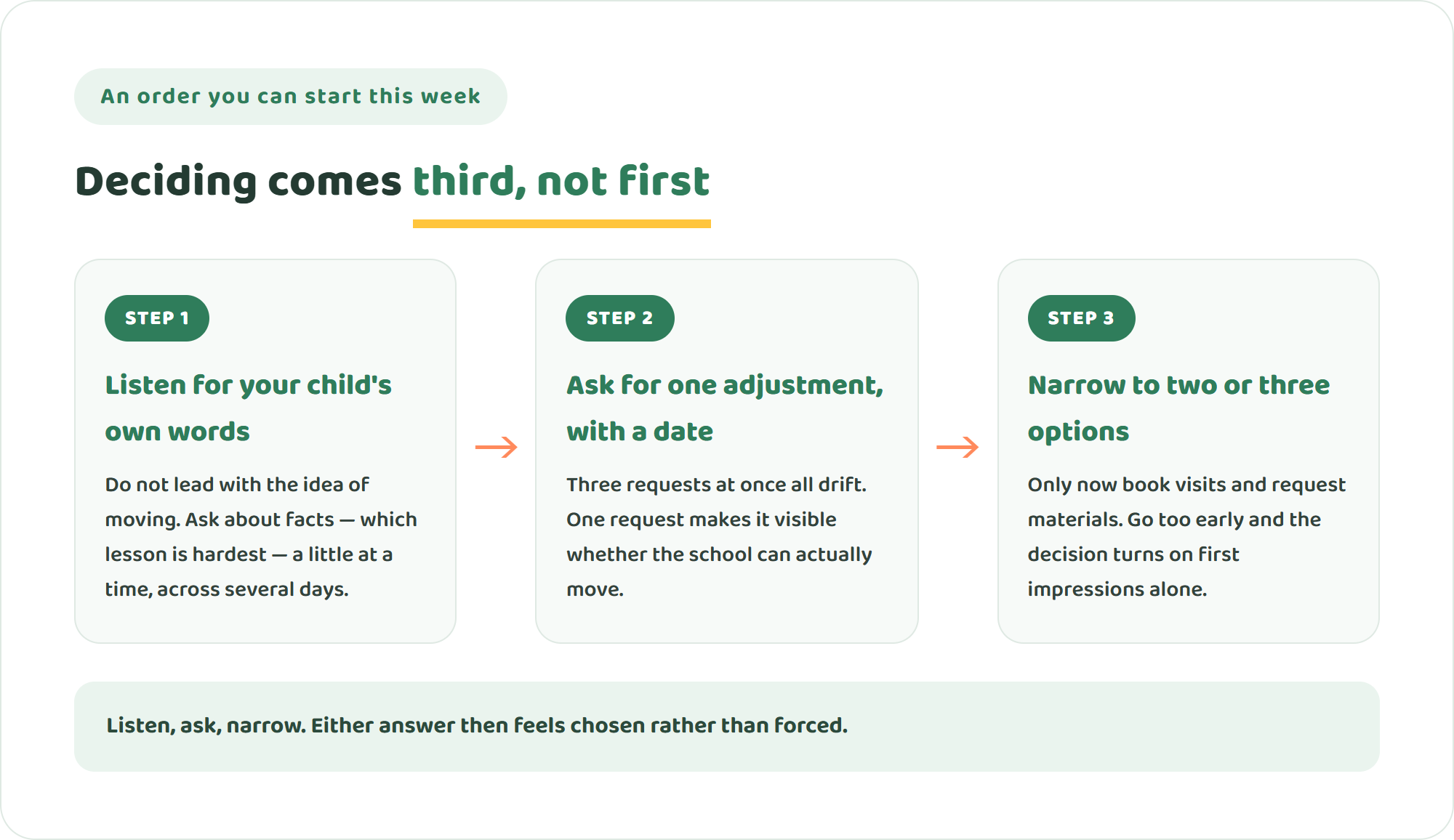
In step one, the trap is letting the listening become a preamble to persuasion. Say “we could move you, you know” first and your child answers the hope rather than the question. Gather facts, a little at a time, across several days.
Step two is one request with a date attached. Ask for three things at once and all three drift; ask for one and it becomes visible whether the school can move — exactly the material step three needs. Only then do you book visits. Start with visits and the decision gets made on atmosphere, while the original mismatch goes unexamined.
Frequently asked questions
Can a child change schools mid-year?
Often yes, though the process differs sharply by country and by whether you are also moving address. Private, alternative and online schools set their own entry points; some admit at any time, others hold to term boundaries. Check with your local education authority and with the school itself.
What if my child cannot decide?
“I don’t know” usually means either not enough information or fear of owning the outcome. For the first, cut the list to two and go and look. For the second, take the weight of the decision yourself, out loud: “we will make the final call, and if it doesn’t work we will think again together.” Children who know a decision is reversible say far more about it.
Won’t the same thing just happen again somewhere else?
It can. That is why the sorting matters. Relationship and culture problems often ease with a change of place; learning gaps and physical or sensory strain travel with the child. Assume they travel, and decide in advance what continues at the new school — the appointments, the catch-up plan, the rules about resting.
What happens to attendance records and reports?
How attendance is recorded, how learning outside school is counted, and how reports carry across are handled differently from one authority and school to the next. Since it can matter later for entry to the next stage of education, ask the current school and your local education authority plainly. It is a fair question for a parent.
What you can do today is not decide
Deciding whether to change schools takes an order more than it takes courage. Separate what is not working. Ask for one adjustment, with a date. Look at the result, then narrow the field. Families who go in that order do not have to repeat that night, even when the answer is staying. Looking for a place where your child can breathe is not running away, and not a parent’s whim.
NIJIN GLOBAL ACADEMY is an online international school due to open in September 2027, with pre-opening trial classes planned for spring 2027. By email, before anywhere else, we share how our learning works — where a child chooses how many people to be with and how much to take part — along with news about our founding intake. Nothing needs deciding today. What you can do today is put a date in the calendar to talk to someone.