You are looking at the fees, the years ahead, and the quiet question underneath it all: is this actually going to pay off for my child? If you searched is international school worth it, you are almost certainly weighing a real investment — tuition that can rival a mortgage in Singapore, Kuala Lumpur, Manila or Tokyo — against an uncertain outcome. And the honest worry is rarely about the classroom today. It is about the finish line: what really happens to these graduates?
Let’s answer that plainly, without the brochure gloss. Whether international school is worth it depends far less on the school’s prestige than on one thing: the pathway a family designs toward what comes after. In this piece we’ll look honestly at what graduates actually do, why the “worth it” question is really a question about outcomes, and how to make the investment pay off — including a third option that doesn’t hinge on exam rankings at all.

Is international school worth it? The honest answer depends on the exit, not the entrance
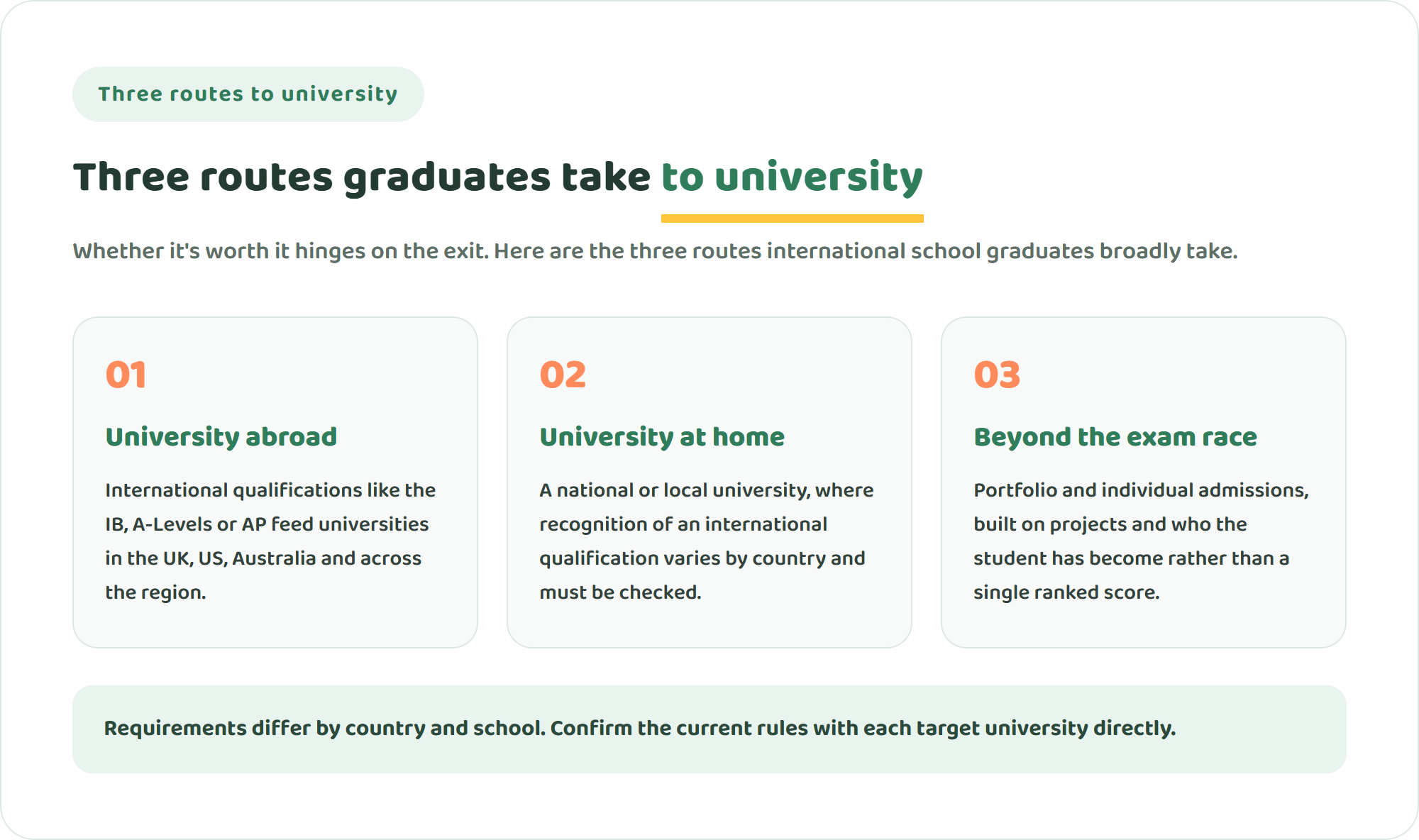
Here’s the part most brochures skip. An international school is worth it when its qualifications actually carry your child to the next stage — and much less so when a family assumes the destination will take care of itself. Across Asia, graduates broadly move along three routes, and the value of the whole investment turns on which one you plan for early.
The first route is university abroad: international qualifications such as the IB, A-Levels or AP feed into universities in the UK, US, Australia and increasingly across the region. The second is university at home — a national or local university, where recognition of an international qualification varies by country and by institution, so it must be checked, not assumed. The third is a beyond-the-exam-race route, where admission rests on a portfolio, projects and who the student has become rather than a single ranked score. When people ask is international school worth it, they are really asking whether one of these three exits is genuinely open. It usually is — but only if you design for it. Requirements differ by country and school, so confirm the current rules with each target university directly.
Why “worth it” is really a question about outcomes, not prestige
So why does this question cause such anxiety? Because the cost is concrete and immediate, while the payoff is distant and conditional. Families see the invoice every term; the graduate outcome only arrives years later. That gap is where doubt grows. And it is made sharper by a structural fact: an international qualification is not automatically equivalent everywhere. An IB or A-Level that opens doors in London may need extra verification for a national university back home. A curriculum built for overseas admissions may not map neatly onto a local system.
This is the root of the “worth it” worry, and it cuts both ways. It means the value is not guaranteed by the school’s name — but it also means the value is largely within your control. Families who research recognition early, in the specific countries they care about, tend to get far more out of the same fees than families who assume prestige equals a pathway. If you are still weighing the trade-offs overall, we lay them out honestly in our guide to the pros and cons of international school.
How to make it worth it — practical pathway design
This is the heart of the article. To turn an anxious “is it worth it?” into a confident “here’s our plan,” design the exit deliberately, working backward from the destination. Three moves make the biggest difference.
First, confirm recognition where it counts. Ask both the school and your target universities — at home and abroad — exactly how the qualification is treated. Second, match the qualification to the pathway. Decide whether the IB, A-Levels, AP or another route best fits your child’s strengths and the universities you’re aiming at, rather than defaulting to whatever the school offers. Third, design a dual home-and-abroad plan. Don’t stake everything on one exit; pair an overseas application track with a home-country or individuality-based one, so a setback in one lane never closes the whole road. A pathway that doesn’t lean solely on ranked exam scores, in fact, tends to widen a child’s options. Compare how the school types stack up below.
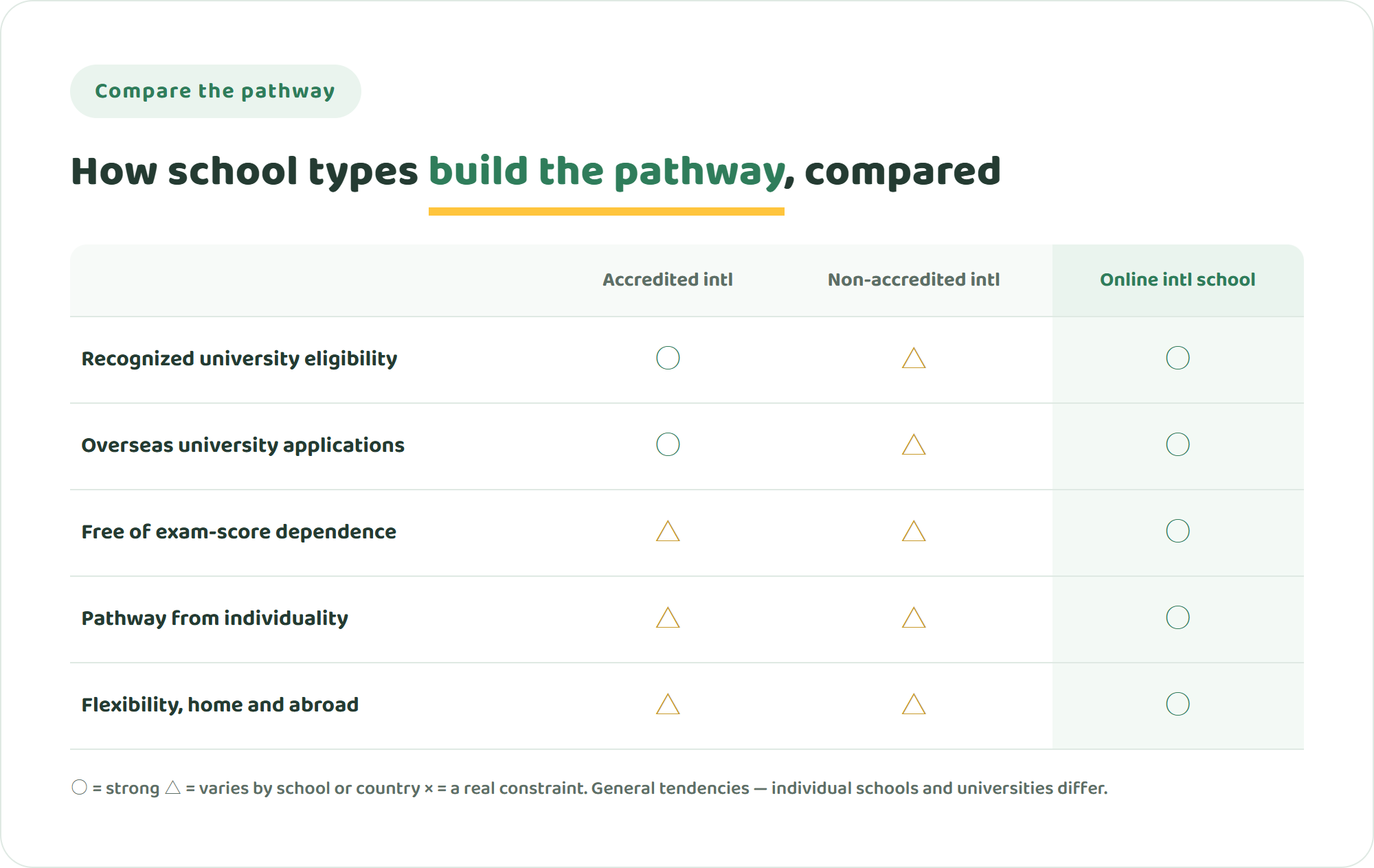
As the table shows, two schools with the same label can build very different pathways, and accreditation is often the divider. Cost is the other pressure point that quietly narrows options; if the fees are starting to feel out of proportion to the payoff, our piece on when international school feels too expensive offers a more grounded way to weigh it. The key is never to judge tuition, qualification and exit in isolation — design them together, inside your family’s own priorities.
See how online learning works →
A third option — individuality over exam scores, home and abroad
Here is another way to think about worth. What we at NIJIN GLOBAL ACADEMY (NGA) aim for is online learning that doesn’t rank children by test scores, built around small-group dialogue. Instead of memorising a fixed answer, we start from “what do you think?” Children exchange views through the screen with peers across different parts of the world, and along the way English, a sense of how wide the world is, and their own interests all grow.
On the question of outcomes, what NGA holds to is this: be honest about the qualification facts, then design exits — at home and abroad — from each child’s individuality rather than an exam ranking. Portfolio-based and individual admissions are a real and growing route, and a student’s genuine curiosity and projects can become the strongest part of an application. So we build a flexible, dual home-and-abroad exit into the learning itself — and we’re aiming for tuition around one-fifth of an on-campus international school, which changes the “worth it” maths considerably. It isn’t a cure-all; compare it fairly with the others and choose it only when it fits your child.

You can start the pathway in three steps
When the stakes feel high, order matters most. Here is how to turn the is international school worth it question into a plan, in three unforced steps.
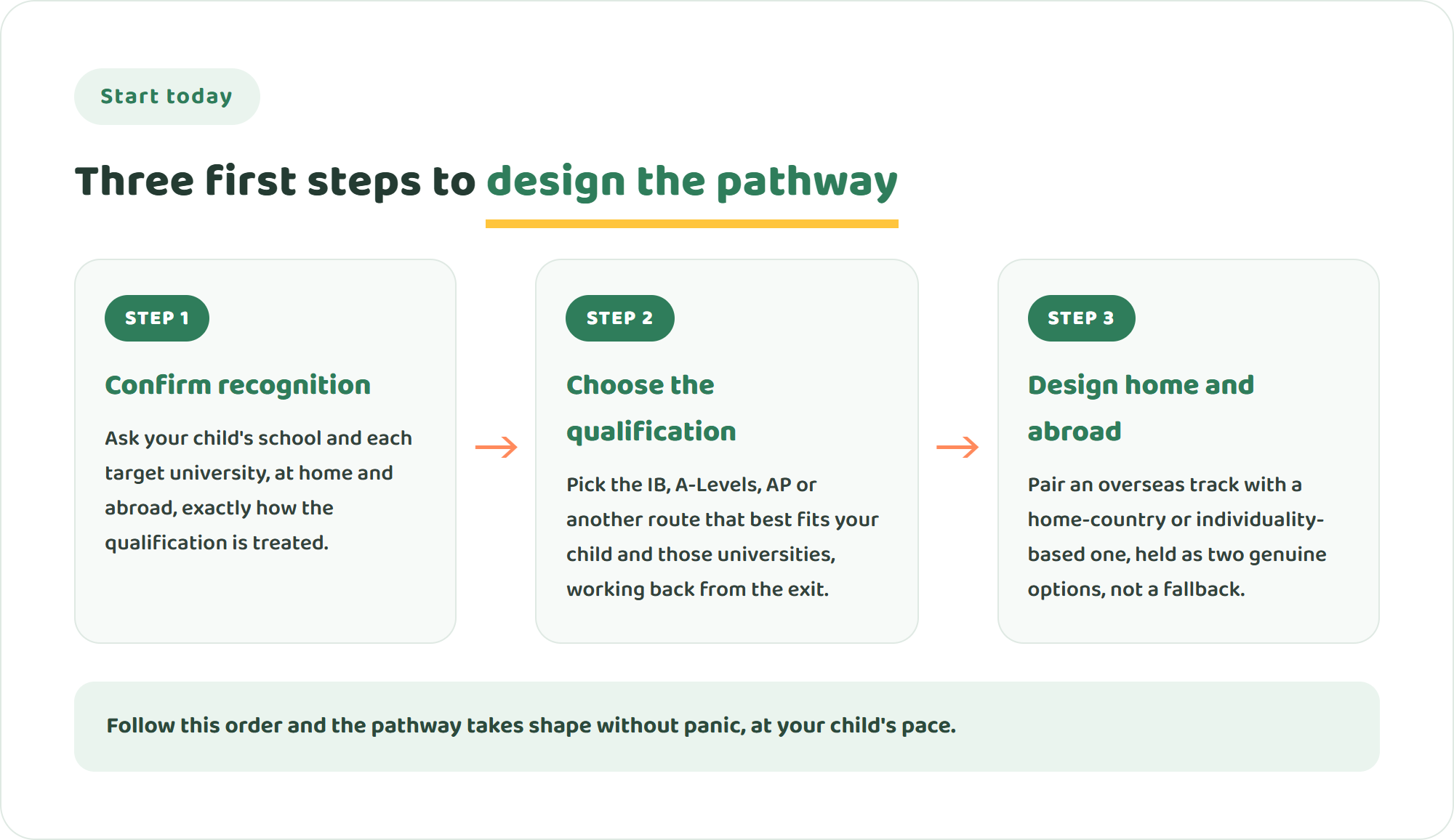
STEP 1 is to confirm recognition: ask your child’s school and each target university, at home and abroad, exactly how the qualification is treated. STEP 2 is to choose the qualification that best matches your child and those universities — IB, A-Levels, AP or another — working backward from the exit and the timing. STEP 3 is to design a home-and-abroad plan: pair an overseas track with a home-country or individuality-based one, held not as a fallback but as two genuine options. Follow this order and the pathway takes shape without panic.
Frequently asked questions
Honestly — is international school worth it?
It can be, but not automatically. The value depends on whether one of the three graduate routes — university abroad, university at home, or a beyond-the-exam-race pathway — is genuinely open for your child, and that comes from designing the exit early rather than trusting the school’s name. Families who confirm recognition and plan the pathway tend to get far more from the same fees.
What really happens to international school graduates?
Broadly, they move along one of three routes: overseas universities via international qualifications like the IB or A-Levels; home-country universities, where recognition varies by country and institution and must be checked; or individuality-based admissions built on a portfolio and projects. Outcomes differ widely by school, qualification and how deliberately the family planned, so treat any single success story with care.
Is it worth it if we might move back home or to another country?
Often yes, but mobility is exactly where planning pays off. Recognition of an international qualification varies between, say, Singapore, Malaysia, the Philippines and Japan, so a pathway that looks strong in one place may need extra steps in another. Confirm the rules with target universities in each country you might land in, ideally before a move is finalised.
Can it be worth it if my child’s English isn’t strong yet?
Yes. Some beyond-the-exam-race online international schools are designed around home-language support, so a child meets English gradually while still building toward home-and-abroad pathways. Choose a place that treats English as something to grow into rather than an entry requirement, and even a child new to it can begin with confidence.
From “is it worth it?” to “here’s how we’ll get there.”
Choosing an international school never had to mean gambling on an uncertain payoff. Get clear on the qualification facts, design the exit from your child’s individuality rather than a ranked score, and both universities at home and universities abroad come within reach in a way that fits who your child actually is. Most of the anxiety in “is it worth it?” is really missing information. Confirm the facts one by one, act in order, and the question quietly turns into a plan.
NIJIN GLOBAL ACADEMY opens in September 2027. We’ll share how our learning works — beyond the exam race, within-reach pricing, and connection with the world through small-group dialogue — along with our approach to designing home-and-abroad pathways from a child’s individuality, and first-cohort enrolment news, straight to your inbox. Let’s widen your child’s future options, together.
Honest Answers to Your Worries — related reading
- Will My Child Lose Their Mother Tongue?
- The Honest Pros and Cons of International School
- Disadvantages of Bilingualism in Childhood: Myths vs Research
- Who Regrets International School — and Who Doesn’t
- International School Special Needs: What to Look For
- International School vs Local School: How to Decide
- Does International School Hurt Your Child’s Home Language?
- When Your Child Is Struggling at International School
- Do International Schools Make Children Fluent in English?
- Should I Send My Child to International School?
- Transfer From a Local School to an International School
- Disadvantages of Early English Education: What Research Says
- What Happens to International School Graduates