If you searched for the disadvantages of bilingualism in childhood, something is probably weighing on you. Maybe you’re raising your child across two languages in Singapore, Malaysia, the Philippines, or elsewhere in Asia, and you’ve started to wonder: “What if they end up half-good at both, and fluent in neither?” “My child seems a little behind in each language compared to their monolingual friends.” Because you love the child growing up between two languages, you’re carrying a worry that’s hard to settle.
Quick answer: bilingualism itself is not what makes a child fall behind
- The fear that a child ends up “half-good at both languages” is common, but the research does not support bilingualism itself as the cause.
- What actually causes a child to fall behind in both languages comes down to four structural causes, which this article sets out one by one.
- At home, quality of dialogue beats sheer quantity — and keeping the mother tongue as the base is the practical starting point.
- NIJIN GLOBAL ACADEMY (NGA) is an online international school beyond the exam-score race, opening in September 2027, operated by NIJIN Inc., for children aged 6–18 across Asia and Oceania. Small-group dialogue that keeps the mother tongue as the base is one option to weigh. About NGA →
Here is the honest short version. A few disadvantages of bilingualism in childhood are real and measurable — but they are narrow, temporary, and far smaller than the internet suggests. Most frightening claims trace back to research since overturned, or to a label modern linguistics has largely abandoned. And almost everything that genuinely goes wrong is structural: it comes from how the environment is arranged, not from your child’s mind. Below we separate the myths, the real-but-small disadvantages, and the structural causes you can act on — then get practical about home, school, and when to seek help.
The disadvantages of bilingualism in childhood: myths versus what research says
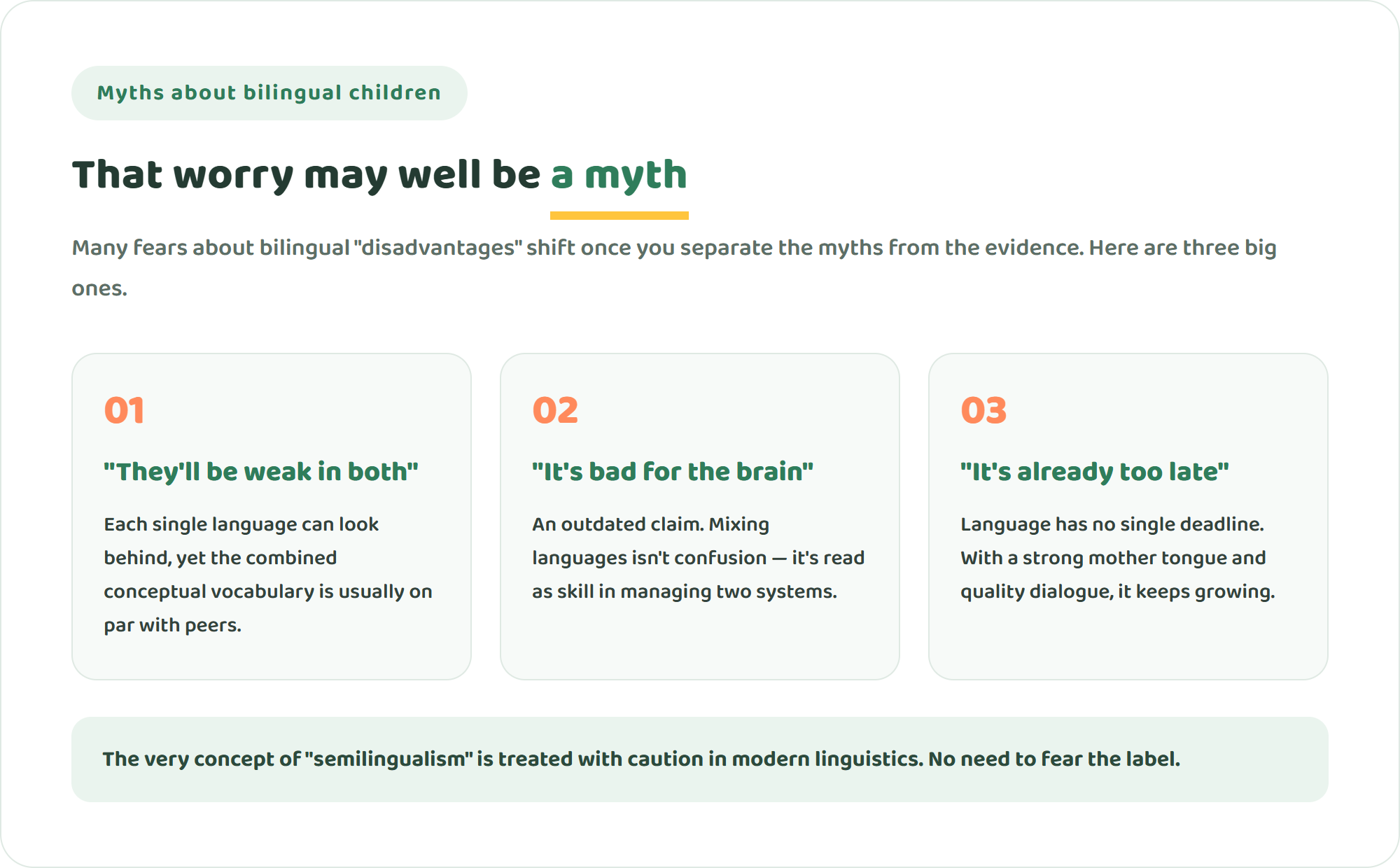
Start with the words. For decades, worries about bilingual children clustered around a now-contested label, “semilingualism,” used for a child who supposedly hasn’t reached an age-appropriate level in either language. Here’s the first thing worth knowing: that concept has been strongly criticised in modern linguistics. It originated in 1960s Scandinavia, where the Swedish researcher Hansegård applied it to minority-language children; researchers later argued it lacked scientific grounding and worked as a stigmatising, deficit-focused label. By around 2000, work by MacSwan and others concluded the phenomenon had never been convincingly demonstrated. The Canadian linguist Jim Cummins, among others, pushed the field away from it. If a “disadvantage” you’ve read about traces back to that idea, treat it with real caution.
The same goes for the old belief that bilingualism “confuses” a child or is “bad for the brain.” Contemporary research does not support it. Code-switching isn’t confusion; it reads as skill in managing two systems, and infants raised with two languages can distinguish them within their first months. So the real question isn’t “are there disadvantages?” but “which worries are myths, and which are challenges I can plan for?”
What research does document as a bilingual disadvantage
Honesty cuts both ways. Studies repeatedly find that bilingual children score lower on vocabulary tests within each single language than monolingual peers. In one widely cited summary by Ellen Bialystok and colleagues, 963 children aged five to nine — 421 monolingual, 542 bilingual — were compared on a picture vocabulary test, and the monolingual group scored higher at every age. Adult bilinguals also show slightly slower word retrieval and lower verbal-fluency scores. That is the documented bilingual disadvantage, and pretending otherwise would be dishonest.
But the fine print changes everything. These are single-language measures; counted across both languages, a bilingual child’s total conceptual vocabulary is typically on par with peers, simply distributed across two systems. And a 2024 review by Dentella, Masullo and Leivada analysed 39 studies, found roughly equal numbers of bilingual advantages and disadvantages, and argued they are two sides of one trade-off rather than a verdict — every population in their data showed both. The honest conclusion is neither “bilingualism is bad” nor “bilingualism is a superpower,” and none of it predicts your individual child.
BICS and CALP — sounding fluent is not the same as thinking in a language
This is the most useful distinction for a worried parent. Educators separate the conversational language of the playground (BICS) from the academic language used to study and think abstractly (CALP). In the framework popularised by Cummins, conversational fluency typically arrives within one to two years, while academic language takes roughly five to seven. Rough guides, and children vary widely.
Misreading that gap causes real harm. A summary from the second-language research centre at the University of Hawai’i notes that confusing playground fluency (about two years) with academic proficiency (five to seven years) led to children being misdiagnosed with learning disabilities when all they needed was time — and to the opposite error, where a genuine difficulty is waved away as “just bilingualism.” Both come from measuring a two-language child with a one-language ruler. So when your ten-year-old chats easily yet struggles to explain their reasoning in writing, the likeliest explanation isn’t a disadvantage of bilingualism at all. It’s a timeline.
Why the fear grows — and what it feels like from the inside
Search the disadvantages of bilingual education at midnight and you will not come away reassured. Worth naming why — not to add to the fear, but to defuse it.
Four reasons the fear takes hold
The label has no edges. There is no diagnostic threshold for “semilingual.” When something has no definition yet gets discussed in absolutes — “by then it’s too late” — you can never check whether it applies to your child, and formless things are the frightening ones. The evidence you find is skewed, too: families for whom bilingualism went smoothly don’t write blog posts, so the internet’s sample is made almost entirely of hard cases. That’s a sampling artefact, not a probability.
The feedback loop is years long. Academic language takes five to seven years to mature, so you cannot know whether this year’s choices were right until several years from now — and that waiting is itself the anxiety. Finally, worry turns into self-blame: “we moved at the wrong age,” “I dropped my own language at home because I thought English mattered more.” A child’s language is tangled up with a parent’s decisions in a way few other worries are. It shouldn’t curdle into guilt; you made reasonable choices with the information you had.
What it feels like for the child
Parents aren’t the only ones who find this hard. Children growing up between two languages often go through a stretch that genuinely hurts, and they rarely have words for it. What they describe later sounds like this: having a thought and finding that neither language will carry it. Sitting through a class discussion feeling like the only one outside the conversation. Being told the home language sounds “off” at home and the school language sounds “off” at school — belonging fully to neither. And the weight of “but you’re bilingual, you must be able to say it,” which turns a strength into an expectation they keep failing.
The most valuable thing an adult can do is specific: never let language ability stand in for intelligence or worth. A child who can’t find the word isn’t a child who isn’t thinking — it’s a child whose thinking has outrun their vocabulary, a completely different problem with a completely different feeling attached. Saying so out loud (“the fact that you have something to say proves you’re thinking; the words will catch up”) changes what the difficulty means to them.
Three ways to loosen the fear’s grip
First, this is a description, not a diagnosis — it names how a child looks at one moment, and that changes with environment and interaction. Second, measured one language at a time, every bilingual child looks behind; don’t mistake a measurement problem for an ability problem. Third, there is no deadline — second-language research suggests that while pronunciation is more age-sensitive, older learners often acquire vocabulary, grammar and literacy more efficiently, precisely because they lean on an established first language. And if you’re reading this at 1 a.m. with a knot in your stomach: stop searching after ten more minutes, and spend those ten minutes talking with your child instead. Searching will not give you an answer. Conversation always gives you something.
What actually causes a child to fall behind in both languages — four structural causes
The worry that “my child seems slower in both languages” comes from somewhere real. It’s usually not about ability — it’s about the structure of the environment. Four causes matter, and each points at its own remedy.
Cause 1: the environment switches before the first language has roots
The most frequently cited risk is timing. When the dominant language of daily life changes abruptly — a move abroad, a switch to an English-medium school before primary — and the first language hasn’t developed enough depth to carry abstract thought, the scaffolding is unsettled and both languages can wobble. This is not an argument against moving. Families who deliberately keep the home language rich through the transition see a much smaller dip; one parent’s account of relocating to the UK with a three-and-a-half-year-old describes the move compounding with reduced home-language use, exactly the combination to avoid. When the environment changes, lean harder into the home language, not away from it.
Cause 2: too little input, and too little of the right kind
A day has 24 hours, and splitting it across two languages means less exposure to each. Jürgen Meisel, a Hamburg-based researcher who has advised bilingual families for over three decades, suggests native-like competence generally needs something on the order of 20–30% of a child’s daily engagement per language — a rule of thumb, not a hard threshold. His more important point: quality of input matters more than the arithmetic of hours. Where parents interact consistently, a bilingual child can accumulate more meaningful input per language than a monolingual child largely left alone. The risk isn’t that two languages divide the day; it’s that neither gets enough genuine, responsive conversation.
Cause 3: a literacy gap opens up
This is the cause most families overlook, and the most consequential. Conversation develops fairly naturally; academic language deepens through reading and writing. A child in a local school abroad may have no structured route to literacy in the home language at all, and a child in an English-medium school in Singapore or Manila may quietly fall behind in written Mandarin, Malay, Tagalog or Japanese while nobody tracks it. Language education generally holds that literacy in the first language transfers and becomes the foundation for literacy and academic achievement in the second — so a gap in one quietly caps the other.
Cause 4: only one language ever gets measured
The last cause sits with the adults. Assessments are almost always administered in a single language, which understates a bilingual child’s ability and has historically produced both over-diagnosis and under-diagnosis of learning difficulties. Research by Cummins and others describes the mother tongue and a second language not as separate containers but as a common underlying proficiency — a shared foundation beneath the surface. Thinking skills built in a strong first language transfer to the second, which is why protecting the home language is one of the smartest ways to strengthen the newer one — a link we explore in raising a bilingual child without losing the mother tongue.
This is a societal pattern too. Among Chinese Singaporean students, the proportion from predominantly English-speaking homes rose from around 28% in 1991 to roughly 59% by 2010, and a 2020 Institute of Policy Studies survey found over 61% of parents aged 26–35 used English most often with their children. A mother tongue can become a school subject rather than a home language within one generation — which is why deliberate choices at home matter so much.
What you can do at home — quality dialogue beats sheer quantity
This is the most important part, and you don’t need to be a linguist or spend money. The guiding idea is quality of dialogue over quantity of words: language deepens when a child uses it in conversations that carry real meaning, not when words are drilled in.
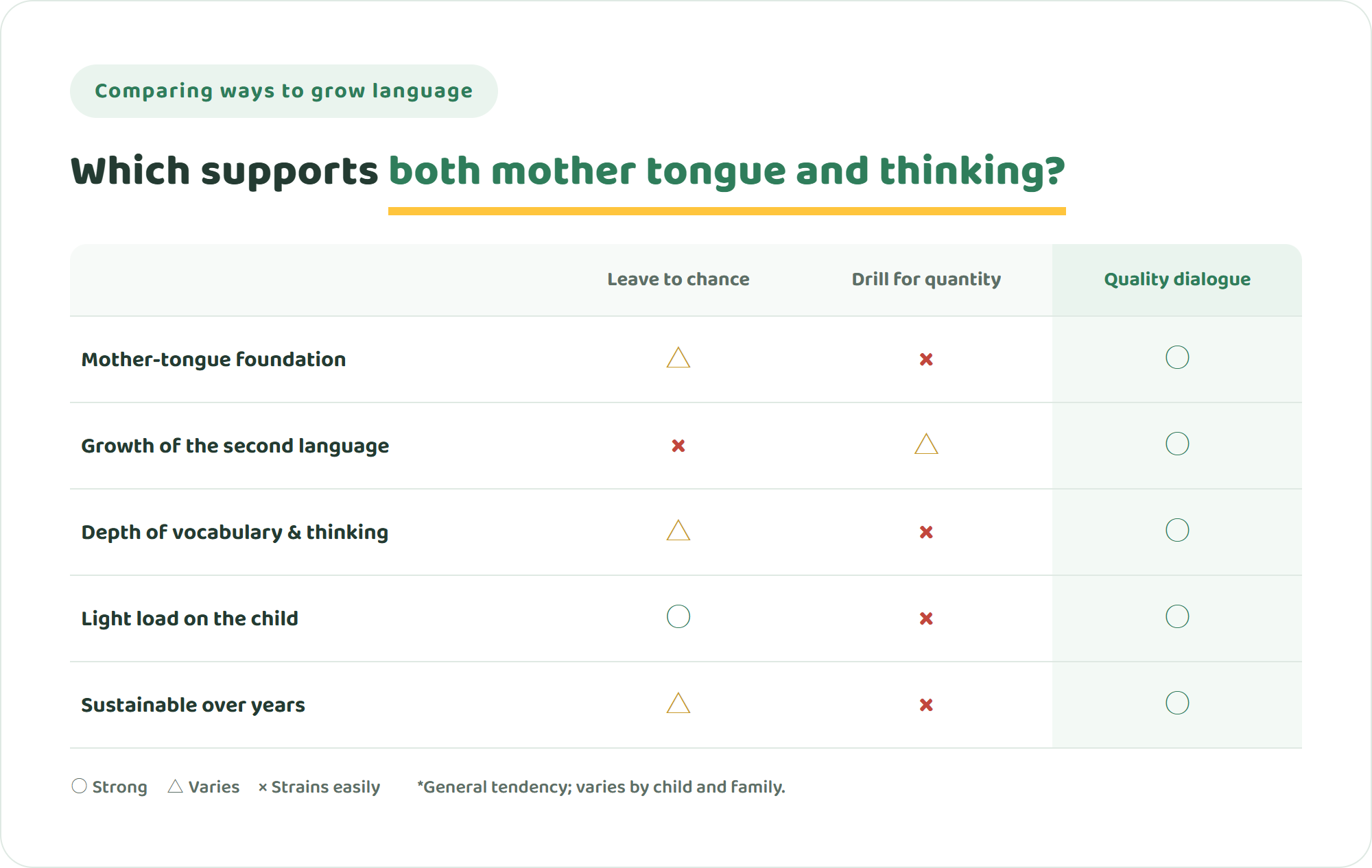
As the table shows, both “leave it to chance” and “drill for quantity” strain somewhere. What works sits between them, in four practical moves.
1. Protect the mother tongue on purpose
Treat the home language as the foundation: a first language deep enough to discuss feelings and abstract ideas is what the second stacks onto. The common, well-intentioned mistake is switching to English at home “for their sake.” When a parent speaks a language they’re less fluent in, the depth of the conversation drops — and depth is the whole point. Speak to your child in the language you can be most fully yourself in. It also helps to make the household’s language pattern explicit rather than accidental — one parent, one language; home language indoors and the local language outside. What matters is not perfection but consistency, and having at least one language in which real conversation is possible. For Japanese-heritage families abroad who worry about keeping Japanese alive, a place like Tomodachi Japan can help hold that base steady.
2. Ten minutes of real dialogue a day
Don’t stop at “what colour is this?” — go one step deeper with “why do you think so?” The time a child spends putting their own thoughts into words is what grows language from the roots, and the most reliable way to make it happen is to fix ten minutes of one-to-one conversation into the day. Frequency beats duration. Prompts that reliably work: “What was the best part of today — and why was it the best part?” “What do you think happens next?” Asking a child to give reasons and imagine consequences is precisely the bridge from conversational to academic language. Apply the same idea to reading: after the book, add one exchange — “which part did you like?” That single extra turn separates reading to a child from reading with one.
3. What to prioritise at each age
Before school, the priority is conversational richness in the home language: read aloud, narrate daily life, put feelings and reasons into words. The second language only needs to be present and enjoyable. Primary years are where literacy in the home language must be deliberate — reading real texts, writing opinions and reasons, a short diary or letters, moving gradually from reading explanatory texts to producing their own. With that foundation, academic language in the second language has something to stand on. Teenage years are about identity and interest: give them somewhere to argue a real position and be taken seriously by peers, in either language. Whether a teenager comes to feel proud of growing up between two languages, rather than defective in both, shapes their relationship with language for years.
4. Work with the school — and know when to ask a professional
You don’t have to carry this alone. Tell the school explicitly that your family uses another language at home and your child’s academic language is still developing. That one conversation often shifts a teacher’s mental model from “a child who is behind” to “a child building two languages,” which changes how support is offered.
Then watch for the signals that warrant professional input rather than patience: comprehension not growing in either language (not just expression), everyday communication itself breaking down, any concern about hearing, or no change over a period of years. A speech-language therapist or developmental specialist is the right port of call — worth consulting rather than guessing, since the same surface signs can have very different causes. Conversely, if your child understands well and communicates comfortably day to day, you are almost certainly in the territory that time and conversation resolve.
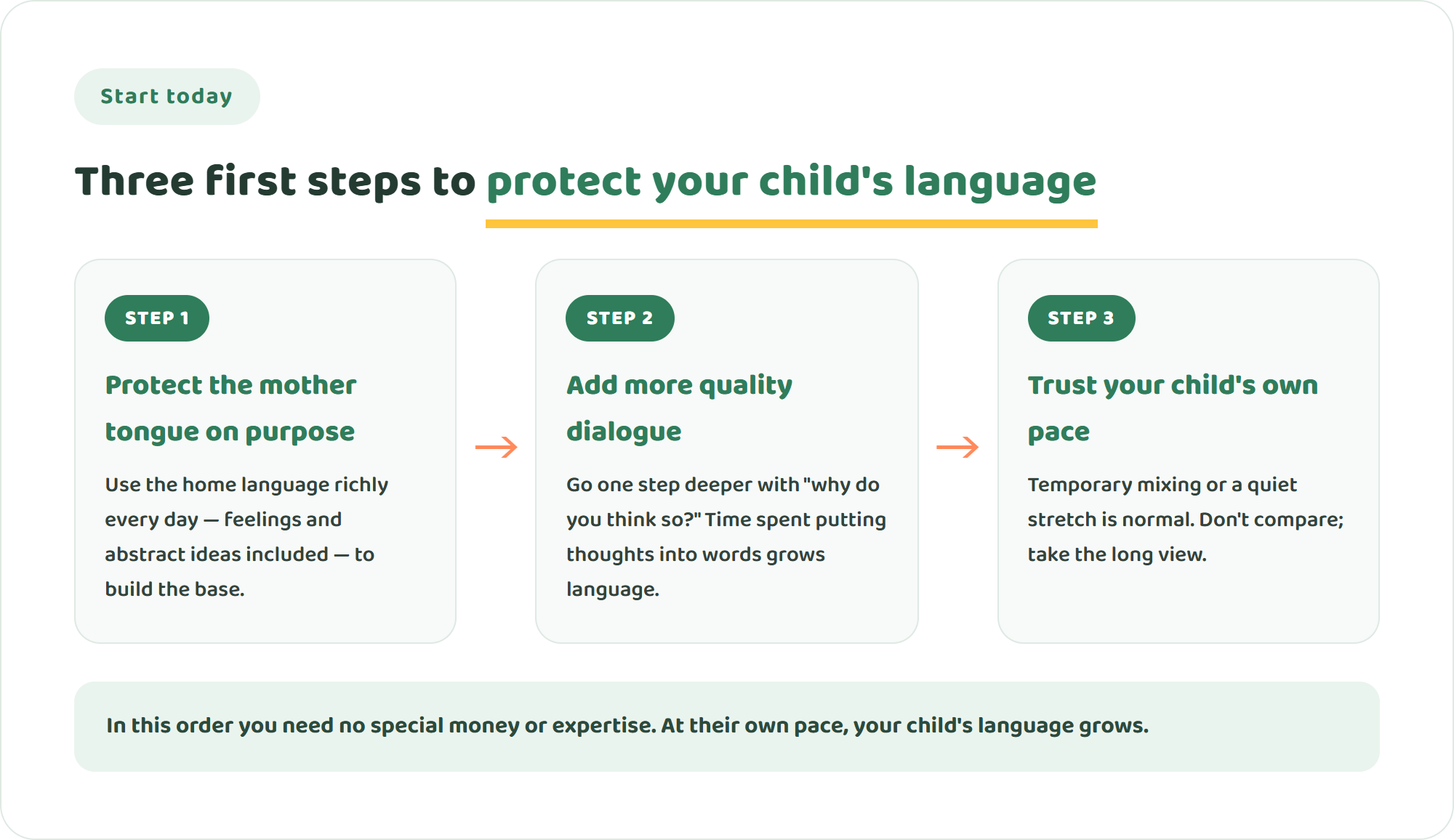
Underneath all four sits one habit: trust your child’s pace. Temporary mixing or a quiet stretch is a normal part of development, not a failure. Stop comparing them to other children and compare them to themselves six months ago. The growth is there.
A third option — small-group dialogue that keeps the mother tongue as the base
What if that same “quality dialogue, mother tongue as the base” approach could happen not only at home but in the learning setting too? That’s where a small-group online international school like our NIJIN GLOBAL ACADEMY (NGA) can be one option to weigh. NGA is an online international school beyond the exam-score race, opening in September 2027, operated by NIJIN Inc., for children aged 6 to 18 across Asia and Oceania. NIJIN Academy, the alternative school we run in Japan, already has over 900 children learning with us.
What we hold onto is precisely the idea that language grows through quality dialogue, not sheer volume. Rather than blasting a large class with an “English shower,” we keep groups small, ask “what do you think?”, and make sure each child has time to speak in their own words. Instead of treating English as an entry requirement, we respect the mother tongue as the foundation and connect each child to the world at their own pace. We haven’t opened yet, so we have no track record to point to, and in-person schools have real strengths of their own. It is not a cure-all.
If this article leaves you with one conviction — that you don’t have to trade away the mother tongue to gain English — carry it into how you compare schools. Read the pros and cons of international school and who regrets international school and who doesn’t; if you’re choosing between international and local, this comparison may help. And since we’re aiming for tuition around one-fifth of an on-campus international school, is international school too expensive? is worth reading alongside it.
Frequently asked questions
What are the real disadvantages of bilingualism in childhood?
Two are genuinely documented: a smaller vocabulary within each single language during the early years, and slightly slower word retrieval. Both are narrow, and neither shows up when you count a child’s knowledge across both languages together. Everything else commonly listed — confusion, lower intelligence, permanent delay — is not supported by contemporary research. Recent work also argues that bilingual advantages and disadvantages are trade-offs that offset each other across tasks, rather than a net verdict either way.
Are the disadvantages of bilingual education different from a bilingual upbringing?
Somewhat. Concerns about bilingual education usually centre on programme design — how much instruction happens in each language, and for how long — rather than on the child. Large-scale reviews have generally found well-designed dual-language programmes produce strong long-term academic outcomes, with students typically needing several years of schooling before matching peers in the second language. Where a disadvantage exists, it’s usually a programme that switches too fast, not bilingualism itself.
Is bilingualism bad for the brain, or does it lower intelligence?
No. The idea that two languages “confuse” a child or reduce intelligence reflects outdated research that later studies have not supported. Two languages sit on a shared underlying foundation, and skills built in one transfer to the other. Mixing languages is a sign of managing two systems, not a defect — infants raised bilingually can distinguish their two languages within months of birth.
Is “semilingual” a discriminatory term?
It isn’t formally classified as one, but the scholarly assessment of it is predominantly negative and specialists increasingly avoid it. It began as a way of describing minority-language children denied the chance to develop their first language, then drifted into implying that learning two languages is itself dangerous — and ended up labelling individual children as deficient. If the word has been used about your family and it stung, that reaction was warranted.
Will my child lose their mother tongue at an English-medium school?
It’s a real risk only if the home language is left to chance — and one you can plan around. Use the mother tongue richly at home, including for feelings and abstract topics, through read-alouds and open-ended conversation. Singapore’s own data shows how quickly a heritage language can shift from home language to school subject, so families in English-dominant settings need to build home-language time in deliberately.
My child mixes both languages in one sentence. Is that a warning sign?
Usually not. Code-switching is widely read as evidence of flexible control over two systems rather than confusion, and it typically sorts itself out as the languages mature. Correcting it sharply tends to make children speak less; celebrating that they got their meaning across tends to make both languages grow.
My child is already in primary school — is it too late?
It isn’t. Language development has no single “too late” deadline, and older learners often pick up vocabulary, grammar and literacy more efficiently because they build on an established first language. At any age, deep dialogue in the mother tongue plus quality exposure to the second language keeps both growing.
How do I tell a bilingual delay from a genuine language disorder?
The most useful distinction is comprehension. A child in normal bilingual development generally understands well even when production lags, and communicates comfortably in daily life. Signs worth professional assessment are comprehension not growing in either language, everyday communication breaking down, hearing concerns, or no progress over years. Don’t self-diagnose in either direction — both over-diagnosis and dismissing a real difficulty as “just bilingualism” cause harm.
Where can I read the actual research?
There is little recent research defending “semilingualism” as a concept; the more informative literature is the critique of it, along with Cummins’s work on conversational versus academic language, common underlying proficiency, and the threshold hypothesis. University second-language research centres and education-authority guidance for multilingual learners are accessible starting points. Treat all of it as frameworks and hypotheses rather than settled fact.
Not “incomplete” — a language still growing.
A child growing up between two languages isn’t “lacking” anything; they’re in the middle of growing. You don’t need to fear the label of “disadvantage” or “semilingual.” With the mother tongue as the base, quality dialogue over quantity, and respect for your child’s own pace, two languages can become their wings. And if you change one thing after this article, make it tonight’s ten minutes: in the language you speak most fully, ask your child what they think about something — and then ask why. Those ten minutes will do more than any amount of searching.
NIJIN GLOBAL ACADEMY opens in September 2027. We’ll share how our learning works — beyond the exam-score race, genuine small-group dialogue, and a design that respects the mother tongue — along with first-cohort enrolment news, straight to your inbox. Let’s keep believing in the possibilities of your child’s language, together.
Honest Answers to Your Worries — related reading
- Will My Child Lose Their Mother Tongue?
- The Honest Pros and Cons of International School
- Who Regrets International School — and Who Doesn’t
- International School Special Needs: What to Look For
- International School vs Local School: How to Decide
- Does International School Hurt Your Child’s Home Language?
- When Your Child Is Struggling at International School
- Do International Schools Make Children Fluent in English?
- Is International School Worth It? What Happens to Graduates
- Should I Send My Child to International School?
- Transfer From a Local School to an International School
- Disadvantages of Early English Education: What Research Says
- What Happens to International School Graduates