
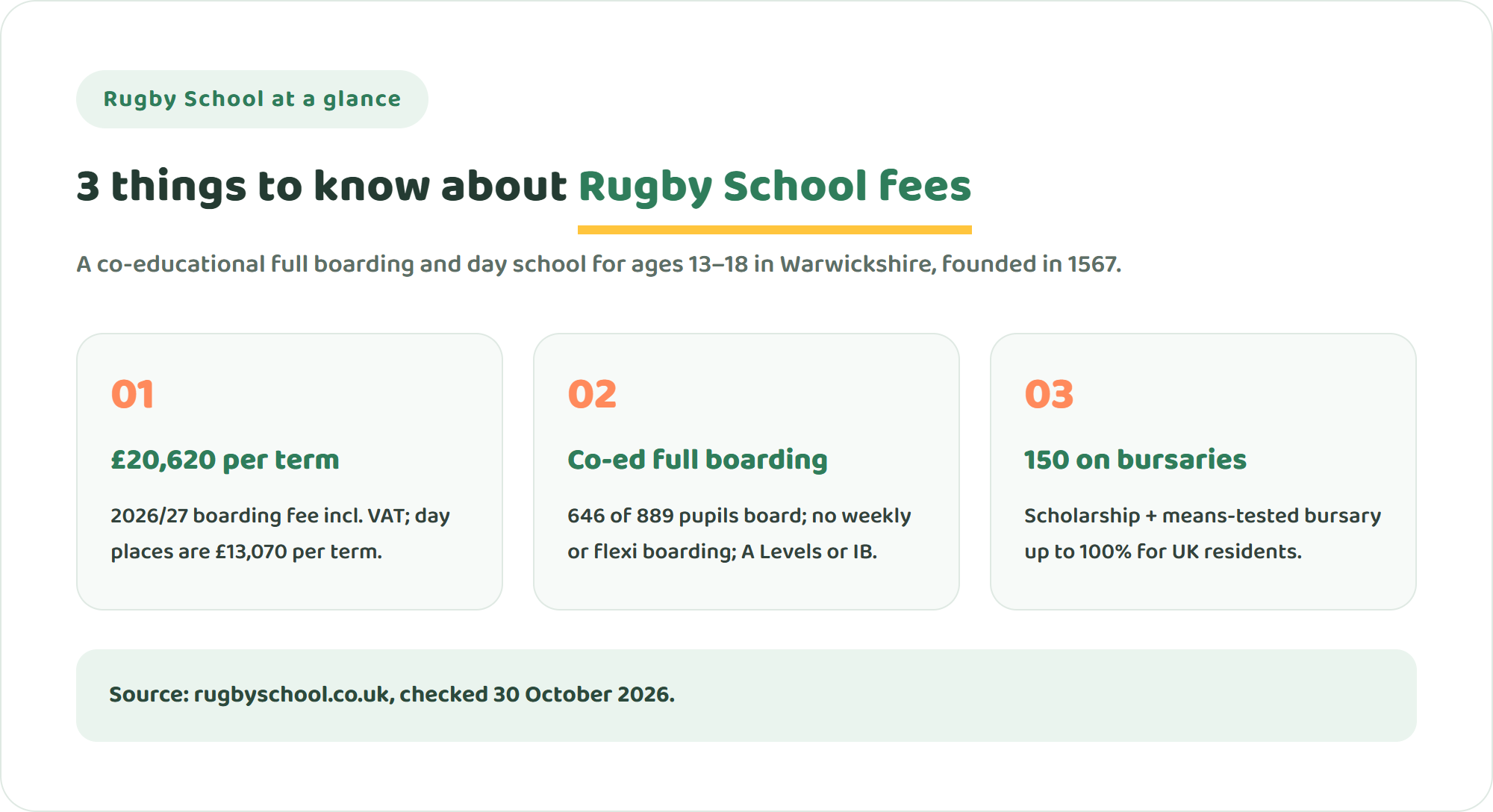
Rugby School fees for 2026–27 are £20,620 per term for boarders (£61,860 a year) and £13,070 per term for day pupils (£39,210 a year), both inclusive of VAT (official fees list, checked 30 October 2026). On top of the termly fee, a new pupil pays a £300 registration fee and a £2,500 entrance fee, half of which is credited back after the first term; families whose normal residence is outside the UK also pay an additional deposit of one term’s fees in advance. Music tuition, public exam entries, textbooks, trips and other extras are billed separately.
If you searched “Rugby School fees”, “Rugby School fees per term” or “Rugby School admissions”, you probably want three things: the real numbers including the one-off and recurring extras, a clear picture of how and when children get in at 13+ and 16+, and an honest sense of who this co-educational full-boarding school suits. This page answers those questions from Rugby’s official website, compares it with Harrow School and Eton College using their official 2026–27 figures, and shows — inside the same table — how NIJIN GLOBAL ACADEMY (NGA), an online international school for ages 6–18 opening in September 2027, differs as a very different kind of option.
The short answer: who Rugby School suits — and who it doesn’t
- Suits: families who want a genuinely co-educational full boarding school. Of Rugby’s 889 pupils, 646 board, and the school says it offers “full-boarding rather than flexi or weekly boarding” — a seven-day-a-week community rather than a Monday-to-Friday one.
- Suits: Sixth Formers who want a real choice between A Levels and the IB Diploma. Rugby offers both routes in its Sixth Form, which it calls “The Twenty (XX)”, and takes 50–60 new students at 16+ each year.
- Suits: children who are strong outside the classroom as well as in it. The 2025 ISI inspection gave Rugby a “significant strength” for co-curricular provision, something the school says roughly one school in ten receives.
- Suits: UK families who could not pay the full fee. 150 pupils currently hold means-tested bursaries, and scholarship holders can combine their award with a means-tested bursary of up to 100% of fees, including boarding.
- Suits: families already in the Rugby School Group. Pupils joining from a group prep school on the Boarding Pathway get a 10% discount on the termly fee, and Rugby School Japan and Rugby School Thailand families will recognise the “Whole Person, Whole Point” ethos.
- Harder fit: families who want weekly or flexi boarding, or a day school close to London. Rugby is in Warwickshire, about 90 minutes by car from Heathrow, and its day places (243 pupils) are a minority.
- Harder fit: families abroad who need financial help. The scholarships page says the means-tested top-up of up to 100% is for UK residents, and overseas families pay an extra term’s fees as a deposit plus international charges.
- Harder fit: children still learning English. Overseas applicants must supply a UKiset report, and the entrance tests are in English, maths and reasoning.
What Rugby School is
Rugby School is an independent co-educational boarding and day school for ages 13 to 18 in the town of Rugby, Warwickshire, in the English Midlands. According to the school’s history page it was founded in 1567 by the will of Lawrence Sheriff, grocer and spice merchant to Queen Elizabeth I; Thomas Arnold was Head Master from 1828 to 1842, and in 1823 a pupil, William Webb Ellis, is credited with picking up the ball and running with it — the origin of rugby football. The school welcomed its first three girls in 1975 and appointed its first Head Girl in 1995; today it describes itself as “the country’s co-ed full boarding school of choice”. The current Head Master is Gareth Parker-Jones.
The admissions overview gives the school’s size as 889 pupils, of whom 646 are boarders — so roughly three in four pupils board, and the remaining 243 attend as day pupils from Day Houses. Main entry is at 13+ into Year 9 (which Rugby calls “F block”) and at 16+ into the Sixth Form; occasional places are offered at 14+. In the Sixth Form pupils choose between A Levels and the International Baccalaureate Diploma.
| Item | Rugby School (official information, checked 30 October 2026) |
|---|---|
| School type | Independent co-educational full boarding and day school, Rugby, Warwickshire |
| Founded | 1567, by the will of Lawrence Sheriff |
| Ages | 13–18 (Year 9 to Year 13) |
| Pupils | 889, of whom 646 board (admissions overview) |
| Boarding | Full boarding only — no flexi or weekly boarding |
| Fees 2026–27 | Boarding £20,620 per term; day £13,070 per term; both inclusive of VAT |
| Entry points | 13+ (Year 9), 16+ (Year 12); occasional 14+ places |
| Sixth Form | A Levels or IB Diploma |
| Inspection | ISI 2025: all standards met; “significant strength” for co-curricular provision |
| Financial aid | 150 pupils on means-tested bursaries; scholarships can be topped up to 100% of fees for UK residents |
The Rugby School Group: prep schools, Japan, Thailand and beyond
Rugby School is the founding school of a wider group. Its official pages list four UK prep schools — Bilton Grange, Aysgarth, Old Buckenham Hall and Beaudesert Park — and a family of international schools: Rugby School Thailand (opened 2017 near Bangkok, over 1,200 students aged 2 to 18), Rugby School Japan (launched 2023 in Kashiwa-no-ha, Greater Tokyo, for ages 11 to 18 as day, weekly or full boarders), Rugby School Nigeria (opened September 2025), Rugby School Dubai and Rugby School Hanoi (opened September 2026), with Rugby School Saigon joining in September 2027. The group says senior staff joining an international school “spend time at Rugby School in order to experience how we deliver our Whole Person Whole Point ethos”. This page is about the English school only; the international schools publish their own fees and admissions rules on their own websites, and nothing here applies to them.
How a school week works: full boarding, day pupils and time zones
Rugby describes itself as “a busy, seven-day-a-week boarding school”. Boarders live in their House throughout the term, including weekends; the school does not offer weekly or flexi boarding, so a child who wants to go home every Friday should look elsewhere. Day pupils belong to Day Houses and travel in daily. The year runs in three terms — Advent (autumn), Lent (spring) and Trinity (summer) — and the fees list notes that annual fees are divided equally between the three, with no reduction for Sixth Formers who leave early in Trinity Term after their exams. A detailed daily timetable, and whether there is Saturday morning school, are not published on the pages we checked; ask at an open day. Everything happens in person on UK time, which matters if you are weighing a boarding school in England against a school your child could attend from home — our explainer on how an online international school day works shows the other side of that choice.
Rugby School fees 2026–27 (official, including VAT)
Everything in this section comes from Rugby’s fees page and the linked Fees List 2026/2027, checked on 30 October 2026. The school states that both the boarding and the day fee are inclusive of VAT, which has applied to UK private school fees at 20% since 1 January 2025 — so there is no separate VAT line to add. The annual figures below are our arithmetic (three terms), because the official list quotes termly fees only.
| Pupil type | Per term (inc. VAT) | Per year (3 terms) |
|---|---|---|
| Boarding student | £20,620 | £61,860 |
| Day student | £13,070 | £39,210 |
For context, the school’s previous Fees List 2025/2026 gave £19,640 per term for boarders and £12,450 for day pupils, so the 2026–27 fee is about 5% higher for both. Rugby does not publish a pre-VAT figure, and the fees list does not state what the termly fee includes beyond tuition and (for boarders) board, so a line-by-line “what is included” list is not published on the official site.
One-off charges when your child joins
| Charge | Amount (official fees list 2026/27) |
|---|---|
| Registration fee | £300 including VAT (not payable by Foundationers) |
| Entrance fee | £2,500 (not payable by Foundationers); £1,250 is credited after the first term, and the balance is refundable when the pupil leaves once all bills are settled — or can be left as a donation to Arnold Foundation bursaries |
| Additional deposit (overseas families) | One term’s fees in advance, payable in addition to the entrance fee where the parents’ normal residence is outside the UK; refundable at the end on the same terms |
| Visa compliance fee | One-off £450 plus VAT (£540) for each pupil who needs the school to support a Child Student or Student visa application |
| Rugbeian Society subscription | Lifetime membership charged over the pupil’s time at the school: £911 in total for pupils joining in 2026–27 |
Recurring extras on the termly bill
- International student charge: £90 plus VAT (£108) per term for every international student, whether or not the school sponsors their visa; it covers compliance work and services such as airport guardians. Actual travel costs are charged separately.
- Academic extras: textbooks and revision guides, public exam entries (GCSE, A Level and IB) and field trips where required; materials for Art or Design GCSE and A Level are reviewed with parents if they are expected to exceed £200 in total. Students also bear the cost of lost or seriously damaged laptops and styluses.
- Co-curricular charges: music tuition, LAMDA, dance and sports coaching are priced in a separate booklet, with participation-based charges for the CCF and the Duke of Edinburgh’s Award. The amounts are not published on the official fees page.
- House subs and personal extras: a termly House subscription for social activities, plus dry cleaning, meals out, medication and taxis as incurred; a School Shop account and a tuck-shop (“Stodge”) allowance, set at £30 a term unless parents agree a different figure.
- Optional insurances: personal effects £8.10 per term; fees refund insurance at 0.67% of the termly fee for boarders or 0.86% for day pupils; private healthcare £158 per term (AXA PPP). Personal accident cover, including emergency dental care, is included in the fees.
Discounts, payment and notice
- Sibling discount: 5% off the net termly fee for a third child at Rugby School or Bilton Grange, and 7.5% for a fourth and subsequent child. There is no published discount for a second child.
- Boarding Pathway: a 10% discount on the termly fee for pupils joining from a Rugby School Group prep school on the Boarding Pathway; it cannot be combined with other remissions.
- CEA remissions: awards for parents serving with the Forces or FCDO who receive the Continuity of Education Allowance and whose child joined from a group prep school (details on request from Admissions).
- Fees in advance: a Composition of Fees scheme is available through the Finance Department; payments under it are against fees including VAT. Instalment plans are not described on the official fees list.
- Notice: a full term’s fees are due if a pupil is withdrawn without a full term’s written notice to the Head Master.
What five years at Rugby cost at today’s prices
Using only the official 2026–27 numbers, with no bursary and no fee rises, for a child who joins at 13+ and stays to Year 13 (15 terms):
- Boarder from the UK: 15 × £20,620 = £309,300 in fees, plus £300 registration, the £2,500 entrance fee (of which £1,250 comes back after one term and the rest when the pupil leaves) and the £911 Rugbeian Society subscription — about £310,500 before co-curricular extras, exam fees and trips.
- Day pupil: 15 × £13,070 = £196,050, plus the same £300, £2,500 and £911.
- Boarder whose parents live abroad: £309,300 in fees, plus £300 registration, £2,500 entrance fee, a £20,620 additional deposit (credited or refunded at the end), £540 visa compliance fee and 15 × £108 = £1,620 in international student charges — roughly £334,900 paid out, of which about £21,870 is returnable, before travel, guardianship and extras.
- Two-year international Sixth Form boarder: 6 × £20,620 = £123,720, plus £300, £2,500, £20,620 deposit, £540 and 6 × £108 = £648 — about £148,300 paid out, with the deposit and entrance-fee balance returnable.
Those totals are why many families also price the alternatives: our guide to online vs in-person international school costs sets boarding budgets like these against day and online options.
Rugby School bursaries and scholarships
Rugby’s Access to Financial Support page says the school offers means-tested support for entry at 13 and at 16 through “bespoke programmes” funded by donors and investments rather than fee income, and cites a figure of around £6.8 million a year behind this support. The numbers it publishes are concrete: 150 pupils currently hold means-tested bursaries, there are 323 current scholars, and the school names three routes:
- Arnold Foundation Award: fully funded boarding places for children likely to thrive as boarders, where parents are assessed as eligible for substantial support. 30 current pupils hold one.
- Foundation Award: means-tested funding for day places, for children living within 20 miles of the school. 66 current pupils.
- Scholarships: awarded for excellence in Academic, Art, Computer Science, Design and Technology, Music, Performing Arts and Sport at both 13+ and 16+, plus exceptional awards at the Head Master’s discretion. The scholarships page is explicit that there is “no fee remission for successful scholarship awards”: a scholarship is an honour and a programme, not a discount. What it does do is open the door to a means-tested bursary of up to 100% of boarding or day fees — and the page says this applies to UK residents.
Two practical points. First, the bursary form is sent after you register, and it must be submitted before the subject-specific scholarship application deadline; applications after that may not be assessed until after results are released, and whether a place is held is at the school’s discretion. Second, several things families usually want to know are not published on the official site: qualifying income levels, the average bursary award, and whether non-UK residents can receive any means-tested help beyond the scholarship route. Contact Admissions before you plan around a bursary.
Entry points: 13+, 14+ and 16+ admissions
Rugby’s admissions pages describe a process that “begins early” and recommend visiting well ahead of your child’s proposed year of entry. Open Days listed for the current cycle are Saturday 7 November 2026, Saturday 30 January 2027, Saturday 6 February 2027, Saturday 27 February 2027 and Saturday 13 March 2027. Registration is online at apply.rugbyschool.co.uk, and depending on the entry point the assessment combines online cognitive tests, an interview with a senior member of staff, group activities or academic tasks, and a review of school reports and references.
13+ entry (Year 9)
- Register. The 13+ page gives no registration deadline; boarding families “can apply at any time”, and late applications go to admissions@rugbyschool.net. Registration costs £300.
- Year 6 Assessment Day — Thursday 26 November 2026 for September 2027 entry. Day candidates are invited to this November assessment day in the Advent Term of Year 6: online tests in English, Maths, Verbal Reasoning and Non-Verbal Reasoning, an interview with a senior member of staff and a group activity.
- Boarding candidates can follow the same Year 6 route and then confirm their House in Year 7 through a further interview, or complete both the School place and House assessments in the Lent Term of Year 7; Year 7 candidates were invited on 7 or 9 October in the current cycle and meet a Housemaster or Housemistress as well.
- Scholarship assessments take place in the Advent and Lent terms of Year 8. For September 2027 entry the published dates are Sport on 6 November 2026 (boys) and 27 November 2026 (girls), Music in the week commencing 25 January 2027, Academic on 23 February 2027, Art on 4 March 2027, and Computer Science, Design and Technology and Performing Arts on 5 March 2027. Academic scholarship results are posted on or before Friday 5 March 2027.
Rugby does not use the ISEB Common Pre-Tests or Common Entrance by name on its 13+ page — it runs its own online tests — and it does not publish the number of applicants or places at 13+. Occasional places at 14+ (Year 10) are handled by the Admissions team.
16+ entry (Year 12, Sixth Form)
- Deadlines for September 2027 entry: candidates at schools outside the UK must apply by Friday 21 August 2026 (the international page states “the last Friday in August”); UK candidates by Friday 18 September 2026. Applications open when the child is in Year 11 (Year 10 for international candidates).
- Assessment day — Tuesday 3 or Thursday 5 November 2026: tests in English, Maths and one subject of the candidate’s choice, Verbal and Non-Verbal Reasoning, online cognitive assessments and a Sixth Form interview. Year 12 applicants, including those from overseas, must attend at Rugby.
- Offers in December of Year 11, awarded on academic merit and co-curricular potential. Rugby takes 50–60 new students at 16+ each year; day and boarding candidates follow the same process and timeline.
- 16+ scholarships are assessed in the Advent Term of Year 11: Performing Arts on 7 October, Art and Design and Technology on 8 October, Sport on 13 October, Computer Science and Music on 3 and 5 November, and Academic (candidates sitting the entrance tests are considered automatically) in November 2026.
The current 16+ page does not restate the GCSE grades required to take up an offer, so offer conditions are not published on the page we checked — ask Admissions for the current minimum grades, especially if your child will sit a non-UK qualification.
International applicants
The international applicants page adds three requirements on top of the UK process: a UKiset report, the appointment of an accredited guardian, and a deposit of one term’s fees in advance alongside the first term’s fees. Year 9 applicants may sit Rugby’s entrance tests overseas under appropriate supervision but are expected to come to Rugby for interviews in Year 7; Year 12 applicants must attend tests and interviews in person, with overseas scholarship interviews normally held the day after the entrance tests. The school supports Child Student and Student visa applications (the £540 visa compliance fee above), is committed to the UK Agent Quality Framework, and notes that Birmingham Airport is about 20 minutes by rail and Heathrow about 90 minutes by car.
Inspection, qualifications and results
UK independent schools are not “accredited” in the American sense; they are registered and inspected. Rugby’s inspection reports page says the Independent Schools Inspectorate inspected the school in 2025 — the school’s summary gives the visit as 29 April to 1 May 2025 — and found that all required standards were met, awarding a “significant strength” for co-curricular provision, which the school says roughly one in ten schools receive. Earlier ISI compliance reports from 2022 and 2018 are also published.
Pupils take GCSEs, then A Levels or the IB Diploma, all of which universities in the UK and worldwide recognise. The admissions overview states the 2026 results as: at GCSE, “over half of all grades awarded were 9-8” and three-quarters were 9-7; at A Level, “64% of grades were awarded at A*-A”. IB average points and university destinations were not on the pages we checked, so we do not quote them.
Rugby School vs Harrow vs Eton vs NIJIN GLOBAL ACADEMY (official data)
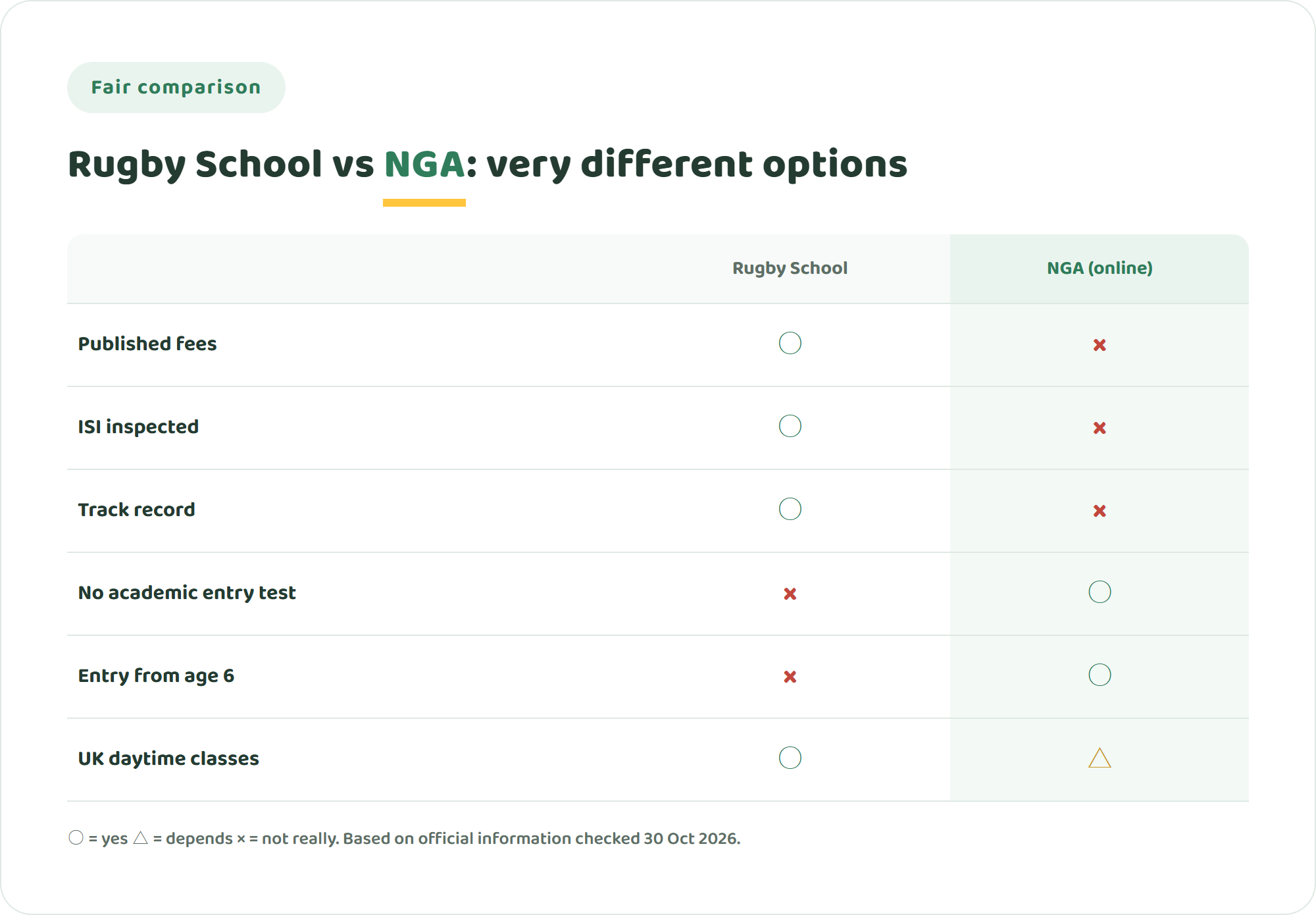
Harrow School and Eton College are the two boarding schools families most often price against Rugby, and both have published their 2026–27 fees; see our Harrow School fees and review and Eton College fees review for the full breakdowns. The obvious difference is that Rugby is co-educational and both Harrow and Eton are boys’ schools. NIJIN GLOBAL ACADEMY is a different kind of option altogether — online, for ages 6–18, and not yet open.
| Rugby School | NIJIN GLOBAL ACADEMY | Harrow School | Eton College | |
|---|---|---|---|---|
| School type | Co-educational full boarding and day school, Warwickshire | Online international school focused on Asia & Oceania; opens September 2027 (planned) | Boys’ full boarding school, London | Boys’ full boarding school, Windsor |
| Ages / entry | 13–18; entry at 13+ and 16+ (occasional 14+) | Ages 6–18 | 13–18; Year 9 and Year 12 entry | 13–18; 13+ and 16+ entry |
| Fees 2026–27 (per term, inc. VAT) | Boarding £20,620 (£61,860 a year); day £13,070 (£39,210 a year) | Not yet published (no enrolment, facility or uniform fees; materials included; sibling discounts) | £21,990 (£65,970 a year) | £21,891 per Half (£65,673 a year) |
| One-off charges | Registration £300; entrance fee £2,500 (£1,250 credited after first term); overseas deposit one term’s fees; visa compliance £540 | No enrolment fee | Registration £450; acceptance fee £1,200 (Y9) / £600 (Y12); deposits £2,400 + £2,400; overseas deposit one term’s fees | Registration £480; acceptance fee £3,840 (£500 refunded on leaving); overseas deposit one term’s fees |
| Visa sponsorship charge | £540 one-off, plus £108 per term international student charge | Not applicable — learn from home | £3,000 a year, payable termly | £3,000 a year, payable termly |
| Curriculum | GCSE; A Levels or IB Diploma | Subjects learned in English, CEFR-based English levels, projects; optional Cambridge IGCSE / A-Level pathway | GCSE and A Level (see official site) | GCSE and A Level (see official site) |
| Classes & time zone | In person, UK; seven-day full boarding | Small live online dialogue groups (about 8); built for Asia–Oceania daytime — may fall outside the day in the Americas or Europe | In person, UK | In person, UK |
| Inspection / qualifications | ISI 2025, all standards met, significant strength in co-curricular; public exams | Not yet accredited; no graduates yet | See official site | See official site |
| Admission | Rugby’s own online tests, interview and group activity (13+); subject tests, reasoning and interview (16+) | No academic entrance exam, no English requirement | Register by 30 September of Year 6; ISEB pre-test, then the Harrow Test | Register by 31 August at the end of Year 5; ISEB pre-test, interview and test in Year 6 |
| Financial aid | 150 pupils on means-tested bursaries; up to 100% with a scholarship (UK residents) | Sibling discounts; tuition not yet published | Means-tested bursaries up to 100%, not for overseas applicants | Means-tested bursaries 5–100% |
Sources: Rugby School fees, Rugby 13+ entry, Rugby 16+ entry, Rugby access to financial support, Harrow School fees and deposits, Eton College school fees and extras — checked 30 October 2026.

Reviews and common concerns, answered honestly
“Worth it” depends on your child and your circumstances. These are the questions parents raise most often about Rugby School, with what the official pages say — and where they fall silent.
“Is Rugby cheaper than Harrow or Eton?”
On the headline boarding fee, yes: £20,620 per term against £21,990 at Harrow and £21,891 at Eton, a difference of roughly £3,800 to £4,100 a year, all inclusive of VAT. Rugby’s one-off charges are also lower (£300 registration and a part-refundable £2,500 entrance fee, against Harrow’s £450 plus £1,200 plus two £2,400 deposits, or Eton’s £480 plus £3,840). For international families the gap widens, because Rugby charges a one-off £540 visa fee and £108 a term, where Harrow and Eton each charge £3,000 a year for visa sponsorship. All three require an extra term’s fees as an overseas deposit. None of this makes Rugby inexpensive — a five-year boarding place is over £300,000 at today’s fees — but the comparison is favourable.
“Is full boarding too much for a 13-year-old?”
Rugby is honest that it is a full boarding school with no weekly or flexi option, and the school describes a seven-day-a-week community as the point, not a drawback. That suits children who want the weekend life of the House — and the 2025 inspectors’ finding that “the school’s co-curricular programme enables pupils to participate at all levels” speaks to how the weekends are filled. It is a poor fit for a child who is clearly happier at home each weekend; in that case a day place (if you live close enough) or a weekly-boarding school is the better comparison. Exeat and half-term dates are published in the school’s term-dates document, which overseas families should read with their guardian arrangements in mind.
“How selective is it?”
Rugby does not publish application or offer numbers at 13+. At 16+ it takes 50–60 new students a year, and its own 2026 results — three-quarters of GCSE grades at 9-7 and 64% of A Level grades at A*-A — show the academic level of the cohort. The entrance tests are Rugby’s own (English, Maths, reasoning, plus one chosen subject at 16+) rather than the ISEB pre-tests used by Harrow and Eton, so a child who has prepared for one route should check the format of the other.
“Can we get financial help from overseas?”
The scholarships page says the means-tested top-up of up to 100% is for UK residents, and the Foundation Award for day places requires living within 20 miles of the school. Nothing on the official pages describes a bursary route for families living abroad, so international families should budget for the full fee, the one-term deposit and the international charges. If cost is the deciding factor, the alternatives section below is the realistic place to look.
“What about the extras and fee rises?”
The fees list is unusually open about extras — exam entries, textbooks, trips, House subs, a £30-a-term tuck allowance and optional insurances are all itemised — but music, LAMDA, dance and sports coaching prices sit in a separate booklet that is not online, so ask for it. Fees rose about 5% from 2025–26 to 2026–27, and the annual fee is split equally across the three terms with no refund for leaving early after exams. Fee-refund insurance (0.67% of the termly boarding fee) is the school’s own suggested cover against an unexpected withdrawal.
Alternatives to Rugby School worth comparing
If co-education and full boarding are the priority, Wellington College and Charterhouse are the schools most families put beside Rugby — see our Wellington College fees and Charterhouse fees pages for their official 2026–27 numbers, or Brighton College fees for a co-educational school with a large day intake. If a boys’ school is acceptable, Harrow and Eton are compared above, and our Winchester College fees review covers a school with a 16+ route for girls. For a London day school at a lower fee, see our Westminster School fees and St Paul’s School fees guides.
NIJIN GLOBAL ACADEMY (NGA) is a different kind of option. It is an online international school for ages 6–18 focused on Asia and Oceania, opening in September 2027 (planned), with free trial classes monthly from September 2026 and pre-opening trial classes in April–May 2027. Its first cohort is 100 students, and it is operated by NIJIN Inc. in Japan, whose alternative school NIJIN Academy has more than 1,000 students. NGA does not rank children by test scores: lessons are small-group live dialogue (classes of about 8), subjects are learned in English with a bilingual English–Japanese mentor, English levels follow the CEFR, and students join social co-creation projects with companies and governments plus international exchange. An optional Cambridge IGCSE / A-Level pathway is listed on the curriculum and timetable page. There is no academic entrance exam and no English requirement; it can run alongside a local school or as the main school, and it travels with the family if they relocate. Tuition is not yet published; NGA says it will be far more affordable than a typical international school, with no enrolment, facility or uniform fees, materials included and sibling discounts.
Be clear about the trade-offs. NGA is not yet open, is not yet accredited and has no graduates or track record. It offers nothing like Rugby’s seven-day boarding community, its playing fields, its Houses or its 450 years of history, and it is not a route to a place in an English boarding school. Its timetable is built for Asia–Oceania daytime, so for families in the UK, Europe or the Americas live classes may fall outside their day — check the timetable against your local time. If your child wants full boarding in England and you can plan from Year 6, Rugby, Wellington and Charterhouse are the schools to compare. If what you actually want is an English-medium international education your child can follow from home — in Tokyo, Bangkok, Singapore or Sydney — without an entrance exam, NGA and the schools in our online international schools compared guide are the right comparison set.
FAQ
How much are Rugby School fees per term?
For 2026–27, Rugby School charges £20,620 per term for boarders and £13,070 per term for day pupils, both inclusive of VAT (official fees list, checked 30 October 2026). Over three terms that is £61,860 a year for boarding and £39,210 for a day place, before extras.
What are the one-off costs of joining Rugby School?
A £300 registration fee and a £2,500 entrance fee, of which £1,250 is credited after the first term and the balance refunded when the pupil leaves once all bills are settled. Families whose normal residence is outside the UK also pay an additional deposit of one term’s fees in advance, and pupils who need visa sponsorship pay a one-off £540 visa compliance fee. Foundationers are exempt from the registration and entrance fees.
Is Rugby School co-educational, and does it offer day places?
Yes. Rugby has been co-educational since its first girls arrived in 1975 and now has 889 pupils, of whom 646 board. Day places exist (243 pupils) but the school offers full boarding only — there is no weekly or flexi boarding.
Can international students apply to Rugby School?
Yes, at 13+ and 16+. Overseas applicants need a UKiset report and an accredited guardian, and pay a deposit of one term’s fees in advance. Year 9 applicants may sit the entrance tests overseas but attend interviews at Rugby in Year 7; Year 12 applicants must attend tests and interviews in person, and those at schools outside the UK must apply by the last Friday in August — 21 August 2026 for September 2027 entry.
Does Rugby School offer scholarships and bursaries?
Scholarships are offered at 13+ and 16+ in Academic, Art, Computer Science, Design and Technology, Music, Performing Arts and Sport, but the school states there is no fee remission attached to them. Scholarship holders who are UK residents can apply for a means-tested bursary of up to 100% of fees, including boarding; 150 pupils currently hold means-tested bursaries, including 30 Arnold Foundation boarders and 66 Foundation Award day pupils. Income thresholds are not published on the official site.
Choosing calmly
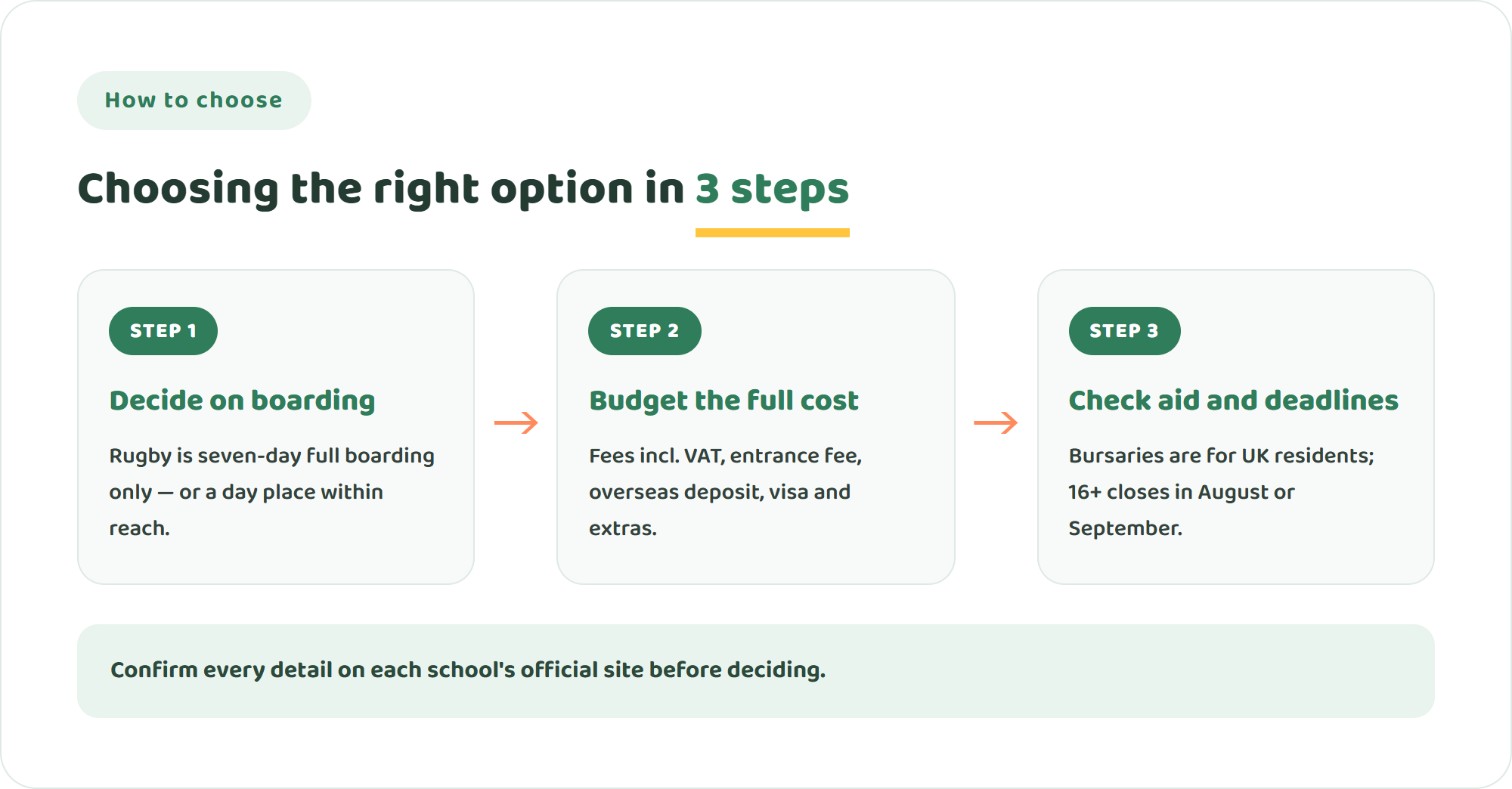
Rugby is a distinctive school — co-educational, fully boarding, with a real choice of A Levels or the IB and a co-curricular programme the inspectors singled out — and applying is a big step for any family, academically, financially and emotionally. The most useful things you can do now are to decide honestly whether seven-day boarding fits your child, to budget the full cost including VAT, deposits and extras, and to check the scholarship and bursary rules against the published deadlines before you register. Whichever school you choose, the right one is the place where your child will be known, stretched and happy.
Tuition and admissions details were checked on the official websites on 30 October 2026. Schools revise fees every year — always confirm on the official site before applying.