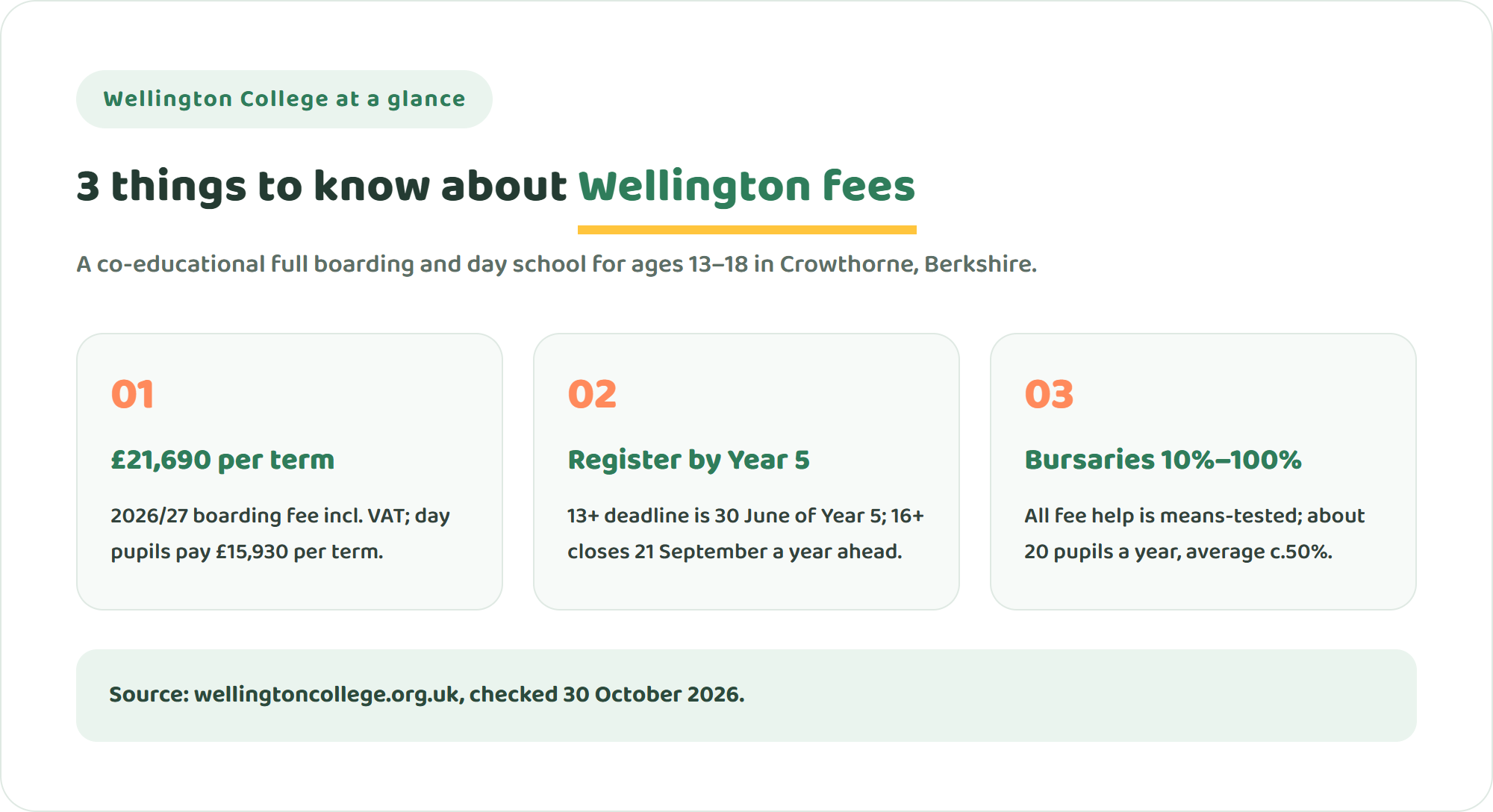
Wellington College fees for 2026/27 are £21,690 per term for boarders (£65,070 a year over three terms) and £15,930 per term for day pupils (£47,790 a year), both including VAT (official site, checked 30 October 2026). The Governors set the fee once a year; the Terms and Conditions divide the annual fee into three equal termly invoices, each due on the first day of term. A non-refundable £400 registration fee applies at 11+, 13+, 14+ and 16+, and an acceptance deposit is payable on accepting a place — the deposit amount is set out in the Acceptance Form rather than on the public fees page.
If you searched “Wellington College fees”, “Wellington College fees per year” or “Wellington College admissions”, you are probably weighing a co-educational full boarding school in Berkshire against London day schools, other boarding schools, or a different kind of schooling altogether. This page sets out the official numbers, how 13+, 14+ and 16+ entry work, what the means-tested fee assistance actually covers, and the honest trade-offs. It compares Wellington with Eton College and Harrow School, and with NIJIN GLOBAL ACADEMY (NGA), an online international school for ages 6–18 that opens in September 2027 and is a very different kind of option. Note that this page is about Wellington College in Crowthorne, England — not Wellington College in New Zealand, and not the international schools in the Wellington College Education network.
The short answer: who Wellington College suits — and who it doesn’t
- Suits: families who want full boarding in a co-educational school. Wellington says about 80% of pupils board and 20% are day pupils, and that it has been 50% boys and 50% girls since 2025. Most boarders go home from Saturday afternoon to Sunday evening.
- Suits: children who will enjoy an academic school that does not select on exam results alone. The selection page says “Selection for entry is not solely based on academic criteria”, and the 13+ process weighs ISEB pre-test scores, references and performance in lessons and problem-solving on an assessment day.
- Suits: Sixth Formers who want a genuine choice between A Levels and the IB Diploma. In 2026 the IB cohort of 79 averaged 39.1 points, and 63% of A Level grades were A*/A.
- Suits: international families applying at 16+. Wellington says about half of its c.60 Sixth Form joiners each year come from international contexts, and it runs the same admissions process for overseas and UK candidates.
- Harder fit: families who need to plan late. The 13+ registration deadline is 30 June of Year 5 — more than three years before entry — and the late routes are described as more competitive with limited House choice.
- Harder fit: families who need a bursary but would pay more than about half of the fee. Fee assistance is means-tested, and the school says an average year sees around 20 pupils admitted with an average award of about 50%.
- Harder fit: a child still learning English. Pupils must be “proficient, if not fluent” in English on arrival; applicants at 16+ whose first language is not English must sit UKiset by 30 September.

What Wellington College is
Wellington College is an independent co-educational boarding and day school for ages 13 to 18 in Crowthorne, Berkshire, set in 400 acres of parkland about an hour west of London. It was founded by Royal Charter in December 1853 as the national memorial to the Duke of Wellington; Queen Victoria laid the foundation stone in 1856 and opened the school in January 1859, and Prince Albert was its first President. Girls were admitted to the Sixth Form in 1975, and the school “started its journey to full co-education in 2006”. The heritage page now describes eight girls’ Houses and one mixed House, with a 50:50 balance of boys and girls.
The school is a charitable trust overseen by a board of Governors, and the Independent Schools Inspectorate (ISI) report of September 2025 lists the Headteacher (the “Master”) as Mr James Dahl. The ISI report counts 16 boarding houses — eight for boys, seven for girls and one Sixth Form house for both — and the houses page lists 18 houses in all, including the day houses. Wellington College Prep, a separate co-educational prep school close by, provides the 11+ route. Wellington College Education, the network founded by the College, runs international schools carrying the Wellington name in Shanghai, Tianjin, Hangzhou, Bangkok, Jakarta, Pune, Qatar, Lagos and Tatu City (Kenya); they are separate schools with their own fees, and nothing on this page applies to them.
| Item | Wellington College (official information, checked 30 October 2026) |
|---|---|
| School type | Independent co-educational full boarding and day school, Crowthorne, Berkshire |
| Ages / years | 13–18 (Third Form / Year 9 to Upper Sixth / Year 13); 11+ route via Wellington College Prep |
| Girls and boys | Co-educational; 50% boys, 50% girls since 2025 |
| Boarding / day | About 80% boarders, 20% day pupils; most boarders go home Saturday afternoon to Sunday |
| Fees 2026/27 | Boarding £21,690 per term; day £15,930 per term; both including VAT |
| Entry points | 11+ (via the Prep), 13+ (c.200 places), 14+ (c.20 places), 16+ (c.60 places) |
| Sixth Form | A Levels (most start with four subjects) or IB Diploma |
| Inspection | ISI, 16–18 September 2025: all Standards met, including the boarding standards |
| Fee assistance | Means-tested, 10%–100% of fees; Prince Albert Foundation fully funded places (10–15 a year) |
Wellington College fees 2026/27 (official, including VAT)
The figures below are from Wellington’s College Fees page, checked on 30 October 2026, which states: “The Governors of Wellington College have set the 2026/27 fees as follows”, with each figure marked “including VAT”. UK private school fees have been subject to 20% VAT since 1 January 2025, so there is no separate VAT line to add. The per-year totals are our arithmetic: the Terms and Conditions say “the annual fees are divided into three equal parts and charged separately on a termly basis, regardless of the length of any term”.
| Pupil type | Per term (incl. VAT) | Per year (3 terms) |
|---|---|---|
| Boarding pupil | £21,690 | £65,070 |
| Day pupil | £15,930 | £47,790 |
Wellington publishes a single boarding rate and a single day rate for all year groups; there is no separate Sixth Form fee on the official page. The 2026/27 figures are the only ones on the fees page, so previous years’ fees are not published there.
One-off charges when your child joins
| Charge | What the official site says |
|---|---|
| Registration fee | £400, non-refundable, at 11+, 13+, 14+ and 16+ (“however far we decide to take your child’s application”); waived for families applying through the fee-assisted route for 90–100% assistance |
| Administration Fee | Payable with the Acceptance Form; “not refundable in any circumstances”; amount not published on the official site |
| Acceptance Deposit | Payable on acceptance; amount is given in the Acceptance Form and is not published on the official site; credited without interest against the final bill when the pupil leaves |
| Overseas Deposit | An additional deposit may be required for a child whose normal residence is outside the UK, or who moves abroad or switches from day to boarding; amount not published on the official site |
| Visa help | Expenses the College incurs in helping a child apply for a UK study visa are a supplemental charge; amount not published on the official site |
What the fee includes — and what is extra
The fees page does not itemise inclusions. The Terms and Conditions (1 March 2026) list what is not included — the “supplemental charges”: uniform, optional school fees insurance, optional health insurance, visa-application expenses, all public examination fees, certain supplemental tuition such as individual music lessons, and the cost of trips, visits and certain co-curricular activities. The College will ask for consent in advance if an item costs more than £50 per pupil or involves an overnight stay or going abroad. The actual charges for music lessons, exam entries or trips are not published on the official site, so ask the Bursary for a typical annual extras figure before you budget.
Payment terms matter for cash flow. Each term’s fees fall due on the first day of term, by bank transfer or direct debit; the College may agree in writing to up to three instalments within three months of the invoice. Late payment can attract interest of 1.5% per month. If the school raises fees and tells you after the last day of the penultimate term before the rise, you may withdraw within 21 days without the usual term’s notice. Withdrawing a pupil otherwise requires a term’s written notice, or a term’s fees in lieu.
What five years at Wellington cost at today’s prices
Using only the official 2026/27 figures, with no fee assistance and no fee rises, for a child who joins at 13+ and leaves after the Upper Sixth (15 terms):
- Boarder: 15 × £21,690 = £325,350, plus the £400 registration fee and the deposit that comes back at the end.
- Day pupil: 15 × £15,930 = £238,950, plus £400 registration.
- Sixth Form boarder (two years): 6 × £21,690 = £130,140, plus registration, deposit and any visa and guardian costs.
Fees rise most years, so the real total will be higher. Wellington’s day rate is also worth noting against London day schools: at £15,930 per term it sits between St Paul’s (£12,666) and Westminster (£16,456 at 13+) in our Westminster School fees guide. For a broader look at how boarding, day and online budgets compare, see our guide to online vs in-person international school costs.
Bursaries and scholarships: what fee assistance really covers
Wellington’s Assistance with Fees page is unusually direct: “All financial aid in terms of fee reduction is awarded via a means-testing procedure.” Means-tested awards range from 10% to 100% of fees, and the school says an average year might see about 20 pupils admitted with an average award of around 50% remission. Eligibility is generally assessed when an offer is made, so families know the level of help before they accept. The total amount the College spends on fee assistance each year is not published on the official site.
Three further routes exist. The Prince Albert Foundation currently funds 10 to 15 fully funded places a year, predominantly at 16+, for children experiencing socio-economic disadvantage whose families would not normally consider independent education; candidates must meet the minimum academic entry criteria and the College’s Chief Operating Officer means-assesses every family. Foundationers are the children of deceased servicemen and servicewomen of His Majesty’s Armed Forces, regardless of rank, and orphans of people who died in acts of selfless bravery. The David Lofthouse Award supports pupils who have faced significant physical challenges. All are applied for through the Admissions Department.
How to apply depends on how much help you need. Families expecting to pay more than 10% of the published fee register on the standard form and pay the £400 registration fee; after the registration deadline they are sent a confidential online “statement of financial position”. Families seeking 90–100% assistance use the fee-assisted registration form, pay no registration fee, and submit the financial form before the assessment stage (by 10 November for the 2027 Sixth Form round). At 13+, the fee-assisted form is accepted only for children in Year 5 or Year 6. The site publishes no residence or nationality conditions for fee assistance.
Scholarships are a different thing entirely. The scholarships page states plainly that “Scholarship awards in themselves do not provide reduction in school fees.” Academic, music (including choral), art, dance, drama and sport awards bring programmes, mentoring and, for music, free tuition in two instruments — but not money off the fee. Most 13+ scholarships are awarded at the end of the Third Form, after a child has joined; at 16+, every candidate is automatically considered for an academic award and may opt in for the others during registration.
Entry points: 13+, 14+ and 16+ admissions, step by step
Wellington admits about 275 new pupils a year: roughly 200 at 13+, around 20 at 14+ and about 60 at 16+, with only very rare entry at other stages. The school says over 100 feeder prep schools are represented and that the 13+ intake comes 58% from prep schools outside the M25, 15% from prep schools inside the M25, 16% from state, grammar and 11–18 schools, and 11% from international backgrounds. Registration dates affect House allocation, so the school advises registering early for a first-choice House, and recommends registering for boarding if you are unsure, because moving from boarding to day status is allowed only “in exceptional circumstances”.
13+ entry (Third Form, Year 9)
- Register by 30 June of Year 5 (£400). Families wanting fee assistance say so at this stage.
- October–November of Year 6: the ISEB Common Pre-Test in English, Maths, verbal and non-verbal reasoning, usually sat at the child’s current school. Wellington requests a reference. UKiset is optional at 13+.
- January–February of Year 6: selected candidates have an online interview with a senior member of staff and attend an assessment session at Wellington with collaborative lessons and problem-solving activities. About 500 children attend the selection days each year.
- March of Year 6: offers, “conditional upon receiving a satisfactory final report” from the current school at the end of Year 8.
Two late routes exist. Route 1 is for children registered by 30 June of Year 6, who follow the same stages a year later; Route 2 is for families who first make contact in Year 7, with a May–June registration window a year before entry, online tests in early September and an assessment day, leading in the first instance to a waiting-list place. The 11+ route is a single joint application for Wellington College Prep and the College: children spend Years 7 and 8 at the Prep, and entry to the College at Year 9 is conditional on a satisfactory final report, with no further exams or interviews.
14+ entry (Fourth Form, Year 10)
Around 20 places a year, day and boarding, “weighted in favour of girls” — most girls join the Hardinge and a handful of boys’ places are in the 13–18 houses. For September 2027 entry the registration window ran from June with a deadline of 30 October; candidates sit online exams in English, verbal reasoning, maths and non-verbal reasoning at home in mid-November, shortlisted candidates have a virtual pastoral interview in the week of 4 January and an assessment day on 14 January, and first decisions are announced in February 2027.
16+ entry (Lower Sixth, Year 12)
The Joining at 16+ page sets out a four-month registration window from early June to mid-September, a year before entry, with a deadline of 21 September; registration for September 2027 had already closed when we checked. Candidates upload their latest reports, grade predictions and a personal statement on the College template. For 2027 entry, Stage Two is a set of cognitive ability tests taken at home between 6 and 9 October; shortlisted candidates are emailed in mid-October; Stage Three is a pastoral interview on Microsoft Teams in the week of 2 November, then assessment days at the College in the weeks of 9 and 16 November (specialist academic interviews on Teams for those who cannot travel), with lessons, discussions and Harkness-style group work. First decisions are announced on 1 December 2026, and later places go to a waiting list. Applicants whose first language is not English must complete UKiset by 30 September. The official pages do not publish GCSE grade conditions for 16+ offers.
International applicants
Wellington says “there is no separate admissions process for overseas pupils” and that it recruits about 20–30 international pupils a year at 13+ and 16+; current pupils represent 44 nations and 122 live overseas. EAL support is available, but pupils are expected to be proficient English speakers and writers on arrival. The College accepts applications via agents but pays no commission and says using an agent gives no advantage. Child Student visa sponsorship, guardianship requirements and any annual visa administration charge are not published on the admissions pages we checked — the Terms and Conditions mention only that visa-application expenses are a supplemental charge — so ask Admissions directly. If you want to visit first, the next Visitors Days are Saturday 14 November 2026 and Saturday 30 January 2027.
How a school week works: full boarding, weekends and time zones
Wellington describes itself as “proudly a full boarding school, with boarding at the centre of the student experience”. In practice the ISI report notes that most boarders leave school on Saturday afternoon and return on Sunday, and the boarding page says students “are able to return home from after College commitments on Saturday until Sunday evening”. The school runs weekend fixtures, trips and house activities for those who stay. A detailed daily timetable, day-pupil hours and whether there are Saturday lessons are not published on the pages we checked, so ask on a visit what a typical week looks like for your child’s year group. The 2026/27 term dates were not on the pages we could reach either; the school’s calendar should be confirmed with Admissions.
Academically, the Third Form takes a core of Maths, English and integrated Science, two humanities, two modern languages (from French, German, Spanish, Mandarin and Russian), Latin or Greek and Latin, three electives and Wellbeing, ending with the Malim Prize extended project. GCSE pupils take Maths, English Language and Literature, at least one science, one language and one humanity, three further options and either the Higher Project Qualification or an internal “Fragments” course. The Sixth Form is a straight choice between A Levels and the IB Diploma. Everything happens in person on UK time — which is the clearest contrast with learning from home in another country, as our explainer on how an online international school day works shows.
Inspection, results and university destinations
UK independent schools are registered and inspected rather than “accredited”. Wellington’s most recent ISI inspection took place on 16–18 September 2025 with a team of ten inspectors, and the published report found all Standards met — leadership and governance, quality of education, wellbeing, social and economic education, safeguarding and the National Minimum Standards for boarding. The one recommended next step is to “ensure consistency in assessing the language needs of pupils who speak EAL”, relevant for international families; the report records 182 pupils with English as an additional language. The school’s own surveys reported 96% pupil, 98% parent and 99% staff satisfaction.
Results for 2026 on the official examination results page: 63% of A Level grades were A*/A and 27% A*; the IB cohort of 79 averaged 39.1 points; and over 85% of GCSE grades were 9–7, with over 70% at 8 or 9. Of the 2025 leavers, 10 went to Oxford or Cambridge, 38 to “G5” universities and 22 to the United States, and 93.6% secured their first- or second-choice university. The school is an IB World School offering the Diploma Programme alongside A Levels, both of which universities worldwide recognise.
Wellington College vs Eton vs Harrow vs NIJIN GLOBAL ACADEMY (official data)
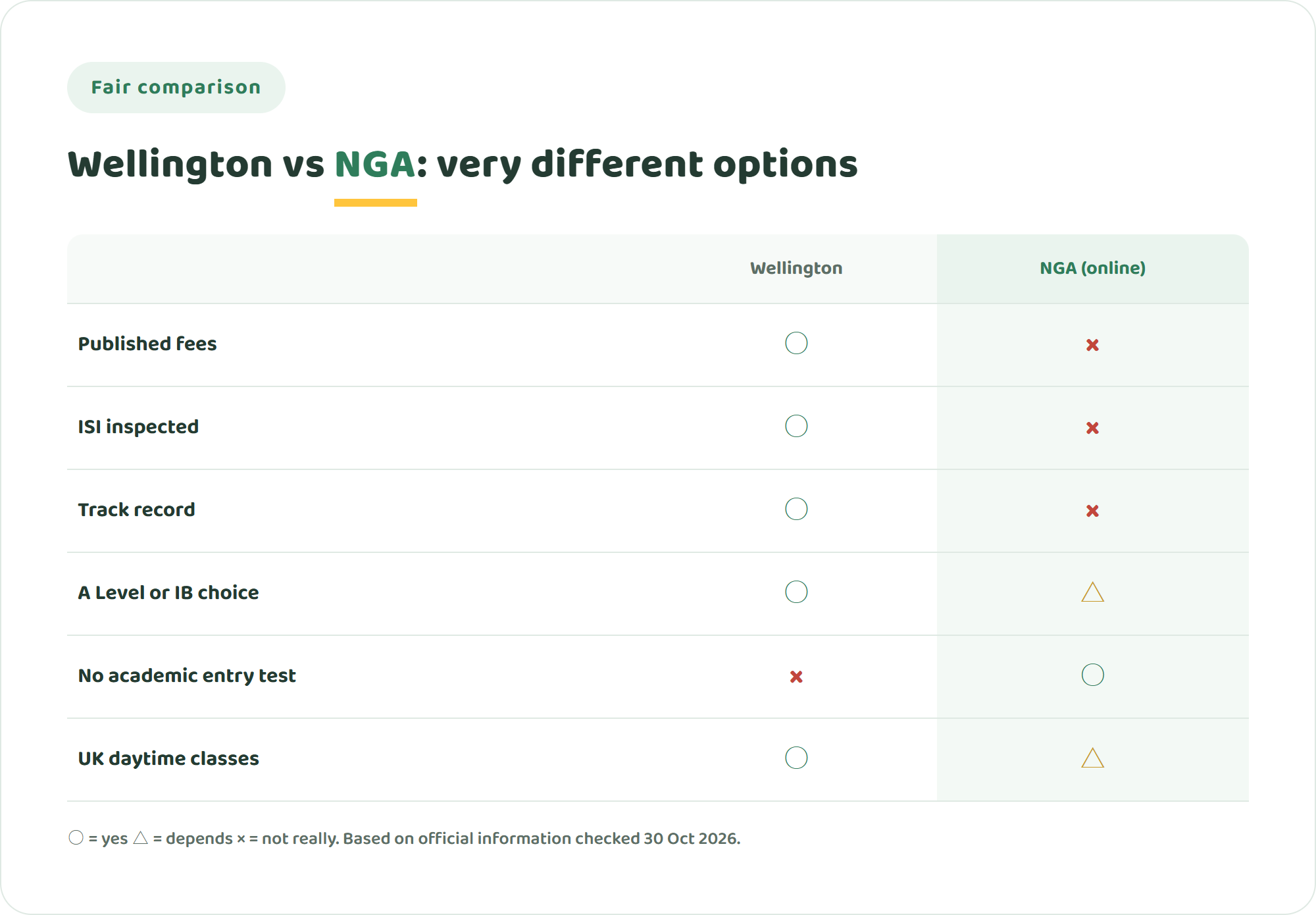
Families looking at Wellington often also look at the two best-known boys’ boarding schools near London. Eton College and Harrow School both cost a little more per term than Wellington’s boarding fee and admit boys only; Wellington is co-educational, slightly cheaper and offers the IB. NIJIN GLOBAL ACADEMY (NGA) is a different kind of school altogether: online, for ages 6–18, focused on Asia and Oceania, and not yet open. For the full breakdowns, see our Eton College fees review and Harrow School fees review.
| Wellington College | Eton College | Harrow School | NIJIN GLOBAL ACADEMY | |
|---|---|---|---|---|
| School type | Independent co-educational full boarding and day school, Berkshire | Independent full boarding school for boys, Windsor | Independent full boarding school for boys, London | Online international school focused on Asia & Oceania; opens September 2027 (planned) |
| Ages / entry | 13–18; 13+, 14+, 16+ (11+ via the Prep) | 13–18; 13+ and 16+ | 13–18; Year 9 and Year 12 | Ages 6–18 |
| Fees 2026/27 (per term) | Boarding £21,690; day £15,930; incl. VAT | £21,891 per Half, incl. VAT (boarding only) | £21,990, incl. VAT (boarding only) | Not yet published (no enrolment, facility or uniform fees; materials included; sibling discounts) |
| Fees per year (3 terms) | Boarding £65,070; day £47,790 | £65,673 | £65,970 | Not yet published |
| Registration / joining | Registration £400; deposit and administration fee per Acceptance Form (not published) | Registration £480; acceptance fee £3,840 (£500 refunded on leaving) | Registration £450; acceptance fee £1,200; deposits £2,400 + £2,400 | No enrolment fee |
| Overseas families | Overseas Deposit may be required (amount not published); visa charge not published | Additional deposit of one term’s fees; visa charge £3,000 a year | Additional deposit of one term’s fees; visa administration fee £3,000 a year | Learn from home in any country; travels with the family if they relocate |
| Curriculum | GCSE; A Levels or IB Diploma | GCSE and A Level | GCSE and A Level | Subjects learned in English, CEFR-based English levels, projects; optional Cambridge IGCSE / A-Level pathway |
| Classes & time zone | In person, UK; most boarders home Saturday afternoon to Sunday | In person, UK; full boarding | In person, UK; full boarding | Small live online dialogue groups (about 8); built for Asia–Oceania daytime — may fall outside the day in the UK, Europe or the Americas |
| Inspection / diploma | ISI September 2025, all Standards met; GCSE, A Level, IB | ISI November 2024, all standards met; GCSE, A Level | ISI February 2024, all Standards met; GCSE, A Level | Not yet accredited; no graduates yet |
| Admission | Register by 30 June of Year 5 (13+); ISEB pre-test, interview, assessment day; 16+ tests and assessment days | Register by 31 August of Year 5; ISEB pre-test, interview and test; conditional place | Register by 30 September of Year 6; ISEB pre-test, then the Harrow Test | No academic entrance exam, no English requirement |
| Fee assistance | Means-tested 10%–100%; c.20 pupils a year, average c.50%; scholarships carry no fee reduction | Means-tested bursaries 5%–100% | Means-tested bursaries up to 100%; scholarships 5% of fees | Tuition not yet published; sibling discounts |
Sources: Wellington College fees, Wellington 13+ entry, Wellington international pupils, Eton College fees, Harrow School fees and deposits — checked 30 October 2026.

Reviews and common concerns, answered honestly
Online reviews of Wellington tend to be enthusiastic about the co-curricular life and the Sixth Form choice, and the Good Schools Guide 2026 quoted on the school’s own site calls it “an academic Disneyland for clever teenagers”. The questions parents actually ask are more practical. Here they are, with what the official pages say.
“Is it really full boarding if everyone goes home on Saturday?”
The school calls itself a full boarding school, and the ISI report confirms that most boarders leave on Saturday afternoon and return on Sunday. In practice that is closer to a six-day boarding week than to the stay-all-term model, which suits UK families within driving distance well. Families overseas should ask what the weekend programme looks like for those who stay, and whether a guardian is required — guardianship rules are not published on the admissions pages.
“We missed the Year 5 deadline — is it over?”
No, but it is harder. Late Route 1 (registered by 30 June of Year 6) follows the normal stages a year later and is described as more competitive with limited House choice; Route 2, for families who first contact the school in Year 7, usually leads to a waiting list first. The 14+ round (about 20 places, weighted towards girls) and the 16+ round (about 60 places) are the other doors.
“Can we get a bursary?”
Only through means-testing, and only if the school wants your child: fee assistance is “aimed at children with exceptional talents whose families could not afford the full fees”. The published averages — about 20 pupils a year, average award about 50% — tell you how competitive it is. The Prince Albert Foundation is separate and fully funded, mostly at 16+, for families in socio-economic disadvantage. A scholarship will not reduce the fee at all.
“How much will the extras add?”
The fees page gives no figure, and the Terms and Conditions list uniform, exam fees, individual music lessons, trips, visa costs and optional insurance as supplemental charges. Budget for them separately and ask the Bursary for a typical annual total for a pupil in your child’s year.
“My child’s English is good but not native — will that be a problem?”
The school expects pupils to be proficient, if not fluent, on arrival, requires UKiset at 16+ for non-native speakers, and offers EAL support; the 2025 ISI report asked the school to assess EAL pupils’ language needs more consistently. If your child is still building English, a bilingual setting may be a better bridge for now.
“Is Wellington worth it compared with Eton or Harrow?”
That depends on what you are buying. Wellington costs slightly less per term, takes girls and boys, offers the IB, and has day places; Eton and Harrow are boys-only full boarding schools with their own histories and networks. All three publish strong results and clean inspection reports. The honest answer is to visit all three and watch how your child reacts.
Alternatives to Wellington College worth comparing
If co-education and the IB matter to you, Charterhouse and Brighton College are the two schools most often shortlisted alongside Wellington: see our Charterhouse fees guide and Brighton College fees guide. For boys-only full boarding, compare Eton and Harrow above, and for a boarding school with day places and a 16+ route for girls, our Winchester College fees review. If a London day school is the alternative, our Westminster guide above covers the capital’s fees and 11+/13+/16+ deadlines.
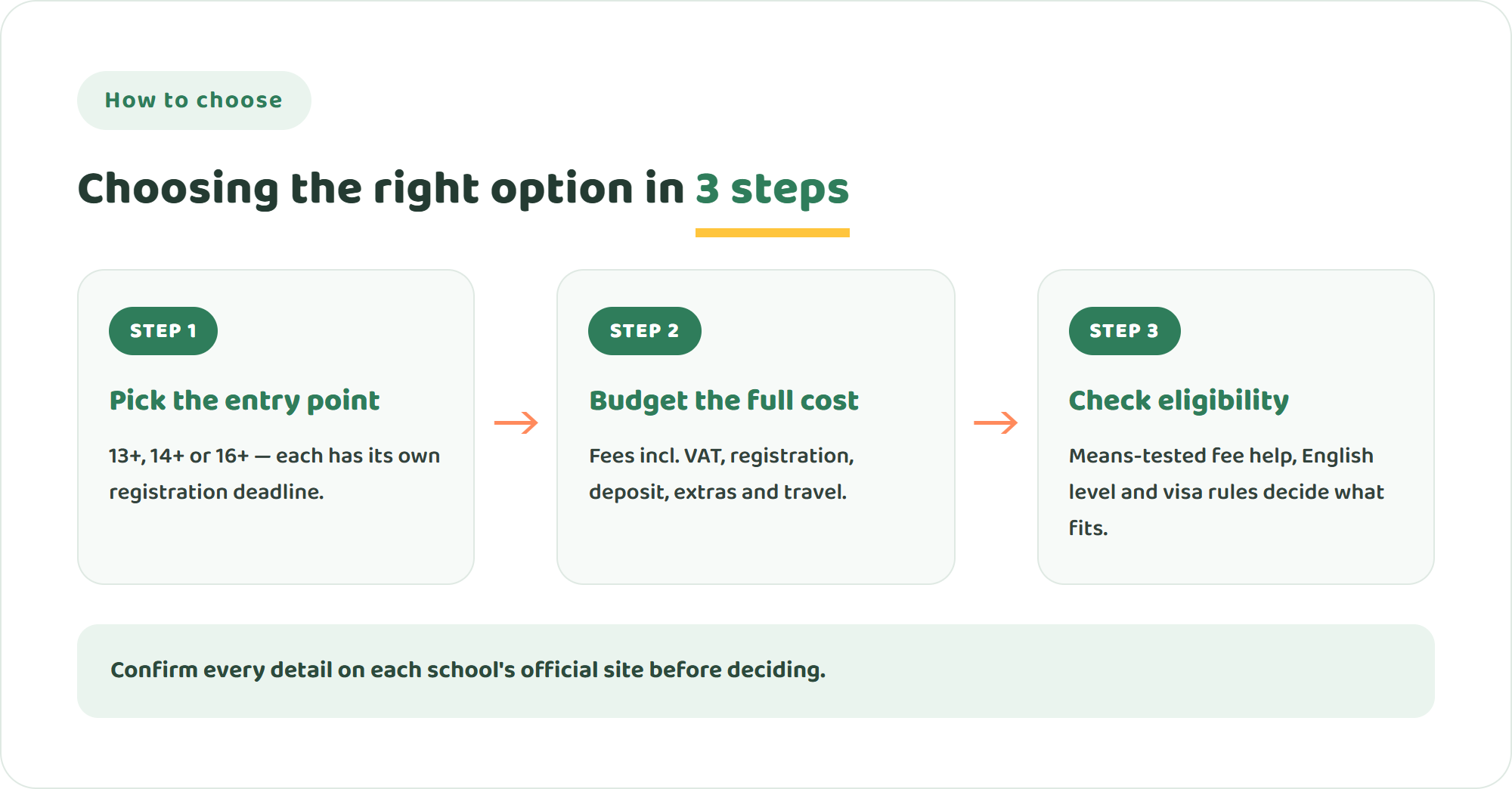
NIJIN GLOBAL ACADEMY (NGA) is a different kind of option. It is an online international school for ages 6–18 focused on Asia and Oceania, opening in September 2027 (planned), with free trial classes monthly from September 2026 and pre-opening trial classes in April–May 2027. The first cohort is 100 students, and it is operated by NIJIN Inc. in Japan, whose alternative school NIJIN Academy has more than 1,000 students. NGA does not rank children by test scores: lessons are small-group live dialogue (classes of about 8), subjects are learned in English with a bilingual English–Japanese mentor, English levels follow the CEFR, and students take part in social co-creation projects with companies and governments and in international exchange. An optional Cambridge IGCSE / A-Level pathway is listed on the curriculum and timetable page. There is no academic entrance exam and no English requirement; it can run alongside a local school or as the main school, and it travels with the family if they relocate. Tuition is not yet published; NGA says it will be far more affordable than a typical international school, with no enrolment, facility or uniform fees, materials included and sibling discounts.
Be clear about the trade-offs. NGA is not yet open, is not yet accredited and has no graduates or track record. It offers nothing like Wellington’s 400-acre campus, its boarding houses, its sport or its in-person teaching. Its timetable is built for Asia–Oceania daytime, so for families in the UK, Europe or the Americas live classes may fall outside the school day — check the timetable against your local time. If your child is a strong candidate for a selective boarding school and you can plan from Year 5, Wellington, Charterhouse and Brighton are the schools to compare.
For a wider view of online options, see our online international schools compared guide.
FAQ
How much are Wellington College fees per year?
For 2026/27, boarding is £21,690 per term and day £15,930 per term, both including VAT. Over three terms that is £65,070 a year for a boarder and £47,790 for a day pupil. A £400 registration fee and a deposit (amount in the Acceptance Form) apply on entry (official site, checked 30 October 2026).
Do Wellington College fees include VAT?
Yes. The fees page marks both the boarding and day figures “including VAT”. UK private school fees have carried 20% VAT since 1 January 2025, so there is nothing to add to the published number — though extras such as music lessons, trips and exam fees are billed separately.
What are the Wellington College admissions deadlines?
13+: register by 30 June of Year 5, with pre-tests in Year 6 and offers in March of Year 6. 14+: register by 30 October a year before entry. 16+: register by 21 September a year before entry, with assessments in October–November and first decisions on 1 December. Late routes exist at 13+ but are more competitive.
Can international students apply to Wellington College?
Yes, through the same process as UK candidates. About half of each year’s Sixth Form joiners come from international contexts, 122 current pupils live overseas and 44 nations are represented. Non-native English speakers must sit UKiset at 16+ (optional at 13+). Visa sponsorship and guardianship details are not published on the admissions pages, so ask Admissions.
Is Wellington College worth it, and what are the alternatives?
For a family that wants co-educational full boarding with a choice of A Levels or the IB, and that can plan from Year 5, many decide it is. Eton and Harrow (boys only), Charterhouse, Brighton College and Winchester are the usual comparisons. NIJIN GLOBAL ACADEMY is a very different, online option for ages 6–18 focused on Asia and Oceania, with no academic entrance exam and no English requirement; it opens in September 2027 and is not yet accredited.
Choosing calmly
Wellington is a confident, well-inspected school with a clear idea of itself, and it asks families to commit early. The most useful things you can do now are to check which entry point and deadline fit your child, to budget the full cost including VAT, deposits and extras, and to be realistic about fee assistance before you register. Whichever school you choose, the right one is the place where your child will be known, stretched and happy.
Tuition and admissions details were checked on the official websites on 30 October 2026. Schools revise fees every year — always confirm on the official site before applying.