If your family is moving to Seoul and you have started looking at international schools, two names come up first: Seoul Foreign School (SFS) and Seoul International School (SIS). The names are almost interchangeable. The schools are not. They teach different curricula, sit in different cities, charge noticeably different fees and have very different student bodies.
This guide compares Seoul Foreign School vs Seoul International School using only what each school publishes: 2026-27 tuition, one-off fees, admissions steps, eligibility and curriculum. Japanese-yen figures in brackets use the reference rate of 16 October 2026 (KRW 1 = JPY 0.11862, US$1 = JPY 158.02) and are rounded estimates.
The short answer: IB at SFS, American AP at SIS, and a gap of roughly US$8,000–9,500 a year
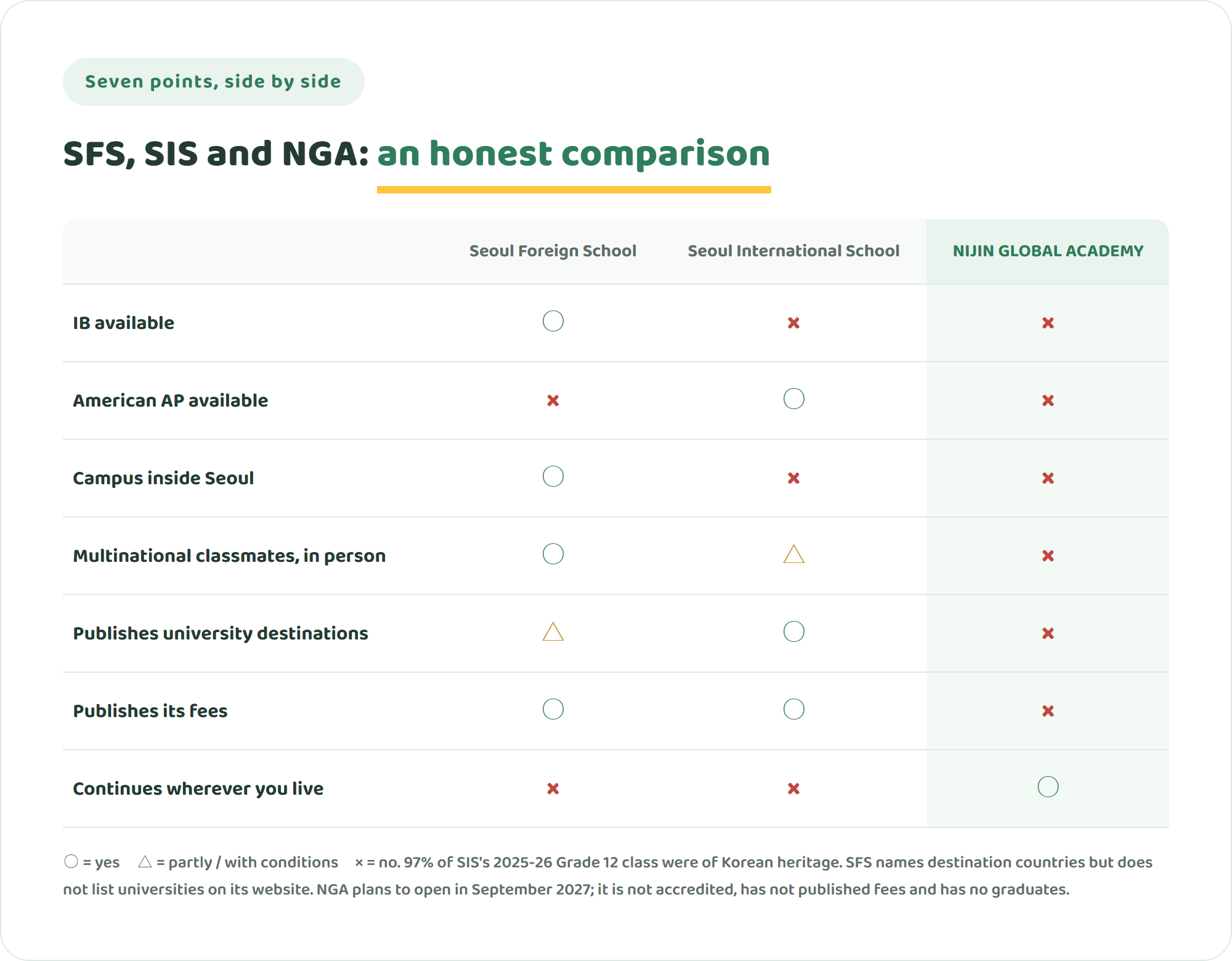
- Curriculum: SFS runs the full IB continuum (PYP, MYP and the Diploma Programme) plus a separate British School section. SIS follows an American curriculum with 24 Advanced Placement (AP) courses and no IB.
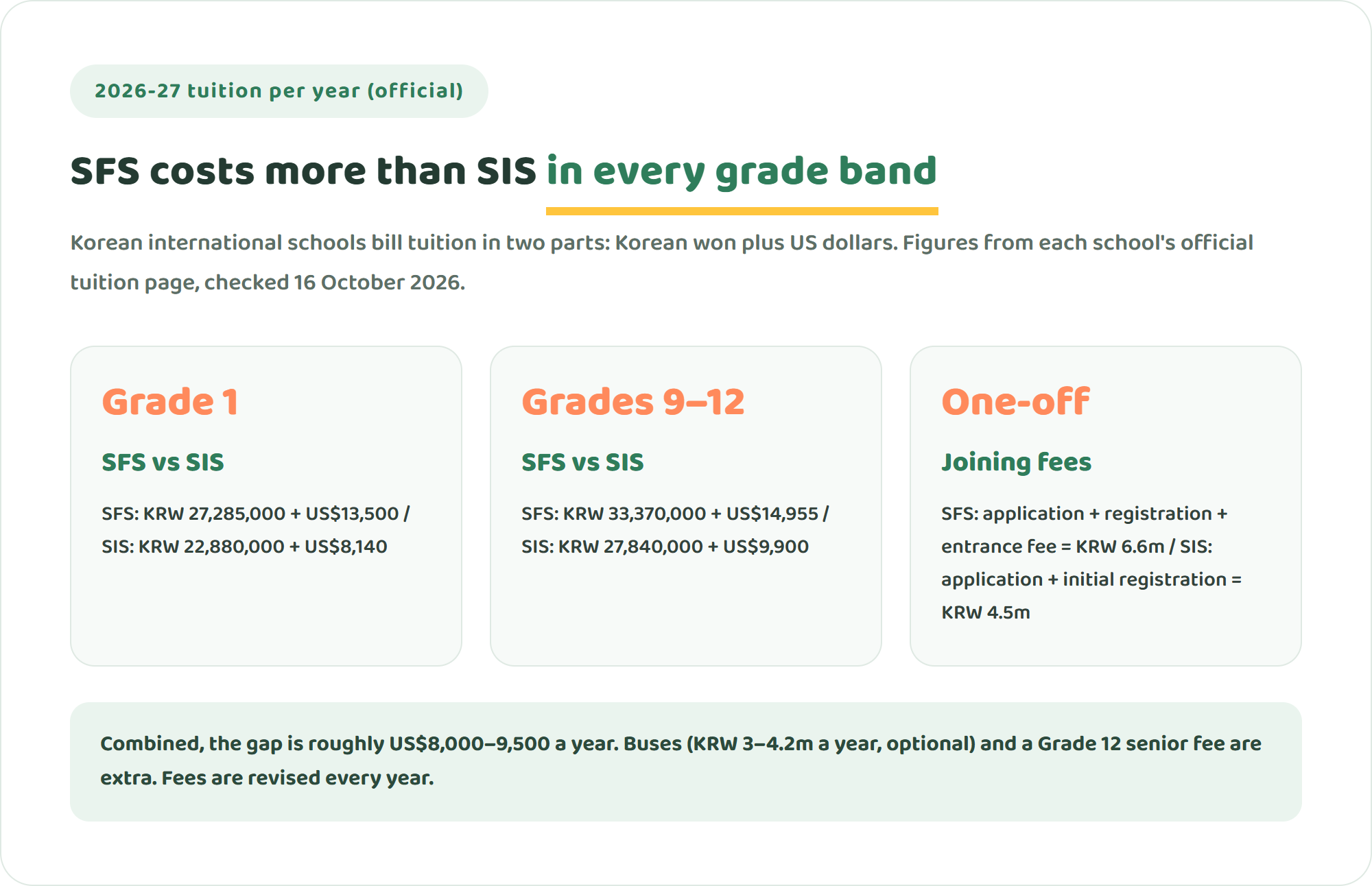
- Tuition: in Grade 1, SFS costs KRW 27,285,000 + US$13,500 and SIS costs KRW 22,880,000 + US$8,140. In high school it is KRW 33,370,000 + US$14,955 at SFS against KRW 27,840,000 + US$9,900 at SIS. SFS is more expensive in every grade band, and its one-off joining fees are higher too.
- Location: SFS is in Yeonhui-dong, Seodaemun-gu, in Seoul itself. SIS is in Sujeong-gu, Seongnam, Gyeonggi Province, outside the city boundary.
- Student body: SFS has around 1,600 students, about half of them US citizens, with 55 other nationalities. SIS has 810 students, and 97% of its 2025-26 Grade 12 class were of Korean heritage.
- Application timing: SFS opens applications for the next school year in November. SIS’s main window is January to March.
In practice: if you want the IB and a genuinely multinational classroom, look first at SFS. If you are aiming at US universities through AP and want to keep costs a little lower, look first at SIS. Either way, you are committing to more than US$25,000 a year, so it is worth checking how long that is sustainable before you compare anything else.
Seoul Foreign School vs Seoul International School tuition (2026-27)
Korean international schools typically bill tuition in two parts: one in Korean won and one in US dollars. The table shows both parts exactly as published on each school’s tuition page (checked 16 October 2026), with a rough yen total.
| Grade band | Seoul Foreign School | Seoul International School |
|---|---|---|
| Kindergarten | K: KRW 27,285,000 + US$13,500 (≈ JPY 5.37m) | JK/SK: KRW 22,620,000 + US$8,040 (≈ JPY 3.95m) |
| Elementary (Grades 1–5) | KRW 27,285,000 + US$13,500 (≈ JPY 5.37m) | KRW 22,880,000 + US$8,140 (≈ JPY 4.00m) |
| Middle (Grades 6–8) | KRW 27,930,000 + US$14,625 (≈ JPY 5.62m) | KRW 24,850,000 + US$8,840 (≈ JPY 4.34m) |
| High school (Grades 9–12) | KRW 33,370,000 + US$14,955 (≈ JPY 6.32m) | KRW 27,840,000 + US$9,900 (≈ JPY 4.87m) |
| One-off fees on joining | Application KRW 450,000 + registration KRW 650,000 + entrance fee KRW 5,500,000 (total KRW 6.6m) | Application KRW 500,000 + initial registration fee KRW 4,000,000 (total KRW 4.5m) |
| School bus (per year, optional) | KRW 4,200,000 | KRW 3,000,000 |
A few details that are easy to miss. SFS’s British School (Years 1–6) charges the same as the elementary IB section. Both schools add a Grade 12 senior fee (KRW 450,000 at SFS, KRW 300,000 at SIS). SIS also asks for a refundable textbook deposit of KRW 150,000–250,000, and its initial registration fee is due within seven days of an offer. SIS allows instalments, but three payments cost an extra KRW 500,000 and five cost KRW 750,000.
What the gap adds up to
Converted at the October 2026 rate, SFS costs about JPY 1.37 million more than SIS per year in elementary school, about JPY 1.28 million more in middle school and about JPY 1.45 million more in high school. Across Grades 1–12, that is a difference of about JPY 16.5 million on tuition alone, if this year’s fees were simply repeated (they will not be; both schools revise fees annually). Because a larger share of SFS’s fee is billed in dollars, its cost also moves more with the exchange rate.
If an employer is paying, check the education allowance cap before you fall in love with either school, and ask whether the cap covers one-off fees and the bus.
Curriculum: the IB at SFS, American AP at SIS
Seoul Foreign School: IB continuum plus a British School
SFS was founded in 1912 as a single classroom of 12 students. It was authorised for the IB in 1980 and now teaches the IB from the early years through the Diploma Programme. Its website reports an average IB Diploma score of 36 and a 98% pass rate for 2021-22. Alongside the IB school it runs a British School for ages 3–11, which holds British Schools Overseas (BSO) approval. SFS is accredited by WASC and lists class sizes of 15–22. If the IB is new to you, our guide to what the International Baccalaureate is explains how the programmes fit together.
Seoul International School: American curriculum and 24 AP courses
SIS received its authorisation from Korea’s Ministry of Education in 1973 and has been WASC-accredited since 1979. It teaches an American curriculum and offers 24 AP courses; in 2025, 48% of its AP exam scores were a 5. The school states that typically 100% of graduates go on to higher education, and it publishes named destinations: across the classes of 2021–2025, for example, 49 students went to NYU, 27 to UC Berkeley and 11 to Stanford.
One thing to weigh honestly: SIS’s own school profile shows that 97% of the 2025-26 senior class were of Korean heritage. Instruction is in English, but the social life of the school will feel different from SFS’s multinational mix. Neither is better; it depends on what you want your child’s friendships to look like.
Admissions: can foreign families apply, and when?
Eligibility under Korea’s foreign school rules
International schools in Korea operate as foreign schools, and Korean law limits who can enrol. According to both schools, a child can apply if at least one parent holds a foreign passport, so most expatriate families qualify on nationality. Families with Korean nationality in the household should check the conditions with each school; children with two Korean-citizen parents must meet extra requirements, such as having lived overseas for at least 1,095 days. SIS asks for the parents’ Korean alien registration cards, so in practice some steps can only be completed after you arrive.
How to apply to Seoul Foreign School
- Use the enquiry form to check whether there is space in your child’s grade.
- Apply online and pay the application fee.
- Submit school reports for this year and the previous two, translated into English and notarised.
- Arrange recommendations (from age 11: maths and English teachers plus a counsellor).
- Complete the assessment: a Learner Readiness Session for ages 2–5, or the SFS Admissions Test for ages 6–17, which may include an English language learner assessment. An interview may also be requested.
Applications for the following year open in November, with decisions from early spring. If a grade is full, applicants join a waitpool. SFS has English language learner (ELL) teachers, but applicants still need to meet the school’s English proficiency standard.
How to apply to Seoul International School
- Pay the application fee and receive an application code.
- Apply through PowerSchool.
- Submit three years of school reports, translated and notarised.
- Arrange recommendations (high school: English and maths teachers plus a counsellor).
- Submit a graded English writing sample.
- Attend the assessment when invited.
The main window runs from January to March (in 2026 it opened on 9 January), and SIS also accepts mid-year applications. SIS’s public pages do not describe its English support or the content of its assessment, so ask the admissions office directly if that matters for your child. To get your child’s English ready, see preparing your child’s English before international school.
Which one fits your family? Three questions
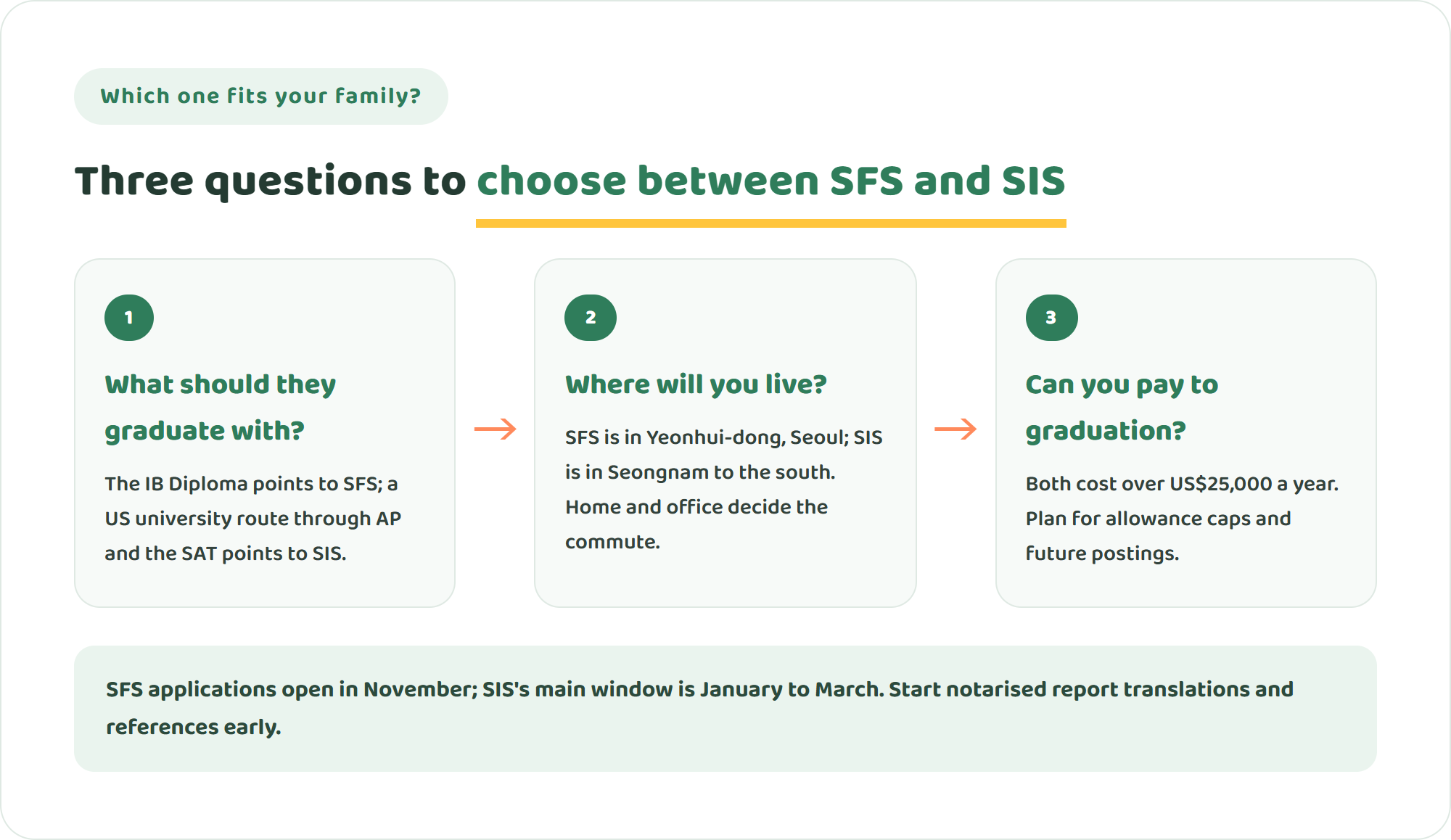
1. What should your child graduate with at 18?
If you want the IB Diploma, which universities around the world recognise, SFS is the natural fit. If the plan is a US university with AP scores and the SAT, SIS is built for that route. If you may return home, check how universities there treat each qualification.
2. Where will you live, and how will your child get to school?
Yeonhui-dong and Seongnam are in different parts of the metropolitan area, so your home and office will shape the daily commute more than anything on a brochure. Both schools run buses, at an extra KRW 3–4.2 million a year.
3. Can you keep paying until graduation?
SIS is the cheaper of the two, but both cost more than US$25,000 a year once the won and dollar parts are combined. Think about what happens if an employer allowance ends, or if you are reassigned to another country part-way through.
Keep a second option in mind
SFS and SIS are only two of Seoul’s international schools. Our guide to international schools in Seoul covers others, including Yongsan International School of Seoul, Dwight School Seoul and Dulwich College Seoul, and international school fees across Asia shows how Seoul compares with other cities.
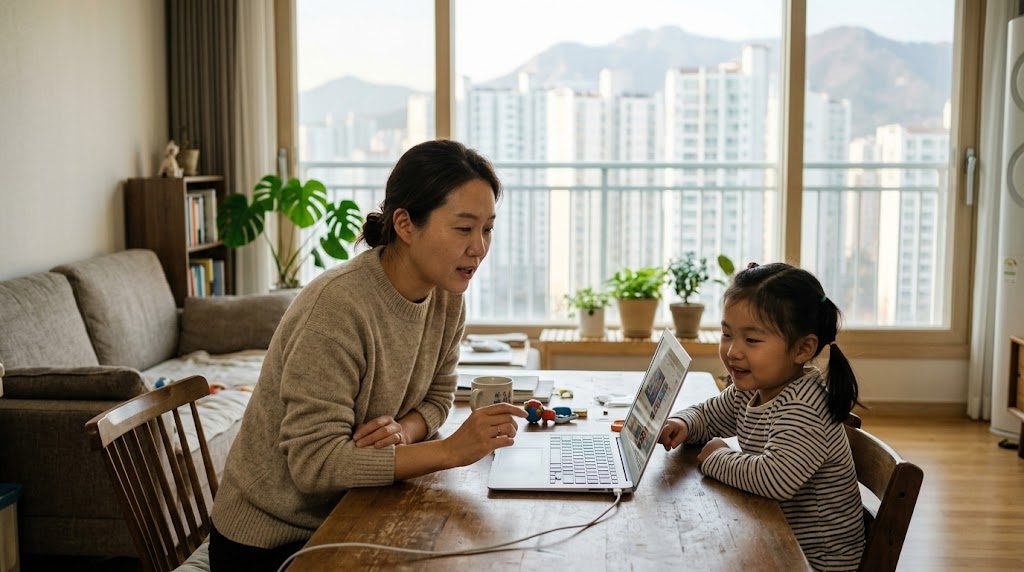
And if the grade you need is full, the fees exceed your allowance, or another move is likely within a few years, an online international school is another route that does not depend on where you live. You can see how classes work at NGA in our online school curriculum overview.
Where NIJIN GLOBAL ACADEMY fits
NIJIN GLOBAL ACADEMY (NGA) is an online international school for ages 6–18, planned to open in September 2027. It is run by NIJIN Inc., which operates NIJIN Academy in Japan, a learning community for children who do not attend school, where more than 1,000 children have studied. NGA plans small live classes, with bilingual Japanese–English mentors supporting subjects taught in English, and admission that is not based on test-score rankings.
To be clear about the limits: NGA has not opened yet, is not accredited, has not published its fees and has no graduates. If your child needs an IB Diploma, a US high school diploma or AP scores, NGA does not replace SFS or SIS. Where we hope to help is as a bridge while you wait for a place, as continuity for families who move often, or as extra English-medium learning alongside a local or Japanese school.
Frequently asked questions
How much is Seoul Foreign School tuition?
For 2026-27, Kindergarten to Grade 5 costs KRW 27,285,000 plus US$13,500, and Grades 9–12 cost KRW 33,370,000 plus US$14,955. New families also pay a KRW 450,000 application fee, a KRW 650,000 registration fee and a KRW 5,500,000 entrance fee.
How much is Seoul International School tuition?
For 2026-27, Grades 1–5 cost KRW 22,880,000 plus US$8,140, and Grades 9–12 cost KRW 27,840,000 plus US$9,900. New families pay a KRW 500,000 application fee and a KRW 4,000,000 initial registration fee.
Is Seoul International School in Seoul?
Not technically. SIS is in Sujeong-gu, Seongnam, in Gyeonggi Province, just south of Seoul. SFS is inside the city, in Yeonhui-dong, Seodaemun-gu.
Does my child need to speak English already?
SFS’s admissions test may include an English language learner assessment, and while it has ELL teachers, applicants must meet its proficiency standard. SIS asks for a graded English writing sample and an assessment whose content it does not publish. As a rule of thumb, start preparing a year or more before you apply.
Choose for the 18-year-old, not the brochure
Seoul Foreign School and Seoul International School share a city and almost a name, but they offer different things: the IB or American AP, a multinational or largely Korean-heritage student body, central Seoul or Seongnam, and a fee gap of roughly US$8,000–9,500 a year once both parts of the bill are counted. Talk as a family about what you want your child to graduate with and who you want them to grow up among, then visit both.
While you compare schools in Seoul, you are welcome to keep NIJIN GLOBAL ACADEMY on the list too. Ahead of its planned September 2027 opening, we expect to run trial classes in April–May 2027.