
“Do you have any questions for us?” You can plan the questions to ask on a school visit, be asked exactly that at the end of the tour, and still have nothing come — and then, on the train home, they all arrive at once. If you have ever been to a school open day, you probably know that feeling. It isn’t a failure of preparation. The questions that surface on the spot are almost always the ones the brochure has already answered.
What follows is a list of fifteen questions to ask on a school visit, grouped by what they are actually for. Each one comes with why it’s worth asking, what a reassuring answer sounds like, and what should give you pause. They work for an international school, an alternative school, your local state school, or an online school. Print them out if it helps.

The questions to ask on a school visit — and the ones that waste it
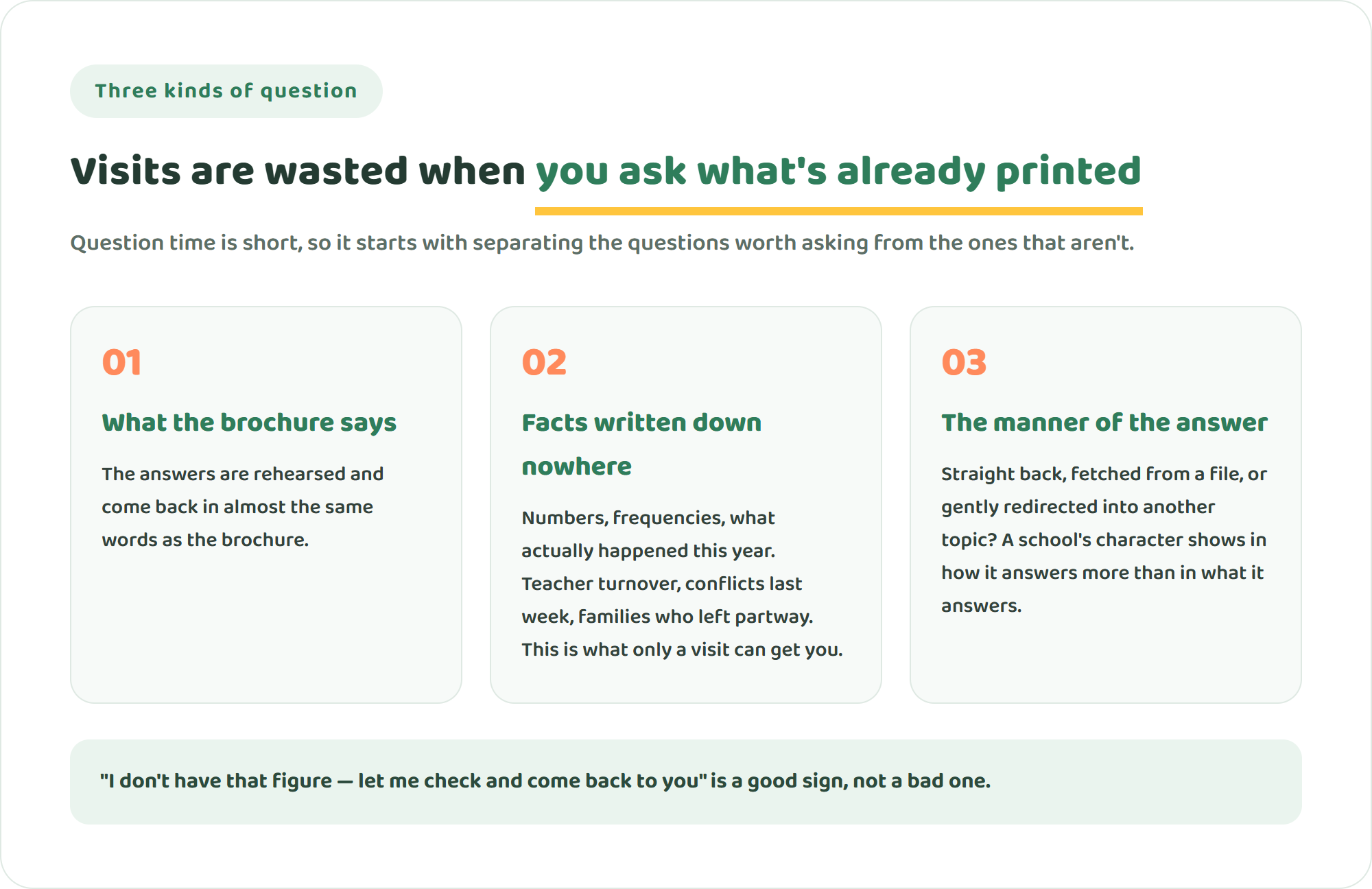
Schools rehearse answers to the questions they hear most. Curriculum philosophy, hours of English, university destinations, values. All of it matters — and all of it is printed, and comes back on the day in almost the same words.
Only two kinds of question are worth the little time you get. The first is a fact that appears nowhere in writing: a number, a frequency, something that actually happened in the past twelve months. The second is the manner of the answer itself. Does it come straight back? Does someone go and fetch the document? Or does the question get gently redirected into a different conversation? A school’s character shows in how it answers far more than in what it answers. “I don’t have that figure — let me check and come back to you” is a good sign, not a bad one.
Deciding whether to move a child in the first place is a separate question, and we’ve written about it in deciding whether to change schools. That piece is about whether to move at all. This one is about what to say out loud once you are in the room, and what to listen for in the answer.
Lessons and teachers: four questions that reveal an ordinary day
An open day is a school’s best day. What you want is not the best day but the unremarkable one your child will have day after day.
1. “Could you show me yesterday’s timetable, exactly as it ran?”
Yesterday, not today — that’s the whole trick. You get the day that actually happened rather than the model week. If someone pulls up a whiteboard photo or a class newsletter, that’s reassuring. If the conversation slides towards the annual plan or a sample curriculum, the daily record may not exist.
2. “In a typical lesson, how much of the talking is done by the children?”
Inquiry-led. Dialogue-centred. Student agency. Every school reaches for the same vocabulary, so ask about the split instead of the philosophy. If the answer is “about half”, ask for one concrete moment from this week. If an example comes easily, it’s real.
3. “How many class teachers have changed in the last three years?”
Nothing tells you more about the inside of a school than whether its teachers stay. High turnover is not automatically bad — young or fast-growing schools see it naturally. What matters is whether they can explain it. “Two maternity leaves and one relocation overseas” and a deflection are very different answers.
4. “How many of your teachers are full-time?”
The full-time to part-time split tells you more than the headcount does, because the adult who notices a change in your child is the one who is there every day. Add “how much time do teachers spend learning from each other each week?” — protected time for that means the school isn’t relying entirely on individual talent.
When a child struggles: four questions about support and assessment
What decides a school placement is rarely the good days. It’s what the school does on the day something goes wrong.
5. “How many conflicts between children were there last week?”
If the answer is “we don’t have bullying here”, pause. Put children together and friction happens. Zero may mean nobody is counting rather than nothing occurred. A school that says “three last week, and here’s how each was handled” is at least counting.
6. “If a child stops coming in for a while, who moves first?”
The class teacher, the school nurse, a year lead, an outside counsellor? A school that can name who moves first has been through this many times. If you only get “we respond flexibly”, push once: “could you describe a recent case, as far as you’re able?”
7. “Could I see a real report, with the name removed?”
A school’s whole theory of assessment is visible in the form it uses. Grades in a row, written comment, a space for the child’s own reflection? Plenty of schools say “we don’t measure by test scores alone” and then hand you a sheet that does. Ask one follow-up: who fills in this section, and when?
8. “How and when would we find out that our child is falling behind?”
The fear is finding out too late. Nothing until the end-of-term meeting, a monthly note, or a call the week it starts? Look for a specific frequency and channel. “We’ll be in touch if anything comes up” needs one more question: what counts as anything?

Money and outcomes: three questions the fee sheet won’t answer
Cost and destinations are the hardest things to raise and the ones that matter longest. Whatever uncertainty you don’t resolve, your household carries.
9. “What must we pay beyond tuition, from entry through to graduation?”
Two words in that question are doing the work: must, and graduation. Entrance fees, facility levies, materials, uniform, trips, transport, the customary donation. Some schools are straightforward about the items marked optional that in practice everyone pays; some aren’t. If they’ll write an annual total on paper, your comparisons get far sharper.
10. “Have fees been revised in the past three years?”
The number you enrol on is not necessarily the number you leave on. Asking whether revisions happened, and by roughly how much, makes the next few years far easier to plan. Explain that you’re asking because you intend to stay the course, and most schools will answer seriously.
11. “Where did last year’s leavers actually go, and how many to each?”
Ask for destinations by headcount, not a list of offers. Ask about the qualification a child leaves with, too. If you are in Japan, note that attending an international or alternative school that is not an ichijoko under Article 1 of the School Education Act does not by itself satisfy Japan’s compulsory education requirement, so families normally keep their child enrolled at the local school as well — and the way this is handled varies between municipalities.
The questions nobody asks: what happens if we leave
Almost every question asked on a tour is an entry question. How to get in, what’s taught, what it costs. But the thing that exhausts families usually happens on the way out. A school that explains its exit clearly has simply dealt honestly with a lot of families.
12. “How many families left partway through in the past year?”
Watch the composure of the answer more than the number. “Two — one relocation, and one child for whom we weren’t the right fit,” delivered calmly, tells you leaving isn’t treated as a failure. Be wary of an answer that gets flustered, or that files every departure under the family’s problem.
13. “If it isn’t working, will you help us move? And what is the refund policy?”
Get the refund policy in writing rather than in conversation. Withdrawal mid-term, a leave of absence mid-year, a move abroad — what is policy and what is handled case by case? Changing schools is not a rare event, and planning for it is not a lack of faith.
Two questions for an online open day
An online session puts distant schools within reach, but the things you absorb without trying on a campus — the noise at break, the air in a corridor, how old the displays are — never arrive. So you go after them with questions instead.
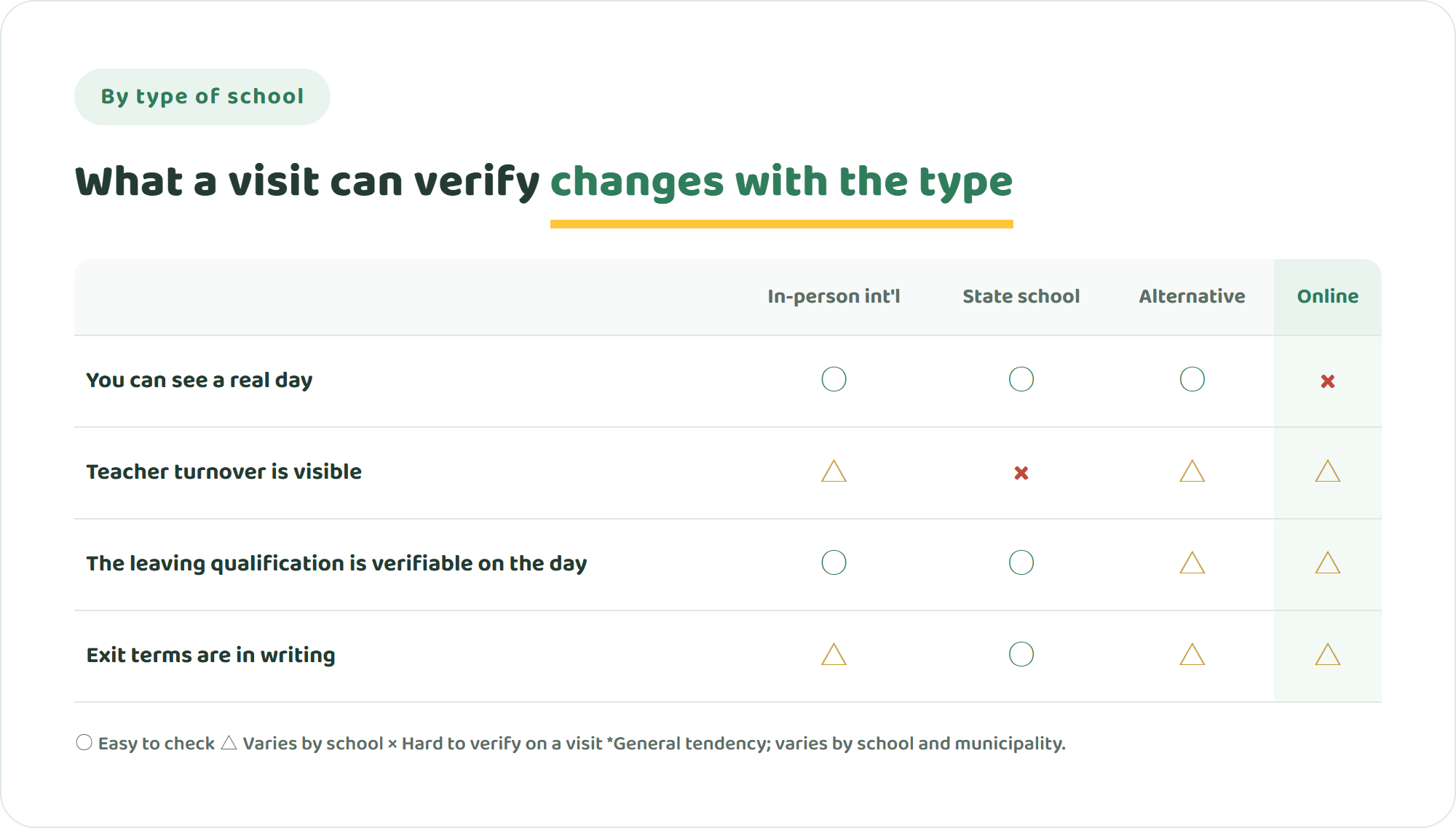
As the table shows, an online school is the hardest place to feel out an ordinary day, and the leaving qualification varies from provider to provider. We’d rather say that plainly. Equally, teacher moves at state schools are decided by systems you cannot see on the day, and alternative schools differ enormously in how they design the exit. Every type has a blind spot. We’ve set out the trade-offs in the pros and cons of international schools.
14. “Are the teachers speaking today the ones who teach every day?”
Some sessions are run entirely by admissions staff; others put classroom teachers in front of you. Neither is wrong, but the second produces answers with the texture of a real room in them. If it’s admissions only, ask whether you can speak to a teacher separately.
15. “What do you do when a child goes silent on screen?”
Freezing in front of a camera is something that happens often online. Called on, picked up in chat, moved to a small breakout room, or simply left alone? A school with a specific policy has lived through it repeatedly.
What to do with the answers when you get home
Carrying a list makes it easy to treat asking as the goal. What counts is what happens afterwards, and there are only three things to do.
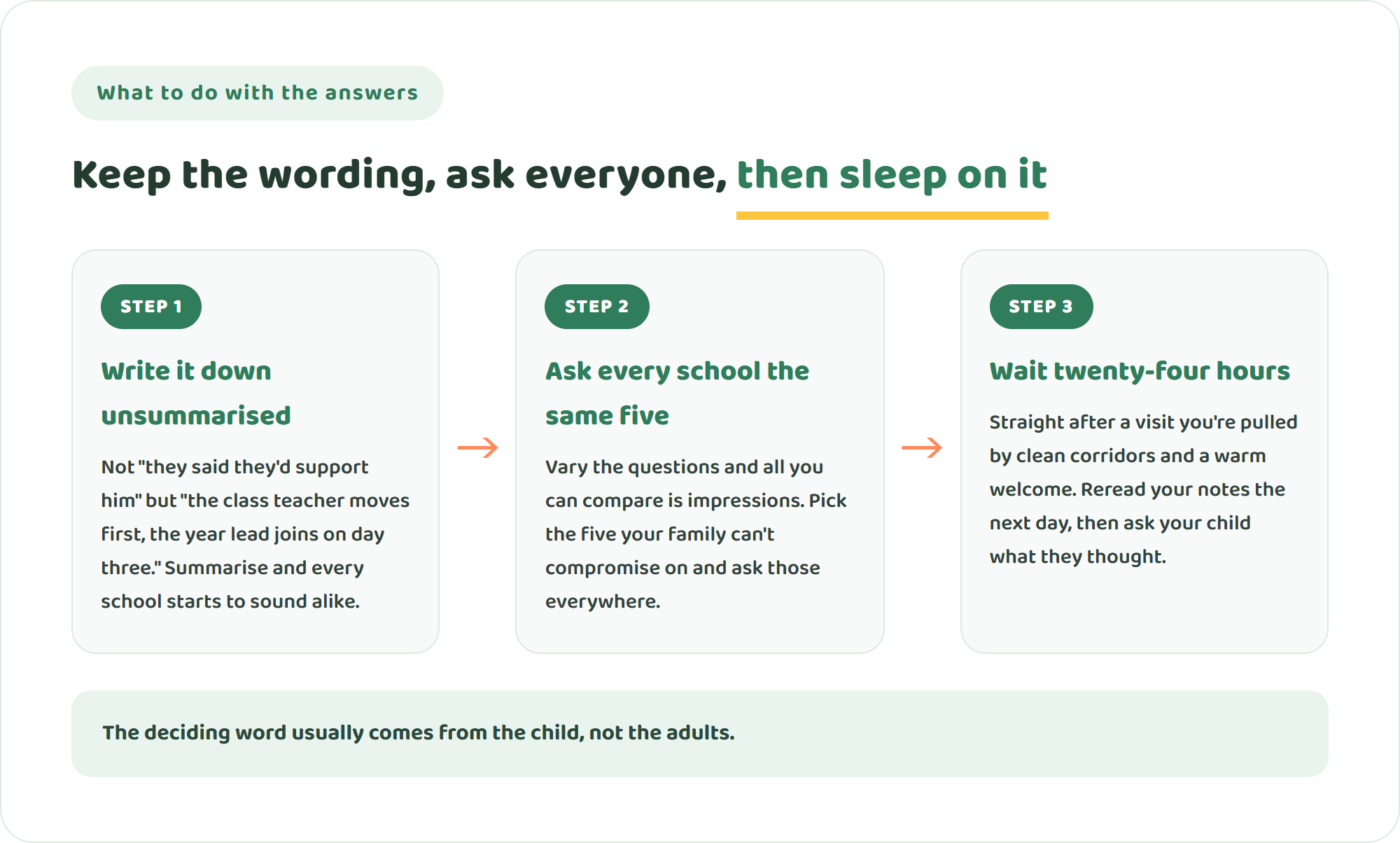
Step one: write the answer down, unsummarised. Not “they said they’d support him” but “the class teacher moves first, and the year lead comes in on day three.” The moment you summarise, every school’s answer starts to look the same.
Step two: ask every school the same questions. Vary them school by school and all you can compare is impressions. It needn’t be all fifteen — pick the five your family cannot compromise on and ask those everywhere. Differences only appear once the answers sit side by side.
Step three: wait twenty-four hours before you talk it through. Straight after a visit you are being pulled by clean corridors and a warm welcome. Sleep on it, reread your notes, then ask your child what they thought. What the adults noticed and what the child noticed are often startlingly different.
See how learning works at NGA →
Where we stand
These fifteen questions point at us too. NIJIN GLOBAL ACADEMY (NGA) is an online international school built around learning beyond test scores, scheduled to open in September 2027 and operated by NIJIN Inc. Our sister school, NIJIN Academy, already has more than 900 children enrolled. Trial classes — a pre-opening term — are planned for April and May 2027.
Our answer to question two is a design in which children talk more than adults do, through small-group dialogue rather than lectures. On question six, being online means an absent day is often noticed sooner rather than later. The refund policy and transfer support in question thirteen will be published in writing at opening.
And honestly, we won’t suit every family. If what you value most is a playground and daily face-to-face contact, online will feel thin. Building a daily rhythm also asks something of parents. So put these same questions to us without hesitation — and where we don’t have an answer yet, we’ll say so.
Frequently asked questions
How many questions should I actually prepare?
You don’t need to read all fifteen aloud. Q&A at an open day often runs five to fifteen minutes, so five is a realistic number for the room. Save the rest for an individual meeting, a trial class, or email. Choose them starting from whatever worries you most.
Will asking these things make a bad impression?
Asking for numbers, frequencies and recent examples is entirely legitimate. Prefacing it with “we’re asking because we hope to be here for years” is usually all it takes. And if a school’s manner changes because you asked, that in itself is worth knowing.
Is it safe to decide based on an online session alone?
We wouldn’t recommend deciding on any single session, online or in person. Where possible, go on to a trial class or an individual meeting and see your child actually learning at least once. Whether something close to a real lesson is on offer is often the deciding factor.
Asking is not rude
Don’t be hard on yourself about the day the questions wouldn’t come. Not knowing what to ask about a school you barely know yet is entirely normal. And questions are not a test you set for a school — they are the first proper conversation with the people you are about to trust for years.
NIJIN GLOBAL ACADEMY is scheduled to open in September 2027. We’ll send you how the learning works, what a school without a campus looks like, and news of our first cohort. Before your next visit, choose five of these fifteen. That alone changes what you carry home.