“Public, private, international, alternative — which one is actually right for our child?”
By the time families ask this, most have already done a great deal of research. Fees, reputations, travel times. And still they cannot decide. The reason is consistent: the problem is not too many options, it is too many criteria.
This article cuts the comparison down to four criteria, lines the four school types up against them, and finishes with what to do when you still cannot choose. Money comes last, deliberately.
Why starting with fees keeps you stuck
Fees are easy to compare, which is exactly why they get looked at first. But cost is an outcome, not an entry point. Two schools with identical annual fees can differ completely in what credential they yield and what role English plays.
Reverse the order. Decide what you will not compromise on, then ask what you can pay. The comparison gets dramatically faster.
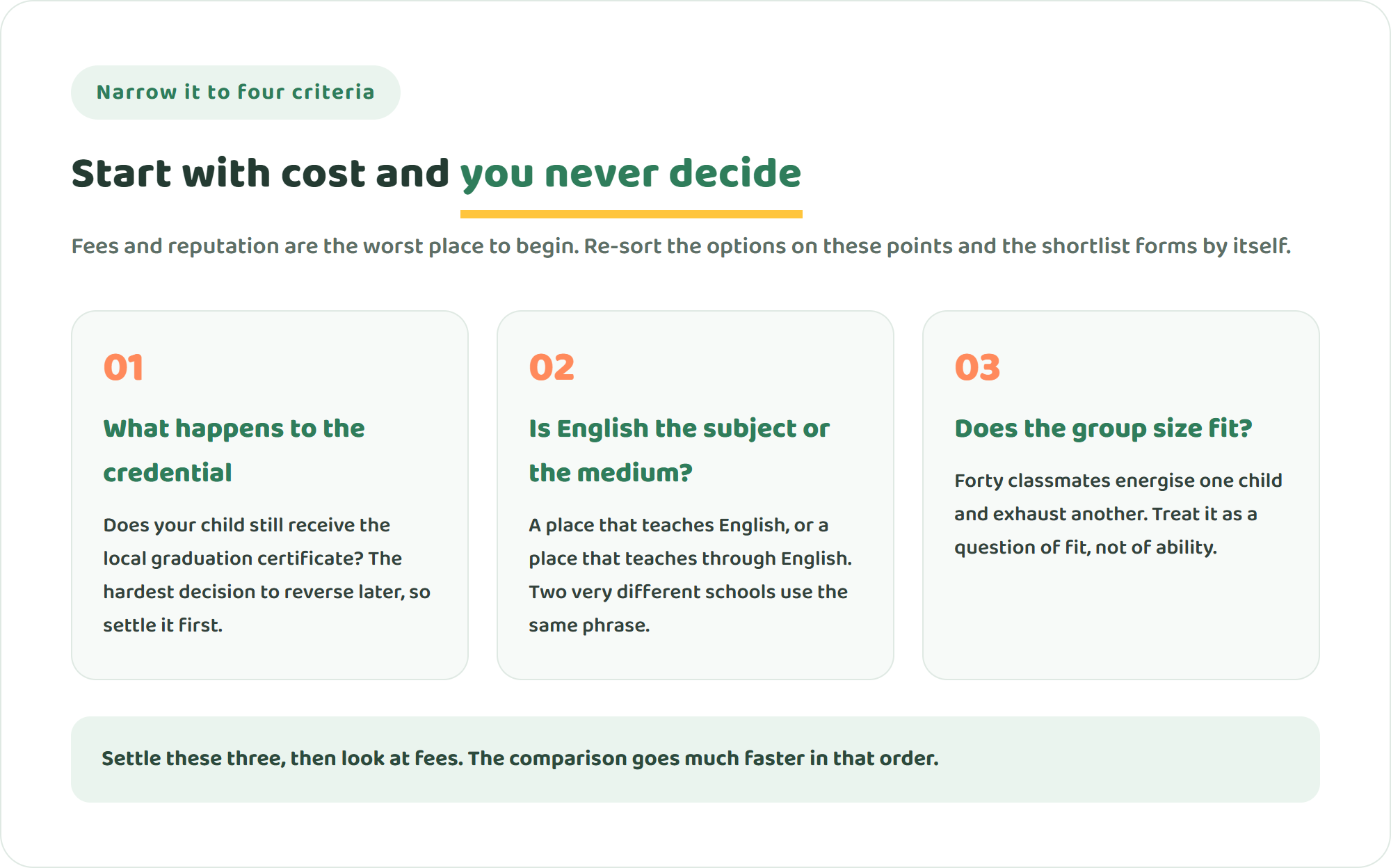
Four criteria are enough
1. What happens to the graduation credential
This carries the most weight, and it is the hardest thing to undo later.
In Japan, public and private elementary and junior high schools are ichijoko — schools defined under Article 1 of the School Education Act — and completing them yields the national graduation certificate. Most international schools in Japan are not ichijoko. Attending one is a separate matter from receiving that certificate.
Are you keeping the option of a Japanese high school entrance exam open, or moving towards an overseas pathway? Choose the school before answering that and the route can close behind you.
2. Is English the subject, or the medium?
The single most misunderstood criterion, because two opposite things are described with the same phrase.
- A school that teaches English: English is a subject, a few periods a week.
- A school that teaches in English: maths, science and humanities all run in English. English is the tool, not the goal.
“We place a strong emphasis on English” is used for both. At any open day, ask instead: “In what language are the subjects taught?” One question, and the difference appears.
3. Does the group size fit?
A class of forty energises some children and drains others. That is a question of fit, not of ability.
Some children genuinely thrive on the stimulation of a big cohort. Others are worn down by numbers alone, regardless of how good the teaching is. There is nothing to apologise for in “large groups are hard for our child” — it is simply information about which environment to choose.
4. Where does it lead?
A choice at primary level does not determine university. But some transitions are smoother than others. A Japanese high school, or an overseas university? Once the direction is set, the necessary qualifications narrow by themselves.
If the direction is genuinely undecided, the rational move is to choose the option that keeps the most doors open — which, for most families, is also the most realistic one.
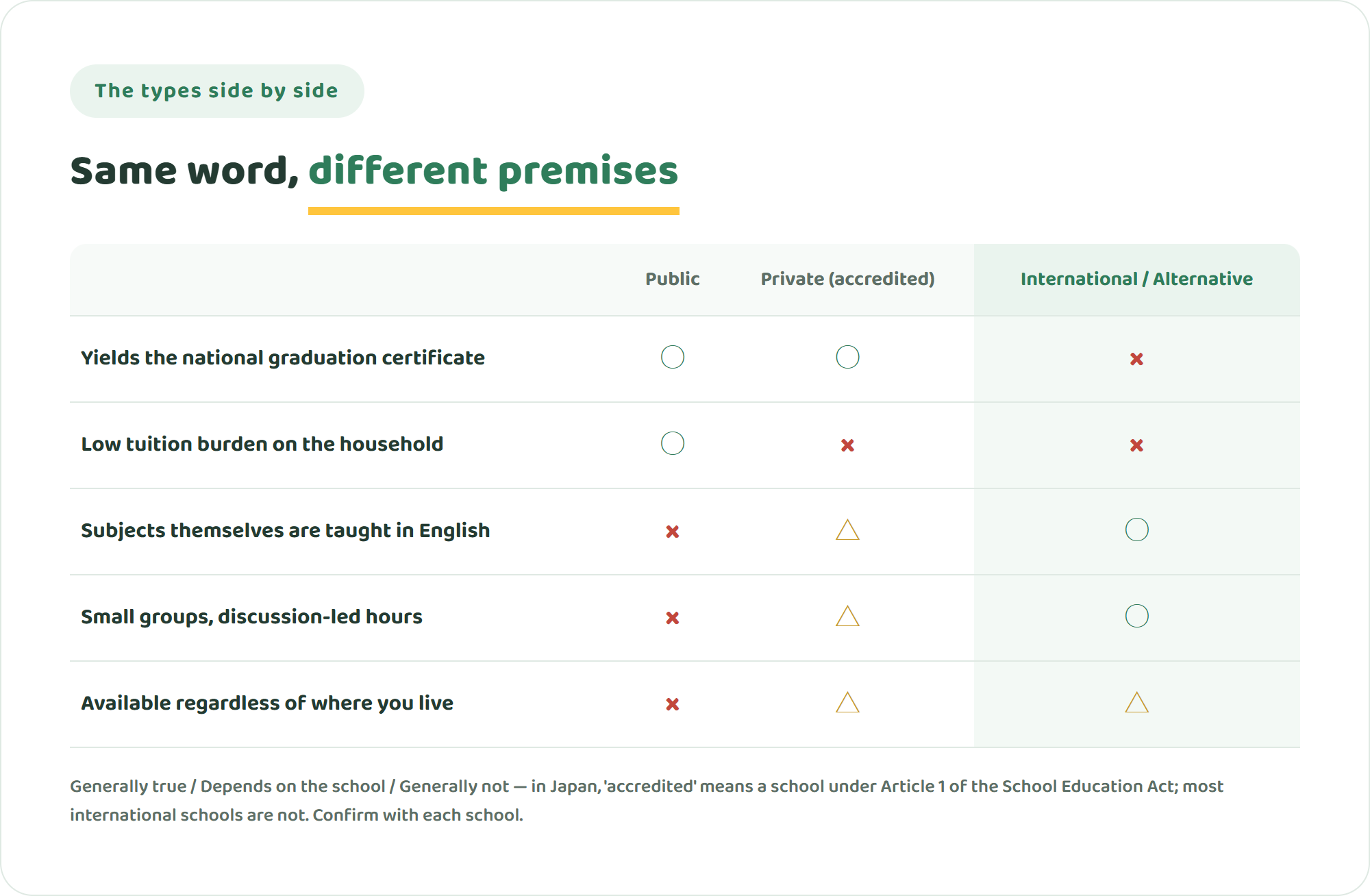
How the four types actually differ
Public
The lowest cost, the national credential, and a natural connection to the local community. If nothing is currently going wrong, this is unquestionably the most rational choice.
The constraints are that class size and pace are not yours to choose, and that the school is decided by where you live. Learning subjects in English is generally not on offer.
Private (accredited)
You choose on educational philosophy and outcomes, and the national credential still follows. Many emphasise English — which is where criterion 2 bites. Whether that means “learning English” or “learning in English” has to be checked school by school.
The constraints are cost, usually travel distance, and an entrance exam at the door.
International schools
Subjects taught in English, smaller groups, and pathways into international qualifications such as the IB or IGCSE. The mix of backgrounds in the room has real value in itself.
Three constraints: cost, a limited catchment, and the fact that most are not ichijoko. The third is the one to handle most carefully, for the reasons under criterion 1.
Alternative schools
An umbrella term for child-led approaches — Montessori, Steiner, Jenaplan, free schools — and the contents vary enormously. Resisting generalisation is almost the defining feature.
They become an option when the pace or the method of the current school does not fit. Most are also not ichijoko, so the credential question has to be asked of each one individually.
The fifth option families overlook
Most families assume they must pick one of the four. In practice there is the option of combining.
Stay enrolled at the local school, and add subject learning in English online after school or at weekends. The national credential stays intact, the experience of learning in English accumulates, and no institutional questions arise at all — structurally it sits alongside any other after-school activity.
Its real value, to my mind, is that it is reversible. If it does not suit, you stop. Transferring schools does not work that way.
How learning works at NIJIN GLOBAL ACADEMY
Not practising English, but studying subjects in it — and how we design those hours.

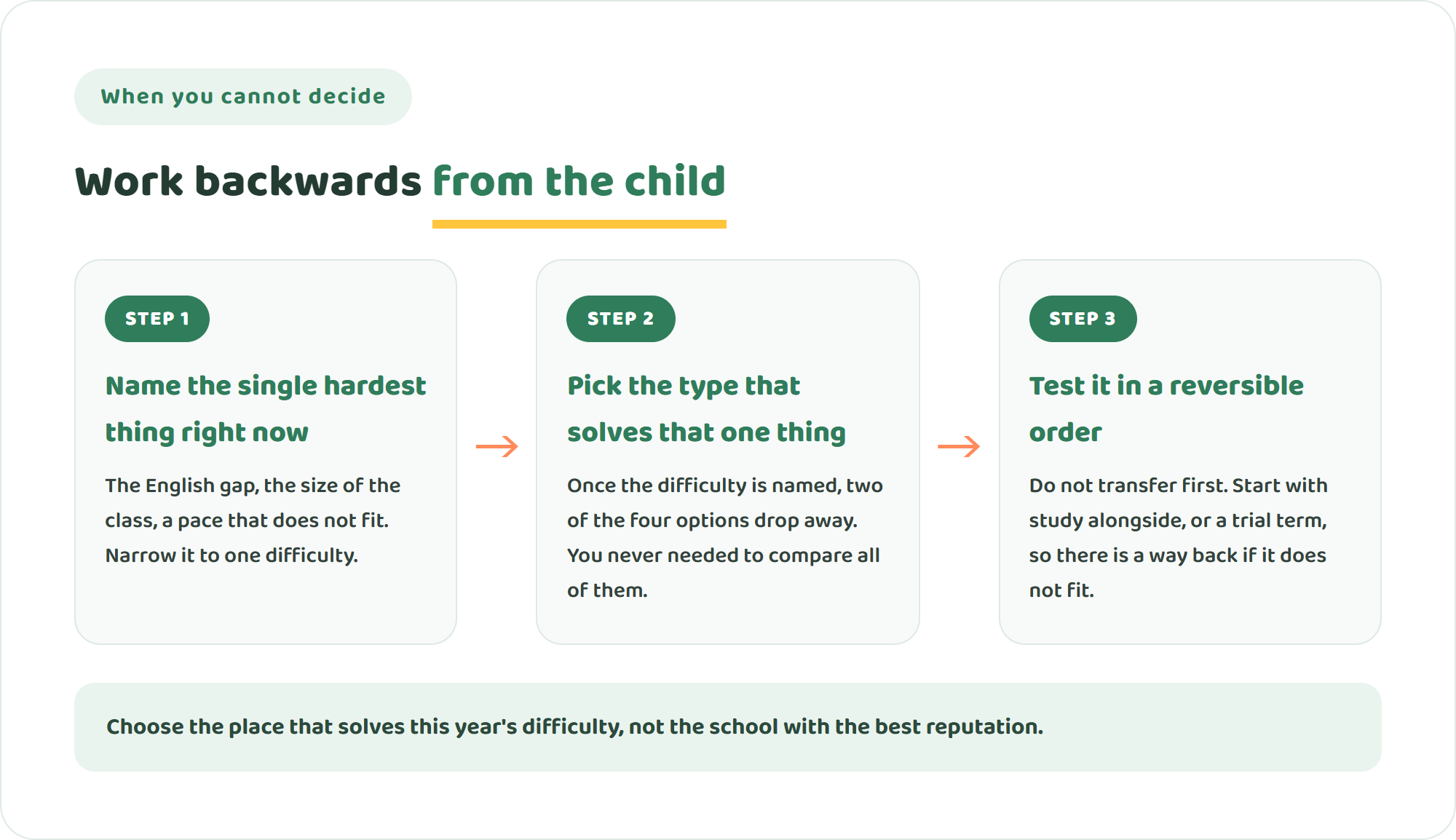
When you still cannot decide: work backwards from the child
If nothing above settled it, the usual cause is that you are reasoning from the schools inward. Turn it around.
Step 1: write down the single hardest thing right now. The English gap, the size of the class, a pace that does not fit, mornings that have become impossible. Narrowing to one matters. Try to solve everything and every school looks inadequate.
Step 2: pick the type that solves that one thing. Name the difficulty and two of the four options fall away immediately. “Large groups are hard” rules out a big public school; “we want subjects taught in English” rules out public entirely. You never needed to compare all four.
Step 3: test it in a reversible order. Do not transfer first. Start with a trial or with study alongside the current school. Testing in a form you can walk back from is, in the end, the fastest route.
Common questions
If we enrol at an international school, will English come naturally?
Environment matters enormously, but nothing happens automatically. Once subjects are taught in English, a different capability from conversation is required: reading and writing reasoning in science or history. Conversation practice alone builds it slowly. Any experience of learning something in English beforehand changes the first year completely.
Can we stay at a public school and add international learning?
Yes — that is the fifth option above. Keeping your place locally and studying subjects in English online after school preserves both the credential and the range of future pathways, with no procedural steps required.
Can we change our minds later?
Yes, though the difficulty depends on the direction. Moving from a local school into an international school is generally easier than moving back, where age and transfer conditions can complicate matters. Which is precisely the argument for making the first step a reversible one.
Which is the best type of school?
There isn’t one. There is only the place that solves what is hard for your child this year. Plenty of children have struggled at highly regarded schools, and plenty have flourished at unremarkable ones.
In closing
Comparing school types breeds a particular fear: that choosing wrongly is irreversible. In practice there is a way of choosing that stays reversible. Narrow the difficulty to one, choose the type that solves it, and test it in an order you can walk back from.
NIJIN GLOBAL ACADEMY is an online international school planning to open in September 2027, with trial classes as a pre-opening in April-May 2027. It is built to be added to a child’s existing school life rather than to replace it — an option that does not require giving up one of the four. Not sorting children by a score is where we started.
You do not have to decide today. Start by writing down the single hardest thing right now.
Opening updates, by email
Curriculum, timetable and our approach to fees — registered families hear each decision first, as it is made.