The fee schedule they hand you after the tour is a single sheet of paper. Tuition, a facility fee, lunches, extended care, and the bus. Every line makes sense on its own — and then your eye reaches the total at the bottom, and the pen stops moving. Plenty of parents remember the day an international preschool cost first appeared in front of them in real numbers, exactly like that. Your child had a wonderful time in the trial class. Which is precisely why running the arithmetic feels faintly disloyal.
So let’s start with the part that matters most. At this stage, the real question is not whether you can pay this month’s tuition. Families who can comfortably cover preschool fees regularly hit a wall at primary school, when the cost steps up sharply and the plan has to change. This article breaks down what an international preschool fee is actually made of, how far Japan’s public support reaches, and how to judge the step that is waiting a few years out. It will not give you an average price. The range between schools is simply too wide for an average to mean anything.
International preschool cost: what the fee is actually made of
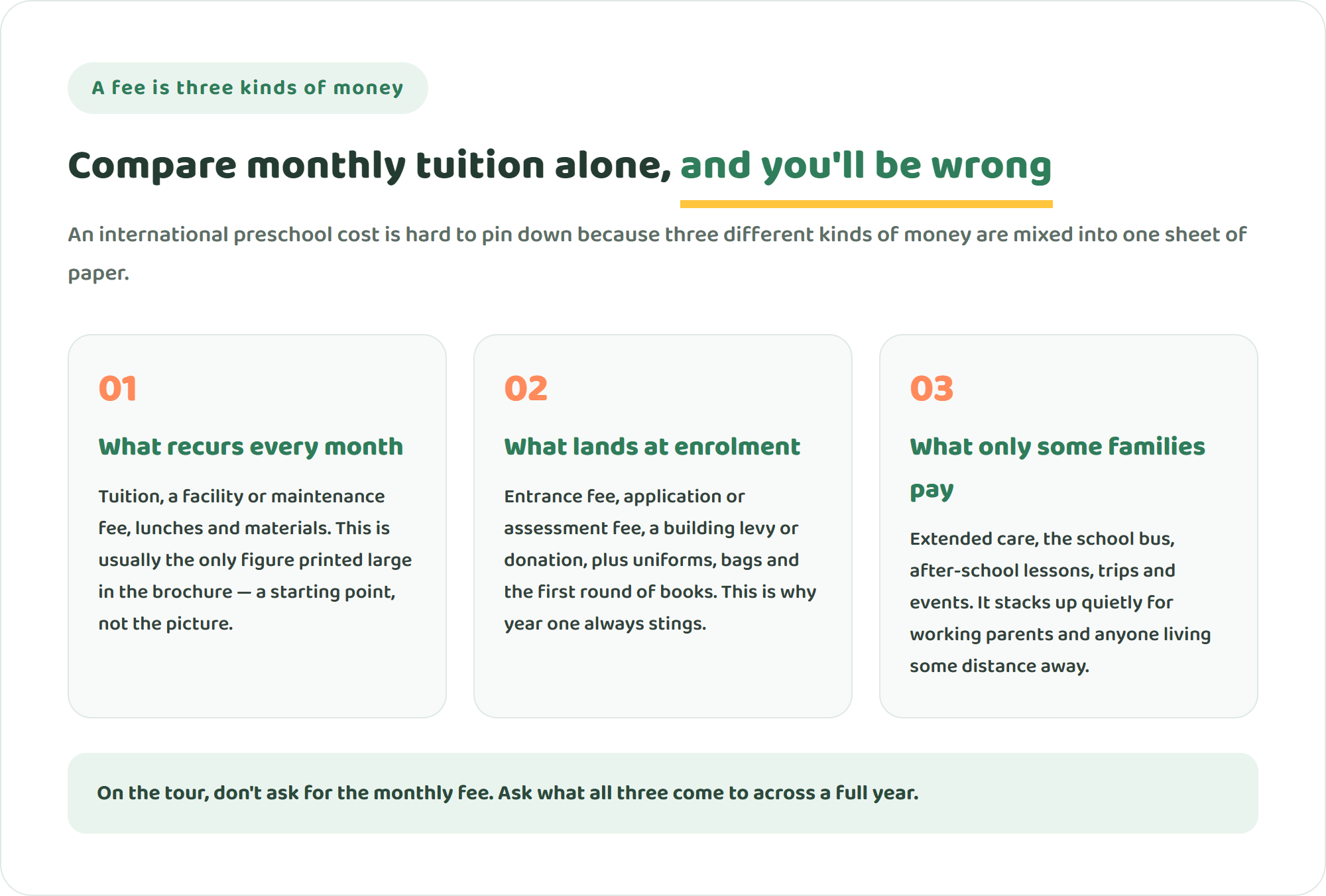
Fee schedules are hard to read because the cost isn’t one number — it is three different kinds of money bundled together. First, what recurs every month: tuition, a facility or maintenance fee, lunches, and materials. Second, what lands in a lump at enrolment: the entrance fee, an application or assessment fee, a building or development levy, and the first round of uniforms, bags and books. Third, what only some families pay: extended care, the school bus, after-school lessons, and the actual cost of trips and events. The number printed largest in the brochure is usually only the first of the three.
And the amounts vary enormously. Two mornings a week versus five full days with lunch and after-care are both called preschool, yet they land on a household budget in completely different ways. That is why you won’t find a headline figure here. What we’d ask instead is that you get the annual total from every school you visit. Comparing monthly tuition alone leaves out the entrance fee, the facility fee and the bus — and those are exactly where two schools that look identical diverge. For how the same line items behave further up the school, see our breakdown of what international school tuition really costs.
One more thing that gets overlooked when you total up an international preschool cost: the increases still to come. Annual fee revisions, tuition that steps up as your child moves through the years, and the rising cost of recruiting teachers from overseas. The figure you sign up to is rarely the figure you graduate on. Asking one question on the tour — have fees been revised in the past few years, and by roughly how much — will tell you more about the next five years than any brochure. Some schools answer reluctantly. Asking is still entirely reasonable.
How far the free preschool programme actually reaches
Japan’s free early childhood education and childcare programme is the support most families in this position rely on. For children attending unlicensed childcare facilities and similar settings, up to 37,000 yen per month is covered for the 3-to-5 age group, and up to 42,000 yen per month for children aged 0 to 2 in municipal-tax-exempt households (Children and Families Agency). For the 3-to-5 group that is up to 444,000 yen a year — not a rounding error, and for many families it is the difference between attending and not.
Here is the catch, though. To qualify, the school itself must be registered with the local authority as an unlicensed childcare facility (ninka-gai hoiku shisetsu), and the family must separately obtain certification of the need for childcare from their municipality. Some international preschools are registered; some are not. Without that registration, no amount of educational quality makes the fee eligible. And the subsidy is a ceiling, not a blank cheque: anything above the cap, plus lunches, event costs and bus fees, stays out of pocket.
Which means you cannot rely on what another family told you, or on what you read online. Municipalities administer this differently. The check itself is simple. Ask the school directly whether it is registered as an unlicensed childcare facility and whether its fees are eligible. Then confirm the certification requirements with your own municipal office. Those two conversations will change how realistic your estimate is more than any spreadsheet will. For the wider picture of what support exists, see subsidies and ways to reduce international school costs.
The real dividing line is primary school
Before school age, there is support. That support disappears the day your child starts primary school, because the free early childhood programme is a pre-school-age scheme by design. At the same moment, another fact starts to matter: most international schools in Japan are not ichijōkō — schools defined under Article 1 of the School Education Act. That generally places them outside free public schooling, outside municipal school-cost assistance, and outside support schemes aimed at private primary schools. The compulsory education years are where public support is thinnest. For how that classification works, see what an international school actually is.
The fees themselves also rise. School days get longer, subjects multiply, and staffing changes. So the point where support falls away and the point where the price climbs arrive together. That overlap is the step. As for what the annual range actually looks like, real figures from the schools within reach of you are far more useful than any average we could print — and if you are weighing a move, our comparison of international school fees across Asia shows how differently that step lands from one country to the next. For what the step itself involves, see starting international school from elementary school.
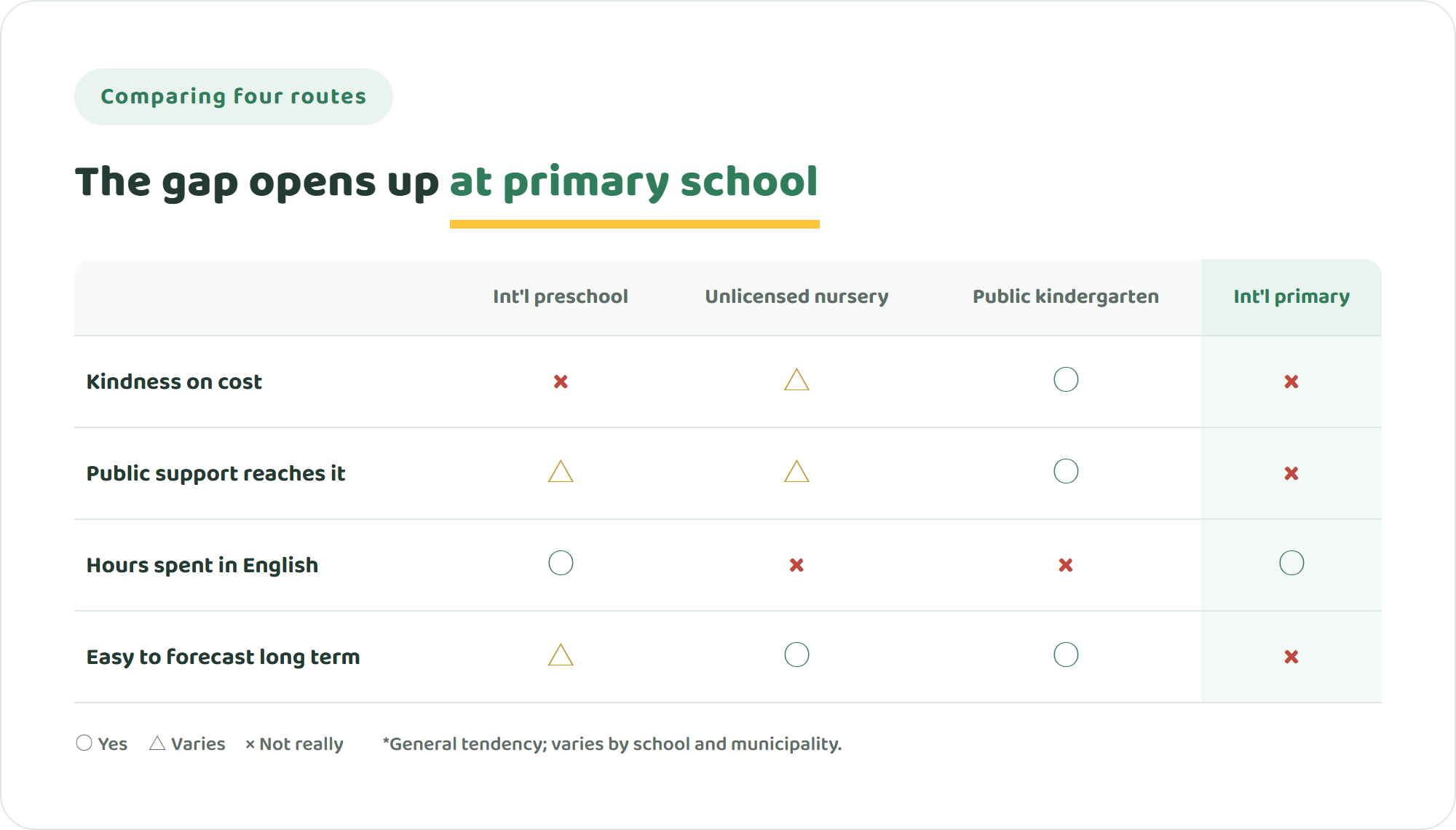
What the table shows is that the cost gap before school age is smaller than most parents expect — because public support is quietly closing part of it. The gap opens at primary school. If it feels affordable right now, that is partly your household, and partly a subsidy doing work on your behalf. Which is exactly why it is worth looking at the numbers on the far side of that subsidy today, while you still have years to plan around them.
Three steps for judging whether you can keep it going
Talking about the step tends to raise anxiety. But knowing about it early is what makes it manageable. Deciding in a panic in the final term of preschool, versus laying out primary options the year you enrol, are two completely different experiences for a family. There are only three things to do.
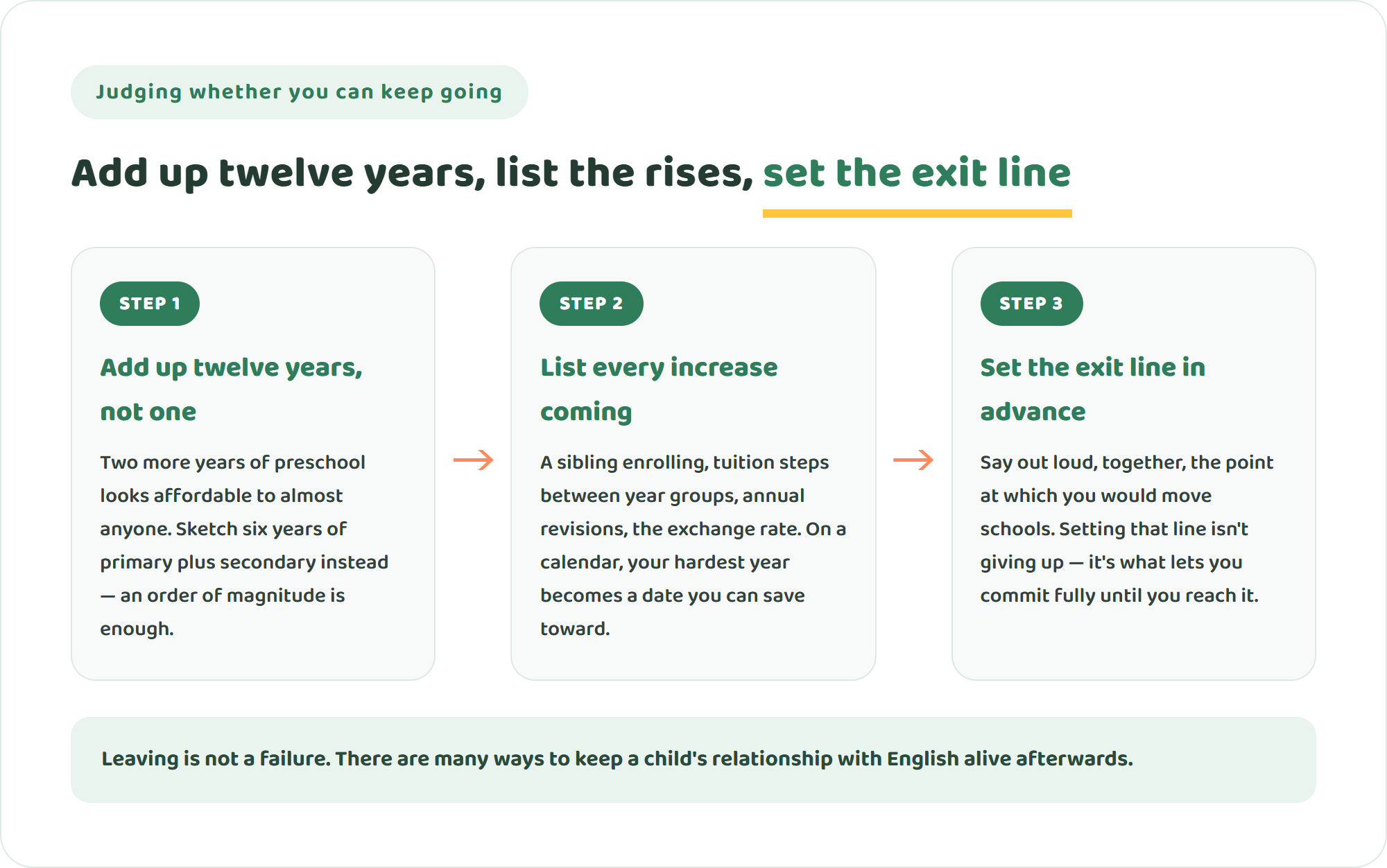
Step 1: add it up over twelve years, not one. Two more years of preschool looks affordable to almost everyone. Instead, sketch the total across six years of primary and on through secondary. A rough order of magnitude is enough. If your plan is to move to a public school partway, that is a perfectly good plan — the problem isn’t switching, it’s arriving at year twelve without ever having had a plan at all.
Step 2: write down every increase that is coming. The year a younger sibling also enrols, the tuition steps between year groups, annual revisions, and the exchange rate — schools that recruit teachers from abroad feel a weak yen in their fee structure. Lay them on a calendar and the single hardest year for your household stops being a vague fear and becomes a date you can save toward.
Step 3: agree the exit line before you need it. Say out loud, with your partner, the point at which you would move to a different school. Setting an exit line is not giving up; it is what lets you commit fully until you reach it. And leaving is not a failure. There are many ways to keep a child’s relationship with English alive afterwards, and if cost is the binding constraint, it is worth knowing whether online international schools are genuinely more affordable before you conclude the door has closed.
See how learning works at NGA →
A third option — lowering the step from the learning side
You can meet the cost step by earning more, or you can meet it by changing the shape of the schooling. Here is where we stand, stated plainly. NIJIN GLOBAL ACADEMY (NGA) is an online international school beyond the exam race, opening in September 2027 and operated by NIJIN Inc. NIJIN Academy, one of Japan’s largest alternative schools, already has over 900 children enrolled.
One thing has to be said before anything else, though. NGA is for children aged 6 to 18. We are not a preschool. If you are searching for a preschool place right now, NGA is not today’s answer for you. Where we can be relevant is at the transition into primary school — precisely the step this article has been describing. A school without a campus or a fleet of buses carries a different cost structure than a bricks-and-mortar one, for structural rather than promotional reasons. Learning is built around small-group dialogue, with the world itself as the material, and the ground beneath it is coming to love yourself and the world.
And there are families it won’t suit. If what you value most is a garden to run around in and daily face-to-face contact, online will feel thin. Building a daily rhythm asks something of parents, too. Compare us honestly against the alternatives and choose us only if it genuinely fits. Whatever you decide, the time your child spends at preschool is not wasted on any of these paths.
Frequently asked questions
Is an international preschool eligible for Japan’s free preschool programme?
It depends on the school. If it is registered with the local authority as an unlicensed childcare facility, fees for the 3-to-5 age group can be covered up to 37,000 yen a month, and up to 42,000 yen a month for children aged 0 to 2 in municipal-tax-exempt households. Families must also obtain certification of the need for childcare from their municipality, and unregistered schools are not eligible at all. Check the Children and Families Agency guidance, then confirm with both the school and your municipal office.
How much more does an international preschool cost than a regular nursery?
There is no single answer, because days per week, hours of care, lunches and after-care move the figure more than the label does. Compare annual totals — including entrance and facility fees and the bus — and normalise them to the same attendance pattern before you look at the difference. Then check eligibility for the subsidy school by school, which is what turns a list price into your actual cost. Whether the hours fit how you work deserves just as much weight as the number.
If we plan to start international school at primary level, do we need preschool at all?
It depends on the school’s admissions policy. Some expect a child to follow lessons in English from day one; others run support classes for beginners. If you have a school in mind, ask about entry requirements early — it is the only reliable answer. From a purely financial view, choosing not to stretch the household during the preschool years, and preserving that capacity for the far more expensive school years, is a perfectly rational strategy.
Not whether you can pay, but whether you can keep going.
If the pen stopped moving over that fee schedule, it wasn’t timidity and it wasn’t a lack of commitment. It was you noticing the right question. Not can we pay this month, but can this child keep learning this way. Asking it now puts you years ahead of the families who will meet the same step without warning.
NIJIN GLOBAL ACADEMY is scheduled to open in September 2027. We’ll send you news of our first cohort, along with how the learning works — small-group dialogue, a school without a campus, and a classroom connected to the world. You don’t have to decide anything today. Just hold on to this: there is a road on the far side of primary school, too.
Get opening updates by email →
More on choosing an international education
- Minerva Virtual Academy Fees for Families in Asia——Paid upfront, taught on UK hours
- American Online Schools for International Students——5 compared on tuition, time zones and eligibility
- Stanford OHS vs Laurel Springs——Live seminars or self-paced, read from Asia
- Alpha School vs Sora vs Primer——Which new school model a family in Asia can use
- Can You Raise a Bilingual Child Without Speaking English?——What parents can realistically do at home
- School Refusal? An Online International School Can Reopen Learning——A route back into learning
- How Do You Nurture the Skills Standardized Tests Cannot Measure?——Beyond exam scores
- The Best Age to Start Learning English for Kids——Too early? Too late?
- Online International Education in Asia and Oceania: 7 Options Compared——An honest comparison
- Where Do International School Graduates Go?——University outcomes, honestly