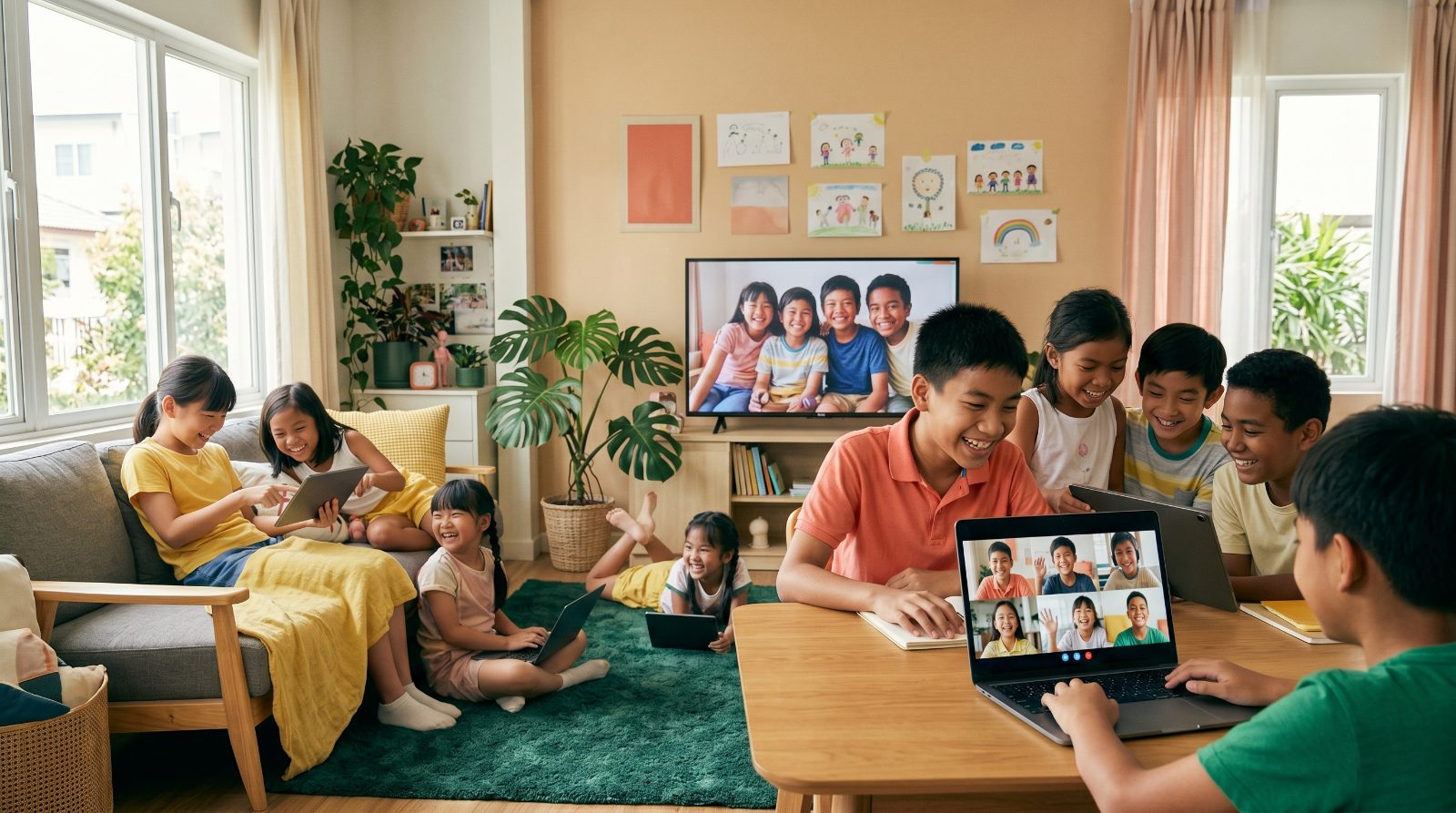
Most children in Australia go to a local government or private school. But in recent years, two other choices have been getting much more attention: homeschooling and international schools. In this article, we look at how popular each one is, why families choose them, and what rules apply.
Homeschooling is growing fast
Homeschooling has become one of the fastest-growing options in Australian education. Across the country, more than 45,000 children are now registered for homeschooling, nearly twice as many as in 2020.
The growth is clear in every large state. In New South Wales, registrations more than doubled from 5,907 in 2019 to 12,762 in 2024. In Victoria, 11,691 children were registered in June 2025. Queensland has seen the biggest jump of all, from about 3,400 children in 2019 to about 11,800 in 2025.
Families give many different reasons. Some found that learning at home worked well during the COVID-19 school closures. Others want more flexibility, have a child who struggled with bullying or anxiety, or have a child with special learning needs that school could not fully support.
The rules: registration in every state
Homeschooling is legal everywhere in Australia, but it is not a free choice without checks. Each state and territory requires families to register with its education authority. In New South Wales, this is now the Department of Education. In Victoria, it is the Victorian Registration and Qualifications Authority (VRQA), and in Queensland, the Home Education Unit.
The details differ by state. Parents usually need to show a learning plan, and some states also ask for progress reports or check in with families. Because so many families are applying, the system is under pressure. A 2025 government audit in New South Wales found that the regulator was struggling to keep up with the rising number of applications.
Homeschooling is also different from distance education. In states like New South Wales, children who live far from a school or cannot attend for other reasons can enrol in a government distance education school, where teachers deliver the regular curriculum remotely. Homeschooling families, in contrast, plan and teach the lessons themselves. Homeschooled students usually do not receive an ATAR, but they can still go to university through other routes, such as TAFE courses or special entry tests.
International schools: popularity and demand
In Australia, the term “international school” usually means a school that offers an international curriculum, most often the International Baccalaureate (IB). Many of these are private schools that teach both the Australian curriculum and the IB.
Interest in the IB is strong. There are now around 200 IB World Schools in Australia. 137 offer the Primary Years Programme, 41 the Middle Years Programme and 83 the Diploma Programme. IB Diploma results can be converted into an ATAR-equivalent score, so students can still apply to Australian universities in the usual way.
Australian schools are also popular with students from overseas. In 2025, about 19,800 international students were studying at Australian schools, up from about 19,000 the year before. Victoria hosts the largest number, with more than 6,200 students.
You might also like
Who chooses these options?
International schools attract several groups of families: families who move to Australia for work, students who come from overseas to study, and local families who want an IB education to keep university options open around the world. Homeschooling families, on the other hand, are often looking for a pace and style of learning that fits their child better than a regular classroom.
Both trends point in the same direction. More and more Australian families want to choose how their children learn, instead of simply following one standard path.
Connecting with Australian students through NGA
Australia has many children learning at home or at international schools. Because NGA is an online school and the time difference with Japan is small, it is easy for our students to have chances to interact with them.
For example, students could take online lessons together or give presentations in English about daily life and culture in each other’s countries. Talking in English with children their own age is an experience that is hard to get from classroom study alone. In the future, exchange programmes with schools in Australia are also a possibility.
We hope this article gives you a picture of how children in Australia are learning today.