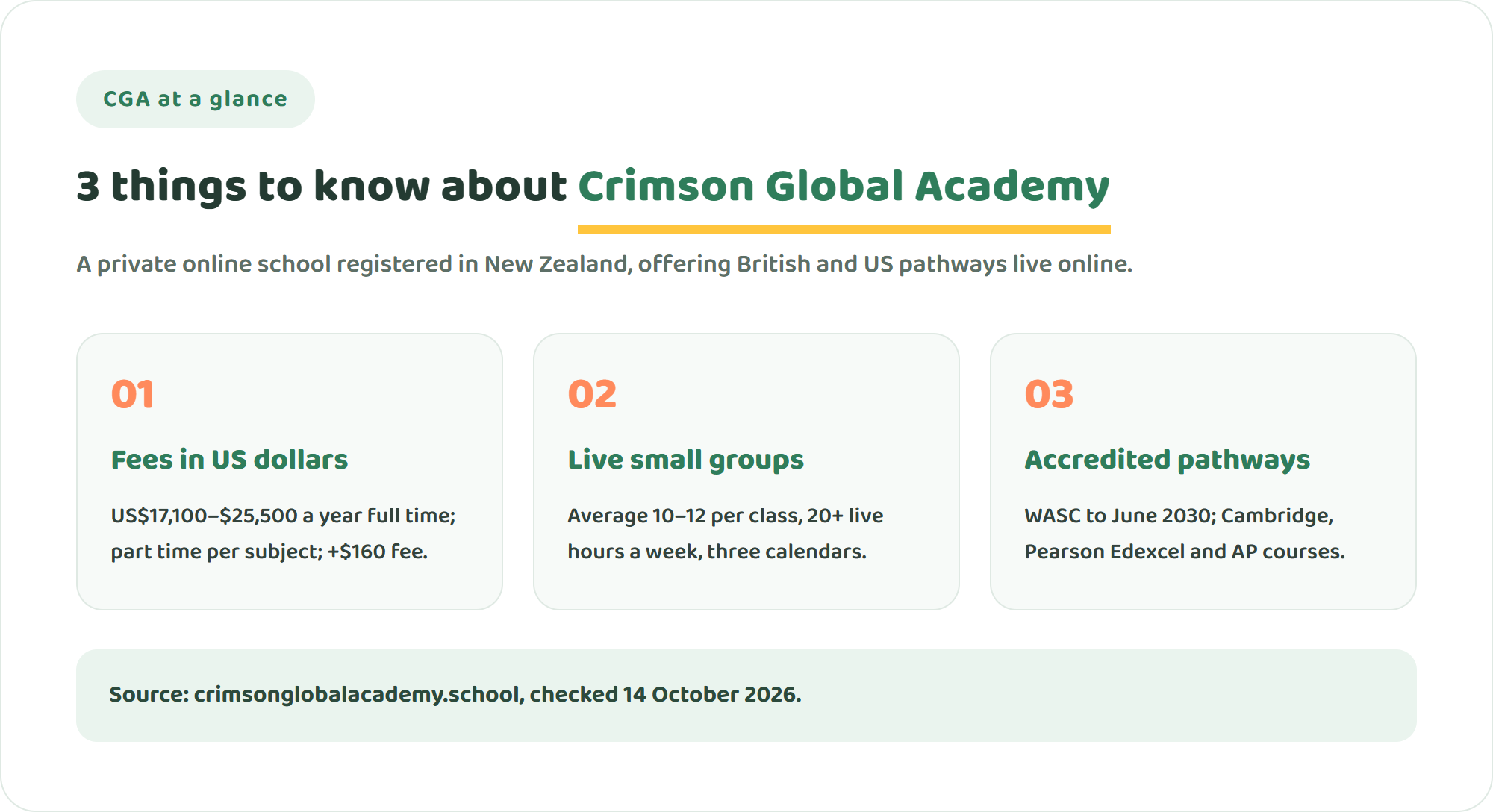
Crimson Global Academy fees on the school’s global fees page are US$17,100–$18,000 per year for full-time British-curriculum study (Years 7–13), US$18,000 for full-time Primary, and US$19,250–$25,500 per year for the full-time US High School Diploma, plus a US$160 application fee charged on every enrolment (official site, checked 14 October 2026). Part-time study is priced per subject — from US$3,100 (Lower Secondary) to US$4,100 (A Level) a year on the global page — and one-to-one “Da Vinci” tuition is US$4,500 per subject for 50 hours. Exam fees, a computer and an internet connection are extra. The US version of the fees page lists some different figures (for example US$22,375–$25,500 for Grades 9–12), so which page applies to your family matters; we show both below.
If you searched “Crimson Global Academy fees”, “Crimson Global Academy review” or “Crimson Global Academy cost”, you are probably weighing a fully online private school for a motivated child — perhaps in New Zealand, Australia, the US, the UK or a family that moves countries. You want the real annual cost, what is and is not included, whether the qualifications are recognised, how lessons fit your time zone, and how admission works. This page answers those questions from CGA’s own official pages, then compares it fairly with King’s InterHigh, Pearson Online Academy and NIJIN GLOBAL ACADEMY, a different kind of online school for ages 6–18 that opens in September 2027 (planned).
The short answer: who Crimson Global Academy suits — and who it doesn’t
- Suits: academically ambitious students who want Cambridge or Pearson Edexcel IGCSEs and A Levels, or a US High School Diploma with Advanced Placement courses, taught live online.
- Suits: families who want a recognised, accredited online school. CGA states it is WASC-accredited through June 2030 and a registered Cambridge International School.
- Suits: students who want to add one or two subjects alongside their current school. Part-time, per-subject enrolment is a published option.
- Suits: globally mobile families. CGA runs three school calendars (Aoraki, Greenwich and US) and offers rolling admissions.
- Harder fit: families looking for a low-cost online school. Full-time fees sit in the US$17,000–$25,500 range before exam fees.
- Harder fit: children who are still building their English. Admission includes an interview, a review of school reports and, for non-native speakers, the Oxford English Placement Test.
- Harder fit: families who need exact class times before applying. Lesson times by time zone are not published on the official site.

What Crimson Global Academy is
Crimson Global Academy (CGA) is a private online school that is part of the Crimson Education group, best known for university admissions consulting. Its New Zealand site describes it as a “Registered NZ Private Online School”, established in 2019 in Auckland, and lists “2500+” students. Students learn in live online group classes, one-to-one, or through recorded “Flex” courses, and can study full time or take individual subjects part time.
CGA offers two main academic pathways. The British pathway runs from Primary through Lower Secondary and Pre-IGCSE to IGCSEs and A Levels (with an optional Extended Project Qualification). The American pathway runs from primary grades and a US Junior High School to a US High School Diploma with Advanced Placement (AP) courses. The school’s global site lists regional versions for countries including New Zealand, Australia, the US, Canada, the UAE and Hong Kong, and the fees shown can differ by region.
| Item | Crimson Global Academy (official information, checked 14 October 2026) |
|---|---|
| School type | Private online school; “Registered NZ Private Online School” (NZ site); part of Crimson Education |
| Founded | 2019, Auckland (NZ site) |
| Ages / levels | Primary (global page: Years 3–6, ages 7–10; NZ page: Years 2–6) to Year 13 / Grade 12, age 18 |
| Curricula | Cambridge and Pearson Edexcel IGCSE and A Level; US High School Diploma; AP |
| Learning modes | Live group classes; 1:1 “Da Vinci”; recorded “CGA Flex”; full time or part time |
| Class size | Average 10–12 students; Primary up to 8 |
| Live hours (full time) | Minimum 5–10 hours a week (Primary); minimum 20 hours a week (other British-pathway levels) |
| Accreditation | WASC (ACS) through June 2030; Cambridge International School; Pearson Edexcel; College Board (AP) |
| Calendars | Aoraki (January–December), Greenwich and US (September–August); rolling admissions |
Crimson Global Academy tuition and fees (2026–27, official)
CGA publishes its fees in US dollars on its global fees and scholarships page. The table below shows those figures exactly as listed when we checked on 14 October 2026. The page’s own FAQ links a fee breakdown labelled “academic year 2025-2026” and gives an overall range of “USD $13,900–25,500” full time and “USD 1,000–4,100” per subject part time, so ask an advisor to confirm the figures for your start date.
| Programme (global page) | Full time, per year | Part time, per subject | Other options |
|---|---|---|---|
| Primary (ages 7–10) | US$18,000 | US$3,600 | CGA Leap (part time): US$3,600 per subject |
| Lower Secondary & Pre-IGCSE (ages 10–13) | US$17,100 | US$3,100 | Da Vinci 1:1: US$4,500 per subject (50 hours) |
| IGCSE (ages 14–16) | US$17,875 | US$3,255 | Da Vinci 1:1: US$4,500 per subject |
| A Level (ages 16–18) | US$18,000 | US$4,100 | EPQ: US$2,800 per year; Da Vinci: US$4,500 per subject |
| US Junior High School | US$17,000 | Not published on the official site | — |
| US High School Diploma (Grades 9–12) | US$19,250–$25,500 (“dependent on number of course credits”) | Not published on the official site | ESOL: US$1,700 per year; CGA Flex: US$1,000–$2,000 per subject; Da Vinci: US$4,500 |
| Advanced Placement (Grades 10–12) | — | US$3,700 per subject | CGA Flex: US$2,000 per subject; Da Vinci: US$4,500 |
| Application fee | US$160, “charged on every enrolment” | ||
The US fees page shows different numbers
The US version of the fees page lists: Grades 1–5 US$18,000 full time; Grades 6–8 (US Jr High School) US$18,800; Grades 9–12 (High School/AP) US$22,375–$25,500 for 4.5–6 credits, “calculated based on Group classes only”. British-curriculum full-time fees match the global page (US$17,100, US$17,875 and US$18,000), but part-time per-subject prices differ slightly: US$3,225 for Years 10–11 and US$4,800 for Years 12–13. The US page also notes that part-time students “will still need to continue to go to a school full-time to receive a high school diploma”. New Zealand families are pointed to separate 2026/27 fee schedules for the Primary, A-Level and US-diploma pathways, published as flipbooks rather than on the page itself.
What is included, and what is extra
According to the official FAQ, tuition covers live interactive classes or 1:1 instruction, small classes, digital resources, pastoral care, extracurriculars and university counselling; full-time students also get form time, assemblies and on-demand recordings. Extra costs named by CGA are the US$160 application fee, exam centre fees (“These fees vary depending on location and subject”), optional extras such as Da Vinci hours, and your own laptop or desktop, webcam and stable internet. Families can pay annually or in instalments. CGA mentions an early enrolment credit, a sibling discount and a community referral award, plus merit scholarships and financial aid that depend on region — but the amounts are not published on the official site.
A worked example using only official numbers
Take a family with two children on the global fees page: one doing two years of IGCSE and one doing two years of A Level, both full time. IGCSE: US$17,875 × 2 = US$35,750. A Level: US$18,000 × 2 = US$36,000. Add two application fees of US$160 = US$320. Total: US$72,070 over two years, before exam fees and before any sibling discount (amount not published). A single student adding two IGCSE subjects part time would pay US$3,255 × 2 + US$160 = US$6,670 for the year. If “every enrolment” means each new year, add US$160 per year — confirm this with an advisor. For a wider view of what families spend, see our guide to online vs in-person international school costs.
How a school day works: schedule, live classes and time zones
CGA’s main model is live group classes with an average of 10–12 students (up to 8 in Primary), taught by subject teachers over video. Full-time students in Lower Secondary, IGCSE and A Level have a minimum of 20 hours of live classes a week; Primary has a minimum of 5–10 hours. Recordings are available, so a student who misses a class can catch up. Students who need a different pace can choose one-to-one Da Vinci tuition (50 hours per subject) or CGA Flex, which the fees page describes as “on-demand recordings of live classes only” with support from an education coach. For a general picture of how an online school day feels at home, read our guide to how an online international school works.
Three school calendars
The term dates page explains that CGA has an Aoraki calendar (January–December, four terms, suited to the southern hemisphere) and Greenwich and US calendars (September–August). New classes start in January and September, each runs for roughly nine months, and exams are usually held in May/June or October/November. On the Aoraki calendar, IGCSE exams are in October/November and A-Level exams in January; on the Greenwich calendar they are in May/June; AP exams are in May. The page lists an Aoraki enrolment deadline of 20 January and orientation on 28–30 January. CGA says it aims to accommodate enrolments “throughout the year”, and Da Vinci students can start at any time.
Time zones
CGA says it has “multiple school calendars to suit different timezones”, but the actual class times for each time zone are not published on the official site. If your child lives in the Americas, Europe or Asia, ask the advisor for a sample weekly timetable in your local time before you pay the application fee, and ask which subjects are only available as recordings at your level.
Accreditation, diploma and college recognition
CGA’s accreditations page states that it has been granted full accreditation by the Accrediting Commission for Schools, WASC, “through to June 2030”; that it is “a registered online Cambridge International School” offering IGCSE and A Level; that it is accredited by Pearson Edexcel to offer International GCSEs and A Levels; and that it is accredited by the College Board to offer AP courses. The same page also lists the NCAA. The New Zealand site describes CGA as a registered private online school in New Zealand; the Ministry registration number is not shown on the pages we checked.
In practice, this means students sit the same external exams as students at bricks-and-mortar schools: IGCSE and A-Level results come from Cambridge or Pearson Edexcel, and AP scores come from the College Board. CGA says A-Level students now sit exams at home via remote invigilation, while US Diploma and AP students must find their own test centre and register. CGA also highlights a Niche ranking and several award shortlists. University acceptance statistics are not published on the official site pages we checked, so ask for verified outcomes for students on your child’s pathway.
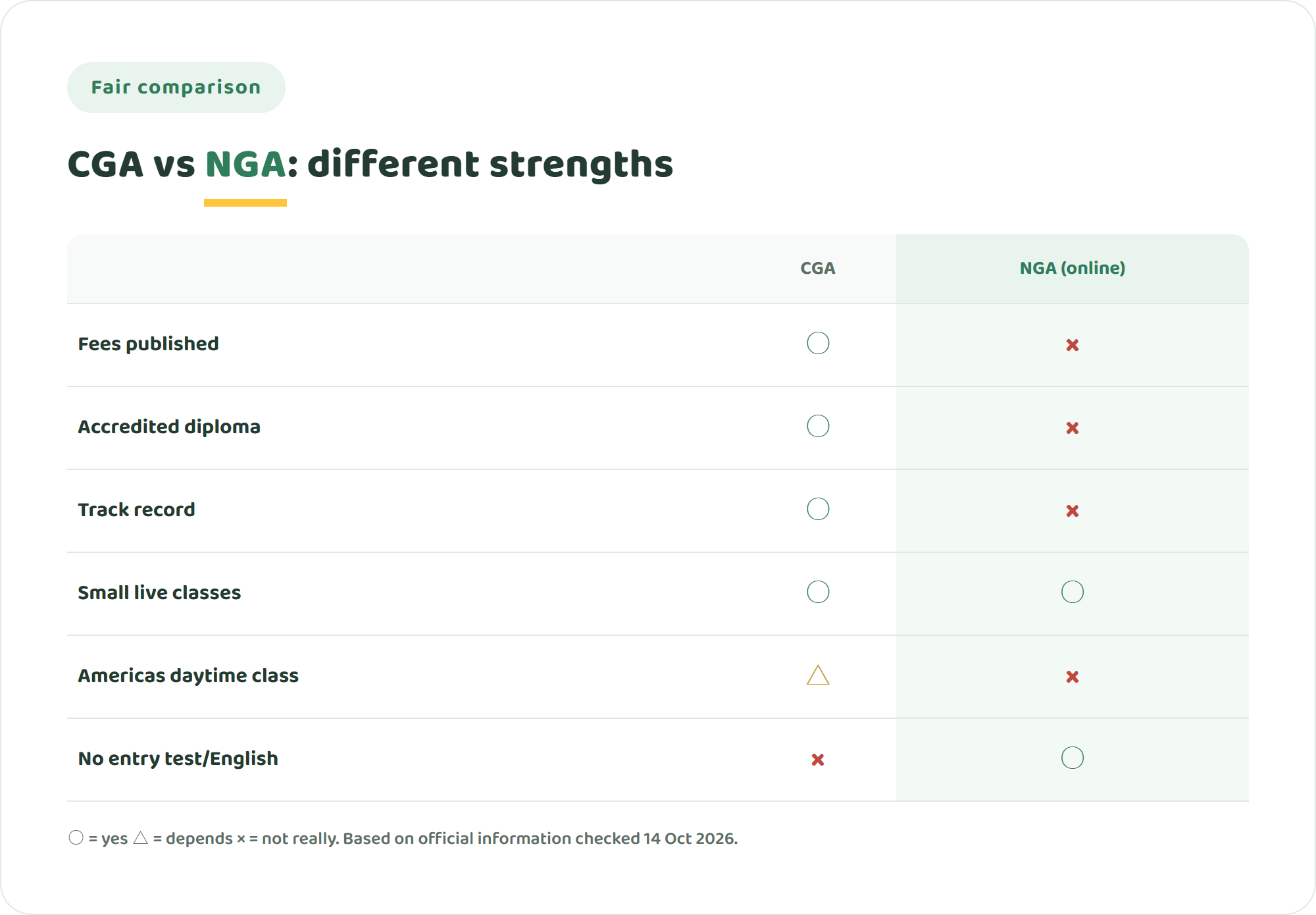
Crimson Global Academy vs NIJIN GLOBAL ACADEMY vs two other options (official data)
Here is CGA beside two other well-known online schools and NIJIN GLOBAL ACADEMY (NGA). King’s InterHigh is a British online school with published fees; Pearson Online Academy is a lower-cost accredited US online school. NGA is a different kind of school, built for families in Asia and Oceania. For more detail, see our King’s InterHigh fees and review and Pearson Online Academy tuition guide.
| Crimson Global Academy | NIJIN GLOBAL ACADEMY | King’s InterHigh | Pearson Online Academy | |
|---|---|---|---|---|
| School type | Private online school; registered in New Zealand; part of Crimson Education | Online international school focused on Asia & Oceania; opens September 2027 (planned) | Online independent school, British curriculum | Accredited private online school (US) |
| Grades / ages | Primary to Year 13 / Grade 12 (about ages 6–18, varies by region) | Ages 6–18 | Years 3–13 (ages 7–19) | K–12 |
| Tuition (2026–27) | US$17,100–$18,000 (British pathway) or US$19,250–$25,500 (US diploma) full time per year; part time from US$3,100 per subject; +US$160 application fee | Not yet published (no enrolment, facility or uniform fees; materials included; sibling discounts) | £4,395–£10,990 per year (annual contract) + £100 registration | US$5,450 (K–5), US$7,050 (6–8), US$8,250 (9–12) per full year; 5% off if paid in full |
| Curriculum | Cambridge / Pearson Edexcel IGCSE and A Level; US diploma with AP | Subjects learned in English with a bilingual mentor; CEFR-based English levels; co-creation projects; optional Cambridge IGCSE / A-Level pathway | KS2–KS3, IGCSE, A Level, IB Diploma | US curriculum; see official site |
| Live classes & time zone | Live groups (average 10–12), recordings, 1:1 and Flex; three calendars; class times not published | Small live dialogue groups (about 8); built for Asia–Oceania daytime — may fall outside the day in the Americas or Europe | Live 40-minute lessons, recorded; UK, Middle East or Southeast Asia timetables | See official site |
| Accreditation / diploma | WASC to June 2030; Cambridge; Pearson Edexcel; College Board (AP); US diploma | Not yet accredited; no graduates yet | DfE OEAS; Cambridge International School; Pearson Edexcel centre; IB | Accreditations listed on the official site; US diploma |
| Admission | Discovery call, school reports and interview; entry test in some cases; Oxford English Placement Test for non-native speakers | No academic entrance exam, no English requirement | Non-selective for most programmes; £100 registration | Application; no registration fee |
| Start dates | New classes January and September; rolling admissions | Opens September 2027; free trial classes monthly; pre-opening trials April–May 2027 | Any time in the year | See official site |
Sources: CGA fees (global), CGA fees (US), CGA accreditations, King’s InterHigh fees, Pearson Online Academy tuition — checked 14 October 2026.

Reviews and common concerns, answered honestly
Parent and student reviews of CGA tend to return to the same questions. Here they are, with what the official pages say, so you can weigh them yourself.
“Is it worth the price?”
Full-time fees are similar to many private schools, so the question is what you get for them. CGA lists live classes, small groups, pastoral care, extracurriculars and university counselling as included. Families comparing value usually set those against a lower-cost online school such as Pearson Online Academy, or against keeping a local school and adding one or two CGA subjects part time.
“How hard is it to get in?”
CGA says enrolment “is competitive”. It reviews school reports and achievements, holds an interview, may require an entry test “especially for younger students”, and uses the Oxford English Placement Test for non-native speakers. The whole process typically takes 2–3 days, according to the admissions FAQ.
“Will the class times work where we live?”
This is the most practical concern. CGA runs three calendars and offers recordings, but class times by time zone are not published. Ask for your child’s actual timetable in local time before committing.
“Is CGA the same as Crimson Education?”
They are related but different. Crimson Education is the group known for university admissions support; CGA is the group’s online school, with its own teachers, accreditation and fees. CGA’s tuition includes university and careers counselling, but the fees page does not say that separate Crimson Education consulting services are included — ask if this matters to you.
“Will my child be lonely studying online?”
CGA lists extracurriculars, form time, assemblies and pastoral support for full-time students. Social life online is still different from a physical campus, so ask which clubs run in your time zone and how often students meet live.
Alternatives to Crimson Global Academy worth comparing
King’s InterHigh suits families who want a British online school with published annual fees and IGCSE, A Level and IB options, with timetables for the UK, Middle East and Southeast Asia. Pearson Online Academy suits US-curriculum families who want an accredited K–12 school at a lower published price. If your child needs a smaller, more supportive UK provider, our Nisai Virtual Academy review is worth reading, and New Zealand families can compare local choices in our guide to online school options in New Zealand. For US-style selective and flexible schools, see our reviews of Stanford Online High School tuition and Laurel Springs School tuition.
NIJIN GLOBAL ACADEMY (NGA) is a different kind of option. It is an online international school for ages 6–18 focused on Asia and Oceania, opening in September 2027 (planned), with free trial classes monthly from September 2026 and pre-opening trial classes in April–May 2027. Its first cohort is 100 students, and it is operated by NIJIN Inc. in Japan, whose alternative school NIJIN Academy has more than 1,000 students. NGA does not rank children by test scores: lessons are small-group live dialogue (classes of about 8), subjects are learned in English with a bilingual English–Japanese mentor, English levels follow the CEFR, and students join social co-creation projects with companies and governments plus international exchange. An optional Cambridge IGCSE / A-Level pathway is listed on the curriculum and timetable page. There is no academic entrance exam, no English requirement; NGA can run alongside a local school or as the main school, and it travels with the family if they relocate. Tuition is not yet published; NGA says it will be far more affordable than a typical international school, with no enrolment, facility or uniform fees, materials included and sibling discounts, and exact tuition will be shared first with its email list.
Be clear about the trade-offs: NGA is not yet open, is not yet accredited and has no graduates or track record. Its timetable is built for Asia–Oceania daytime, so for families in the Americas or Europe live classes may fall outside their day — check the timetable against your local time. If your child is ready for a selective, accredited school with IGCSEs, A Levels or a US diploma now, CGA is the more established choice.
For a broader overview, see our online international schools compared guide or read why families choose an online international school.
FAQ
How much does Crimson Global Academy cost per year?
On the global fees page, full-time study costs US$17,100 (Lower Secondary), US$17,875 (IGCSE), US$18,000 (A Level or Primary) and US$19,250–$25,500 (US High School Diploma) per year, plus a US$160 application fee and exam fees. Part-time study is priced per subject. The US page lists some different figures, such as US$22,375–$25,500 for Grades 9–12 (checked 14 October 2026).
Is Crimson Global Academy accredited?
Yes. CGA states it is accredited by WASC through June 2030, is a registered Cambridge International School, is accredited by Pearson Edexcel for International GCSEs and A Levels, and by the College Board to offer AP courses. Its New Zealand site describes it as a registered private online school.
Can international students enrol at Crimson Global Academy?
Yes. CGA describes itself as a global online school for “globally mobile families”, runs regional sites and three calendars, and accepts international payments. Admission includes an interview and, for non-native speakers, an English placement test. Class times in your time zone are not published, so ask an advisor.
Is Crimson Global Academy worth it?
For a motivated student who wants live, accredited IGCSE, A-Level or US-diploma study online and whose time zone fits the timetable, the published fees are in the same range as many private schools, with live classes, counselling and extracurriculars included. It is a harder fit if cost is the main concern, if your child is still learning English, or if class times fall at night where you live.
What are the alternatives to Crimson Global Academy?
Common alternatives are King’s InterHigh (British online school with published fees), Pearson Online Academy (lower-cost accredited US online school) and, for families in Asia and Oceania who want small live groups and bilingual support, NIJIN GLOBAL ACADEMY — no academic entrance exam, no English requirement, opening September 2027 and not yet accredited.
Choosing calmly, one question at a time
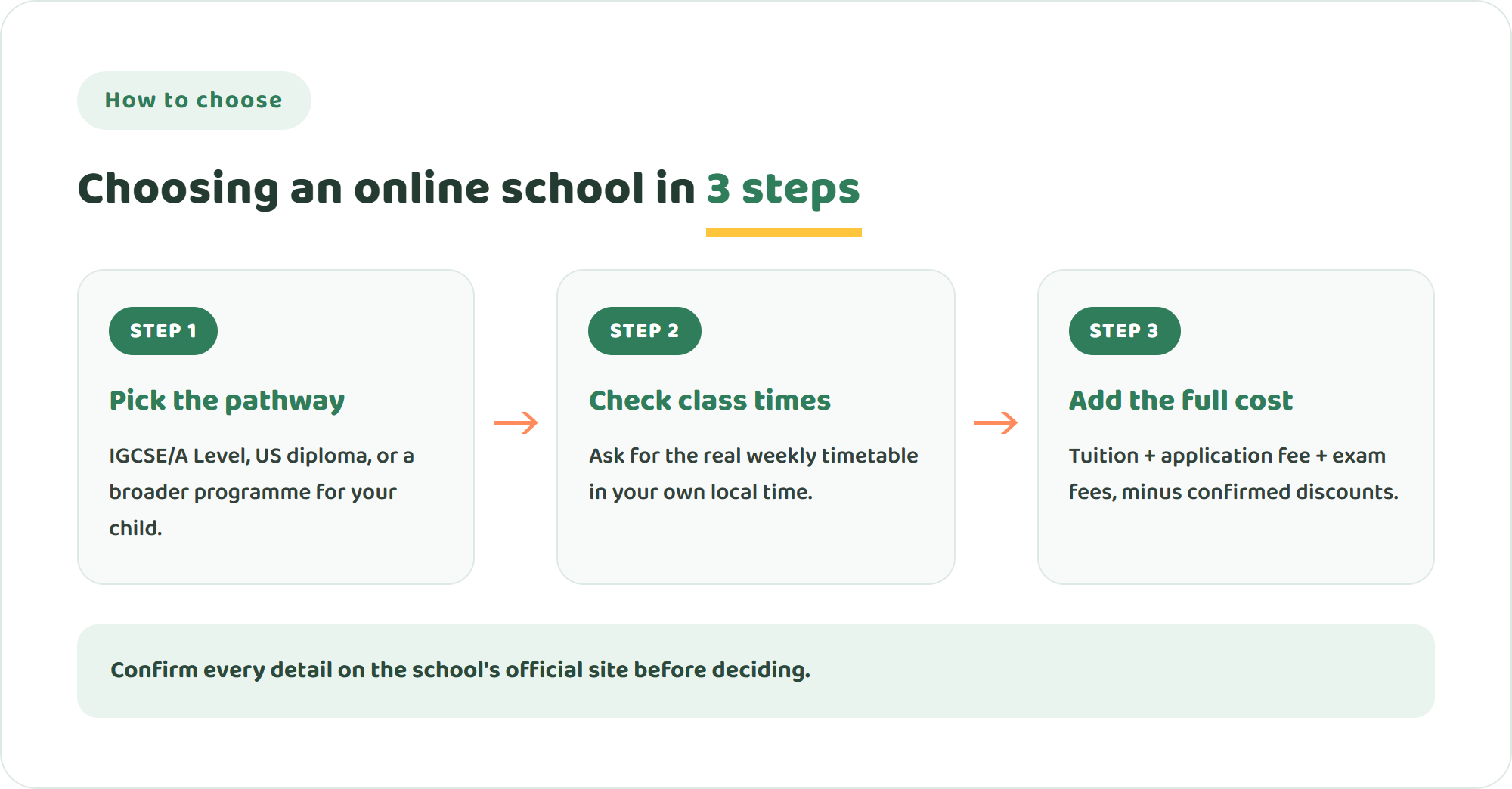
An online school is a big decision, and the fee table is only the start. Book the discovery call, ask for your child’s real weekly timetable in your local time, ask which discounts apply to your family and what exam fees will be, and let your child join a trial class before you decide. The right school is the one your child can join with energy, week after week.
Tuition and admissions details were checked on the official websites on 14 October 2026. Schools revise fees every year — always confirm on the official site before applying.