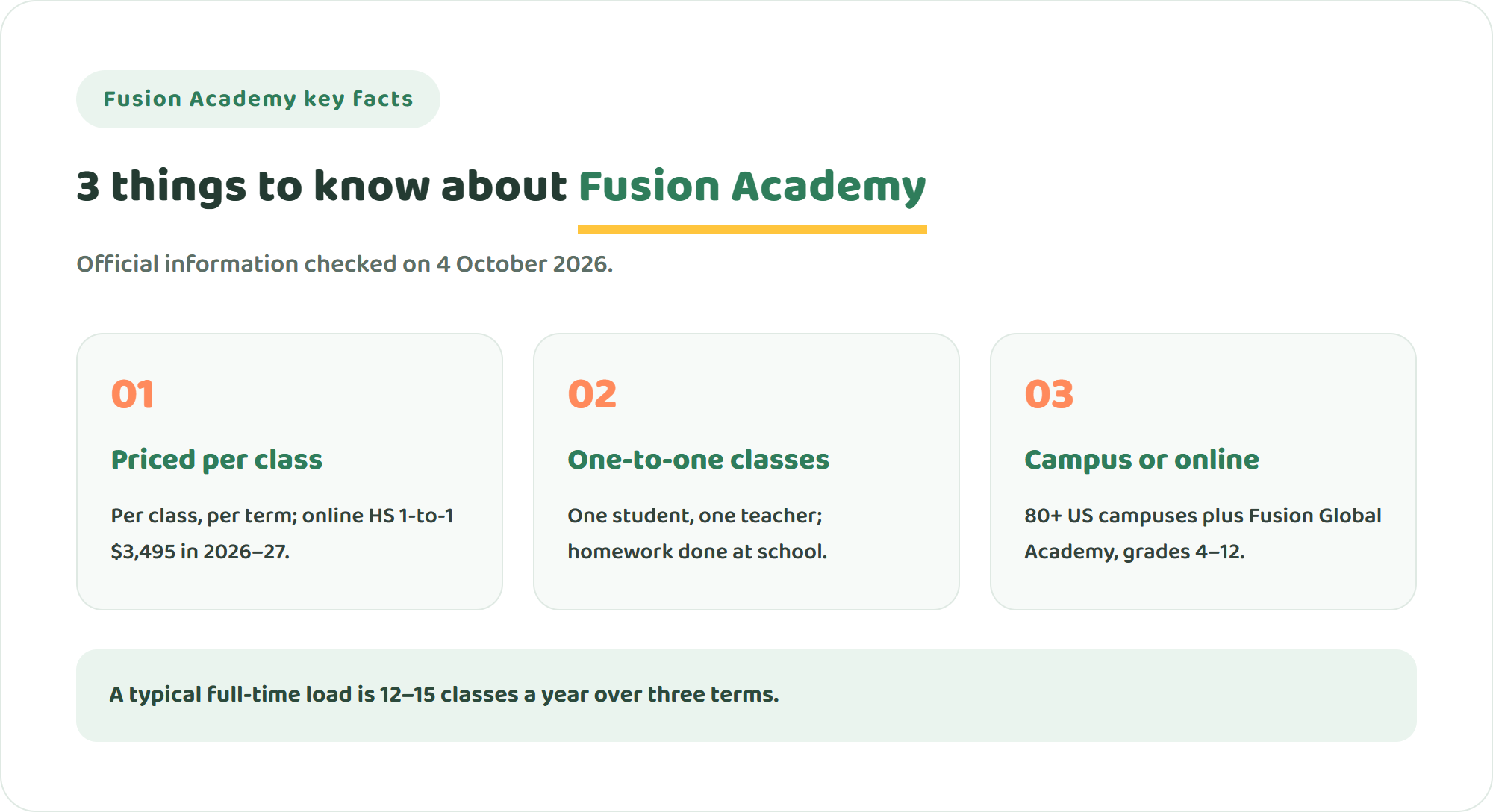
Fusion Academy does not charge one flat annual fee. Tuition is set per class, per term, and each campus publishes its own price list. For the 2026–27 school year, the online campus, Fusion Global Academy, lists $3,495 per class, per term for a standard one-to-one high school class and $3,810 for a standard one-to-one middle school class, plus a $1,500 registration fee for full-time students (official online tuition page, checked 4 October 2026). Fusion says full-time students typically take 12–15 classes a year over three terms, so a full-time year of standard one-to-one classes adds up to roughly $41,940–$52,425 in tuition online before registration. That figure is our arithmetic from the official prices, and campus prices are different: from $3,375 per high school class in Scottsdale, Arizona to $5,525 in Manhattan’s Upper West Side among the campuses we checked.
If you searched “fusion academy tuition” or “fusion academy review”, you probably want more than a per-class price. How many classes does a full-time student really take? What does a one-to-one school day look like, and can it work from another time zone? Is the diploma accredited, and do colleges accept it? Can a child outside the US enrol online? This guide answers those questions from Fusion Academy’s own pages and says clearly when something isn’t published. It then compares Fusion with Laurel Springs School, Stanford Online High School and our own school, NIJIN GLOBAL ACADEMY (NGA). NGA is a very different kind of option, and we’ve tried to be fair to everyone.
The short answer: who Fusion Academy suits — and who it doesn’t
- Suits students who struggle in a crowded classroom: Fusion describes its online school as built for “students with learning, social, or emotional differences”, and has pages for students with ADHD, anxiety and dyslexia, as well as gifted students.
- Suits families who want a fully personalised timetable. Every class is one student and one teacher, schedules are built around the family, and enrolment is rolling — a student can start at any time of the year.
- Suits student-athletes, young actors and others with commitments during normal school hours, or families who move: Fusion has 80+ campuses in the US plus a 100% online campus, and students can mix in-person and online classes.
- Suits families who want an accredited US diploma: Fusion holds Cognia system accreditation and lists NCAA- and UC-approved courses.
- Less suited to families on a tight budget. Even the lowest published campus price for a standard one-to-one high school class works out at about $40,500 a year for a typical 12-class full-time load. State education savings accounts help in some states, but there is no published need-based financial aid programme.
- Less suited to children who want to learn alongside classmates. Most teaching is one-to-one; social life happens in the Homework Café, clubs and events instead of in class.
- Less suited to younger children: Fusion serves grades 4–12, and the published tuition tables only show middle school and high school prices.

What Fusion Academy is
According to its About page, Fusion Academy was founded by Michelle Rose Gilman, beginning with one campus in Solana Beach, California in 1989. A Los Angeles campus followed in 2010 with the support of what is now Fusion Education Group, and the school has since grown to more than 80 campuses across the United States plus a 100% virtual campus. Its stated mission is “to personalize school for each student – emotionally, socially, and academically”.
The defining feature is the one-to-one classroom: one student and one teacher per class, working at the student’s pace. Fusion describes its teaching philosophy in three words — love, motivate, teach — meaning that a trusting relationship with the teacher comes first. Courses are offered at Essential, College Prep and Honors levels, plus AP® courses at many campuses, and students must reach mastery before moving on. Homework is done during the school day in the Homework Café, a supervised space where students also socialise. Families get a progress report from each teacher every school day.
Students can attend fully in person, fully online through Fusion Global Academy, or as a hybrid. Fusion also sells single classes for credit (over 300 core and elective classes, which students at other schools can transfer back with their home school’s approval), tutoring and college counselling.
| Item | Fusion Academy (official information) |
|---|---|
| Type | Private middle and high school network with one-to-one classes |
| Founded | 1989, Solana Beach, California (Michelle Rose Gilman) |
| Grades | Grades 4–12 |
| Locations | 80+ campuses in the US; Fusion Global Academy (100% online) |
| Class size | 1 student : 1 teacher (some small-group and self-directed options) |
| Tuition | Per class, per term; set by campus. Online 2026–27: $3,495 (HS standard 1-to-1) |
| Accreditation | Cognia school-system accreditation; campuses may also hold ACS WASC, MSA-CESS or NEASC |
| Enrolment | Rolling — start any time of year, including summer |
Fusion Academy tuition and fees (2026–27, official)
Fusion’s main tuition page explains the model: “Total tuition is calculated on a per-course basis and will depend on the specific classes your student chooses to take.” Each campus then has its own tuition page with a price table marked “Pricing above is for the 2026-2027 School Year.” Prices are per class, per term, and there are three terms a year. Below are the published figures for the online campus and four in-person campuses we checked on 4 October 2026.
| Campus (2026–27) | MS standard 1-to-1 | HS standard 1-to-1 | HS honors 1-to-1 | HS AP® 1-to-1 | Full-time registration |
|---|---|---|---|---|---|
| Fusion Global Academy (online) | $3,810 | $3,495 | $3,810 | $5,010 | $1,500 |
| Scottsdale, AZ | $3,900 | $3,375 | $3,900 | $4,350 | $1,800 + $250 new-student fee |
| Dallas, TX | $4,620 | $4,215 | $4,620 | $5,070 | $1,800 + $250 new-student fee |
| San Francisco, CA | $5,100 | $4,850 | $5,100 | $5,640 | $1,800 + $250 new-student fee |
| Upper West Side, NY | $6,090 | $5,525 | $6,090 | Not listed | $1,800 + $250 new-student fee |
Most campuses (and the online campus) also list two cheaper class types: a standard small-group class at $3,480 (middle school) or $2,900 (high school) per term, and a standard self-directed class at $725 (middle school) or $775 (high school) per term. Part-time students taking classes for credit pay a $200 registration fee. Tutoring is sold separately — for example $105 per single session online, $110 in Scottsdale, Dallas and San Francisco, and $140 at the Upper West Side — and college counselling packages range from $1,450 to $6,120 depending on the campus and package.
What is included: the campus pages say the cost of each class “covers equal time in class and in the Homework Café”. Honors, extended and AP® courses cost more because they need more sessions, and if a student needs longer to reach mastery, “additional class sessions may be required” — a cost that can’t be known in advance. Tuition for grades 4–5: not published on the official site (the tables only show middle and high school). Laptop, materials and activity costs: not published on the official site.
Discounts and funding: Fusion offers a 2% discount for paying in full by check or ACH, and custom payment plans. It accepts a range of state-funded scholarships and education savings accounts, including Arizona ESA, Florida FES-EO/FES-UA, Georgia and Tennessee programmes, North Carolina ESA+ and Texas TEFA; some (Arkansas EFA, New Hampshire EFA, Utah UFA, West Virginia Hope Scholarship) apply to the 100% online option only. A need-based financial aid programme or sibling discount: not published on the official site. New full-time students are covered by the Parent Promise: withdraw within 30 calendar days of the first class of a fall, winter or spring semester and the tuition for that semester is refunded (registration and activity fees excluded).
A worked example (official 2026–27 prices, our arithmetic). A high school student at Fusion Global Academy taking 12 standard one-to-one classes in a year: 12 × $3,495 = $41,940, plus the $1,500 registration fee = $43,440. At 15 classes: 15 × $3,495 = $52,425 + $1,500 = $53,925. Mixing class types lowers the bill: 8 one-to-one + 2 small-group + 2 self-directed classes = $27,960 + $5,800 + $1,550 = $35,310, plus $1,500 = $36,810. The same 12 one-to-one classes cost $40,500 + $2,050 = $42,550 in Scottsdale and $66,300 + $2,050 = $68,350 at the Upper West Side for a new student. For a family with two high schoolers studying online for four years, tuition alone at today’s prices would be 12 × $3,495 × 2 children × 4 years = $335,520, before registration fees, AP® surcharges and any price rises in future years (which are not published).
Fusion itself says families can’t get an exact estimate before meeting the Head of School, because the plan is built for each child. Use the figures above to sanity-check the quote you receive. If you’re weighing online against in-person schooling on cost alone, our online vs in-person international school cost guide covers the costs that don’t appear in a tuition table.
How a school day works: schedule, live classes and time zones
There is no standard Fusion timetable. On campus, a student goes to their one-to-one classes and spends the rest of the day in the Homework Café, where homework is finished at school — Fusion says students don’t bring “hours of additional work” home. A full-time student takes four to six classes per term. Because every class is one-to-one, the school says students “can take classes at a time of day that works best”.
Online, the Fusion Global Academy student life page says students “typically” have 2–4 hours of live one-to-one instruction each day. All classes are live with a teacher, not recorded lessons. Between classes, students use the Global Homework Café, an online space with subject breakout rooms and mentors who help with maths, science, English, social studies and executive-function skills. There are also online clubs, events and some in-person meetups.
Time zones: Fusion promises flexible scheduling and its international page mentions students who value “flexibility both in terms of my location … and the hours”. However, the hours during which online teachers are available, and how far that stretches for students in Asia, Europe or Oceania, are not published on the official site. If you live outside the Americas, ask the admissions team for a sample timetable in your local time before enrolling.
For comparison, a typical day at an online international school with small group classes looks different again. Our guide to how an online international school works walks through one hour by hour.
Accreditation, diploma and college recognition
Fusion’s accreditation page states that Fusion “has a School System Accreditation with Cognia”, which includes NCA CASI, SACS CASI and NWAC. New campuses start as “Candidate for accreditation” under Cognia and, according to Fusion, the system status gives them “a pathway … to be fully accredited within a few months”. Regionally, campuses “may be accredited” by ACS WASC, MSA-CESS or NEASC — NEASC only for the Burlington, Greenwich, Hingham, Fairfield and Newton campuses. The online campus page says Fusion Global Academy “is accredited by Cognia, WASC, and MSA”. Each campus’s own accreditation, CEEB code and school profile are listed on the school information and profiles page, which is the best place to check the campus you are considering.
Students can earn a US high school diploma. The international students page lists “NCAA and UC-approved courses”, which matters for student-athletes and for applicants to the University of California. On college outcomes, Fusion publishes that 99% of 2025 graduates who applied were accepted to a four-year college, that 87.5% of those attending college are going to their first-choice college, and that the Class of 2025 had 1,032 graduates. These are the school’s own figures.
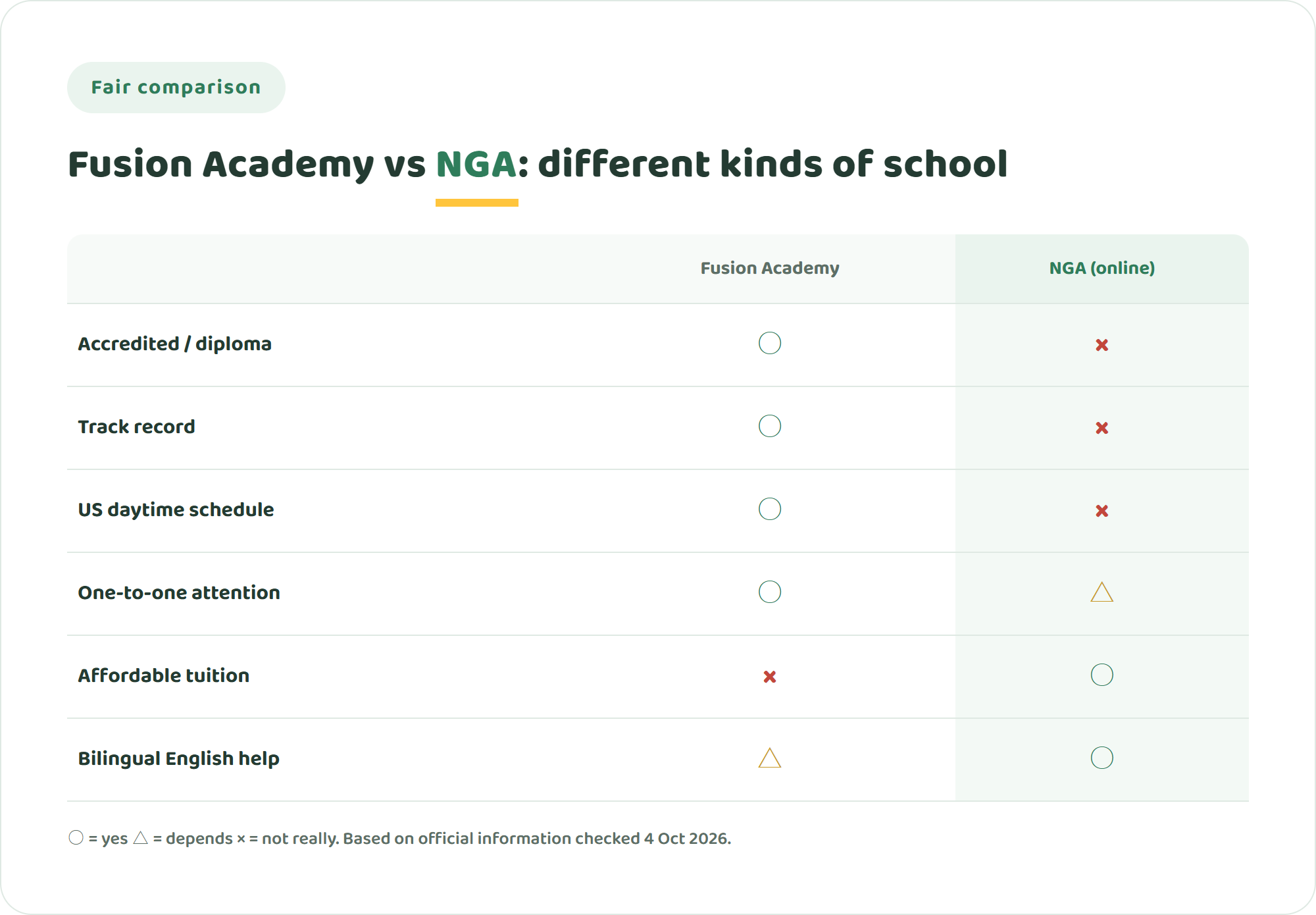
Fusion Academy vs NIJIN GLOBAL ACADEMY vs two other options (official data)
Here is how Fusion compares with two well-known online US schools and with NGA. These are four quite different models: one-to-one teaching, self-paced courses, a selective live seminar school, and small-group dialogue classes.
| Item | Fusion Academy | NIJIN GLOBAL ACADEMY | Laurel Springs School | Stanford Online High School |
|---|---|---|---|---|
| School type | Private school network; 80+ US campuses + online campus | Online international school (Asia & Oceania focus) | Private online school | Private online school (Stanford University) |
| Grades / ages | Grades 4–12 | Ages 6–18 | K–12 | Grades 7–12 |
| Tuition (2026–27) | Per class per term; online HS standard 1-to-1 $3,495 (12 classes = $41,940/yr) + $1,500 registration | Not yet published (no enrolment, facility or uniform fees; materials included) | High school $11,700/yr; middle $8,300; K–5 $7,200 (no year label on page) | Full-time $31,900; part-time $19,140; single course $6,380 |
| Curriculum | US courses at Essential, College Prep, Honors and AP® levels | Subjects in English, CEFR-based English levels, projects; optional Cambridge IGCSE / A-Level pathway | US college-prep courses, honors and AP® | University-style US college-prep and advanced courses |
| Live classes & time zone | Live 1-to-1; typically 2–4 hours a day online; flexible scheduling (teacher hours not published) | Live small groups of about 8, built for Asia & Oceania daytime (may fall outside daytime in the Americas/Europe) | Mostly self-paced; live sessions vary by programme | Live seminars twice a week per course, mostly 7:15am–9pm Pacific Time |
| Accreditation / diploma | Cognia system accreditation; WASC/MSA/NEASC by campus; US diploma | Not yet accredited; no graduates yet (opens 2027) | WASC and Cognia; US diploma | WASC and CAIS; diploma for full-time students |
| Admission | Meeting with Head of School; no entrance exam published | No entrance exam, no English requirement | Application and transcripts; no entrance exam published | Competitive: essays, writing sample, recommendations |
| Start dates | Rolling, any time of year | Opening September 2027 (planned); free trial classes monthly from Sept 2026 | Rolling starts through the year | Once a year; 2027–28 applications due 7 January 2027 |
Sources: fusionacademy.com (tuition, online tuition, campus tuition pages, accreditation, international students, about, admissions, Parent Promise), Laurel Springs tuition, Stanford OHS tuition and NGA’s own admissions information — checked 4 October 2026.
Reviews and common concerns, answered honestly
“Why is it so expensive?”
This is the most common theme. One teacher for one student costs far more to run than a class of 20, and Fusion’s per-class pricing reflects that. The total can climb further with honors or AP® classes, extra sessions to reach mastery, tutoring and counselling. The fairest way to judge it is against what a family would otherwise pay for a private school plus private tutoring, and to ask Fusion for a written breakdown before enrolling. Mixing in small-group or self-directed classes, where suitable, is the main lever Fusion offers to reduce the cost.
“Will my child be lonely without classmates?”
Parents often ask whether one-to-one teaching isolates children. Fusion’s answer is the Homework Café (on campus and online), clubs, events and, for online students, in-person meetups. Some students who were overwhelmed in large classes find this balance easier; others miss group discussion. Visiting a campus or attending a virtual open house is the best way to judge the social side for your own child.
“Is it rigorous enough for college?”
Some reviewers wonder whether a school designed for children who struggled elsewhere can stretch strong students. Fusion offers Honors and AP® courses, NCAA- and UC-approved courses and post-secondary counselling, and publishes a 99% four-year college acceptance rate among 2025 graduates who applied. Rigour still depends on the course level chosen, so look at the proposed schedule closely.
“Does quality vary by campus?”
With 80+ campuses, experiences naturally differ by location and by teacher, and prices differ too. Accreditation status is listed per campus on Fusion’s school profiles page. Ask to meet the Head of School and, if possible, the teachers who would work with your child.
“What if it doesn’t work out?”
Fusion’s Parent Promise lets new full-time students withdraw within the first 30 calendar days of a fall, winter or spring semester and get that semester’s tuition refunded (registration and activity fees excluded). After that, the standard refund policy in the handbook applies; its details are not published on the public site.
Alternatives to Fusion Academy worth comparing
Laurel Springs School is an accredited private online school for K–12 with self-paced courses and a flexible, rolling start. Its published high school tuition ($11,700 a year) is far lower than Fusion’s, but most learning is self-directed rather than live one-to-one. Our full Laurel Springs School tuition and review covers its programmes and fees.
Stanford Online High School is a selective online school for grades 7–12 with live university-style seminars, at $31,900 a year full-time in 2026–27. It suits academically driven students who want a challenging peer group rather than one-to-one support. If you’re comparing newer models, our Alpha School tuition and review looks at another personalised, high-cost private school.
NIJIN GLOBAL ACADEMY (NGA) is an online international school for ages 6–18, focused on Asia and Oceania, opening in September 2027 (planned), with free trial classes every month from September 2026 and pre-opening trial classes in April–May 2027. Children learn subjects in English in small live dialogue groups of about eight, with a bilingual (English–Japanese) mentor, CEFR-based English levels and social co-creation projects with companies and governments. There is no entrance exam and no English requirement, and it can run alongside a local school or as the main school. Tuition has not been published yet; it is designed to be far more affordable than a typical international school, with no enrolment, facility or uniform fees and materials included. Honestly: NGA is not yet accredited, has no graduates or track record yet, and its timetable is built for Asia and Oceania daytime, so live classes may fall outside the day for families in the Americas or Europe. You can see the full curriculum on our curriculum and timetable page, or compare more schools in Online International Schools Compared.
FAQ
How much does Fusion Academy cost per year?
Fusion charges per class, per term, with prices set by campus. For 2026–27, a standard one-to-one high school class costs $3,495 per term at the online campus and $3,375–$5,525 at the campuses we checked. With a typical 12–15 classes a year, a full-time year of standard one-to-one classes is roughly $40,500–$82,875 in tuition depending on campus and load, plus a $1,500–$2,050 registration fee. Small-group and self-directed classes cost less. Grades 4–5 prices are not published.
Is Fusion Academy accredited?
Yes. Fusion holds School System Accreditation with Cognia (including NCA CASI, SACS CASI and NWAC), and campuses may also be accredited by ACS WASC, MSA-CESS or NEASC. Fusion Global Academy states it is accredited by Cognia, WASC and MSA. New campuses begin as candidates for accreditation; check the campus profile for its current status.
Can international students enrol?
Yes. Fusion has an international students page and says 70 of its campuses are SEVIS-approved for students coming to the US, and the 100% online Fusion Global Academy is open to students abroad. Online live-class hours for distant time zones are not published, so ask for a sample timetable in your local time.
Is Fusion Academy worth it?
It depends on the child. For a student who needs one-to-one attention, a flexible schedule or a fresh start after a difficult experience, many families find the cost worthwhile, and Fusion reports high parent satisfaction in its own surveys. For a child who learns well in a group, a lower-cost accredited online school may meet the same goals. The 30-day Parent Promise reduces the risk of trying it.
What are the alternatives to Fusion Academy?
Common alternatives are Laurel Springs School (self-paced, accredited, lower tuition), Stanford Online High School (selective live seminars), other personalised private schools such as Alpha School or Acton Academy, and, for families in Asia and Oceania, NIJIN GLOBAL ACADEMY, which opens in September 2027 (planned).
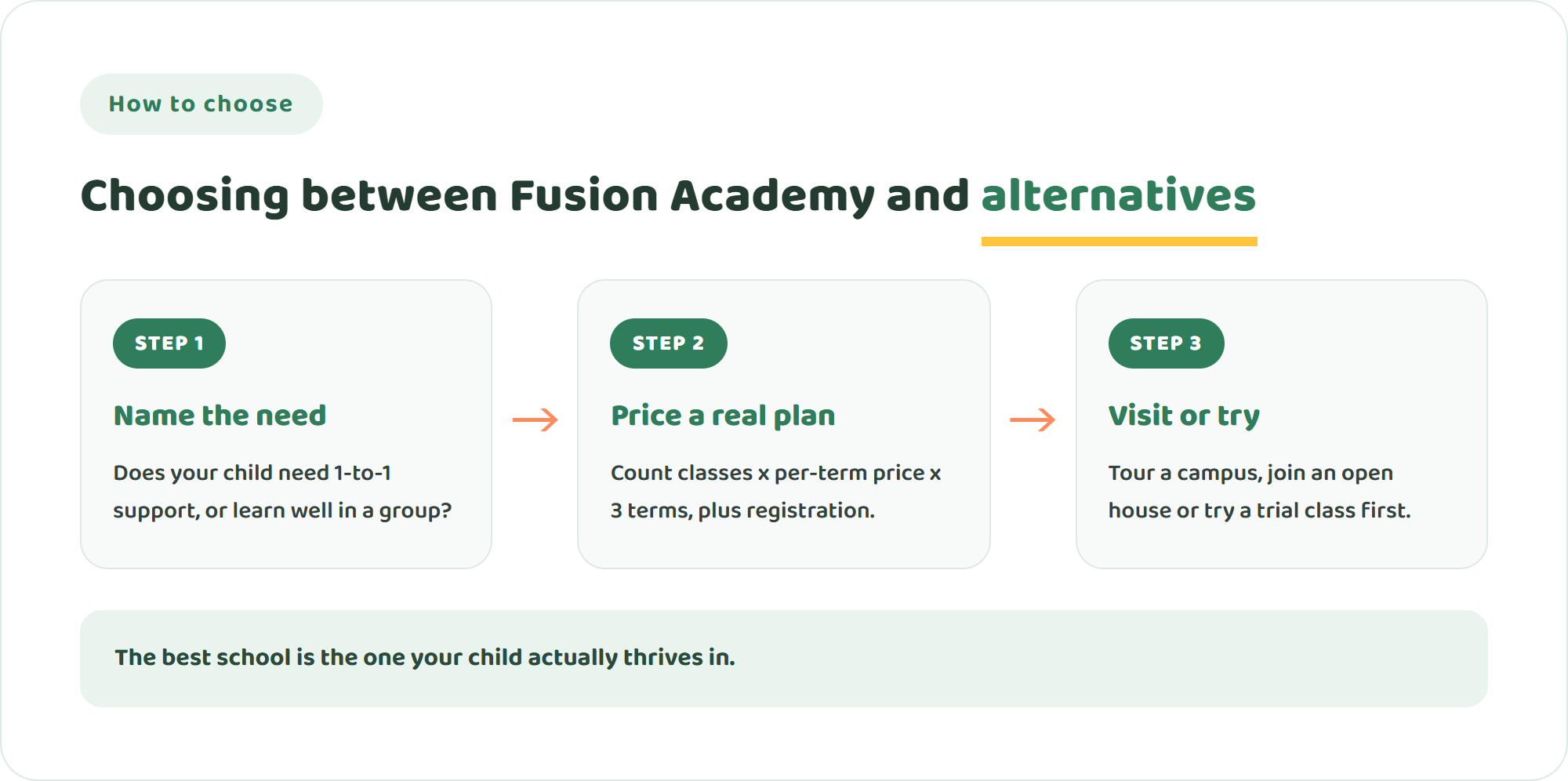
Choosing the right amount of support for your child
Fusion Academy’s promise is simple: one teacher, one student, and a school built around the child rather than the other way round. For many children who were lost in a big class, that can be life-changing, and the school is open about the fact that it comes at a premium price. Take the published per-class prices, build a realistic plan with the Head of School, and compare the total with the other options above. And if you’re a family in Asia or Oceania looking for a small, bilingual, more affordable live school, we’d be glad to keep you posted about NGA.
Tuition and admissions details were checked on the official websites on 4 October 2026. Schools revise fees every year — always confirm on the official site before applying.