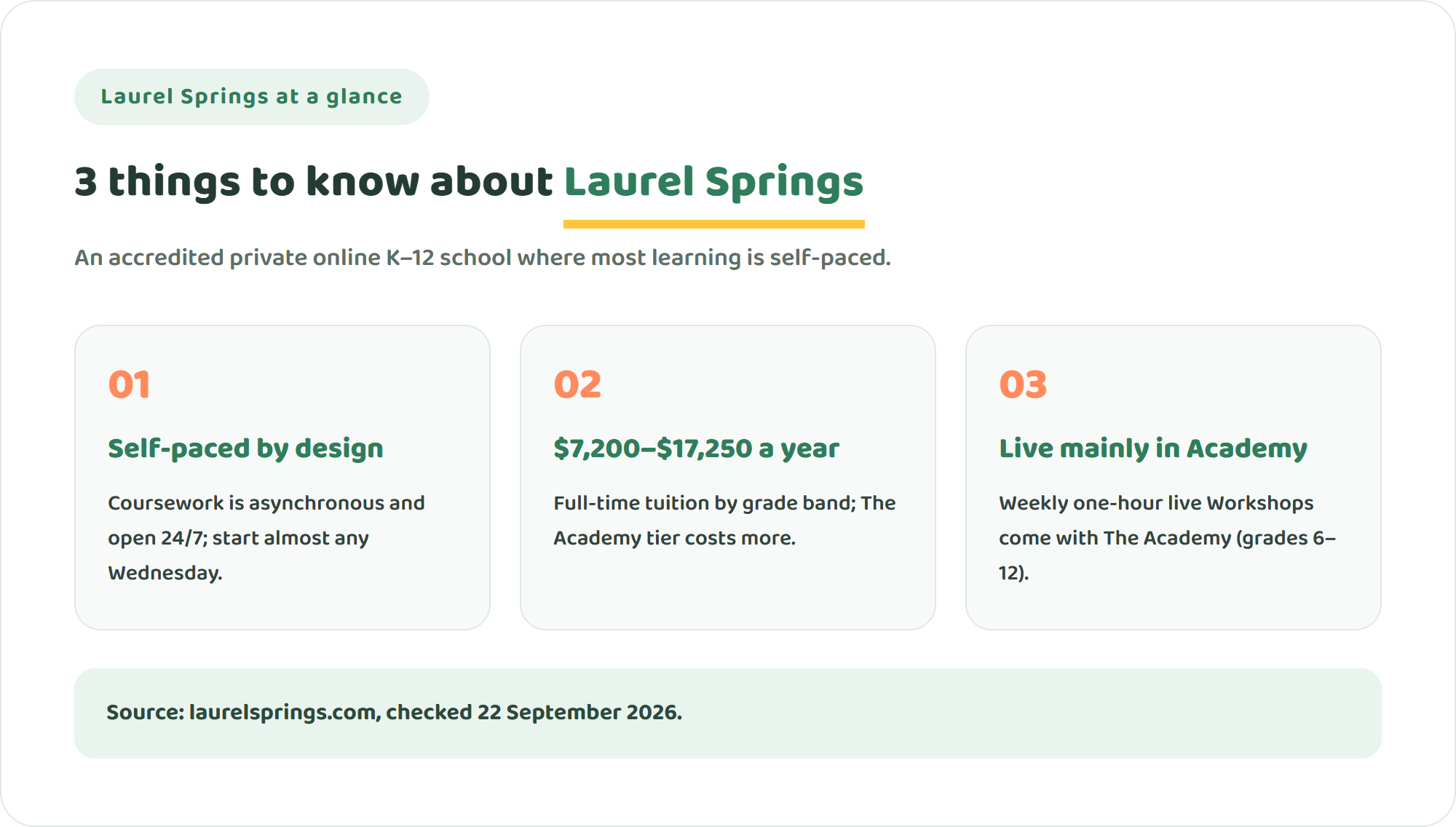
Laurel Springs School tuition is $11,700 per year for its full-time online high school (grades 9–12), $8,300 for middle school (6–8) and $7,200 for elementary school (K–5); the more live, cohort-style Academy program costs $12,650 (grades 6–8) or $17,250 (grades 9–12) per year (official tuition page, checked 22 September 2026). The tuition page does not print an academic-year label, but a post by the Head of School dated 15 September 2026 quotes the same figures as current pricing, so these are the numbers that apply to families enrolling for 2026–27. Single courses for part-time students run from $600 to $2,200 per year.
If you searched “Laurel Springs School tuition” or “Laurel Springs School review”, you probably want more than a price list: what that money actually buys, how a school day works when almost everything is self-paced, whether the diploma is recognised, whether you can enrol from outside the United States, and where families tend to struggle. This page answers those questions from Laurel Springs’ own website first, then compares it fairly with Stanford Online High School, Pearson Online Academy and NIJIN GLOBAL ACADEMY, a different kind of online school that opens in 2027.
The short answer: who Laurel Springs suits — and who it doesn’t
- Suits: students whose schedule is irregular — athletes, performers, travelling families — and who need school to fit around training, touring or time zones. The core curriculum is self-paced and available 24/7.
- Suits: families who want a private, accredited US diploma (WASC and Cognia) with college counselling built in, at a price well below many US private day schools.
- Suits: students who start mid-year: rolling admissions let students begin on almost any Wednesday.
- Suits: students who want a wide catalogue — the school cites 300+ courses, 60+ Honors and AP courses, six world languages and dual enrollment with university partners.
- Harder fit: children who need daily live teaching and a fixed timetable to stay motivated. The standard program is asynchronous; live weekly Workshops come only with the more expensive Academy tier (grades 6–12).
- Harder fit: younger children without an adult at home. For K–5, the official site says a parent or family member acts as the “learning coach”.
- Harder fit: students who are still learning English. No English test is required, but the school states that students need fluent academic English to work through a curriculum delivered entirely in English.

What Laurel Springs School is
Laurel Springs describes itself as the first online K–12 school in America. According to its history page, it was founded in 1991 in Ojai, California, grew out of a home-learning program for students who needed flexibility, and launched its first online Advanced Placement course in 1994. Today it is an accredited private online school for kindergarten through grade 12 (plus post-graduate students), with offices listed in West Chester, Pennsylvania and Ojai, California. There is no physical campus: all coursework is completed online, supplemented by optional in-person field trips, regional meet-ups and an annual Year-End Celebration with graduation and prom.
The school offers four main programs: Elementary School (K–5), Middle School (6–8), High School (9–12) and The Academy (6–12, full-time only), plus summer courses for grades 1–12. The school’s footer notes that it belongs to Spring Education Group.
| Item | Laurel Springs School (official) |
|---|---|
| Type | Private, tuition-based online school (not a free public/charter program) |
| Founded | 1991, Ojai, California |
| Grades | K–12 (Elementary K–5, Middle 6–8, High 9–12, The Academy 6–12) |
| Accreditation | Western Association of Schools and Colleges (WASC) and Cognia |
| Learning model | Self-paced, asynchronous, mastery-based; The Academy adds weekly live Workshops |
| Start dates | Rolling — almost any Wednesday; 5 months per semester course, 10 months per full-year course |
| Reach | Families in 100+ countries; over 15% of students international; 6,200+ graduates since 1991 |
| Diploma | Accredited US high school diploma; 23.5 credits required |
Laurel Springs School tuition and fees (2026–27, official)
These are the full-time prices published on the official Laurel Springs tuition page, in US dollars. A “semester” enrollment gives five months of access; a “full year” gives ten months.
| Full-time program | Grades | Full-year price | Semester price |
|---|---|---|---|
| Elementary School | K–5 | $7,200 | $4,000 |
| Middle School | 6–8 | $8,300 | $4,750 |
| High School | 9–12 | $11,700 | $6,450 |
| Academy Middle School | 6–8 | $12,650 | $7,125 |
| Academy High School | 9–12 | $17,250 | $9,425 |
Part-time students can take 1–3 individual courses. Official single-course prices (full year / semester):
| Single course | Full-year price | Semester price |
|---|---|---|
| K–5: Core (English, social studies, science, math), world language or elective | $1,650 | $975 |
| K–5: P.E./Health | $600 | $350 |
| 6–8: Core, world language or elective | $1,700 | $1,150 |
| 6–8: P.E./Health | $600 | $350 |
| 9–12: Advanced Placement | $2,200 | $1,600 |
| 9–12: Honors | $1,950 | $1,350 |
| 9–12: College Prep (English, social studies, science, math, world language) or elective | $1,850 | $1,300 |
| 9–12: P.E. | $900 | $700 |
What full-time tuition includes
According to the tuition page FAQ, full-time high school tuition covers records review and academic placement (including international records review), a typical load of 5–7 courses per term including Honors, AP, world languages and electives, one dual-enrollment course per enrollment in grades 11 and 12, 1:1 academic support from certified teachers, an assigned college counselor, athletic counseling for NCAA eligibility, virtual clubs and honor societies, technical support, report cards, transcript and diploma, 24/7 live tutoring through Tutor.com, access to 1:1 music lessons through a partner, and a SportsEdTV membership. The Academy adds 70+ courses with a weekly live Workshop, two dual-enrollment courses per enrollment from grade 9, an Academy Counselor from grade 6, Academy-only courses and clubs, and peer mentoring.
Fees, payment plans and discounts
- Deposit: families sign an Enrollment Agreement and pay a deposit. Amount: Not published on the official site.
- Registration fee: the site says the registration fee is waived for families who attend a Virtual Open House. Amount: Not published on the official site.
- Payment plan: the admissions steps include “set up tuition payment plan”. Instalment schedule and any plan fee: Not published on the official site.
- Discounts: for siblings enrolled at the same time, for students of active military and veteran families, and for paying in full. Discount percentages: Not published on the official site.
- Referral program: a referring family earns $250 and the referred family receives a $300 tuition credit (full-time students).
- State funding: Laurel Springs is an approved vendor for state ESA, voucher or scholarship programs in Arizona, Alabama, Arkansas and New Hampshire; eligible, approved families may use those funds for part or all of tuition.
- Books, lab kits and materials beyond the course: Not published on the official site — ask your Admissions Coordinator.
- Refund / withdrawal policy: Not published on the official site in the pages we checked; it will be in the Enrollment Agreement.
A worked example: two children, four years
Using only the official full-year prices (before any discount, deposit, registration fee or materials): one child in the main High School for grades 9–12 costs 4 × $11,700 = $46,800. A younger sibling going from grade 5 to grade 8 costs $7,200 (one elementary year) + 3 × $8,300 (three middle-school years) = $32,100. Together that is $78,900 over four years, before the sibling discount. If the older child chose Academy High School instead, their four years would be 4 × $17,250 = $69,000, and the family total would rise to $101,100. Note also that two semester enrollments ($6,450 × 2 = $12,900) cost $1,200 more than one full-year High School enrollment ($11,700). For how these numbers compare with a campus international school, see our guide to online vs in-person international school costs.
How a school day works: schedule, live classes and time zones
This is the single most important thing to understand before you pay. The main Laurel Springs program is asynchronous. Course material sits in the learning management system and students work through it whenever they choose, demonstrating mastery through assignments, projects, labs and assessments. The school’s own FAQ says there is no single template for a “typical day”, by design. Students also get 10 personal days each semester to step away from deadlines.
What does exist live? For K–5, the elementary page says certified teachers run weekly live learning experiences in math, language arts, science and social studies. For grades 6–12, live teaching mainly comes through The Academy: a weekly one-hour live Workshop with a teacher and classmates in the same course, plus a research-based Symposium course. Laurel Springs itself notes that Academy families should expect “a slightly more structured weekly rhythm” because Workshops depend on real-time attendance. Tutoring through Tutor.com is available 24/7.
Time zones. Because coursework is self-paced, the school says every time zone is accommodated, which is genuinely useful for families in Asia, Europe or Australia. The nuance is in the live pieces: the international students page says its virtual clubs and activities are an option “for those who are available during U.S.-friendly time zones”, and its Virtual Open Houses are scheduled in US Eastern/Pacific time. The times of Academy Workshops are Not published on the official site — if you live outside the Americas, ask which Workshop sections run at hours your child can attend. For a general picture of how different online schools structure the day, read how an online international school day works.
Accreditation, diploma and college recognition
Laurel Springs states that it is accredited by the Western Association of Schools and Colleges (WASC) and Cognia, and that its high school program is covered by both. Graduates earn an accredited US high school diploma after completing 23.5 credits: 4 English, 3 math (including Algebra 2 or higher), 3 science, 3 social studies including US History, 2 of the same world language, 1 PE, 0.5 health, plus electives. The school also lists NCAA-approved courses and UC a–g approved courses. We verified accreditation on the school’s own pages; you can confirm current status in the ACS WASC and Cognia public directories.
On outcomes, the official school profile reports for the Class of 2025: 77% college-bound, 86% admitted to at least one of their top three choices, and 90% scoring 3 or higher on at least one AP exam. It also says graduates of the past four years enrolled at nearly 600 colleges and universities. These are the school’s own figures; like any school-published statistics, read them alongside your own child’s goals.
Laurel Springs vs NIJIN GLOBAL ACADEMY vs two other options (official data)
Laurel Springs is often compared with Stanford Online High School (selective, live seminars) and Pearson Online Academy (lower-cost private online school). NIJIN GLOBAL ACADEMY is included because it is a very different model — small live groups for Asia and Oceania — not because it is the same kind of school.
| Laurel Springs School | NIJIN GLOBAL ACADEMY | Stanford Online High School | Pearson Online Academy | |
|---|---|---|---|---|
| School type | Private online school (US), since 1991 | Online international school operated by NIJIN Inc. (Japan); opening September 2027 (planned) | Independent school within Stanford University | Accredited private online school |
| Grades / ages | K–12 | Ages 6–18 | Grades 7–12 | K–12 |
| Tuition (2026–27) | $7,200 (K–5), $8,300 (6–8), $11,700 (9–12); Academy $12,650–$17,250 per year | Not yet published; no enrolment, facility or uniform fees; materials included; sibling discounts | $31,900 full-time (4+ courses); $19,140 part-time (2–3 courses) | $5,450 (K–5), $7,050 (6–8), $8,250 (9–12) per full academic year; 5% off if paid in full |
| Curriculum | US college-prep; 300+ courses, 60+ Honors/AP, dual enrollment | Subjects learned in English with a bilingual mentor; CEFR-based English levels; co-creation projects; optional Cambridge IGCSE / A-Level pathway | Advanced, university-style seminar courses | US curriculum; see official site |
| Live classes & time zone | Self-paced 24/7; weekly live Workshops in The Academy only; clubs in US-friendly hours | Small-group live dialogue (about 8 per class) timed for Asia & Oceania daytime — may fall outside daytime in the Americas/Europe | Small live discussion seminars; attendance expected | See official site |
| Accreditation / diploma | WASC and Cognia; accredited US diploma | Not yet accredited; no graduates yet | Accredited (see official site); US diploma | SACS CASI, NWAC, NCA CASI and Middle States (as listed on the official site); US diploma |
| Admission | Application, records review, placement; no English test (fluent academic English needed) | No entrance exam, no English requirement | Selective, by application only | Application; no registration fee |
| Start dates | Rolling, almost any Wednesday | Free trial classes monthly from Sept 2026; pre-opening trials April–May 2027; opens Sept 2027 | Fall only; 2027–28 application deadline 7 January 2027 | See official site |
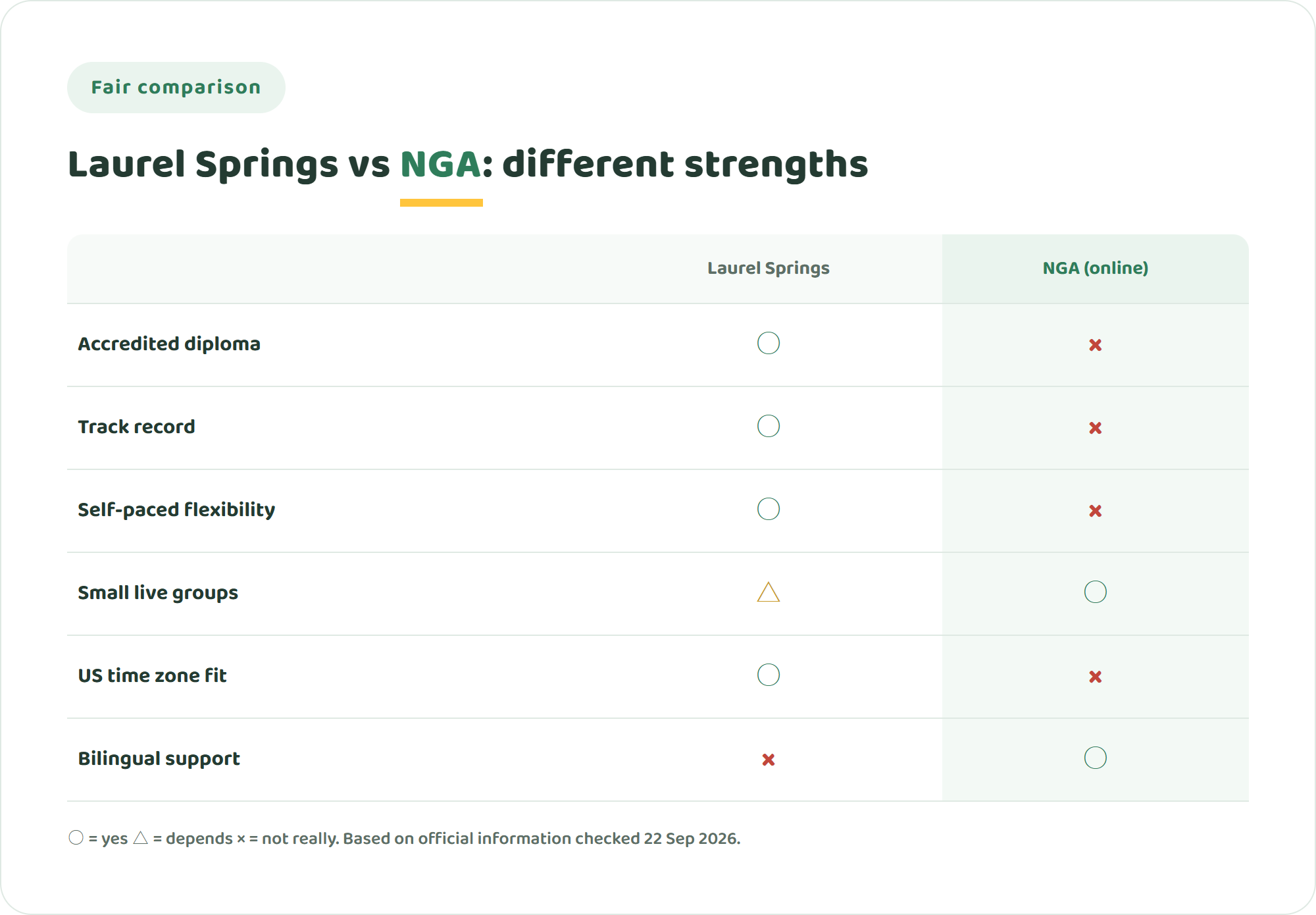
Sources: Laurel Springs tuition, Stanford OHS tuition, Stanford OHS admissions, Pearson Online Academy tuition — all checked 22 September 2026. For more detail on Pearson, see our Pearson Online Academy tuition guide, and for Stanford, our Stanford Online High School tuition review.

Reviews and common concerns, answered honestly
Parent and student reviews of Laurel Springs tend to circle the same themes. Here they are, with what the school officially says about each.
“My child needs more structure than self-paced work”
This is the most common trade-off with any asynchronous school. Self-paced learning suits motivated students and busy schedules, but some children drift without fixed class times. Laurel Springs’ answer is The Academy, with weekly live Workshops and a more structured rhythm — at a higher price. For younger children, the school expects a parent to act as learning coach.
“Is it worth paying when free public online schools exist?”
In many US states, tuition-free virtual public schools are available to residents. Laurel Springs is private and tuition-based, so what you pay for is flexibility of start date and pace, an in-house counseling team, a large course catalogue and a private-school diploma. Families outside the US generally cannot use free state programs, which makes a private option like Laurel Springs more relevant. Our Connections Academy tuition review explains how a free public online model differs.
“Will my child be lonely?”
The school lists virtual clubs, honor societies, student government, field trips, regional meet-ups and a Year-End Celebration. The club counts differ between official pages (from “30+” to “100+”), so ask for the current list. For families abroad, note that many live activities are scheduled in US-friendly hours.
“How quickly do teachers respond?”
Reviews of self-paced schools often mention teacher responsiveness, positively and negatively. Laurel Springs promises 1:1 academic support from certified teachers and 24/7 tutoring via Tutor.com. A guaranteed response time is Not published on the official site — worth asking at a Virtual Open House.
“Will colleges take the diploma seriously?”
The diploma is accredited by WASC and Cognia, and the school publishes college destinations and acceptance figures. Accreditation matters more than the online format; it is the first thing to check at any online school.
Alternatives to Laurel Springs worth comparing
1. Stanford Online High School — for academically advanced students in grades 7–12 who want live, discussion-based seminars rather than self-paced work. Admission is selective, entry is in the fall only, and 2026–27 full-time tuition is $31,900.
2. Pearson Online Academy — a lower-priced accredited private online school, with 2026–27 full-year tuition from $5,450 (K–5) to $8,250 (9–12), a 5% pay-in-full discount and no registration fee. International families should ask about shipping fees for physical materials.
3. NIJIN GLOBAL ACADEMY (NGA) — an online international school for ages 6–18 focused on Asia and Oceania, opening September 2027 (planned), with a first cohort of 100 students. It is built around small live dialogue groups of about 8, learning subjects in English with a bilingual (English–Japanese) mentor, CEFR-based English levels and projects with companies and governments. There is no entrance exam and no English requirement, and it can run alongside a local school. Tuition is not yet published; the school says it will be far more affordable than a typical international school, with no enrolment, facility or uniform fees. Be clear about the limits: NGA is not yet accredited, has no graduates yet, and its live timetable is built for Asia–Oceania daytime, so it may not suit families in the Americas or Europe. You can see the NGA curriculum and timetable or compare more schools in our online international schools comparison.
FAQ
How much does Laurel Springs School cost per year?
Full-time tuition is $7,200 for Elementary (K–5), $8,300 for Middle School (6–8) and $11,700 for High School (9–12). The Academy costs $12,650 (6–8) or $17,250 (9–12). Semester prices and single courses ($600–$2,200) are also available. The deposit and registration fee amounts are not published on the official site.
Is Laurel Springs School accredited?
Yes. The school states it is accredited by the Western Association of Schools and Colleges (WASC) and Cognia, and graduates receive an accredited US high school diploma after 23.5 credits.
Can international students enrol?
Yes. Laurel Springs says it supports families in 100+ countries and that over 15% of its students are international. No English proficiency test is required, but students need fluent academic English. International applicants follow a separate records-review process with their Admissions Coordinator.
Is Laurel Springs worth it?
It is strongest for self-motivated students who need a flexible schedule and want an established, accredited US diploma with counseling. It is weaker for children who need daily live teaching unless you pay for The Academy. Compare the total cost, the amount of live contact and the time zone of live sessions before deciding.
What are the alternatives to Laurel Springs?
Common alternatives are Stanford Online High School (selective, live seminars, grades 7–12), Pearson Online Academy (lower-cost accredited K–12) and, for families in Asia and Oceania who want small live groups and bilingual support, NIJIN GLOBAL ACADEMY, which opens in September 2027 (planned).
Choosing calmly
Laurel Springs has more than thirty years of experience, a genuinely flexible model and an accredited diploma — for the right student, that combination is hard to match. The key question is not whether it is a “good” school, but whether your child learns best alone at their own pace or with people in real time. Visit a Virtual Open House, ask about Workshop times in your time zone and the deposit and payment-plan terms, and compare the total cost with one or two alternatives. If you would like to know when NGA’s tuition and trial classes are announced, you are welcome to join the email list — no pressure either way.
Tuition and admissions details were checked on the official websites on 22 September 2026. Schools revise fees every year — always confirm on the official site before applying. Main sources: tuition, admissions process, international students, why Laurel Springs (accreditation), school profile, The Academy, cost and discounts.