“Maybe school just isn’t the right fit for this child.” Watching your child get ready in the morning, has that thought crossed your mind? The reluctant days start adding up. They stop mentioning the classroom. And yet nothing is clear enough to justify pulling them out. What most families find hardest is the question that comes next: what learning options are there when school does not fit?
Here is the short answer. When school does not fit, the learning options open to your child are not limited to one. Adjusting things at the current school, a public support centre, an alternative learning centre, learning at home, distance schooling, an alternative school, an online school — seven of them, just counting the common ones. This article lines all seven up against the same yardstick: who it suits, who it doesn’t, what it tends to cost, and how enrolment and attendance are handled.
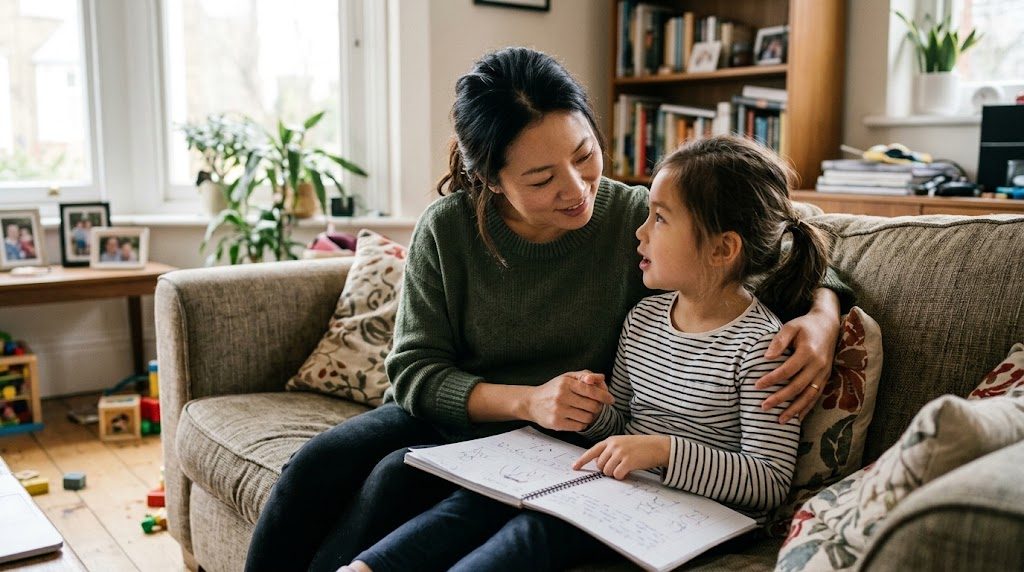
If school doesn’t fit, it isn’t your fault, and it isn’t your child’s
According to Japan’s Ministry of Education (MEXT) annual survey on student guidance issues, published in 2025, the number of elementary and junior high school students recorded as long-term non-attenders reached 353,970 in fiscal 2024 — the highest on record. That is not the sum of individual families getting it wrong. It is how many children the standard shape — same hour, same room, same number of people — does not fit. We work from a simple principle: don’t blame people, fix the structure. The problem was never the child, the teacher or the parent. It was that when one setting didn’t fit, there was effectively only one place to go.
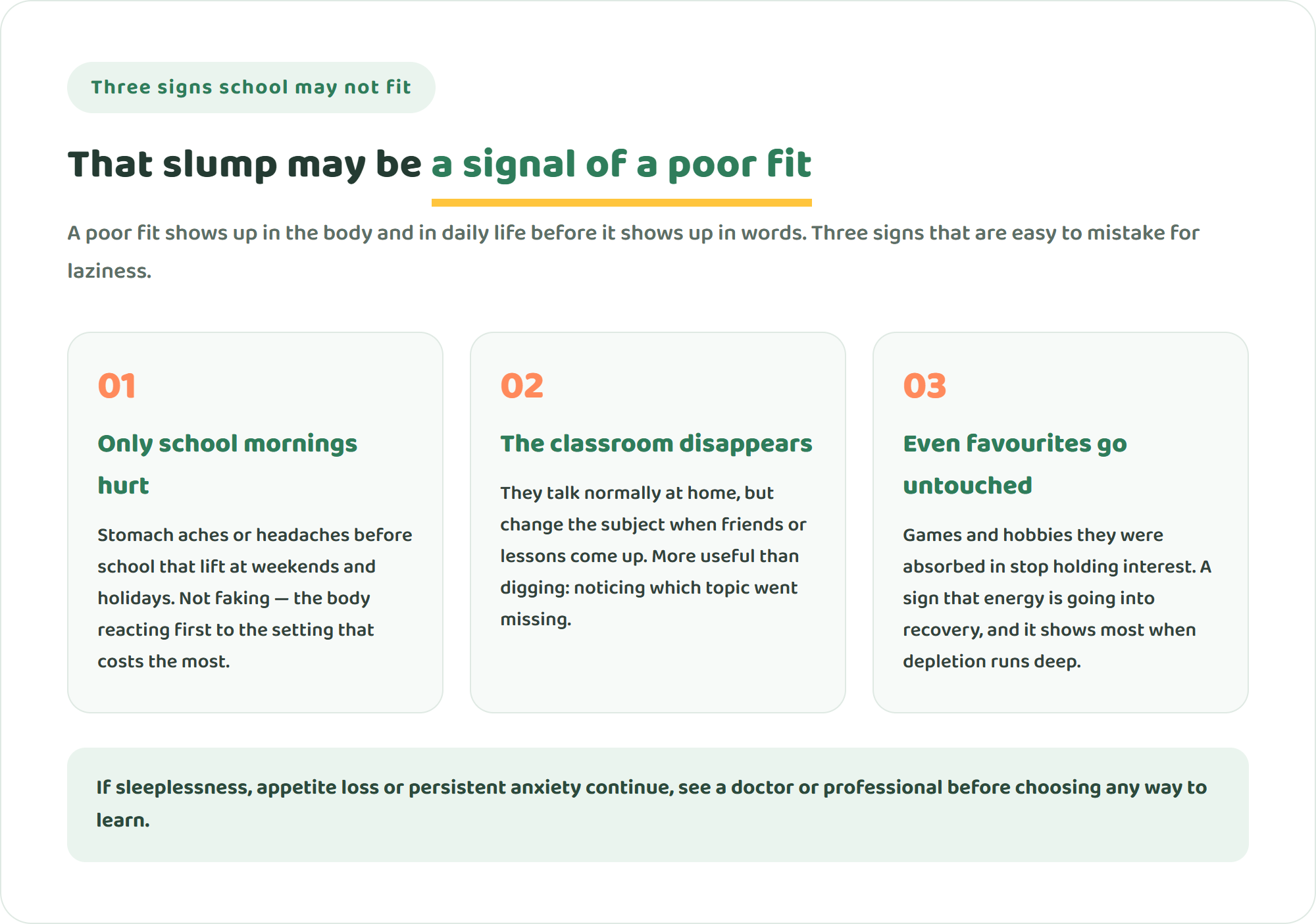
The signs usually show up in the body and in daily life before they show up in words. Stomach aches or headaches that appear only before school and lift at the weekend. Plenty of talk at home, but the classroom never comes up. Things they used to love, left untouched. You don’t have to attach a label to any of it yet. If mornings are where you’re struggling, see when your child does not want to go to school; for the view that stepping back is a transition rather than a retreat, see choosing to step away on purpose.
One request about order. If your child is not sleeping, not eating, or carrying persistent anxiety or low mood, put a doctor or a mental health professional ahead of any decision about how they learn. Choosing a learning setting can wait until body and mind have recovered a little. In Japan, MEXT runs a free 24-hour Children’s SOS line (0120-0-78310), which also takes calls from parents.
Six things to weigh before you choose
Deciding the yardstick first makes the choosing far easier. Cost (varies enormously by municipality and provider). Enrolment (during compulsory schooling in Japan, most options are used while the child stays enrolled at their local school). Attendance (whether days count toward the enrolled school depends on conditions and on a judgement, as below). Peers (for some children this, not academics, is what drives recovery). The load on you (an arrangement your family cannot sustain is not really an option). Learning that compounds (does it still build something two or three years out?). Deciding which of the six comes first is the work that precedes the actual choice.
Seven learning options when school does not fit
Costs vary too widely by municipality and provider for firm figures, so none are given here. Always check each provider’s official information.
1. Adjust the environment at the current school
A separate room, a shorter day, attending only for events, a change of seat or a lighter workload. Bringing in the school nurse and the counsellor, not just the homeroom teacher, can change the picture. Suits: a child who wants to keep their friendships and doesn’t dislike school itself. Less suited: when entering the building is itself the strain. Cost: usually little or nothing extra. Enrolment and attendance: both unchanged. Adding a second learning setting after hours is another way to spread the load.
2. A municipal education support centre
A public drop-in facility run by the local authority. Because coordination with the enrolled school is built in, attendance is easier to discuss. Suits: a child who can leave the house for a small group, and families who want the reassurance of a public service. Less suited: when there isn’t one within reach and travel is the burden. Cost: often light, being public, though it varies by municipality. Enrolment and attendance: the child stays enrolled at their school, and counting these days as attendance is widely practised — though, as with every option below, the final call rests with the principal of the enrolled school.
3. An independent alternative learning centre
These range from drop-in spaces to structured academic support, so two places with the same name can be entirely different. Visit before deciding. Suits: a child ready to be around peers again in small doses, who needs adults that accept their pace. Less suited: a long journey, or when adjusting to yet another new place is itself the hurdle. Cost: usually a monthly fee, with a very wide range. Enrolment and attendance: enrolment stays with the current school; attendance depends on coordination and the principal’s decision.
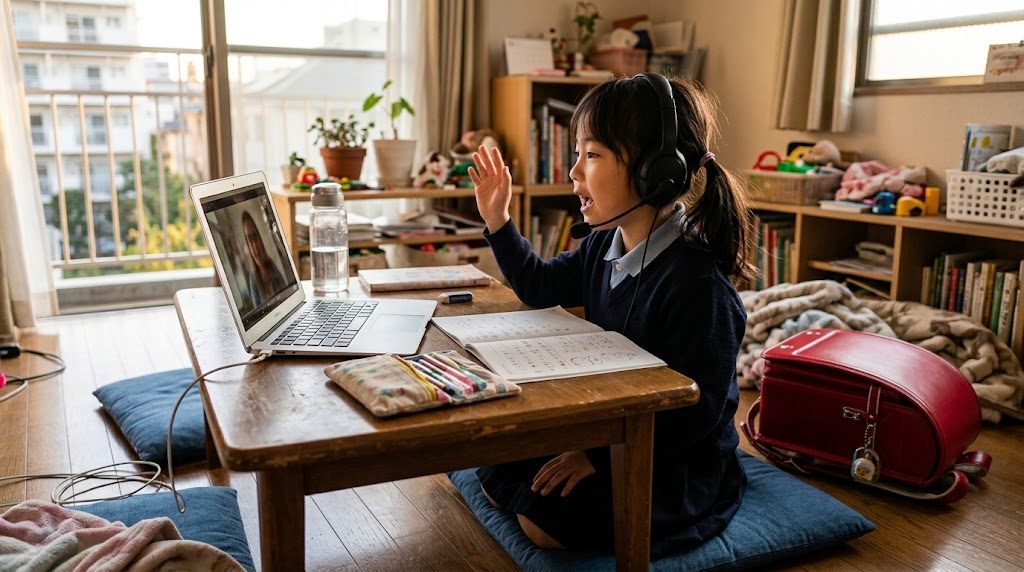
4. Homeschooling and learning at home
In Japan there is no framework under which homeschooling replaces compulsory schooling, so a child learns at home while remaining enrolled. With that said, it is the quietest option and the best one for getting their own pace back. Suits: a child who is depleted and needs rest, or who wants to restart from genuine interest. Less suited: a child who wants peers, or who struggles to hold a daily rhythm alone. Cost: mostly materials, so easier to contain. Enrolment and attendance: enrolment unchanged; attendance depends on the conditions covered in the next section.
5. Distance and correspondence schooling
Mainly a high school route, but knowing it exists while your child is still in junior high makes today’s decision lighter. Reports and scheduled attendance days combine into credits earned at your child’s own pace. Suits: a child who cannot commute daily but wants a recognised qualification. Less suited: a child who finds self-directed planning hard, or who wants day-to-day contact with peers. Cost: varies widely by school; public tuition support may apply. Enrolment and attendance: the child enrols at that school directly.
6. An alternative school (inquiry-based, Jena Plan and similar)
Schools whose whole philosophy of education differs. Being measured by something other than test scores can be genuinely restorative for a child who has concluded they are no good. Suits: a child who likes inquiry and dialogue and is tired of being constantly assessed. Less suited: a child who feels safer with a fixed framework, or when none is within reach. Cost: mostly independently run, with a wide range. Enrolment and attendance: during compulsory schooling, children typically attend while staying enrolled at their local school.
7. An online school or online international school
Your child takes part from the one place that already feels safe, without carrying classroom tension into it. No commute, and it flexes around days when their health dips. If an international route interests you, start with what an international school is so you can compare fairly. Suits: a child who wants to choose the group size and how they take part, and who is drawn to learning connected to the world. Less suited: a child who needs more than a screen can carry, or who wants physical activity at the centre. Cost: a wide range by school. Enrolment and attendance: during compulsory schooling, children generally stay enrolled locally. See also learning with the world when school isn’t working and our list of online international schools in Asia.
Beyond these seven there are also transfers to another public school through a change-of-designated-school request, and in-school support routes such as resource rooms and special-needs classes. If sensory sensitivity or a learning difficulty may be part of the picture, ask the enrolled school or your board of education about these before weighing the seven.
Learning at home can count as attendance, under conditions
MEXT has set out an approach under which, when a child who is not attending school carries out learning activities at home using ICT and similar means, those days may be treated as attendance at the school where the child is enrolled, provided certain conditions are met (MEXT information on supporting children who are not attending school). The conditions set out include sufficient cooperation between the family and the school, appropriate face-to-face guidance such as home visits, a planned programme of study, the principal having a grasp of how the learning is going, and — the one most often left out — that home study is used essentially where the child cannot receive support at a public support centre or an independent learning centre outside school. In other words, learning at home is framed as the option when no reachable setting exists, so whether one exists is itself part of the conversation with the enrolled school.
The part not to skip over: the decision on whether days actually count as attendance rests with the principal of the school where your child is enrolled. The same framework is applied differently from school to school and area to area. If a provider tells you their material guarantees attendance credit, pause there. Speak to the homeroom teacher, then confirm with the board of education and your school’s own official guidance.
See how learning works at NGA →
The order to compare the seven in
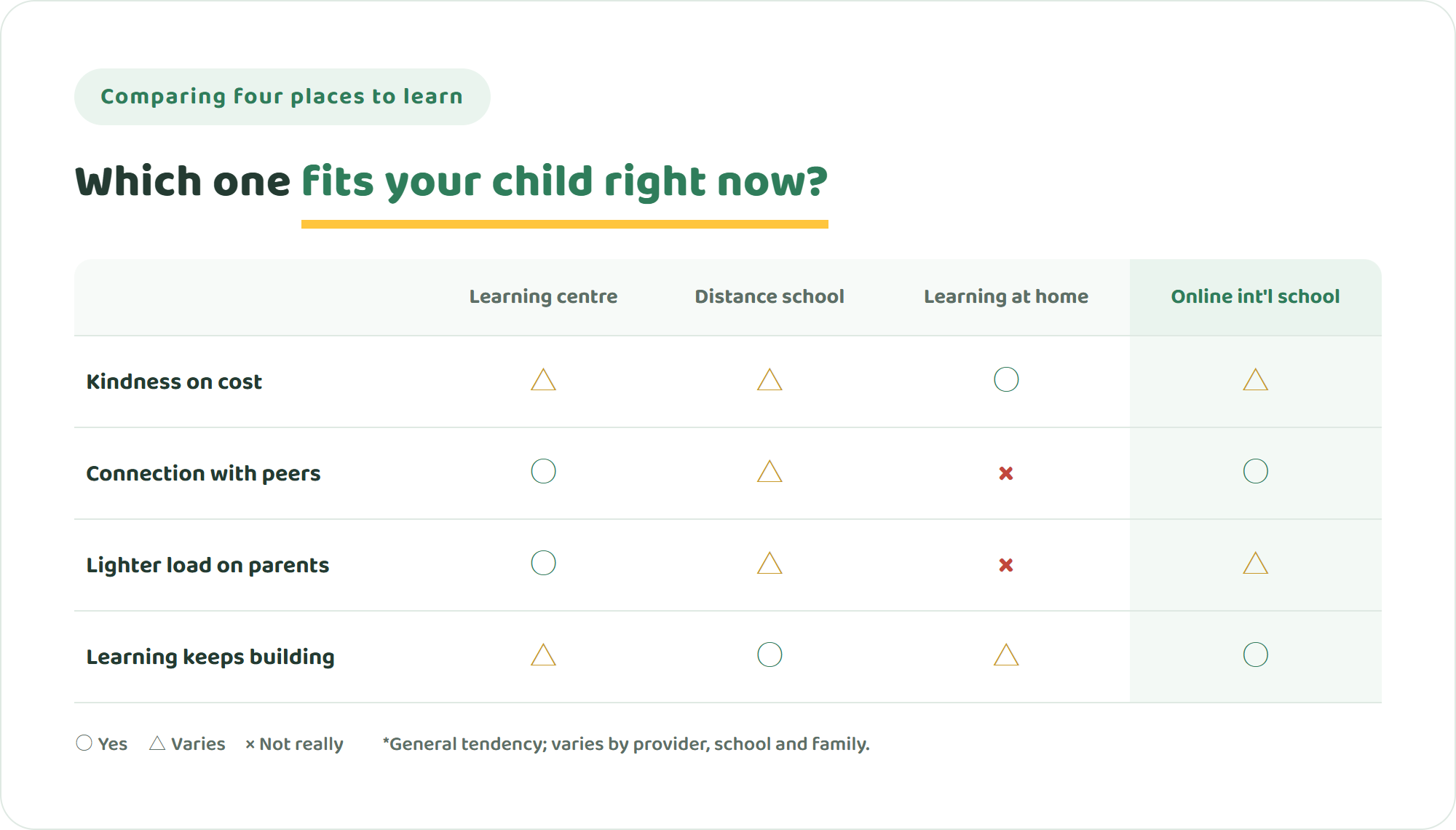
The table above picks out the four families most often weigh side by side — a learning centre, distance schooling, learning at home and an online international school. As it shows, nothing scores well on every row. Which is exactly why the order you choose in matters.
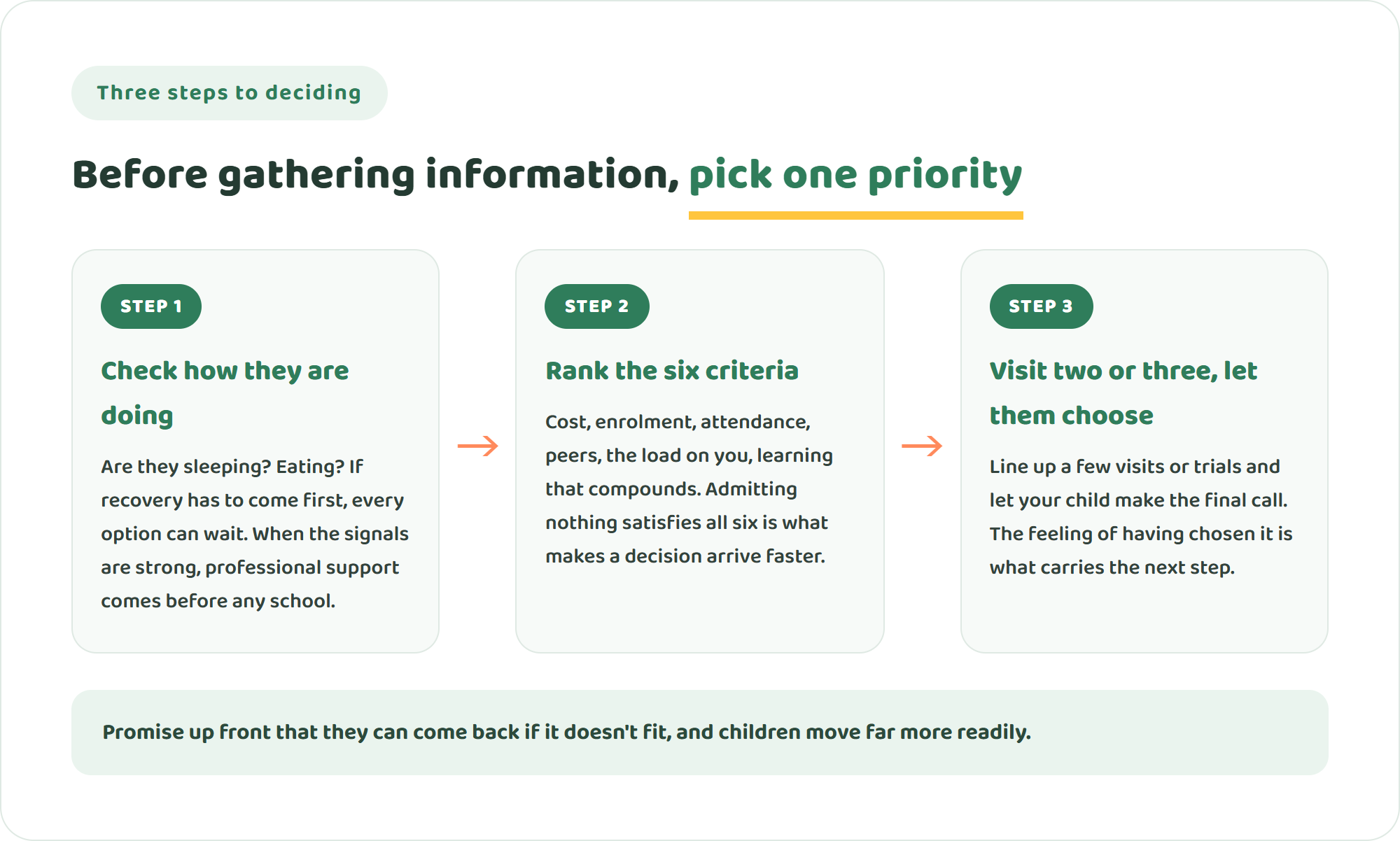
STEP 1 is to check how your child is doing. If recovery has to come first, every option on this page can wait. STEP 2 is to rank the six criteria. Admitting up front that nothing satisfies all of them is what makes a decision arrive faster. STEP 3 is to visit or trial two or three places and let your child make the final call. Promise beforehand that they can come back if it doesn’t fit, and children move far more readily than you’d expect.
Lastly, where we stand. NIJIN GLOBAL ACADEMY (NGA) is an online international school beyond the exam race, opening in September 2027 for ages 6 to 18 and operated by NIJIN Inc. NIJIN Academy, one of Japan’s largest alternative schools, already has over 900 children enrolled. What we hold above everything is psychological safety — in practice, each child chooses how many people they engage with, and how. Whether the camera goes on, whether they speak or write in the chat, is theirs to decide. The world itself is the material, and the ground beneath it is coming to love yourself and the world.
And in fairness, there are families NGA does not suit. If physical activity and in-person relationships need to sit at the centre of your child’s learning, a learning centre or alternative school within travelling distance will serve you better. Compare us honestly against the other six, and choose us only if it genuinely fits.
Frequently asked questions
Can we combine more than one of these?
Yes, and many families do. Learning at home in the mornings, a learning centre twice a week, the enrolled school on event days. Trying to settle on one makes the decision feel enormous; treating it as something you can add to and subtract from makes it far easier to test. Whatever the mix, tell the enrolled school early — it keeps attendance and future pathways straightforward.
Roughly what will it cost?
Costs vary so widely by municipality, provider and school that no single figure would be honest. Public education support centres tend to be light on cost, while independent learning centres and alternative schools generally involve a monthly fee. When you visit, ask about materials, travel and event costs as well as tuition.
When should we decide about leaving the current school?
Don’t rush it. During compulsory schooling, most options can be used while your child stays enrolled, so learning can start moving before that decision is made. Try another setting with enrolment intact and watch whether your child’s face and sleep change. There is no penalty for deciding later.
It was never your child that didn’t fit
The hardest part of feeling that school does not suit your child is often the sense that yours alone fell outside the frame. But as this page shows, there are seven places to stand. What didn’t fit wasn’t your child — it was the shape of the first place they happened to land in.
NIJIN GLOBAL ACADEMY opens in September 2027. We’ll email you news of our first cohort, and how our learning works — small-group dialogue where a child decides even whether the camera goes on. You don’t have to decide anything today. Just hold on to this: there is more than one place your child can learn.