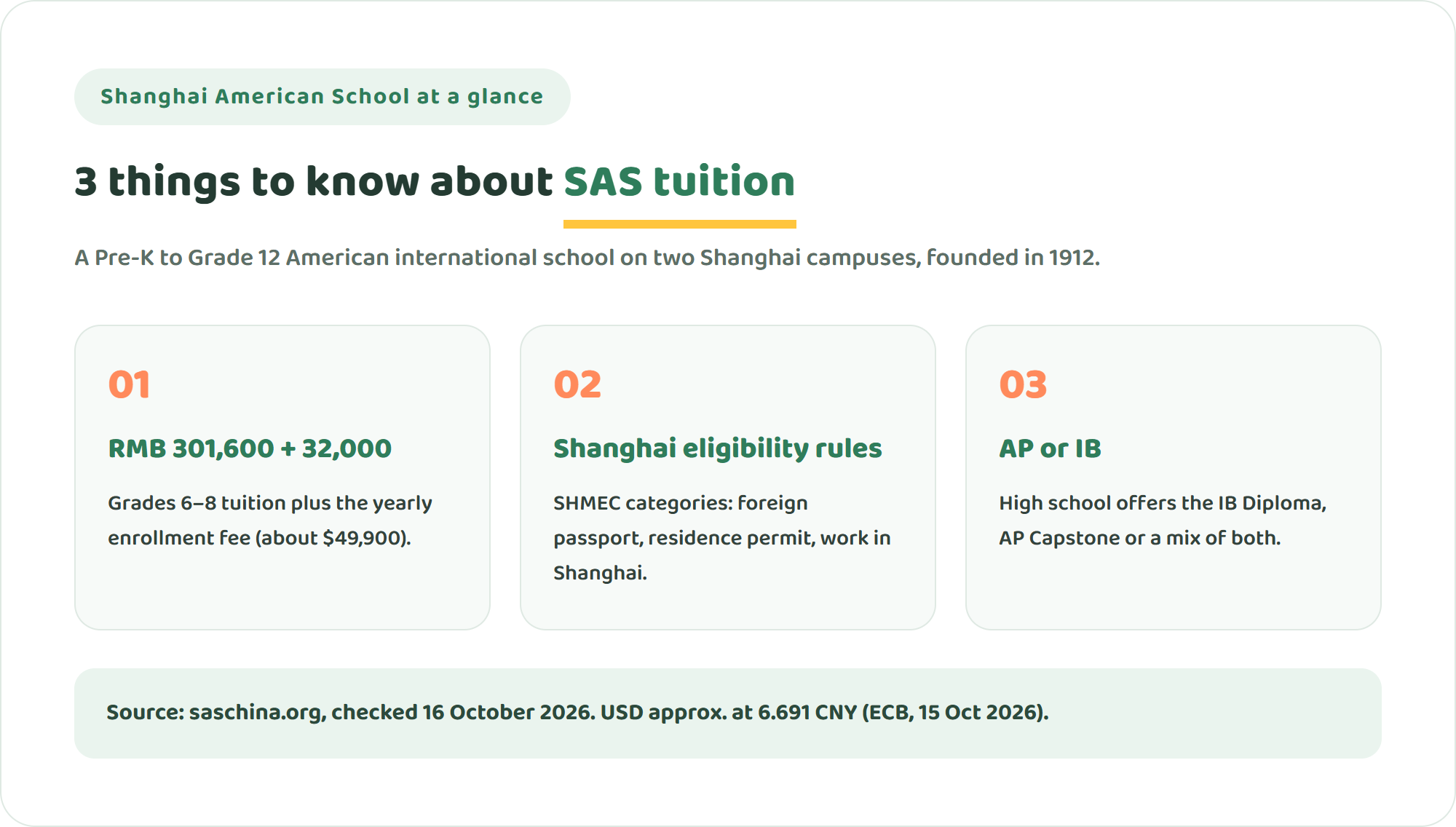
Shanghai American School (SAS) tuition for 2026–27 is RMB 301,600 a year for middle school (Grades 6–8) and RMB 311,000 for high school (Grades 9–12), plus a non-refundable RMB 32,000 enrollment fee every year (official SAS fee schedule, checked 16 October 2026). Pre-Kindergarten is RMB 246,000, Kindergarten to Grade 4 is RMB 285,800 and Grade 5 is RMB 290,300. New students also pay a one-time entry fee of RMB 28,000 (Pre-K to Grade 5) or RMB 33,000 (Grades 6–12) and a RMB 2,800 application fee. In US dollars, a year of middle school with the enrollment fee comes to roughly $49,900 — an approximate conversion at the European Central Bank reference rate of 1 USD = 6.691 CNY on 15 October 2026; SAS bills in RMB, and your real cost depends on the exchange rate on the day you pay.
If you searched “Shanghai American School tuition”, “Shanghai American School tuition USD” or “Shanghai American School vs Dulwich Shanghai for middle school”, you probably want three things: the real yearly number including the fees that are easy to miss, a plain explanation of who is actually allowed to enrol at an international school in Shanghai, and a fair side-by-side with the schools families most often weigh against SAS. This page answers those questions from the schools’ official websites, compares SAS with Dulwich College Shanghai Pudong and Concordia International School Shanghai, and — in the same table — with NIJIN GLOBAL ACADEMY (NGA), a very different option: an online international school for ages 6–18 that opens in September 2027. For the wider city picture, see our guide to international schools in Shanghai.
The short answer: who Shanghai American School suits — and who it doesn’t
- Suits: foreign-passport families living and working in Shanghai who want an American-style, college-preparatory education from Pre-K to Grade 12. SAS describes itself as the oldest international school in China, founded in 1912, with more than 2,900 students on two campuses.
- Suits: students who want a choice of pathway at the end of high school. SAS offers both Advanced Placement (AP) and the International Baccalaureate (IB): students can take the IB Diploma, the AP Capstone Diploma, or a mix of AP and IB courses.
- Suits: families aiming at US universities. On the Pudong campus, most recent graduates went to the United States (195 of the destinations listed for 2023–2025 in the official college profile).
- Suits: families who want a choice of location — Pudong (Lingbai Road) or Puxi (Jinfeng Road, Minhang) — within one school and one fee schedule.
- Harder fit: families who do not meet Shanghai’s eligibility rules. SAS follows the Shanghai Municipal Education Commission (SHMEC) categories, which depend on the family’s passports, work and residence in Shanghai.
- Harder fit: families on a tight budget. Tuition plus the annual enrollment fee is RMB 333,600 a year for middle school, and the school’s fee page does not mention financial aid.
- Harder fit: families who move often or live outside Shanghai. SAS is an in-person day school, and a family living overseas must show Shanghai work and residence permits within 60 days of the student starting.

What Shanghai American School is
Shanghai American School was founded in 1912. Its official college profile calls it “the oldest international school in China” and describes it as a private, not-for-profit, co-educational, non-denominational school offering a college-preparatory education to an international student body. Today it runs two campuses — Pudong and Puxi — with more than 2,900 students from Pre-K to Grade 12. The profile notes that nearly all SAS students hold foreign passports; on the Pudong campus, 64% of students hold North American passports and 20% Asian passports, with students from 48 passport countries and regions.
The school is organised into elementary (Pre-K to Grade 5), middle school (Grades 6–8, students typically aged 12 to 14) and high school (Grades 9–12). In high school, students choose between AP and IB courses, and Grades 9–10 can apply to the Innovation Institute, a two-year interdisciplinary, project-based cohort. Students in Grades 10–12 may also take credit-bearing online courses through Global Online Academy, Virtual High School and Pamoja (IB).
| Item | Shanghai American School (official information, checked 16 October 2026) |
|---|---|
| School type | Private, not-for-profit, co-educational, non-denominational international day school |
| Founded | 1912 |
| Grades | Pre-K (ages 3–4) to Grade 12; 2,900+ students |
| Campuses | Pudong: 1600 Lingbai Road, Pudong District. Puxi: 258 Jinfeng Road, Minhang District |
| Tuition 2026–27 | RMB 246,000 (Pre-K) to RMB 311,000 (Grades 9–12) a year, plus RMB 32,000 enrollment fee |
| High school pathways | AP (including AP Capstone) and the IB Diploma Programme |
| Accreditation | Western Association of Schools and Colleges (WASC); IB World School (IB code 2763) |
| Who can apply | Families meeting SHMEC eligibility categories (foreign passport holders and some specific groups) |
Campuses, school day and time zones
SAS is an in-person day school on China Standard Time (UTC+8). Each campus has its own middle school and high school profile and course catalogue, and the school runs an optional bus service for families who live on its routes. SAS’s middle school page describes daily Advisory and Home Base sessions focused on friendship and belonging, with core classes in maths, science, language arts and social studies plus exploratory classes, including world languages. However, the “One Day at SAS Middle School” section was empty when we checked, and a detailed daily timetable and the 2026–27 calendar dates are not published on the official site pages we checked — ask Admissions for both. Tuition is billed in two halves (due 1 June and 1 November), which follows the two-semester year.
From Grade 6, every student must bring their own MacBook and an external backup drive to school; this is not a school fee, but it is a real cost to budget for. If you are weighing an in-person school against learning from home, our explainer on how an online international school day works shows the other side of that trade-off.
Shanghai American School tuition and fees 2026–27 (official, RMB and approximate USD)
Everything below comes from the SAS tuition and fees page and the official Schedule of 2026/2027 Fees (PDF), checked on 16 October 2026. All SAS fees are set in RMB. The USD column is our approximate conversion at the European Central Bank reference rate of 1 USD = 6.691 CNY (15 October 2026), rounded to the nearest $100. It is not an SAS price.
| Grade | Annual tuition (RMB) | + Enrollment fee (RMB, every year) | Yearly total (RMB) | Approx. USD per year (total) |
|---|---|---|---|---|
| Pre-K (Pre-K3 and Pre-K4) | 246,000 | 32,000 | 278,000 | about $41,500 |
| Kindergarten to Grade 4 | 285,800 | 32,000 | 317,800 | about $47,500 |
| Grade 5 | 290,300 | 32,000 | 322,300 | about $48,200 |
| Grades 6–8 (middle school) | 301,600 | 32,000 | 333,600 | about $49,900 |
| Grades 9–12 (high school) | 311,000 | 32,000 | 343,000 | about $51,300 |
One-time and other fees
| Fee | Amount (2026–27) | Notes from the official fee schedule |
|---|---|---|
| Application fee | RMB 2,800 | Paid on application, before the Admission Committee evaluates it; non-refundable; valid only for that school year |
| Enrollment fee | RMB 32,000 per year | Non-refundable; secures the place for the coming year. Returning students pay by 1 April; new students within five working days of the invoice |
| Entry fee (new students only) | RMB 28,000 (Pre-K and elementary); RMB 33,000 (middle and high school) | Supports long-term development and infrastructure; refunded in full only if the student never attends and written withdrawal is received before the first day |
| Bus transportation (optional) | RMB 12,150 per semester | Only where the home is on an existing route |
| External exams | Invoiced separately | AP and IB exam fees are paid by students |
| Lunch, school trips, PE uniform (Grades 6–10) | Varies | Lunch priced per item; trips priced per trip; PE uniform sold at the Eagle Shop |
| MacBook and backup drive (Grades 6–12) | Not a school fee | Required under the Bring Your Own Mac programme |
Paying in RMB or USD
Tuition is paid in two equal instalments, due 1 June and 1 November. Paying in advance earns a 1% discount on the prepaid amount — for example, paying both instalments by 1 April. SAS accepts wire transfers, debit or credit cards and RMB cash deposits to its bank account; payments under RMB 5,000 can also be made in cash at the Finance Office. Fees can be paid in USD by wire transfer only, using the Bank of China exchange rate on the first working day of the month, as published by the SAS Finance Office. All bank charges are paid by the payer. This is why any USD figure — including ours — can only ever be approximate.
Refunds
The application and enrollment fees are never refunded. For tuition, the official schedule says a written withdrawal received on or before 1 August gets a full refund of tuition paid; after 1 August but before the first day, the refund is the tuition paid minus 10% of annual tuition. Similar rules apply around 1 December for the second semester. If a student is not officially withdrawn in writing before the first day of a semester, that instalment is not refunded.
What three years of SAS middle school cost at today’s prices
Using only official 2026–27 numbers, here is the arithmetic for a new student who joins in Grade 6 and stays to the end of Grade 8, with no fee rises and no bus:
- One-time: application RMB 2,800 + entry fee RMB 33,000 = RMB 35,800
- Each year: tuition RMB 301,600 + enrollment fee RMB 32,000 = RMB 333,600
- First year total: RMB 35,800 + RMB 333,600 = RMB 369,400 (about $55,200)
- Three years: RMB 35,800 + 3 × RMB 333,600 = RMB 1,036,600 (about $154,900), before exam fees, lunch, trips and the laptop
- Optional bus: 2 × RMB 12,150 = RMB 24,300 a year (about $3,600)
SAS notes that its fees remain valid until the next schedule is released and are subject to change, so expect the figures to move during a child’s time at the school. Many expatriate families in Shanghai have tuition paid as part of an employment package — if that applies to you, check exactly which fees your employer covers (tuition only, or also the enrollment, entry and bus fees). Our guide to online vs in-person international school costs puts these numbers in a wider context.
Who can enrol: eligibility rules for foreign-passport holders in China
This is the question most tuition pages skip. In Shanghai, schools for the children of foreign nationals follow eligibility rules set by the Shanghai Municipal Education Commission (SHMEC), and SAS says so directly. Its admissions page says eligibility depends on “the family’s passport, work and residence in Shanghai” and lists four categories:
- Child of a foreign citizen
- Child born overseas to PRC citizens
- Child of Hong Kong, Macau or Taiwan residents
- Child holding a SHMEC waiver letter
The SAS admissions checklist (PDF, updated December 2023) spells out the practical rules behind those categories and the government documents for each (passports, visas and residence permits, a work permit and employment letter, a Shanghai business licence, proof of Shanghai residence and proof of the parent–child relationship). Its key lines are:
- Every student who holds a foreign passport must have a valid Residence Permit to stay in China (not required for PRC passport holders).
- At least one parent must be working in Shanghai; exceptions may be possible when all family members hold foreign passports.
- Families already in Shanghai need all government documents to start the application. Families still living overseas must produce their work and residence permits and proof of Shanghai residence within 60 days of the student starting at SAS.
- SAS follows SHMEC eligibility, “which may be subject to change”.
In practice this means that a foreign-passport family moving to Shanghai for work is the core SAS applicant, while a family whose parents are both PRC passport holders usually needs to fit one of the narrower categories (for example, a child born overseas with a foreign birth certificate, or a SHMEC waiver). Dulwich College Shanghai lists five similar SHMEC-based categories on its own eligibility page, so the rules are broadly the same across the city’s schools for foreign nationals. Confirm your own situation with Admissions before paying an application fee.
The admissions process
SAS reviews applications on a rolling basis. Applications for 2027–28 opened on 14 September 2026, and the school warns that seats for 2026–27 are very limited, recommending that families contact the Admissions Team before applying. For Grades 6–12, applicants have student and parent interviews and take the NWEA MAP assessment in maths, language usage and reading (recent standardised scores such as SSAT, ERB, ISA, Iowa or state tests from the last 12 months may be accepted instead). Non-native English speakers take an English test, native speakers submit a writing sample, and Grades 11–12 require English proficiency. All applicants submit school reports for the current and previous two years, recommendation forms and a family questionnaire. The number of places offered each year is not published on the official site.
Accreditation, diploma and college recognition
SAS’s official 2025–26 high school course catalogue states that the school is fully accredited by the Western Association of Schools and Colleges (WASC) and is an IB World School, and that it is a member of the Council of International Schools (CIS), EARCOS and NACAC. Its college profile lists its codes for universities: CEEB 694322, IB 2763 and UCAS 45655. The exact WASC accreditation term and next review date are not published on the official site pages we checked.
Graduates earn an SAS high school diploma, and many add the IB Diploma or the AP Capstone Diploma, all of which universities in the US, UK, Canada and elsewhere recognise. The official Pudong college profile for 2025–26 reports, for the Pudong campus:
- AP 2025: 232 students sat 646 exams; 96% of scores were 3 or above, with an average score of 4.39.
- IB: 100% of IB Diploma candidates in the Class of 2025 were awarded the diploma, with an average score of 37; 8 of the 84 students in the Class of 2026 are full IB Diploma candidates (most combine AP and IB courses instead).
- Class of 2026 SAT mid-50% range: 1410–1540. Grades are not weighted and students are not ranked.
- Destinations 2023–2025: the large majority to the USA (195), followed by Canada (22) and the UK/Europe (16), with smaller numbers to China, South Korea and the wider Asia-Pacific.
SAS also limits each senior to 12 university applications, a policy worth knowing if your child plans a very long list. The Puxi campus publishes its own college profile.
Shanghai American School vs Dulwich College Shanghai (and Concordia) for middle school
For middle school, the three schools families most often compare are SAS, Dulwich College Shanghai Pudong and Concordia International School Shanghai. All three are established, well-regarded schools; the real differences are curriculum, the pathway at the end of high school, location and cost. One point that causes confusion: SAS and Concordia use American grades, while Dulwich uses British year groups, so US Grades 6–8 correspond roughly to UK Years 7–9.
| Shanghai American School | Dulwich College Shanghai Pudong | Concordia International School Shanghai | |
|---|---|---|---|
| Curriculum | American, college-preparatory | National Curriculum of England (adapted) to Year 9, then IGCSE (Years 10–11) and IB Diploma (Years 12–13) | American (courses “parallel” US school subjects) |
| Ages / grades | Pre-K to Grade 12 | Ages 2–18 (DUCKS, Junior School, Senior School) | Ages 3–18 (early childhood to high school) |
| Campuses | Pudong and Puxi | Pudong campus of Dulwich College Shanghai (the college also has a Puxi campus with its own fee schedule) | One campus: Jinqiao, Pudong |
| Middle school tuition 2026–27 | RMB 301,600 (Grades 6–8) + RMB 32,000 annual enrollment fee | RMB 377,200 (Years 7–9, annual payment); IB and IGCSE exam costs included | RMB 322,000 (Grades 6–8, full-year payment) |
| Approx. USD (our conversion) | about $49,900 incl. enrollment fee | about $56,400 | about $48,100 |
| One-time fees for new students | Application RMB 2,800; entry fee RMB 33,000 | Application RMB 3,800; capital development fee RMB 15,000; refundable resource fee RMB 15,000 | Application RMB 2,500; capital fee RMB 25,000; ELL support fee RMB 20,000 if needed |
| High school pathway | AP (incl. AP Capstone) and/or IB Diploma | IGCSE then IB Diploma | AP and accelerated courses (see official site for IB) |
| Accreditation | WASC; IB World School; CIS member | See official site | WASC (third accreditation completed June 2022); National Lutheran School Accreditation |
| Eligibility | SHMEC categories | SHMEC-based categories | SHMEC requirements |
Sources: SAS tuition and fees, Dulwich College Shanghai fees and its 2026–27 Pudong fee schedule (PDF), Dulwich Pudong Senior School, Concordia tuition and payments, About Concordia — checked 16 October 2026. USD figures are our approximate conversion at 1 USD = 6.691 CNY (ECB reference rate, 15 October 2026).
How to read this comparison
Choose SAS if you want an American middle school that keeps both doors open in high school — AP or IB — and if the choice of a Pudong or Puxi campus matters for your commute. Choose Dulwich College Shanghai Pudong if you prefer a British structure leading to IGCSE and a single, clear IB Diploma route; its tuition is higher at this stage, but Dulwich says IB and IGCSE exam costs are included, and families with three or more children in full-day programmes get a 5% discount per student. Dulwich also reports a 2026 IB average of 38. Choose Concordia if you want an American curriculum with a strong AP programme on a single campus in Jinqiao; Concordia was founded in 1998 in the tradition of Lutheran Church–Missouri Synod schools, includes spirituality among its high school core subjects, and for 2027–28 uses application rounds (12 November 2026 and 26 February 2027, then rolling).
For a student moving between systems, the practical question is usually the exit: a child planning US universities is well served by either American school, while a child who may return to the UK or Europe often finds the IGCSE-plus-IB route at Dulwich, or the IB route at SAS, easier to transfer.
Shanghai American School vs NIJIN GLOBAL ACADEMY vs two other options (official data)
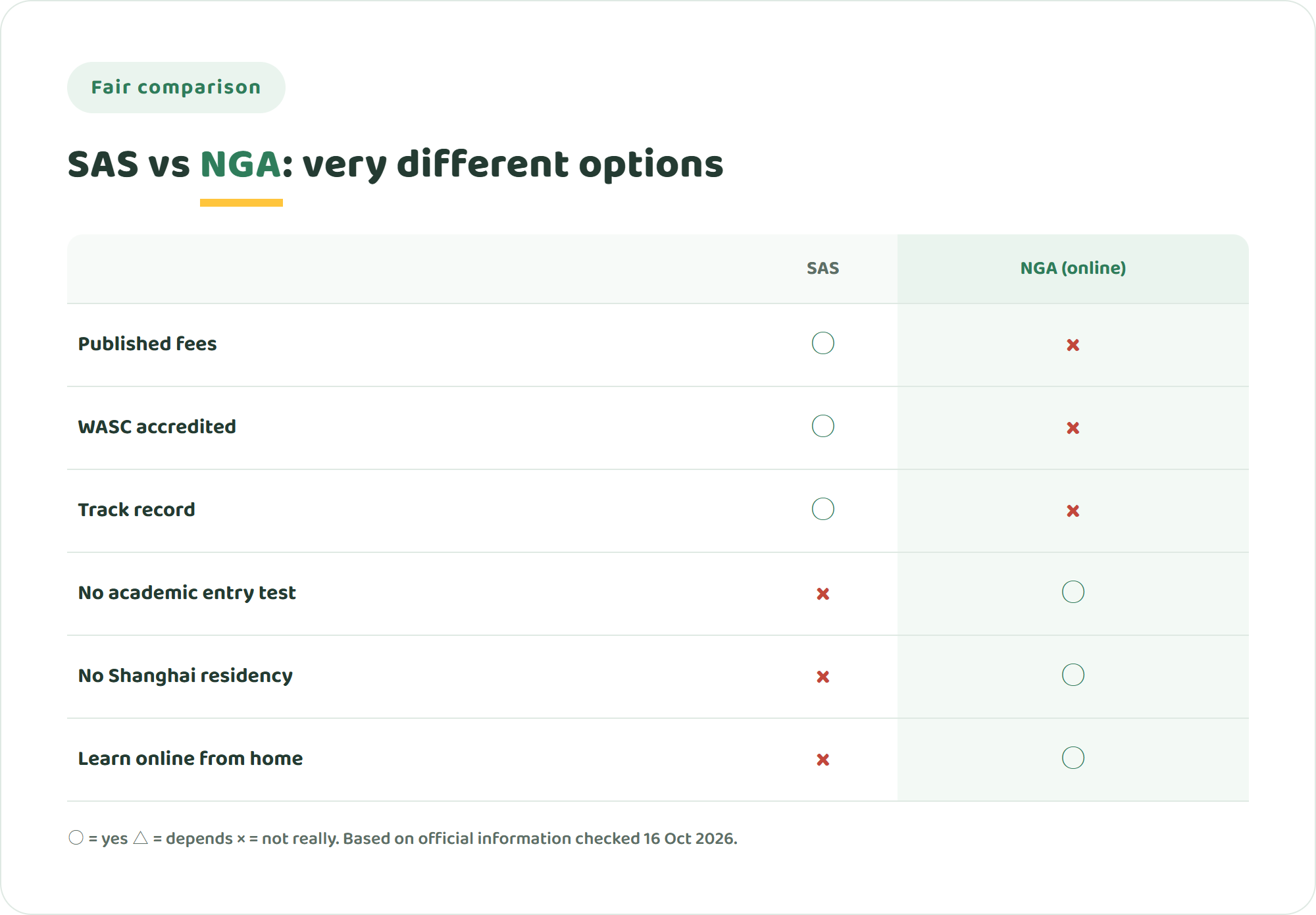
NIJIN GLOBAL ACADEMY (NGA) is a different kind of school from the three above: it is online, for ages 6–18, focused on Asia and Oceania, and not yet open. We include it because some families in China — and families who do not meet Shanghai’s eligibility rules or do not live in Shanghai — look at online options alongside in-person ones.
| Shanghai American School | NIJIN GLOBAL ACADEMY | Dulwich College Shanghai Pudong | Concordia International School Shanghai | |
|---|---|---|---|---|
| School type | Private, not-for-profit international day school; Pudong and Puxi | Online international school focused on Asia & Oceania; opens September 2027 (planned) | International day school; Pudong campus of Dulwich College Shanghai | International day school; Jinqiao, Pudong |
| Grades / ages | Pre-K to Grade 12 | Ages 6–18 | Ages 2–18 | Ages 3–18 |
| Tuition (2026–27) | RMB 246,000–311,000 a year by grade + RMB 32,000 enrollment fee | Not yet published (no enrolment, facility or uniform fees; materials included; sibling discounts) | RMB 282,000–411,750 a year by year group | RMB 250,000–330,000 a year by grade |
| Curriculum | American; AP and IB Diploma | Subjects learned in English, CEFR-based English levels, social co-creation projects; optional Cambridge IGCSE / A-Level pathway | English National Curriculum, IGCSE, IB Diploma | American; AP |
| Live classes & time zone | In person, China Standard Time | Small live online dialogue groups (about 8); timetable built for Asia–Oceania daytime, which includes China — may fall outside the day in the Americas or Europe | In person, China Standard Time | In person, China Standard Time |
| Accreditation / diploma | WASC; IB World School; SAS diploma, AP and IB | Not yet accredited; no graduates yet | See official site; IGCSE and IB Diploma | WASC and National Lutheran School Accreditation |
| Admission | SHMEC eligibility; interviews, MAP test (Grades 6–12), English assessment | No academic entrance exam, no English requirement | SHMEC-based eligibility; see official site for assessments | SHMEC eligibility; interview or assessment, possibly English proficiency |
| Start dates | Rolling admission; 2027–28 applications open | Free trial classes monthly from September 2026; pre-opening trials April–May 2027; opens September 2027 | See official site | Rounds: 12 Nov 2026, 26 Feb 2027, then rolling |
Sources: SAS tuition and fees, SAS admissions, Dulwich College Shanghai eligibility, Concordia admissions — checked 16 October 2026. NGA information from our own curriculum and timetable page.
Reviews and common concerns, answered honestly
Parents researching SAS tend to raise the same questions. Here is what the official pages say, so you can weigh them yourself.
“What does SAS really cost in US dollars?”
SAS sets every fee in RMB. At 1 USD = 6.691 CNY (ECB reference rate, 15 October 2026), middle school tuition plus the annual enrollment fee is about $49,900 a year, and high school about $51,300. If you pay in USD, SAS uses the Bank of China rate on the first working day of the month, so the dollar amount will move with the exchange rate.
“Why is there an enrollment fee every year on top of tuition?”
The RMB 32,000 enrollment fee is charged to every student every year to secure the place for the coming year, and it is non-refundable. The separate entry fee (RMB 28,000 or RMB 33,000) is paid once by new students. Budget for both — the tuition figure alone understates the real yearly cost by about 10%.
“Can we apply before we have moved to Shanghai?”
Yes, but with a deadline. SAS’s checklist says families living overseas must produce their work and residence permits and proof of Shanghai residence within 60 days of the student starting, and every foreign-passport student needs a valid Residence Permit. At least one parent must work in Shanghai, with exceptions possible when all family members hold foreign passports.
“Is there financial aid?”
The SAS tuition page does not mention financial aid or scholarships; the only discount it lists is 1% for paying tuition in advance. Many families’ fees are paid through an employer’s relocation package, so check that first.
“Pudong or Puxi — is there a difference?”
Both campuses share one fee schedule and the same AP and IB pathways, but each publishes its own college profile and course catalogue, and the published results differ slightly (for example, Class of 2026 SAT ranges). Visit both if your home location allows a choice.
“Is it hard to get a place?”
SAS says seats for 2026–27 are very limited and recommends contacting Admissions before applying. It does not publish how many places it offers per grade, so ask about seat availability for your child’s grade early.
Alternatives to Shanghai American School worth comparing
Dulwich College Shanghai Pudong suits families who want a British structure through Year 9, then IGCSE and the IB Diploma, with exam costs included in tuition. Concordia International School Shanghai suits families who want an American curriculum with AP on a single Pudong campus, at a middle school fee of RMB 322,000 a year. If your family may move elsewhere in Asia, our guides to international school tuition in Manila and international schools in Seoul show how the costs compare in other cities.
NIJIN GLOBAL ACADEMY (NGA) is a different kind of option. It is an online international school for ages 6–18 focused on Asia and Oceania, opening in September 2027 (planned), with free trial classes monthly from September 2026 and pre-opening trial classes in April–May 2027. Its first cohort is 100 students, and it is operated by NIJIN Inc. in Japan, whose alternative school NIJIN Academy has more than 1,000 students. NGA does not rank children by test scores: lessons are small-group live dialogue (classes of about 8), subjects are learned in English with a bilingual English–Japanese mentor, English levels follow the CEFR, and students take part in social co-creation projects with companies and governments plus international exchange. An optional Cambridge IGCSE / A-Level pathway is listed on the curriculum and timetable page. There is no academic entrance exam and no English requirement; it can run alongside a local school or as the main school, and it travels with the family if they relocate. Its timetable is built for Asia–Oceania daytime, which includes China’s time zone — though families should still check the published timetable against their own day. Tuition is not yet published; NGA says it will be far more affordable than a typical international school, with no enrolment, facility or uniform fees, materials included and sibling discounts.
Be clear about the trade-offs: NGA is not yet open, is not yet accredited and has no graduates or track record. It has no campus, no AP or IB Diploma programme and nothing like SAS’s century of history, college counselling or facilities. If you are in Shanghai, meet the eligibility rules and want an in-person American or British education, SAS, Dulwich and Concordia are the schools to compare. Families should also check what local schooling rules mean for their own situation before choosing any online school as a child’s main school.
For a wider view, see our online international schools compared guide.
FAQ
How much does Shanghai American School cost per year?
For 2026–27, SAS tuition is RMB 246,000 (Pre-K), RMB 285,800 (Kindergarten–Grade 4), RMB 290,300 (Grade 5), RMB 301,600 (Grades 6–8) and RMB 311,000 (Grades 9–12), plus a RMB 32,000 enrollment fee every year. New students also pay an entry fee of RMB 28,000 or RMB 33,000 and a RMB 2,800 application fee (official site, checked 16 October 2026).
What is Shanghai American School tuition in USD?
Approximately $41,500 (Pre-K) to $51,300 (high school) a year including the enrollment fee, converted at 1 USD = 6.691 CNY (ECB reference rate, 15 October 2026). SAS bills in RMB, so the dollar figure changes with the exchange rate.
Is Shanghai American School accredited?
Yes. SAS’s official course catalogue states that it is fully accredited by the Western Association of Schools and Colleges (WASC) and is an IB World School; it is also a member of CIS, EARCOS and NACAC.
Can international students enrol at SAS?
Yes — SAS mainly serves foreign-passport families. Eligibility follows Shanghai Municipal Education Commission rules: foreign-passport students need a valid Residence Permit, and at least one parent must work in Shanghai (exceptions may be possible when all family members hold foreign passports). Children of Hong Kong, Macau and Taiwan residents, some children born overseas to PRC citizens, and holders of a SHMEC waiver may also be eligible.
Is SAS or Dulwich better for middle school?
Neither is better in general; they are different. SAS offers an American middle school (RMB 301,600 plus the RMB 32,000 enrollment fee for Grades 6–8) leading to AP and/or IB. Dulwich College Shanghai Pudong follows an adapted English National Curriculum to Year 9 (RMB 377,200 for Years 7–9), then IGCSE and the IB Diploma. Concordia offers an American curriculum with AP at RMB 322,000 for Grades 6–8. NIJIN GLOBAL ACADEMY is a separate, online option opening in 2027.
Choosing calmly, with the full picture
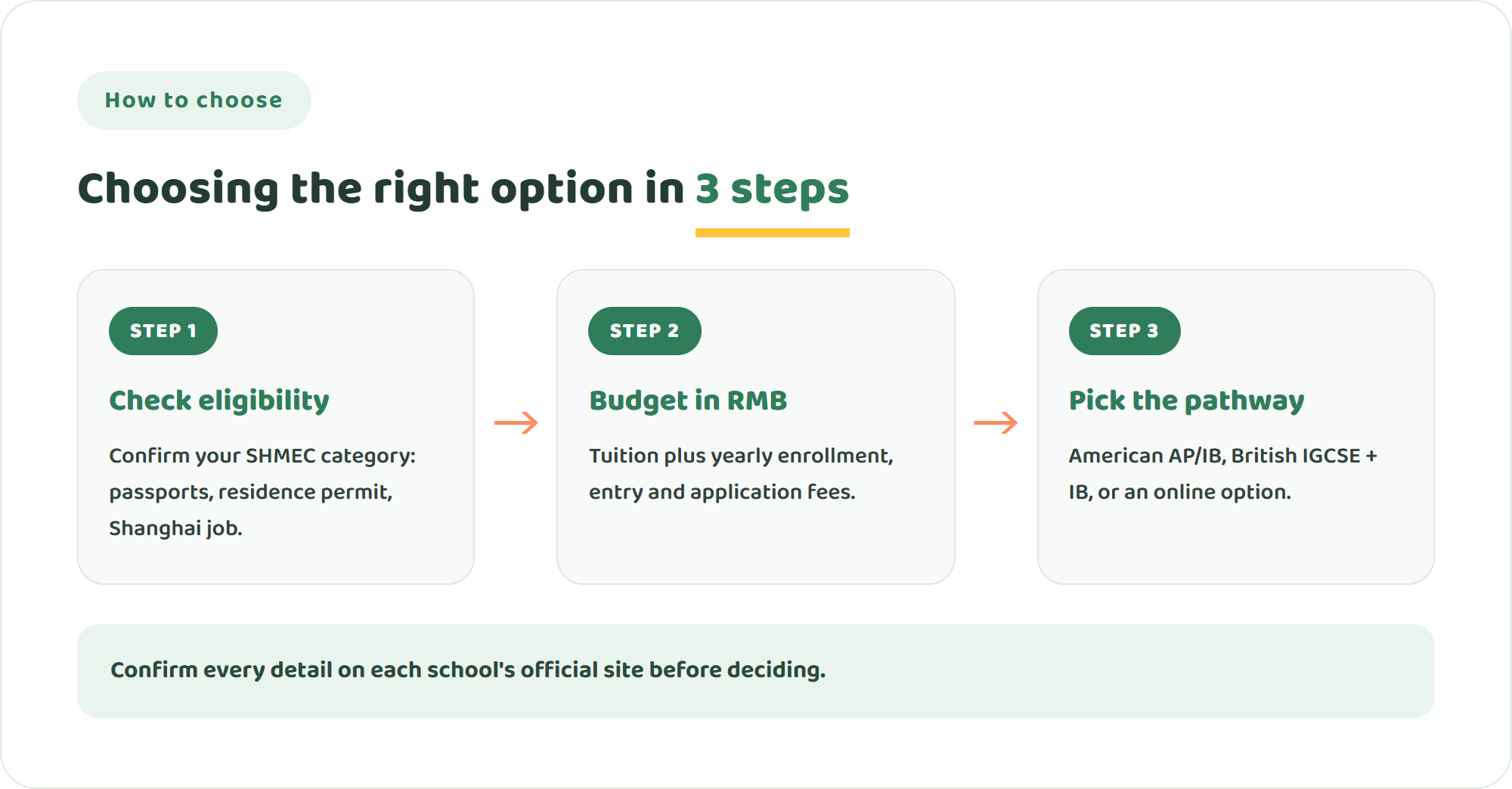
Choosing a school in Shanghai is rarely just about the school: it is tied to a job, a visa, a home and often a relocation package. The most useful steps now are to confirm which eligibility category your family fits, budget the full yearly cost in RMB — tuition, enrollment fee and one-time fees — and visit the campuses with your child. Whichever school you choose, the right one is the place where your child will be known, stretched and happy.
Tuition and admissions details were checked on the official websites on 16 October 2026. Schools revise fees every year — always confirm on the official site before applying.