Dulwich College Singapore fees for 2026/27 range from SGD 21,080 a year (half-day Toddler/Nursery) to SGD 59,220 a year (Year 13), inclusive of 9% GST (official 2026–27 fee schedule, checked 16 October 2026). A child in Reception to Year 2 pays SGD 45,240, Years 3–6 pay SGD 46,760 and Years 7–9 pay SGD 53,850. New students also pay a non-refundable SGD 1,500 application fee, a SGD 4,000 enrolment fee after a successful assessment and a one-off SGD 4,500 capital levy — so the first year for a Year 7 newcomer comes to SGD 63,850 before bus, lunch, uniform, devices and trips.
If you searched “Dulwich College Singapore fees” or “frequently asked questions Dulwich College Singapore”, you probably want the full fee table, a clear list of what is and isn’t included, how siblings are treated, and the rules that decide who can actually enrol — especially for Singapore Citizens, who need an exemption from the Ministry of Education (MOE). This page answers those questions from the College’s official website and fee schedule, then compares Dulwich with two other well-known Singapore international schools, Tanglin Trust School and UWC South East Asia (UWCSEA), and with NIJIN GLOBAL ACADEMY (NGA) — a very different option: an online international school for ages 6–18 that opens in September 2027.
The short answer: who Dulwich College (Singapore) suits — and who it doesn’t
- Suits: families living in Singapore who want a British-style education on one campus from age 2 to 18 — DUCKS (ages 2–7), Junior School (7–11) and Senior School (11–18).
- Suits: students heading for the IB Diploma. The College reports a 2026 IB average of 37.7 points out of 45, four perfect scores and 29 bilingual diplomas.
- Suits: families who want daily Mandarin. DUCKS runs a dual-language programme with a Chinese co-teacher, and Junior School has daily Mandarin with three language pathways.
- Suits: larger families: three or more children enrolled earns a 5% tuition discount for every child in Reception and above.
- Harder fit: Singapore Citizens without a qualifying reason. Citizens can apply only in specific cases (for example, moving from overseas above Primary 1 age) and can attend only once MOE grants an exemption.
- Harder fit: families who need English support from scratch. The College says it does not run a separate EAL programme and expects at least one parent to be fluent in English.
- Harder fit: families who will not be living in Singapore. Students must live full-time with a parent (boarding is available only in Years 12–13) and must hold a valid pass before day one.

What Dulwich College (Singapore) is
Dulwich College (Singapore) is a private international school in Singapore and part of the Education in Motion (EiM) family of schools linked to Dulwich College in London. It is organised in three schools: DUCKS (Toddler to Year 2, ages 2–7), the Junior School (Years 3–6, ages 7–11) and the Senior School (Years 7–13, ages 11–18). The Senior School says it has grown from 66 students in Years 7 and 8 in 2014 to nearly 1,400 students across Years 7–13.
The curriculum is British in structure. DUCKS follows the UK Early Years Foundation Stage, then “an enhanced version of the English National Curriculum” in Years 1–2. The Junior School follows the English National Curriculum, with daily Mandarin. Years 7–8 follow a curriculum “inspired by the English National Curriculum”; Years 9–11 lead to IGCSE or GCSE qualifications from boards including Pearson Edexcel, Cambridge, Oxford AQA and CCEA. After Year 11, students choose between three pathways: the IB Diploma Programme, Pearson Edexcel International A Levels in STEM, or the Dulwich High School Diploma.
| Item | Dulwich College (Singapore) — official information, checked 16 October 2026 |
|---|---|
| School type | Private international school (British curriculum), registered as a Private Education Institution (PEI 201027137D, registration period 9 January 2024 to 8 January 2028) |
| Ages / years | Ages 2–18: Toddler and Nursery through Year 13 |
| Curriculum | EYFS → English National Curriculum → IGCSE/GCSE → IB Diploma, International A Levels (STEM) or Dulwich High School Diploma |
| Tuition 2026/27 | SGD 21,080 (half-day Toddler/Nursery) to SGD 59,220 (Year 13) a year, inclusive of 9% GST |
| One-off fees | Application SGD 1,500; enrolment SGD 4,000; capital levy SGD 4,500 |
| Accreditation / memberships | Accredited by the Council of International Schools (CIS, decision dated 26 April 2022); the College also states WASC accreditation; full member of HMC (UK) since 2024 |
| 2026 IB results | Average 37.7 points out of 45; four perfect scores; 29 bilingual diplomas |
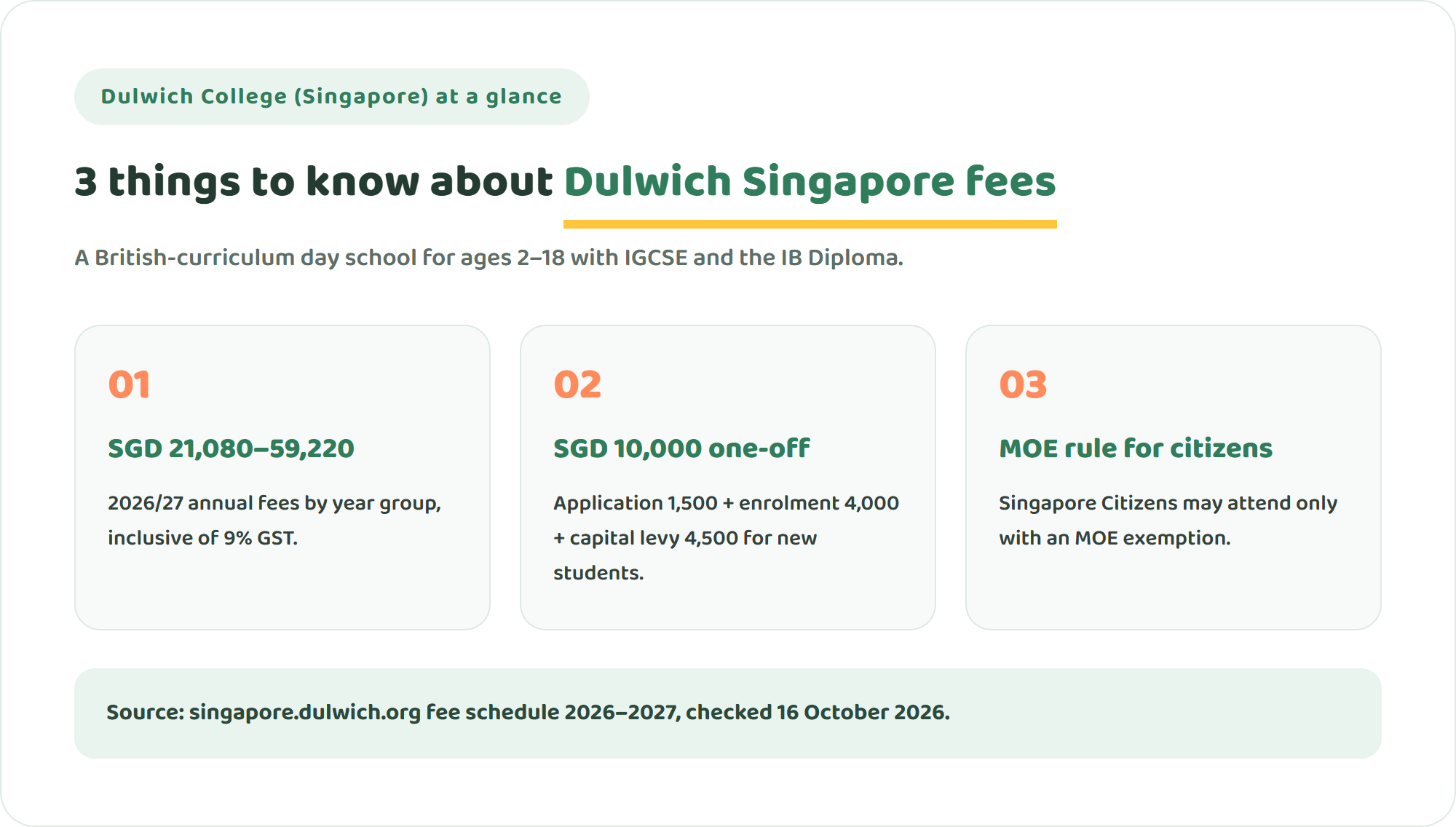
Dulwich College Singapore fees 2026/27 (official, including GST)
Everything below comes from the College’s fees page and its 2026–2027 fee schedule (PDF), checked on 16 October 2026. The schedule states that “fees are inclusive of 9% prevailing GST”.
| Year level | Annual fee (SGD) | Term 1 | Term 2 | Term 3 |
|---|---|---|---|---|
| Toddler / Nursery (half day) | 21,080 | 7,030 | 7,030 | 7,020 |
| Toddler / Nursery (full day) | 37,520 | 12,510 | 12,510 | 12,500 |
| Reception – Year 2 | 45,240 | 15,080 | 15,080 | 15,080 |
| Years 3 – 6 | 46,760 | 15,590 | 15,590 | 15,580 |
| Years 7 – 9 | 53,850 | 17,950 | 17,950 | 17,950 |
| Year 10 | 56,540 | 18,850 | 18,850 | 18,840 |
| Year 11 | 57,540 | 19,180 | 19,180 | 19,180 |
| Year 12 | 58,470 | 19,490 | 19,490 | 19,490 |
| Year 13 | 59,220 | 19,740 | 19,740 | 19,740 |
One-off fees for new students
| Fee | Amount | Notes from the official site |
|---|---|---|
| Application fee | SGD 1,500 | Paid with the online application; “strictly non-refundable and non-transferable” |
| Enrolment fee | SGD 4,000 | Payable after a successful entry assessment and an offer. Non-refundable except where ICA rejects a Student’s Pass application or MOE rejects an exemption for a Singapore Citizen |
| Capital levy | SGD 4,500 | One-off, non-refundable, payable by all new students before admission (not charged again to returning students who already paid it) |
| Development levy | None listed | The 2026–27 schedule lists a one-off capital levy only; no annual development levy appears |
| Boarding (Years 12–13 only) | SGD 46,700 a year | At ACS Oldham Hall; plus SGD 380 boarding application fee and a refundable SGD 4,000 deposit paid to Oldham Hall |
After the enrolment fee is paid, parents sign a student contract — described as legally binding for an academic year — and receive an invoice for the capital levy and the first term’s fees. Fees are billed termly in advance (Term 1 billing from 8 May 2026, Term 2 from 11 September 2026, Term 3 from 11 January 2027), each due within 14 days. Withdrawal deadlines are 7 September 2026, 11 December 2026 and 5 March 2027 for leaving at the end of Terms 1, 2 and 3. Payment is in Singapore dollars by bank transfer, NETS or card; card payments carry a 3% non-refundable convenience fee, cash is no longer accepted, and a late fee applies under the student contract.
What is included — and what costs extra
The schedule says school fees include textbooks and exercise books. The following are listed as other costs, paid separately:
- School bus: run by Woodlands Transport Services (WTS); fees are set and invoiced directly by the provider. Not published on the official site.
- Lunch and food: students pay the College’s caterer at dining halls and cafés (a student ID card can be topped up); packed lunches are allowed and the campus is nut-free. Prices not published on the official site.
- Uniforms: bought from the uniform provider’s shop at the College. Prices not published on the official site.
- Technology: students in Years 7–13 must have their own device.
- Trips and activities: outdoor education, overseas sports, optional trips and paid activities are notified during the year.
- Lost or damaged books and other resources are charged to the family.
Sibling policy
Families with three or more children enrolled receive a 5% discount on tuition fees for all children in Reception and above. The discount does not apply to Toddler and Nursery, and the schedule does not list a discount for two children. Siblings of current students do receive admissions priority (see below).
Guaranteed Placement Rights
The College also sells a limited number of Placement Rights each year at SGD 275,000 excluding GST. A Placement Right gives one nominated child admissions priority in any year group, but the child must still meet all entry requirements, and the price excludes school fees, the capital levy and the application fee. It cannot be transferred. The College says the contributions fund its Alleynian Scholarship Programme. Most families will never need this; it is listed here because it often comes up in searches about Dulwich costs.
What the full school journey costs at today’s prices
Using only the official 2026/27 numbers, with no fee rises:
- One child, Year 7 to Year 13 (seven years): 3 × 53,850 + 56,540 + 57,540 + 58,470 + 59,220 = SGD 393,320 in tuition, plus SGD 10,000 in one-off fees (1,500 + 4,000 + 4,500) = SGD 403,320.
- Two children in Years 3–6 for four years: 2 × 4 × 46,760 = SGD 374,080, plus 2 × SGD 10,000 one-off fees = SGD 394,080 (no sibling discount applies to two children).
- Three children in Years 3–6 for one year: 3 × 46,760 = SGD 140,280, less the 5% discount (SGD 7,014) = SGD 133,266.
All of these exclude bus, food, uniform, devices and trips, and Dulwich reviews fees every year. For a broader view of how campus fees compare with online schooling, see our guide to online vs in-person international school costs, and for other Singapore schools see our overview of international schools in Singapore.
How a school day works: timings, campus life and time zones
Dulwich is a day school on Singapore time (UTC+8). The College’s new-family information pages give these regular timings: in Junior and Senior School, drop-off is 8.00–8.30am, the school day runs from 8.30am to 3.35pm, and co-curricular activities (CCAs) start from 3.45pm. In DUCKS, the day starts at 9.00am and ends at 12.30pm for half-day or 3.25pm for full-day children, with CCAs from 3.45pm for Year 2 and above. The CCA bus is available only from Year 2 and not for CCAs ending after 4.45pm.
Because the school year runs in three terms (Michaelmas, Lent and Trinity) and students must live in Singapore with a parent, time zones are not an issue for enrolled families — but they matter if you are relocating mid-year or comparing Dulwich with online options. Class sizes and a detailed daily timetable are not published on the official site. If you are curious how a school day works online instead, our explainer on how an online international school day works shows the other side of that trade-off.
Admissions: the process step by step
- Apply online with supporting documents and the SGD 1,500 application fee. Applications should be submitted no more than 18 months before the intended start; assessments take place within the 12 months before entry.
- Assessment. The College evaluates academic assessments for the year group, English proficiency, previous school records, teacher recommendations, diagnostic testing for learning needs and, for any year group, possibly an interview.
- Offer. Applicants who apply by 31 October and meet the requirements may receive an early offer in November; most applicants hear in March. Priority goes to Placement Right holders, children of full-time staff, children transferring from another Dulwich school, siblings of current students, and children of Old Alleynians.
- Waiting and roll-over. Applicants who meet the standard but cannot be offered a place in March are rolled over for up to one year; after that they reapply and are reassessed. Unsuccessful applicants may re-sit the assessment 6–12 months later at the College’s discretion.
- Enrol. Pay the SGD 4,000 enrolment fee, sign the student contract, then pay the capital levy and first term’s fees. The College applies for a Student’s Pass through ICA where needed. One deferral of one academic year is allowed, subject to reassessment and availability.
Every student must hold a valid Dependant’s Pass, Student’s Pass, Immigration Exemption Order, Long Term Visit Pass or Singapore PR re-entry permit before the first day — or, for Singapore Citizens, an approved MOE exemption. Students with additional educational needs are considered case by case.
Singapore Citizens: the MOE exemption rule
This is the most important rule for local families. On the MOE “other options” page (last updated 9 July 2026), the Ministry says international schools — other than three privately funded schools — must seek MOE’s approval before admitting a Singapore Citizen. MOE expects Singaporean students to attend national schools in general, but may consider individual cases, such as children who have studied overseas for a few years from Grade or Year One. The school submits the documents; MOE needs up to 4 weeks for a complete application (up to 8 weeks for complex medical cases) and processes only one application per child at a time.
Dulwich’s own admissions FAQ adds that a child counts as a Singapore Citizen if they hold a Singapore passport, even with dual nationality, and that citizens can apply only if at least one of these is true: a sibling attends the College at the time of enrolment; the child is moving from another Dulwich College; a parent is an Old Alleynian or International Old Alleynian; the child is moving from overseas and is above Primary 1 age; or the child is above Primary 1 age and already holds an MOE exemption. The College applies to MOE after offering a place, and the child can attend only once MOE grants the exemption. If MOE refuses, the enrolment fee is refundable.
Accreditation, qualifications and university recognition
Dulwich College (Singapore) is registered in Singapore as a Private Education Institution (registration period 9 January 2024 to 8 January 2028). The Council of International Schools lists it as newly accredited with a decision dated 26 April 2022, and the College states that it holds full accreditation from both CIS and WASC. In 2024 it became a full member of HMC (The Heads’ Conference, UK) after a visit by two experienced heads, and it is also associated with FOBISIA and COBIS.
Students sit public qualifications — IGCSE/GCSE from UK exam boards, the IB Diploma and Pearson Edexcel International A Levels — which universities in the UK, Singapore and worldwide recognise. The College’s 2026 IB average of 37.7 out of 45 is well above the minimum pass of 24 points. University destination statistics are not published on the official pages we checked.
Dulwich College (Singapore) vs NIJIN GLOBAL ACADEMY vs two other options (official data)
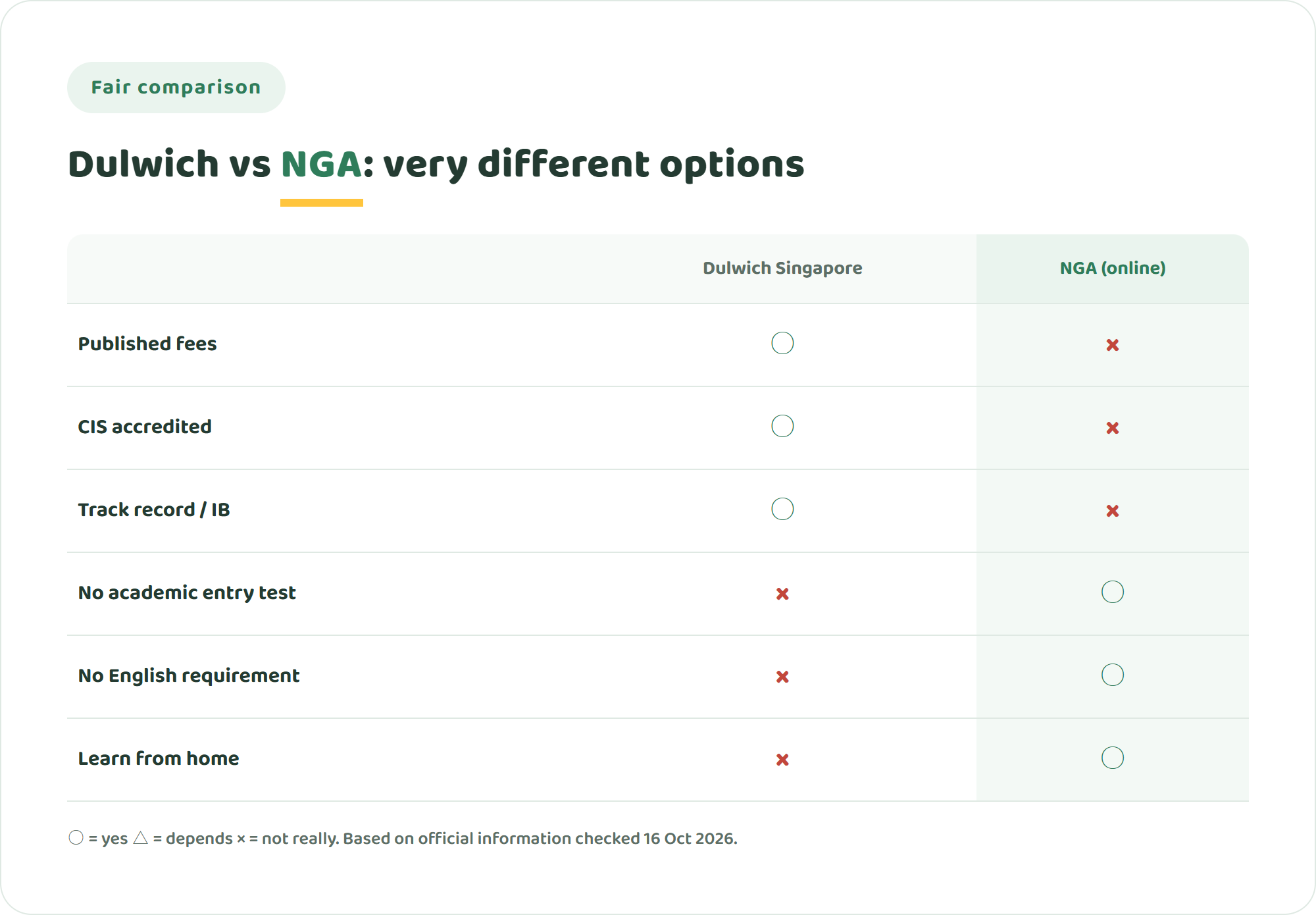
Tanglin Trust School and UWC South East Asia are the two schools Singapore families most often weigh against Dulwich: Tanglin as another long-established British school, UWCSEA as an IB school on two campuses, Dover and East. NIJIN GLOBAL ACADEMY (NGA) is a different kind of school altogether — online, for ages 6–18, and not yet open.
| Dulwich College (Singapore) | NIJIN GLOBAL ACADEMY | Tanglin Trust School | UWC South East Asia | |
|---|---|---|---|---|
| School type | Private British international day school, Singapore | Online international school focused on Asia & Oceania; opens September 2027 (planned) | British international school, Singapore | International school, Dover and East campuses |
| Ages / years | Ages 2–18 (Toddler to Year 13) | Ages 6–18 | Nursery to Year 13 | K1 to Grade 12 |
| Tuition (2026/27) | SGD 21,080–59,220 a year incl. 9% GST | Not yet published (no enrolment, facility or uniform fees; materials included; sibling discounts) | SGD 36,300–58,080 a year incl. 9% GST | SGD 39,069–49,926 a year (GST: see official site) |
| One-off / levies | Application 1,500; enrolment 4,000; capital levy 4,500 | No enrolment fee | Application 1,000; enrolment 4,500; capital levy 4,500 | Application from 627; enrolment 4,992; development levy 9,537 in year 1, then 5,166 a year |
| Curriculum | EYFS, English National Curriculum, IGCSE/GCSE, IB Diploma, International A Levels, Dulwich High School Diploma | Subjects learned in English, CEFR-based English levels, projects; optional Cambridge IGCSE / A-Level pathway | British curriculum; GCSE/IGCSE, A Level or IB Diploma (see official site) | IB Diploma in Grades 11–12 (see official site) |
| Classes & time zone | In person, Singapore time; 8.30am–3.35pm (Junior/Senior) | Small live online dialogue groups (about 8); built for Asia–Oceania daytime, which suits Singapore — may fall outside the day in the Americas or Europe | In person, Singapore time | In person, Singapore time |
| Accreditation / diploma | CIS accredited (2022); WASC stated by the College; IB Diploma and public exams | Not yet accredited; no graduates yet | See official site | See official site |
| Admission | Academic and English assessment, records, possible interview; Singapore Citizens need MOE exemption | No academic entrance exam, no English requirement | See official site | See official site |
| Start dates | Three terms (Michaelmas, Lent, Trinity); offers can be made during the year when places allow | September 2027 (planned); free trial classes monthly from September 2026 | See official site | Applications for 2027/2028 open on 1 September |
Sources: Dulwich College (Singapore) fee schedule 2026–2027, Dulwich admissions criteria, Tanglin Trust School fees 2026/27, UWCSEA fee schedule 2026/2027, UWCSEA fees — checked 16 October 2026.
Reviews and common concerns, answered honestly
Parents researching Dulwich tend to raise the same questions. Here is what the official pages say, so you can weigh them yourself.
“Is it hard to get a place?”
Admission is selective and depends on availability. The College assesses academic readiness and English, gives priority to certain groups (including siblings), and rolls over applicants who meet the standard but cannot be placed immediately. Applying by 31 October gives a chance of an early offer in November; otherwise most decisions arrive in March.
“What does it really cost beyond tuition?”
The one-off fees for a new student add SGD 10,000. Bus, food, uniform, a personal device from Year 7, and trips are extra, and their prices are not published on the official site. Ask Admissions for current bus and meal costs for your area and year group before you sign.
“Our child is still learning English.”
The College says it does not run a separate EAL programme and expects applicants to be able to access the curriculum in English; children identified as needing support are assessed by an EAL teacher, and Year 7–8 offers to EAL students may include supplementary lessons. At least one parent must be fluent in English.
“We are Singaporean — can we apply?”
Only in the cases listed above, and only with an MOE exemption. If your child has been studying overseas and is above Primary 1 age, apply early: MOE processes one application per child at a time and may take up to 4 weeks.
“Is it a good fit for families who move often?”
Dulwich is part of a wider family of schools, and a child moving from another Dulwich school gets admissions priority. Students who left for a relocation after at least one term may be re-admitted without paying the application fee, enrolment fee and capital levy again, subject to availability.
Alternatives to Dulwich College (Singapore) worth comparing
Tanglin Trust School suits families who want another British school in Singapore with a similar fee level (SGD 36,300–58,080 in 2026/27, including GST) and a lower application fee. UWC South East Asia suits families who want an IB Diploma school with somewhat lower published tuition, although its development levy (SGD 9,537 in the first year, then SGD 5,166 a year) changes the comparison — always compare totals, not tuition alone. If you are also weighing other Asia-Pacific schools, see our review of International School Manila tuition and fees; for a British boarding perspective, our Eton College fees review shows how UK boarding costs compare.
NIJIN GLOBAL ACADEMY (NGA) is a different kind of option. It is an online international school for ages 6–18 focused on Asia and Oceania, opening in September 2027 (planned), with free trial classes monthly from September 2026 and pre-opening trial classes in April–May 2027. Its first cohort is 100 students, and it is operated by NIJIN Inc. in Japan, whose alternative school NIJIN Academy has more than 1,000 students. NGA does not rank children by test scores: lessons are small-group live dialogue (classes of about 8), subjects are learned in English with a bilingual English–Japanese mentor, English levels follow the CEFR, and students join social co-creation projects with companies and governments plus international exchange. An optional Cambridge IGCSE / A-Level pathway is listed on the curriculum and timetable page. There is no academic entrance exam and no English requirement; it can run alongside a local school or as the main school, and it travels with the family if they relocate. Its timetable is built for Asia–Oceania daytime, which fits families in Singapore. Tuition is not yet published; NGA says it will be far more affordable than a typical international school, with no enrolment, facility or uniform fees, materials included and sibling discounts.
Be clear about the trade-offs: NGA is not yet open, is not yet accredited and has no graduates or track record. It has no campus, no CCAs on site and nothing like Dulwich’s facilities or IB results. For families in the Americas or Europe, live classes may fall outside their daytime — check the timetable against your local time. If your child is a Singapore Citizen of school age, check MOE’s compulsory education rules before choosing any online school as the main school. If your family lives in Singapore, your child qualifies to enrol and you want a full campus education with an established IB record, Dulwich, Tanglin and UWCSEA are the schools to compare.
For a wider view, see our online international schools compared guide.
FAQ
How much does Dulwich College Singapore cost per year?
For 2026/27, annual fees run from SGD 21,080 (half-day Toddler/Nursery) to SGD 59,220 (Year 13), inclusive of 9% GST: SGD 45,240 for Reception–Year 2, SGD 46,760 for Years 3–6 and SGD 53,850 for Years 7–9. New students add SGD 1,500 application, SGD 4,000 enrolment and SGD 4,500 capital levy (official fee schedule, checked 16 October 2026).
Do Dulwich College Singapore fees include GST?
Yes. The 2026–2027 fee schedule states that fees are inclusive of 9% prevailing GST. The SGD 275,000 Placement Right is quoted excluding GST.
Is there a sibling discount at Dulwich College Singapore?
Families with three or more children enrolled get a 5% tuition discount for every child in Reception and above (not Toddler or Nursery). Siblings of current students also receive admissions priority.
Is Dulwich College (Singapore) accredited?
Yes. It is accredited by the Council of International Schools (decision dated 26 April 2022), states WASC accreditation, is a full HMC member and offers the IB Diploma. It is registered in Singapore as a Private Education Institution.
Can international students and Singapore Citizens enrol?
Foreign students need a valid pass — such as a Dependant’s Pass or a Student’s Pass, which the College applies for through ICA. Singapore Citizens can apply only in specific cases (for example, moving from overseas above Primary 1 age, or with a sibling at the College) and can attend only after MOE grants an exemption.
Is Dulwich College Singapore worth it?
That depends on your family. If you live in Singapore, want a British curriculum from age 2 to 18 with daily Mandarin and strong IB outcomes (37.7 average in 2026), many families find it worth the cost. If budget, eligibility or English is the barrier, compare totals and entry rules with other schools first.
What are the alternatives to Dulwich College Singapore?
Families usually compare Tanglin Trust School (SGD 36,300–58,080 a year including GST in 2026/27) and UWC South East Asia (SGD 39,069–49,926 a year plus a development levy). NIJIN GLOBAL ACADEMY is a very different, online option for ages 6–18 focused on Asia and Oceania, with no academic entrance exam and no English requirement; it opens in September 2027 and is not yet accredited.
Choosing calmly, with the full picture
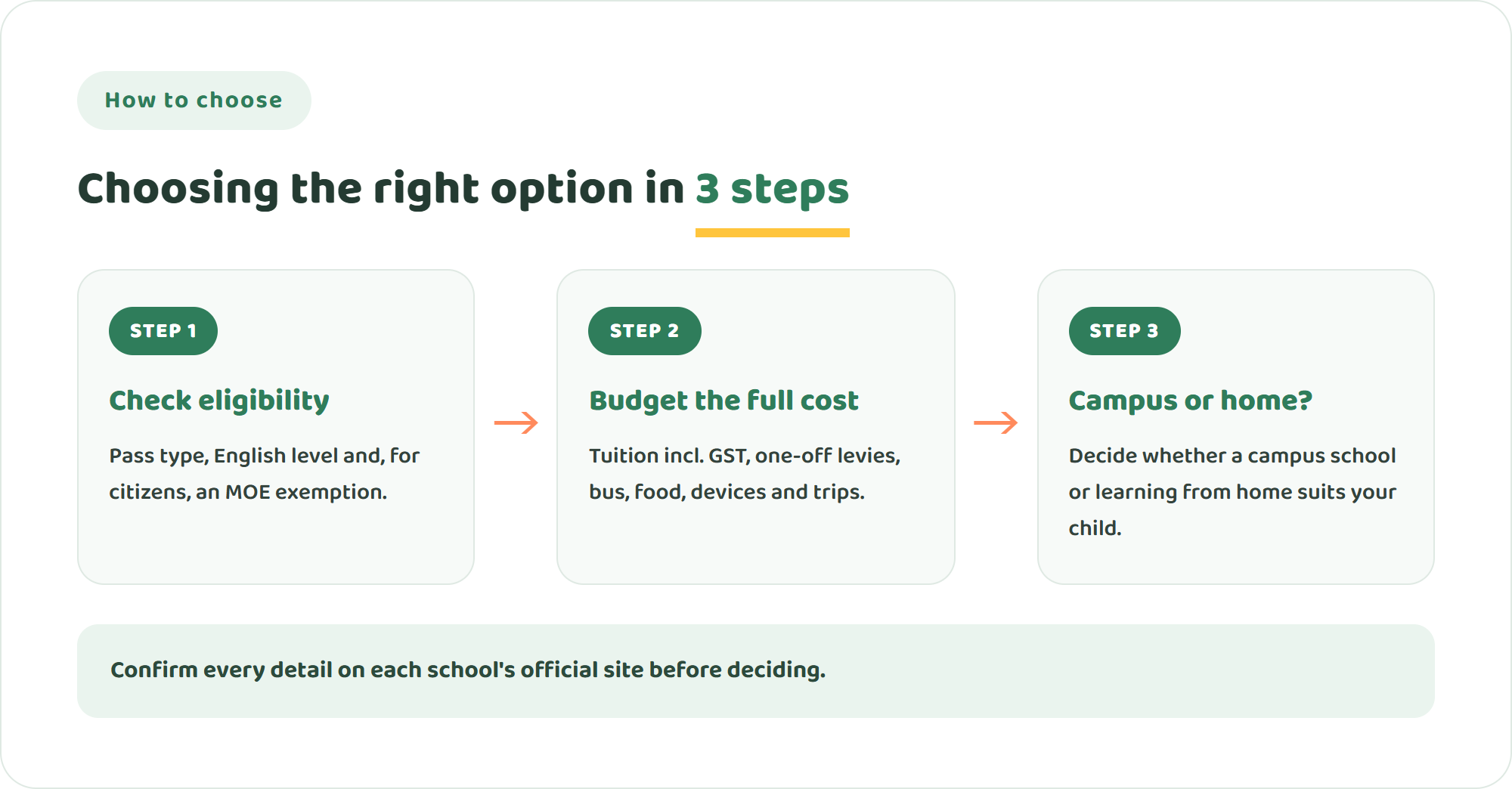
Choosing a school in Singapore is a big decision — financially, practically and emotionally. The most useful things you can do now are to check your child’s eligibility (pass or MOE exemption), budget the full cost including one-off fees and extras, and visit the schools on your shortlist. Whichever school you choose, the right one is the place where your child will be known, stretched and happy.
Tuition and admissions details were checked on the official websites on 16 October 2026. Schools revise fees every year — always confirm on the official site before applying.