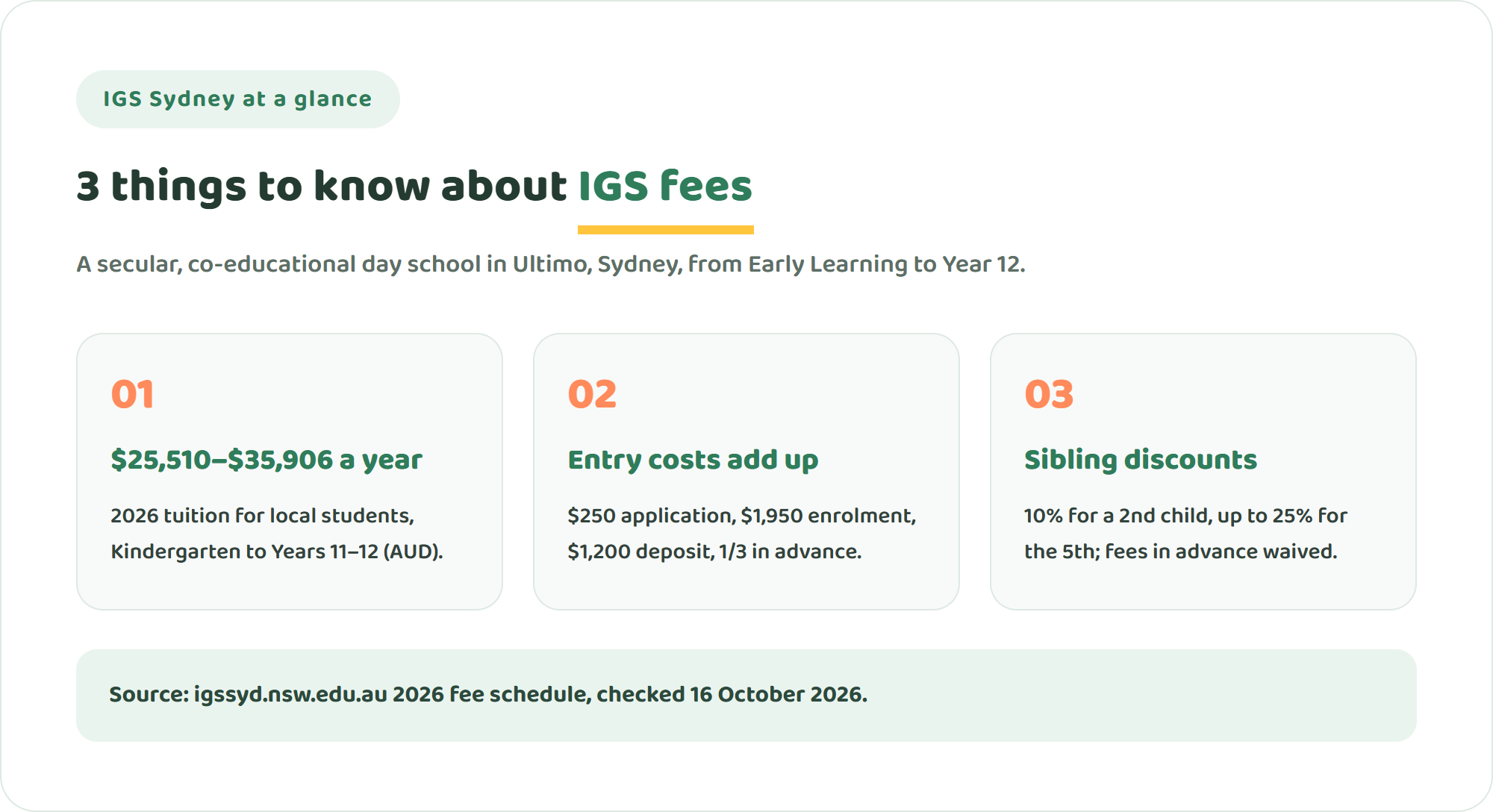
International Grammar School fees for 2026 range from $25,510 a year in Kindergarten to $35,906 a year in Years 11–12 (AUD, local students), according to the school’s official 2026 Kindergarten to Year 12 fee schedule (checked 16 October 2026). Years 7–9 are $33,624 and Year 10 is $34,398. On top of tuition, new families pay a $250 application fee, a $1,950 non-refundable enrolment fee and a $1,200 fee deposit, plus one third of the annual fees in advance on confirming a place. There is a $500 ICT levy per student, compulsory camps and programs from Year 4 to Year 10, and sibling discounts of 10% to 25% of tuition. A 2027 fee schedule was not yet published on the official site when we checked.
If you searched “International Grammar School fees” or “International Grammar School Sydney IB Diploma Programme”, you probably want the real number for your child’s year, a clear list of the extras, and a straight answer on whether IGS offers the IB Diploma or the HSC. This page answers those questions from IGS’s own website and fee schedules, then compares IGS with two other Sydney schools families often weigh it against, Sydney Grammar School and Cranbrook School, and with NIJIN GLOBAL ACADEMY (NGA) — a very different option: an online international school for ages 6–18 that opens in September 2027.
The short answer: who IGS suits — and who it doesn’t
- Suits: families who want languages at the centre of school life. A second language is compulsory from Preschool to Year 10, with bilingual partial immersion from Preschool to Year 6, and every student adds a third language (currently Chinese or Spanish) in Years 7 and 8.
- Suits: families who want a secular, co-educational day school in the inner city. IGS is in Ultimo, a short walk from the University of Sydney, UTS and The University of Notre Dame.
- Suits: families with more than one child. IGS publishes sibling discounts of 10% for a second child, 15% for a third, 20% for a fourth and 25% for the fifth and subsequent child, and waives the fees-in-advance payment for siblings.
- Suits: children who want breadth without compulsory Saturday sport. The official FAQ says IGS does not impose a Saturday sport requirement, unlike many independent schools.
- Harder fit: families specifically seeking the IB Diploma. The official site describes Years 11 and 12 as NSW Higher School Certificate (HSC) courses, and we found no mention of the IB Diploma Programme on the IGS pages we checked.
- Harder fit: families who apply late for a popular year. Places are allocated mainly by the date the application is received, and the main intake years are Early Learning, Kindergarten, Year 5 and Year 7.
- Harder fit: international students on a student visa. IGS says it accepts overseas enrolments only “in very special circumstances, on a case-by-case basis”, and overseas fees are available on request only.
What International Grammar School is
International Grammar School (IGS) is an independent, secular, co-educational day school in Ultimo, on the edge of the Sydney CBD. Its official history says it opened on 3 February 1984 in Randwick with 44 students, founded by linguist Professor Reg St Leon with the aim of creating the nation’s first bilingual school. After sites in Surry Hills and Balmain, the whole school moved in 1997 to its current home on the historic Dalgety Wool Store site in Kelly Street, Ultimo. The school’s motto is “Unity Through Diversity”.
IGS runs from Early Learning (from age 3) through Primary School (Kindergarten to Year 6) to High School (Years 7 to 12). The campus has grown into a cluster of inner-city buildings: the Reg St Leon Building, the Wright Building, the Kerrie Murphy Building with its Global Learning Centre for languages, a Senior Annexe in Mountain Street, the Renaissance Centre (opened 2023) and a purpose-built Kindergarten Centre opened in May 2025. Sport uses nearby Wentworth Park and the Ian Thorpe Aquatic Centre, and since 2023 IGS has a 40-acre retreat in Kangaroo Valley used for language camps and field studies. Total student numbers are not published on the official pages we checked.
| Item | International Grammar School (official information, checked 16 October 2026) |
|---|---|
| School type | Independent, secular, co-educational day school |
| Ages / years | Early Learning (from age 3), Kindergarten to Year 12 |
| Location | 4–8 Kelly Street, Ultimo NSW 2007 (inner Sydney) |
| Tuition 2026 (local students) | $25,510 (Kindergarten) to $35,906 (Years 11–12) per year, AUD |
| Senior credential | NSW Higher School Certificate (HSC); IB Diploma not mentioned on the official site |
| Languages | Second language compulsory Preschool–Year 10 (Chinese, French, German, Italian or Japanese); third language (Chinese or Spanish) in Years 7–8 |
| Main intake years | Early Learning, Kindergarten, Year 5 and Year 7; other years on availability |
| Founded | 1984 |
International Grammar School fees 2026 (official)
Everything below comes from IGS’s fees page, the Kindergarten to Year 12 2026 fee schedule (PDF), the Early Learning Centre 2026 fee schedule (PDF) and the enrolment process page, all checked on 16 October 2026. All amounts are in Australian dollars.
Annual tuition by year level (local students, 2026)
| Year level | Annual tuition 2026 | Per instalment (three instalments) |
|---|---|---|
| Kindergarten | $25,510 | about $8,503 |
| Years 1–2 | $25,935 | $8,645 |
| Year 3 | $26,017 | about $8,672 |
| Years 4–6 | $26,801 | about $8,934 |
| Years 7–9 | $33,624 | $11,208 |
| Year 10 | $34,398 | $11,466 |
| Years 11–12 | $35,906 | about $11,969 |
The per-instalment column is our own arithmetic (annual fee divided by three, rounded); IGS publishes the annual figures only. The 2027 fee schedule was not published on the official site when we checked on 16 October 2026 — the fees page listed only the 2026 documents. Fees for overseas students are “available upon request”.
One-off and entry costs
| Cost item | Amount | Notes from the official schedule |
|---|---|---|
| Application fee | $250 per child | Non-refundable; inclusive of GST; required to process each new application |
| Enrolment fee (Kindergarten–Year 12) | $1,950 per child | Non-refundable; paid on confirmation of entry |
| Fee deposit | $1,200 per child | Paid on confirmation; may be credited against the fee account when the student leaves, at the parent’s request and with the required notice |
| Fees in advance | One third of the current annual fees | Payable on confirmation of entry; waived for siblings |
| Early Learning Centre enrolment fee | $750 per child | Plus the $1,200 deposit; moving from the ELC to Kindergarten, families pay the remaining $1,200 of the enrolment fee and the deposit rolls over |
Levies and compulsory activity fees (2026)
- ICT levy: $500 per student.
- Sports levy: $110 per term for Years 7 and 8, covering the Tuesday afternoon sport program.
- Compulsory camps and trips, charged with the first instalment: Year 4 Language Camp $410; Year 5 Language Camp $410 and Outdoor Education Camp $830; Year 6 Language Camp $410, Outdoor Education Camp $830 and Canberra Trip $588; Year 7 Language Immersion Day $110, Outdoor Education Camp $830 and SAGE Shakespeare Boot Camp $263; Year 8 Language Immersion Day $110, Outdoor Education Camp $830 and SAGE Rocks Quest $263; Year 9 SAGE Opera on Kelly Street $420 and Outdoor Education Camp or Bronze Duke of Ed $1,103; Year 10 SAGE Tasmania program $1,500.
- Faculty fees and other excursions: “additional fees may be charged” — amounts not published on the official site.
- Building Fund: a voluntary, tax-deductible contribution of $1,000 per family a year ($250 per account invoice) that parents are “encouraged” to make.
- After School Care: $31 per session, or $39 casual; Vacation Care is charged separately. Families may be eligible for the Australian Government Child Care Subsidy.
Uniforms, devices beyond the ICT levy, music tuition and overseas exchanges are not priced in the fee schedule; ask the school for current costs.
Early Learning Centre fees (2026)
The ELC charges by the day: $161.50 a day for Term Time attendance (8.20am–3.20pm during school terms) and $203 a day for Extended Hours (7.30am–6pm, including term breaks), on 2, 3 or 5 days a week. Two weeks’ fees are payable in advance on confirming a place. The schedule notes that in 2026 all families in Early Learning are eligible for NSW Start Strong fee relief of up to $1,783 for 4-year-olds and $423 for 3-year-olds, in addition to any Child Care Subsidy.
Payment options and discounts
Tuition can be paid in full in advance — with a $500 per-student discount if paid by 2 February 2026 — or in three instalments due 2 February, 4 May and 27 July 2026, or in 10 direct-debit instalments through School EasyPay. Late fees attract an administration charge of $35 per week overdue. Fees are payable for the whole year; no deduction is made for non-attendance. Withdrawal requires one term’s written notice (two terms for students leaving Year 6 and Year 12), otherwise a late withdrawal fee of one term’s fees applies.
What a full High School costs at 2026 prices
Using only official 2026 numbers, here is the arithmetic for one child who starts in Year 7 and stays to Year 12, with no fee rises, no early-payment discount and no sibling discount:
- Tuition: 3 × $33,624 (Years 7–9) + $34,398 (Year 10) + 2 × $35,906 (Years 11–12) = $207,082
- Application $250 + enrolment fee $1,950 = $2,200 (plus the $1,200 deposit, which can be credited back when the student leaves)
- ICT levy: 6 × $500 = $3,000; sports levy: 4 terms × 2 years × $110 = $880
- Compulsory camps and programs, Years 7–10: $1,203 + $1,203 + $1,523 + $1,500 = $5,429
- Total: about $218,591 at 2026 prices, before uniforms, faculty fees, other excursions and annual fee increases
For Kindergarten to Year 6 at 2026 prices, tuition alone is $25,510 + 2 × $25,935 + $26,017 + 3 × $26,801 = $183,800, so a full Kindergarten-to-Year-12 education is about $390,882 in tuition at today’s rates. With two children — say one in Year 7 and a sibling in Year 3 — the 2026 tuition bill would be $33,624 + $26,017 less 10% ($23,415.30) = $57,039.30, assuming the 10% discount applies to the second child’s fees. Our guide to online vs in-person international school costs sets these numbers against other ways of schooling.
Scholarships and financial help
IGS’s scholarships page describes two programs. Academic scholarships are awarded through the ACER Co-operative Scholarship Testing Program for entry into Year 7 and Year 11; for 2028 entry, registrations close at midnight on Sunday 7 February 2027 and testing is on Saturday 27 February 2027, with no late registrations. The Indigenous Scholarship Program supports Aboriginal and Torres Strait Islander students from Kindergarten to Year 12 whose families could not otherwise afford the fees; the FAQ says it covers all tuition fees, full uniform, a textbook allowance, club and society fees, excursions and exchange programs (applications for 2027 had closed). The value of academic scholarships and any means-tested bursary criteria are not published on the official site.
How a school day works: languages, terms and time zones
IGS is an in-person day school on Sydney time, and its signature is the languages program. From Preschool to Year 6, children learn in bilingual partial immersion: selected units of the core curriculum are taught directly in their second language — Chinese, French, German, Italian or Japanese — alongside songs, games and craft. The official pages describe the daily time slightly differently: the Primary School page says 40 minutes a day in Kindergarten and 80 minutes a day in Years 1–6, while the Primary languages page gives 55 minutes daily, plus an extra half-period three times a week in Years 1–6. Either way, it is a daily, substantial commitment. Year 4 and Year 6 students attend language camps.
In High School, every student continues the second language to the end of Year 10 (students new in Year 7 join a beginner class in a selected language), and all students in Years 7 and 8 add a third language, currently Chinese or Spanish, which becomes an elective from Year 9. All languages can be studied to Year 12 as HSC Continuers courses, with Extension courses available. Students in Years 9 to 11 can join reciprocal exchanges with partner schools in France, Germany, Italy and Spain, and there are accompanied programs with Japan and China.
The 2026 school year runs in four terms, from Friday 30 January to Thursday 3 December for classes; the 2027 term dates are already published, with classes starting on Friday 29 January 2027. Primary School has optional After School Care and Vacation Care. If you are comparing a day school like IGS with learning from home, our explainer on how an online international school day works shows what the other side looks like.
HSC or IB Diploma? Qualifications and results
Because some school directories list IGS as an IB school, this is worth stating carefully. IGS’s official High School page says that in Stage 6 (Years 11 and 12) “IGS offers a wide range of NSW Education Standards Authority developed courses for the Higher School Certificate (HSC)”, and that its programs develop “well beyond” NESA requirements. We found no mention of the International Baccalaureate or the IB Diploma Programme on the IGS pages we checked on 16 October 2026. If the IB Diploma matters to you, ask IGS Admissions directly and check the IB’s own school directory; among nearby schools, Cranbrook (below) states that students in Years 11–12 can choose between the IB Diploma Programme and the HSC.
The HSC leads to an ATAR, which Australian universities use for admission, and is recognised by many universities overseas. IGS publishes highlights of its HSC results. Its 2023 highlights page reports that 5% of the Year 12 cohort achieved an ATAR of 95 or above, 14% achieved 90 or above and 45% achieved 80 or above, with 149 early university offers, and that Year 11 students accelerated in languages and mathematics. Results for other years and a full destinations breakdown are not published on the pages we checked.
Admissions: entry points, the waitlist and how to apply
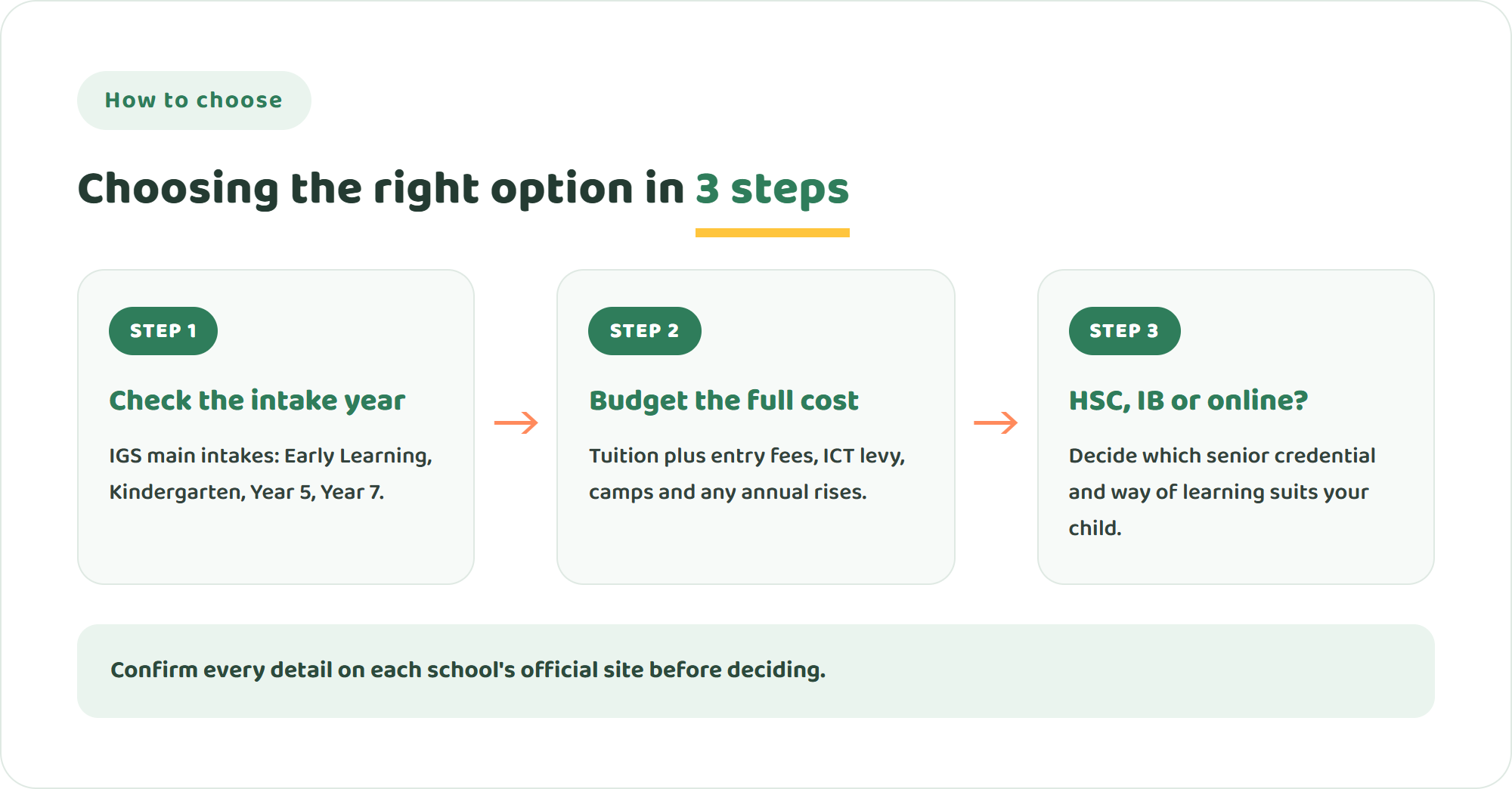
- Know the intake years. IGS’s main intake years are Early Learning (from age 3), Kindergarten, Year 5 and Year 7. Offers into these year groups are made throughout the year before entry; other year groups receive offers when places become available.
- Apply early, online. An application signed electronically by both parents or guardians, the $250 application fee and the required documents (birth certificate; passport or visa for non-citizens; school reports for Year 1 and above) place your child on the waitlist.
- The waitlist is mainly by date. The FAQ says places are allocated mainly by the date the application is received, with priority for siblings of current students, children of permanent staff, previously enrolled students and children of IGS Year 12 graduates.
- Offer and confirmation. Offers are made in writing by the Principal with a contract for both parents to sign. Offers are generally open for about three weeks; enrolment is confirmed on receipt of the signed contract and the enrolment fee, deposit and fees in advance.
- Visit. IGS runs Kindergarten Open Mornings, Open Mornings for Years 3 to 11 and small-group Early Learning Centre tours, plus a virtual tour.
A formal entrance exam for general admission is not described on the official pages; the ACER test applies to scholarship applicants. Students on an international student visa cannot use the online form and must email Admissions for a separate application.
IGS vs NIJIN GLOBAL ACADEMY vs two other options (official data)
Sydney Grammar School and Cranbrook School are two of the schools inner-Sydney families often compare with IGS. Sydney Grammar’s senior school is on College Street, a short trip from Ultimo; Cranbrook in the eastern suburbs is moving to full co-education and offers the IB Diploma alongside the HSC. NIJIN GLOBAL ACADEMY (NGA) is a different kind of school altogether — online, for ages 6–18, and not yet open.
| International Grammar School | NIJIN GLOBAL ACADEMY | Sydney Grammar School | Cranbrook School | |
|---|---|---|---|---|
| School type | Independent, secular, co-educational day school, Ultimo | Online international school focused on Asia & Oceania; opens September 2027 (planned) | Independent academic selective school for boys; Years 7–12 at College Street, Darlinghurst | Independent school; girls joined Years 7 and 11 with full co-education across the campus by 2029 |
| Ages / years | Early Learning (from 3) to Year 12 | Ages 6–18 | Years 7–12 (College Street); preparatory schools at Edgecliff and St Ives | Pre-School and Kindergarten to Year 12 |
| Tuition (2026) | $25,510 (K) to $35,906 (Years 11–12) a year | Not yet published (no enrolment, facility or uniform fees; materials included; sibling discounts) | $52,410 a year for Years 7–12 (three instalments of $17,470) | Domestic: $35,526 (K) to $52,470 (Years 11–12) a year |
| One-off fees | Application $250; enrolment $1,950; deposit $1,200; one third of fees in advance | No enrolment fee | Entrance fee $8,735 (one sixth of Form I tuition) | Application $440; enrolment $7,500 |
| Curriculum / senior credential | NSW curriculum; HSC; compulsory second language and bilingual partial immersion | Subjects learned in English, CEFR-based English levels, projects; optional Cambridge IGCSE / A-Level pathway | NSW HSC | IB MYP in Years 7–10; IB Diploma or HSC in Years 11–12 |
| Classes & time zone | In person, Sydney time | Small live online dialogue groups (about 8); built for Asia–Oceania daytime — Sydney is close to Japan’s time zone, but check the timetable | In person, Sydney time | In person, Sydney time |
| Accreditation / diploma | NSW HSC courses developed by NESA (official High School page) | Not yet accredited; no graduates yet | NSW HSC (see official site) | IB World School; HSC or IB Diploma |
| Admission | Waitlist mainly by application date, with sibling and other priorities; no entrance exam described | No academic entrance exam, no English requirement | Entrance Assessment in English and Mathematics; cannot enrol international students | See official site |
| Start dates | Main intakes: Early Learning, Kindergarten, Year 5, Year 7 | September 2027 (planned); free trial classes monthly from September 2026 | Form I (Year 7); Forms II–V by assessment when places allow | See official site |
Sources: IGS fees, IGS key enrolment dates, Sydney Grammar School fees, Sydney Grammar entrance, Cranbrook School 2026 fee schedule (PDF), Cranbrook curriculum, Cranbrook co-education — checked 16 October 2026.
Reviews and common concerns, answered honestly
Parents researching IGS tend to raise the same questions. Here is what the official pages say, so you can weigh them yourself.
“Does IGS offer the IB Diploma?”
On the official site, no: Years 11 and 12 are described as NESA courses for the HSC, and the IB is not mentioned on the pages we checked. Some third-party directories say otherwise, so confirm with Admissions. If the IB Diploma is essential, Cranbrook offers it alongside the HSC.
“Is a compulsory second language too much for my child?”
IGS’s languages FAQ says no prior experience is needed, that beginners are supported with differentiated tasks, and that students new in Year 7 join a beginner class. In Year 9, students choose whether to continue their second or third language, and in Year 11 they can switch through a Beginners course.
“What do the extras really add?”
More than tuition alone suggests. Every student pays the $500 ICT levy; Years 7–8 add the $110-per-term sports levy; and compulsory camps and programs range from $410 in Year 4 to $1,500 for the Year 10 Tasmania program. Faculty fees and other excursions are charged as they arise, and the Building Fund is voluntary.
“How hard is it to get a place?”
The waitlist is mainly by application date, with priority for siblings and some other groups, and the main intakes are Early Learning, Kindergarten, Year 5 and Year 7. Applying early matters more than any test.
“Can we enrol from overseas?”
IGS says it mainly serves local Sydney students and accepts overseas enrolments only case by case, with fees on request. Families moving to Sydney on other visas should list their visa details in the application and talk to Admissions early.
Alternatives to International Grammar School worth comparing
Sydney Grammar School suits academically strong boys whose families want a selective, HSC-focused school close to the city, and who can plan around a set Entrance Assessment; its fee of $52,410 a year for Years 7–12 is well above IGS’s. Cranbrook School suits families who want the option of the IB Diploma and are comfortable with a higher fee ($50,478 to $52,470 a year for domestic students in Years 7–12) and a school still completing its move to co-education. For an international view of how fees work at other well-known schools, see our Eton College fees review and our guide to International School Manila tuition fees.
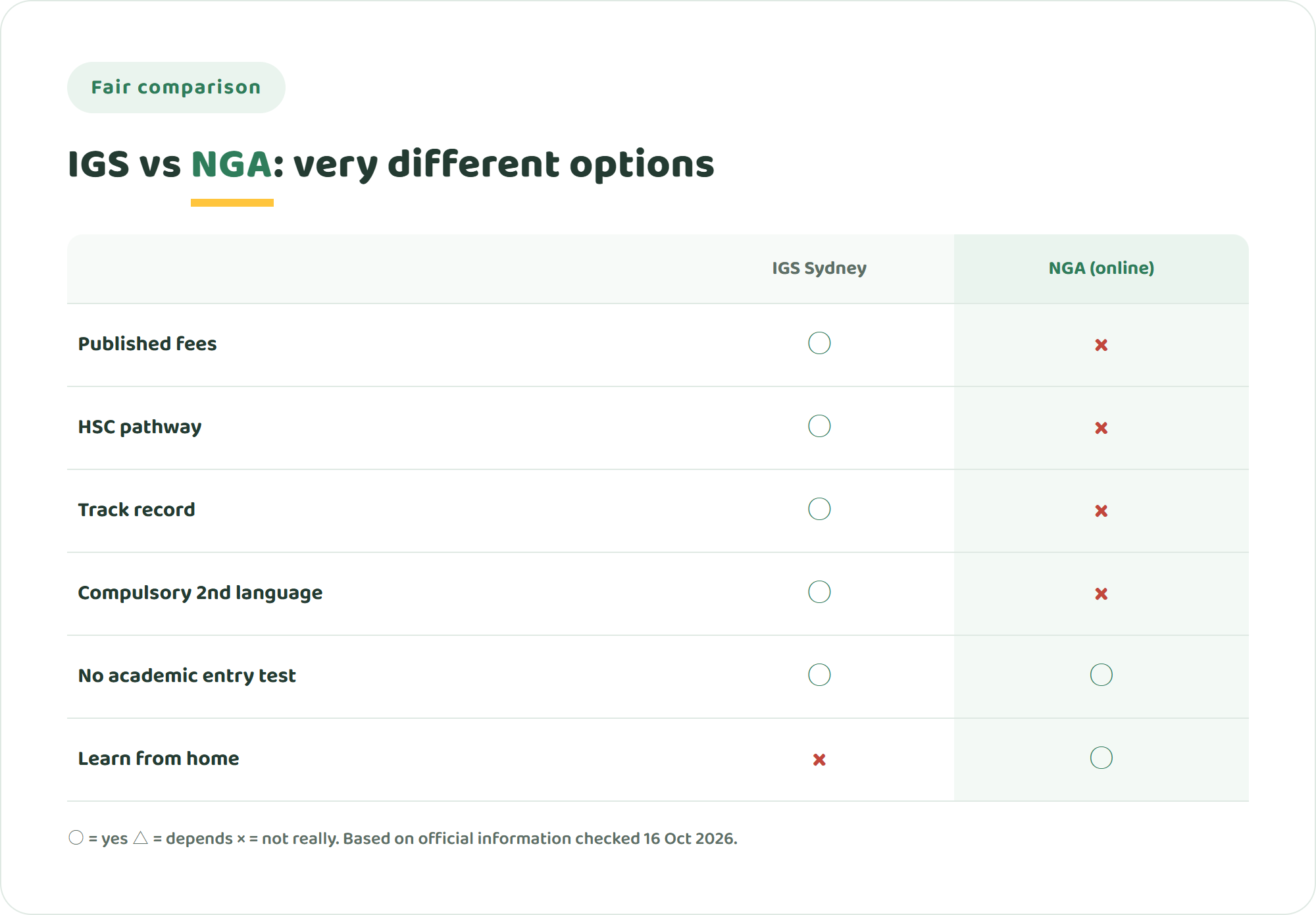
NIJIN GLOBAL ACADEMY (NGA) is a different kind of option. It is an online international school for ages 6–18 focused on Asia and Oceania, opening in September 2027 (planned), with free trial classes monthly from September 2026 and pre-opening trial classes in April–May 2027. Its first cohort is 100 students, and it is operated by NIJIN Inc. in Japan, whose alternative school NIJIN Academy has more than 1,000 students. NGA does not rank children by test scores: lessons are small-group live dialogue (classes of about 8), subjects are learned in English with a bilingual English–Japanese mentor, English levels follow the CEFR, and students join social co-creation projects with companies and governments plus international exchange. An optional Cambridge IGCSE / A-Level pathway is listed on the curriculum and timetable page. There is no academic entrance exam and no English requirement; it can run alongside a local school or as the main school, and it travels with the family if they relocate. Tuition is not yet published; NGA says it will be far more affordable than a typical international school, with no enrolment, facility or uniform fees, materials included and sibling discounts.
Be clear about the trade-offs: NGA is not yet open, is not yet accredited and has no graduates or track record. It does not award the HSC, and it is not a day school — there is no campus, no rooftop basketball court and no daily language immersion with classmates in a Sydney classroom. Its timetable is built for Asia–Oceania daytime; Sydney is only one or two hours ahead of Japan, so live classes may fit an Australian school day well, but families should still check the timetable against local time, especially during daylight saving. If your child is thriving in a Sydney day school and you want the HSC with a serious languages program, IGS, Sydney Grammar and Cranbrook are the schools to compare.
For a wider view, see our online international schools compared guide, or read why some families choose an online international school.
Comparing Sydney independent schools? See also Sydney Grammar School fees, entry and scholarships.
Comparing other Australian schools? Read Scotch College Melbourne fees, Geelong Grammar School fees and the Australian Christian College online review.
FAQ
How much does International Grammar School cost per year?
For 2026, IGS tuition for local students is $25,510 in Kindergarten, $25,935 in Years 1–2, $26,017 in Year 3, $26,801 in Years 4–6, $33,624 in Years 7–9, $34,398 in Year 10 and $35,906 in Years 11–12 (AUD, official 2026 fee schedule, checked 16 October 2026). Add the $500 ICT levy and compulsory camps for your child’s year.
What are the entry costs at IGS?
A $250 non-refundable application fee, a $1,950 non-refundable enrolment fee, a $1,200 fee deposit and one third of the annual fees paid in advance on confirmation. The fees-in-advance payment is waived for siblings.
Does International Grammar School offer the IB Diploma Programme?
The official site describes Years 11 and 12 as NSW HSC courses and does not mention the IB Diploma on the pages we checked on 16 October 2026. Confirm directly with IGS Admissions.
Can international students enrol at IGS?
Only in very special circumstances, case by case. Students on an international student visa must email Admissions for a separate application form, and overseas student fees are available on request.
What are the alternatives to IGS?
Inner-Sydney families often compare Sydney Grammar School ($52,410 a year for Years 7–12, boys, HSC) and Cranbrook School ($35,526 to $52,470 a year domestic, IB Diploma or HSC). NIJIN GLOBAL ACADEMY is a very different, online option for ages 6–18 focused on Asia and Oceania, with no academic entrance exam and no English requirement; it opens in September 2027 and is not yet accredited.
Choosing calmly, with the whole picture
International Grammar School offers something genuinely distinctive in Sydney: a secular, co-educational city school where two, and often three, languages are part of every child’s week. The most useful thing you can do now is check which intake year fits your child, add the levies and camps to the tuition figure, and be sure whether you want the HSC, the IB Diploma or something else entirely. Whichever school you choose, the right one is the place where your child will be known, stretched and happy.
Tuition and admissions details were checked on the official websites on 16 October 2026. Schools revise fees every year — always confirm on the official site before applying.