If you have been researching online schools, two names keep coming up: Connections Academy and Stride K12. Both describe themselves as tuition-free online public schools, and both run schools across many US states. So which is better? This guide compares Connections Academy vs K12 from one specific angle: a family living outside the United States, in Japan or elsewhere in Asia, who wants to know what they can actually enrol in and what it will cost.
Here is the short answer. The free versions of both are only for families who live in a participating US state. If you live abroad, the realistic comparison is between their private, tuition-based siblings: Pearson Online Academy (formerly International Connections Academy) and K12 Private Academy. Below we set out who runs each network, what you really pay, how lessons work, what the accreditation covers and what the time difference means in practice. Every figure comes from the schools’ official websites, checked on 4 October 2026. At the end, we explain where NIJIN GLOBAL ACADEMY, a new online international school opening in 2027, fits in.

Connections Academy vs K12 at a glance
Each network has two faces: a set of state public schools that are free for residents, and a private school that charges tuition and accepts students from abroad. Most of the confusion in reviews and search results comes from mixing the two.
| Item | Connections Academy | Stride K12 |
|---|---|---|
| Who runs it | Connections Education, part of Pearson | Stride, Inc. (formerly K12 Inc.) |
| Free public version | State online public schools in around 30 states | K12-powered online public schools in participating states |
| Who gets it free | Residents of that state, with proof of residency | Residents of that state who meet grade rules and provide proof of residency |
| Version open to families abroad | Pearson Online Academy (private) | K12 Private Academy and other K12-powered private schools |
| Private full-time tuition | $5,450–$8,250 per year | $4,495–$7,995 per year (2026–27) |
| Teaching model | LiveLesson sessions (typically about an hour, often recorded) plus self-paced work | Live classes plus self-paced work; private students may watch recordings |
| Accreditation | Connections Education accredited by Cognia | K12-powered schools accredited by Cognia |
Sources: connectionsacademy.com, pearsononlineacademy.com, k12.com and k12privateacademy.com, checked 4 October 2026. US dollars. Some pages carry no school-year label, so confirm prices before applying.
The key fact: “free” means free for US state residents
Connections Academy’s cost page is clear that its schools are tuition-free because “your student’s education is paid for with state tax dollars”, exactly like a neighbourhood public school. Its state enrolment pages make the condition explicit. Texas Connections Academy, for example, says you must reside within the state of Texas and provide acceptable proof of residency.
K12 works the same way. Its explainer on whether online public schools are free says families do not pay tuition, curriculum fees or teacher costs, and that students typically qualify if they live in the state where the online school operates. Visit K12’s international page from outside the US and it tells you plainly that there are currently no tuition-free options in your area, and points you to its tuition-based private schools.
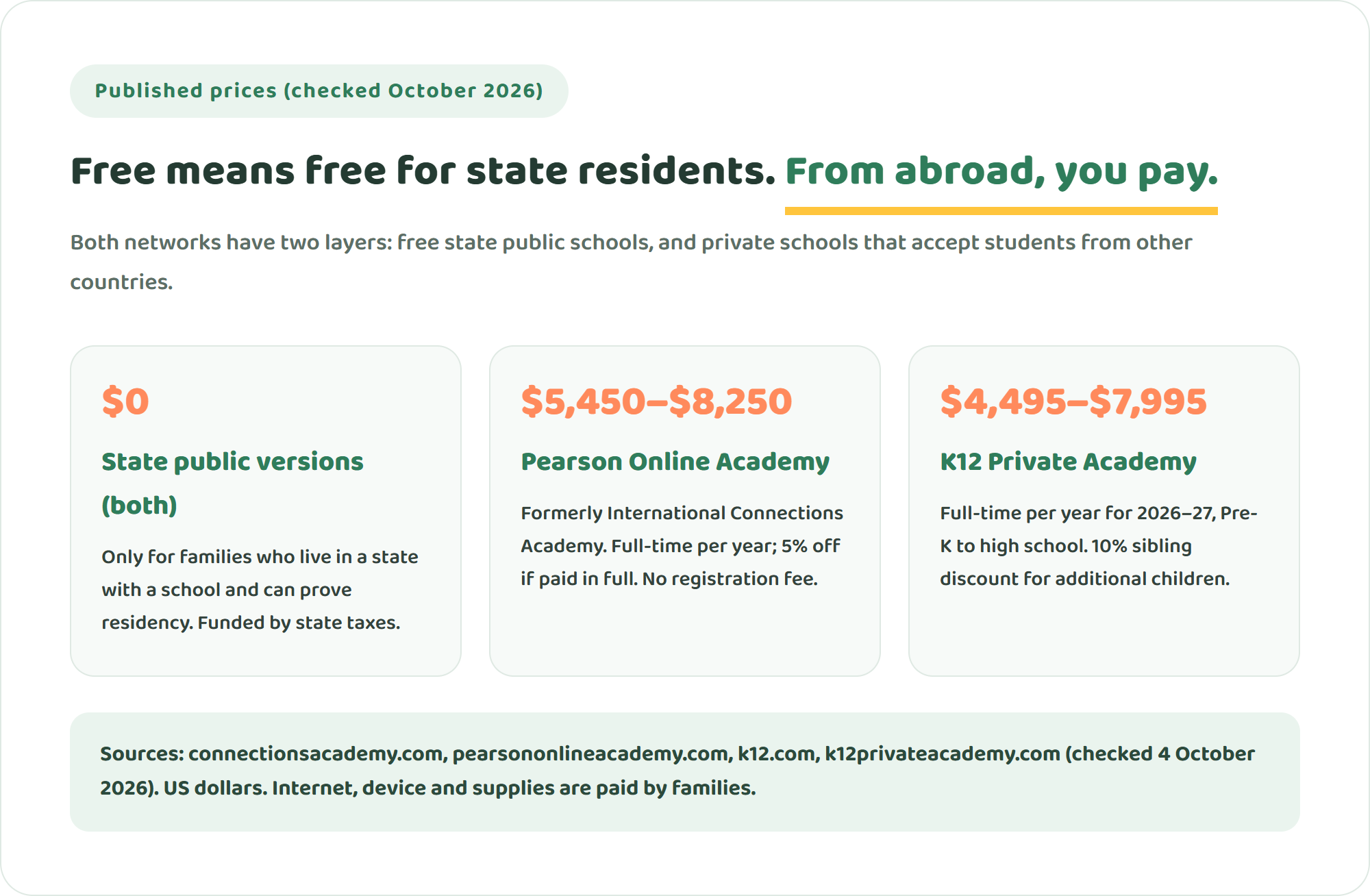
That is why searches like “connections academy tuition” or “connections academy fees” return a confusing mix of “$0” and real prices. For a family in Tokyo, Singapore or Bangkok, the meaningful question is Pearson Online Academy vs K12 Private Academy. If you want the full detail on each public network, read our Connections Academy tuition and review guide and our Stride K12 tuition and review guide.
Tuition and the costs that are not tuition
Pearson Online Academy (the Connections Academy model, private)
Pearson Online Academy, which started life as International Connections Academy, lists full-time tuition of $5,450 for elementary (K–5), $7,050 for middle school (6–8) and $8,250 for high school (9–12). Paying in full saves 5%, bringing those to $5,178, $6,698 and $7,838. There is no registration fee, but the school notes that shipping fees apply to materials sent outside the continental US and internationally. Part-time students pay $335 per course in K–8 and $435–$850 per course in high school. The price table itself carries no school-year label, although the page promotes enrolment for 2026–27, so confirm the year with admissions. Our Pearson Online Academy tuition guide goes deeper.
K12 Private Academy (the Stride K12 model, private)
For 2026–27, K12 Private Academy charges $4,495 for Pre-K, $5,995 for elementary, $6,995 for middle school and $7,995 for high school, full-time. A 10% sibling discount applies to additional children enrolled full-time at the same time. Part-time courses from August 2026 cost $1,150, $1,250 or $1,350 per course for the year, depending on level. As a worked example, four years of full-time high school at 2026–27 prices would be $7,995 × 4 = $31,980 before any increases.
One important detail: K12 Private Academy publishes a list of countries it cannot enrol students from, including the United Kingdom, Ireland, much of the EU, China and India. Japan, South Korea and Singapore were not on that list when we checked, but if your family may relocate, check the current list first.
Which is cheaper?
It depends on the grade. Pearson Online Academy is cheaper in elementary ($5,450 vs $5,995); K12 Private Academy is slightly cheaper in middle school ($6,995 vs $7,050) and high school ($7,995 vs $8,250). The gap is a few hundred dollars a year either way, so price alone rarely decides it.
Costs beyond tuition
For both, families provide home internet, a computer, basic supplies and printer ink. Some state public schools lend computers or subsidise internet, but if you are enrolling privately from abroad, plan to supply your own device.
Live lessons vs self-paced work, and the time-zone reality
Both networks blend scheduled live classes with self-paced lessons. Connections Academy calls its live classes LiveLessons: teacher-led sessions that typically last about an hour, are often recorded, and where cameras are encouraged but not required. In the public schools, about 30% of the elementary day is on a computer, rising to about 75% in middle school and about 90% in high school. Pearson Online Academy describes its LiveLesson sessions as required, with other study time arranged around them.
Both also rely on a Learning Coach, a parent or other trusted adult at home. K12 suggests 4–6 hours a day of adult involvement in elementary school and 1–3 hours a day in middle and high school. Low tuition is possible partly because a family member takes on some of the teacher’s day-to-day role.

What the clock says in Asia
A US Eastern school day of 9am to 3pm is roughly 10pm to 4am in Japan during US daylight saving time, and a Pacific school day is roughly 1am to 7am. Neither school publishes when its live classes for international students take place. K12 Private Academy’s international programmes page tells families they can join live classes or watch recordings later. In practice, a child studying from Asia should expect a recording-first experience, with live contact limited to whatever sessions happen to fall in a reasonable local hour.
Some children thrive on working through recorded lessons at their own pace. Others learn best when they can talk with a teacher and classmates in the moment. If you are weighing those two styles, our curriculum page explains how NGA approaches live, small-group learning.
Accreditation, diploma and grade range
Connections Academy states that it is a division of Connections Education, which is accredited by Cognia. Pearson Online Academy lists accreditation from the Southern Association of Colleges and Schools Council on Accreditation and School Improvement, the Northwest Accreditation Commission, NCA CASI and the Middle States Association. K12 says K12-powered schools are accredited by Cognia, and that Stride received the top score of 4 for “Culture of Learning” in its 2025 Cognia review.
Both private schools cover K–12 (K12 Private Academy from Pre-K) and lead to a US high school diploma. Whether that diploma is the right route depends on where your child plans to go next. Our guides to accredited online international schools and to British vs American online international schools explain how US diplomas compare with IGCSE and A-Level routes.
Connections Academy vs K12 reviews: the themes that keep coming up
Parent reviews of both networks are mixed, and experiences vary a lot from one state school to another. These are the recurring themes, checked against what the schools say officially.
- “I thought it was free.” It is free only for state residents. From abroad you are looking at private tuition.
- “The parent workload is heavier than expected.” Several hours a day of Learning Coach support in elementary school is the official guidance, not an exaggeration.
- “Too much screen time.” The share of computer-based work rises sharply with age.
- “My child feels isolated.” When recordings can replace live sessions, social contact depends on attending live, which is harder across time zones.
None of this makes either a bad school. Both are designed to support very large numbers of US students learning largely at their own pace, with a family member close by.
Four options side by side
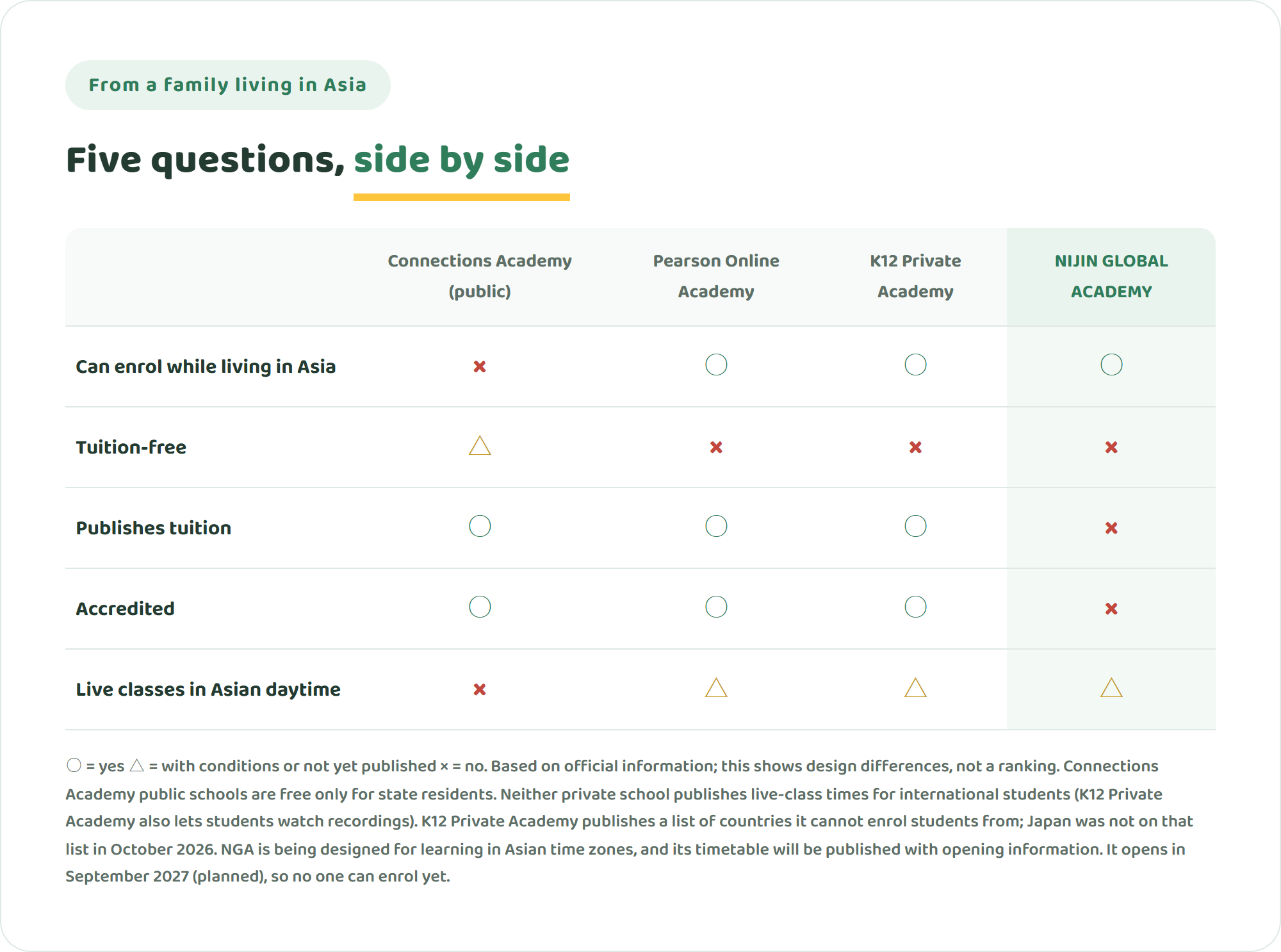
For a wider view of US options that accept students abroad, see American online schools for international students.
Choosing from Asia in three steps
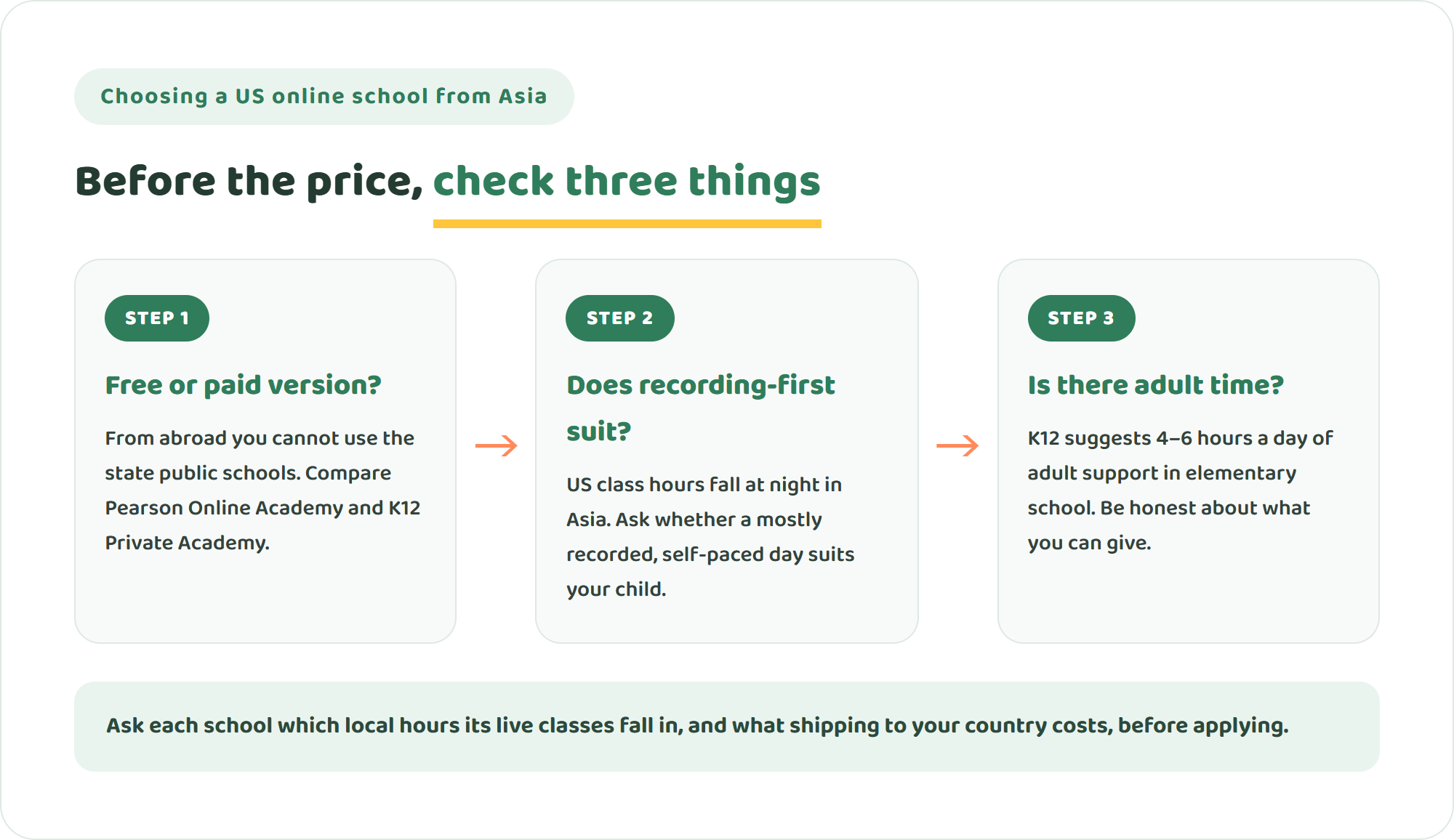
First, confirm you are comparing the private versions, not the free public schools. Second, ask whether a mostly recorded, self-paced day suits your child’s temperament. Third, be honest about how many hours an adult at home can give each day, especially for younger children.

Where NIJIN GLOBAL ACADEMY fits
NIJIN GLOBAL ACADEMY (NGA) is an online international school scheduled to open in September 2027. Rather than offering a US school built for American families to students abroad, it is being designed around small live classes for children living in Japan and elsewhere in Asia, in Asian time zones, where children learn through conversation with teachers and classmates. The timetable will be published with our opening information. There is no test-score-based entrance exam, and children who are still building their English can start learning subjects in English. NGA is run by NIJIN Inc., whose programmes in Japan, including NIJIN Academy for children who do not attend school, have supported more than 1,000 children.
To be clear about what NGA is not yet: it has not opened, it is not accredited, it has no graduates, and its tuition has not been published. If a US diploma from an accredited school is your priority, Pearson Online Academy and K12 Private Academy are sensible options. If live, small-group learning designed for Asian time zones matters more, NGA may be worth following.
FAQ
Can international students attend Connections Academy for free?
No. The free Connections Academy schools are state public schools for residents of that state. Families abroad are directed to Pearson Online Academy, which students can attend no matter where they live, at $5,450–$8,250 a year full-time.
What is International Connections Academy’s tuition?
International Connections Academy is the former name of Pearson Online Academy. Its official full-time tuition is $5,450 (K–5), $7,050 (6–8) and $8,250 (9–12) per year, with 5% off if you pay in full (checked 4 October 2026).
Is K12 free for students outside the US?
No. K12 says there are no tuition-free options outside participating states. K12 Private Academy accepts students from many countries, though not all, at $4,495–$7,995 a year full-time for 2026–27.
Is Connections Academy or K12 better?
For a family abroad, they are closer than the names suggest: similar prices, Cognia-linked accreditation, and the same mix of live and self-paced work. Ask both schools which local hours their live classes fall in and what shipping costs apply to your country.
The better school is the one that fits your family’s day
Connections Academy and Stride K12 have strengths built for families living in US states. Choosing from Asia, look past the tuition figure to three things: the time difference, a recording-first day, and the adult time your family can give.
NIJIN GLOBAL ACADEMY is scheduled to open in September 2027, with trial classes planned for April and May 2027. We will share our timetable and fees by email as they are confirmed.
There is no need to decide today. Try asking your child one question: would you rather talk with a teacher live, or work through lessons at your own pace? The answer will tell you a lot about which kind of school to look for.