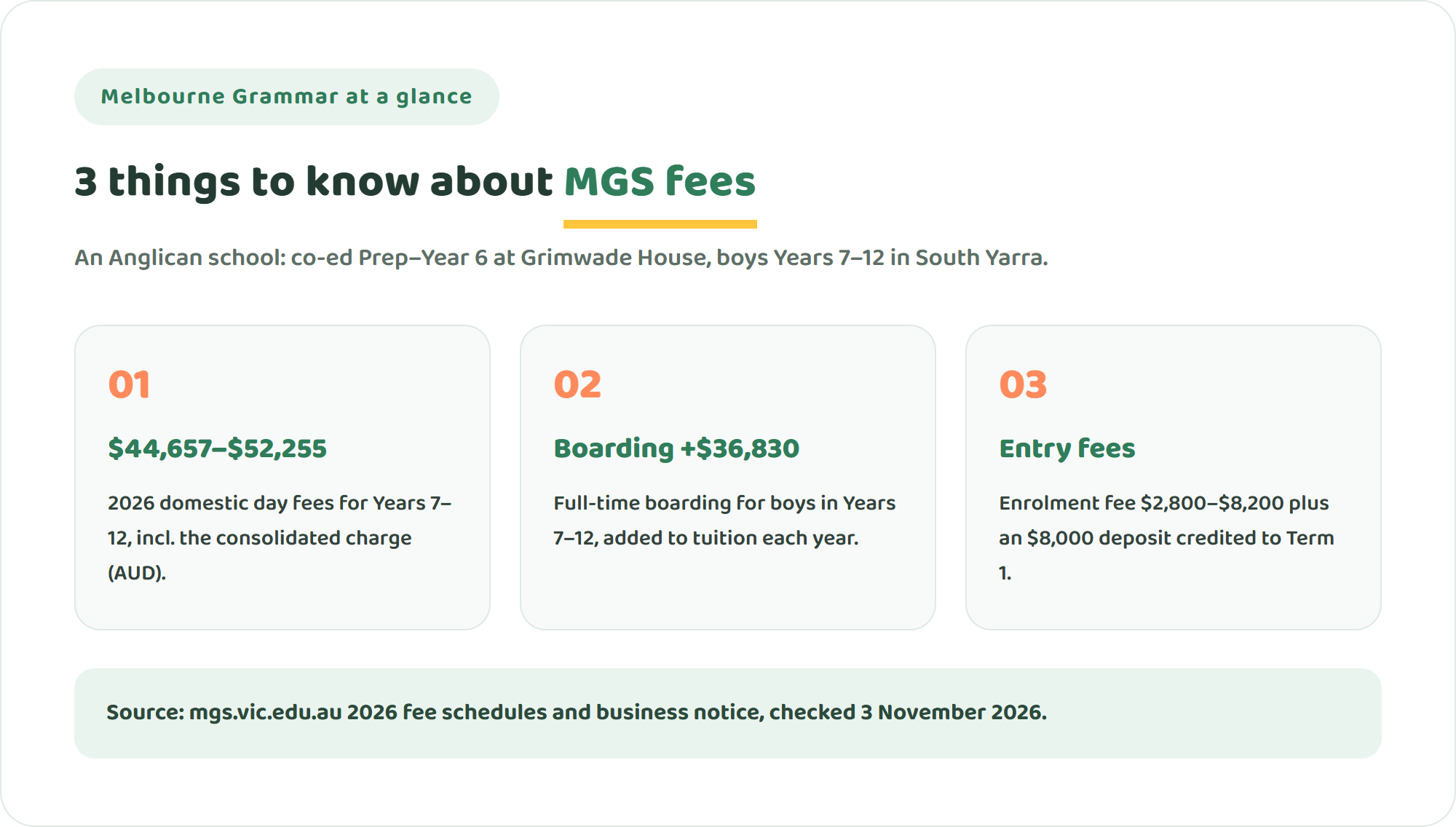
Melbourne Grammar School fees for 2026 range from $36,639 a year in Year 1 to $52,255 a year in Year 10 for domestic day students, with boarding (Years 7–12, boys) an additional $36,830 a year, according to the school’s official 2026 Fee Schedule (AUD, tuition plus the compulsory “consolidated charge”, checked 3 November 2026). A boy in Year 7 pays $44,657 a year as a day student, or $81,487 a year as a boarder. Every application costs a small non-refundable fee, and once a place is accepted families pay a non-refundable enrolment fee of $2,800 for girls, $5,600 for boys and $8,200 for international students, plus an $8,000 holding deposit that is later credited to the first term’s fees. On 3 November 2026 the school’s fees page still showed the 2026 schedule; a 2027 fee schedule had not been published there yet.
If you searched “Melbourne Grammar School fees”, you probably want more than one figure. You want to know what each year level costs, what the consolidated charge covers, what boarding adds, how the total adds up from Year 7 (or Prep) to Year 12, when you have to apply, and whether the school is worth it for your child. This page answers those questions from Melbourne Grammar’s own website, fee schedules and enrolment documents, then compares it with Scotch College Melbourne, Geelong Grammar School and NIJIN GLOBAL ACADEMY (NGA) — a very different option: an online international school for ages 6–18 that opens in September 2027.
The short answer: who Melbourne Grammar suits — and who it doesn’t
- Suits: families in or near Melbourne who want a long-established Anglican school with a strong academic record. The school reports a median ATAR of 92.55 for its Class of 2025.
- Suits: families who plan early. Prep is the main junior intake and Year 7 the main secondary intake, and most Year 7 places are offered three years ahead, when the child is in Year 4.
- Suits: boys from regional Victoria, interstate or overseas who want to board in the middle of the city. About 120 boarders in Years 7–12 live in a precinct beside the Royal Botanic Gardens, a few minutes’ walk from class.
- Suits: families wanting a co-educational primary years with a boys’ secondary school. Grimwade House (Prep–Year 6) is co-educational; Wadhurst (Years 7–8) and the Senior School (Years 9–12) are for boys.
- Harder fit: families with a daughter looking for secondary school. Girls attend only from Prep to Year 6; Melbourne Girls Grammar is a separate school.
- Harder fit: families who decide late. Entry outside Prep, Year 3, Year 7 and Year 9 depends on vacancies, and Years 7–12 entry normally involves an entrance or assessment test.
- Harder fit: families on a tighter budget, or who want to learn from home or outside Victoria. Day fees from Year 7 to Year 12 total more than $280,000 at 2026 prices, before extras.
What Melbourne Grammar School is
Melbourne Grammar School is an independent Anglican school founded in 1858 by Charles Perry, the first Bishop of Melbourne. Its official history says it opened on 7 April 1858 with 77 students on a fifteen-acre site then thought to be “too far from the city”, and it remains on that original site on St Kilda Road, South Yarra. Wadhurst followed in 1878 to take an overflow of boarders, and the gift of Harleston in 1918 established Grimwade House as a junior school. In the 1970s a restructure made Grimwade House co-educational and set up Wadhurst as a boys’ school for Years 7 and 8.
Today the school runs three campuses. Grimwade House in Caulfield teaches girls and boys from Prep to Year 6 as day students. Wadhurst, the Middle School on St Kilda Road, teaches boys in Years 7 and 8, and the adjoining Senior School teaches about 800 boys in Years 9 to 12, including just over 100 boarders. In Years 11 and 12 students take the Victorian Certificate of Education (VCE), choosing from more than 40 subject areas.
| Item | Melbourne Grammar School (official information, checked 3 November 2026) |
|---|---|
| School type | Independent Anglican day and boarding school; co-educational Prep–Year 6, boys Years 7–12 |
| Campuses | Grimwade House, Caulfield (Prep–Year 6); Wadhurst, South Yarra (Years 7–8, boys); Senior School, South Yarra (Years 9–12, boys) |
| Boarding | Boys, Years 7–12, full-time boarding; around 120 boarders in three houses |
| Fees 2026 (domestic) | $36,639–$52,255 a year depending on year level; boarding an additional $36,830 (AUD) |
| Senior credential | VCE (no IB Diploma on the pages we checked) |
| International students | Boys, Years 7–12 only; must board |
| Founded | 7 April 1858, on its original St Kilda Road site |
Melbourne Grammar School fees 2026 (official)
All figures below come from the school’s tuition and boarding fees page, the 2026 Fee Schedule for domestic students, the 2026 Fee Schedule for full fee paying overseas students and the 2026 Enrolment Terms & Business Notices, all linked from the fees page and checked on 3 November 2026. Fees are set each year by the School Council. The 2027 schedule was not yet published on the fees page on that date, so expect the figures for 2027 entry to be higher.
Melbourne Grammar bills two lines for every student: tuition and a consolidated charge. The consolidated charge is specific to each year level and bundles the known compulsory costs into one fee — book lists and, according to the business notice, the Year 6 Canberra excursion, the Year 7, 8 and 9 outdoor education camps, the Year 10 “Beyond the Gates” programme and the Year 12 valedictory dinner. That is why Year 10 is the most expensive year.
Day fees by year level (domestic students, 2026)
| Year level | Tuition | Consolidated charge | Total per year | Per term |
|---|---|---|---|---|
| Prep | $36,470 | $284 | $36,754 | $9,188.50 |
| Year 1 | $36,470 | $169 | $36,639 | $9,159.75 |
| Year 2 | $36,470 | $191 | $36,661 | $9,165.25 |
| Year 3 | $37,030 | $235 | $37,265 | $9,316.25 |
| Year 4 | $37,030 | $164 | $37,194 | $9,298.50 |
| Year 5 | $37,530 | $219 | $37,749 | $9,437.25 |
| Year 6 | $37,530 | $2,256 | $39,786 | $9,946.50 |
| Year 7 | $43,390 | $1,267 | $44,657 | $11,164.25 |
| Year 8 | $43,390 | $1,231 | $44,621 | $11,155.25 |
| Year 9 | $46,230 | $1,955 | $48,185 | $12,046.25 |
| Year 10 | $46,230 | $6,025 | $52,255 | $13,063.75 |
| Year 11 | $46,230 | $175 | $46,405 | $11,601.25 |
| Year 12 | $46,230 | $359 | $46,589 | $11,647.25 |
Boarding fees and international student fees (2026)
| Item | Domestic per year | International per year |
|---|---|---|
| Boarding, Years 7–12 (added to tuition) | $36,200 + $630 consolidated charge = $36,830 | $50,750 + $630 = $51,380 |
| Years 7–8 tuition and consolidated charge | $44,657 / $44,621 | $63,757 / $63,721 (tuition $62,490) |
| Years 9–12 tuition and consolidated charge | $48,185–$52,255 | $67,345–$73,195 (tuition $67,170) |
| Example: Year 7 boarder, full year | $44,657 + $36,830 = $81,487 | $63,757 + $51,380 = $115,137 |
| Example: Year 10 boarder, full year | $52,255 + $36,830 = $89,085 | $73,195 + $51,380 = $124,575 |
| Prep–Year 6 | See day fees above | Not offered (international students are enrolled only in Years 7–12) |
The fees page notes that the international schedule does not include the Grimwade book list charge (there are no international students at Grimwade House). Families can pay annually (due by 27 January 2026), by term (29 January, 21 April, 21 July and 5 October 2026) or in ten monthly instalments on the 17th of each month from January to October.
One-off fees, deposits and payment rules
| Cost item | Amount | Notes from the official documents |
|---|---|---|
| Application fee | $150 (2026 Business Notice) / $175 (2026 Enrolment Policy) | Non-refundable, per application. The two official documents state different amounts — confirm with Admissions. Waived for children, grandchildren, nephews and nieces by birth of Old Melburnians. |
| Enrolment fee | Girls $2,800; boys $5,600; international students $8,200 | Non-refundable, paid on accepting a place (Prep or above); not credited to tuition; includes life membership of the Old Melburnians |
| Holding deposit | $8,000 | From 2026 for 2027 entry onward; charged in March of the year before entry and credited in full to Term 1 fees; non-refundable if the place is not taken up |
| Withdrawal | Two full school terms’ notice | From 1 January 2026; with less notice, a fee in lieu equal to one term’s tuition is charged |
| Leave of absence over one term | At least one term of tuition as a holding fee | Non-refundable; guarantees re-enrolment on return (maximum two years) |
| Failed payment | $50 plus GST each | Three dishonours void an instalment agreement; a credit card surcharge also applies |
| Sibling discount | Not published on the official site | The fee documents we checked do not list one |
Extras: what the fees do not cover
The business notice says the school issues an interim account at the end of each term for elective and non-compulsory charges — for example elective subject resources, excursions, music lessons, uniform items and before- and after-school care. Interstate and overseas trips, tours and enrichment programmes are optional and paid separately. No amounts for these extras are published on the pages we checked, so budget for them on top of the fee table. Parents are also “strongly advised” to hold ambulance membership and private health insurance, because the school’s student accident policy is limited. For international students, the school arranges health cover for the length of the course; its cost is not published on the official site.
What Melbourne Grammar costs to Year 12 (2026 prices)
Using only the official 2026 figures, assuming no fee rises, no scholarship and no extras (the $8,000 holding deposit is not added because it is credited to Term 1):
- Domestic day boy, Year 7 to Year 12: $44,657 + $44,621 + $48,185 + $52,255 + $46,405 + $46,589 = $282,712, plus a $150 application fee and the $5,600 enrolment fee = $288,462.
- Domestic boarder, Year 7 to Year 12: $282,712 + 6 × $36,830 boarding ($220,980) = $503,692, plus $5,750 in entry fees = $509,442.
- Domestic boarder entering at Year 9: $48,185 + $52,255 + $46,405 + $46,589 = $193,434, plus 4 × $36,830 ($147,320) = $340,754, plus $5,750 = $346,504.
- Domestic day boy, Prep to Year 12: Prep–Year 6 total $262,048, plus Years 7–12 $282,712 = $544,760, plus $5,750 = $550,510. A girl at Grimwade House from Prep to Year 6 costs $262,048 + $150 + $2,800 = $264,998.
- International boarder, Year 7 to Year 12: tuition and charges $404,672 + 6 × $51,380 boarding ($308,280) = $712,952, plus $150 and $8,200 = $721,302, before health cover.
If the $150 application fee in the business notice is in fact $175 (as in the Enrolment Policy), add $25 to each total. Fees are reviewed every year, so real totals will be higher. Our guide to online vs in-person international school costs puts figures like these in a wider context.
Scholarships and bursaries
The scholarships page lists Academic, Music, Boarding, General Excellence, EH Flack and First Nations scholarships. All are offered in the year before entry, and applicants must have a permanent home in Australia and be Australian citizens or permanent residents — student visa holders are not eligible. The school says scholarships “prioritise students whose families may not otherwise be able to access” the school, and families may be asked to complete means-testing.
- Academic and Music Scholarships are for Year 7 and Year 9 entry only, through the Annual Scholarship Exam. The exam is now held about 18 months before entry (in Year 5 or Year 7). For 2028 entry the exam was held in person on Saturday 29 August 2026, and registrations are now closed. Music applicants sit the academic exam first and are then auditioned (for example, Year 7 piano at AMEB Grade 6 or equivalent).
- Boarding Scholarships are for students living in regional or rural areas or interstate, and were open for Year 7 and Year 9 entry in 2028 when we checked.
- General Excellence Scholarships are for new day students and boarders in Years 7–11, including students with exceptional ability in APS sport, and can cover part of tuition and/or boarding fees.
What the school does not publish: the percentage or dollar value of any scholarship (“remission levels are not publicly disclosed”) and the number awarded each year. The business notice adds an important condition: scholarships are a partial remission of tuition, awarded on the basis that the student stays to Year 12, and if the student is withdrawn before finishing Year 12 “all scholarship funds awarded must be repaid in full”. The admissions pages also mention Indigenous bursary places, for which families should contact the Admissions Office; no general bursary amounts are published.
Entry points and admissions: Grimwade House, Wadhurst and the Senior School
Applications are accepted from birth. The entry points page and the 2026 Enrolment Policy describe four formal intakes. Places at other year levels depend on vacancies, waiting lists apply at every year level, and an offer usually has to be accepted, with the enrolment fee paid, within about two weeks.
| Entry point | Campus | Places (official) | How offers are made |
|---|---|---|---|
| Prep (girls and boys) | Grimwade House | 84 places in four classes | Mostly offered two to three years in advance by waitlist position and age at application; interview with the Head of Grimwade House or Head of Junior Primary |
| Year 3 (girls and boys) | Grimwade House | About 16 places | Entrance testing, school reports and a meeting with the Head of Grimwade House or delegate |
| Year 7 (boys; day or boarding) | Wadhurst | About 140 places, offered three years ahead | Entrance test in Year 4 (by invitation), school report, co-curricular interests; the largest intake |
| Year 9 (boys; day or boarding) | Senior School | About 20–30 places (the entry points page says about 30) | Assessment test in Year 8 (by invitation), school report, meeting with the Head of Senior School; the main intake for boarders and the final formal intake |
When choosing who to invite and offer, the school weighs academic records and entrance test results, age at the time of application, co-curricular interests, family association (siblings and Old Melburnians), whether the place is day or boarding, and the interview. Siblings of current students and sons of Old Melburnians receive priority, but an offer is not guaranteed. In practice, this means a family that applies when their son is already in Year 5 or 6 is unlikely to find a Year 7 place, and should look at Year 9 or ask about vacancies.
International students — boys only — are accepted in Years 7–12, with the main intakes at Year 7 and Year 9. They sit an AEAS entrance test (often in their home country), may be invited to sit the school’s own test and meet the Director of Boarding, must live in the boarding houses, and need a Local Support Person in Melbourne. After the offer fees are paid, the school issues a Confirmation of Enrolment for the student visa.
Boarding, the school week and time zones
Boarding is for boys in Years 7–12 and, the school says, is “a full-time offering”, meaning boarders are generally expected to stay in the boarding house over weekends. The precinct, beside the Royal Botanic Gardens and a few minutes’ walk from Wadhurst and the Senior School, has three houses — one for Years 7–8 and two for older students. School House and Perry House each hold roughly 55 boys; students share rooms until Year 10 and have single rooms in Years 11 and 12. Boarding staff live in or near the precinct, younger boarders have supervised homework before dinner and older ones after, Saturday mornings are usually for sport and homework, and phones are not allowed in bed.
Like all Australian schools, Melbourne Grammar follows a calendar year of four terms. On the official term dates page, Year 7 students start on Thursday 28 January 2027 and Term I begins for Grimwade House, Year 8 and Years 9–12 on Friday 29 January 2027; Term I ends on Thursday 25 March 2027. Families moving from the Northern Hemisphere should note that the Australian school year starts in late January, so year levels may not line up with a September start. All classes are in person on Melbourne time (UTC+10, or UTC+11 in daylight saving). For a different model, see how an online international school day works.
VCE results and university destinations
Melbourne Grammar offers the VCE in Years 11–12; we did not find the IB Diploma on the pages we checked. The school’s report on its 2025 VCE results gives a median ATAR of 92.55 and a median study score of 36; 15% of students achieved an ATAR of 99 or above, 38.5% 95 or above and 61% 90 or above, and five students achieved the maximum 99.95. Its destinations page says most graduates stay in Melbourne at universities such as the University of Melbourne, Monash and RMIT, while others go interstate or overseas. Because entry at Years 7 and 9 includes an entrance test, these results reflect a partly selected intake as well as the teaching.
Melbourne Grammar vs NIJIN GLOBAL ACADEMY vs two other options (official data)
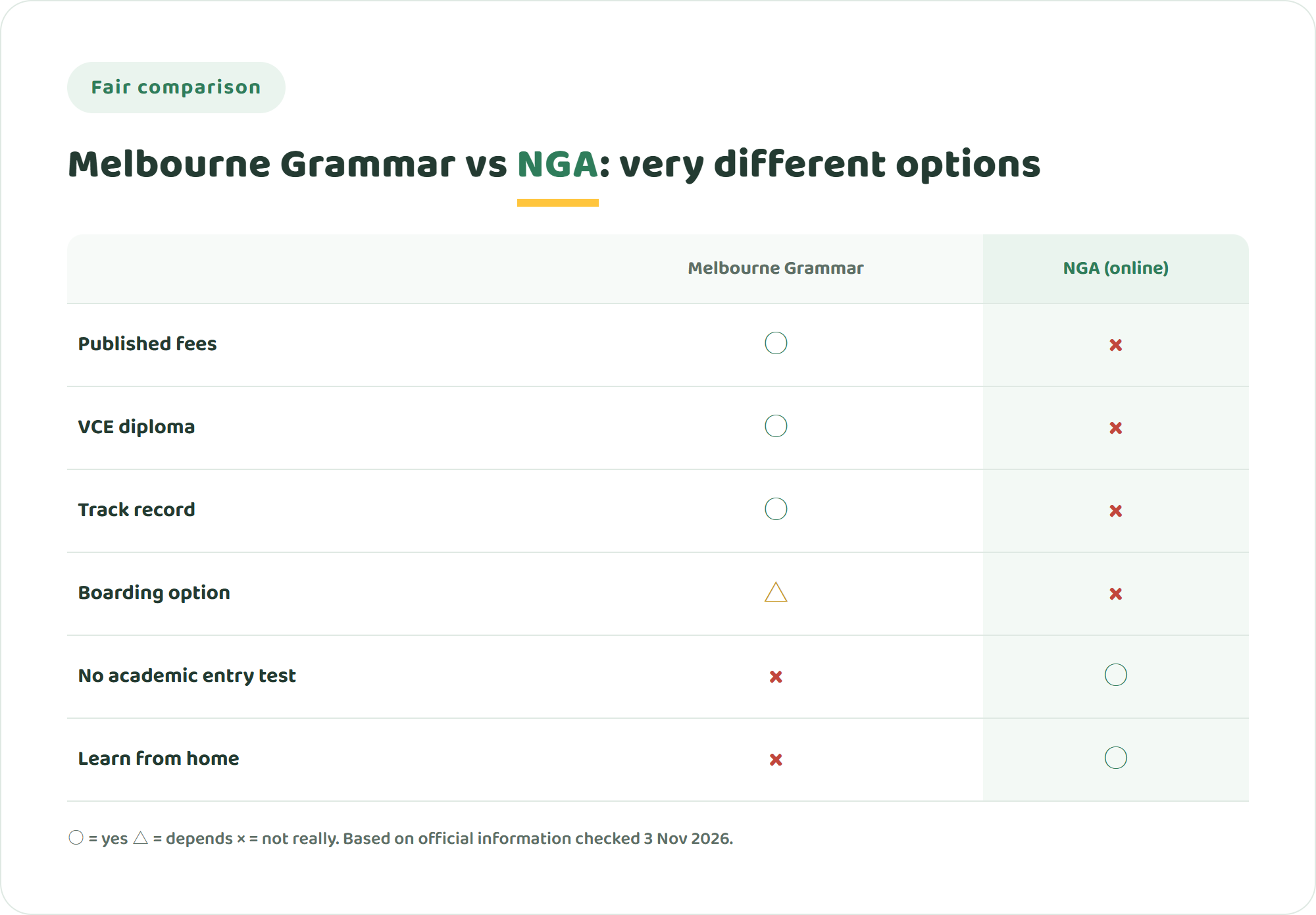
| Item | Melbourne Grammar School | NIJIN GLOBAL ACADEMY | Scotch College Melbourne | Geelong Grammar School |
|---|---|---|---|---|
| School type | Independent Anglican; co-ed Prep–Year 6, boys Years 7–12; South Yarra and Caulfield | Online international school (operated by NIJIN Inc., Japan) | Independent boys’ school in Hawthorn, Melbourne, with boarding | Independent Anglican co-ed boarding and day school, Corio / Timbertop / Toorak |
| Grades / ages | Prep to Year 12 | Ages 6–18 | Prep to Year 12 | ELC to Year 12 |
| Fees | 2026: $36,639–$52,255 a year (day, domestic); boarding +$36,830 | Not yet published; no enrolment, facility or uniform fees; materials included; sibling discounts | 2027: $45,927 (Years 7–8) and $47,853 (Years 9–12) a year; boarding +$38,031 | 2027: $48,180 (Years 7–8 day); $98,820 full boarding in Years 9–12 (domestic) |
| Curriculum | VCE in Years 11–12; 40+ subject areas | Subjects in English with a bilingual mentor; CEFR-based English levels; optional Cambridge IGCSE / A-Level pathway listed | VCE in Years 11–12 | VCE or IB Diploma |
| Classes & time zone | In person, Melbourne time | Live online in small groups of about 8; timetable built for Asia–Oceania daytime, which suits Australian time | In person, Melbourne time | In person, Melbourne time; Year 9 at Timbertop |
| Accreditation / diploma | VCE; 2025 median ATAR 92.55 | Not yet accredited; no graduates yet | VCE | VCE and IB Diploma; IB World School since 1997 |
| Admission | Entrance test for Years 3–12 entry; interview; waiting lists; enrolment fee $2,800–$8,200 | No academic entrance exam and no English requirement | Waiting list with priority criteria; $250 application and $2,000 enrolment fee | Application, interview, reports; English test if needed |
| Start dates | Late January (Australian year) | Opening September 2027 (planned); free trial classes monthly from September 2026 | Late January (Australian year) | Late January (Australian year) |
Melbourne Grammar vs Scotch College: the comparison most families make
Both are long-established boys’ secondary schools in inner Melbourne offering the VCE and boarding, so families often shortlist them together. On the published numbers, Scotch’s 2027 tuition ($45,927 for Years 7–8 and $47,853 for Years 9–12) sits close to Melbourne Grammar’s 2026 day totals ($44,657 in Year 7, $48,185 in Year 9, $52,255 in Year 10) — but the years differ, and Melbourne Grammar’s figure includes its consolidated charge for camps and book lists, while Scotch lists some costs separately (including a Year 9 Fairhaven outdoor programme fee that it has not yet published). Compare like with like by asking each school for the 2027 total including camps. The structural differences are clearer: Melbourne Grammar’s junior school is co-educational and on a separate Caulfield campus, while Scotch is boys-only from Prep on one Hawthorn campus; Melbourne Grammar’s entry from Year 3 upwards relies on an entrance test, while Scotch describes a waiting list with priority criteria. Our page on Scotch College Melbourne fees has its full fee scale.
Sources: Melbourne Grammar School 2026 fee schedules, business notice, Enrolment Policy, entry points, scholarships, boarding, term dates and 2025 VCE results pages, and the Geelong Grammar School fees page (2027 schedule), all checked 3 November 2026. Scotch College Melbourne’s site returned an access error to our fetch on 3 November 2026; its figures are from its official Scale of Fees 2027 as recorded on our Scotch page (checked 23 October 2026). Note that Melbourne Grammar’s figures are for 2026 and the other two schools’ for 2027.
Reviews and common concerns, answered honestly
“Is Melbourne Grammar worth it?”
It depends on what your family values. The fee pays for a long-established school with strong VCE results, a central Melbourne campus and a broad co-curricular life, with the camps and outdoor programmes largely bundled into the consolidated charge. If your son will make full use of that, many families see the value; if you mainly want good teaching close to home, a government school or a lower-fee independent school costs far less.
“Is it hard to get in?”
Entry is competitive and early. Prep places are mostly offered two to three years ahead, Year 7 places are offered when children are in Year 4 after an invited entrance test, and Year 9 has only about 20–30 places. Siblings and sons of Old Melburnians get priority. Apply as early as you can and keep your contact details up to date, because applications can be removed if the school cannot reach you.
“Can my daughter go to Melbourne Grammar?”
Only from Prep to Year 6, at Grimwade House. Wadhurst and the Senior School are for boys. Melbourne Girls Grammar is a separate school with its own fees, and the Enrolment Policy notes that relatives who attended Melbourne Girls Grammar do not count for the Old Melburnian application fee waiver.
“Why is Year 10 more expensive?”
Because Year 10’s consolidated charge ($6,025 in 2026) includes the “Beyond the Gates” programme. Tuition itself is the same in Years 9–12 ($46,230).
“What if we have to leave, or lose a scholarship?”
From 2026 the school asks for two full terms’ notice of withdrawal; otherwise one term’s tuition is charged. Scholarships are awarded on the basis that the student stays to Year 12 and must be repaid in full if he leaves earlier. Read the business notice before accepting any offer.
“Can we apply from overseas?”
Yes, for boys in Years 7–12, who must board. There is an AEAS test, a $8,200 enrolment fee and international fees of $63,721–$73,195 a year plus $51,380 boarding in 2026. Scholarships are not open to student visa holders.
Alternatives to Melbourne Grammar School worth comparing
Scotch College Melbourne is a boys’ school in Hawthorn with boarding, the school Melbourne Grammar families most often compare it with; see our Scotch College Melbourne fees page. For the wider city picture, see international schools in Melbourne, and for a Sydney comparison, Sydney Grammar School fees.
Geelong Grammar School is a co-educational Anglican boarding and day school at Corio (with a Toorak campus in Melbourne) that offers both the VCE and the IB Diploma and sends every Year 9 student to its Timbertop campus. It suits families who want girls and boys together through secondary school, or full boarding in the country; our page on Geelong Grammar School fees covers its 2027 schedule, including $98,820 full boarding in Years 9–12.
NIJIN GLOBAL ACADEMY (NGA) is an online international school for ages 6–18 focused on Asia and Oceania, opening in September 2027 (planned), with a first cohort of 100 students. It is operated by NIJIN Inc. in Japan, whose alternative school NIJIN Academy has more than 1,000 students. Classes are small live dialogue groups of about 8, with subjects learned in English, a bilingual (English–Japanese) mentor, CEFR-based English levels, social co-creation projects with companies and governments, and international exchange; an optional Cambridge IGCSE / A-Level pathway is listed on the curriculum and timetable page. There is no academic entrance exam and no English requirement. It can run alongside a local school or as the main school, and it travels with the family if they relocate. Tuition is not yet published; NGA says it will be far more affordable than a typical international school, with no enrolment, facility or uniform fees, materials included and sibling discounts. Free trial classes run monthly from September 2026. The timetable is built for Asia–Oceania daytime, so it fits an Australian day well.
Be clear about the trade-offs: NGA is not yet open, is not yet accredited and has no graduates or track record. It does not award the VCE, and it offers no boarding, no campus and no APS sport. If you want an established Melbourne school with a recognised senior credential, Melbourne Grammar, Scotch College and Geelong Grammar are the schools to compare.
For a wider view, see our online international schools compared guide or online school options in Australia.
Comparing Melbourne independent schools? See Haileybury fees 2027, including its online school Pangea.
Comparing Melbourne Grammar with Scotch? See Scotch College vs Melbourne Grammar for fees by year level, one-off costs and entry in one table.
FAQ
How much does Melbourne Grammar School cost per year?
For 2026 (domestic, AUD, including the consolidated charge): Prep–Year 6 cost $36,639–$39,786; Years 7–8 about $44,650; Year 9 $48,185; Year 10 $52,255; Years 11–12 about $46,500. Boarding adds $36,830 a year. The 2027 schedule had not been published on the fees page when we checked on 3 November 2026.
What are Melbourne Grammar boarding fees?
Boarding for boys in Years 7–12 is $36,830 a year in 2026 for domestic students ($36,200 plus a $630 consolidated charge) on top of tuition — for example, $81,487 in total for a Year 7 boarder. International boarders pay $51,380 for boarding, or $115,137–$124,575 a year in total.
Is Melbourne Grammar accredited, and does it offer the IB?
Melbourne Grammar is a registered Victorian school offering Prep–Year 10 and the VCE in Years 11–12; the 2025 cohort’s median ATAR was 92.55. We did not find the IB Diploma on its official pages.
Can international students enrol?
Yes, boys in Years 7–12, who must board. They sit an AEAS entrance test, pay an $8,200 enrolment fee and need a Local Support Person in Melbourne. Girls and Prep–Year 6 international students are not enrolled.
Is Melbourne Grammar worth it, and what are the alternatives?
It can be for families who plan early and want a city boys’ school with strong VCE results and boarding. Families often compare Scotch College Melbourne and Geelong Grammar School. NIJIN GLOBAL ACADEMY is a very different, online option for ages 6–18 with no academic entrance exam and no English requirement; it opens in September 2027 and is not yet accredited.
Choosing calmly, with the whole picture
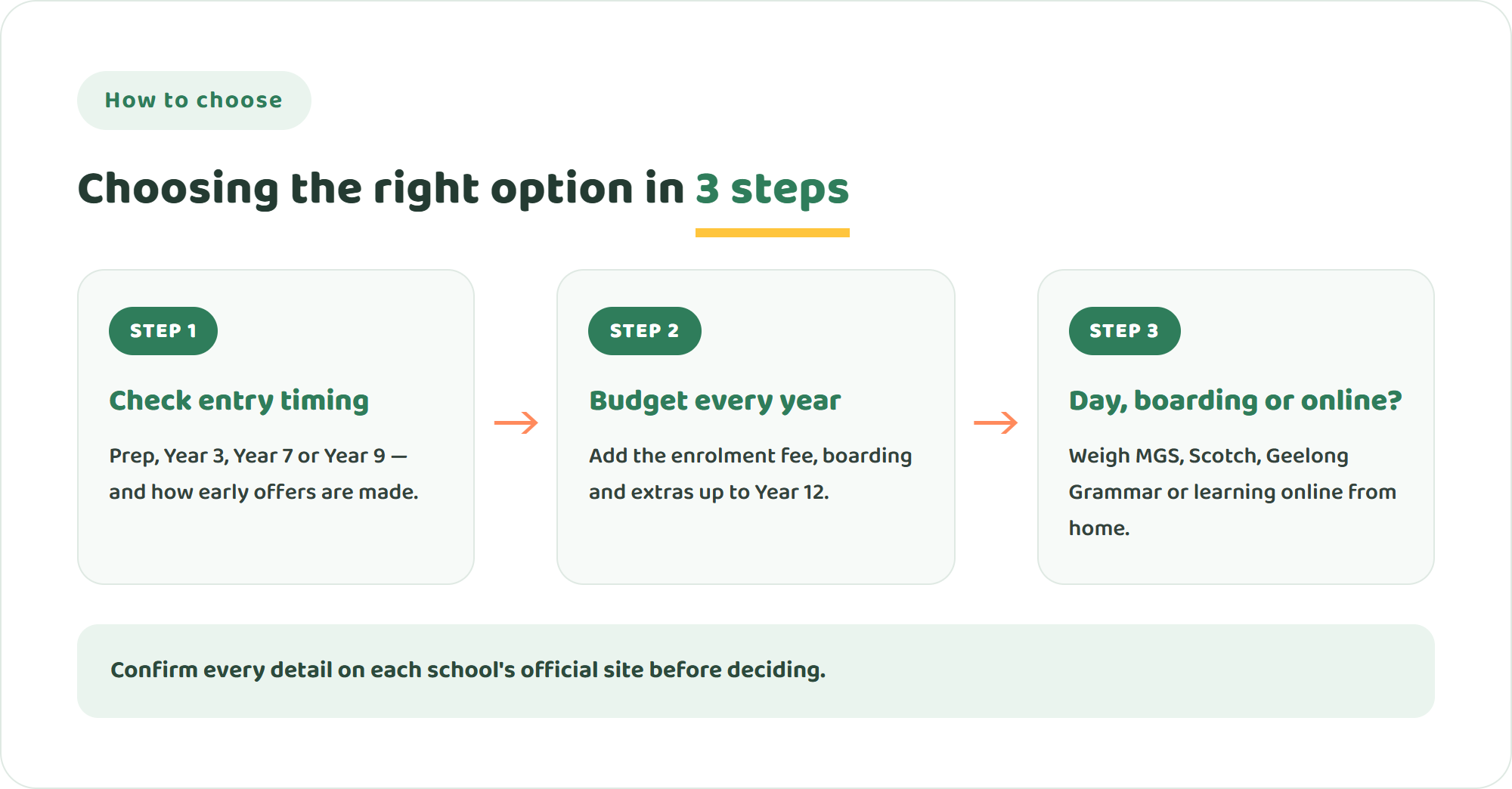
Melbourne Grammar offers a long tradition, a central Melbourne campus, strong VCE results and boarding in the heart of the city. The most useful step now is to check which entry point fits your child’s age — Prep, Year 3, Year 7 or Year 9 — and how early you need to apply, then add the enrolment fee, the holding deposit, boarding if needed and the extras to every year you expect your child to stay. Whichever school you choose, the right one is the place where your child will be known, stretched and happy.
Tuition and admissions details were checked on the official websites on 3 November 2026. Schools revise fees every year — always confirm on the official site before applying.