If you have searched “online school Australia”, you will have noticed that the results mix very different things: government distance education schools, private online colleges, homeschool curriculum services, and online international schools based overseas. They can all be described as online schooling, but they work under different rules, cost very different amounts, and lead to different qualifications.
This guide sorts online school options in Australia into three routes: state distance education schools, private online schools and registered home education, and international online schools. It uses only what state education departments and schools publish on their official websites (checked in October 2026), and it pays particular attention to the two questions that most often decide things for internationally mobile families: who is eligible, and who pays fees. By the end, you should know which route to look at first.
Online school in Australia: the three routes
School education in Australia is run by the states and territories, so the options and rules change depending on where you live. Seen from a family’s point of view, though, they fall into three broad routes.
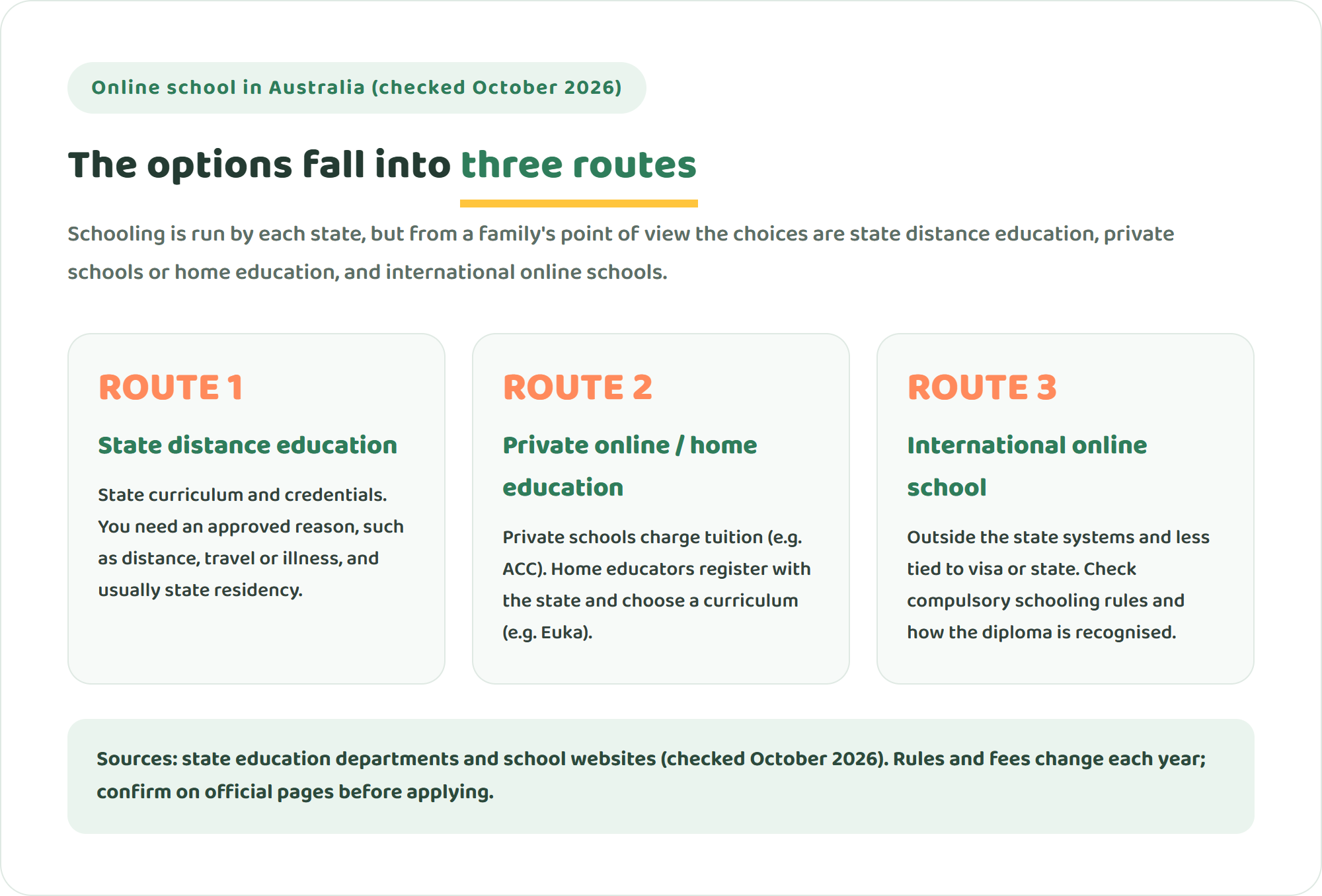
Route 1 is the government distance education school in your state. These are public schools that follow the state curriculum and lead to state credentials, but you need an approved reason why your child cannot attend a local school. Route 2 covers private online schools, which charge tuition, and home education, where parents register with the state and take responsibility for the program. Route 3 is an international online school that sits outside the Australian state systems altogether. Which route fits depends less on any school’s reputation and more on your visa status, how long you expect to stay, and where you want your child to finish school.
Route 1: state distance education schools
Australia’s distance education schools began as a way to reach children on remote stations and in isolated communities, and today most of their teaching happens online. Every state has at least one. What they share is that enrolment is based on eligibility categories, each requiring documented evidence.
| State | Example school | Main eligibility (as published) |
|---|---|---|
| NSW | Sydney Distance Education High School (Years 7–12); Sydney Distance Education Primary School (K–6) | 11 distance education schools statewide. Categories include geographic isolation, travelling within Australia, temporarily resident or travelling overseas, medical conditions, pregnant students and young parents, and vocationally talented students |
| QLD | Brisbane School of Distance Education (Prep–Year 12) | Eight categories, including “home-based by choice” and travelling overseas |
| VIC | Virtual School Victoria (F–12) | Six categories, including medical, travel, elite sports/performance and distance. Victorian residents only |
| SA | Open Access College | Rural and remote students, students travelling for one term or longer, medical conditions, some subjects for home-educated students |
| WA | School of Isolated and Distance Education (SIDE) | Geographic isolation, long-term travel with family, courses not offered locally, long-term illness |
The details differ a lot between states. Queensland is unusual in offering a “by choice” category: Brisbane School of Distance Education accepts home-based students whose families have simply chosen distance education, even if they live near a school. Those enrolments pay a compulsory Distance Education Fee, listed at $1,738.80 for applications from mid-May 2026, plus year-level resource fees (statement of fees dated August 2026). Victoria sets out specific tests instead. Virtual School Victoria charges no enrolment fees to eligible students, but its distance category, for example, requires a student over nine to live more than 4.8 km from the nearest government school and bus route, and its travel category expects students based interstate or overseas for more than two years to enrol in a school where they are.
The most important point for newcomers is residency. State distance education is built around residents of that state, usually citizens and permanent residents. Brisbane School of Distance Education lists Australian citizens, children of citizens and permanent residents, and asks temporary visa holders to contact the school because only some subclasses may qualify. Virtual School Victoria’s 2026 handbook states that it does not generally accept students on temporary visas.
Temporary visas and school fees: how the rules work
If your family is in Australia on a temporary visa, such as a skilled work visa (subclass 482) or as dependants of an international student, your child may be charged tuition even at a government school. The rules depend on the combination of state and visa subclass, and amounts are reviewed each year, so here are the principles we could confirm on official pages rather than a fee table that will date quickly.
- New South Wales: most temporary residents pay the Temporary Residents Program application fee and tuition fee, with the amount depending on the visa subclass. From the 2025 school year, a tuition fee exemption applies to some 482 visa holders living in eligible regional areas and attending eligible regional schools. Sydney Distance Education Primary School tells families on temporary visas to follow the department’s temporary residents process.
- Queensland: most school-age children holding temporary visas pay fees to attend a state school, with exemptions for some visa types and a hardship waiver process.
- Western Australia: families on 457 or 482 visas pay a tuition fee of AUD 4,000 per year per family, regardless of the number of children enrolled (2025/2026 information from TAFE International WA, which manages the fee for the Department of Education).
- South Australia: the department publishes a 2026 fee calculator for families on 482 visas, based on gross household income.
- Victoria: children of international students apply through the state’s International Student Program; check the department’s pages for other visa types.
In short, “public” does not always mean “free”, and “online” does not always mean “cheaper”. Before applying, check your child’s visa subclass against your state’s official page, or call the department with the subclass number in hand.

Route 2: private online schools and home education
If your family does not meet the state criteria, private schools are the next option. A well-known example is Australian Christian College (ACC), a Christian school group with distance education programs. ACC Marsden Park in NSW offers distance education from Kindergarten to Year 12, with 2026 annual fees of $1,280 for K–2, $2,155 for Years 3–6, $3,005 for Years 7–8, $3,460 for Years 9–10 and $6,285 for Years 11–12 (first child; most textbooks included). As a faith-based school, it is worth checking that its approach suits your family.
The other path is home education. In Australia, a school-age child who is not enrolled in a school must be registered for home education with the state. In NSW, oversight of home schooling moved from NESA to the NSW Department of Education on 5 May 2025. Parents submit an educational program based on the NSW syllabus, and an Authorised Person reviews the program and records, usually through a home visit. New applicants often receive a shorter first registration period.
This is where Euka Future Learning often comes up. Euka is not a school. It is a home education support provider offering online curriculum aligned to the Australian Curriculum and optional help with registration documents and reports. You do not enrol in Euka; you register as a home educator and use Euka as your curriculum. That gives a lot of freedom, but the parent carries the responsibility for the program.
Across all of these, the deciding factor is usually who teaches. If you want to see how we think about live, teacher-led learning online, our curriculum page explains the approach.
Route 3: international online schools from Australia
The third route is an international online school. These include online schools based in the US or UK and schools offering international curricula. Because they sit outside the Australian state systems, they are much less tied to your state of residence or visa status, and a child can keep learning in the same school after a move, whether that is back home or on to another country.
Time zones are a real advantage here. Sydney and Melbourne are one hour ahead of Japan (two hours during daylight saving), Brisbane is one hour ahead all year, and Perth is one hour behind. That puts Australia within a few hours of much of Asia, so classes scheduled for Asian daytime hours are generally easy to join from Australia, unlike US-based programs whose live sessions can land late at night.
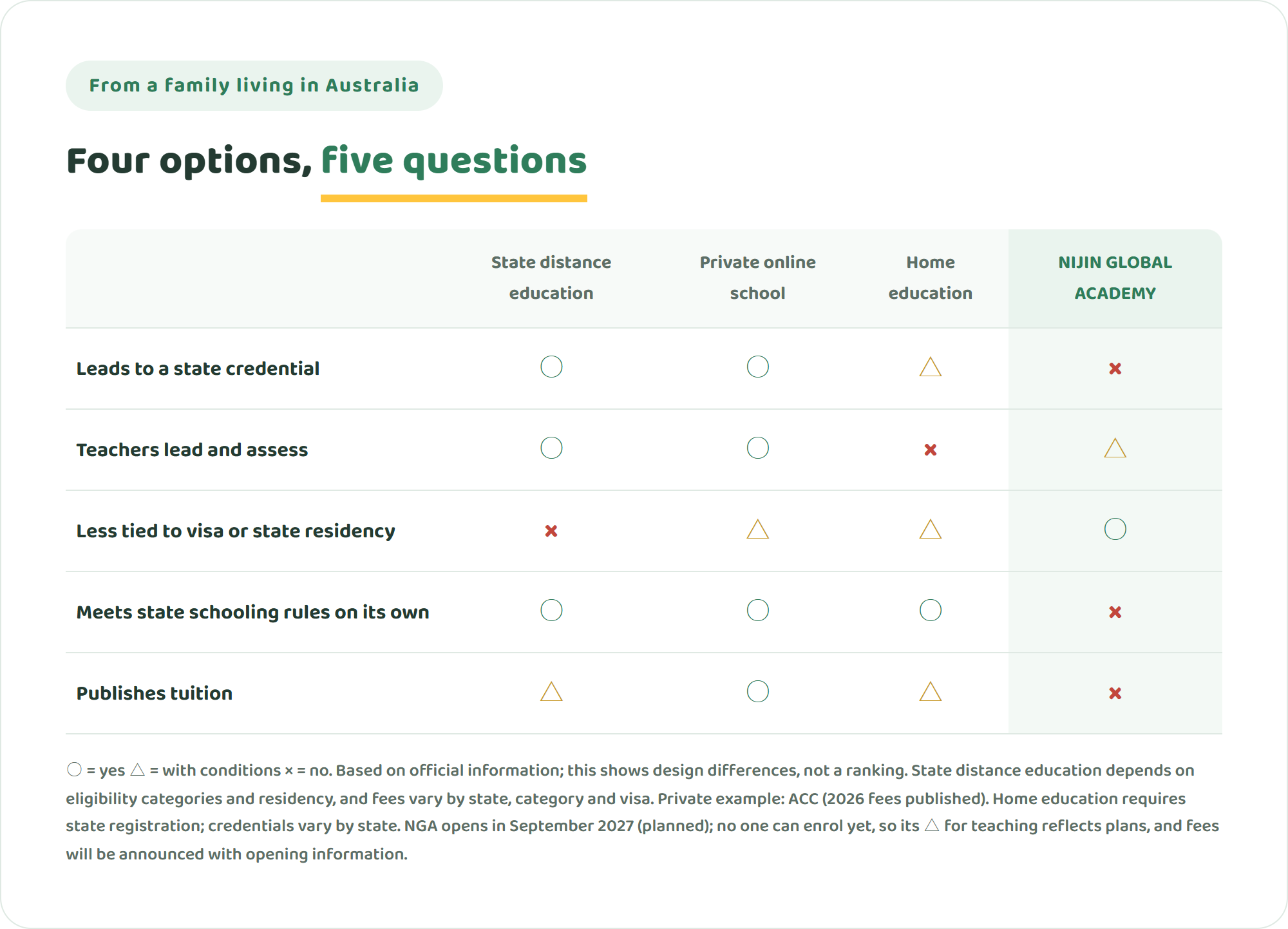
There are two things to check. The first is compulsory schooling. Australian states generally expect a school-age child to be enrolled in a school or registered for home education, so ask your state how enrolment in an overseas online school alone is treated. The second is credentials and next steps: confirm which universities recognise the school’s diploma, and whether the school is accredited. Our guides to accredited online international schools and where online school graduates go next cover these questions in detail.
Which route fits your family? Three steps
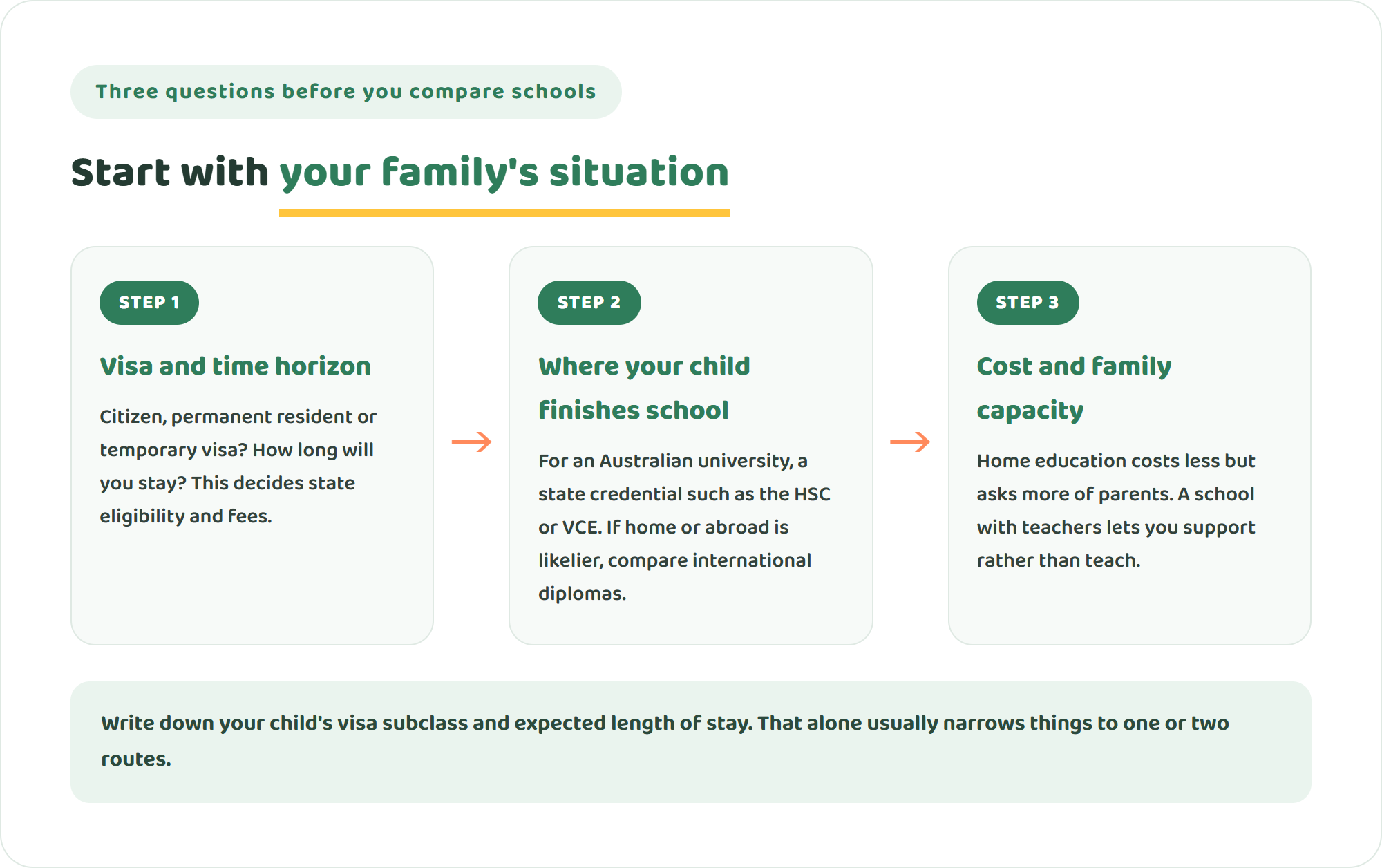
Step 1: your visa and time horizon. If you are citizens or permanent residents planning to stay, your state’s distance education school is the natural first stop. If you are on a temporary visa and expect to move in a few years, check eligibility and fees carefully, and put an international online school on the list alongside the state options.
Step 2: where your child will finish school. For an Australian university, a route that leads to a state credential such as the HSC in NSW or the VCE in Victoria is the most direct, whether through a distance education school or a private school working to the state curriculum. If home, or a third country, is more likely, compare international diplomas as well. Our guide to choosing an online international school and online international school comparison lay out the questions.
Step 3: cost and family capacity. Home education can keep costs low, but a parent needs time to plan and run the program. A school with teachers costs more, but lets the parent be a supporter rather than the teacher. If you are also weighing campus schools, see our overview of international schools in Sydney. Families comparing with New Zealand can read our guide to online school options in New Zealand.
Where NIJIN GLOBAL ACADEMY fits
NIJIN GLOBAL ACADEMY (NGA) is an online international school scheduled to open in September 2027, so in the terms of this guide it belongs to Route 3. It has no test-score-based entrance exam, and learning centres on small, live classes built around dialogue. NGA is run by NIJIN Inc., which operates learning programs in Japan, including NIJIN Academy for children who are not attending school, and has supported more than 1,000 children.
To be clear about what NGA is not: it is not yet open, and it does not lead to an Australian state credential. Our timetable and fees will be shared in our opening information. If you are weighing how a state option and an international one might fit together for your child, we would be glad to help you think it through.
FAQ
Is online school free in Australia?
State distance education is generally low-cost for eligible citizens and permanent residents, but not always free. Queensland’s “by choice” category carries a Distance Education Fee ($1,738.80 for applications from mid-May 2026), and families on temporary visas may pay tuition depending on the state and subclass. Private options such as ACC charge annual fees ($1,280–$6,285 in 2026 for the first child).
Can children on a 482 visa enrol in state distance education?
It depends on the state and school. Virtual School Victoria does not generally accept students on temporary visas, Brisbane School of Distance Education assesses some subclasses case by case, and in NSW temporary residents follow the department’s Temporary Residents Program. Contact the school with your child’s visa subclass.
Is Euka Future Learning an online school?
No. Euka is a home education support provider. Parents register with their state as home educators and can use Euka’s online curriculum and optional registration and reporting services.
Can my child attend an Asia-based online school from Australia?
Time zones make it practical: eastern Australia is one to two hours ahead of Japan and Perth is one hour behind. Check with your state how this fits compulsory schooling requirements, and confirm the school’s accreditation and university recognition.
Choosing an online school in Australia gets easier once you know your route
The hard part of online school in Australia is rarely a lack of options. It is that eligibility and fees change by state and by visa, which makes the picture hard to read. Once you are clear on your visa and time horizon, where your child will finish school, and how much support your family can give, the choice usually narrows to one or two routes.
NIJIN GLOBAL ACADEMY is scheduled to open in September 2027, with trial classes planned for April and May 2027. We will share our curriculum, timetable and fees by email as they are confirmed.
There is no need to decide today. Start by writing down your child’s visa subclass and how long you expect to stay in Australia. That one page will tell you which route to explore first.