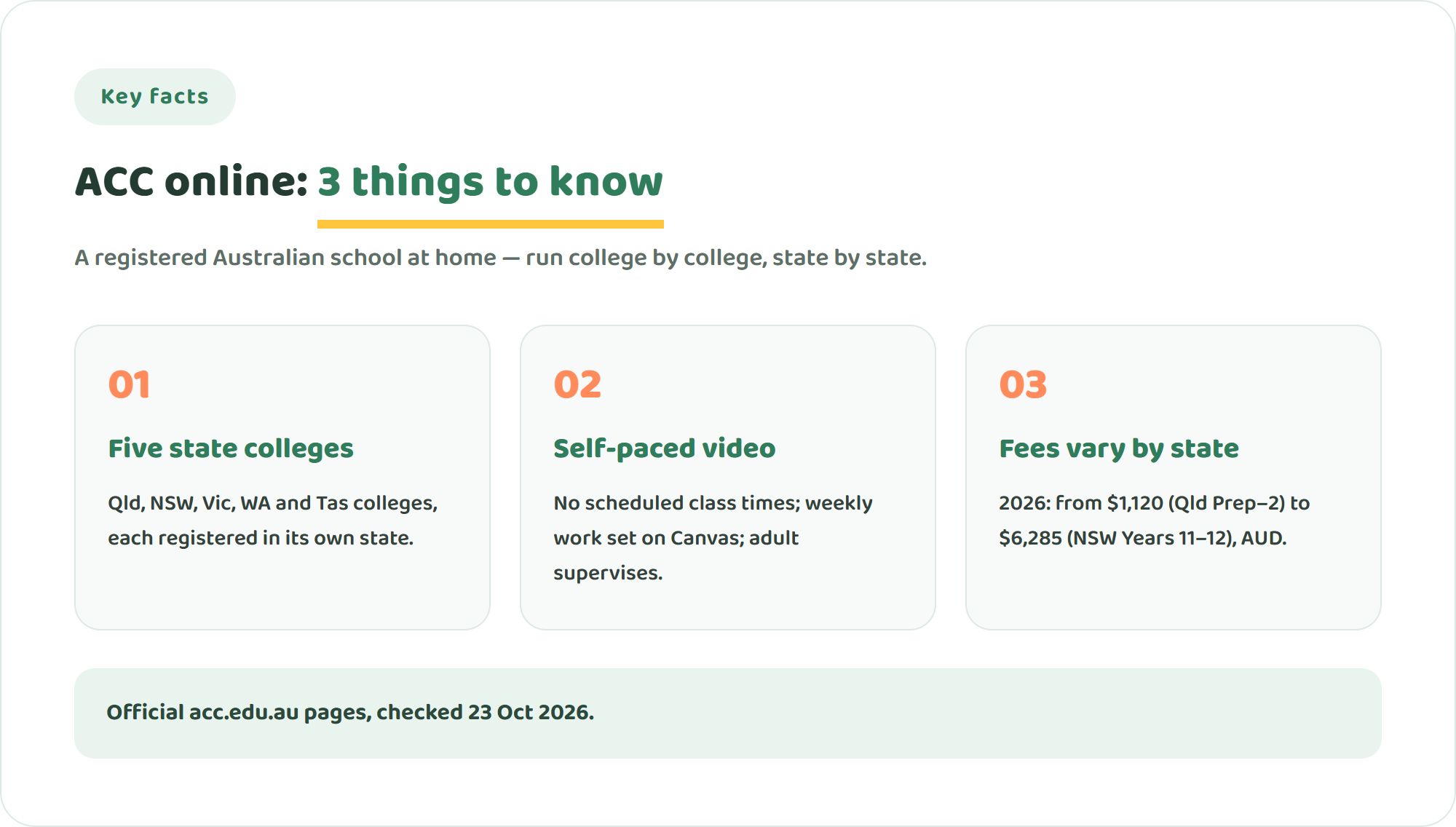
Australian Christian College online, in one paragraph: Australian Christian College (ACC) is an independent Christian school group whose distance education program — ACC calls it “ACC Distance Education” — is delivered by five state-based colleges, each registered to teach students online in its own state: Moreton (Queensland), Marsden Park (New South Wales), Victoria Online (Victoria), Southlands (Western Australia) and Launceston (Tasmania). In other words, it is not one national online school but five registered schools sharing one model. The NSW college says its senior students “graduate with an accredited HSC”, and its published 2026 fees run from $1,280 (K–2) to $6,285 (Years 11–12) per child per year. Queensland’s Moreton fees start at $1,120 (Prep–2). All figures are in Australian dollars, from the official acc.edu.au fee pages, checked 23 October 2026.
If you searched “australian christian college online review”, “is australian christian college accredited”, “acc online school fees” or “australian christian college distance education”, you are probably weighing up whether a home-based, mostly self-paced Christian school is a real school — one that gives your child a recognised certificate — and whether it is open to your family, especially if you live overseas or move often. This review answers those questions using only what ACC and the relevant authorities publish. It starts with registration and certificates, then explains how learning actually works, sets out the official fees campus by campus, and finishes with honest concerns and alternatives — including Euka, a NSW public distance education school, and NIJIN GLOBAL ACADEMY, an online international school opening in September 2027. For a broader view of Australian options, see our guide to online school options in Australia.
The short answer: who ACC Distance Education suits — and who it doesn’t
- Australian families who want a registered school at home, not homeschooling: ACC’s own comparison stresses that distance education students are taught by qualified teachers through a registered school, so parents do not register as home educators, write their own curriculum or keep their own compliance records. That is the core reason families choose it over homeschooling.
- Families who want a Christian school: ACC is a Christian school, operated by Christian Education Ministries, with a published statement of faith. Families who want that ethos will see it as a strength; families who want a secular school should factor it in.
- Students who need flexible hours: ACC says its distance education has “no scheduled class times”. Lessons are video-based and can be paused and replayed, with set work each week. ACC also reports that over a third of its students start before 7:00am and another third after 1:00pm — useful for athletes, performers, travellers and rural families.
- Families on a budget: the published fees (about $1,100–$6,300 a year depending on state and year level) are far below typical on-campus independent school fees in Australia, and several campuses list a $0 fee for a fourth and subsequent child at most year levels.
- Families living overseas: possible, but only through a specific route. ACC’s international site, run from the Moreton (Queensland) college, says enrolment is open to Australian expatriates and to students who have never lived in Australia. The state-based campus pages do not publish overseas eligibility, and Victoria Online says it is open to Victorian residents. Ask before you apply.
- Who might look elsewhere: children who need a lot of daily live, face-to-face interaction with classmates; families who want a non-religious school; families who want an internationally portable curriculum such as Cambridge or IB rather than an Australian state certificate; and households where no adult can supervise during the day — ACC says the parent’s role is “that of supervisor”.
What Australian Christian College’s online program is
Australian Christian College is a group of independent Christian schools in Australia. Some ACC campuses are ordinary day schools; five also run distance education, which ACC describes as making its colleges collectively “Australia’s largest non-government distance education provider”. Its distance education page states that “five Australian Christian Colleges are registered to deliver school fully online”. You will see both “ACC Distance Education” and “online school” used on the official site; the Victorian college is branded “ACC Victoria Online”.
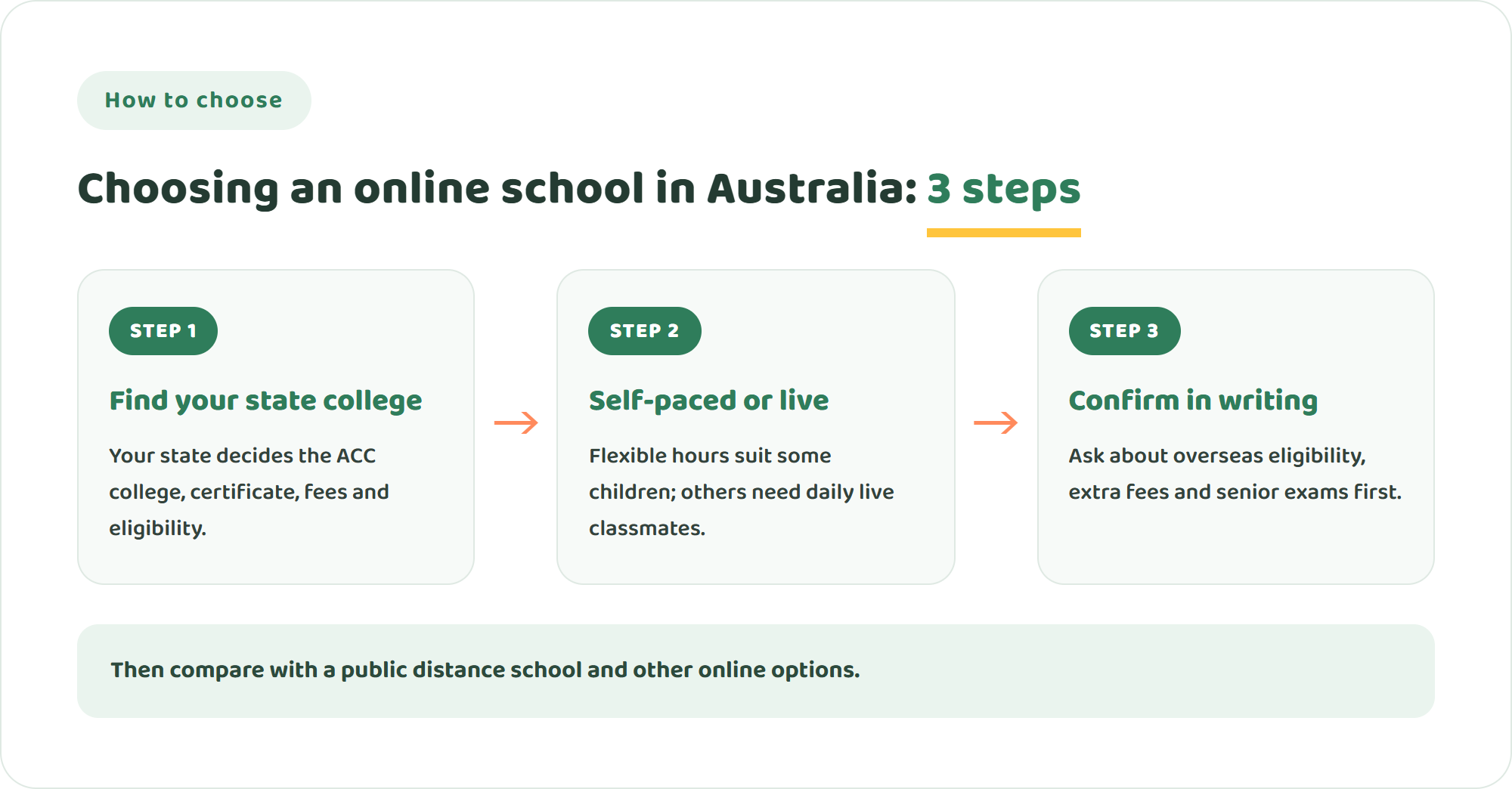
The important point for families is that you enrol with the college for your state, and that college’s registration, certificate, fees and eligibility rules apply. A NSW family enrols with Marsden Park, a Queensland family with Moreton, a West Australian family with Southlands, and so on.
| Item | What the official site says (checked 23 October 2026) |
|---|---|
| Official name | Australian Christian College (ACC); program called “ACC Distance Education” / online school |
| Operator | Christian Education Ministries (named as parent organisation on the Moreton page) |
| Delivering colleges | Moreton (Qld), Marsden Park (NSW), Victoria Online (Vic), Southlands (WA), Launceston (Tas) |
| Year levels | Marsden Park K–12; Moreton Prep–12; Southlands Pre-primary–12; Launceston Prep–10 (per fee table); Victoria Online Years 5–11 in 2026, Year 12 from 2027 |
| Senior certificate | NSW: HSC (“accredited HSC”); Qld: QCE course (and a QCIA course); WA: WACE and ATAR courses; Vic: VCE “from 2026” |
| How lessons are delivered | Video lessons on ACC’s Canvas platform, weekly work, teacher feedback and forums; no scheduled class times (Victoria Online adds short morning live lessons) |
| Religious affiliation | Christian (statement of faith published) |
| Overseas enrolment | Via ACC International (Moreton, Qld): open to Australian expatriates and students who have never lived in Australia |
Is Australian Christian College accredited? Registration and certificates
Yes — with a nuance. In Australia, schools are not “accredited” by a private agency the way US online schools are; they are registered (or accredited) by the regulator of each state, and that registration can cover classroom teaching, distance education or both. ACC states that its five distance education colleges are registered to deliver school fully online. Here is what we could confirm and how:
- Queensland (Moreton): ACC International describes Moreton as “a registered online school located in Queensland, Australia”. Queensland’s Non-State Schools Accreditation Board publishes register changes for the school (for example, an October 2023 notice recording the governing body as Australian Christian College – Queensland Ltd at the Caboolture site). The fee table lists a QCE course for Years 10–12.
- New South Wales (Marsden Park): the NSW pages describe “fully accredited education from Kindergarten to Year 12” and say ATAR-pathway students “graduate with an accredited HSC”. The page does not name NESA; families who want certainty can check the NESA register or ask the school directly.
- Western Australia (Southlands): the fee table lists separate WACE and ATAR courses for Years 11–12.
- Victoria (Victoria Online): the newest college. ACC said in 2024 that Victoria was still in its registration phase; local news reported registration with the Victorian Registration and Qualifications Authority ahead of a Term 1 2025 start. The official page now says it is “offering the VCE program from 2026” and Year 12 from 2027.
- Tasmania (Launceston): the published distance education fee table covers Prep–Year 10 only; a Tasmanian senior pathway is not published on the distance education fees page.
What this means in practice: an ACC student in NSW sits within the NSW certificate system, a Queensland student within the QCE system, and so on. The certificate is the same state certificate any registered school in that state works toward, which is why ACC can point to university, TAFE and apprenticeship pathways. What ACC does not offer is an international curriculum such as IB or Cambridge, or a US diploma; for families planning to stay in Australia, that rarely matters, but for globally mobile families it can.
How learning works: lessons, supervision and time zones
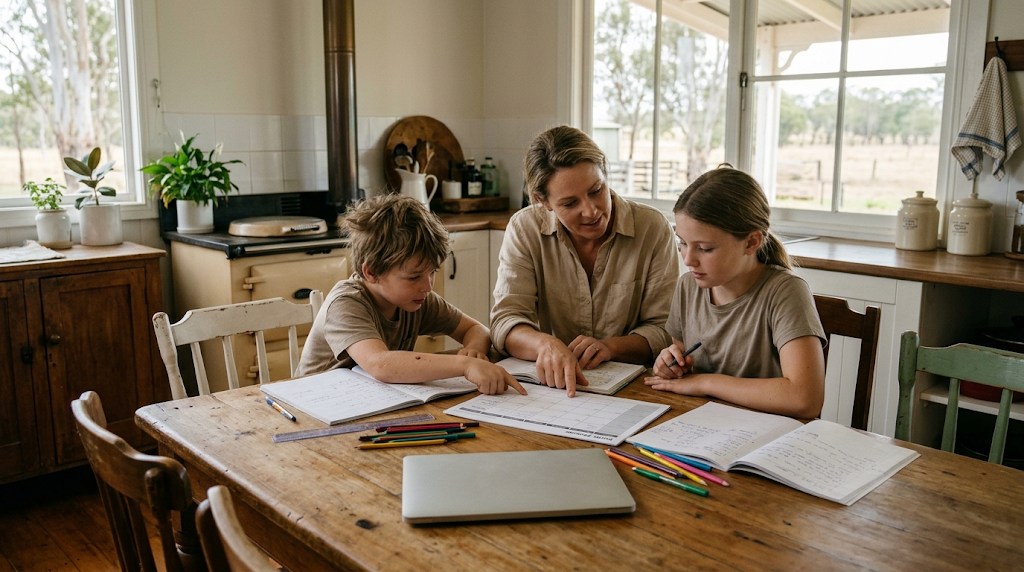
ACC’s own guide to distance education is unusually clear. “There are no scheduled class times.” ACC provides a recommended timetable, but students finish when their work is complete. Lessons are video-based — from ACC teachers and other providers — so students can “pause and replay lessons until they understand”. Courses are uploaded at the start of each term, and students “must complete the lessons set for each subject every week”. The platform is Canvas.
- Hours: ACC estimates about three to five hours of schoolwork a day for primary students and about five to seven for secondary students.
- Teachers: teachers “monitor their academic progress, help to resolve any learning issues, and provide feedback on assessments”, and use online discussion forums. Learning support is available.
- Parents: “The parents’ role is that of supervisor.” A responsible adult must be present; parents do not need to be teachers. Primary children need more hands-on attention than secondary students.
- Live lessons: the classic ACC model is self-paced. The exception is Victoria Online, whose page describes “interactive live lessons” each morning, blended with self-paced lessons. A published live timetable is not on the official site.
- Time zones: because most learning is not live, time zones matter less than with live online schools. ACC International says overseas students can “work on your courses at a time of your choosing without being affected by differences in time zones”. Teacher replies and any live sessions will, however, run on Australian working hours (Marsden Park lists office hours of 8:30am to 4pm, Monday to Friday).
- Start dates: applications are accepted at any time; ACC says students can start any time, though the start of a term is preferable. NSW (Marsden Park) 2027 terms are listed as 1 February–9 April, 27 April–25 June, 19 July–24 September and 11 October–8 December.
If you want to picture how a live-class online school day differs from this self-paced model, our explainer on how an online international school works walks through a typical day.
ACC online school fees (2026, official)
Fees are set per college, in Australian dollars, per year. “Child 1” is the eldest enrolled child.
| College (state) | Year levels and 2026 annual fee |
|---|---|
| Marsden Park (NSW) | K–2 $1,280 · 3–6 $2,155 · 7–8 $3,005 / $2,735 / $2,405 (child 1 / 2 / 3) · 9–10 $3,460 / $3,150 / $2,770 · 11–12 $6,285 · child 4+ $0 at every level |
| Moreton (Qld) | Prep–2 $1,120 · 3–6 $1,275 · 7–9 $1,935 · 10–12 QCIA course $2,200 · 10–12 QCE course $3,365 (per student) |
| Southlands (WA) | PP–2 $1,325 · 3–6 $2,085 · 7–10 $2,550 · 11–12 WACE $3,600 · 11–12 ATAR $4,300 (per student) |
| Launceston (Tas) | Prep–6 $1,785 (child 1–4+, as published) · 7–10 $2,390 / $2,105 / $1,675 · child 4+ $0 |
| Victoria Online (Vic) | Years 5–6 $3,450 · 7–8 $4,200 · 9–10 $4,725 · Year 11 $5,200 (child 1–3) · child 4+ 100% tuition discount · levy $100 per student per year · application fee $100 · enrolment fee $250 (non-refundable) |
What is included and extra: most textbooks are included. Families buy or borrow novels and DVD media; technology courses may cost extra depending on projects; uniforms, student technology (a device and internet) and electives are outside the fee estimator. Fees can be paid annually with a small discount (Victoria Online: 5% if paid in full in January) or in ten monthly instalments. A Ministry Discount is available to families engaged in ministry, by annual application. Fees are prorated per term, but enrolling in Term 3 or 4 means paying the remainder upfront, and withdrawal needs six term weeks’ written notice.
Application and enrolment fees are published only for Victoria Online; for the other four colleges they are not published on the official site. Fees for overseas students are also not published on the official site.
Worked example (official numbers only): a NSW family with children in Year 9 and Year 7 at Marsden Park would pay $3,460 (child 1) + $2,735 (child 2) = $6,195 for 2026, before novels, a device and internet. The same two children at Moreton (Queensland) would pay $1,935 + $1,935 = $3,870. If you are comparing this with a city day school, our review of Sydney Grammar School fees and our guide to online vs in-person school costs show the gap.
Can overseas and expat families enrol?
This is the question most third-party reviews skip. The official answer depends on the college:
- ACC International (Moreton, Queensland): “Enrolment is open to both Australian expatriates and students from other countries who have never lived in Australia.” It says full-time students can progress from Year 3 to Year 12, and lists past students in the United States, Vanuatu, Indonesia, Papua New Guinea, Vietnam, New Zealand, Mongolia and India. Note that parts of this microsite appear older than the main acc.edu.au site (for example, its senior page still describes Queensland’s former QCS test), so confirm current senior arrangements and fees with Moreton directly.
- Marsden Park (NSW), Southlands (WA), Launceston (Tas): eligibility rules for overseas residents are not published on the official site; the enrolment page says the team will tell you “whether you are eligible”. ACC’s general guide notes that with private distance education you “may even be able to enrol … from overseas”, and that “different states impose different eligibility requirements”.
- Victoria Online: “Enrolment is open to Victorian residents.”
Also check whether any senior assessment needs to be sat in person in Australia — this is not published on the official site for the current certificates.
ACC online vs NIJIN GLOBAL ACADEMY vs two other options (official data)
| Item | ACC Distance Education | NIJIN GLOBAL ACADEMY | Euka Future Learning | Sydney Distance Education High School |
|---|---|---|---|---|
| School type | Independent Christian schools, registered per state for online delivery | Online international school (Japan-based operator) | Online curriculum provider for homeschooling families | NSW public distance education high school |
| Grades / ages | K/Prep–12 (varies by college) | Ages 6–18 | Preparatory, Foundation and Grades 1–12 | Secondary (single courses in Stages 5–6 also offered); see official site for full range |
| Fees | From $1,120 to $6,285 per year (2026, by state and year) | Not yet published (no enrolment, facility or uniform fees; materials included; sibling discounts) | See official site (fees reviewed annually) | Public school: “all financial contributions are voluntary” |
| Curriculum / certificate | State certificate: HSC, QCE, WACE, VCE (by college) | Subjects in English; optional Cambridge IGCSE / A-Level pathway listed | Australian-curriculum-aligned homeschool program; families register as home educators | NSW curriculum; HSC |
| Live classes & time zone | Mostly self-paced video, no scheduled class times; Victoria Online adds morning live lessons | Small live dialogue groups (about 8), timetable built for Asia–Oceania daytime — fits Australian hours | Self-paced | Blended learning; see official site |
| Registration / accreditation | Registered by each state for online delivery | Not yet accredited; no graduates yet | Not a registered school; offers a homeschool registration assistance service | NSW Department of Education school |
| Admission | Enquiry, online application (about 30 minutes), review within about two weeks | No academic entrance exam, no English requirement | See official site | NSW residents meeting distance education criteria (e.g. geographic isolation, special circumstances) |
| Religious affiliation | Christian | None stated | See official site | Public (non-religious) |
| Start dates | Any time; start of term preferred | Opens September 2027 (planned); free trial classes monthly | See official site | See official site |
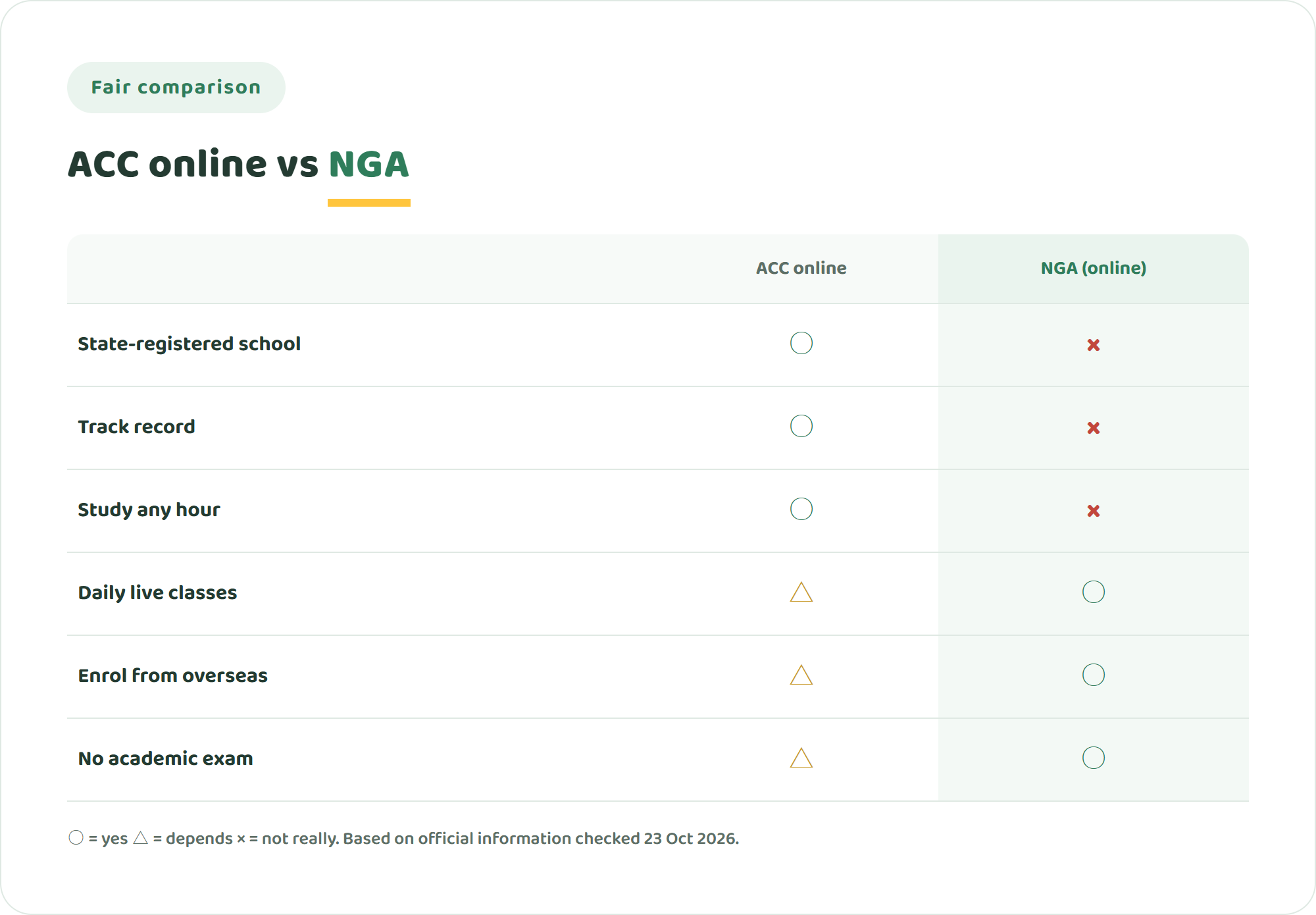
Sources: acc.edu.au distance education, campus fee and enrolment pages; international.acc.edu.au; euka.edu.au; sydneyh-d.schools.nsw.gov.au — checked 23 October 2026. NGA facts from nijinglobal.academy.
Reviews and common concerns, answered honestly
“Is it a real school, or just homeschooling with videos?”
It is a registered school. The practical difference from homeschooling is that ACC, not the parent, is responsible for the curriculum, teaching, assessment and reporting, and the student works toward the state certificate. The lessons are mostly recorded, which is why some families describe it as feeling like homeschooling — but the legal and academic responsibility sits with the school.
“Will my child be lonely?”
This is the most common worry with any self-paced model. ACC points to discussion forums, teacher contact and what it calls “a caring community”, and Victoria Online adds daily live sessions. Families whose children thrive on daily face-to-face peer contact often add local sport, clubs or co-ops. Ask the college what live or social contact is offered for your child’s year level.
“How much parent time does it take?”
More than a day school. ACC is explicit that a responsible adult must supervise, and that primary children need more focused attention. If both parents work full time outside the home, plan who that adult will be before enrolling.
“Is the Christian content a problem if we are not religious?”
That is a values decision for each family. ACC publishes a statement of faith and its NSW senior subjects include Studies of Religion. Ask at the enquiry stage how faith features in daily lessons and whether the family is expected to support the school’s ethos.
“Can we use it while living abroad?”
Possibly, through ACC International at Moreton, which accepts expatriate and international students. Because overseas fees and current senior assessment arrangements are not published on the official site, get them in writing before enrolling.
“Are the fees really that low?”
The published tuition is low compared with on-campus independent schools, and most textbooks are included. Budget separately for a device, internet, novels and any technology-course projects, and note that Victoria Online charges application, enrolment and levy fees on top.
Alternatives to ACC Distance Education worth comparing
1. Your state’s public distance education school. In NSW, Sydney Distance Education High School is a public school offering distance education to eligible NSW students who are geographically isolated, have special circumstances that prevent regular attendance, or cannot access the curriculum they need locally. Contributions are voluntary, but eligibility is narrower than at a private provider.
2. Euka Future Learning. Euka describes itself as “the largest online full time education provider in Australia” for K–12 students and runs a self-paced program for homeschooling families. The key difference: with Euka, the family is the registered home educator (Euka offers a paid registration assistance service), whereas with ACC the school is responsible. Fees are on Euka’s official site.
3. NIJIN GLOBAL ACADEMY (NGA). NGA is an online international school for ages 6–18, focused on Asia and Oceania, opening in September 2027 (planned). Its timetable is built for Asia–Oceania daytime, so live classes fall within normal Australian school hours. Classes are small live dialogue groups of about eight, subjects are learned in English with a bilingual (English–Japanese) mentor, English levels follow CEFR, and an optional Cambridge IGCSE / A-Level pathway is listed on the curriculum page. There is no academic entrance exam and no English requirement, and NGA can run alongside a local school or as the main school. It is not a Christian school. Be clear about the trade-offs: NGA is not yet open, not yet accredited and has no graduates, so it cannot yet offer what a registered Australian school offers. Tuition is not yet published; NGA says it will be far more affordable than a typical international school. Free trial classes run monthly from September 2026.
For wider comparisons, see online international schools compared, our guide to accredited online international schools, and — for families weighing US-style online schools — our Connections Academy review and Stride K12 review.
FAQ
How much does Australian Christian College online cost per year?
It depends on your state and year level. For 2026, Marsden Park (NSW) lists $1,280 (K–2) to $6,285 (Years 11–12) for the eldest child; Moreton (Qld) $1,120 (Prep–2) to $3,365 (Years 10–12 QCE course); Southlands (WA) $1,325 to $4,300; Launceston (Tas) $1,785 to $2,390; and Victoria Online $3,450 to $5,200, plus fees. All in AUD, from acc.edu.au.
Is Australian Christian College accredited?
ACC states that five of its colleges are registered to deliver school fully online, each in its own state. Students work toward that state’s certificate — for example the HSC in NSW or the QCE in Queensland.
Can international students enrol in ACC Distance Education?
ACC International, run from the Moreton college in Queensland, says enrolment is open to Australian expatriates and to students who have never lived in Australia. Overseas fees are not published on the official site, and Victoria Online is limited to Victorian residents.
Are there live classes at ACC online?
Mostly not. ACC says its distance education has no scheduled class times and uses video lessons with weekly deadlines. Victoria Online adds brief interactive live lessons each morning.
What are the alternatives to ACC Distance Education?
A state public distance education school (such as Sydney Distance Education High School for eligible NSW students), a homeschool curriculum provider such as Euka, or an online school with live classes such as NIJIN GLOBAL ACADEMY (opening September 2027, not yet accredited).
Fees and admissions details were checked on the official websites on 23 October 2026. Schools revise fees every year — always confirm on the official site before applying. Main sources: ACC Distance Education, ACC guide to distance education, Marsden Park fees, Moreton fees, Southlands fees, Launceston fees, ACC Victoria Online, ACC International, Euka, Sydney Distance Education High School enrolment.
Choosing calmly
ACC Distance Education is a low-cost way to give a child a registered Australian education at home, with a state certificate at the end and a Christian ethos throughout. For many rural, travelling and sporting families in Australia it is exactly the right fit. If your family instead wants daily live classes, a non-religious setting, bilingual support or an international pathway in an Asia–Oceania time zone, it is worth keeping another option on the list — and taking a free trial class before deciding.