If you are moving to South Korea with children, most of what you will find online about international schools is about Seoul. That is understandable, since the capital has the largest cluster. But a posting to Busan, a job in Songdo or Daejeon, or the idea of a boarding school on Jeju Island leads to a different set of schools, and a different set of rules. In Korea, “international school” covers three legally distinct kinds of school, and which kind a school is decides who may enrol and how its diploma is treated at home.
This guide to international schools in South Korea puts the official 2026-27 fees of ten schools into one table: the four schools of Jeju Global Education City (NLCS Jeju, Branksome Hall Asia, St. Johnsbury Academy Jeju and KIS Jeju), Chadwick International in Songdo, the International School of Busan and Busan Foreign School, Daegu International School, Taejon Christian International School in Daejeon, and Seoul Foreign School as a Seoul reference point. It then explains the rules that separate a “foreign school” from a Jeju “international school”, quoting Korean legislation rather than hearsay.
Every fee comes from the school’s own website or fee PDF, checked on 31 October 2026. Most schools bill tuition in two parts, Korean won plus US dollars, so the dollar totals below add both at a reference rate of 30 October 2026 (USD 1 = KRW 1,335.27). They are rounded estimates.
Quick Answer: Your Options in South Korea
If you only read one section, read this. Below are the schools covered in this guide, plus the online option — so you can see every route side by side before the details.
- Foreign schools (oegugin hakgyo): Seoul, Busan, Daegu, Daejeon
- Jeju international schools (gukje hakgyo): the four schools of Jeju Global Education City
- Foreign educational institutions: Chadwick International in Songdo
- NIJIN GLOBAL ACADEMY (online) — Ages 6–18 / opening September 2027, currently taking opening-update registrations / fees around one-fifth of a typical campus international school / Japanese-language support. An option when commute or fees are the wall.
The short answer: about USD 18,600 to 37,600 a year in elementary, and three kinds of school
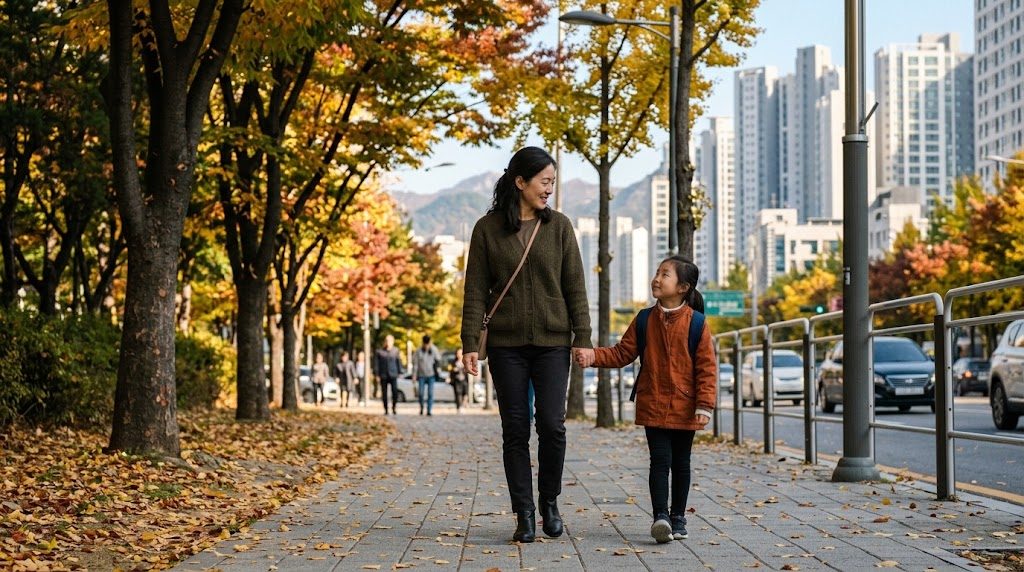
- Fees (annual tuition, won plus dollar parts; one-off fees, boarding and buses excluded): in elementary grades, from Daegu International School at KRW 24.8 million (about USD 18,600) to Chadwick International at KRW 28.59 million plus USD 16,230 (about USD 37,600). In the final high school year the range is about USD 23,900 to 44,300.
- Jeju’s four schools charge about USD 23,000 to 30,600 in elementary grades. All four have boarding houses, at KRW 14.9 to 21.5 million a year (about USD 11,200 to 16,100) on top of tuition.
- Three legal categories: most schools in Seoul, Busan, Daegu and Daejeon are foreign schools, where a Korean national generally needs at least three years’ residence abroad and Korean students are capped at 30% of capacity (up to 50% where the local education office allows). Jeju’s international schools were created under a special act to build Korean citizens’ foreign-language skills, and those limits do not apply. Songdo’s Chadwick is a foreign educational institution with its own 30% band.
- Non-Korean children, including those with only Japanese or another foreign nationality, can apply to all three kinds. Admission still depends on each school’s own process.
- One-off fees such as entrance fees, capital levies and deposits typically add several million won in the first year.
There is no official ranking of the best international schools in Korea. The useful question is narrower: which schools can your child actually attend from where you will live, under your child’s nationality, for the years you expect to stay.
Three kinds of international schools in South Korea
Elsewhere, “international school” is a loose label (see our guide to the types of international schools). In Korea the legal category matters, because it sets the admission rules for Korean nationals and decides whether the diploma counts as a Korean school qualification.
1. Foreign schools (oegugin hakgyo): Seoul, Busan, Daegu, Daejeon
Article 60-2 of the Elementary and Secondary Education Act defines foreign schools as schools established to educate the children of foreigners. Foreign children are their core students. For Korean nationals, a category that includes dual nationals, the presidential regulation on foreign schools (Article 10) requires a total of at least three years’ residence abroad, and limits Korean students to 30% of a school’s authorised enrolment. The provincial superintendent may raise that by up to 20 percentage points through local rules. There are exceptions: Taejon Christian International School, a registered foreign school inside the Daedeok Research and Development Special Zone, states that Korean national students may apply without three years abroad.
2. Jeju international schools (gukje hakgyo): the four schools of Jeju Global Education City
Article 223 of the Jeju Special Self-Governing Province act allows “international schools” in Jeju’s English Education City, with the stated aim of improving Korean citizens’ foreign-language ability and developing internationally minded professionals. Article 224 disapplies the Elementary and Secondary Education Act to them unless the act says otherwise, so the three-year and 30% rules for foreign schools do not apply. Under Article 228, each head of school sets admission requirements and may admit foreign students. Korean students follow a Korean language and social studies curriculum set by the Ministry of Education, and the act provides for recognition of graduates’ qualifications.
3. Foreign educational institutions: Chadwick International in Songdo
These are schools opened by overseas school foundations in Korea’s free economic zones. Chadwick International describes itself as an accredited Foreign Educational Institution. The enforcement decree for these institutions sets the share of Korean students at up to 30% of capacity, as adjusted by a committee, with up to 20 more percentage points allowed by local rules. At Chadwick, Korean students take a weekly two-hour Korean studies programme that lets them apply to Korean universities without sitting the national high school equivalency exam.
For most expatriate families the practical point is simple: a child without Korean nationality is a foreign student at all three kinds of school. The rules start to matter if your child holds Korean citizenship, including dual citizenship, so ask the school directly before you apply.
International school fees in South Korea: official 2026-27 table
The table lists published annual tuition for an elementary grade and for the final year of high school. Annual tuition is the won part plus the dollar part; KIS Jeju publishes a semester rate, which we doubled. Entrance fees, deposits, boarding, buses and meals are excluded.
| Location and type | School | Elementary, per year | Final high school year | Main one-off fees | Source |
|---|---|---|---|---|---|
| Jeju, international school | NLCS Jeju | KRW 23,004,700 + USD 13,334 (≈ USD 30,600; Years 1–6) | KRW 29,023,910 + USD 16,814 (≈ USD 38,600) | Capital fee KRW 3m (new students); refundable acceptance deposit KRW 5m | Fee PDF |
| Jeju, international school | Branksome Hall Asia | KRW 21,762,000 + USD 14,148 (≈ USD 30,400; JK Prep–G5) | KRW 26,640,000 + USD 17,294 (≈ USD 37,200) | Seat deposit KRW 3m (deducted from first tuition payment) | Fees page |
| Jeju, international school | St. Johnsbury Academy Jeju | KRW 24,588,000 + USD 9,161 (≈ USD 27,600; G1–5) | KRW 27,458,000 + USD 10,226 (≈ USD 30,800) | Registration KRW 5m; international student fee KRW 3.6m | Fees page |
| Jeju, international school | KIS Jeju | KRW 18,490,000 + USD 9,184 (≈ USD 23,000; G1–5) | KRW 24,960,000 + USD 12,528 (≈ USD 31,200) | Entrance fee KRW 3m; enrolment deposit KRW 3m (credited to tuition) | Fees page |
| Songdo, foreign educational institution | Chadwick International | KRW 28,590,000 + USD 16,230 (≈ USD 37,600; Village School) | KRW 33,670,000 + USD 19,090 (≈ USD 44,300) | Capital development KRW 5m; matriculation KRW 1m | Fees page |
| Busan, foreign school | International School of Busan | KRW 19,920,000 + USD 13,340 (≈ USD 28,300; K–G5) | KRW 22,930,000 + USD 15,500 (≈ USD 32,700) | Technology development KRW 2.5m; annual capital development KRW 2.5m | Fee handbook |
| Busan, foreign school | Busan Foreign School | KRW 21,630,000 + USD 8,500 (≈ USD 24,700) | KRW 23,520,000 + USD 12,100 (≈ USD 29,700) | Not listed; fees page states no school year | Fees page |
| Daegu, foreign school | Daegu International School | KRW 24,800,000 (≈ USD 18,600; G1–5) | KRW 31,900,000 (≈ USD 23,900) | Entrance fee KRW 3m (all fees in won) | Fees page |
| Daejeon, foreign school | Taejon Christian International School | KRW 19,933,000 + USD 7,320 (≈ USD 22,200; K–5) | KRW 28,087,000 + USD 10,530 (≈ USD 31,600) | Capital fee KRW 4m; registration KRW 0.5m | Fees page |
| Seoul, foreign school (reference) | Seoul Foreign School | KRW 27,285,000 + USD 13,500 (≈ USD 33,900; K–G5) | KRW 33,370,000 + USD 14,955 (≈ USD 39,900) | Entrance fee KRW 5.5m; registration KRW 0.65m | Fees page |
Sources: each school’s official website or fee document, checked 31 October 2026. Busan Foreign School’s fees page does not state a school year. Dollar totals use the 30 October 2026 reference rate and are estimates. Fees change every year, so confirm the current schedule with each school.
Seoul: where most of Korea’s international schools are
Seoul has the widest choice, and the differences between schools there are finer: curriculum (IB, American, British), religious affiliation, location and waiting lists. We cover them separately. Start with our guide to international schools in Seoul, then compare fees and admissions in detail in Seoul Foreign School vs Seoul International School and Yongsan International School of Seoul vs Dwight School Seoul. Seoul Foreign School appears in the table above only as a reference point: its elementary tuition, about USD 33,900, sits below Chadwick’s and above all four Jeju schools.
Jeju Global Education City: four boarding schools
Jeju’s English Education City, set up under the island’s special act, hosts four international schools. All four run boarding houses, so in some grades a child can board while the family lives elsewhere in Korea or abroad.
NLCS Jeju: British curriculum, the highest fees of the four
The overseas campus of North London Collegiate School uses British year groups from Reception to Year 13. For 2026-27, Junior (Years 1–6) tuition is KRW 23,004,700 plus USD 13,334, and Sixth Form (Years 12–13) is KRW 29,023,910 plus USD 16,814, the highest of the Jeju four at both ends. Paying in one lump sum earns a 2% discount. New students pay a KRW 3 million capital fee and a KRW 5 million acceptance deposit that is refunded on graduation or withdrawal. Boarding runs from KRW 14,912,340 (Years 3–6) to KRW 17,679,780 (Sixth Form).
Branksome Hall Asia: sister school of Toronto’s Branksome Hall
Tuition is KRW 21,762,000 plus USD 14,148 from JK Prep to Grade 5 and KRW 26,640,000 plus USD 17,294 in Grade 12. Boarding is open to Grades 6–12 in two forms: full-time at KRW 21,520,000 or a five-day weekday programme at KRW 17,192,000. New students pay a KRW 3 million seat deposit, which is deducted from the first tuition payment.
St. Johnsbury Academy Jeju: the Jeju campus of a Vermont school
Pre-K 3 through Grade 5 share one rate of KRW 24,588,000 plus USD 9,161, and Grades 9–12 pay KRW 27,458,000 plus USD 10,226, the lowest high school tuition of the four. The school states that tuition is paid 70% in won and 30% in dollars. One-off fees include a KRW 5 million registration fee and a KRW 3.6 million international student fee. Boarding for Grades 6–12 is KRW 16,922,000, and siblings receive 5% (second child) and 10% (third child) discounts.
KIS Jeju: the Jeju campus of Korea International School
Tuition is billed per semester in two equal instalments. On an annual basis Grades 1–5 cost KRW 18,490,000 plus USD 9,184, the lowest elementary tuition in Jeju, and Grade 12 costs KRW 24,960,000 plus USD 12,528. New students pay a KRW 3 million entrance fee and a KRW 3 million enrolment deposit that is credited to tuition. The school does not accept lump-sum annual payment or credit cards. Single-room boarding for Grades 8–12 is KRW 16,900,000 a year.
Busan, Daegu and Daejeon
Outside Seoul, several foreign schools serve expatriate families. As foreign schools, they admit non-Korean children as their core students.
International School of Busan
ISB teaches from Early Years 1 to Grade 12. Kindergarten to Grade 5 costs KRW 19,920,000 plus USD 13,340 a year and Grades 11–12 cost KRW 22,930,000 plus USD 15,500. Paying annually costs slightly less than two semester instalments. Note the recurring capital development fee, KRW 2.5 million for new students and KRW 1.5 million for returning students, plus a one-time KRW 2.5 million technology development fee.
Busan Foreign School
Its fees page lists elementary tuition of KRW 21,630,000 plus USD 8,500 and high school at KRW 23,520,000 plus USD 12,100, lower than ISB. The page gives no school year and no one-off fees, so request the current schedule from the school before applying.
Daegu International School
All fees are in won: KRW 24,800,000 for Grades 1–5 and KRW 31,900,000 for Grades 9–12, the lowest of the ten schools in this guide at both levels. With no dollar component, the cost is less exposed to exchange-rate swings for families paid in won. The entrance fee is KRW 3 million, and a residence programme for Grades 5–12 costs KRW 4.5 million per semester.
Taejon Christian International School (Daejeon)
Kindergarten to Grade 5 costs KRW 19,933,000 plus USD 7,320 and Grades 9–12 cost KRW 28,087,000 plus USD 10,530, with boarding for Grades 6–12. As noted above, TCIS states that Korean nationals may apply without three years abroad, subject to review, which makes it one of the more accessible options for families with Korean or dual-national children.
Songdo (Incheon): Chadwick International
Chadwick International, linked to Chadwick School in the United States, sits in Songdo International City in Incheon. Its Village School (Pre-K to Grade 5) costs KRW 28,590,000 plus USD 16,230 and its Upper School KRW 33,670,000 plus USD 19,090, the highest of the ten schools in this guide at both levels and above Seoul Foreign School. Tuition includes field trips and outdoor education. New students pay a KRW 5 million capital development fee and a KRW 1 million matriculation fee. School buses also serve Seoul and Pangyo, at KRW 6,300,000 a year.
For context across the region, our comparison of international school fees in Asia sets Korea next to Singapore, Hong Kong, Shanghai and other cities. Families who want a Japanese-language school instead can see the Seoul figures in Japanese school abroad tuition.
How to choose: three steps for families moving to Korea
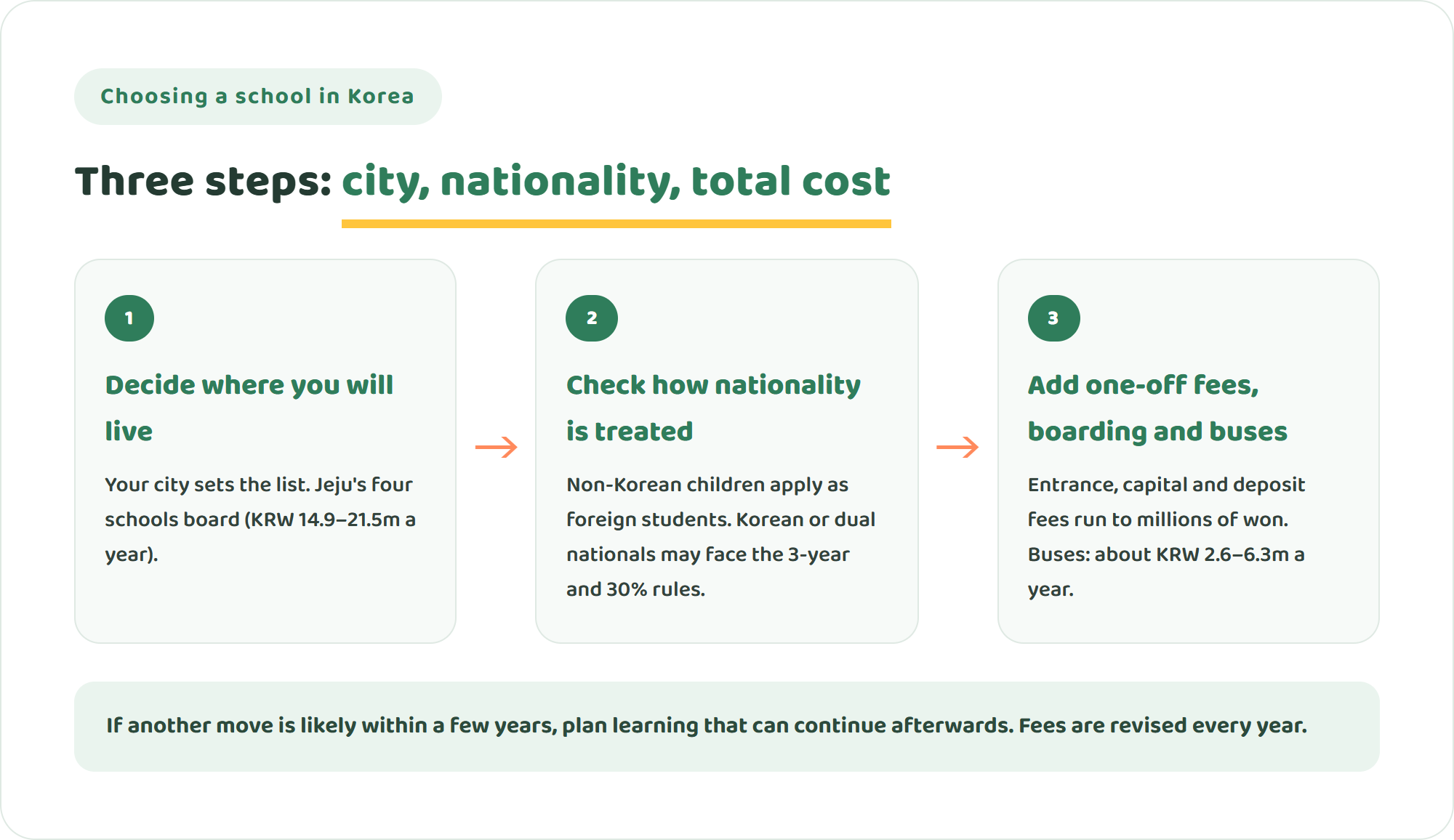
Outside Seoul, the city you live in narrows the list quickly. Three questions, in this order, usually settle the rest.
- 1. Decide where you will live and how your child will get to school. Which schools are within reach? Jeju’s four schools board students in certain grades, which opens them to families living elsewhere, at an extra KRW 14.9 to 21.5 million a year.
- 2. Check how your child’s nationality is treated. A child with no Korean citizenship applies as a foreign student. A Korean or dual national may fall under the three-year and 30% rules at a foreign school, but not at a Jeju international school, and TCIS states that Korean nationals may apply without three years abroad.
- 3. Add one-off fees, boarding and buses to tuition. Entrance fees, capital levies and deposits run to several million won, buses cost roughly KRW 2.6 to 6.3 million a year, and some schools (ISB, for example) charge a capital fee every year.
One more question is worth asking early: how long will you stay? If the posting is two or three years and another move follows, it helps to have a way of learning that continues wherever you go next. You can see how we structure English-medium learning online in our online school curriculum.
Where NIJIN GLOBAL ACADEMY fits
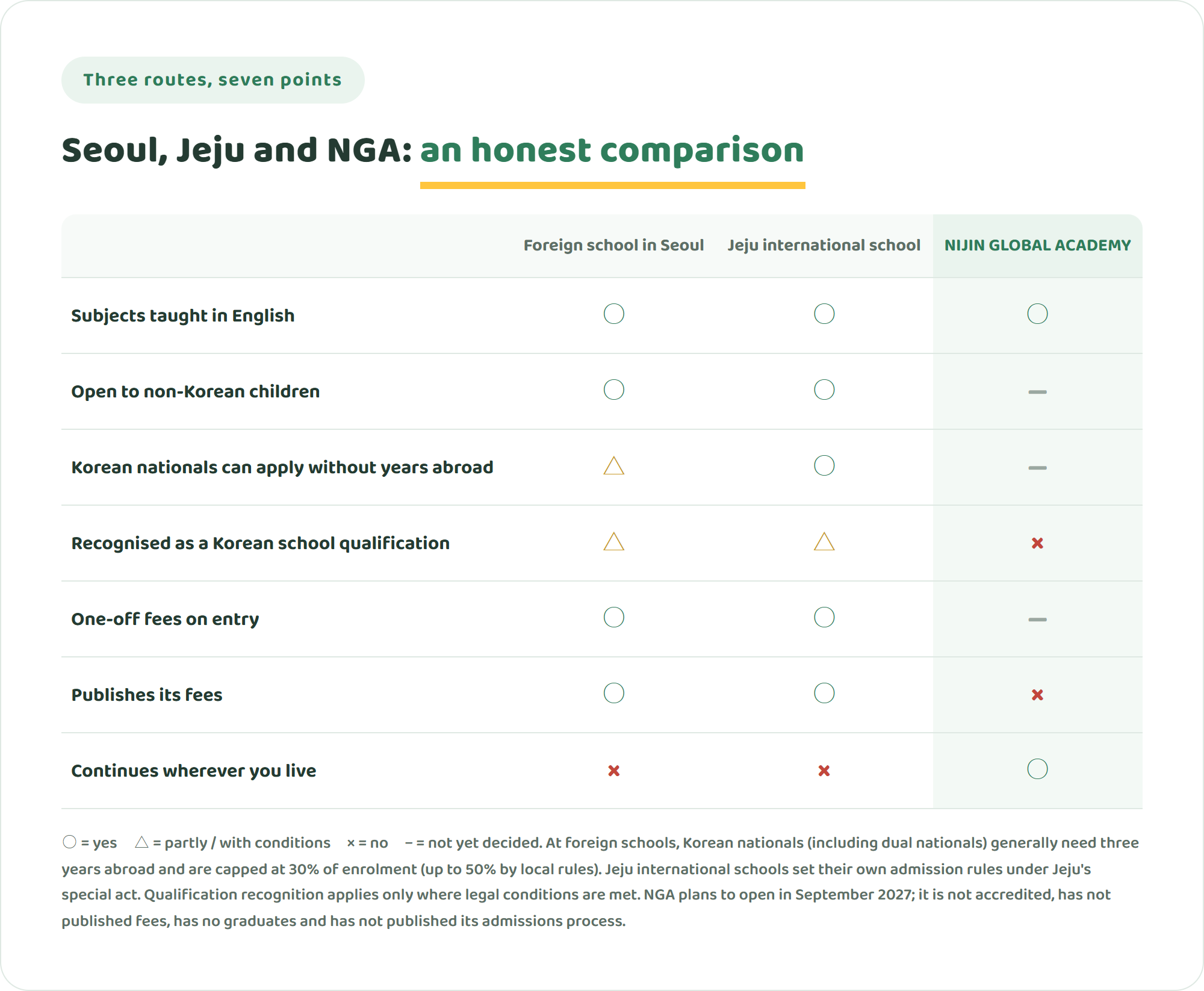
NIJIN GLOBAL ACADEMY (NGA) is an online international school for ages 6–18, planned to open in September 2027. It is run by NIJIN Inc., which operates NIJIN Academy, an online school in Japan for children who do not attend school, where more than 1,000 children have studied. NGA plans small live classes in which subjects are taught in English and supported by bilingual Japanese–English mentors, with admission that is not based on test-score rankings.
To be clear about the limits: NGA has not opened, is not accredited, has not published its fees and has no graduates. It cannot replace a Korean international school where a family needs a recognised diploma, Korean qualification recognition, boarding, or the daily life of a campus. Where we hope to help is when there is no suitable school within reach of where you live, when your child attends a local or Japanese school and you want to add English-medium learning, or when you expect to move on from Korea within a few years.
FAQ
Can foreign children attend international schools in South Korea?
Yes. Foreign schools exist to educate the children of foreigners, and Jeju’s special act allows its international schools to admit foreign students. Seoul Foreign School, for example, accepts applications from families in which at least one parent holds a non-Korean passport. Places are still limited and each school runs its own admissions process, so contact schools early.
Can Korean citizens attend international schools in Korea?
It depends on the kind of school. At a foreign school, a Korean national generally needs at least three years’ residence abroad, and Korean students are capped at 30% of enrolment (up to 50% where local rules allow). Jeju’s international schools are not subject to those rules and set their own admission requirements. Foreign educational institutions such as Chadwick have a separate band of up to 30%, adjustable by local rules. Some schools are exceptions: TCIS in Daejeon states that Korean nationals may apply without having lived abroad.
What are the best international schools in Korea?
There is no official ranking, and the right school depends on location, curriculum, boarding needs and your child’s nationality. Practically: in Jeju, compare the four schools of Global Education City; in Busan, ISB and Busan Foreign School; in Songdo, Chadwick; in Daegu and Daejeon, DIS and TCIS; and in Seoul, see our separate Seoul guide.
How much do international schools in Korea cost?
Across the ten schools in this guide, elementary tuition for 2026-27 runs from about USD 18,600 (Daegu International School) to about USD 37,600 (Chadwick International), and final-year high school tuition from about USD 23,900 to 44,300. One-off fees, boarding and buses are extra.
Once you know where you will live, the choice gets much smaller
International schools in South Korea outside the capital cost about USD 18,600 to 37,600 a year in elementary grades. Jeju offers four boarding schools under its own law; Busan, Daegu and Daejeon have foreign schools; and Songdo has Chadwick, the most expensive school in this guide. A child without Korean citizenship can apply to any of them. What deserves the most thought is what comes after Korea, especially if your child holds dual nationality or another move is likely.
If you would like to compare a way of learning that stays with your child through those moves, you are welcome to keep NIJIN GLOBAL ACADEMY on your list. Ahead of the planned September 2027 opening, we expect to run trial classes in April–May 2027.