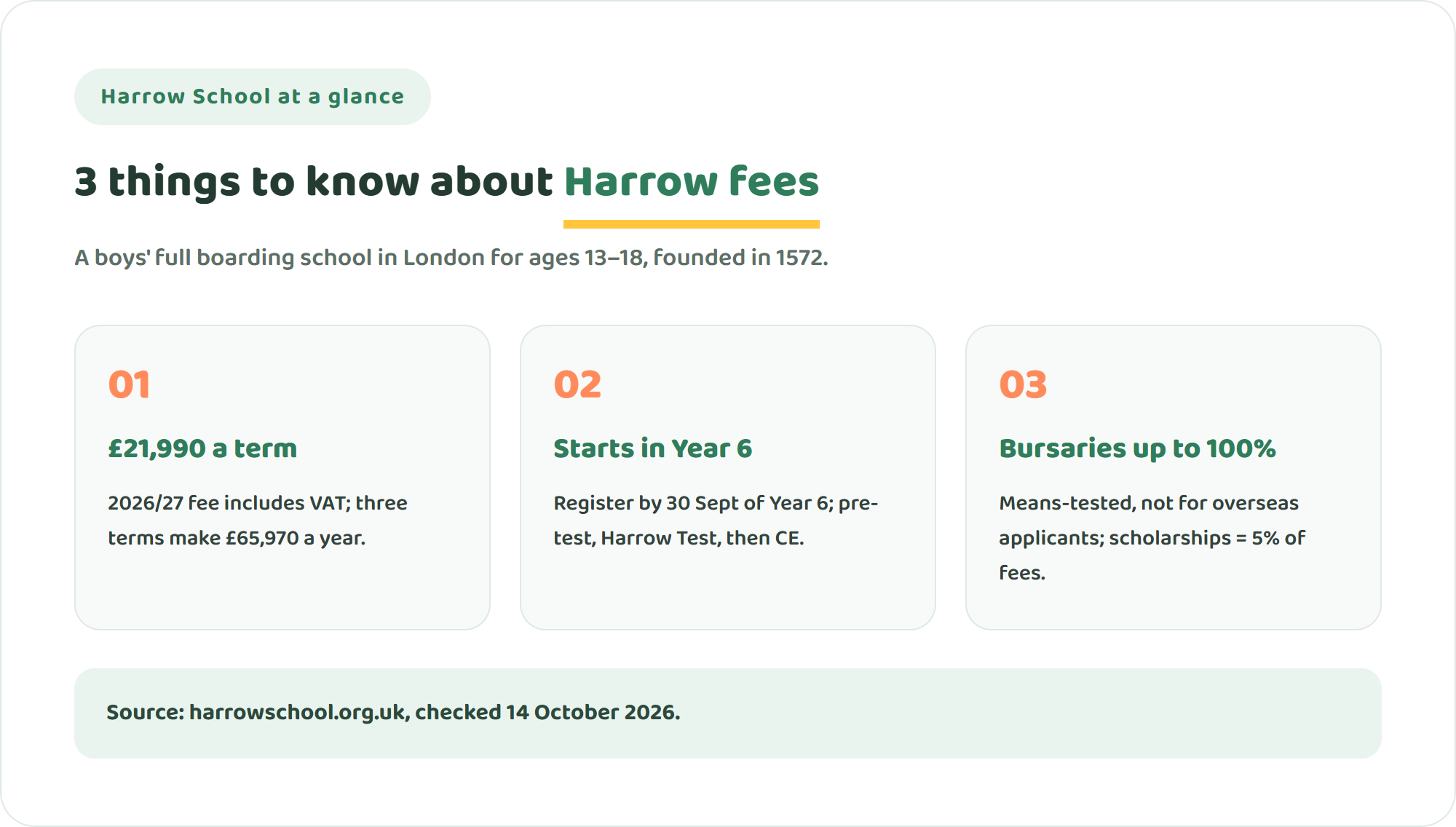
Harrow School fees for 2026/27 are £21,990 per term, inclusive of VAT, according to the school’s official fees page (checked 14 October 2026). Harrow runs three terms a year, so a full year costs £65,970 (3 × £21,990). The termly fee covers board, tuition, textbooks, a stationery allowance and laundry. On top of that come a £450 non-refundable registration fee, an acceptance fee (£1,200 for Year 9, £600 for Year 12), two £2,400 deposits for Year 9 entry, an extra deposit of one full term’s fees for families living overseas, and a £3,000-a-year visa administration fee for boys who need Harrow to sponsor a UK student visa.
If you searched “Harrow School fees”, “how much does Harrow School cost” or “Harrow School bursary”, you probably want three things: the real total, including VAT and the one-off charges; how the admissions timeline works (it starts years earlier than many parents expect); and whether financial help is available. This page answers those questions from Harrow’s own website, explains how Harrow School in London differs from the Harrow International Schools you may also have seen, and then compares Harrow fairly with Eton College, Winchester College and NIJIN GLOBAL ACADEMY — a very different kind of option, an online school for ages 6–18 opening in September 2027.
The short answer: who Harrow School suits — and who it doesn’t
- Suits: boys aged 13–18 who will thrive in full boarding. Harrow describes itself as a boarding school for boys aged 13 to 18, with 12 boarding houses on a 324-acre estate in north-west London.
- Suits: academically able boys whose families can plan ahead. Year 9 registration closes on 30 September of Year 6, and the pre-test and Harrow Test happen in Year 6.
- Suits: families aiming for highly selective universities in the UK and the US. Harrow’s university destinations page lists 9 boys taking places at Oxford or Cambridge and 50 going to US universities in 2026.
- Suits: UK families who need substantial financial help. Means-tested bursaries at Year 9 and Year 12 can cover up to 100% of fees.
- Harder fit: girls (the school is single-sex for boys), and children under 13.
- Harder fit: overseas families who need a bursary. The bursaries page says bursaries cannot be considered for applicants from overseas.
- Harder fit: families who want their child to keep living at home, or who are looking for a non-selective school.
What Harrow School is
Harrow School was founded in 1572 by a local landowner, John Lyon, under a royal charter from Elizabeth I. Today, according to its frequently asked questions page, it has about 830 boys aged 13 to 18 and around 700 staff, of whom about 150 teach. It sits on Harrow on the Hill in north-west London, roughly 12 minutes by train from Marylebone and about 30 minutes by car from Heathrow. All boys board, living in one of 12 houses, each led by a House Master.
Around 160 boys join each year in Year 9 (the “Shell”), and up to 20 more join in Year 12 (the Lower Sixth). The FAQ says the school receives about 600 applications for its 160 Year 9 places, that about 20% of boys live overseas and that about 15% are sons of Old Harrovians. Boys study GCSEs and then A levels; the official pages we checked do not mention the International Baccalaureate. The school’s most recent Independent Schools Inspectorate (ISI) inspection, in February 2024, found that all the Standards were met.
| Item | Harrow School (official information, checked 14 October 2026) |
|---|---|
| School type | Independent full boarding school for boys |
| Location | Harrow on the Hill, north-west London, UK |
| Ages / entry points | 13–18; main entry Year 9 (about 160 boys), Year 12 (up to 20 boys) |
| Size | About 830 boys; 12 boarding houses |
| Fees 2026/27 | £21,990 per term inclusive of VAT (three terms = £65,970) |
| Curriculum | GCSEs, then A levels in the Sixth Form |
| Inspection | ISI inspection, 6–8 February 2024: all Standards met |
| Founded | 1572 |
Harrow School fees 2026/27 (official), including VAT
Here is every charge listed on Harrow’s Fees and Deposits page, as checked on 14 October 2026.
| Charge | Amount (2026/27) | Notes from the official page |
|---|---|---|
| Termly fee | £21,990 per term (inclusive of VAT) | Includes board, tuition, textbooks, a stationery allowance and laundry; paid in advance by the first day of term |
| Annual fee | £65,970 | Our arithmetic: 3 terms × £21,990 |
| Registration fee | £450 | Non-refundable; registration is complete only once it is paid |
| Acceptance fee | £1,200 (Year 9) / £600 (Year 12), inclusive of VAT | Non-refundable |
| Entry Deposit | £2,400 (inclusive of VAT) | Year 9 entry, UK and overseas, on accepting a place |
| Final Confirmation Deposit | £2,400 (inclusive of VAT) | Year 9 entry, payable by 31 January of the calendar year of entry |
| Additional Deposit (overseas only) | One full term’s fees (inclusive of VAT) | For families with at least one parent normally living overseas; credited on the final fee bill; refunded in full if the boy withdraws with a full term’s notice before his year of entry |
| Visa Administration Fee | £3,000 per year, payable termly | For each boy who needs Harrow to sponsor a UK Child Student Visa or Student Visa |
| Additional tuition | Extra charge | For any subject requiring additional tuition; amounts not published on the official site |
| Extra English lessons | Charged | The FAQ says the English assessment is free but extra English lessons are charged; amount not published on the official site |
How VAT shows up in Harrow’s fees
Since 1 January 2025, UK private school fees, including boarding closely related to the education, have been subject to VAT at the standard rate of 20%, as set out in the UK government’s VAT on private school fees guidance. Harrow quotes its termly fee, deposits and acceptance fees “inclusive of VAT”, so the £21,990 figure is the amount you actually pay — there is nothing extra to add on top. Harrow does not publish a split between the VAT and the pre-VAT fee. If the whole termly fee is charged at 20%, the VAT element would be about £3,665 per term (£21,990 ÷ 1.2 = £18,325 before VAT) — that is our arithmetic, not a figure from the school.
What a full Harrow education costs at today’s prices
Fees change every year, so these totals use the 2026/27 fee only and will rise if fees go up.
- Year 9 to Year 13 (five years, UK family): 15 terms × £21,990 = £329,850, plus £450 registration and £1,200 acceptance = £331,500. On top of that, the two Year 9 deposits total £4,800; how these two deposits are returned or credited is not published on the official site.
- Year 9 to Year 13 (overseas family needing a visa): £331,500 + visa fee £3,000 × 5 = £346,500, plus the deposits above and the Additional Deposit of one term’s fees (£21,990, credited on the final bill).
- Sixth Form only (two years, UK family): 6 terms × £21,990 = £131,940, plus £450 registration and £600 acceptance = £132,990.
These totals do not include extras such as additional tuition, trips, uniform, travel or pocket money, which are not published as fixed amounts on the official fees page. To see how a boarding school’s cost compares with online schooling more broadly, read our guide to online vs in-person international school costs.
Harrow School bursaries and scholarships
According to Harrow’s bursaries page, all financial awards are means-tested, and bursaries for Year 9 and Year 12 entry can cover up to 100% of fees. For Year 9, families indicate on the online registration form what percentage of the fee they need; the page says this will not disadvantage the application. For Year 12, families are asked to contact the Admissions office. There is also a Year 7 route (awards typically go to applicants needing 100% or close to it), for which families must apply by 1 July of Year 5. Named awards include the HJ Flower and H Gower Award for sons of serving British armed forces members, and in Year 12 the Churchill Places and a Sixth Form Award of up to 100% of fees for a candidate from the London Borough of Harrow. Income thresholds and the number of boys receiving bursaries are not published on the official site. Importantly, the page states that bursaries cannot be considered for applicants from overseas.
Scholarships are a separate thing. The scholarships page lists Academic, Sport, Drama, Music, Art and Design Technology & Engineering awards. A Year 9 scholarship carries a value of 5% of the school fees (at 2026/27 prices, £1,099.50 per term, or £3,298.50 a year), and Year 12 awards normally carry 5% too. The FAQ says up to 40–45 scholarships are awarded each year. In other words, a scholarship is mainly recognition; real fee reductions come from means-tested bursaries.
How admission works: Year 9 and Sixth Form timeline
Harrow’s admissions process for Year 9 (13+) entry begins when a boy is in Year 6 — about three years before he arrives. The steps on the official Year 9 entry page are:
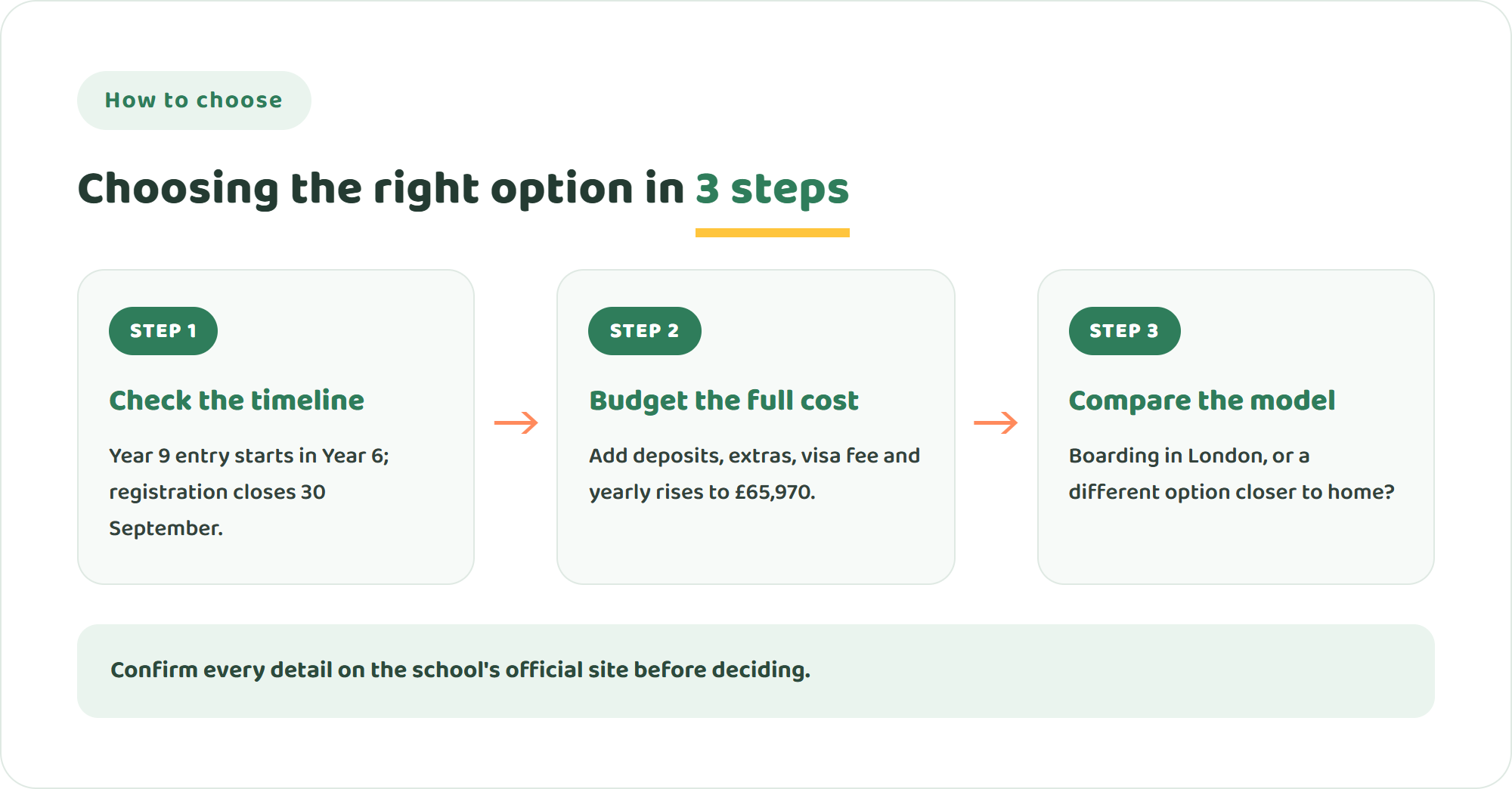
- Register by 30 September of Year 6 and pay the £450 fee. Later registrations are treated as late applicants, competing for fewer places (the FAQ gives 1 January of Year 7 as the late deadline).
- School reference requested at the start of Year 6.
- ISEB Common Pre-Test (online, about two and a half hours: verbal and non-verbal reasoning, English and maths) between 1 October and the end of November of Year 6.
- The Harrow Test in the spring term of Year 6: a 20-minute interview with a House Master, a one-hour computerised English and maths assessment, and a 20-minute group activity.
- Results in late April or early May of Year 6: an offer for a specific house, an offer with the house confirmed later, a waiting list place, or no offer.
- Exams in Year 8: all offers are conditional on sitting Common Entrance in June of Year 8 or the Academic Scholarship examinations. There is no set pass mark; the FAQ says an average of about 65% across subjects is hoped for. The Additional Maths paper is compulsory for applicants from Singapore, Mainland China and Hong Kong.
Sixth Form (Year 12) entry is for up to 20 boys. Applicants are expected to be predicted at least seven or eight GCSE passes at grades 7/8/9. For 2027 entry, the key dates page lists standard applications by 7 September 2026, two subject tests returned by 21 September 2026, an assessment at Harrow on 7 or 14 November 2026 and results in mid-December 2026; late applications close on 6 January 2027, with assessment on 6 March 2027. For Year 9 entry in 2029, standard registration closes on 30 September 2026.
How a school week works: boarding life, terms and time zones
Harrow is not an online school — every lesson happens in person in London, on UK time. The FAQ describes the routine: breakfast at 8am, then assembly or Chapel; eight lessons on Monday, Wednesday and Friday; and five lessons on Tuesday, Thursday and Saturday, with afternoons for activities. Saturday school is part of normal life. Alongside exam courses, the ISI report highlights the “Super-curriculum” of elective lessons, talks and pupil-run academic societies, plus a very wide range of sport, music, drama and community service.
The official 2026–27 term dates show three terms: Autumn from Tuesday 8 September to Saturday 12 December 2026, Spring from Monday 11 January to Thursday 25 March 2027, and Summer from Monday 19 April to Saturday 3 July 2027, with half-terms and short “exeat” weekends when boys go home or to a guardian. For overseas families this means planning flights around these dates and, in many cases, arranging a UK guardian. If you are curious how a school day looks in an online model instead, see how an online international school works.
Inspection, qualifications and university outcomes
Harrow is inspected by the Independent Schools Inspectorate, which is appointed by the Department for Education. Its February 2024 report (published on Harrow’s inspection reports page) found that the Standards on leadership, quality of education, wellbeing, social education and safeguarding were all met. The single recommended next step was to keep suitable records of the checks made on guardianship arrangements. The report also notes that a small minority of pupils who speak English as an additional language receive tailored support when they are new.
Boys take GCSEs and then A levels. Harrow’s academic results page (which does not state the year) reports 73% of A level grades at A* or A, 94% at A*–B, and that half the year group achieved ten or more GCSE grades 9–7. Its university destinations page for 2026 lists 9 boys taking places at Oxford or Cambridge, 50 attending US universities (14 of them in the Ivy League), and 134 at universities in the QS global top 100.
Harrow School vs Harrow International Schools (and Harrow Appi in Japan)
Many parents — especially in Asia — search for “Harrow” and find several schools. They are not the same. Harrow School is the original boys’ boarding school in London described on this page. Harrow International Schools, such as those in Bangkok, Beijing, Hong Kong and Shanghai, and Harrow International School Appi Japan (a full-boarding school for ages 11–18 in Appi Kogen, Hachimantai, Iwate Prefecture), are separate schools. The Relationship Statement published on Harrow Appi’s website explains that these schools use Harrow School’s name and badge under a sub-licence from Harrow International Schools Limited (HISL), a trading subsidiary of the charity that owns Harrow School; that their educational, administrative, financial and operational responsibilities rest with their own owners and operators; and that fees are paid to those owners and operators, not to Harrow School. So Harrow School’s £21,990 termly fee, admissions process and bursaries do not apply to the Harrow International Schools — each publishes its own.
You may also come across references to “Harrow School Online”. We could not verify its current status from an official source when we checked, so we have not treated it as an option on this page.
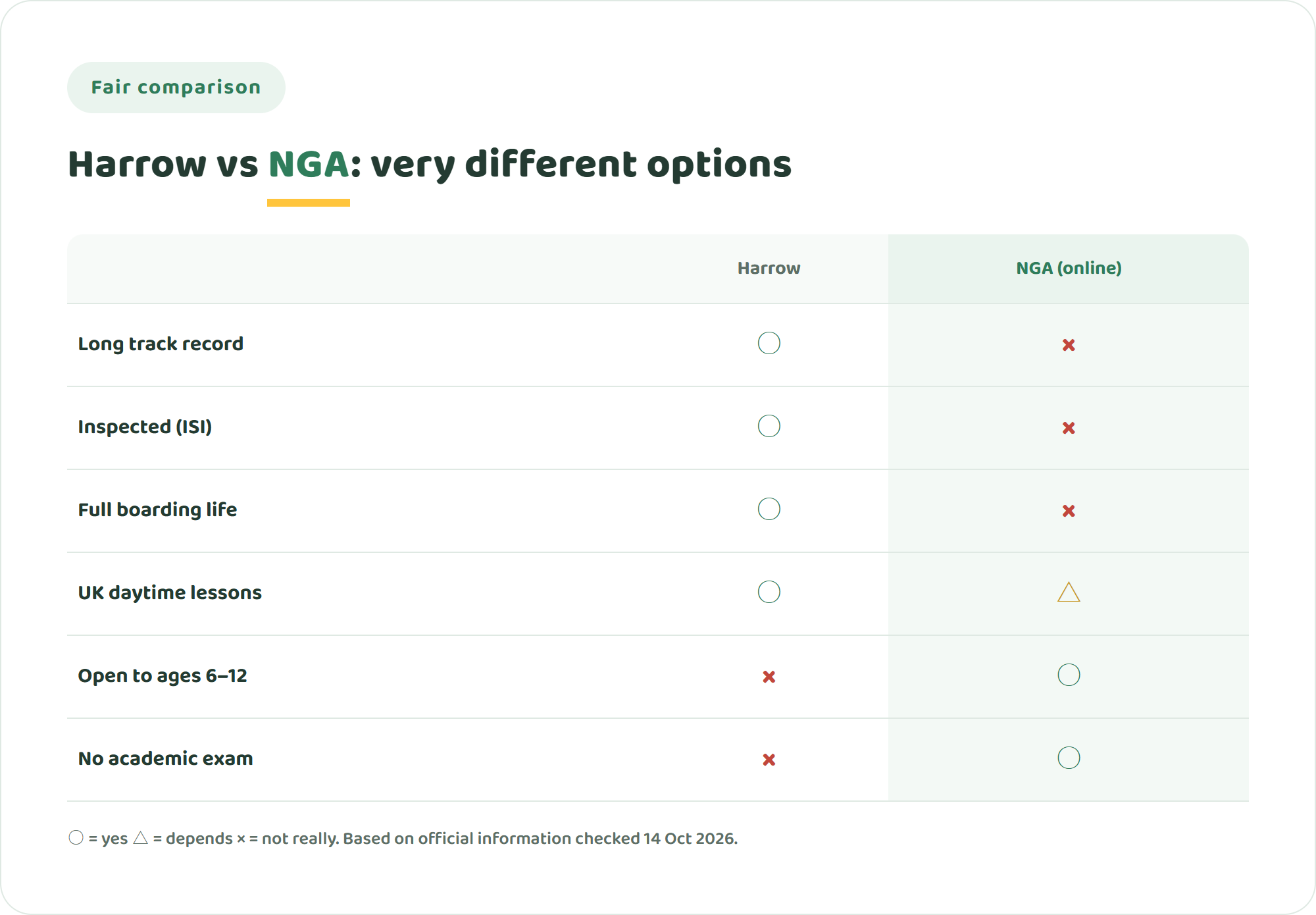
Harrow School vs NIJIN GLOBAL ACADEMY vs two other options (official data)
Below, Harrow sits alongside two other famous English boarding schools — Eton College and Winchester College — and NIJIN GLOBAL ACADEMY (NGA). NGA is a very different option: an online school, not a boarding school, and not yet open. For the full picture of Eton’s costs, see our Eton College fees review.
| Harrow School | NIJIN GLOBAL ACADEMY | Eton College | Winchester College | |
|---|---|---|---|---|
| School type | Independent full boarding school for boys, London | Online international school focused on Asia & Oceania; opens September 2027 (planned) | Independent boarding school for boys, Eton, Berkshire | Independent boarding and day school; boys from 13, girls and boys in the Sixth Form |
| Ages / entry | 13–18; Year 9 and Year 12 entry | Ages 6–18 | Year 9 (13+) and Sixth Form (16+) entry | Year 9 (boys) and Sixth Form (16+, boys and girls) |
| Fees (2026/27) | £21,990 per term incl. VAT (£65,970 a year) | Not yet published (no enrolment, facility or uniform fees; materials included; sibling discounts) | £21,891 per Half (term) incl. VAT; three Halves (£65,673 a year) | Boarding £20,700 / day £15,318 per term, incl. VAT where applicable |
| Curriculum | GCSE, A level | Subjects learned in English, CEFR-based English levels, projects; optional Cambridge IGCSE / A-Level pathway | See official site | See official site |
| Lessons & time zone | In person in London, UK time; lessons six days a week | Small live online dialogue groups (about 8); built for Asia–Oceania daytime — may fall outside the day in Europe or the Americas | In person, UK time | In person, UK time |
| Inspection / diploma | ISI inspection Feb 2024: all Standards met; GCSE and A level qualifications | Not yet accredited; no graduates yet | See official site | See official site |
| Admission | Register by 30 Sept of Year 6; ISEB pre-test, Harrow Test, then Common Entrance or scholarship exams | No academic entrance exam, no English requirement | Registration fee £480; selective (see official site) | Registration fee £480; 16+ registration closes 1 October 2026; ability testing and interviews |
| Start dates | September (Year 9 or Year 12) | Opens September 2027; free trial classes monthly; pre-opening trials April–May 2027 | September (Michaelmas Half) | September |
Sources: Harrow School fees and deposits, Harrow School admissions FAQ, Eton College fees, Winchester College fees — checked 14 October 2026.
Reviews and common concerns, answered honestly
Parents weighing Harrow tend to raise the same questions. Here is what the official pages say, so you can judge for yourself.
“Is the fee really all-inclusive?”
The termly fee includes board, tuition, textbooks, a stationery allowance and laundry, and it already includes VAT. It does not cover additional tuition in any subject that needs it, extra English lessons, or the visa administration fee. Budget separately for uniform, travel, trips and pocket money, which are not listed as fixed amounts on the official fees page.
“We live overseas. Can we get a bursary?”
No — the bursaries page says bursaries cannot be considered for applicants from overseas. Overseas families also pay an Additional Deposit of one term’s fees, and a £3,000-a-year visa fee if Harrow sponsors the visa. Scholarships (worth 5% of fees) are open through the normal admissions route.
“Is my son’s English strong enough?”
The FAQ says boys must be able to take a full part in lessons. The English assessment is free, but extra English lessons are charged. The ISI report found that tailored support helps the small minority who speak English as an additional language. Harrow notes that about half of overseas Year 9 entrants attend a UK prep school first.
“How competitive is it?”
The FAQ mentions about 600 applications for 160 Year 9 places, and up to 20 places in Year 12. Registering early does not give an advantage, but missing the 30 September (Year 6) deadline means applying as a late applicant for fewer places.
“Will boarding suit my child?”
Harrow is full boarding from age 13, with Saturday lessons and exeat weekends. The ISI report describes highly effective pastoral care in the houses. Still, boarding is a family decision as much as an academic one; open mornings run on Saturdays for Year 5 families and are the best way to see house life first-hand.
Alternatives to Harrow School worth comparing
Eton College is the closest comparison on cost: £21,891 per Half including VAT in 2026/27, with means-tested bursaries and a £480 registration fee. Winchester College is slightly lower for boarders (£20,700 per term) and, unlike Harrow, offers day places and admits girls in its Sixth Form. If a London boarding school does not fit your plans, an online British school is another route — see our King’s InterHigh fees and review and our overview of online British curriculum school fees, or compare more options in our online international schools compared guide.
NIJIN GLOBAL ACADEMY (NGA) is a very different kind of option. It is an online international school for ages 6–18 focused on Asia and Oceania, opening in September 2027 (planned), with free trial classes monthly from September 2026 and pre-opening trial classes in April–May 2027. Its first cohort is 100 students, and it is operated by NIJIN Inc. in Japan, whose alternative school NIJIN Academy has more than 1,000 students. NGA does not rank children on test scores: lessons are small-group live dialogue (classes of about 8), subjects are learned in English with a bilingual English–Japanese mentor, English levels follow the CEFR, and students take part in social co-creation projects with companies and governments plus international exchange. An optional Cambridge IGCSE / A-Level pathway is listed on the curriculum and timetable page. There is no academic entrance exam, no English requirement; it can run alongside a local school or as the main school, and it travels with the family if they relocate. Tuition is not yet published; NGA says it will be far more affordable than a typical international school, with no enrolment, facility or uniform fees, materials included and sibling discounts.
Be clear about the trade-offs: NGA is not yet open, is not yet accredited and has no graduates or track record, and it is not a boarding school. Its timetable is built for Asia–Oceania daytime, so for families in the UK, Europe or the Americas live classes may fall outside their day — check the timetable against your local time. If your son is 13 or older, academically strong and ready to board in England, Harrow and its peers offer something NGA does not.
Also weighing Winchester? See the Winchester College fees review (2026/27) for its termly fee, how its own entry test differs from Harrow and Eton, and its bursaries.
Also weighing a London school? Read the Westminster School fees and admissions guide with official 2026–27 figures.
FAQ
How much does Harrow School cost per year?
Harrow School fees for 2026/27 are £21,990 per term inclusive of VAT. With three terms, that is £65,970 a year. One-off charges include a £450 registration fee, an acceptance fee (£1,200 for Year 9, £600 for Year 12) and, for Year 9, two deposits of £2,400 (official site, checked 14 October 2026).
Is Harrow School accredited?
Harrow is an independent school inspected by the Independent Schools Inspectorate. Its February 2024 inspection found that all the Standards were met. Boys take GCSEs and A levels, which are recognised by universities in the UK and abroad.
Can international students apply to Harrow School?
Yes. About 20% of boys live overseas. Overseas families pay an Additional Deposit of one term’s fees and, if Harrow sponsors the visa, a £3,000-a-year visa administration fee. Bursaries cannot be considered for overseas applicants.
Does Harrow School offer bursaries?
Yes. All awards are means-tested, and Year 9 and Year 12 bursaries can cover up to 100% of fees for UK applicants. Scholarships are worth 5% of fees. Income thresholds are not published on the official site.
What are the alternatives to Harrow School?
Similar English boarding schools include Eton College (£21,891 per Half in 2026/27) and Winchester College (boarding £20,700 per term). NIJIN GLOBAL ACADEMY is a very different, online option for ages 6–18 focused on Asia and Oceania, with no academic entrance exam, no English requirement; it opens in September 2027 and is not yet accredited.
Choosing calmly, years ahead
Harrow’s timeline starts early and its costs are significant, so it helps to look at the whole journey at once: when to register, what the full five years really cost, whether a bursary is possible, and whether full boarding is right for your child. Whatever you decide, the best school is the one where your child can grow with confidence — and there is more than one path to that.
Tuition and admissions details were checked on the official websites on 14 October 2026. Schools revise fees every year — always confirm on the official site before applying.