Once a move to Bangkok is confirmed, most parents ask the same two questions about international schools: is there an entrance exam, and what do we need to do, by when? If you are used to a system built around a single written test, the international school admissions process in Bangkok can feel vague. It is actually quite predictable once you see how schools describe it themselves.
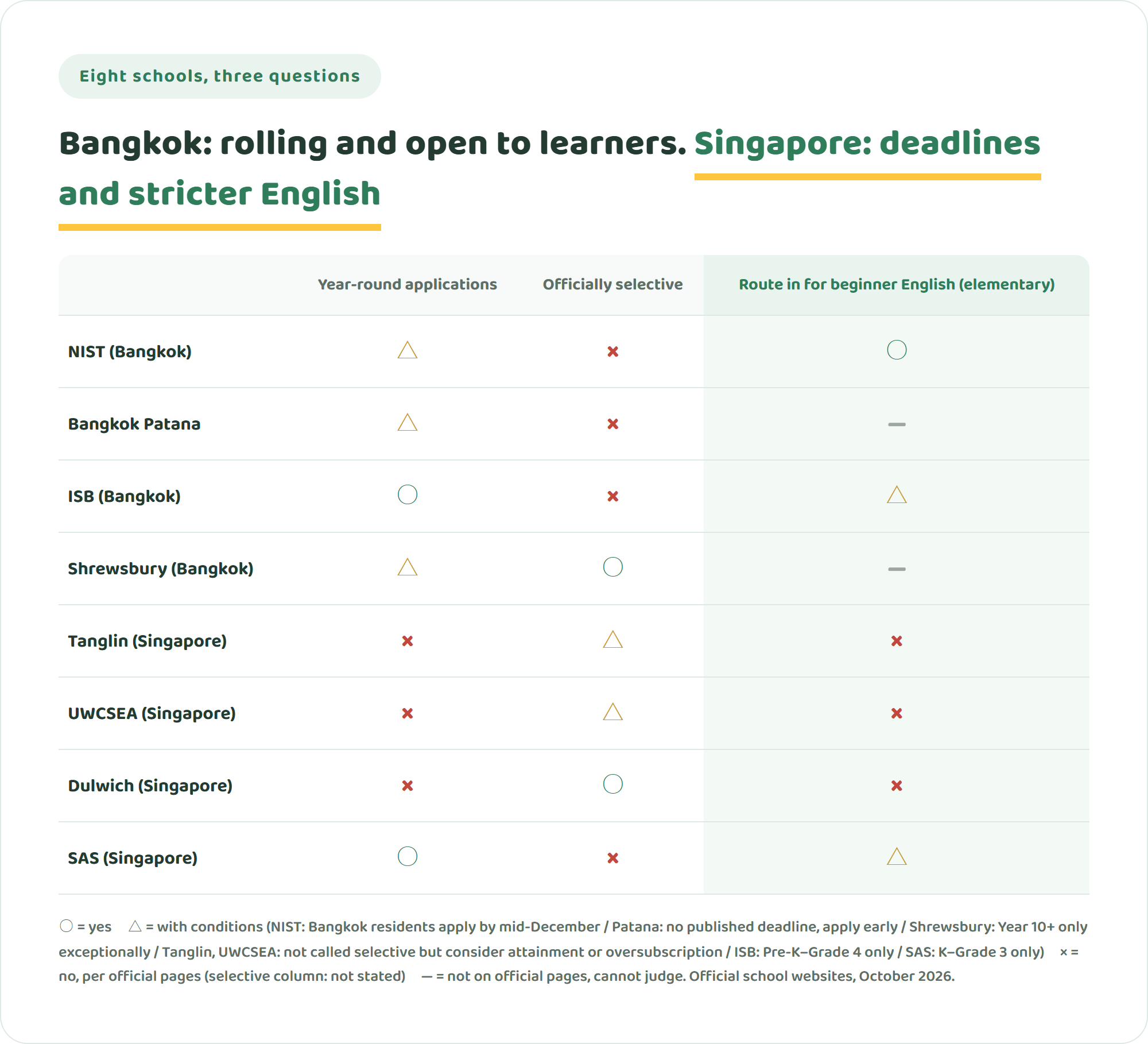
This guide sets out the admissions process at four leading Bangkok schools (NIST, Bangkok Patana, ISB and Shrewsbury) and, for comparison, four in Singapore (Tanglin, UWCSEA, Dulwich and Singapore American School), using each school’s official admissions pages as of October 2026. It deliberately leaves out tuition and focuses on how places are decided and when to act.

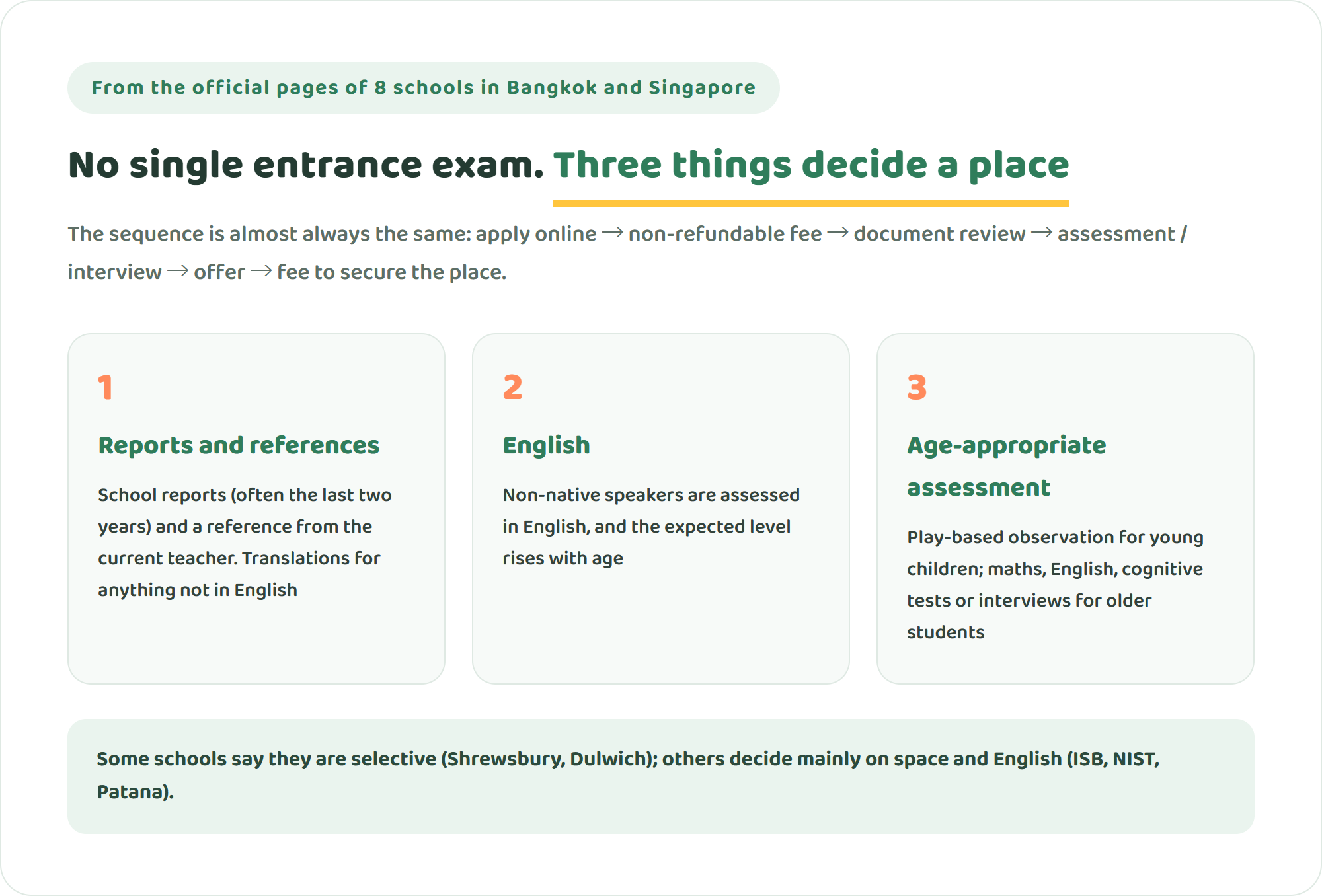
The short answer: no single entrance exam, but three things decide a place
None of the eight schools we reviewed uses a one-day written exam taken by every applicant. The sequence is almost identical everywhere: apply online, pay a non-refundable application fee, have your documents reviewed, complete an assessment and/or interview, receive an offer, then pay a further fee to secure the place.
Three things carry most of the weight:
- School reports and teacher references. Schools ask for school reports and a recommendation from your child’s current teacher; half of the eight (Patana, Shrewsbury, Tanglin and UWCSEA) specify the last two years of reports.
- English. Children who are not native speakers are assessed in English, and the expected level rises with age.
- An age-appropriate assessment or interview. Young children are usually observed at play; older students may sit maths, English or cognitive tests, and some schools interview.
Beyond that, schools fall into two groups. Some describe themselves as selective (Shrewsbury Bangkok, for example). Others decide mainly on available space and English proficiency (ISB, NIST and Patana). In Bangkok, international school admissions are less about ranking children by score and more about checking two things: can your child access the curriculum, and is there a seat in the grade?
International school admissions in Bangkok: four schools
NIST International School: Bangkok residents apply by mid-December
NIST’s process runs from a pre-application form to a full application, a review by the admissions committee, an assessment and/or interview, an acceptance letter and payment to confirm the place. Elementary applicants have a one-to-one or small-group assessment (online if you live outside Bangkok); secondary applicants take a grade-level test. The committee looks at age, year level, space, English proficiency, previous records and academic ability together.
Families already living in Bangkok should apply by mid-December for the following school year, with processing from January. Applications from overseas are accepted all year, and NIST asks families to apply as early as possible. In elementary school NIST can accept beginner English learners; in secondary it supports only intermediate and advanced English learners. The application fee is THB 6,000 and the assessment fee THB 2,500, both non-refundable.
Bangkok Patana School: an EAL assessment and a nationality balance
Patana asks for a recommendation sent directly by your child’s current teacher, a writing sample and two years of school reports, submitted with an online application. Children who are not native English speakers are assessed by an EAL specialist before a place is confirmed, and Foundation Stage children have an in-person school-readiness assessment.
Applications for 2027/28 opened on 1 September 2026. There is no published deadline, but the school notes it often has waiting lists and encourages early applications. When places are tight, it considers prior connections (siblings, returning students, children of alumni), siblings applying together, balance of gender, nationality and language, and the date the application was completed. Notably, no single nationality may exceed 20% of the school. Accepting an offer requires a non-refundable THB 50,000 fee to hold the place.
International School Bangkok (ISB): no minimum English up to Grade 4
At ISB you register in OpenApply, upload documents, pay the fee, and the school then reviews the file and may request testing, a school observation, an interview or more reports. Non-native speakers from Kindergarten to Grade 12 take an English proficiency assessment. Interviews are recorded asynchronously: parents answer for Pre-K to Grade 5, and students answer themselves from Grade 6.
For expatriate families, ISB admits on a rolling basis, with applications opening on 15 September; some grades have limited seats, so earlier applications have a better chance. On English, there is no minimum proficiency for entry from Pre-K to Grade 4. From Grade 5, a minimum level applies and rises by division.
Shrewsbury International School Bangkok: officially selective
Shrewsbury states plainly that it is a selective school. The youngest children are assessed for school readiness; from Year 3, applicants take cognitive tests, which may be combined with maths and English tests and an interview. Students joining for A Level sit subject-specific entrance tests.
Applications are accepted year-round, but the school recommends applying at least 12 months before your intended start date. Entry into Year 10 and above, part-way through a course, is only possible in exceptional circumstances. The application fee is THB 5,000.
How Singapore compares: firmer deadlines and stricter English
Many families have both cities on the table, so it helps to see how four Singapore schools differ. Two contrasts stand out: more schools work to fixed deadlines, and more schools are strict about English.
- Tanglin Trust School: you can apply up to three years ahead; the 2027/28 deadline is 15 February 2027, and most offers are made from March. There is no EAL programme; children need age-appropriate fluency and at least one parent living in Singapore must be fluent in English.
- UWCSEA: applications for August 2027 opened on 1 September 2026. Round 1 closes on 2 November 2026 (offers in January) and Round 2 on 1 February 2027 for day students (offers in March). It is not first-come, first-served; eligible applicants typically exceed places. Young children attend a 45-minute “Meet and Play” session, and older applicants are expected to have one to three or more years of English-medium schooling depending on grade.
- Dulwich College (Singapore): you can apply up to 18 months ahead; applying by 31 October may bring an early offer in November, though most families hear in March. The school says academic selection is part of the process and that it does not run a separate EAL programme.
- Singapore American School: the only one of the four with rolling admission. Admissible applicants join a waitpool and are offered places by priority lane (for example, US citizens before families of employees of American companies). From Grade 4, English proficiency is required, and there is no EAL programme beyond Grade 4.
In short, Bangkok has more schools where a child who is still learning English can get in if you apply early, while Singapore more often expects you to meet a deadline and an English threshold. Our guide to international schools in Singapore covers schools there in more detail.
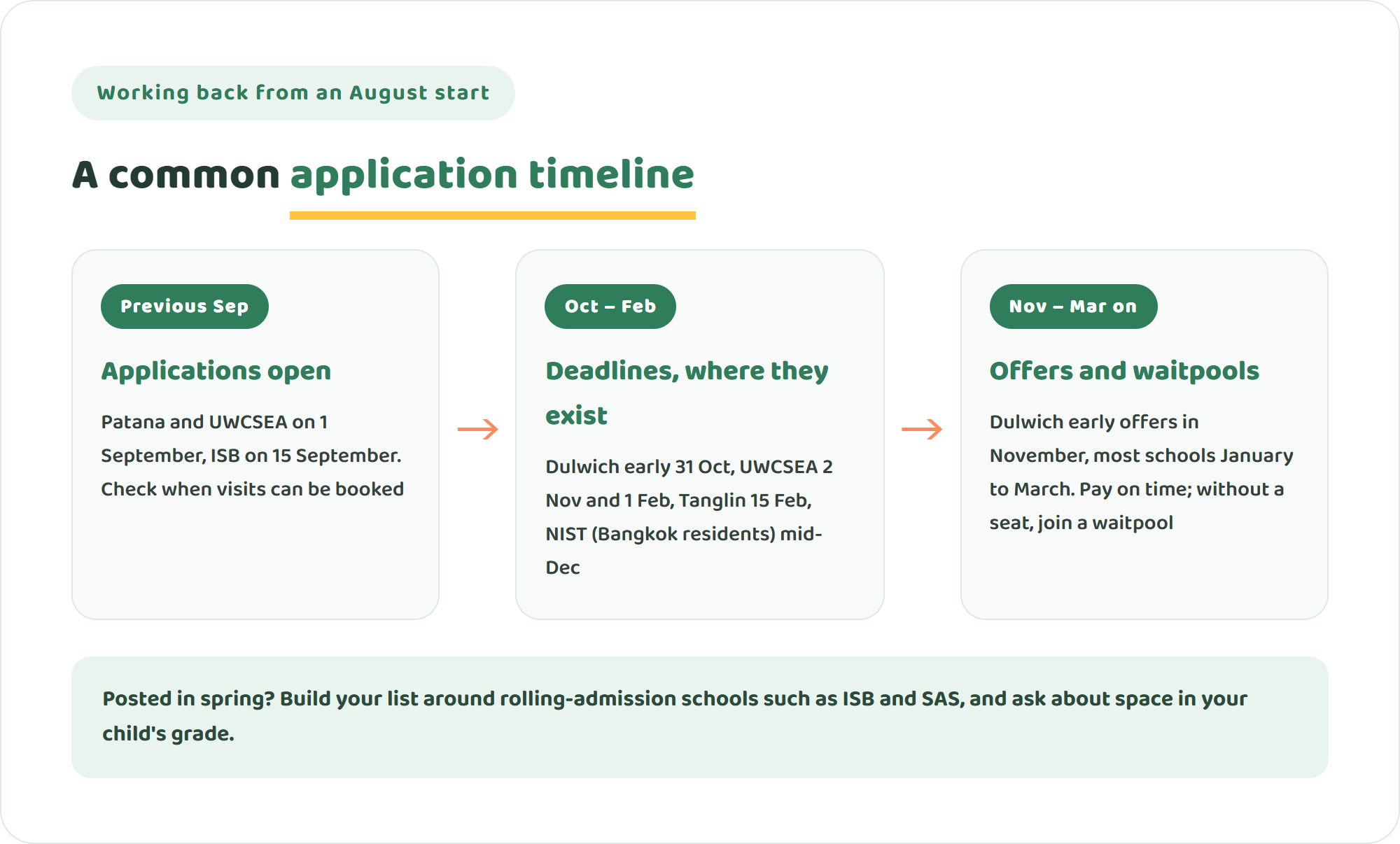
Working back from an August start
Most of these eight schools start the year in August (NIST, Tanglin, UWCSEA and SAS among them), and there is a common rhythm:
- September of the previous year: applications open (Patana and UWCSEA on 1 September, ISB on 15 September). Check with each school when visits can be booked.
- October to February: deadlines, where they exist (Dulwich early offers 31 October, UWCSEA 2 November and 1 February, Tanglin 15 February, NIST mid-December for Bangkok residents).
- November to March onwards: offers and waitpools (Dulwich early offers in November; most schools January to March). Once you have an offer, the deposit or acceptance fee is due quickly (UWCSEA typically within two weeks).
If your posting is confirmed in spring and you move in summer, you will usually be behind this cycle. In that case, build your shortlist around schools with rolling admission, such as ISB in Bangkok or SAS in Singapore, and ask each school directly about space in your child’s grade. Some schools, such as Tanglin, explain that places open up when current students leave, so availability can change at short notice.
Documents and English: what to start before you move
Families are more often caught out by paperwork than by the assessment itself. Three things are worth starting while you are still at home:
- Translated school reports. Many schools ask for two years, and anything not in English must be translated. UWCSEA asks for notarised translations.
- Teacher references. Some schools, such as Patana, want the reference sent directly by the teacher. Teachers unfamiliar with English-language forms appreciate plenty of notice.
- Passports, birth certificates and visas. ISB and Patana require a valid non-immigrant visa; UWCSEA and Dulwich ask for copies of immigration passes; Dulwich also asks for vaccination records.
For younger children, some Bangkok schools let English develop after entry, but most of these schools expect a working level of English in the upper grades. Our guide to preparing your child’s English before international school looks at how much preparation is realistic.
Rules worth knowing
- Thailand: we could not find an official national restriction on foreign children enrolling in international schools. In practice schools require a valid visa, so run the visa process alongside your applications.
- Singapore: international schools need Ministry of Education approval to admit Singapore Citizens, but that rule applies to citizens, not foreign families. The Immigration & Checkpoints Authority states that a child holding a valid Dependant’s Pass or Long-Term Visit Pass does not need a separate Student’s Pass.
- Japan (for Japanese families): Japan’s Ministry of Education explains that Japan’s compulsory schooling obligation does not apply directly to Japanese children living abroad. When you move back and register your address, the local board assigns a school and an entry date.

If there is no place yet
Waitpools can last months, and mid-year places are never guaranteed. Bangkok has a wide range of British, American and IB schools to fall back on, compared in our guide to international schools in Bangkok, and you can check typical costs in international school fees across Asia.
Another option is an online international school, which does not depend on where you live. It can keep English-medium learning going while you wait for a seat, or give continuity if another posting is likely within a few years. You can see how NGA plans to teach in our online school curriculum overview.
Where NIJIN GLOBAL ACADEMY fits
NIJIN GLOBAL ACADEMY (NGA) is an online international school for ages 6–18, planned to open in September 2027. It is run by NIJIN Inc., which operates NIJIN Academy in Japan, a learning community for children who do not attend school, where more than 1,000 children have studied. NGA plans small live classes, with bilingual Japanese–English mentors supporting subjects taught in English, and admission that is not based on test-score rankings.
To be honest about the limits: NGA has not opened, is not accredited, has not published its fees and has no graduates. It cannot offer a campus, in-person classmates or an established diploma in the way Bangkok’s and Singapore’s international schools do. Where we hope to help is as a bridge while you look for a place, or as a constant for families whose country of residence keeps changing.
Frequently asked questions
Do international schools in Bangkok have entrance exams?
Not in the sense of a single written exam. Schools decide using reports, teacher references, an English assessment and an age-appropriate assessment or interview. Selective schools such as Shrewsbury Bangkok add cognitive and subject tests.
Can my child get in without much English?
It depends on the school and the grade. ISB has no minimum English requirement from Pre-K to Grade 4, and NIST accepts beginner English learners in elementary school. Older children generally need stronger English, and in Singapore, Tanglin and Dulwich do not run separate EAL programmes.
When should we start?
For an August start, many schools open applications the previous September, and Shrewsbury recommends applying at least 12 months ahead. As soon as your move is confirmed, start translating reports and requesting teacher references.
Can we join mid-year?
ISB, NIST (for overseas applicants), Shrewsbury and SAS accept applications year-round, but entry always depends on a seat being free in your child’s grade. Ask each school directly.
Less about passing, more about fitting in
International school admissions in Bangkok are not a contest of scores. Schools want to know whether your child can follow lessons in English, whether the school suits them, and whether there is a seat. The best preparation is to start early, prepare documents carefully and see how your child responds on a school visit.
If you want a way of learning that carries on through waitpools and the next posting, NIJIN GLOBAL ACADEMY plans to start with trial classes in April–May 2027, ahead of its planned September 2027 opening. We will send details of lessons and fees by email once they are set.