If you are a Japanese family living abroad, or a family in Japan whose child has stopped being able to go to school, the word homeschooling arrives with a lot of promise attached. English-language articles treat it as an ordinary choice: learn at home, parent-led, at the child’s own pace. It is natural to wonder whether the same door exists in Japan.
Search in Japanese and the picture immediately clouds. One site says it is possible; another says it is unlawful; neither cites anything. So the decision stalls.
Here is the position, plainly. Japan has no homeschooling status. The School Education Act places a duty on guardians to have their child enrolled, and there is no mechanism that treats learning at home as a substitute for school. That is not the same as “nothing is possible”. There is a published route by which a child stays enrolled at their school while study done at home is recorded as attendance — and the conditions for it, seven of them, are written down in a ministry notice.
This article reads those seven conditions from the source, then compares parent-led home study with enrolling at an online international school. Not to declare a winner: to show where the two differ under the rules, and which one fits which family.
Three different arrangements share one word
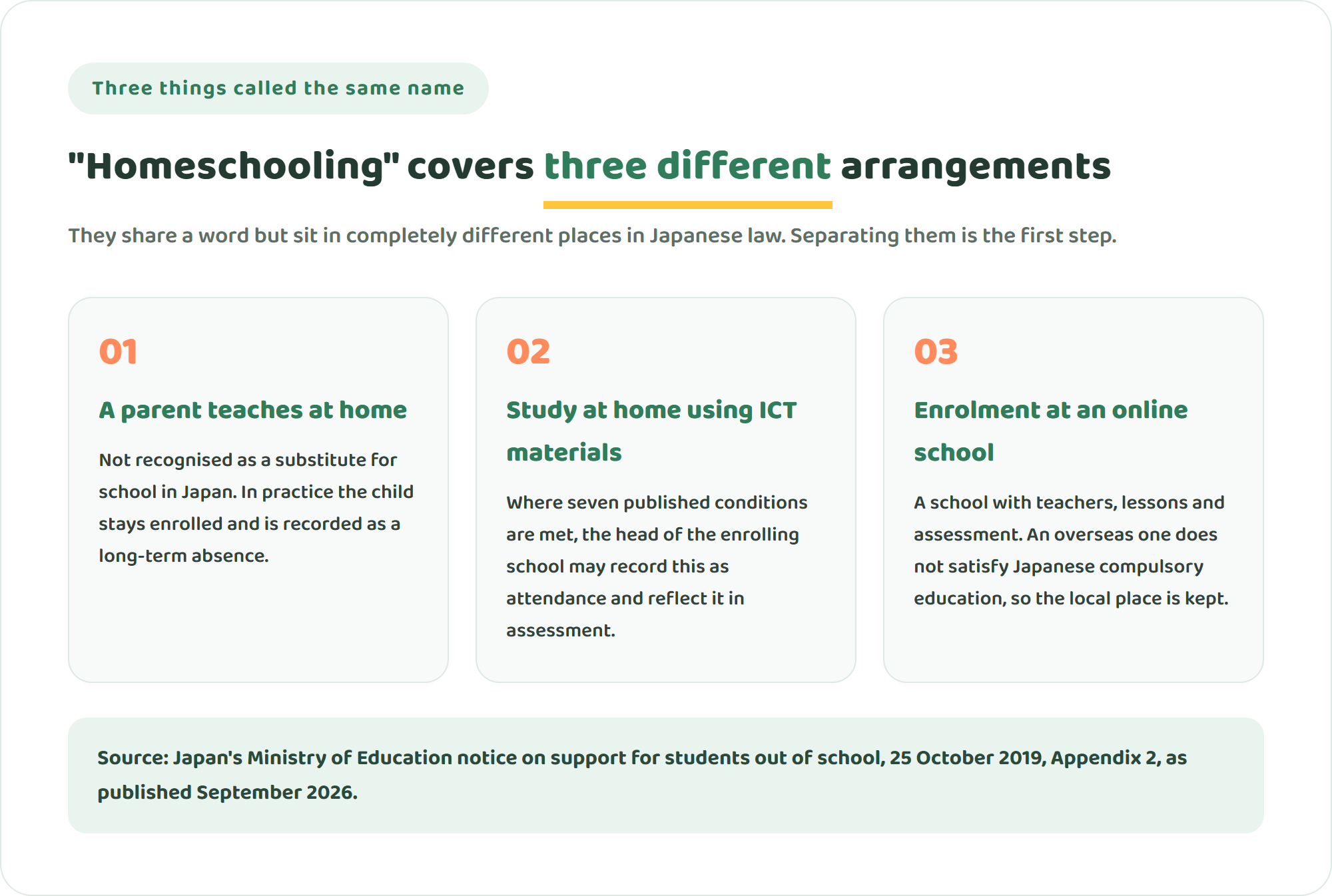
The reason these conversations go in circles is that one word is doing three jobs. Under Japanese rules they sit in entirely different places, so separate them first.
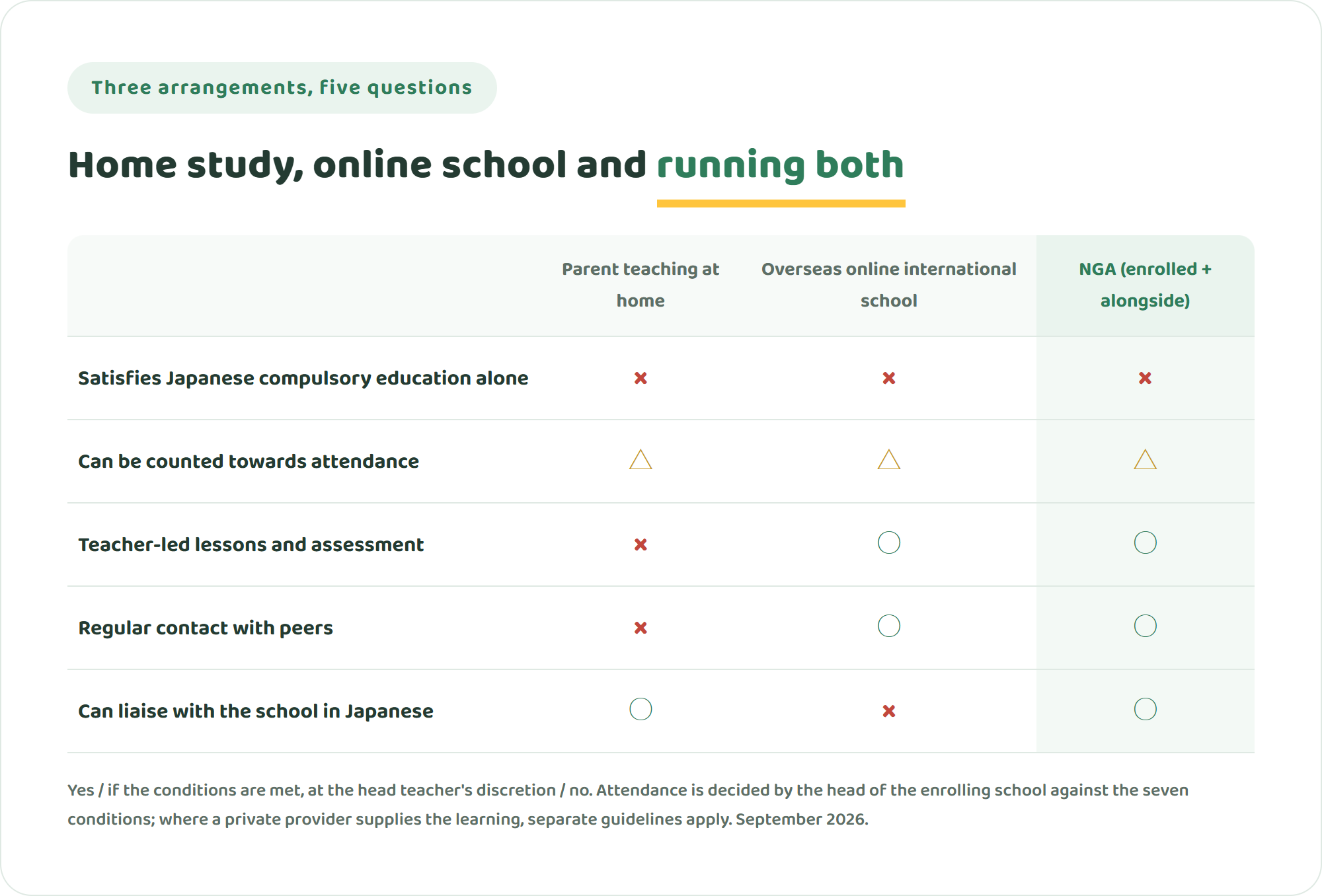
One: a parent teaches at home. This is homeschooling in the original sense. Japan does not recognise it as a substitute for school. In practice the child remains on the school register and is recorded as a long-term absence.
Two: the child studies at home using ICT materials. This is where the route exists. Where the seven conditions below are met, the head of the enrolling school may record the days as attendance and may reflect the results in assessment.
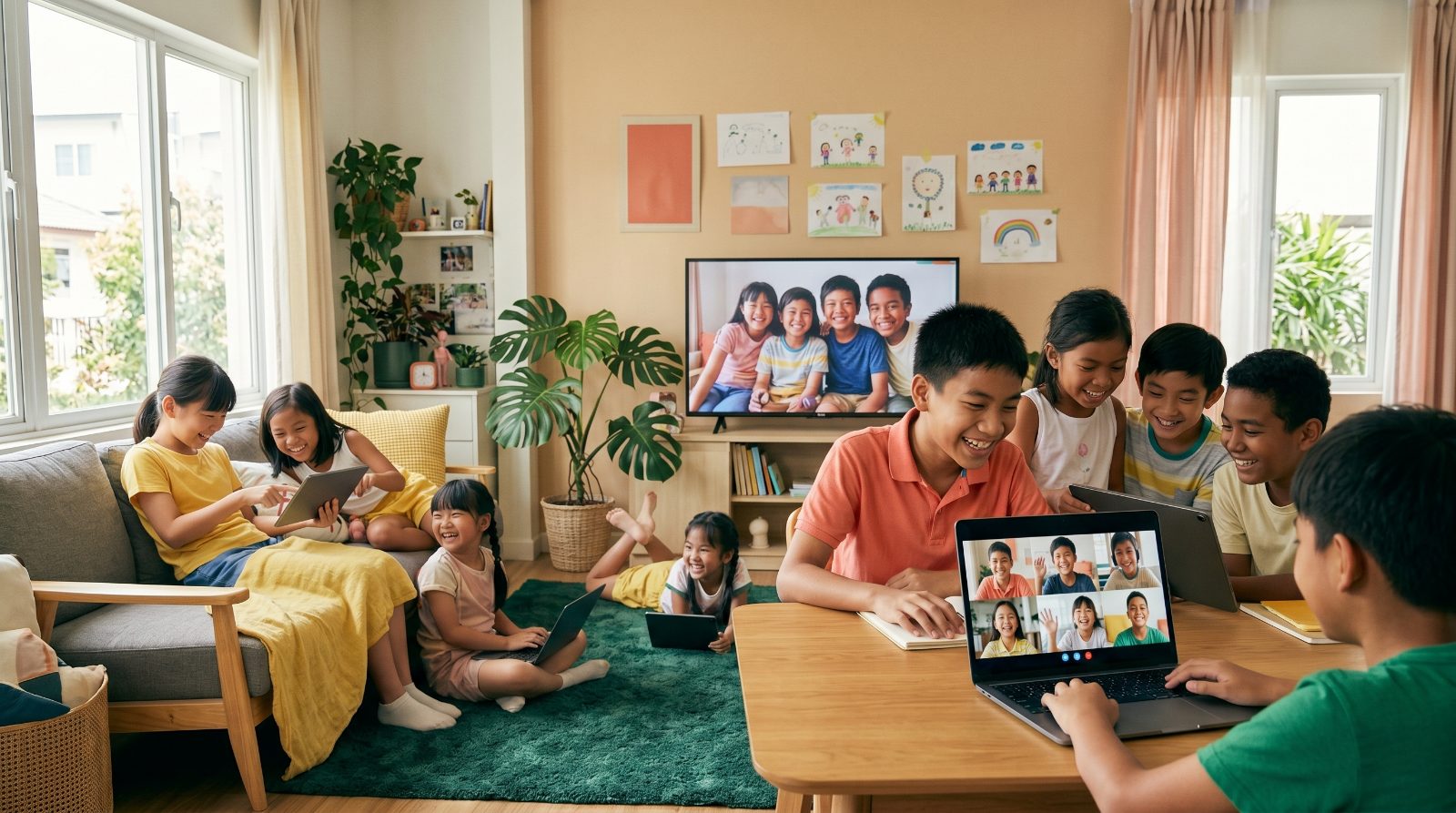
Three: the child enrols at an online school. A school in the full sense — teachers, lessons, assessment. But an overseas online school does not by itself satisfy Japanese compulsory education, so families keep the local school place alongside it.
The seven conditions for home study to count as attendance
This is the part worth having in front of you. Appendix 2 of the Ministry of Education’s notice on support for students who are out of school (25 October 2019) sets out how attendance is recorded when a child studies at home using ICT. Its stated purpose is that, while taking Japan’s compulsory education system as the premise, and where certain conditions are met, the head teacher may record attendance and reflect the results in assessment. The conditions:
(1) A sufficient relationship of cooperation is maintained between the guardians and the school.
(2) The learning is delivered via ICT — computers, the internet, distance-learning systems — or by post or fax.
(3) Appropriate face-to-face support, such as home visits, is presupposed, and that support is provided regularly and continuously, covering both learning and the child’s future independence.
(4) The learning is a planned programme matched to the child’s level of understanding. Where a private provider delivers it, the school judges suitability with reference to the notice’s separate guidelines on private facilities.
(5) The head teacher adequately understands the state of the face-to-face support and the learning — for example through regular reports from whoever provides the in-person support, or meetings involving the class teacher and guardians.
(6) It applies, in principle, where the child cannot receive counselling or guidance at a public facility or private facility outside school.
(7) Where results are reflected in assessment, the plan and content must be judged appropriate against the school’s curriculum.
Read together, the design intent is unmistakable. The decisive conditions are (1), (3) and (5) — not the quality of the materials or the volume of work, but whether the connection to the school is alive, whether a person is meeting the child regularly, and whether the head teacher can see what is happening. “We bought an excellent programme, so please count it” is the wrong order of operations. The relationship moves first.
On how many days may be counted, the notice says schools and boards of education may set their own criteria based on things like the number of face-to-face sessions or hours of study; no single national standard is issued. So a school with no precedent is not a closed door — it is a school that has not yet written its criteria. The notice’s own examples of qualifying study include private ICT materials, individualised learning systems, materials made by education support centres, school worksheets and correspondence courses, and lessons from the child’s own school delivered to the home, live or on demand.
So how do home study and an online international school differ?
Held against the seven conditions, the difference is not better or worse. It is which conditions each one finds easy.
Parent-led home study can handle (1) cooperation and (3) face-to-face support relatively well — the family is already in contact with the school. The heavy lifting is (4), a planned programme matched to the child’s understanding, and (7), content judged appropriate against the school curriculum. Designing sequence, tracking progress, articulating assessment: that is professional work, and carrying all of it inside the household is what makes this arrangement collapse. Outside the rules altogether, there is a further cost — contact with peers quietly disappears from the week.
An online international school is the mirror image. Teacher-led lessons, a curriculum and recorded results give you plenty to put against (4) and (7). Peers come with it. But where the school is overseas, its curriculum does not map onto Japan’s, which makes (7) hard for the enrolling school to judge; the time zone is its own problem; and (1) is the real wall — if all correspondence is in English, the class teacher cannot see what is happening, and cooperation never takes shape.
Line those up and the arrangement that satisfies the seven conditions most naturally becomes visible: keep the local school place, keep the liaison in the school’s own language, and add learning that has real teachers and real assessment behind it. That is the design we build around — nobody has to leave the school they belong to. You can see how it works in how we learn.
The order to talk to the school in
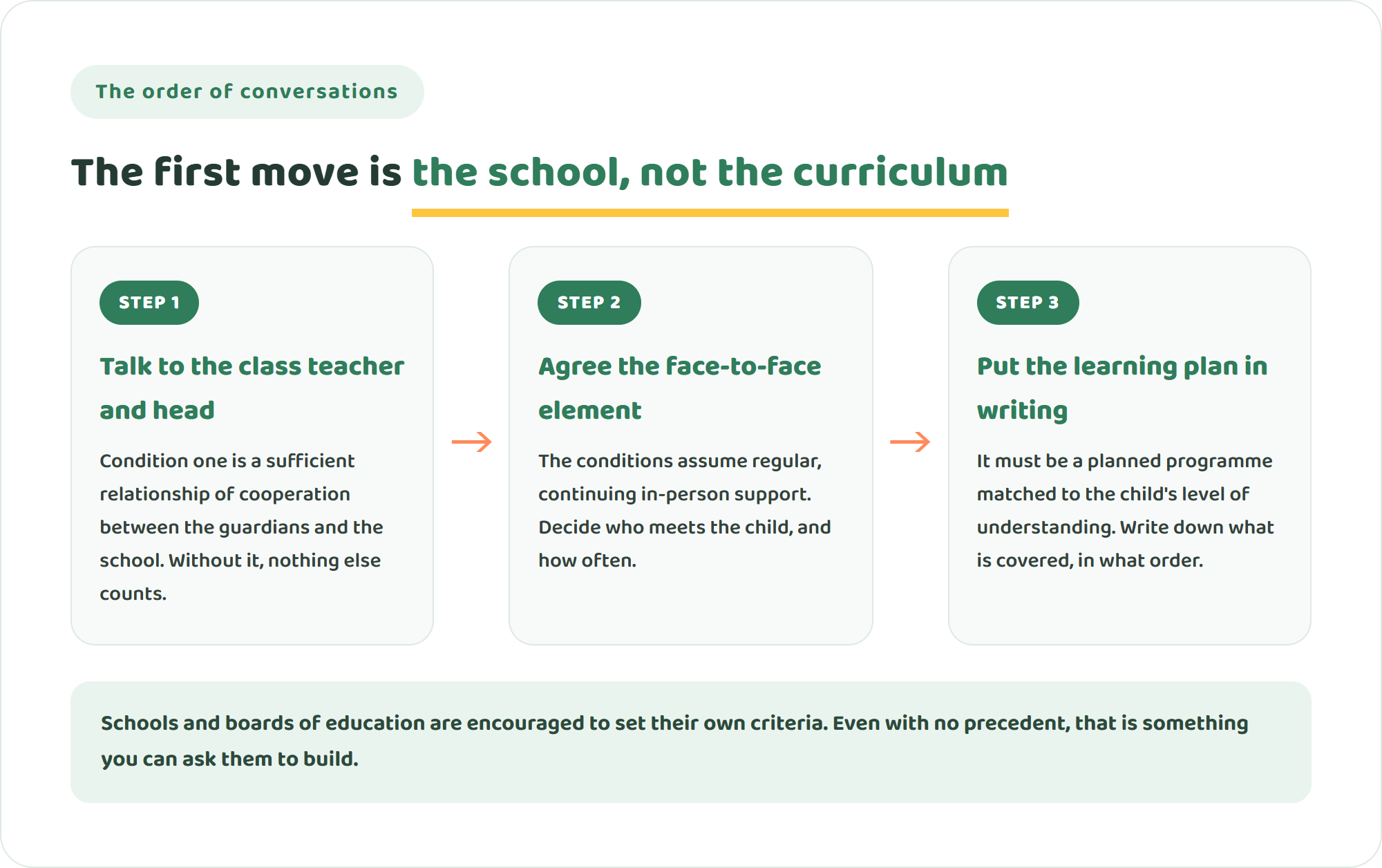
The conditions are, conveniently, already in the order you should act.
Step 1: talk to the class teacher and the head. Condition one is the cooperative relationship. Choosing materials or a school before this is in place will not move the attendance question at all.
Step 2: agree the face-to-face element. Condition three presupposes regular in-person support. Who meets the child, and how often — the class teacher on a home visit, the school counsellor, a staff member from the education support centre? Make it concrete.
Step 3: put the learning plan in writing. That is condition four. What is covered, in what order, for how many hours a week. On paper, it is something the school can actually assess.
One more not to skim: condition six. The route is intended, in principle, for situations where the child cannot receive counselling or guidance at a public or private facility outside school. If there is a reachable education support centre or free school, you may be asked to consider it first. The wider set of options is laid out in where a child can learn if school doesn’t fit and when your child does not want to go to school.
Questions families ask
Is homeschooling illegal in Japan?
It is not as simple as learning at home being punishable. The position is that guardians carry a duty of enrolment and that no mechanism recognises home learning as a substitute for school. That is why families keep the school place and use the attendance route instead. Where you see a flat “legal” or “illegal”, check whether any provision is cited.
What happens to grades if days are counted as attendance?
The notice says that where results are reflected in assessment, it is not necessarily required to record observation-based status and grades for every subject and viewpoint; a written description of the child’s learning, framed to improve teaching in the following year, may be appropriate. It also notes that results can be communicated to the child and guardians through the report card or other means.
If we enrol at an online international school, can our child stop attending school?
No. Enrolling at an overseas online school does not by itself discharge Japanese compulsory education, so the local place is normally kept. Whether days are counted as attendance is for the head of the enrolling school to judge against the seven conditions. Telling a child they never have to go back before that conversation happens narrows your options later.
The school says there is no precedent for this.
The notice states that although no uniform national standard is issued, it is necessary for schools and boards of education to prepare their own criteria, and that outdated criteria should be reviewed. In other words, the absence of a standard is not a reason to refuse; it is something to be written. Quoting that line alone sometimes changes how the conversation goes.
The rules are not a choice between school and home
Japan has no homeschooling status. That is true. What the rules offer, though, is not a choice between showing up and giving up. There is a route that keeps a child’s place while counting study done at home as attendance, and its seven conditions are published. The decisive ones turned out to be about connection and contact, not curriculum.
If your child is not able to attend right now, the first move is a conversation with the class teacher — before any material is bought. And if what you want on top of that is subject learning in English, choose a form you can add without giving up the school your child belongs to.
NIJIN GLOBAL ACADEMY opens in September 2027 (planned), with a pre-opening term of trial classes in April–May 2027: subjects taught in English, in small talk-based classes, designed to sit alongside a child’s existing school with liaison in the family’s own language. Join the mailing list for the design, the fees and first-intake details. Nothing needs deciding today.