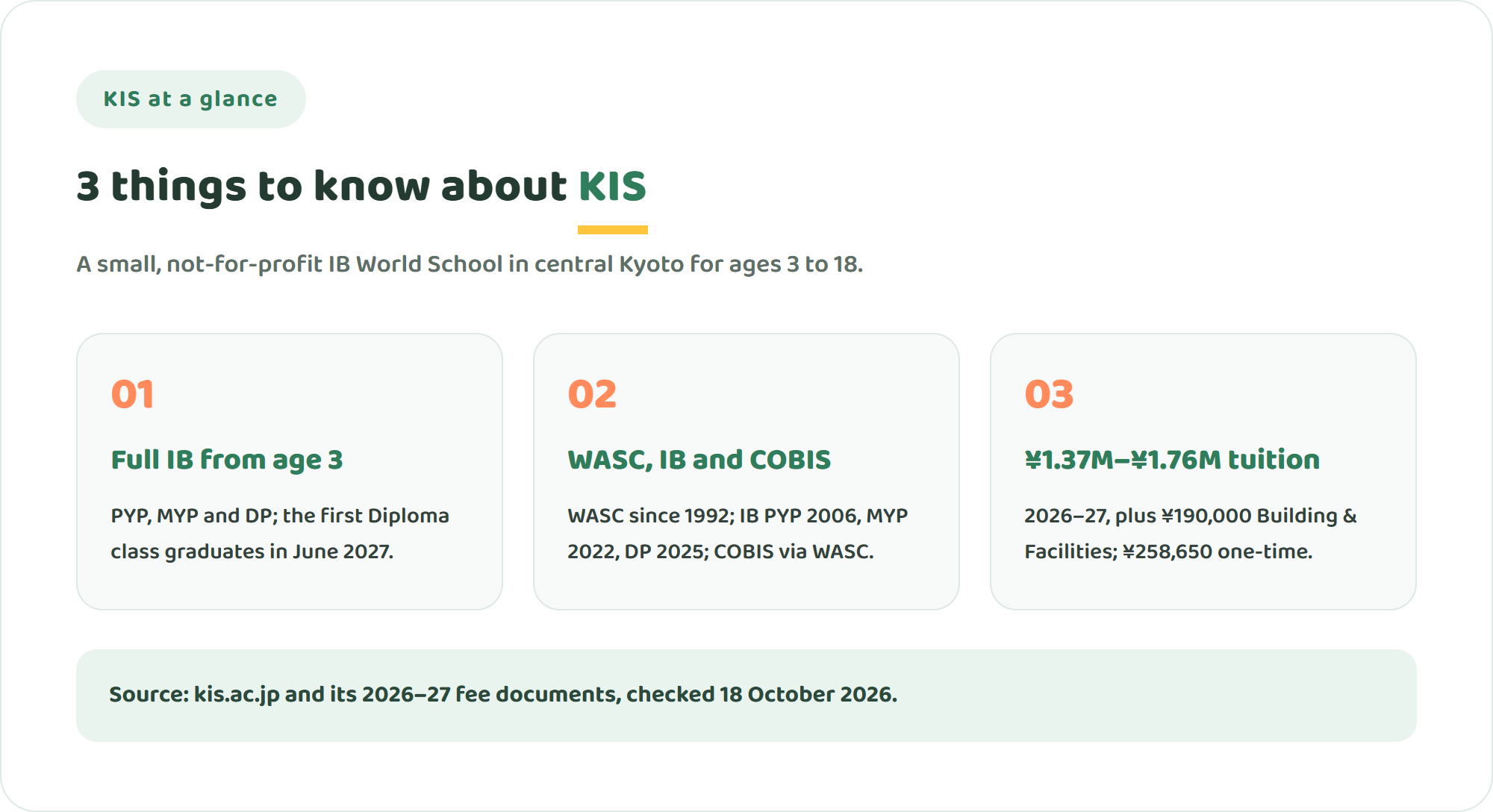
Kyoto International School (KIS) is a not-for-profit IB World School in central Kyoto for children aged 3 to 18, offering the IB Primary Years, Middle Years and Diploma Programmes and accredited by WASC; its 2026–27 tuition is ¥1,366,800 a year for Preschool to Grade 5 and ¥1,761,000 for Grades 6–12, plus a ¥190,000 Building & Facilities fee (official Admissions page and its Tuition and Fees at a Glance 2026–27, checked 18 October 2026). New students also pay ¥258,650 in one-time fees. All fees are in Japanese yen; we do not convert them because exchange rates move.
If you searched “Kyoto International School”, you are probably moving to Kyoto or the wider Kansai region — for a university or research post, a company transfer or your own work — and you want to know whether KIS is the right school before you look at anything else. This page is built as a decision guide rather than a price list. It answers, from KIS’s own website and documents, the questions families actually ask: is it accredited, what is taught at each grade, how admissions and English support work, what the first year really costs, what the community is like, and how it compares with Canadian Academy, Osaka International School, Doshisha International School, Kyoto and Osaka YMCA International School. NIJIN GLOBAL ACADEMY, a different kind of option (an online school that opens in 2027), is included in the same comparison table as the last column.
The short answer: who KIS suits — and who it doesn’t
- Suits: families who want to live in Kyoto city itself. KIS is the only international school in the city that offers all three IB programmes, on two campuses in Kamigyo-ku — one in the Nishijin district and one beside Nijo Castle.
- Suits: families who want the IB from age 3 all the way to the IB Diploma, in one school, without moving campus city.
- Suits: families who prefer a small school. KIS publishes a teacher-to-student ratio of 1:6 and describes itself as “a small but growing school” with small class sizes.
- Suits: visiting researchers and scholars. KIS offers a Visiting Scholar Scholarship of 30% off tuition in the PYP and 20% off in the MYP and DP for children of researchers in Kyoto for a fixed period.
- Suits: families watching cost. On official 2026–27 figures, KIS’s annual fees are the lowest of the five Kansai international schools compared on this page, and its one-time fees (¥258,650) are the smallest.
- Harder fit: families who want a long track record in the IB Diploma. KIS opened its first Grade 11 class in August 2025 and Grade 12 in 2026, so its first Diploma cohort finishes in June 2027 and no DP results are published yet.
- Harder fit: families who need boarding or a student visa (KIS offers neither), or who need a school bus, a published school day or a cafeteria — none of these are described on the official site.

What Kyoto International School is
KIS traces its history to late 1957, when the American School on the Botanical Gardens army base in Kyoto closed and missionary families had to find another way to educate their children. It began as home-schooling for three children in a spare bedroom; the following year the family’s house on Ichijo-dori became the Kyoto Christian Day School, with 28 students in Grades 1–8 by 1958–59. The school took its current name in 1966. The official timeline then lists WASC accreditation in 1992, a move to the former Juraku Elementary School in 1997, IB PYP authorisation in 2006, approval as a gakko hojin (school corporation) in 2007, IB MYP authorisation in 2022, use of the former Taiken Elementary School for secondary from 2024, and IB Diploma authorisation and COBIS accreditation in 2025. The 2026–27 school year is its 70th.
KIS is run as a not-for-profit and is guided by a volunteer board, many of whose members are parents. Its brochure gives a snapshot of about 30 nationalities, 70% international students and a teacher-to-student ratio of 1:6. The total number of students is not published on the official site.
| Item | Kyoto International School (official) |
|---|---|
| Type | Private, not-for-profit international day school (no boarding); gakko hojin status since 2007 |
| Founded | 1957 (current name since 1966) |
| Ages / grades | Ages 3–18: Preschool, Pre-Kindergarten, Kindergarten, Grades 1–12; placement by age with a 1 September cut-off |
| Campuses | Juraku Campus (Early Years and Primary), 317 Kitatawara-cho, Kamigyo-ku; Taiken Campus (Secondary), 536-1 Waraya-cho, Kamigyo-ku, next to Nijo Castle |
| Curriculum | IB Primary Years Programme (Preschool–Grade 5), Middle Years Programme (Grades 6–10), Diploma Programme (Grades 11–12) |
| Accreditation named on the official site | WASC; IB (PYP, MYP, DP); COBIS (through its WASC accreditation) |
| School year | Two semesters, late August to late June (2026–27: 24 August 2026 – 25 June 2027) |
| Community | About 30 nationalities; 70% international students; teacher-to-student ratio 1:6 |
| Tuition 2026–27 | ¥1,366,800 (Preschool–G5) or ¥1,761,000 (G6–G12), plus ¥190,000 Building & Facilities and ¥3,000 PTA per family |
Is Kyoto International School accredited?
Yes. KIS’s About page states that it is “fully accredited by both the International Baccalaureate and the Western Association of Schools and Colleges (WASC)”, and that it was the first school accredited by the Council of British International Schools (COBIS) through its WASC accreditation. Here is what each of those means for a family:
- WASC (ACS WASC). A US regional accreditation that covers the school as a whole, which matters when your child transfers to another school or applies to universities that ask about accreditation. KIS’s timeline gives 1992 as the year of first accreditation. The current accreditation term is not published on the official site.
- IB World School. KIS is authorised for the PYP (2006), the MYP (2022) and the Diploma Programme (2025), which makes it, in its own words, the city’s “first and only IB Continuum School”. We tried to cross-check this on the IB’s public school directory, but the directory could not be opened from our side on the check date; please confirm on ibo.org if you need it for an employer.
- COBIS. COBIS’s own site carries a case study featuring KIS as a WASC-accredited member.
- CIS. KIS does not state Council of International Schools (CIS) accreditation on its official site. Some Kansai schools hold CIS accreditation; KIS’s route is WASC plus IB.
One honest caveat: accreditation of the school is not the same as a long Diploma record. KIS’s Diploma Programme is newly authorised, and the first Grade 12 class sits the IB exams in 2027. If DP results matter to your decision, ask the school how it is preparing that first cohort and what university counselling looks like.
Curriculum and grades: PYP, MYP and the new Diploma Programme
Early Years (Preschool to Kindergarten). KIS frames its Early Years with the IB PYP and describes a play-based, inquiry-led approach in which children build thinking, social, communication, self-management and research skills. Children are placed by age: for 2026–27 applications, Preschool is for children born between 1 September 2022 and 31 August 2023, Pre-Kindergarten for 2021–22 birthdays and Kindergarten for 2020–21 birthdays.
Primary (Grades 1–5). The PYP continues as the curriculum framework, with units of inquiry rather than a single country’s national curriculum — useful for children who have moved between systems.
Lower Secondary (Grades 6–10). The MYP covers language and literature, language acquisition, sciences, mathematics, individuals and societies, arts and performing arts, physical and health education and design, with a social and emotional learning programme alongside. KIS says students new to English can take English conversation sessions.
Upper Secondary (Grades 11–12). The Diploma Programme: six subjects, usually three at standard level (150 hours) and three at higher level (240 hours), plus the core of Theory of Knowledge, the 4,000-word Extended Essay and Creativity, Activity, Service. Subject options shown on the official site include language and literature, language acquisition, global politics, chemistry, mathematics, theatre and visual arts; ask for the full current subject list, because a new DP often adds options year by year. College counselling begins in Grade 10, with individual meetings in Grades 11 and 12, group sessions on applications and essays, and university fairs.
Calendar comparison. KIS follows the North American calendar (August to June) and publishes a school system comparison: a child aged 6 is in Grade 1 at KIS (Year 2 in the UK). The school decides placement for children coming from a different calendar, taking into account age, educational history and how much of the school year has been completed.
Admissions and English requirements
Who can apply. KIS welcomes families from local and international communities. It does not offer boarding and cannot support student visa applications, so the child needs to live in Kyoto with family. KIS accepts students at any time of the school year if there is space.
How to apply. According to the KIS brochure, families create an account on OpenApply, complete the online application with academic history, submit transcripts and report cards from the most recent school (and standardised test scores if required), provide a letter of recommendation from a teacher, and pay the ¥31,500 non-refundable application fee. The Principal makes the enrolment decision based on the application and review, available space and school policies. On acceptance you receive an acceptance letter, a parental agreement and a registration invoice; the process is complete once the agreement and the ¥220,000 registration fee are received. Tours can be booked through OpenApply.
English. KIS does not publish a minimum English level for admission. Instead, its fee document lists an EAL Support Fee of up to ¥100,000 a year for Early Years and Primary students who need English as an Additional Language support, billed each semester, with the level of support decided by the school from WIDA assessment results (the 2026–27 PDF shows ¥0 for this line in Grades 6–12). In secondary, KIS mentions English conversation sessions for students new to English. If your child is still learning English, ask Admissions how they would be assessed and supported before you pay the application fee — especially for Grades 11–12, where the Diploma is demanding in any language.
Deadlines and open days. Fixed application deadlines and open-day dates are not published on the official site. Contact admissions@kis.ac.jp with your arrival date.
Kyoto International School tuition and fees (2026–27, official)
KIS publishes its fees in a two-page set of PDFs linked from the Tuition & Fees section of its admissions page. Here is every line of the Tuition and Fees at a Glance 2026–27 sheet, checked 18 October 2026.
| Annual fee | EY & PYP (Preschool–G5) | MYP & DP (G6–G11) | DP (G12) |
|---|---|---|---|
| Tuition | ¥1,366,800 | ¥1,761,000 | ¥1,761,000 |
| Building & Facilities Fees | ¥190,000 | ¥190,000 | ¥190,000 |
| PTA due (per family) | ¥3,000 | ¥3,000 | ¥3,000 |
| IB Diploma Fee | ¥0 | ¥0 | ¥144,000 |
| EAL Support Fee | Up to ¥100,000 (only if needed) | ¥0 | ¥0 |
| Annual total (without EAL) | ¥1,559,800 | ¥1,954,000 | ¥2,098,000 |
One-time fees for new students (all non-refundable): application ¥31,500, registration ¥220,000 and emergency kit ¥7,150 — ¥258,650 in total. The IB Diploma Fee covers the IB’s assessment fee, exam shipping and sending documents to universities, but not November retakes or re-marks. One small note: the fee cards on the admissions web page show headline totals (for example ¥1,602,000 for Primary) that do not add up exactly to the line items; we have used the 2026–27 PDF, and you should ask Admissions to confirm your invoice.
What the first year adds up to
| Case (2026–27 official figures) | Calculation | Total |
|---|---|---|
| New student, Preschool–Grade 5 | ¥1,366,800 + ¥190,000 + ¥3,000 + ¥258,650 | ¥1,818,450 |
| New student, Grades 6–11 | ¥1,761,000 + ¥190,000 + ¥3,000 + ¥258,650 | ¥2,212,650 |
| Each later year, Preschool–Grade 5 | ¥1,366,800 + ¥190,000 + ¥3,000 | ¥1,559,800 |
| Each later year, Grades 6–11 | ¥1,761,000 + ¥190,000 + ¥3,000 | ¥1,954,000 |
| Grade 12 | ¥1,761,000 + ¥190,000 + ¥3,000 + ¥144,000 | ¥2,098,000 |
For a three-year posting with a child in Primary, if 2026–27 fees stayed the same, the total would be ¥1,818,450 + 2 × ¥1,559,800 = ¥4,938,050, plus up to ¥100,000 a year if EAL support is needed. For two children starting together — say one in Grade 2 and one in Grade 7 — KIS’s 10% sibling discount on the second child’s tuition changes the sum. Assuming the discount applies to the Grade 2 child: tuition ¥1,761,000 + (¥1,366,800 × 0.9 = ¥1,230,120); Building & Facilities 2 × ¥190,000 = ¥380,000; PTA ¥3,000 (per family); one-time fees 2 × ¥258,650 = ¥517,300. Total ¥3,891,420 for the first year. Which child receives the discount is not spelled out, so check with the school.
Payment plans, discounts and scholarships
- Three payment plans (Payment Plans 2026–27): an early one-time payment by 30 June 2026 with a 2% discount (¥1,529,500 for EY/PYP, ¥1,915,800 for G6–G11, ¥2,059,800 for G12, tuition plus Building & Facilities and DP fee); a standard plan in three instalments due 31 July, 15 December and 15 March (totals ¥1,556,800, ¥1,951,000 and ¥2,095,000); and a monthly plan in ten instalments with a 3% administration surcharge. Families choose by 20 June; otherwise the standard plan applies.
- Mid-year joiners: tuition and Building & Facilities fees can be prorated; the PTA fee cannot. Payments can be made from Japan or abroad through Flywire, using the link on the school’s invoice.
- Sibling discount: 10% off the tuition of the second and each subsequent child.
- Visiting Scholar Scholarship: for children of researchers or scholars visiting Kyoto for a fixed period, 30% off tuition in the PYP and 20% in the MYP and DP, for the length of the research stay; all other fees are paid in full, and an invitation letter from the host university or researcher is required. For a PYP child that is ¥410,040 off ¥1,366,800.
- High School Academic Excellence Scholarship: up to 100% of tuition for students with outstanding academic achievement.
- Tuition assistance: a limited number of places with a percentage reduction or deferred payment, assessed per family per year with tax documents; existing families apply by the end of April.
How the fees are moving
In a letter to parents dated 10 April 2026, the Board Chair and Principal announced a 2% tuition increase for 2026–27. They explain that KIS previously raised fees by about 2% every two years, that fees rose 6.03% between August 2020 and June 2025, and that the total to June 2027 will be 8.03%, which they describe as below cumulative inflation. The letter says the increase supports staffing and core education, not building work. Fees for 2027–28 are not yet published.
If you are weighing an in-person school against other models, our guide to online vs in-person international school costs lists what usually sits outside the tuition line.
School year, campuses and daily life
Calendar. The 2026–27 whole-school calendar has 180 school days: Semester One runs from 24 August 2026 to 29 January 2027 and Semester Two from 1 February to 25 June 2027. Breaks are Autumn (2–6 November), Winter (21 December – 6 January), Spring (23–26 March) and Summer (from 28 June). A new-family orientation is held on 21 August, and a day summer camp runs from 28 June to 30 July, open to non-KIS children too.
Two campuses, both in Kamigyo-ku. Early Years and Primary are on the Juraku Campus, on the site of the former Juraku Elementary School in the Nishijin textile district; Secondary is on the Taiken Campus, the former Taiken Elementary School right next to Nijo Castle. Both are in central Kyoto, so housing nearby keeps the commute short; families with a child on each campus should plan for two drop-offs.
After school. Students join a House team named after the four guardians of Kyoto. Free bukatsu clubs run by KIS teachers (calligraphy, gardening, board games, photography, dance, sports, STEM and more) meet from 3:30 to 4:30 on Mondays, Tuesdays, Thursdays and Fridays for 12 weeks each semester, and paid lessons run by outside providers (such as aikido, dance and coding) are offered on top. The brochure mentions 20 to 30 after-school programmes a year, Model United Nations and robotics. KIS also runs an after-school childcare service and a Saturday School English programme for children aged 3 to 12.
Not published on the official site: daily start and finish times, school bus routes, lunch arrangements and prices, and uniform costs (a dress code document is published). Ask Admissions about each if they affect your housing decision.
Kyoto International School vs other Kansai options vs NIJIN GLOBAL ACADEMY (official data)
Families moving to Kansai usually compare KIS with the other English-medium IB schools in the region. We used each school’s own fee page or fee document. NIJIN GLOBAL ACADEMY is included in the last column as a different kind of option — an online school, not a campus school.
| Kyoto International School | Canadian Academy | Osaka International School | Doshisha International School, Kyoto | Osaka YMCA International School | NIJIN GLOBAL ACADEMY | |
|---|---|---|---|---|---|---|
| Location / type | Kyoto city (Kamigyo-ku); day school, two campuses | Kobe; day and boarding school | Minoh, Osaka (Senri); day school, shares a campus with Senri International School | Kizugawa City, south of Kyoto prefecture; day school | Osaka city (Nakatsu and Tosabori campuses); day school | Online international school (Asia & Oceania focus) |
| Ages / grades | Ages 3–18 (Preschool–Grade 12) | Pre-K–Grade 12 | KA–Grade 12 | Ages about 11–18; closing in 2029 | Pre-school–Grade 12 | Ages 6–18 |
| Annual fees 2026–27 | ¥1,559,800 (Preschool–G5) to ¥2,098,000 (G12), incl. Building & Facilities and PTA | Tuition ¥2,100,000 (Pre-K/KA) to ¥3,370,000 (G12) + Building & Development ¥300,000; boarding ¥3,500,000 | Tuition ¥2,270,000 (KA–G5), ¥2,708,000 (G6–10), ¥2,828,000 (G11–12) + PTA ¥5,000 | ¥1,850,000 (tuition ¥1,700,000 + enrichment ¥150,000); page updated Sep 2025, year not stated | Annual totals ¥1,754,000 (Pre-school) to ¥2,317,000 (G10–12) | Not yet published; no enrolment, facility or uniform fees; materials included; sibling discounts |
| One-time fees | ¥258,650 (application, registration, emergency kit) | ¥1,090,000 (application ¥90,000, registration ¥400,000, capital contribution ¥600,000) | ¥370,000 (application ¥40,000, registration ¥330,000) | ¥270,000 (entrance test ¥20,000, registration ¥250,000) | ¥330,000 (application ¥30,000, registration ¥300,000); ¥222,000 for G10–12 | None of these fees (exact tuition shared first with the email list) |
| Curriculum | IB PYP, MYP, DP (first DP graduates 2027) | IB PYP, MYP, DP | IB PYP, MYP, DP (DP since 1994) | MYP-aligned middle school, IB DP | IB PYP, MYP, DP | Subjects in English with a bilingual (English–Japanese) mentor; CEFR-based English; optional Cambridge IGCSE / A-Level pathway |
| Accreditation named officially | WASC; IB; COBIS | CIS, WASC and IB listed on official site | WASC (2023–28 certificate); IB | WASC; IB World School (DP) | ACS WASC; IB | Not yet accredited; no graduates yet (opens 2027) |
| Admission and English | No minimum English level published; EAL support up to ¥100,000/yr (EY/PYP) | Interview; EAL support at all levels; Grades 11–12 expected to be proficient in English | Interview plus language, maths and cognitive tests; places for non-English speakers may be limited | English proficiency required; 4–5 hour in-person test and interview | Must be able to access the curriculum in English within a reasonable time; EAL fee ¥175,000/yr for selected students | No academic entrance exam, no English requirement |
| Start dates | Late August; any time of year if space | Mid-August; any time of year | Fall term; late enrolment charged pro rata | Only into existing grades, not G11–12; G10 entry closed end of May 2026 | Rolling; often April entries; 2026–27 applications closed 6 March | Opening September 2027 (planned); free trial classes monthly from September 2026; pre-opening trials April–May 2027 |
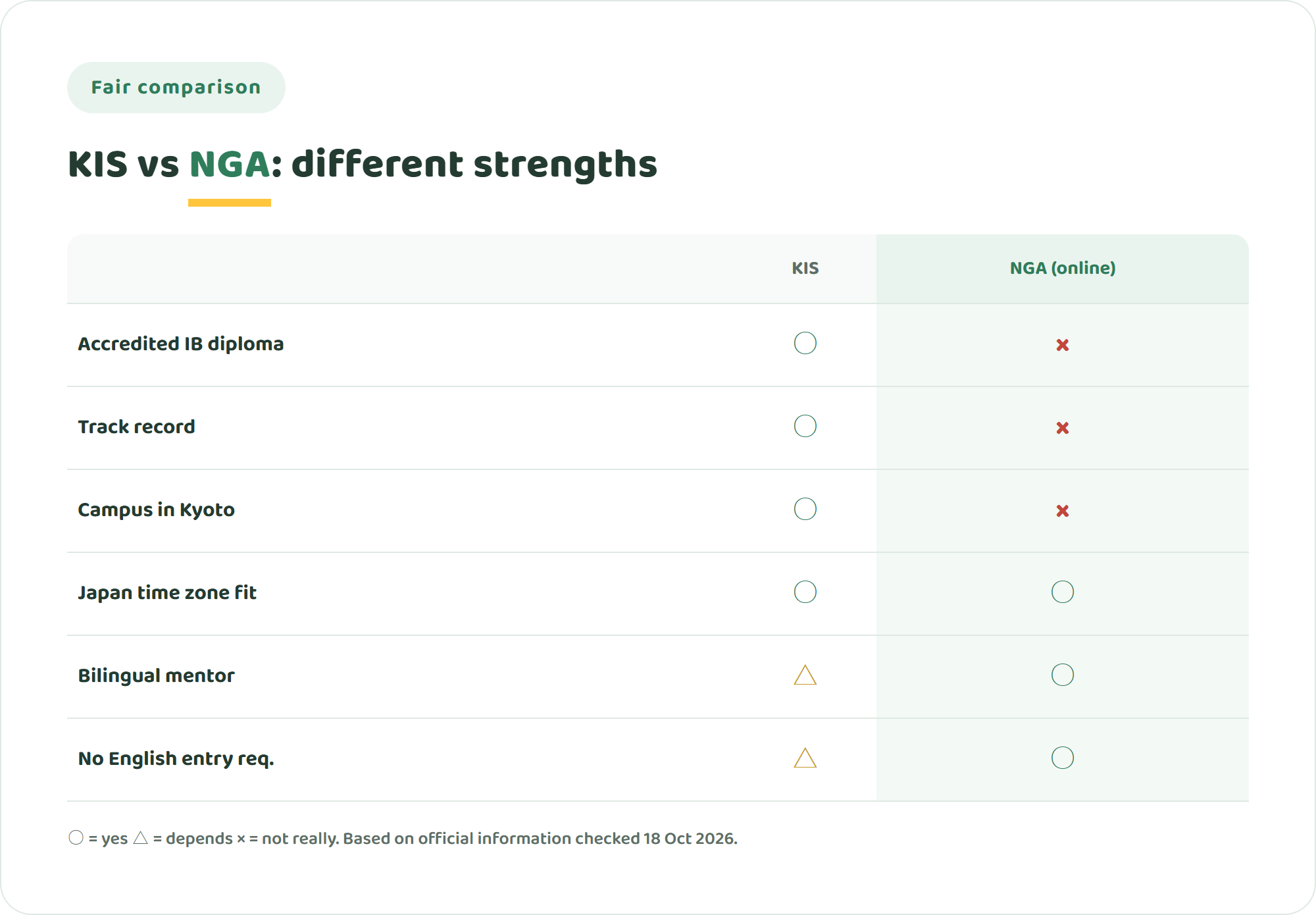
Sources: KIS Admissions and fee documents, Canadian Academy Tuition and Fees, Osaka International School Fees, Doshisha International School, Kyoto Academic Fees and Admissions, Osaka YMCA International School 2026–27 Tuition and Fees and NGA’s curriculum and timetable page — checked 18 October 2026. Each school charges further items (buses, lunches, trips, learning support) listed on its own site.

Reviews and common questions, answered factually
Families searching for “Kyoto International School review” tend to ask the same practical questions. Here is what the official site and documents say on each.
“How big are the classes?”
KIS describes small class sizes and publishes a teacher-to-student ratio of 1:6. A maximum class size per grade is not published on the official site, so ask Admissions for the current number in your child’s grade.
“What is the community like?”
The brochure gives about 30 nationalities and 70% international students. The school is not-for-profit with a parent-heavy volunteer board, an active PTA and House teams, and, as Kyoto is home to many universities and research institutes, KIS offers a dedicated Visiting Scholar Scholarship. As in any small school, a grade can be small, so friendship groups and subject choices in secondary depend on who enrols that year.
“The Diploma Programme is new — is that a risk?”
It is a fair question. KIS was authorised for the DP in 2025 and its first Grade 12 class graduates in June 2027, so there are no KIS DP results or university destination lists to read yet. On the other hand, it is an IB-authorised programme assessed externally by the IB, with college counselling from Grade 10. Families with a child entering Grade 11 may want to compare KIS with schools whose DP has a longer record, such as Osaka International School (since 1994) or Canadian Academy.
“Our child is still learning English.”
KIS does not publish a minimum English level and offers paid EAL support in the Early Years and Primary (up to ¥100,000 a year, decided by WIDA assessment) and English conversation sessions in secondary. Ask how they would assess your child and what support would look like at their grade.
“Fees keep rising.”
KIS raised tuition by 2% for 2026–27, and its own letter puts the total increase from August 2020 to June 2027 at 8.03%. Budget for further increases if you plan to stay several years.
“Do they have a bus, lunch and fixed hours?”
These are not described on the official site. Both campuses are in Kamigyo-ku in central Kyoto; confirm how your child would get to school, and what they would do for lunch, before signing a lease.
Alternatives to Kyoto International School worth comparing
Osaka International School — an IB continuum school in Minoh with a Diploma Programme dating from 1994 and a WASC 2023–28 certificate, alongside its sister school, Senri International School. Tuition is higher (¥2,270,000–¥2,828,000 for 2026–27) and admission includes tests and interviews; it suits families living in northern Osaka or commuting between Osaka and Kyoto.
Canadian Academy — a long-established IB school in Kobe for Pre-K to Grade 12, and it offers boarding (¥3,500,000 a year). Its 2026–27 tuition (¥2,100,000–¥3,370,000) and one-time fees (¥1,090,000) are the highest on this page; it suits families settling in Kobe or needing boarding.
Osaka YMCA International School — an IB PYP–MYP–DP school in central Osaka with rolling admissions and annual totals of ¥1,754,000–¥2,317,000; a fit for families living in Osaka city. Doshisha International School, Kyoto is listed in the table for completeness, but it states that it will close in 2029 and only admits new students into existing grades, so it is not an option for most families arriving now.
NIJIN GLOBAL ACADEMY (NGA) — an online international school for ages 6–18 focused on Asia and Oceania, opening in September 2027 (planned), with a first cohort of 100 students. Classes are small live dialogue groups of about 8, subjects are learned in English with a bilingual (English–Japanese) mentor, and English is taught by CEFR level; an optional Cambridge IGCSE / A-Level pathway is listed on its curriculum page. There is no academic entrance exam and no English requirement; it can run alongside a local Japanese school or as the main school, and it travels with the family if they move again. Its timetable is built for Asia–Oceania daytime, which fits Japan time. Tuition is not yet published; NGA says it will be far more affordable than a typical international school, with no enrolment, facility or uniform fees, materials included and sibling discounts. The honest limitations: it is not yet open, not yet accredited, has no graduates and no track record, and it is not a campus school — families who want daily in-person IB school life in Kyoto should choose a school like KIS. Free trial classes run monthly from September 2026. NGA is operated by NIJIN Inc. in Japan, whose alternative school NIJIN Academy has more than 1,000 students.
For a wider view, see our guides to international schools in Kyoto, international schools in Osaka and international schools in Tokyo if your posting may move. Families comparing Tokyo schools can read our British School in Tokyo fees guide, and our overview of online international schools compared explains how the online model works.
FAQ
How much does Kyoto International School cost per year?
For 2026–27, tuition is ¥1,366,800 for Preschool to Grade 5 and ¥1,761,000 for Grades 6–12. Every student also pays a ¥190,000 Building & Facilities fee, families pay ¥3,000 PTA dues, and Grade 12 adds a ¥144,000 IB Diploma fee. New students pay ¥258,650 once. A new Primary student’s first year comes to ¥1,818,450 before any EAL support.
Is Kyoto International School accredited?
Yes. KIS states that it is accredited by WASC (since 1992) and is an IB World School authorised for the PYP, MYP and Diploma Programme, and that it holds COBIS accreditation through WASC. CIS accreditation is not stated on the official site.
Can international students enrol at KIS?
Yes — KIS has about 30 nationalities and accepts students throughout the year when space allows. It has no boarding and cannot support student visa applications, so the child must live in Kyoto with family. No minimum English level is published; paid EAL support is available in the younger grades.
Is Kyoto International School worth it?
For families living in Kyoto city who want the IB from age 3 in a small, not-for-profit school, many find it is — and on official 2026–27 figures its fees and one-time costs are the lowest of the Kansai IB schools compared here. Families who need a long Diploma record, boarding or a school bus should compare it carefully with Osaka International School or Canadian Academy.
What are the alternatives to Kyoto International School?
Osaka International School (Minoh), Canadian Academy (Kobe) and Osaka YMCA International School (Osaka) are the main English-medium IB alternatives in Kansai; Doshisha International School, Kyoto is closing in 2029. For children aged 6–18 who need bilingual support or a flexible online option, NIJIN GLOBAL ACADEMY opens in September 2027 (planned); it is not yet accredited.
Does KIS offer the IB Diploma?
Yes. KIS was authorised for the Diploma Programme in 2025, opened Grade 11 in August 2025 and Grade 12 in 2026, so its first Diploma students finish in June 2027.
Choosing calmly before your move to Kyoto
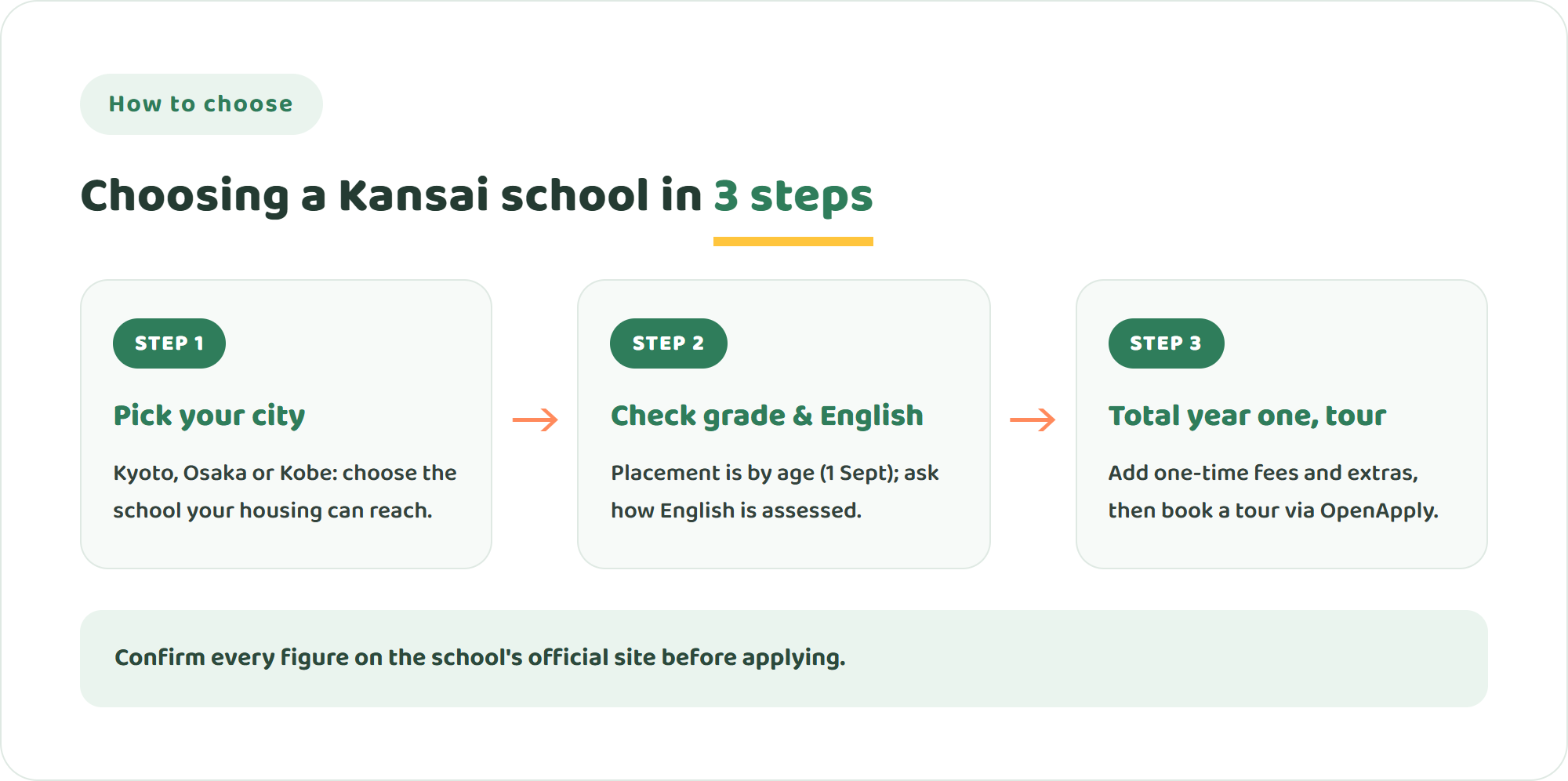
KIS is the international school of Kyoto city: small, not-for-profit, almost 70 years old, and now offering the full IB from Preschool to the Diploma. The best next steps are concrete. Check your child’s grade on the age-placement table, email Admissions with your arrival date to ask about space, ask how English would be assessed, book a tour through OpenApply, and work out the first-year cost from the official fee sheet — including the Visiting Scholar Scholarship if you are coming for research. If you will live in Osaka or Kobe, or your child is entering Grade 11, compare at least one of the other schools above. And if your plans are still uncertain — a short stay, a child still growing into English, or a gap before a seat opens — it is worth keeping one flexible option in view too. You can read more about why families choose an online international school.
Tuition and admissions details were checked on the official websites on 18 October 2026. Schools revise fees every year — always confirm on the official site before applying.