When you research an online international school, most things eventually become clear: the fees, the timetable, the name of the curriculum. One question stays fogged in right to the end — online international school graduate destinations. Where can this child actually go afterwards? The school’s site says graduates go on to universities around the world. But does that include the university your child has in mind? Does it include universities in your own country? Nobody answers that part.
The answer is not in the prospectus. It is in the entrance-eligibility rules of the country your child will apply in — and for families with a connection to Japan, those rules are published, itemised, by the Ministry of Education. Several of the items apply directly to a child who studied an overseas curriculum online. More usefully, they separate into three distinct levers.
This article lays out the three levers and turns them into three checks to complete before you enrol. It does not praise or criticise any school. It gives you the rule, and the questions to ask.

Online international school graduate destinations are decided by the rules, not the school
Start from the premise. Admission to a Japanese university requires falling under one of the items on the ministry’s published list. Graduating from a high school, completing the third year of a KOSEN, passing the equivalency examination — those are widely known.
What gets overlooked is that the same list carries several items for people who studied abroad or hold international qualifications. Choose a school without reading them and you can discover, years in, that the credential does not qualify. Read them first and the questions to ask a school write themselves.
Three levers, and they are not equivalent
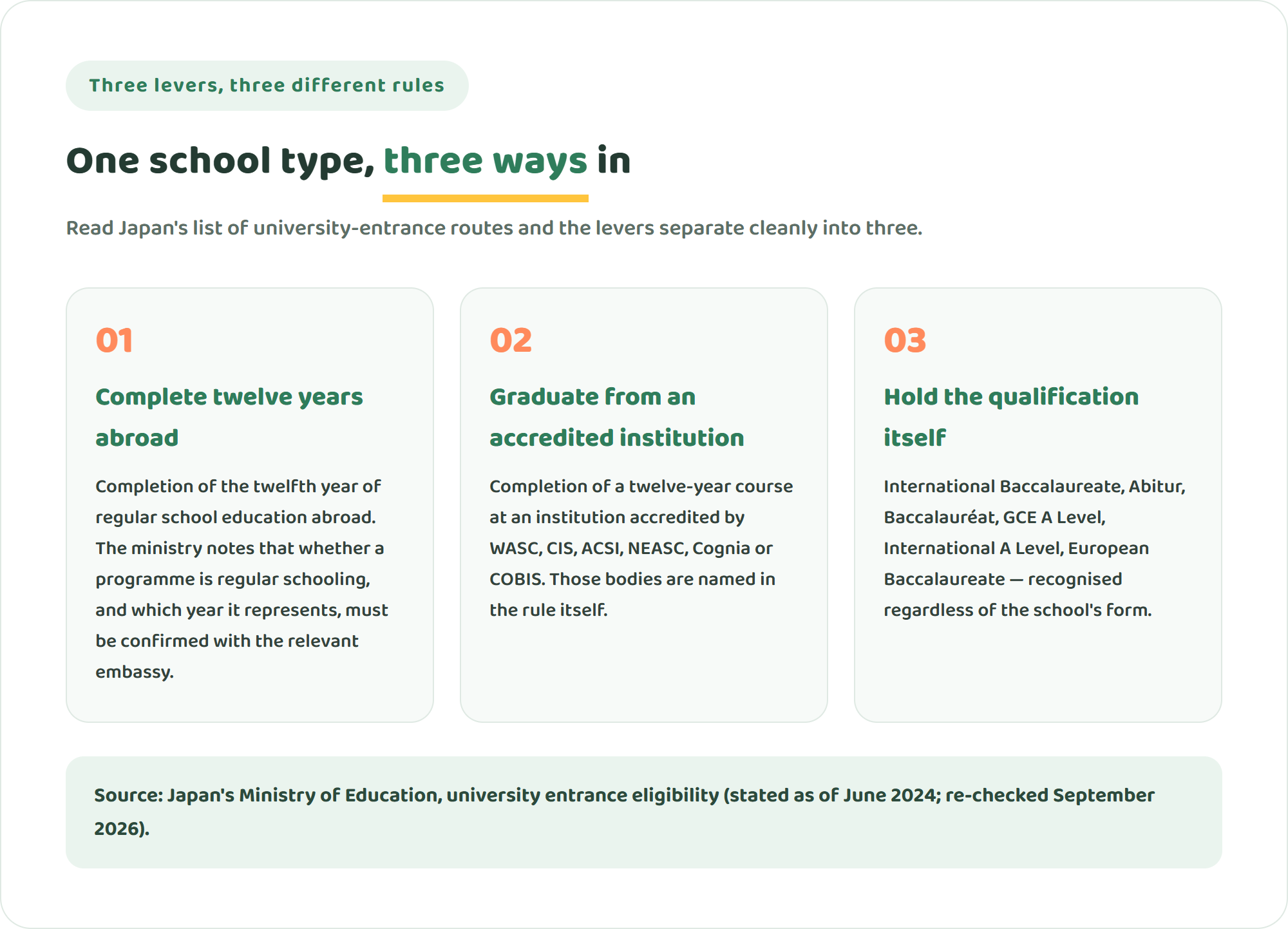
Lever 1: complete twelve years of school education abroad
The list includes “a person who has completed a twelve-year course of school education in a foreign country”. Where a course runs shorter than twelve years, a designated preparatory course must also be completed.
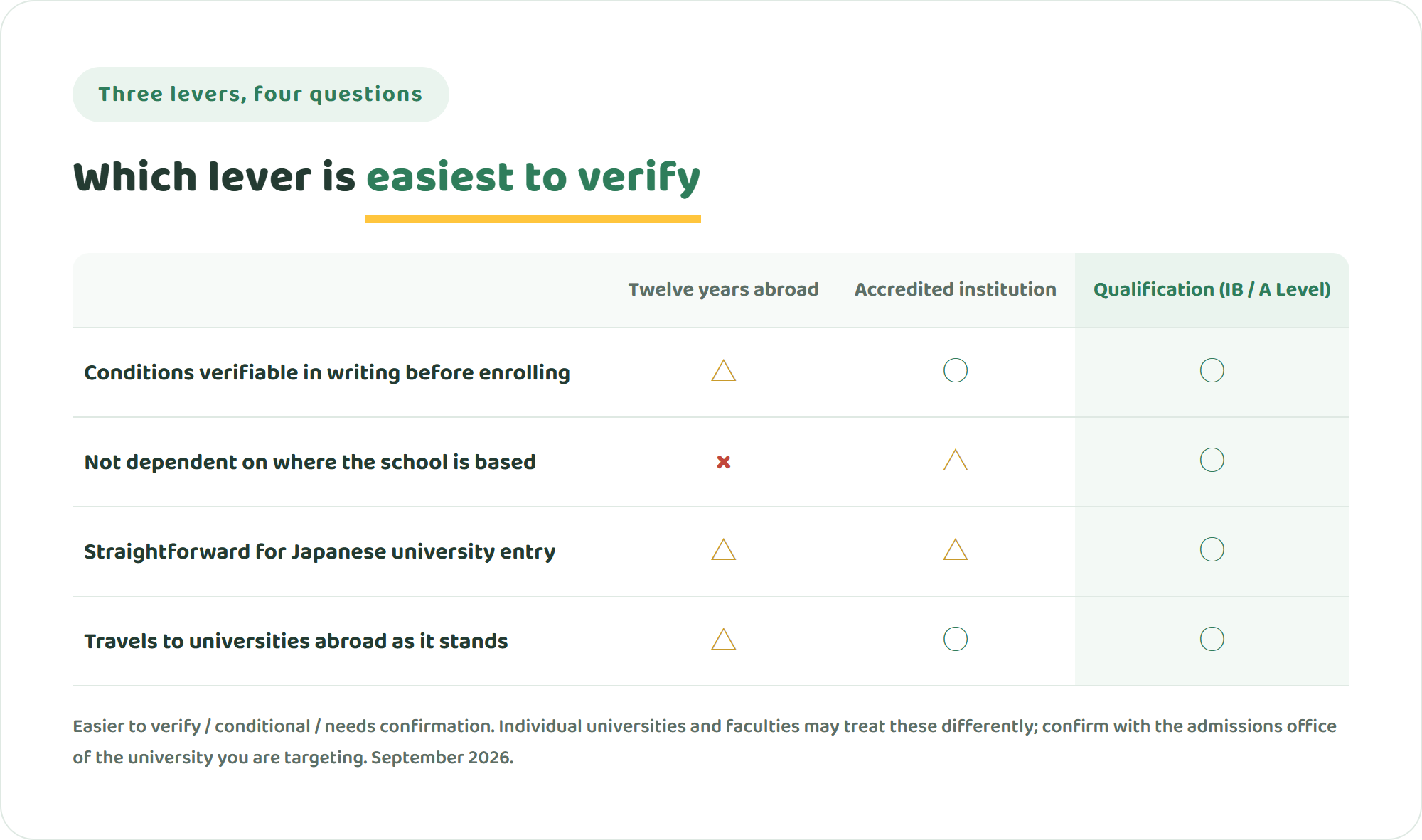
The critical part is the ministry’s own footnote: this means completing the twelfth year of a foreign country’s regular school education, and whether a given course counts as regular school education — and which year it represents — must be confirmed with that country’s embassy. So finishing an overseas programme online does not automatically constitute “the twelfth year of regular schooling”. It depends on how the programme sits within its own country’s system. Of the three levers, this is the hardest one to pin down before enrolling.
Lever 2: complete a twelve-year course at an accredited institution
The same list includes a person who has completed a twelve-year course at an institution accredited by an international accrediting body — WASC, CIS, ACSI, NEASC, Cognia or COBIS. The bodies are named in the rule. A footnote adds that accreditation under CIS’s former name, ECIS, is also recognised.
Which means that while you are still choosing, you can verify this yourself. Schools usually list their accreditors in the site footer or on an About page: read them, and check them against those six names. This lever is easier to confirm than the first and leaves a wider field of schools than the third.
Lever 3: hold the qualification itself
And this is the most robust of the three. The list includes a person who holds a foreign university entrance qualification: the International Baccalaureate, Abitur, Baccalauréat, GCE A Level, International A Level or European Baccalaureate.
Its strength is that it does not depend on the school’s form or location. The test is whether the qualification is held, not where it was studied for. A child who studied online and holds A Levels falls under this item. The same qualifications also function as a common language when applying to universities abroad. How IGCSEs and A Levels work in practice from Japan is covered in taking IGCSEs online from Japan.
All three are valid. They are not equally checkable
This is the practical heart of it. What differs is how much you can confirm before you commit money.
Lever 1 ultimately routes through an embassy enquiry, so it is hard to settle in writing in advance. Lever 2 is a matter of comparing the accreditors a school publishes against six names in a rule — you can do it this afternoon. Lever 3 is the clearest of all, because the qualification is named in the rule itself.
So when choosing an online international school, a school where lever 2 or lever 3 is available will cause you far less trouble later. Two questions settle most of it: “Who accredits you?” and “Which qualifications can a student obtain here?”
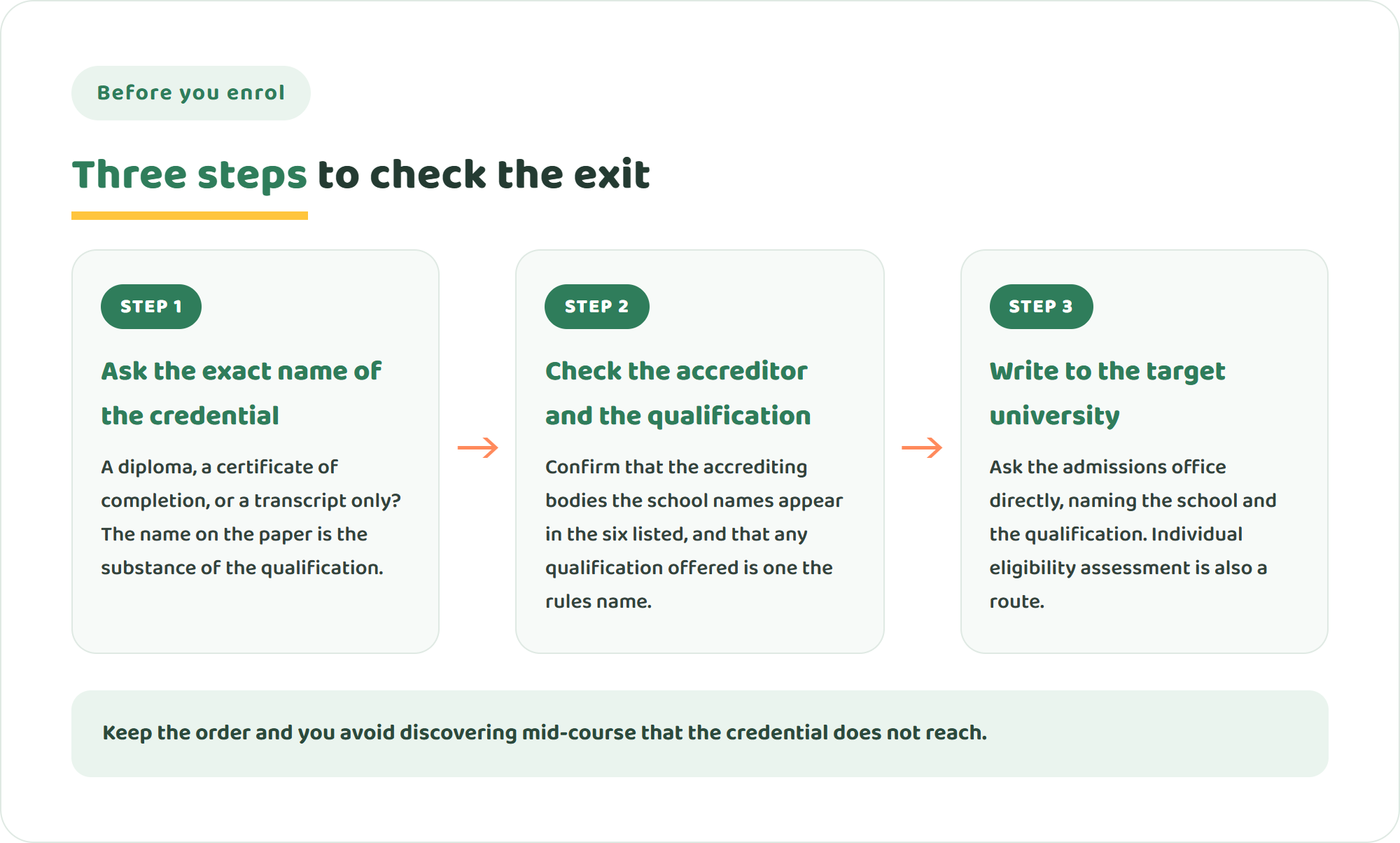
Three checks to complete before you enrol
A few hours of work, plus a fortnight of waiting for replies. Considerably cheaper than finding out afterwards.
Check 1: ask the exact name of the credential. Not “can my child graduate?” but “what is the formal name of the document issued on completion?” A High School Diploma, a Certificate of Completion, or a Transcript only? The name on the paper is the substance of the qualification. This is the step families most often leave vague.
Check 2: match the accreditor and the qualification against the rule. Note the accrediting bodies the school publishes and compare them with the six named in the ministry’s list (WASC, CIS, ACSI, NEASC, Cognia, COBIS). If none matches, you are relying on lever 1 or lever 3, which changes what the next check has to establish. In the same email, ask which of the named qualifications — IB, GCE A Level, International A Level — a student can actually obtain there. “Students may sit the exams” and “the school prepares students and arranges the centre” are different claims. Ask who sits them, and where.
Check 3: write to the university you are targeting. Finish at the admissions office. Name the school and the qualification and ask whether it is accepted for entrance eligibility. The ministry’s list also includes “a person aged 18 or over whom a university has accepted through its own individual eligibility assessment”, so a credential that does not map neatly onto an item has not closed the door — it means preparing on the basis that individual assessment will be needed.

Decide the exit and the school list shortens itself
You may have noticed the order most families use: find a school that looks good, think about destinations later. Read from the rules, it runs the other way — settle which item will carry your child’s eligibility, and the field of schools narrows on its own.
If a Japanese university is the main target, you want a school where lever 3 is available or lever 2 is unambiguous. If a university abroad is the target, you want a school issuing a qualification that the destination country reads fluently. And if you genuinely cannot choose yet, the arrangement that keeps the most doors open is to keep the local school place and add subject learning in English alongside it — the domestic diploma is secured where the child is already enrolled, while the English-medium experience accumulates. The wider set of routes at high school age is laid out in seven high school pathway options in Japan, and what happens to international school graduates in practice is covered in career outcomes for international school graduates, and the reasoning behind our own “add, don’t replace” design is in how we learn.
Questions families ask
Can a graduate of an online school apply to a Japanese university?
There are recognised routes, but not automatically. It depends on whether the programme counts as the twelfth year of regular schooling abroad, whether the institution is accredited by one of the six named bodies, or whether the student holds a qualification such as the IB or GCE A Level. Verify it by naming the school and the credential — and confirm with the admissions office, which makes the final judgement.
Should we rule out schools whose accreditor is not on the list of six?
No. If the school leads to an internationally recognised qualification, that route stands, and individual eligibility assessment remains available. What increases is the amount of verification you have to do and the residual uncertainty. Read it as “more to check”, not “not allowed”.
Can our child study at an online international school without leaving their current school?
Yes, and many families do exactly that: the domestic diploma is secured at the school where the child is enrolled, while subjects studied in English accumulate alongside. While the destination is still undecided, this is the arrangement that forecloses the least.
Does the same checking apply if we are aiming abroad?
Checks 1 and 3 are identical. In place of check 2, read the entry requirements published by the universities and countries you are targeting — the number of A Level subjects, IB score, English evidence. Where applications will span several countries, lever 3 is the one that travels.
Read the rule before the prospectus
Where an online international school leads is determined by entrance-eligibility rules, not by a page of alumni destinations. Three levers do the work: twelve years abroad, accreditation by a named body, or the qualification itself. The third is the easiest to verify and the first the hardest — which is why the two questions to put to any school are: who accredits you, and which qualifications can a student obtain here?
And until the exit is settled, keeping the local school place while adding English-medium learning is the safe position. Sometimes not deciding is what keeps the most roads open.
NIJIN GLOBAL ACADEMY opens in September 2027 (planned), with a pre-opening term of trial classes in April–May 2027: subjects taught in English in small, talk-based classes, designed to run alongside the school a child already attends. Join the mailing list for the design, the fees and first-intake details. Nothing about your child’s pathway needs deciding today — just keep the checklist.