“High paying jobs using English.” If you searched that, you want your English to stop being a hobby or a line on a CV and start showing up in your income. So let us start with numbers. Read across published job listings for English-using roles and the advertised pay spreads roughly from the equivalent of USD 25,000 to well over USD 150,000 a year — a six-fold gap inside the same category. Why does the same “job that uses English” pay so differently? For reference, we at NIJIN GLOBAL ACADEMY (NGA) will be blunt about our own terms: internationally, founding roles begin as volunteer positions ahead of our 2027 opening, with detailed terms shared later in the process. This article exists to take that spread apart honestly.
One thing up front: this piece will not tell you that “English alone makes you rich.” Read enough listings and you find that high pay is rarely attached to language ability itself. What moves the figure is English multiplied by expertise. We will go in order: the real pay ranges by role (hedged and honest), the multiplication structure that actually moves income, and a third way of working — business roles beyond teaching, and an honest account of how our own international track starts.
High paying jobs using English: the ranges you can see in job listings
First, a feel for the market. Every figure below is a range visible in job listings on recruitment sites, and it varies enormously by role, experience, company size, and country. These are not authoritative statistics. With that said, the pattern is consistent. English teaching and language-school roles cluster in the lower band, often the equivalent of USD 25,000–40,000. In-house interpreting and translation, trade administration, and export sales support sit around USD 30,000–55,000. Sales and customer success at multinationals, with incentives, are often advertised at USD 45,000–90,000. In tech, consulting, and finance at global firms, listings frequently run USD 80,000–150,000 and above. International school teaching varies so much by school and country that a single going rate is genuinely impossible to state.
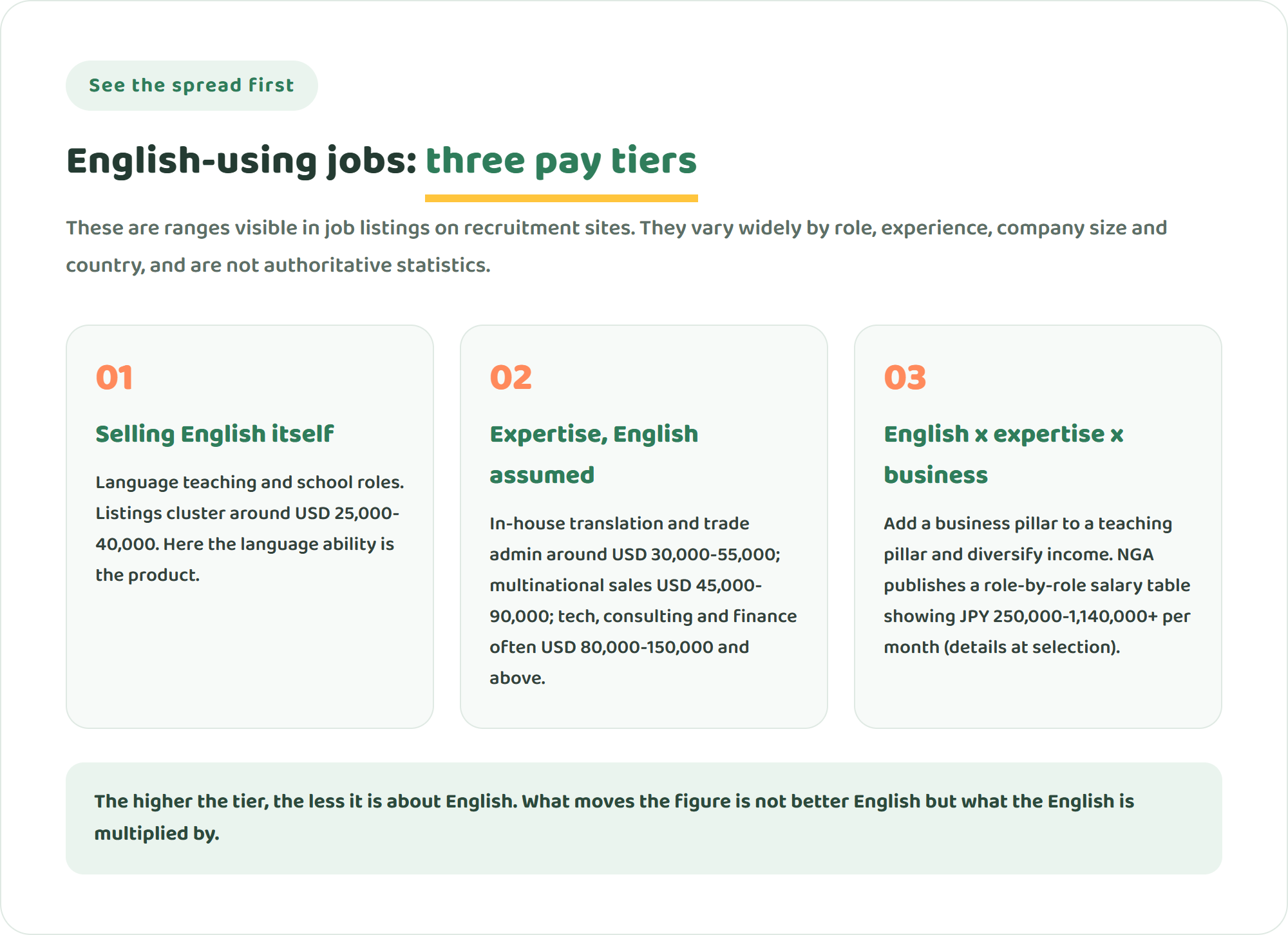
What the ladder shows is that the higher the band, the less it is about English. The lower band is where English itself is the product. The upper band is where English is simply assumed, and finance, engineering, legal, strategy, or learning design sits on top of it. The gap is not created by better English; it is created by what the English is multiplied by. Mistake that, and you can spend years raising a test score while your income stays flat. If you want the same lens applied to school pay, our piece on the international school teacher salary breaks down the variables that move it.
Why “good English equals high pay” does not hold — the multiplication structure
This is the heart of the article. English on its own moves income surprisingly little, for a simple reason: far more people speak it well now. When scarcity falls, the price attached to that skill alone falls with it. This is not an argument against studying English — it is the opposite. English works hardest when you place it on the left side of a multiplication. Plenty of people speak English. Plenty of people have expertise. The number of people who hold both, and can do expert work in English, drops sharply. Scarcity lives at that intersection.
The right side of the multiplication can be something you already own: instructional design, curriculum development, data, web, marketing, hiring, operations, sales. Skills built in a classroom count too — moving a whole group at once, structuring complex ideas so they land, reading comprehension in real time. Those transfer cleanly to the business side. If you have the English and the expertise but nowhere that values both, that is not a capability problem; it may be a problem of where your multiplication lands. Compare three ways of using English below.
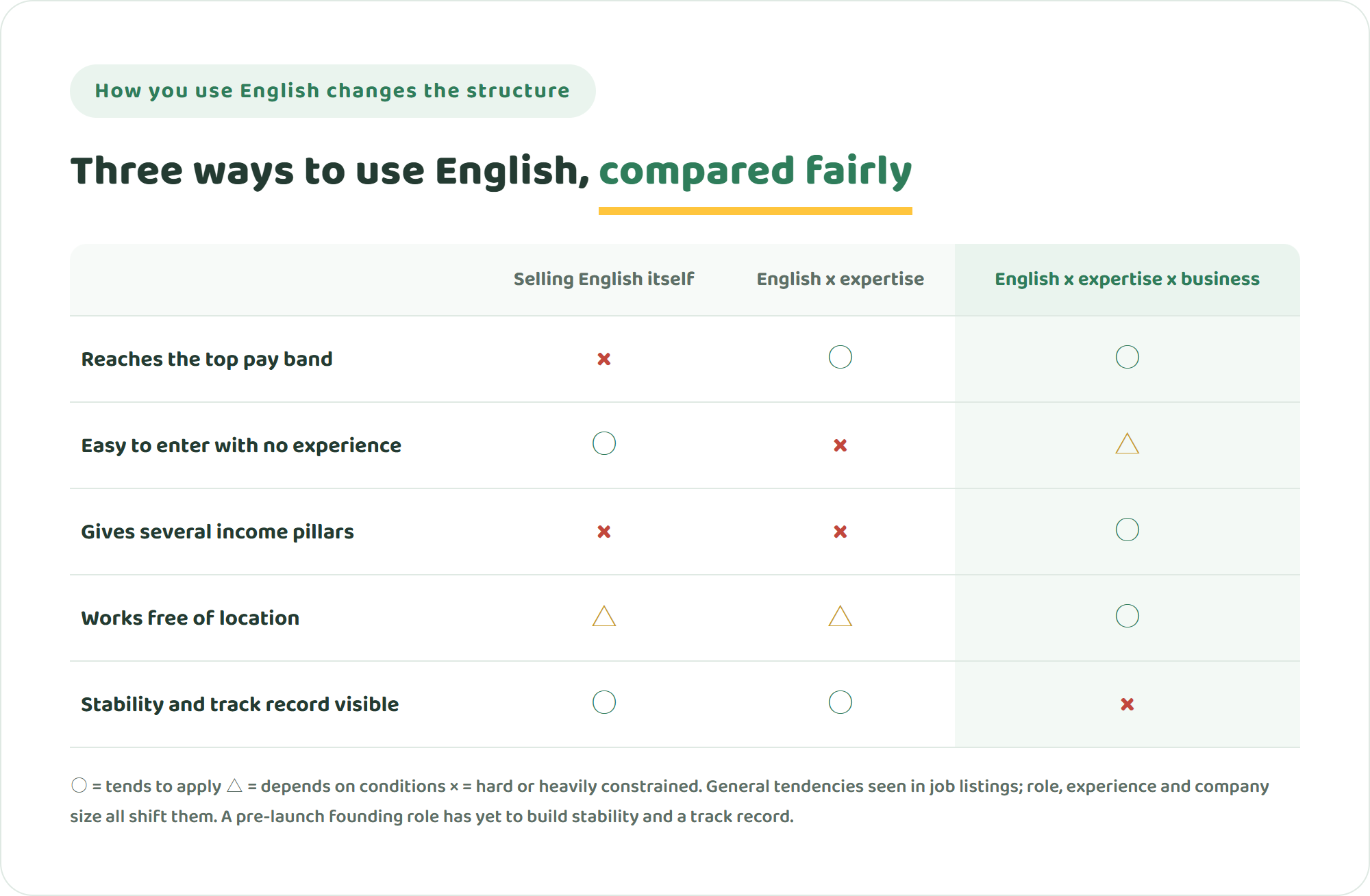
As the table makes plain, the multiplication route is not a cure-all. Carrying several roles does not suit someone who wants to sink deep into one specialism, and in a launch phase, stability and track record are still to come. Even so, a structure with several income pillars, grown by multiplying English with expertise, is a realistic hedge against staking your whole life on one market rate. If location freedom matters to you as well, see remote jobs using English.
See NIJIN GLOBAL ACADEMY’s founding-member roles → — internationally, founding roles begin as volunteer positions ahead of the opening, with detailed terms shared later; worth knowing before you decide anything.
A third way of working — terms stated plainly, and English x education x business
The hardest part of the pay question is usually opacity: you will not really know what you earn until you are inside. The founding-member roles that NIJIN GLOBAL ACADEMY (NGA) is recruiting for ahead of its September 2027 opening face that head-on. First, we say plainly what the terms are — founding roles on this track begin as volunteer positions ahead of our September 2027 opening, and the detailed terms are shared later in the process. Putting the awkward money conversation in the open from day one is our stance on transparency.
Second, the multiplication becomes the job itself. Founding members choose their involvement across five working styles spanning teaching, marketing, web, partnerships, and HR. The “English x expertise” from the previous section becomes your actual remit. Third, it is fully remote — designed around working while traveling the world, with no fixed location. What we ask is roughly English at CEFR B2+ and an appetite for building from zero. We look at that drive more than at a glossy résumé. NGA stands for learning beyond test scores, with small-group dialogue at the centre. Careers can also continue across the eleven companies of the NIJIN group.
Turning English into income — three steps
“Multiply your skills” is easy to say and hard to start. Break it into three manageable steps.
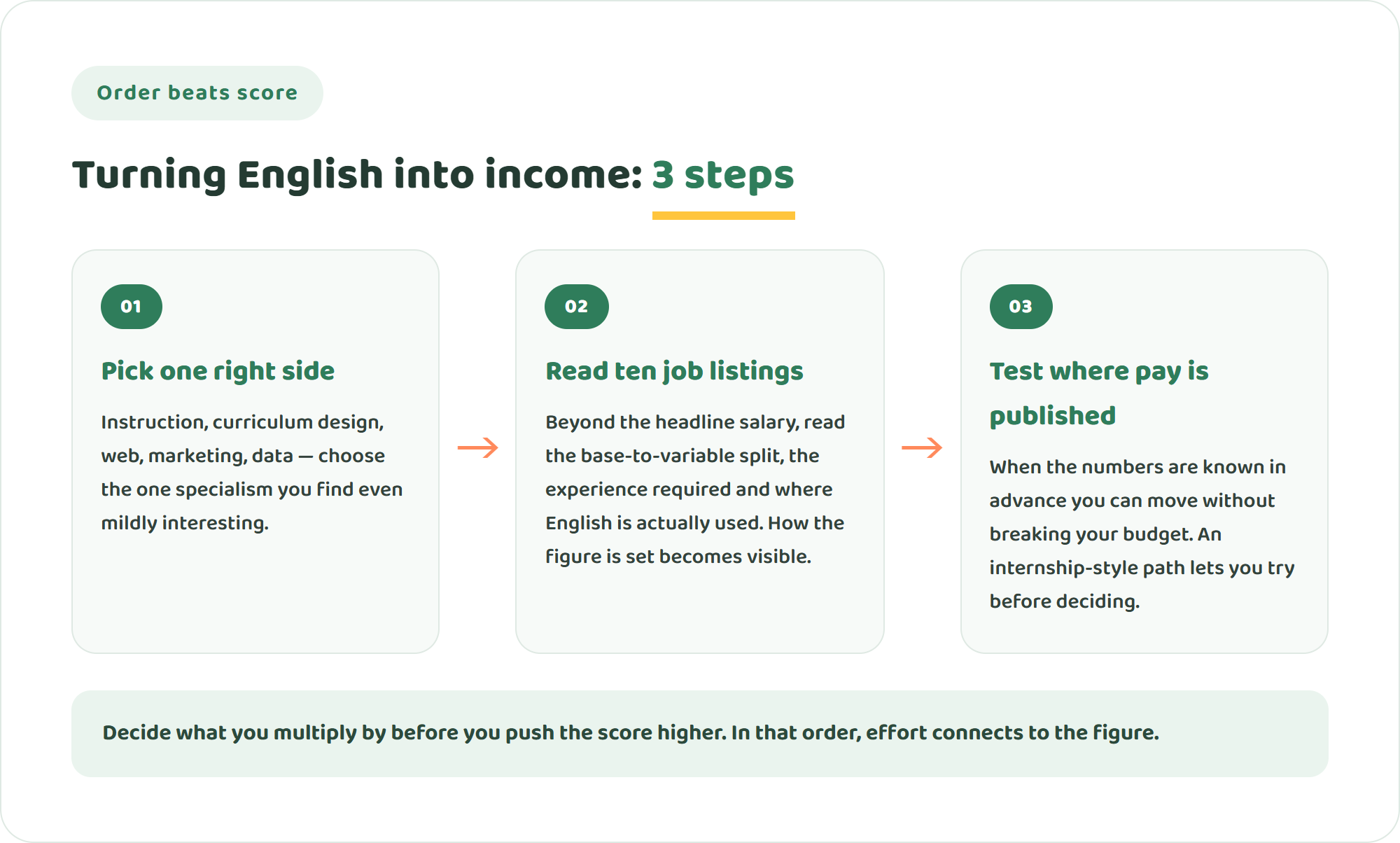
First, pick one right side: instruction, curriculum design, web, marketing, data — whichever direction you find even mildly interesting. Second, read ten listings for that combination. Beyond the headline salary, read the split between base and variable pay, the experience required, and where English is actually used. Ten listings make it concrete: how the figure is set, and what you are still missing. Third, test small somewhere the terms are stated plainly. When you know how a role actually starts before you commit, you can take a step without breaking your household budget. NGA’s process runs documents, group interview, an internship at NIJIN Academy, and a final presentation (applications via Google Form). Being able to try before deciding is a practical design if income security is your worry.
FAQ
Which English-using job pays the most?
By advertised ranges, tech, consulting, and finance at global firms tend to sit at the top. But it varies hugely by role, experience, company size, and country — two listings with the same job title can differ by a factor of two. Choosing by how much your expertise is worth in English tends to move the figure more than choosing by job title.
Will raising my test score raise my pay?
A score widens the doors open to you, but on its own it rarely moves the figure much. In most listings, English appears as an eligibility condition, while the pay is tied to expertise and results. Decide the right side of the multiplication first, and the same study effort pays back far better.
Can I move from teaching toward higher pay?
Yes. The design, communication, and group-building skills built in a classroom are exactly what business roles need. NGA is looking for people who can take something from zero to one, and you can grow a second pillar while keeping the teaching one. You do not have to give up the work you love.
Why does knowing the terms up front matter?
It prevents the “this is not what I was told” regret — which is exactly why we say the uncomfortable part out loud: internationally, founding roles at NGA begin as volunteer positions ahead of the 2027 opening. The full terms are explained later in the process, and knowing that now is worth more than a figure we could not honestly promise.
English works hardest on the left side of a multiplication.
If you searched “high paying jobs using English,” you are looking for a place where what you have is properly valued. That instinct is right. But income is moved by structure — by what your English is multiplied by — not by a score. Choose what to multiply, stand where that combination is needed, and test it somewhere the terms are stated plainly. Change only the order, and the English and expertise you already built finally start connecting to the figure. The steering wheel stays in your hands.
Working at an International School — More Articles
- international school teacher salary
- how to become an international school teacher
- career change from teaching
- career change from teaching in your 30s and 40s
- how much do teachers earn?
- how to become an IB teacher
- jobs for moving abroad
- school principal salary in Japan
- how the Japanese teacher pay scale works
- teacher bonuses in Japan
- private school teacher salary in Japan
- international school staff jobs
- elementary school teacher salary in Japan
- junior high school teacher salary in Japan
- high school teacher salary in Japan
- remote teaching jobs
- international school teaching jobs
- teaching jobs without a license
Take your English and your expertise into a new way of working.