Whether you have just landed an assignment in Thailand or are planning a family relocation, choosing among the international schools in Bangkok can feel overwhelming — there are simply so many. This guide gives you the essentials in one place: seven genuinely strong schools across different price bands, a quick-reference tuition fee table, an area-by-area guide (Sukhumvit, Sathorn, Bang Na and more), how to pick by curriculum (IB, British, American), admissions timing and the ED visa, and an honest framework for deciding which type of school fits your family. No rankings for the sake of rankings — just what you need to make a confident decision.
Quick Answer: Your Options in Bangkok
If you only read one section, read this. Below are the schools covered in this guide, plus the online option — so you can see every route side by side before the details.
- NIST International School — Ages — 3–18 / Tuition guide — approx. THB 630,000–1,095,000 per year (public info as of 2026; confirm…
- Bangkok Patana School — Ages — 2–18 / Tuition guide — approx. THB 545,000–1,044,000 per year (public info as of 2026; confirm…
- International School Bangkok (ISB) — Ages — 3–18 / Tuition guide — approx. THB 800,000–1,200,000 per year (public info as of 2026; confirm…
- Shrewsbury International School Bangkok Riverside — Ages — 3–18 / Tuition guide — approx. THB 720,000–1,120,000 per year (public info as of 2026; confirm…
- Harrow International School Bangkok — Ages — 18 months–18 years (day and boarding) / Tuition guide — approx. THB 700,000–1,037,000 per year for day students (public info as…
- St Andrews International School Bangkok (Sukhumvit 107) — Ages — 2–18 / Tuition guide — approx. THB 362,000–849,000 per year (public info as of 2026; confirm…
- Wells International School — Ages — 2–18 / Tuition guide — approx. THB 240,000–522,000 per year (public info as of 2026; confirm…
- NIJIN GLOBAL ACADEMY (online) — Ages 6–18 / opening September 2027, currently taking opening-update registrations / fees around one-fifth of a typical campus international school / Japanese-language support. An option when commute or fees are the wall.
Can’t justify Bangkok international school fees?
Families in Bangkok often face the same wall: the school is right, the fee is not. NIJIN GLOBAL ACADEMY is an online international school with no campus — and no campus fees. Live, small-group lessons in English, at roughly one-fifth the cost of an in-person international school. It is built for children who are not yet fluent in English, so you do not need an English-speaking household to start.
🎁 Register and we will email you the school prospectus (English & Japanese) straight away — plus tuition and trial-class details before anyone else.
Free to join. Unsubscribe any time.
International Schools in Bangkok: The Landscape and Typical Fees
Greater Bangkok is home to more than 100 international schools, spanning British, American, and IB curricula, plus Cambridge, Singaporean, and bilingual programmes. Quality at the top end rivals anywhere in the world, and the mid-tier has grown rapidly, giving families far more room to match budget and philosophy than a decade ago. If you are weighing options across the region, compare with our guides to international schools in Singapore and international schools in Manila.
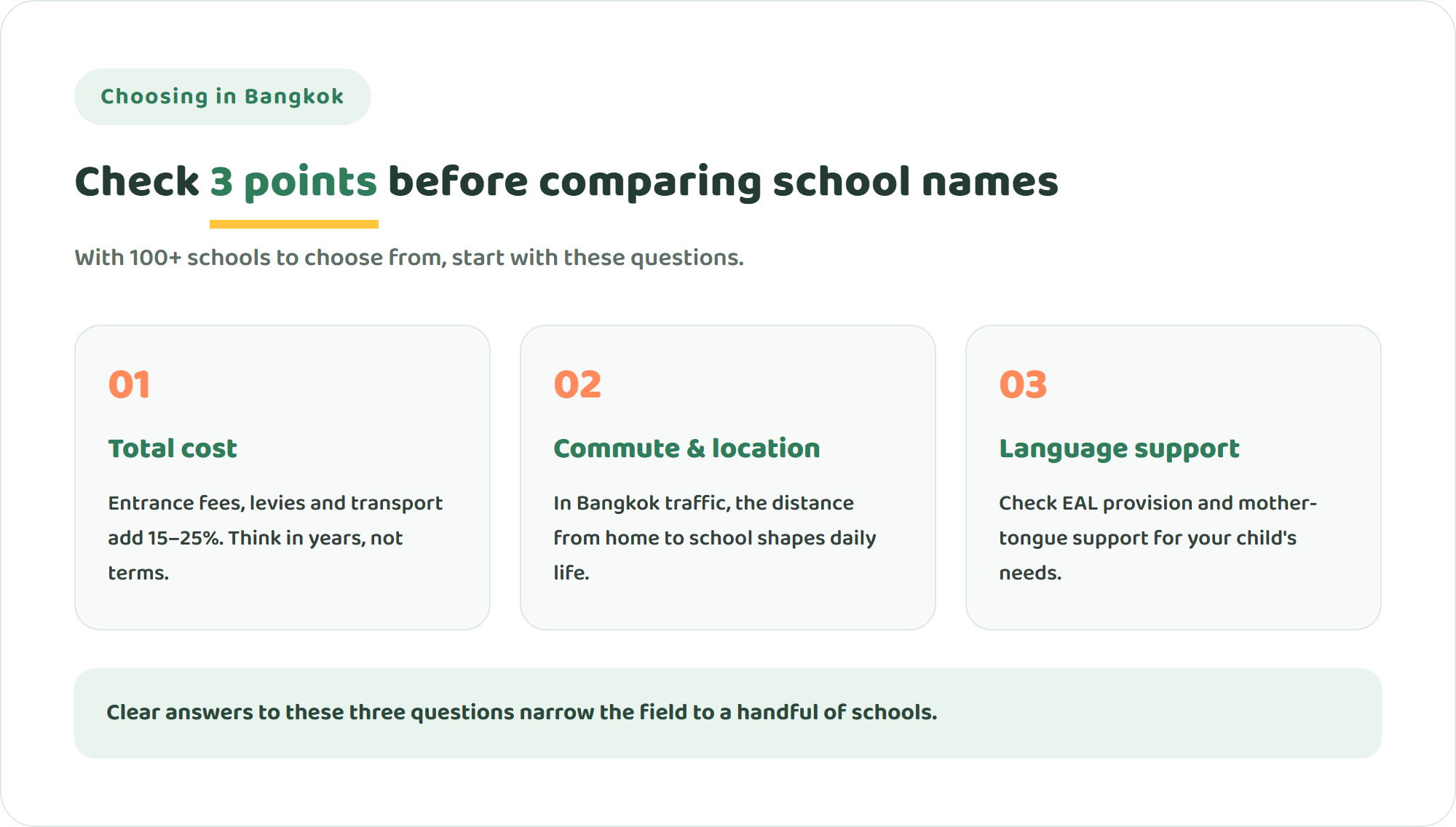
Annual tuition ranges roughly from THB 200,000 to over THB 1,200,000 (about USD 5,500–33,000) depending on the school and year level. Independent databases put the average Bangkok international-school fee at around THB 575,000, from a low near THB 104,000 to a high around THB 1,159,000 (source: International Schools Database). On top of tuition, budget for one-time entrance fees (often THB 100,000–300,000 at established schools), capital or development levies, transport, and lunches — extras can add 15–25% to the headline figure. For a full breakdown of what international school fees actually include, see our guide to international school tuition and costs. Note: all fees below are based on publicly available information as of July 2026 — always confirm current figures on each school’s official website.
Bangkok International School Tuition: Quick-Reference Fee Table (2026-27)
Here is the whole picture on one screen. The table below shows the annual tuition range (lowest to highest year group) for our seven featured schools, alongside area and curriculum. Tuition does not include entrance fees, development levies, or transport.
| School | Area | Curriculum | Annual tuition (THB) | Approx. USD |
|---|---|---|---|---|
| NIST International School | Sukhumvit (Soi 15) | Full IB | 630,000–1,095,000 | $17,500–30,400 |
| Bangkok Patana School | Bang Na | British + IBDP | 545,000–1,044,000 | $15,100–29,000 |
| International School Bangkok (ISB) | Nonthaburi (Nichada) | American + IBDP/AP | 800,000–1,200,000 | $22,200–33,300 |
| Shrewsbury (Riverside) | Chao Phraya Riverside | British (A Levels) | 720,000–1,120,000 | $20,000–31,100 |
| Harrow International School | Don Mueang (north) | British (+ boarding) | 700,000–1,037,000 | $19,400–28,800 |
| St Andrews (Sukhumvit 107) | Sukhumvit 107 | British + IBDP | 362,000–849,000 | $10,100–23,600 |
| Wells International School | On Nut / Sukhumvit | American (AP) | 240,000–522,000 | $6,700–14,500 |
USD figures are approximate (≈ THB 36 = USD 1) and rounded. Ranges reflect publicly available information as of July 2026 and vary by year group and options. Entrance fees (THB 100,000–300,000), development levies, and transport are additional. Confirm current figures with each school.
The 7 Best International Schools in Bangkok (2026)
Here are seven schools chosen for reputation, curriculum diversity, and a realistic spread of price bands. This is not a ranking — the right school depends on your child and your circumstances.
1. NIST International School
NIST was founded to serve United Nations families and remains Thailand’s original full-IB school. Located on Sukhumvit Soi 15 in the heart of the city, it enrols students from more than 60 nationalities — arguably the most internationally diverse community in Bangkok.
- Curriculum — Full IB continuum (PYP, MYP, DP)
- Ages — 3–18
- Tuition guide — approx. THB 630,000–1,095,000 per year (public info as of 2026; confirm with the school)
- Best for — Families who prioritise IB education and genuine diversity, with a central-city commute.
2. Bangkok Patana School
Founded in 1957, Bangkok Patana is Thailand’s oldest British international school. Its leafy Bang Na campus offers exceptional facilities, and the school’s all-round strength — academics, sport, and the arts — has earned decades of trust from expatriate families.
- Curriculum — English National Curriculum, IGCSE, IB Diploma
- Ages — 2–18
- Tuition guide — approx. THB 545,000–1,044,000 per year (public info as of 2026; confirm with the school)
- Best for — Families seeking a well-rounded British education with heritage and first-class facilities.
3. International School Bangkok (ISB)
ISB, established in 1951, is the city’s flagship American-curriculum school. It sits inside the Nichada Thani community in Nonthaburi, where many families live within walking distance of campus. Strong mother-tongue programmes (including Japanese) support its large multinational community.
- Curriculum — American curriculum with IB Diploma and AP options
- Ages — 3–18
- Tuition guide — approx. THB 800,000–1,200,000 per year (public info as of 2026; confirm with the school)
- Best for — Families wanting an American pathway and a self-contained campus community, open to suburban living.
4. Shrewsbury International School Bangkok Riverside
Shrewsbury Riverside is the Bangkok sister school of one of England’s most storied public schools. Set on the Chao Phraya River, it is known for academic rigour and consistently strong placements at top UK universities.
- Curriculum — British (IGCSE, A Levels)
- Ages — 3–18
- Tuition guide — approx. THB 720,000–1,120,000 per year (public info as of 2026; confirm with the school)
- Best for — Academically driven families with UK university ambitions.
5. Harrow International School Bangkok
Harrow Bangkok was the first overseas school of the 450-year-old Harrow School in London. Its vast lakeside campus near Don Mueang offers a classic British education with leadership development at its core, plus optional boarding.
- Curriculum — British (IGCSE, A Levels)
- Ages — 18 months–18 years (day and boarding)
- Tuition guide — approx. THB 700,000–1,037,000 per year for day students (public info as of 2026; boarding extra; confirm with the school)
- Best for — Families drawn to a heritage British brand and whole-person education, especially those living north of the city.
6. St Andrews International School Bangkok (Sukhumvit 107)
St Andrews, part of the global Nord Anglia group, delivers a British and IB education at a noticeably gentler price point than the elite tier. Its warm, genuinely international community — including many Japanese and Asian expat families — and strong EAL support make it one of Bangkok’s most welcoming schools for children new to English.
- Curriculum — British curriculum with IB Diploma
- Ages — 2–18
- Tuition guide — approx. THB 362,000–849,000 per year (public info as of 2026; confirm with the school)
- Best for — Families seeking strong value, a caring community, and support for children still building their English.
7. Wells International School
Wells runs several campuses along Sukhumvit (including On Nut) and offers an American curriculum at less than half the cost of the premium tier. Smaller classes and a family-like atmosphere make it a standout among Bangkok’s genuinely affordable international schools.
- Curriculum — American curriculum with AP courses
- Ages — 2–18
- Tuition guide — approx. THB 240,000–522,000 per year (public info as of 2026; confirm with the school)
- Best for — Families who want an international education on a realistic budget without leaving central Sukhumvit.
International Schools in Bangkok by Area
Bangkok is famous for its traffic — so in practice, where you live and how long the commute is settles half the decision. Here is how the main areas compare.
- Sukhumvit (Phrom Phong, Thong Lo, Ekkamai, On Nut) — the central expat heartland, well served by the BTS. NIST (Soi 15), St Andrews (Soi 107) and Wells (On Nut) are all within reach, alongside international hospitals and supermarkets.
- Sathorn / Silom (central business district) — the office core for many postings, with easy access to city-centre schools and riverside Shrewsbury along the Chao Phraya.
- Bang Na (south-east) — a green, family-friendly district built around Bangkok Patana’s large campus, with plenty of family housing.
- Nonthaburi (Nichada Thani) — effectively a “school town” around ISB, where an established expat-family community lives beside campus.
- Don Mueang (north) — home to Harrow’s expansive campus; further from the centre but convenient if you live on the city’s north side.
With traffic, a one-way morning commute of an hour is not unusual. Families who prioritise “a school we can actually reach every day” over “the school we dreamed of” tend to last the longest.
Choosing by Curriculum: IB, British, or American?
Bangkok’s schools fall into three broad curriculum families. Working backwards from your child’s likely next step — repatriation, an overseas university, or staying international — makes the choice far clearer.
| Curriculum | Character | Example schools | Best suited to |
|---|---|---|---|
| IB (International Baccalaureate) | Inquiry-led, globally recognised; broad university access worldwide | NIST, Patana, ISB (DP) | Families keeping universities worldwide in view |
| British (IGCSE, A Levels) | Fewer subjects, studied in depth; strong for UK universities | Shrewsbury, Harrow, St Andrews | Families aiming at UK / Commonwealth universities |
| American (AP) | Broad, flexible; aligns naturally with US colleges | ISB, Wells | Families eyeing US universities or a flexible path |
Admissions Timing, Mid-Year Entry, and the ED Visa
Relocations rarely arrive on a convenient schedule, so it helps to know how enrolment works before you need it.
- Academic year — Most British and IB schools follow an August-start, three-term calendar, and American schools also begin in August. Note this is about six months out of step with a Japanese April start.
- Mid-year entry — Many schools accept transfers mid-term when seats are available. Popular schools and year groups build waiting lists, so enquire the moment a posting is confirmed.
- Documents you’ll need — Typically recent report cards, proof of enrolment, passports, and vaccination records; some schools add an English assessment or interview.
- ED (education) visa — School-age children usually hold a Non-Immigrant ED visa based on their enrolment. Schools often assist with the paperwork, so ask during the application process.
Comparing Your Options: Which Type of School Fits Your Family?
Step back from individual names and Bangkok’s options fall into three broad types: top-tier schools, mid-range and newer schools, and — increasingly — online international schools. Each has honest trade-offs.
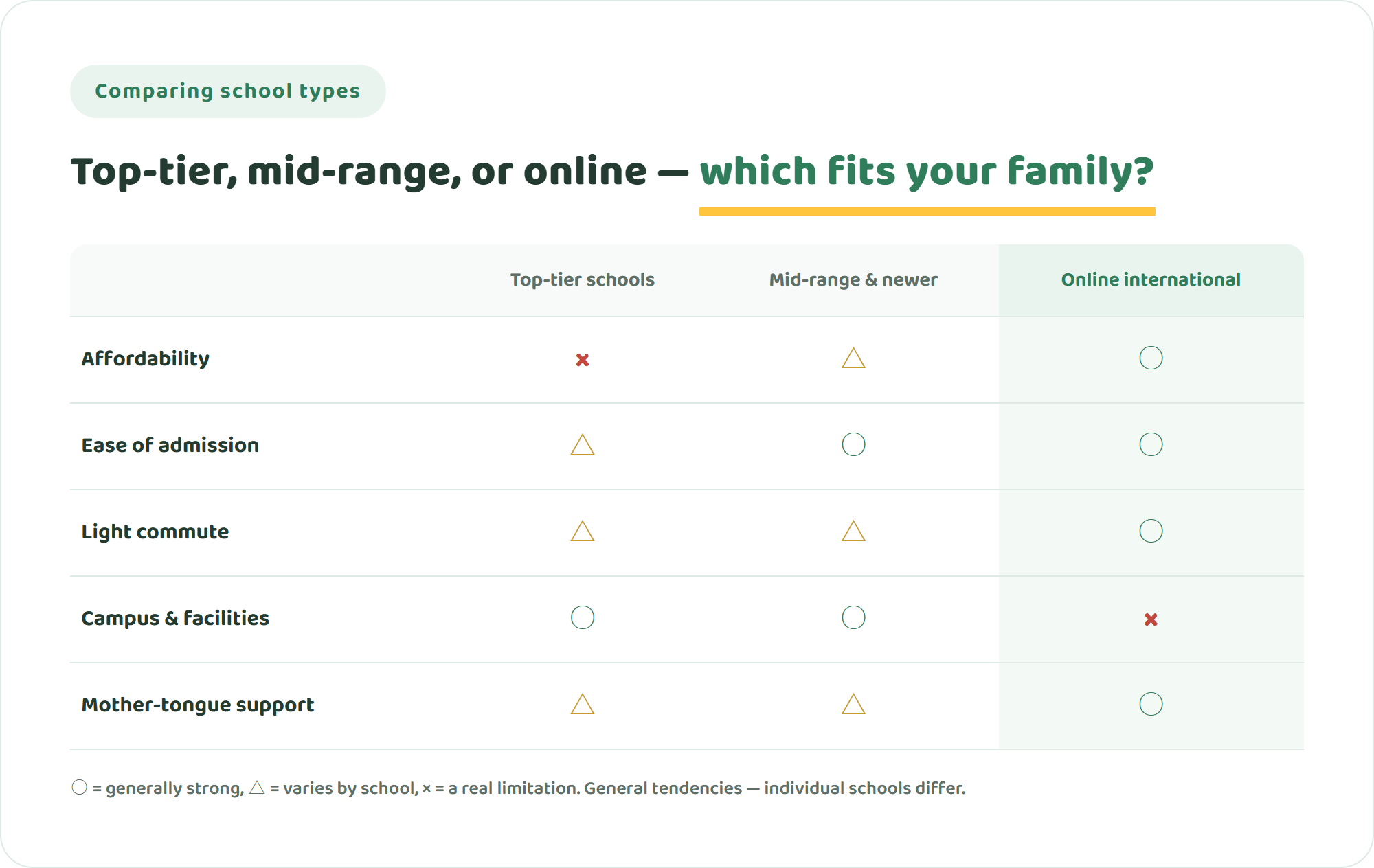
Top-tier campuses offer facilities and traditions that online learning cannot replicate. But when you factor in total cost over many years, Bangkok’s notorious traffic, and what happens if your family relocates again, the real question becomes not “can we get in?” but “can we sustain this happily for years?” If you are curious how a school can work without a campus, take a look at how learning works online →.
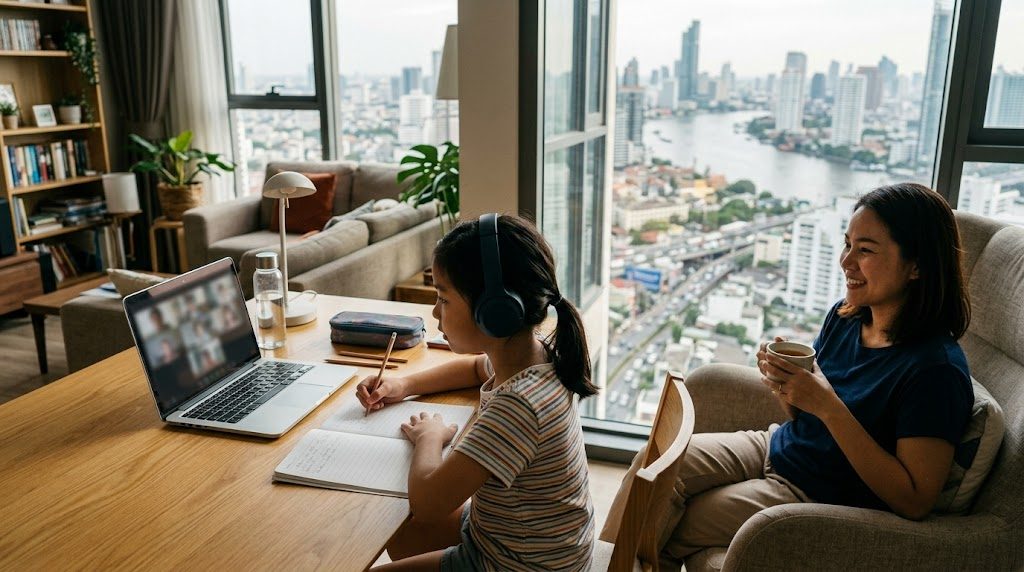
If Fees or the Commute Are the Barrier — an Online 8th Option
Perhaps you have read this far thinking: “These schools sound wonderful, but the fees — or the daily commute — just don’t work for us.” If so, allow us to introduce an eighth option honestly. We are NIJIN GLOBAL ACADEMY (NGA), an online international school opening in September 2027, run by NIJIN Inc. of Japan, whose alternative school NIJIN Academy already serves more than 1,000 students.
NGA is built on three ideas: no ranking children by test scores, small dialogue-centred classes where children come to like themselves and the world, and tuition targeted at roughly one-fifth of a traditional bricks-and-mortar international school. Designed for children aged 6–18 across Asia and Oceania, it works wherever you live — in Bangkok, in a provincial town, or back home after your posting ends. To be fully transparent: we have not yet opened, our track record is still to be built, and an online school is not the same experience as a physical campus. We simply ask to be compared fairly alongside the seven schools above.
Frequently Asked Questions
From what age do international schools in Bangkok accept children?
Most schools take children from age 2–3 into early years programmes. Popular schools can have waiting lists at entry points, so enquire as early as possible — ideally as soon as a relocation is confirmed. Check each school’s age cut-off dates too, as they differ between British and American systems.
How much are international school fees in Bangkok?
Annual tuition runs roughly THB 200,000 to THB 1,200,000 (about USD 5,500–33,000), with an average near THB 575,000. Premium schools exceed THB 1,000,000, while affordable options start in the THB 200,000s. Remember to add one-time entrance fees (THB 100,000–300,000), development levies, and transport — see the fee table above for a side-by-side view.
Is there support for children who don’t speak English yet?
Yes. Many Bangkok schools run well-established EAL (English as an Additional Language) programmes, and some — including St Andrews and ISB — also support mother-tongue development in languages such as Japanese, Korean, and Mandarin. Ask specifically how much EAL support is included in tuition and how much is charged separately.
Can my child join mid-year?
Often, yes. Most schools follow an August-start, three-term calendar but accept mid-year entries when seats are available. Admissions criteria, capacity, and entry timing vary by school and year group, so always confirm directly with each school.
Which areas of Bangkok have the most international schools?
Central Sukhumvit (Phrom Phong, Thong Lo, Ekkamai, On Nut) is the densest and most convenient for expat families, but excellent schools also cluster in Bang Na, Nonthaburi (Nichada Thani), along the riverside, and north near Don Mueang. Because traffic can turn a short distance into a long commute, weigh location as heavily as reputation.
Choose the Years, Not Just the School
Bangkok gives families a rare luxury: real choice. The families who look back with no regrets are rarely the ones who chased the most famous name — they are the ones who started from their child’s personality, their budget over the full journey, and where life might take them next. Whether that leads you to a riverside campus, an affordable neighbourhood school, or a classroom that lives online, we hope this guide brings you closer to the right fit for your child.
International Schools in Other Cities
- International Schools in Sendai: 7 Picks and Fees
- International Schools in Shinjuku: Fees
- International Schools in Karuizawa: All 4 Schools
- International Schools in Sapporo: Fees
- International Schools in Dubai: Fees
- International Schools in Meguro: All 8 Schools
- International Schools in Edogawa, Tokyo
- International Schools in Fukuoka: Fees
- International Schools in Singapore
- International Schools in Manila
- International Schools in Kuala Lumpur
- International Schools in Ho Chi Minh City
- International Schools in Tokyo
- International Schools in Osaka
Get opening updates by email →
The cheapest and most affordable international schools in Bangkok
Bangkok international school fees range widely — from around THB 200,000 to well over THB 1,000,000 a year — so “cheapest” and “affordable” are common searches for good reason. Beyond the lowest-fee campuses above, a fast-growing option is an affordable online international school: no campus cost, a recognised curriculum, and you can join from Bangkok or anywhere. See also our honest breakdown of what international school really costs.