You noticed it in a small moment, not a big one. Your child answered you in English again. The phone call with grandparents got shorter. A book in your language came back with “can you read it to me?” Or perhaps you haven’t enrolled yet, and you’re weighing an international school while quietly wondering what it will cost the language spoken at your dinner table.
Here is the honest answer up front. The local-language problem at international schools is real. But it is not inevitable — it is what happens by default when nobody plans for it. A home language can be protected on purpose. This is a practical guide for families in Singapore, Malaysia, the Philippines, Thailand, Japan and across Asia: what actually slips, what to protect at each age, how to divide the work between school, home and outside help, and what the policy realities look like when you return or transfer.
The local language problem: what parents actually notice
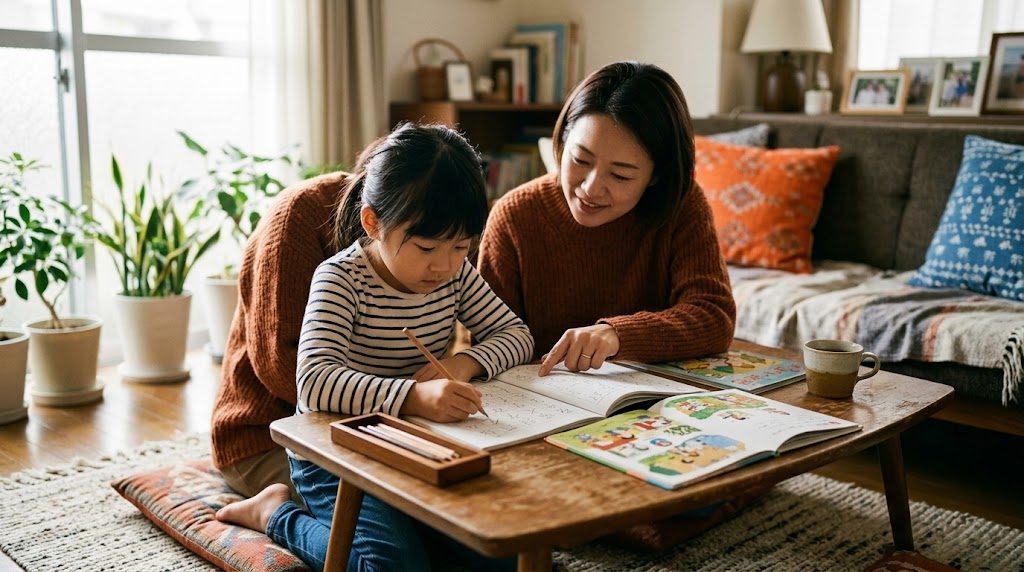
Let’s not soften it. “Two or three years in, she answers me in English even at home.” “He speaks our language fine but can’t read a school textbook in it.” “Writing is the first thing to go.” “Our child can’t hold a real conversation with their grandmother.” These aren’t exaggerations — they’re the ordinary result of an English-medium day.
But notice the distinction most families miss. What you spot first is spoken language. What lasts longest is literacy and academic language — reading a dense text, arguing a point in writing, handling subject vocabulary. Speaking comes back with use. Reading and writing do not come back on their own. If you want the broader trade-offs first, our guide to the real pros and cons of international school sets the context.
Why it happens — the school language wins by default
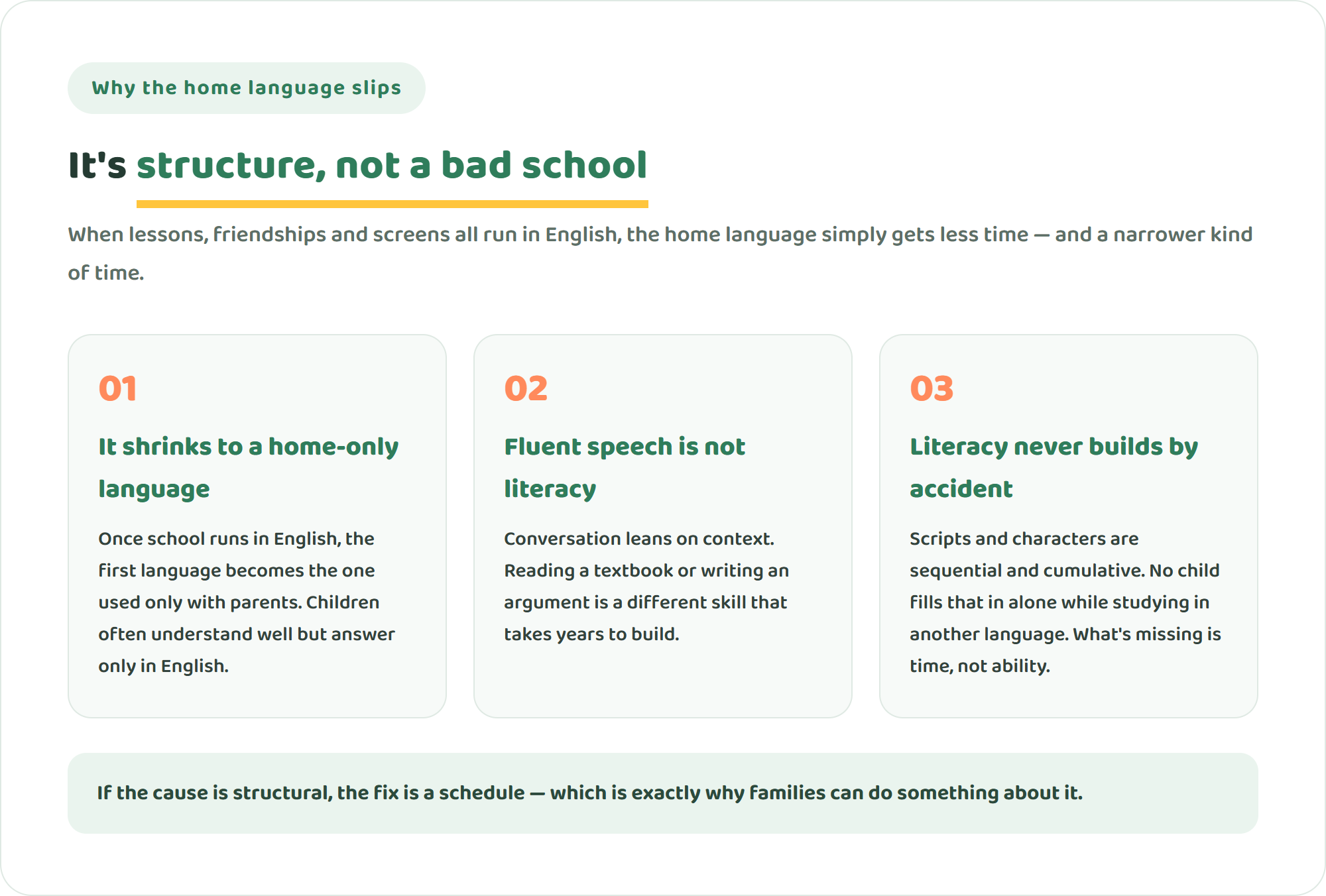
This is not a sign of a bad school. When lessons, friendships and screens all run in English, the home language shrinks to “the language I speak with my parents.” Researchers describe this as heritage language attrition, and it is well documented in migrant and international families. Blaming the school won’t fix it, because the cause is structural: exposure.
Fluent speech is not academic literacy
Everyday conversation leans on context: gesture, shared situation, tone. Reading a textbook, explaining a process, writing an argument — those rely on language without contextual support, and they take years to build. That is why “they still speak it fine, so we’re okay” is the most dangerous conclusion a parent can draw. Fluent speech masks a widening gap. For the research and myth-busting behind bilingual development, see bilingual child disadvantages: myths and evidence.
The second thing to know: literacy never accumulates by accident. Japanese primary school, for example, spreads 1,026 kanji across six years by national curriculum. Chinese, Tamil and Thai literacy work the same way — sequential, cumulative, unforgiving of skipped years. What’s missing is not ability. It’s time and opportunity. So the fix is a schedule, not a pep talk.
What to protect at each age
You don’t need to do everything. Protect whatever is most easily lost at that stage.
Early years to about age 8
Protect the desire to use the language. Keep speaking it yourself even when your child replies in English. Read aloud daily, briefly. Get the basic script — hiragana, hanzi, Tamil letters, whatever applies — in place around school-entry age. Above all, don’t let the home language become the language of being corrected. Languages tied to warmth survive; languages tied to obligation get dropped.
Ages 9 to 12
This is the decisive window, and where most of the loss happens. Script and character loads climb steeply, and school vocabulary turns abstract — cause, evidence, compare, conclude. Skip this stretch and you get a child who speaks well but cannot read anything written for their age. The working target is 15 to 20 minutes of reading and writing daily, tracked by grade level. Include something they read alone and something they write — a paragraph is enough. Writing does not grow out of reading.
Teens, 13 and up
Shift from volume to depth. Discuss news and novels in the home language; research and summarise in it. Being able to argue abstractly in your first language is a foundation for thinking in your second, not a competitor to it. At this age motivation decides everything, so talk openly about why the language matters — family, identity, future options. Ownership has to move from you to them.
School, home, or outside help — where the home language survives
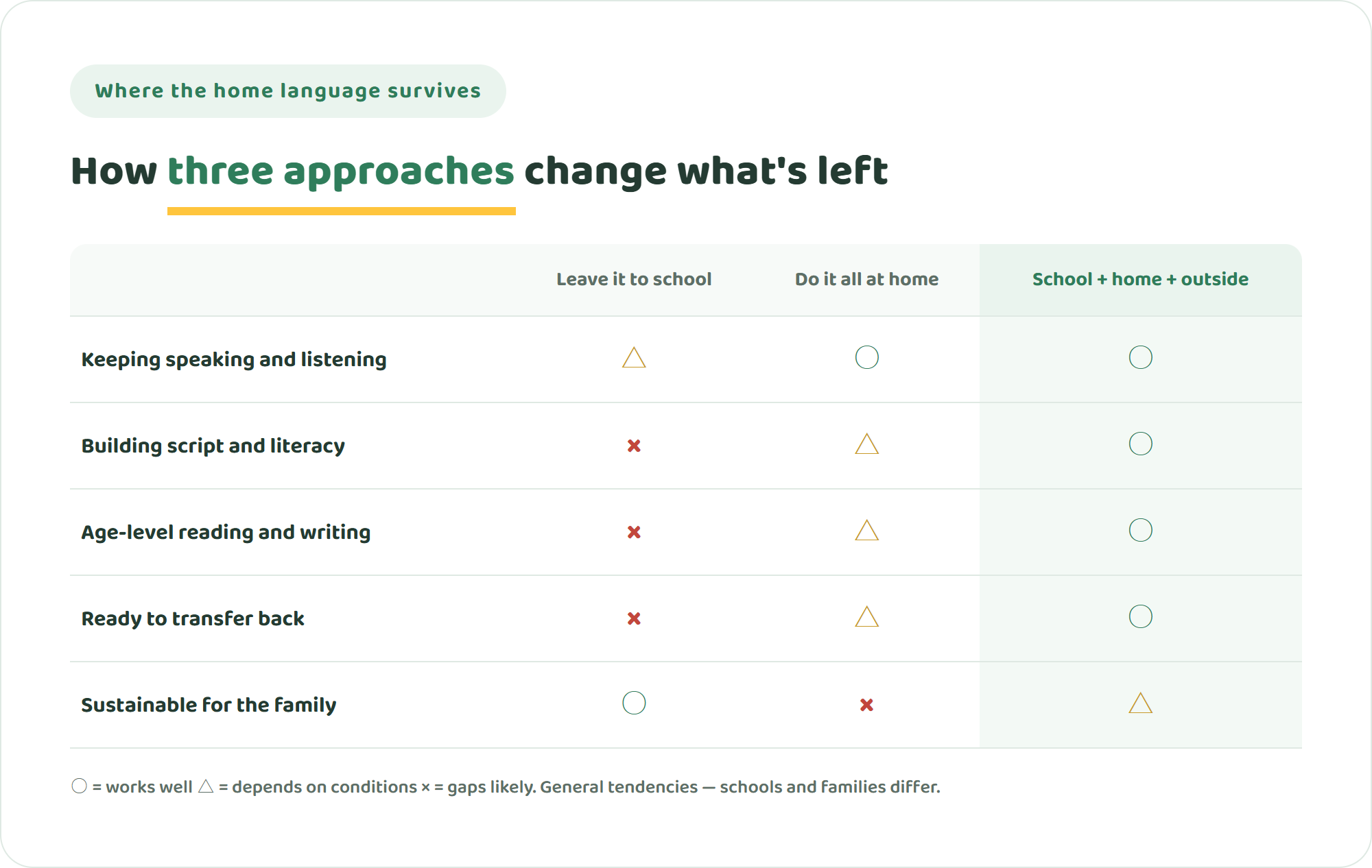
Leaving it to school may keep speech alive but rarely reaches age-level reading and writing. Mother-tongue programmes are more common than they used to be, and good ones matter — but content and contact hours vary enormously. Don’t stop at “yes, we offer it.” Ask how many periods a week, what is taught, and to what level. That single question separates a real programme from a cultural add-on.
Doing it all at home can be high quality but usually isn’t sustainable. When a parent doubles as the teacher, the home language becomes the language of tension, and children push back against the language itself. The workable split is school for English and academics, home for conversation and habit, outside help for literacy instruction. Parents do better designing a system that lasts than teaching the lessons.
Three steps you can start this week
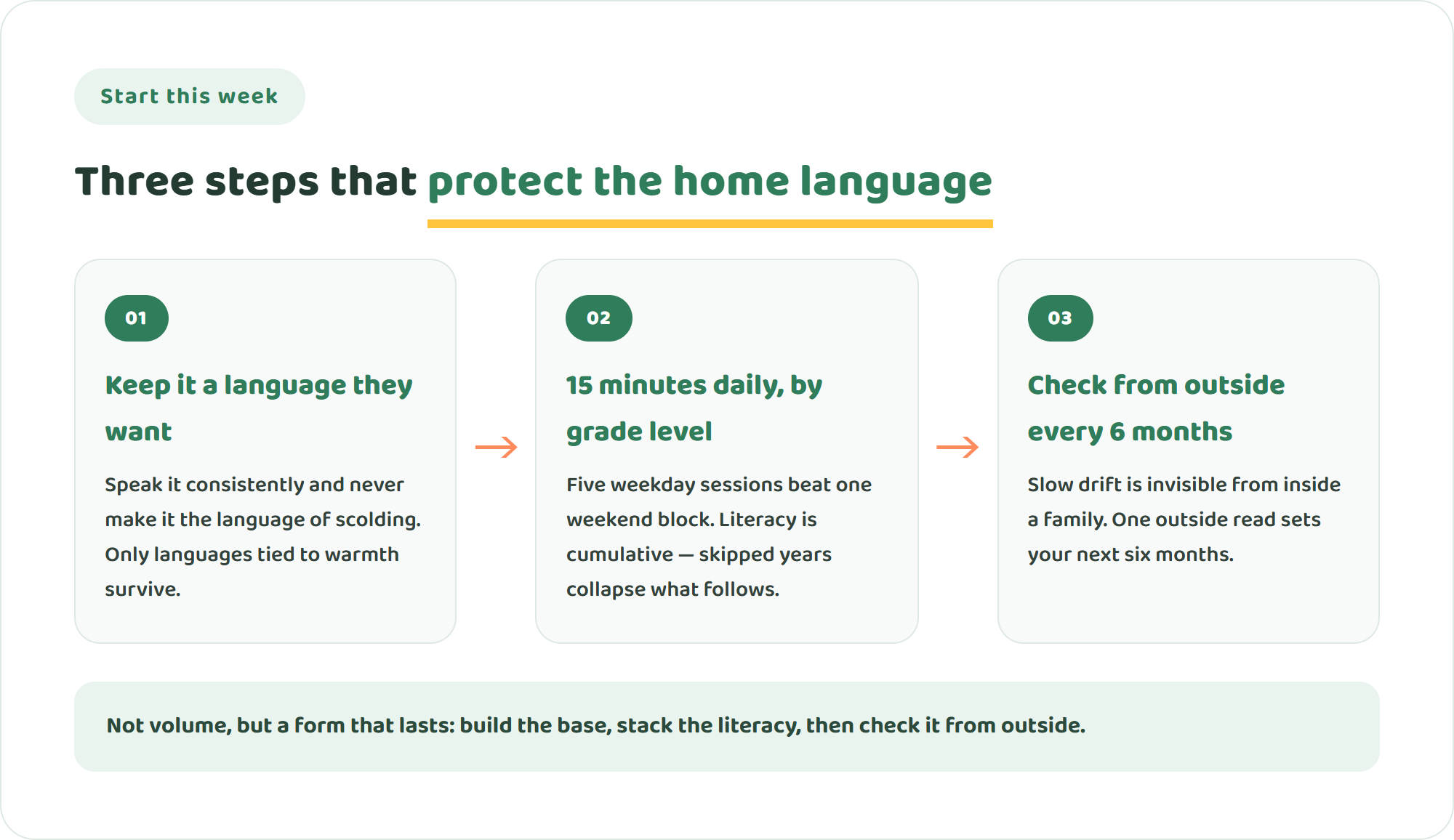
1. Keep it a language they want to use. Speak it consistently; never make it the language of scolding; create real reasons to use it with relatives and friends. 2. Add 15 to 20 minutes of literacy daily, tracked by grade level. Five weekday sessions of fifteen minutes beat one two-hour weekend block every time. 3. Every six months, get an outside read on whether they’re at age level. Slow drift is invisible from inside a family. One assessment sets your next six months.
If there’s no suitable class nearby, online works. Japanese-speaking families can look at our sister service Tomodachi Japan (online Japanese for children, run by NIJIN Inc.). The principle holds whatever your language: geography shouldn’t decide whether literacy continues.

Policy realities worth checking before you commit
Two practical points that catch families out.
National language requirements. In Singapore, the Ministry of Education’s bilingual policy means Singaporean citizens and permanent residents are generally expected to study an official Mother Tongue Language, and exemptions are assessed case by case — typically for returning Singaporeans without sustained prior exposure, or students with significant special educational needs. Attending an international school as a citizen also involves MOE processes. Requirements differ in Malaysia, Thailand and elsewhere, so confirm with the relevant ministry rather than with a forum.
Compulsory schooling. In Japan, most international schools are not Article 1 schools under the School Education Act, and it is generally explained that attendance does not fulfil the compulsory education requirement for children with Japanese nationality — with different treatment for dual and foreign nationals, and practice that varies by municipality. Wherever you are, ask your local education authority before enrolling, not after. The same applies when transferring back into a national school system: age-level placement is usual, but literacy gaps can make it a discussion rather than a formality.
Please note: policies and practice reflect publicly available information as of August 2026. Confirm the latest with each school and your local education authority.
A third option — a school built around the home language
If this has read like a choice between sacrificing the home language for English or giving up an international education to protect it, it isn’t. That dilemma comes from one assumption: that a school can only run in one language. Families who don’t regret their choice tend to question that assumption early — see who regrets international school and who doesn’t.
NIJIN GLOBAL ACADEMY (NGA), opening in September 2027, is designed on the opposite assumption. It’s an online international school that doesn’t rank children by test scores, built around small-group dialogue starting from “what do you think?” On language, it is designed so children ease into English with the support of their home language — treating “protect the first language on purpose” as a design decision rather than a family’s private burden. Our companion guide on raising a bilingual child without losing the mother tongue goes deeper on the principle.
NGA is operated by NIJIN Inc.; its alternative school in Japan already serves more than 900 children. It’s open to 6- to 18-year-olds across Asia and Oceania, with tuition designed to be around one-fifth of a typical campus international school. Honestly: online is not the same as a physical campus, and as a pre-launch school our track record is still ahead of us.
Frequently asked questions
Will my child stop speaking our language altogether?
Left alone, speaking can thin out — children often end up understanding well but answering only in English. Keep using the language at home and give them real people to speak it with, and you prevent most of it. Speech is also the part that recovers most readily.
By what age should reading and writing be in place?
Think in sequence rather than deadlines. Get the basic script down around school-entry age, then build literacy without skipping years. The 9-to-12 window matters most: leave it empty and filling it later is far harder.
Do we have to send our child to a weekend language school?
No. Weekend schools are a strong option where they exist — Japanese families abroad, for instance, can use the hoshuko supplementary schools recognised by Japan’s education ministry, which teach the national curriculum in Japanese. But what matters is that age-level literacy is happening somewhere. A class, an online tutor or structured home study all count.
Will my child struggle if we transfer back to a national school?
Usually not in conversation — but often in reading, writing and word problems in maths and science, because textbook language is a different register. If returning is even possible, don’t let literacy lapse. Contact the local education authority early about placement and paperwork.
Is a mother-tongue programme at school enough on its own?
Sometimes, but rarely. Ask for specifics: periods per week, curriculum, and the level students actually reach. A programme integrated into the timetable is very different from an after-school club, and only the first tends to reach academic literacy.
We’re worried about ending up weak in both languages
That risk is real when neither language gets enough time or depth — and it falls sharply when at least one language is deliberately grown as the language of thinking. Depth in one supports the other; splitting attention thinly across both is what causes trouble.
A home language is how your child says who they are.
When you worry about the home language, you’re not really worried about characters or spelling. You’re worried about laughing with grandparents, about your child being able to say the deepest thing they feel, about the thread that connects them to where they come from. That worry is worth trusting.
And it is answerable. Not with a perfect plan — with fifteen minutes a day, a check every six months, and the patience to keep the language warm. English and the home language are not rivals. Both are how your child will speak to the world.
NIJIN GLOBAL ACADEMY opens in September 2027. We’ll share how learning designed around the home language works, and send first-intake news early, by email.
Honest Answers to Your Worries — related reading
- Will My Child Lose Their Mother Tongue?
- The Honest Pros and Cons of International School
- Disadvantages of Bilingualism in Childhood: Myths vs Research
- Who Regrets International School — and Who Doesn’t
- International School Special Needs: What to Look For
- International School vs Local School: How to Decide
- When Your Child Is Struggling at International School
- Do International Schools Make Children Fluent in English?
- Is International School Worth It? What Happens to Graduates
- Should I Send My Child to International School?
- Transfer From a Local School to an International School