“On-campus international schools cost too much.” “We live outside a big city, and there simply isn’t an international school we can attend.” “We don’t want our child on the exam-score treadmill.” “School wasn’t working, so our child is home right now.” The reasons differ, but across Asia and Oceania many parents are now looking for a different way for their child to learn. The good news: today you can attend a genuine international school online, connected to the world from wherever you live. This article is our honest list of online international schools in Asia, built to help you choose.
The trouble is, once you start researching, the names just pile up and you end up more confused than before. Cambridge, IGCSE, American-style, EdTech — it’s hard to see what actually sets them apart, or which one fits your child. This piece gathers a practical list of online international schools in Asia, sorting the main schools and services into seven types, and lays them out honestly — with both the strengths and the caveats of each. It isn’t here to sell one particular school. It’s here so you can decide for yourself which option fits your child.
Quick Answer: The Main Online International Schools to Consider
If you only read one section, read this. Below are the main online international schools available from Asia, with age ranges and the fees each school publishes officially. Sources and full conditions are in the comparison table further down.
- Crimson Global Academy — Ages 6–18 / Cambridge (IGCSE, A-Levels), US diploma, AP / full-time from approx. JPY 2.06–2.4 million per year (school’s published rate)
- King’s InterHigh (UK online school) — Ages 7–19 (Years 3–13) / UK curriculum (GCSE, A Level) and IB Diploma / Primary from £4,395 per year (2026/27, school’s published rate)
- Nisai British International Online School — NS course ages 11–14, A-Level course ages 16–19 / Cambridge-based (NS, IGCSE, A-Level) / priced per subject, from approx. JPY 22,000 per subject per month (school’s published rate)
- NIJIN GLOBAL ACADEMY (online) — Ages 6–18 / inquiry- and practice-based international education with Japanese-language support / opening September 2027, so fees are not yet published; designed to target around one-fifth of a typical campus international school. Currently taking opening-update registrations
Online English services (eikaiwa and EdTech platforms) are a different category — they do not award a school-leaving qualification. The type-by-type breakdown is further down the article.
Note: named schools change their fees and intake often, so confirm specifics on each school’s official pages. What this guide stands behind is how to tell the seven types apart.
Three things to weigh before the list
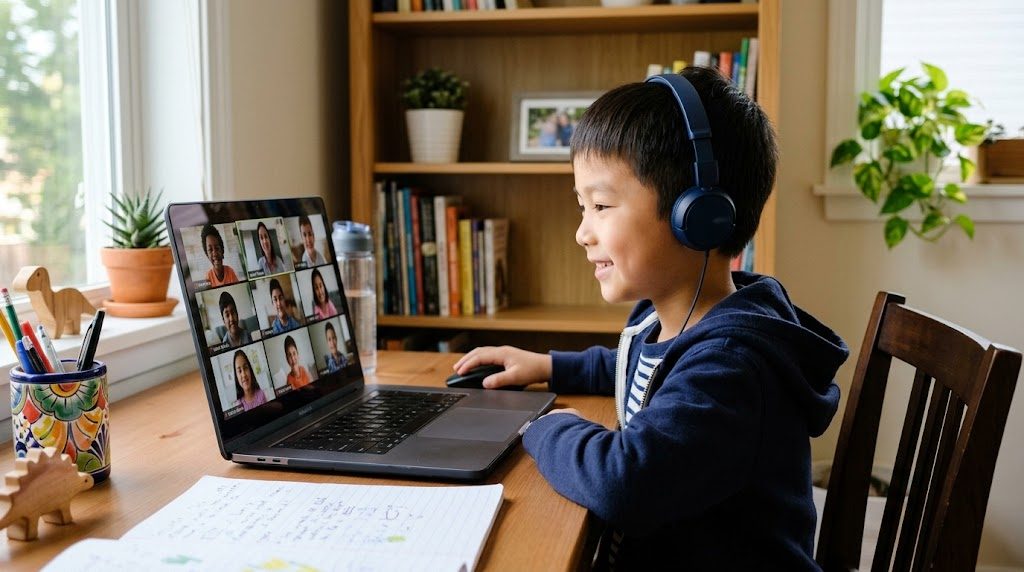
Before we go through the schools one by one, it helps to hold a few axes in mind so you aren’t pulled around by marketing. Because online international schools come in so many kinds, three matter most, in our view.
- Is the credential and pathway clear? Does it lead to a recognised credential and a next step? Judge by “can the child move on?” rather than just “can they learn?” — and always confirm the latest details on each school’s official site.
- English and staying power. Is there care for a child new to English? Does it fit your child’s pace and temperament so they can keep going without strain? Continuing is what lets learning accumulate.
- Is the cost something you can sustain? Even the best learning stalls if the family budget can’t carry it. Judge by “can we keep this up for years?” rather than “can we get in?”
Seven types on our list of online international schools in Asia
Here is a practical list of online international schools in Asia, sorted into seven types and taken one by one. For each, we’ve kept it short and honest: who it suits, what’s good, and what to watch for. This isn’t about ranking one above another — the best answer changes with your child’s situation. Note that tuition and entry requirements differ by school and change often, so always confirm specific fees and the fine detail of accreditation on each school’s official information.
1. Curriculum-based online international schools (Cambridge/IB)
Students from around the world gather online to study an international curriculum such as Cambridge or the IB. Names like Crimson Global Academy and King’s InterHigh are well known.
- Suits — families who want to learn free of location and keep universities abroad in view; children comfortable learning in English.
- Strengths — a world-standard curriculum you can access from a rural area or overseas, alongside peers from many countries, with pathways that open globally.
- Watch for — tuition tends to be high, and because lessons are mainly in English, the first hurdle can be steep for a child new to the language. Time zones matter too. Confirm the details officially.
2. IGCSE and A-Level online providers
Schools that deliver the British-style IGCSE and A-Levels as online distance education. Wolsey Hall Oxford and Cambridge-based online providers are examples. Children prepare for world-recognised exams from home.
- Suits — families who want to work steadily toward qualifications at their own pace, with university abroad or at home in view.
- Strengths — you learn against widely recognised qualifications, which makes the pathway easier to plan, with fairly high freedom over study hours.
- Watch for — materials and exams are English-based with a large element of self-study, so self-management is needed. Check exam centres and entry procedures.
3. American-style online schools
Online schools built around a U.S. high-school diploma. Services such as Pearson Online Academy let a child follow an American curriculum from home.
- Suits — families with a U.S. university in view, or children who anticipate living or studying in an English-speaking country.
- Strengths — a flexible American credit system, pathways into English-speaking destinations, and access from anywhere in the world.
- Watch for — lessons and assessment assume English and are exposed to time-zone effects. The credential differs from a domestic graduation certificate, so plan the pathway in advance.
4. Distance-learning and alternative, plus international
Distance high schools or alternative schools combined with international exchange or online English. You secure a domestic graduation credential while adding an international element.
- Suits — families who also want to secure a domestic pathway, who need a flexible way to attend, or whose child found ordinary school a poor fit.
- Strengths — flexible (you can often choose how often to attend) with a reassuring sense of belonging, and options that lead to a recognised local credential.
- Watch for — approach and quality vary widely, and how “international” it really is depends on the school. Check how much of an international element there is, and whether it fits your goal.
5. Online English and EdTech services
Online conversation lessons or learning platforms offering top-tier courses — single-subject, skill-focused services. They’re used less as a replacement for school and more as a complement.
- Suits — families who want to build English or a specific subject while staying at their current school; children who want a light, low-commitment first taste of international learning.
- Strengths — easy and affordable to start, fits into spare moments, and free to combine as your goals require.
- Watch for — it’s skill-by-skill, so it can’t really carry the belonging, structure or graduation credential of a “school.” Keeping it up takes the child’s own motivation.
6. Homeschool-support online international education
Learning from a home base while drawing on online materials, tutoring and international community support. Parents design the learning, and the service supports it.
- Suits — families who want to put the child’s pace first, where a parent can take time to be involved in the learning.
- Strengths — both content and pace can be designed flexibly around the child, and support services make isolation easier to prevent.
- Watch for — it assumes parental involvement and a real load, and peer connection has to be built deliberately. The legal treatment also varies by country and region.
7. Beyond-the-exam-race online international schools (like NGA)
A newer kind of online international school that doesn’t rank children by test scores and aims to stay within reach on price. Our own NIJIN GLOBAL ACADEMY (NGA) is working toward exactly this position.
- Suits — families wanting to step off the exam-score treadmill, those living rurally or overseas, and those for whom school hasn’t been a fit.
- Strengths — learn from anywhere, connect with the world through small-group dialogue, easy to begin even if English is new, with pricing aimed at a level families can sustain.
- Watch for — as a new form, its track record is still being built, and we’ll say plainly that it isn’t identical to an on-campus experience.
See how online learning works →
Comparing four main types, point by point
With the seven in mind, let’s compare the fully-online representatives — Cambridge/IB type, IGCSE providers, EdTech type and beyond-the-exam-race online international schools — across the axes from earlier. No single one is a cure-all; what becomes clear is that the answer depends on what you choose to prioritise.
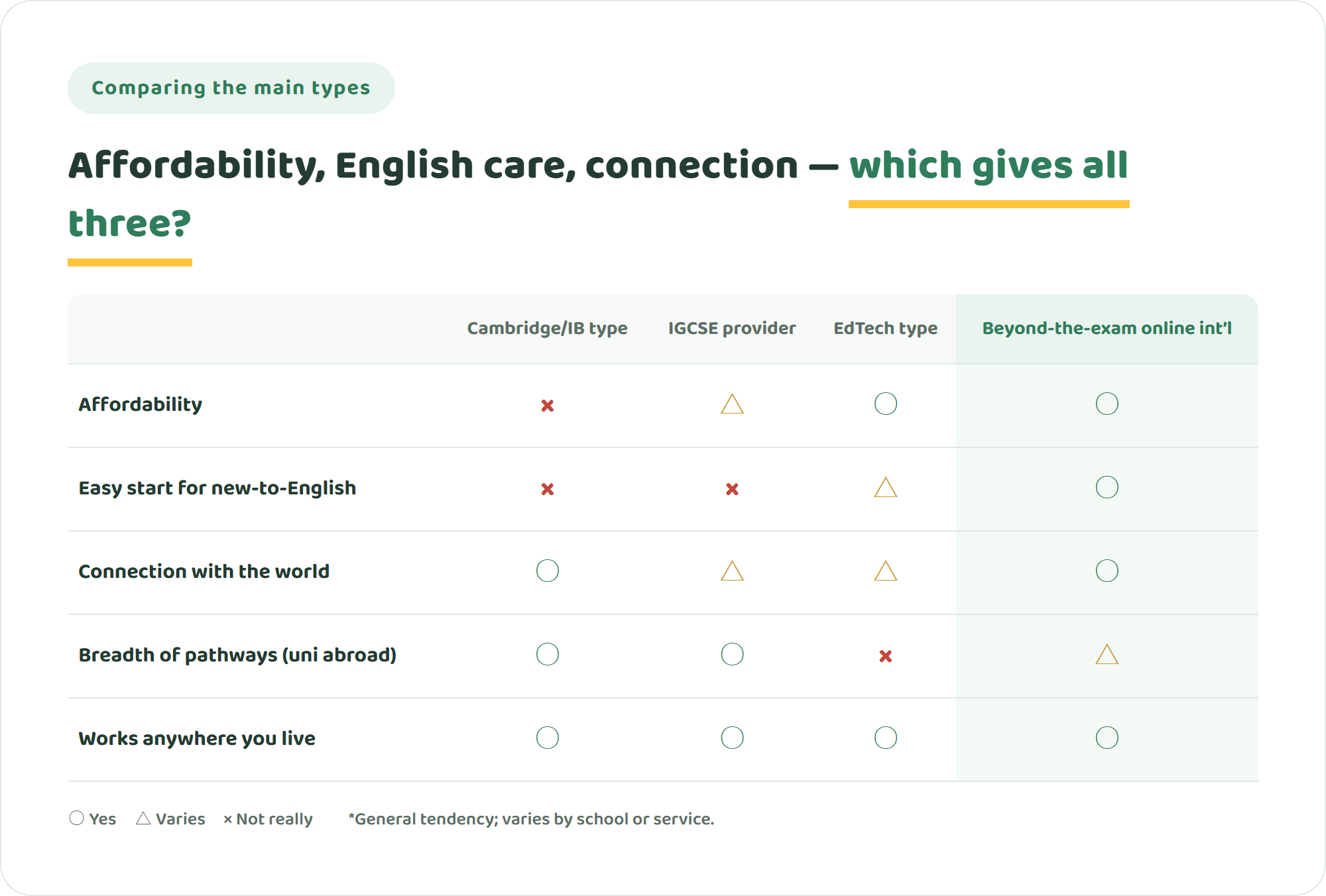
Looking at the table, the axis for choosing is how many of these you can satisfy at once: affordability, an easy start for a child new to English, connection with the world, breadth of pathways, and working anywhere you live. Which of them weighs most, though, differs from family to family. The point isn’t to find “the best school,” but “the best school for your child, right now.” If you’d like the wider picture — including on-campus schools and homeschooling — see our roundup of online international education options across Asia and Oceania as well.
How to choose what fits your child — three steps
The more options there are, the more an order to deciding keeps you from getting lost. If the list of online international schools has you stalled, try this three-step approach.
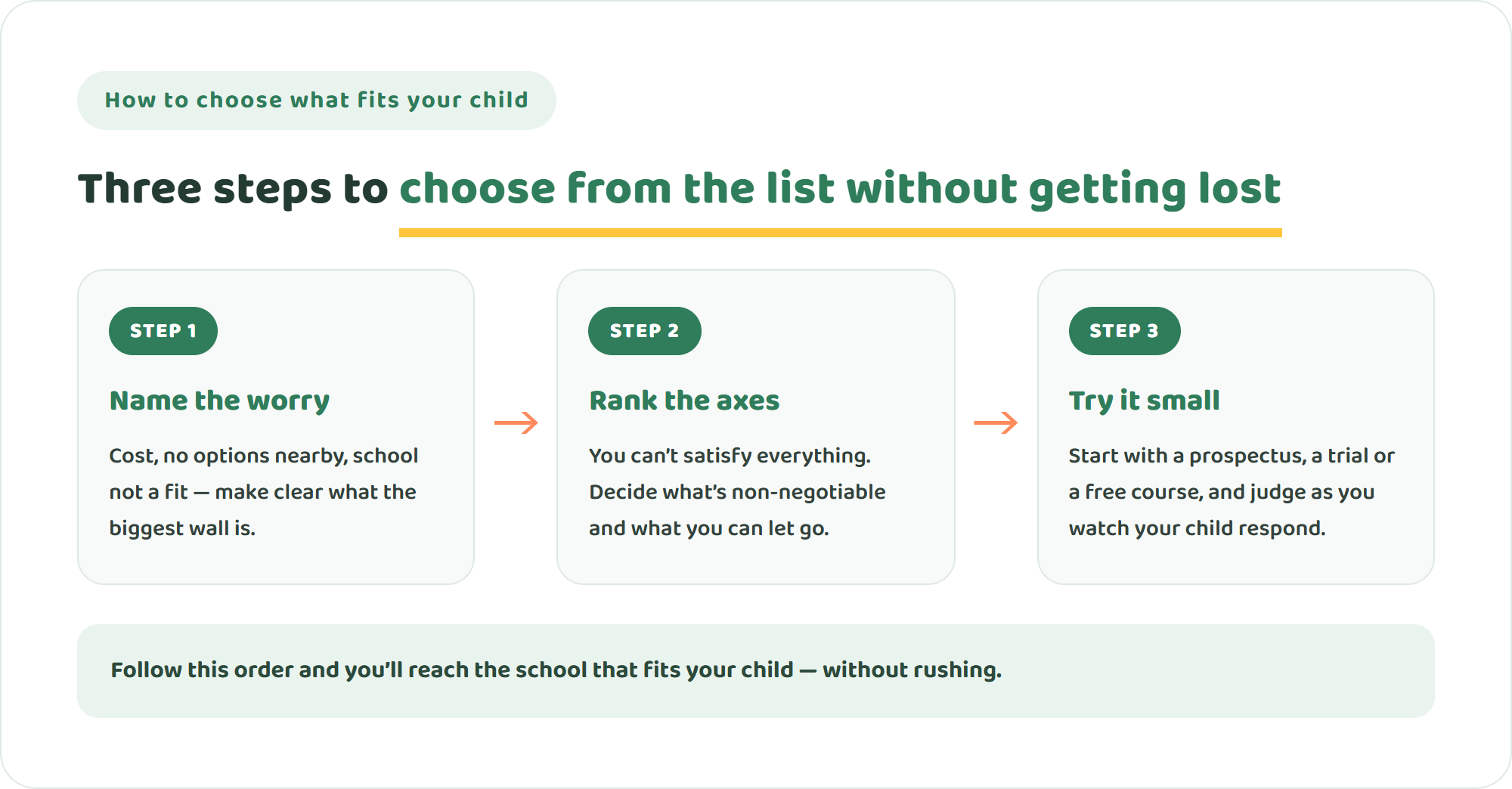
First, put the current worry into words. “Cost scares us,” “there’s no international school we can attend where we live,” “school wasn’t a fit” — naming the biggest wall narrows the schools that fit. Next, rank the axes from earlier. No form of learning satisfies everything; decide what you can let go of and what you can’t. Then, rather than switching everything at once, try it small — start with a prospectus, an information session, a trial, or a free online course, and judge as you watch how your child responds. There’s no need to decide in a hurry.

Where NGA sits on this list
Having laid the list out honestly, here is where our NIJIN GLOBAL ACADEMY (NGA) sits. NGA is an online international school beyond the exam race, opening in September 2027, operated by NIJIN Inc. NIJIN Academy, the alternative school we run in Japan, already has over 1000 children learning with us.
What we aim for is learning that doesn’t rank children by test scores. On the foundation of learning to love yourself and the world, children connect globally through small-group dialogue. Our distinguishing features: it works wherever you live; it starts from each child’s interests rather than a test score; and we’re aiming for tuition around one-fifth of an on-campus international school — within reach. “It was too expensive to choose.” “There was no international school we could attend where we live.” “We didn’t want the exam-score treadmill.” We want to be another option for exactly those families. It isn’t a cure-all, of course — we’d simply ask that you compare it fairly with the others on this list and choose it when it feels right for your child.
Frequently asked questions
Does an online international school lead anywhere — universities at home or abroad?
It depends on the type. An online international school or IGCSE provider with a recognised international curriculum tends to open the way to universities abroad, while a distance-learning combination tends to secure a domestic graduation credential. Whatever you consider, always confirm “what pathways does this connect to after graduation?” on the school’s official information. At NGA, we’ll share our thinking on pathways alongside the opening news.
Is there an online international school we can attend if my child speaks no English at all?
Yes. Among EdTech services and beyond-the-exam-race online international schools, some are designed around home-language support so a child can meet English gradually. Choosing a place that treats English as “something to grow into” rather than “an entry requirement” makes it far easier for a child to begin.
Can we use the schools on this list if we live in a rural area?
Yes. The great strength of online-based schools is that they don’t depend on where you live. Most of the online international schools, IGCSE providers, EdTech services and homeschool-support options on this list work just the same from a rural area or overseas. “There’s no international school nearby” is no longer a reason to give up on an international education.
Turning “no international school we can attend” into “a real choice.”
Where you live, the family budget, and the exam-score race once narrowed a child’s options sharply. Now online has been added as a path, and wherever you are in Asia or Oceania, you can choose an international school connected to the world. What matters is finding, without rushing, the one option among many that fits your child.
NIJIN GLOBAL ACADEMY opens in September 2027. We’ll share how our learning works — beyond the exam race, within-reach pricing, and connection with the world through small-group dialogue — along with first-cohort enrolment news, straight to your inbox. A global education, within reach for your child.