If you’re moving to Singapore — or already here and rethinking your child’s education — you’ve probably discovered two things at once: the international schools in Singapore are world-class, and the fees can take your breath away. This guide cuts through the noise. Below you’ll find seven genuinely different schools, from famous flagship campuses to more affordable options, with honest fee ranges, curricula, and a simple framework for deciding which one actually fits your family.
International Schools in Singapore: The Landscape and What Fees Really Look Like
Singapore is home to roughly 50 international schools offering an unusually wide menu of curricula: IB, British, American, Cambridge, Indian (CBSE), and various blends of these. Add political stability, safety, and strong university outcomes, and it’s easy to see why expatriate families from every continent compete for places here.
That demand shows up in the fees. Annual tuition at international schools in Singapore generally runs from about SGD 15,000 at the affordable end to SGD 55,000+ at premium schools — before you add application fees, one-off enrolment fees, facility levies, technology fees, and school bus transport. If you want to understand where all that money actually goes, see our breakdown of what international school tuition really costs. Note: all fees in this article are based on publicly available information as of July 2026 — always confirm the latest figures on each school’s official website.
One more reality check: the most popular schools carry long waitlists, and your preferred year group may simply be full. Starting early — and applying to more than one school — is not paranoia; it’s standard practice here.
International Schools in Singapore by Area: Where the Schools Cluster
Fees and curriculum tend to dominate the conversation, but where you live and how far your child commutes shape daily life just as much. Singapore is compact, yet morning traffic and bus routes add up. Here’s a rough map of where the major international schools sit.
- West (Bukit Timah / Dover / Jurong) — the classic expat belt. UWCSEA (Dover), Tanglin Trust, Dulwich College (Bukit Batok), and OWIS (Nanyang) all sit here, close to family-friendly neighbourhoods with plenty of housing choice.
- North (Woodlands) — home to the vast Singapore American School (SAS) campus, popular with American families and known for spacious living.
- Central (Novena / Serangoon) — Stamford American and OWIS (Newton) offer easy access to the city and suit dual-career families.
- North-East (Punggol) — a fast-developing district where newer, tech-forward campuses cluster, including GIIS (SMART Campus) and OWIS (Punggol Digital Campus). Fees here tend to be more accessible.
Note that a single school may run several campuses in different areas, so confirm the exact location and bus route before you sign a housing lease. Comparing across cities? See our guides to international schools in Bangkok and international schools in Tokyo.
7 Best International Schools in Singapore: Our Honest Shortlist
We’ve chosen these seven to cover the full spectrum — heritage giants, mid-priced newcomers, and value options. Fee ranges are approximate annual tuition drawn from official school websites and public databases (as of July 2026).
1. UWCSEA (United World College of South East Asia)
Founded in 1971 and spread across the Dover and East campuses, UWCSEA is one of the most sought-after schools in Asia. Students from around 100 nationalities, a mission built on service and outdoor education, and consistently strong IB Diploma results make it the school everyone asks about first — and the one with the longest queues.
- Curriculum — IB pathway (its own concept-based programme through to the IBDP)
- Ages — 4 to 18
- Fees (approx.) — SGD 39,000–50,000 per year (official 2026 figures; confirm latest)
- Best for — families who prioritise diversity, service learning, and a genuinely global peer group
2. Tanglin Trust School
Established in 1925, Tanglin is Singapore’s oldest British international school — and one of the few anywhere to offer both A Levels and the IB Diploma in Sixth Form. It pairs a traditional, well-ordered British education with outstanding pastoral care and university guidance.
- Curriculum — English National Curriculum, (I)GCSE, then A Levels or IBDP
- Ages — 3 to 18
- Fees (approx.) — SGD 34,770–55,734 per year including building fund and GST (official 2026 figures)
- Best for — families wanting British structure with a choice of post-16 routes
3. Singapore American School (SAS)
With around 4,000 students on a sprawling Woodlands campus, SAS is the flagship of American education in Asia. Its Advanced Placement offering is among the broadest in the world, and the facilities — from maker spaces to athletics — are on a scale few schools can match.
- Curriculum — American, with an extensive AP programme
- Ages — 3 to 18
- Fees (approx.) — SGD 40,000–50,000+ per year depending on grade (public 2026 information)
- Best for — families on a US university track who want big-school energy and resources
4. Dulwich College (Singapore)
The Singapore campus of the 400-year-old London institution blends British academics with an unusually strong arts programme — music, drama, and design thrive here. The school follows the English curriculum through IGCSE, then moves to the IB Diploma.
- Curriculum — British (to IGCSE), then IBDP
- Ages — 2 to 18
- Fees (approx.) — SGD 20,270–56,220 per year, from part-time early years to Senior School (official 2026 figures)
- Best for — families drawn to British heritage plus serious arts and sport
5. Stamford American International School
Stamford’s signature is flexibility: an American curriculum layered with the full IB continuum, so students can graduate with an IB Diploma, AP courses, a US high school diploma — or a combination. Its EAL support is well established, making it a popular landing spot for families whose children are still building English.
- Curriculum — American + IB (PYP to DP) + AP options
- Ages — 2 months (Early Learning Village) to 18 years
- Fees (approx.) — SGD 47,000–54,000 per year for Grades 1–12 (official 2026 figures)
- Best for — families who want to keep every university pathway open, with strong English-language support
6. One World International School (OWIS)
OWIS set out to prove that IB education doesn’t have to cost a fortune, and it has built a loyal following doing exactly that. Across its Nanyang and Punggol Digital campuses, the school caps nationality concentrations to keep classrooms genuinely international, and parent satisfaction relative to fees is consistently high.
- Curriculum — IB (PYP and DP) with Cambridge IGCSE in middle years
- Ages — 3 to 18
- Fees (approx.) — SGD 24,000–40,000 per year depending on campus and grade (official 2026 figures)
- Best for — value-conscious families who won’t compromise on IB or diversity
7. Global Indian International School (GIIS)
GIIS’s award-winning SMART Campus in Punggol offers some of the most accessible fees among international schools in Singapore, without narrowing the options: families can choose CBSE, Cambridge, or the IB pathway. The school is particularly known for rigorous maths and science teaching.
- Curriculum — CBSE, Cambridge, and IB pathways
- Ages — 3 to 18
- Fees (approx.) — SGD 14,500–35,000 per year depending on curriculum and grade (public 2026 information)
- Best for — budget-aware families who still want an international curriculum and strong STEM
International Schools in Singapore Fees: Comparison Table (Top 7 + Areas)
Here’s the shortlist at a glance — fees, curriculum, and area side by side. Figures are approximate annual tuition ranges from public information (as of 2026); they vary widely by grade, from early years to senior school. Always confirm the exact amount for your child’s entry grade.
| School | Main Curriculum | Annual Tuition (SGD, approx.) | Main Area |
|---|---|---|---|
| UWCSEA | IB | 39,000–50,000 | Dover (West) / East |
| Tanglin Trust | British + A Level / IBDP | 34,770–55,734 | Portsdown (West) |
| Singapore American (SAS) | American + AP | 40,000–50,000+ | Woodlands (North) |
| Dulwich College | British + IBDP | 20,270–56,220 | Bukit Batok (West) |
| Stamford American | American + IB + AP | 47,000–54,000 | Serangoon (Central) |
| One World (OWIS) | IB + Cambridge | 24,000–40,000 | Nanyang (West) / Punggol |
| Global Indian (GIIS) | CBSE / IB / Cambridge | 14,500–35,000 | Punggol (North-East) |
Read the table and a shortlist starts to form itself. Budget-first? GIIS or OWIS. British heritage? Tanglin or Dulwich. US university track? SAS or Stamford. Diversity and IB pedigree? UWCSEA. Because tuition can nearly double between the youngest and oldest year groups within the same school, always verify the real figure for your child’s entry grade on the official site.
Beyond Tuition: The Additional Fees You Should Budget For
The easiest costs to overlook are the ones that aren’t tuition. Application fees, building levies, and transport can push your real annual outlay 15–25% above the headline tuition. Here’s a rough guide (typical public ranges, as of 2026).
| Fee | Typical Range (SGD) | When |
|---|---|---|
| Application & assessment fee | 2,000–4,000 | At application (often non-refundable) |
| Enrolment fee / deposit | Usually about one term of tuition | On enrolment (partly refundable at some schools) |
| Building / capital levy | 2,000–5,000 per year | Annually |
| School bus / transport | 3,500–5,800 per year | Annually (if used) |
| Uniforms & technology (laptop, etc.) | 800–2,500 | Mostly Year 1 |
| Meals | 1,500–2,800 per year | Annually (if used) |
| Exam fees (IB / IGCSE, etc.) | 1,800–3,200 | In examination years only |
In practice, a school advertising SGD 35,000 in tuition can cost closer to SGD 45,000 once the extras land. When you budget, use “tuition + 20–30%” as a working figure and choose a level you can sustain for the full run to graduation. For a fuller breakdown, see our guide to international school tuition costs.
Admissions, Waitlists, and the MOE Waiver: How It Really Works
Alongside fees, the biggest wall families hit is simply getting a place. Popular schools are competitive and the process has its quirks, so map it out early.
Waitlists are normal. Sought-after schools like UWCSEA carry waitlists from the earliest year groups, and a spot in your target grade can take months — sometimes over a year. When a posting is confirmed, applying to several schools at once, not just your first choice, is standard practice in Singapore.
Admissions criteria vary by school. Most require an English-language check (interview or assessment), past school reports, and sometimes references. English entry requirements tend to tighten in higher grades, and EAL (English as an Additional Language) support — its availability, eligible year groups, and any extra cost — differs from school to school.
Singapore Citizen children need an MOE waiver. Singapore has compulsory education, so a Singapore Citizen child of Primary 1 age or above who wishes to attend an international school (a Foreign System School) must obtain a waiver from the Compulsory Education Act from the Ministry of Education (MOE). Parents cannot apply directly — the school submits the waiver application only once it has a place available, and MOE grants it case by case at its discretion (sources: MOE; UWCSEA). For non-resident expat families, this waiver generally does not apply.
Comparing Your Options: Which Type of School Fits Your Family?
Seven schools, three broad types. Rather than ranking them, it’s more useful to compare what each type is genuinely good at — and where it asks you to compromise.
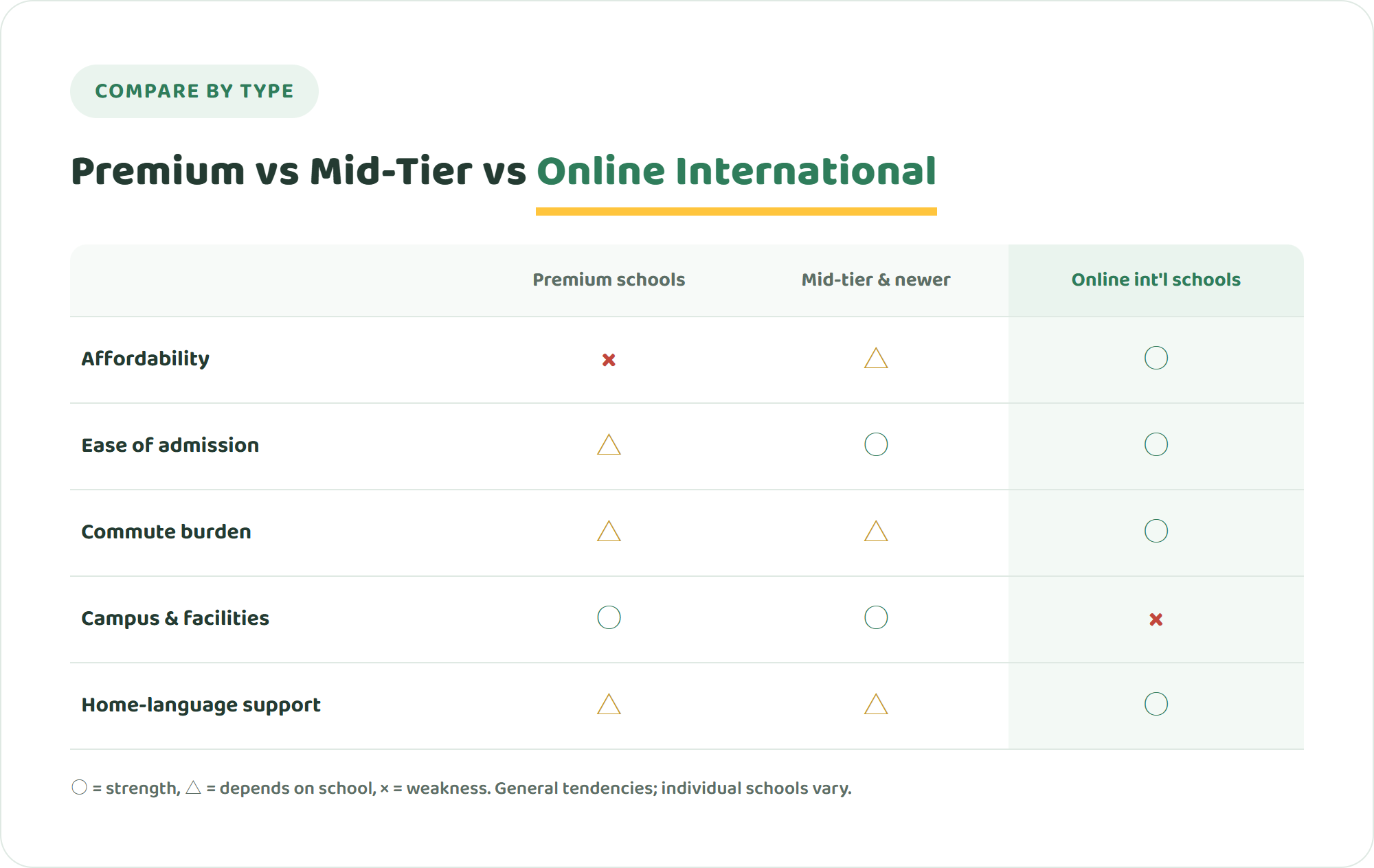
Premium schools deliver extraordinary environments — at premium prices and with the toughest admissions. Mid-tier and newer schools offer the best fee-to-quality balance, though with shorter track records. And online international schools remove the barriers of fees and location entirely, while honestly lacking a physical campus and playground. The question isn’t “which school is best?” but “which trade-offs can our family live with?” See how learning works online →

When Fees or Logistics Are the Wall: An Online Eighth Option
Maybe you’ve read this far and thought: “These schools are wonderful — and completely out of budget,” or “We may relocate again in two years; committing to a campus feels risky.” If so, let us introduce an eighth option we know well, because we’re building it: NIJIN GLOBAL ACADEMY (NGA).
NGA is an online international school opening in September 2027, run by NIJIN Inc. of Japan — whose alternative school in Japan, NIJIN Academy, already serves more than 1,000 students. NGA is built around small-group dialogue rather than test-score rankings, with a simple mission: helping children come to love both themselves and the world. It serves ages 6 to 18 across Asia and Oceania, works wherever you live, and is designed so children can grow into English step by step with Japanese-language support along the way. Tuition is targeted at roughly one-fifth of a traditional bricks-and-mortar international school.
In fairness: NGA has not yet opened, so its track record is still ahead of it, and an online school is not identical to a campus experience — no playing fields, no physical labs. But if fees or location have been quietly closing doors for your family, it deserves a place on your comparison list.
Frequently Asked Questions
From what age can children join international schools in Singapore?
Most schools admit children from around age 3, and some — like Stamford’s Early Learning Village — start even earlier. Popular schools often have waitlists from the earliest year groups, so enquire with several schools as soon as your move is confirmed.
Can my child enrol without strong English?
Many schools offer EAL (English as an Additional Language) support, but entry requirements typically tighten in higher grades, and support may carry extra fees or apply only to certain year levels. Always confirm the details before applying.
Can we join mid-year?
Most international schools in Singapore start their year in August, but many accept mid-year transfers when places are available. The catch is availability: popular schools and year groups fill quickly, so start the process the moment a relocation looks likely.
Which is the best international school in Singapore?
There’s no single “best” for everyone. UWCSEA leads on diversity and IB pedigree; Tanglin Trust and Dulwich for British heritage; SAS and Stamford American for a US pathway; OWIS and GIIS for value. The right answer depends on your family’s priorities — use the fee comparison table and area guide above to narrow to two or three schools, then visit them.
How much should I budget in total, including fees?
Headline tuition runs from about SGD 15,000 to 55,000+, but once you add application fees, building levies, transport, meals, and exam fees, real annual spend is typically 15–25% higher. Budget on “tuition + 20–30%” and pick a level you can sustain for the full run to graduation.
The Right School Isn’t the Famous One — It’s the One That Fits.
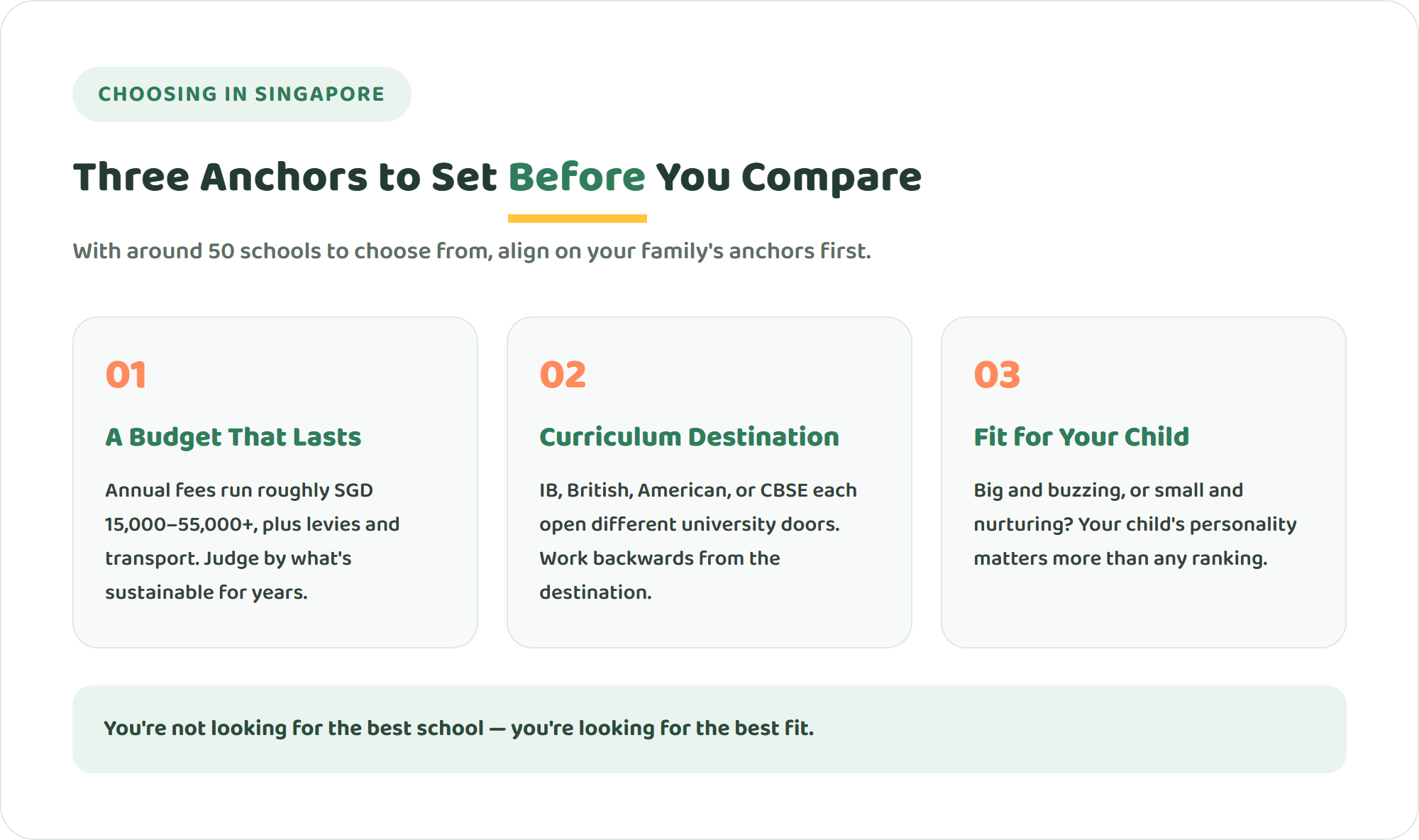
Singapore offers some of the finest schools in the world. But a top-ranked name is not automatically the right fit for your child, and no education is worth a family budget stretched to breaking. Anchor your decision in three things — sustainable budget, curriculum fit, and your child’s personality — and take your time. And remember that today, one of your real options doesn’t require a campus, a commute, or premium fees at all.
NIJIN GLOBAL ACADEMY opens in September 2027. Be the first to hear how our learning works and when founding-class enrolment opens.
International Schools in Other Cities
- International Schools in Bangkok
- International Schools in Manila
- International Schools in Kuala Lumpur
- International Schools in Ho Chi Minh City
- International Schools in Tokyo
- International Schools in Osaka
- International Schools in Sydney
- International Schools in Melbourne
Get opening updates by email →
A more affordable alternative in Singapore
Fees at the schools above are high because of campus costs. If you want a global education without that price, read the cheaper alternative to a Singapore international school and whether an online international school is really affordable.