“Once we get them into an international school, surely the English will just come.” On the way home from an open day, many parents let that hope swell. Lessons in English, foreign teachers and friends all around — it’s an appealing picture. But is the hope true? Today, let’s pause for a moment and think it through, honestly, together.
“Put them in the environment and they’ll speak” is half true and half not. In this piece, we’ll answer honestly the question do international schools make children fluent in English — not just the convenient parts, but the real difference between children who flourish and children who stall. By the end, you’ll see a lens that matters more than “which school.”
And if you’re searching because your child isn’t speaking English yet, there are usually two worries tangled together. One is about the child: will they cope, and what if the fluency never comes? The other is about you: what if I don’t speak English well myself — can I handle the emails, the parent evenings, the homework? We answer both. The first half is about your child; the second half is written for parents who are not confident English speakers, which is where most guides stop short.

Do international schools make children fluent in English?
Let’s start with the conclusion. An international school environment greatly raises the chances that a child learns to speak English. Placed somewhere Japanese barely gets you by, a child’s exposure to English shoots up. That much is true.
But “put them in and every child will speak, automatically and effortlessly” is not something we can honestly promise. In the same school, some children speak with confidence within a few years, while others keep up with lessons yet can’t get the words out on their own. The environment is a trigger, but it isn’t the whole story. What matters is what actually happens inside that environment. Miss this, and the gap between hope and reality can wear both parent and child down.
Put another way: most international schools are not schools that teach English — they are schools that teach subjects in English. Maths, science and history all run in English, which means English is treated as a starting condition rather than a goal. No school guarantees fluency, and none can. What they can offer is exposure plus support, and how good that support is varies enormously. If you’re still weighing the decision itself, our honest look at the pros and cons of international school is a useful companion.
When a child “can’t speak English” at an international school — what it really looks like
Across Asia — Japan, Thailand, Singapore, Malaysia — parents type variations of the same worry: my child is at an international school and still can’t speak English. It’s one of the most common anxieties in the region, and it deserves a straight answer rather than reassurance.
The silent period — and when it hardens into something else
A child who starts with little or no English almost always passes through a silent period. They hear the words but the meaning doesn’t land; they have something to say but nothing comes out. This isn’t failure — it’s a well-recognised stage of language acquisition, and it passes for most children. What you want to avoid is the silence setting. In a large class where a child can go a whole day without being asked to speak, and break times spent with peers who share the home language, silence becomes a stable, comfortable habit within a term or two.
It’s also worth knowing that many international schools are built for children who already have a foundation. Accounts from students who attended and did not become fluent describe the same thing: the school was not a place that taught English from zero, and even the lowest EAL group assumed a working base. That isn’t a criticism of any particular school — it’s simply the design of the sector, and it’s better to know it before you enrol than after.
How long does English actually take?
Having a realistic timeline removes an enormous amount of panic. Research on second-language acquisition generally distinguishes conversational fluency (often labelled BICS) from the academic language needed to learn subjects (CALP). It is widely reported — drawing on work associated with Cummins and Collier, and cited by education authorities and international schools alike — that conversational fluency tends to develop within roughly one to three years, while academic language typically takes something like five to seven years to reach parity with peers who speak it as a first language. Where literacy in the home language is weaker, longer is often suggested.
These are general indications, not promises, and individual children vary a great deal. But simply knowing that a year of immersion does not produce a child who is both fluent and able to study in English changes how you parent through year one. Expect results in six months and a child concludes they are the problem.
Speaking fluently is not the same as understanding
There’s a second trap. ISS International School in Singapore makes the point plainly: for EAL learners, fluent speech can mask gaps in understanding. The reverse happens too — a child grasps the concept but can’t express it in English yet. The two develop at different rates. So don’t relax simply because your child chats away, and don’t conclude they’ve understood nothing because they’ve gone quiet.
The environment alone isn’t enough — what really grows English
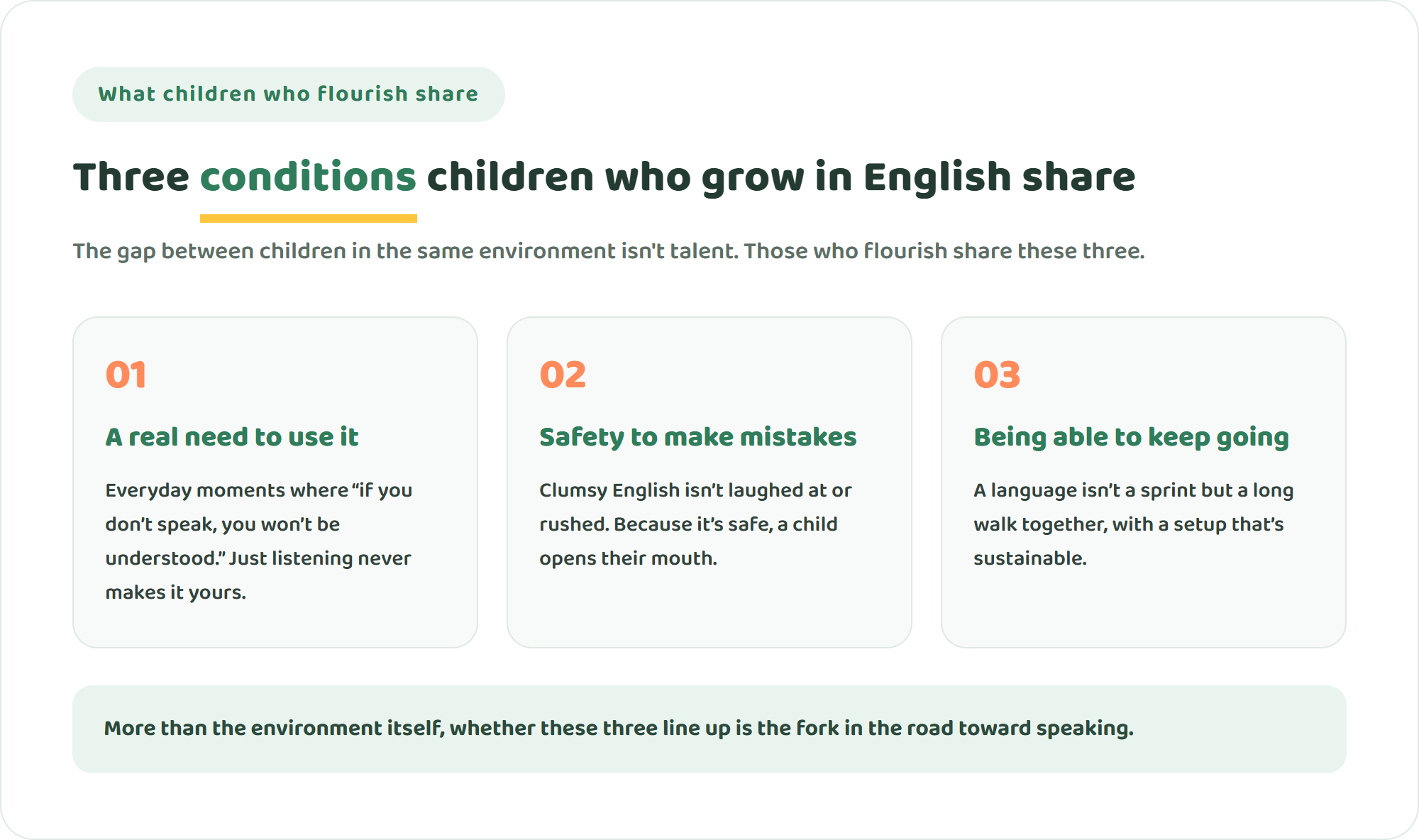
So what’s needed beyond the environment? What we’ve seen is that children whose English flourishes tend to share three conditions.
- A real need to use it — everyday moments where “if you don’t speak, you won’t be understood.” Just listening never makes the language your own.
- Safety to make mistakes — clumsy English isn’t laughed at or rushed. Because it’s safe, a child opens their mouth.
- Being able to keep going — a language isn’t a sprint; it’s a long walk together, with a setup that’s sustainable.
Put the other way: however privileged the environment, missing any of these three and progress stalls. A big class where a child “can get by without speaking,” mistakes met with laughter until they fall silent, cost or commute that ends it early. More than the environment itself, whether these conditions line up is the fork in the road.
What sets apart children who flourish from those who stall
The gap between children in the same environment isn’t about talent. Mostly it’s a difference in speaking volume and a sense of safety. The more a child actually says English out loud, the more — naturally — they come to speak it. And behind children who speak a lot, there’s usually the reassurance that “it’s okay to get it wrong.”
There’s no need to blame the children who stall. Don’t blame the person — look again at the system. Is speaking in a large class skewed toward a few children? Is there a small, safe space for a child who goes quiet out of embarrassment to find their voice? “Can’t speak” may not be the child’s fault at all — it may simply be that the need to speak, and the safety to do so, are missing. Reframe it that way, and the next move comes into view.
The overlooked factor: what isn’t understood in the home language won’t be understood in English
Here’s the part that rarely gets said. If a child has never once thought about fractions, or photosynthesis, in the language they think in, hearing it in English won’t produce understanding — it produces an hour of meaningless sound. The Singapore school quoted above is explicit that parents needn’t be fluent English speakers; what helps is using the home language to build the concept. The mother tongue isn’t a rival to English; it’s the ground English stands on. When that ground erodes, the stretch where both languages look half-formed drags on — the worry many parents know as losing the mother tongue while chasing English. Several of the fears attached to it are less settled than they sound; we’ve unpacked them in the myths about bilingual children.
The keys: a real need to use it, and a safe place to make mistakes
Boiling it down, the keys to learning to speak English come to just two: a real need to use it, and a safe place to make mistakes.
These two go well together, yet they’re hard to hold at once. Push the need to use it by dropping a child into English-only, and some lose the safety and clam up. Over-prioritise safety, and they fall back on their home language and speaking volume never grows. That’s exactly why the heart of learning that truly grows English is this: build on safety first, then offer up the “need to speak” a little at a time.
What EAL and ESL support really is — and seven questions to ask the school
If your child is starting with little English, the school’s EAL (English as an Additional Language) or ESL (English as a Second Language) provision is the single most important thing you will assess. And provision varies enormously. Some schools embed a specialist teacher inside subject lessons; some run separate small-group classes, or an intensive programme before mainstream entry; most assess a child’s language on arrival to decide placement. Fees vary too — included in tuition at some schools, charged separately at others — and some schools cap the year group up to which support is available.
So don’t accept “we have strong EAL support” as an answer. Ask these seven questions at the open day or in your individual meeting, and write the answers down.
Seven questions to ask before you enrol
- Is EAL support delivered inside subject lessons or in separate sessions — and how many hours per week?
- What is the group size, and what qualifications do the EAL specialists hold?
- Is it included in tuition? If not, what is the annual cost?
- Is there a language assessment on entry, and what is the threshold for admission?
- How long can a child receive support — is there a year-group limit?
- How often, and in what form, is progress reported to parents?
- What is the school’s policy on maintaining the home language?
A school that answers all seven concretely has designed its provision. Vague answers usually mean support depends on individual teachers’ goodwill. This isn’t about good schools and bad schools — it’s about whether the specific help your child needs actually exists there. If you’re also weighing the fees against the outcome, our piece on whether international school is worth it, and where the pathways lead covers the other half of that question.
Please note: this describes general practice as of August 2026. Provision changes — always confirm the current position with each school directly.
See how learning works at NGA →
On-campus, online, at home — English environments compared honestly
“So which is best?” Let us answer honestly. Every environment has strengths and weaknesses; there’s no all-purpose right answer. Let’s compare them on speaking volume, safety to speak, home-language support, ease of continuing, and connection with the world.
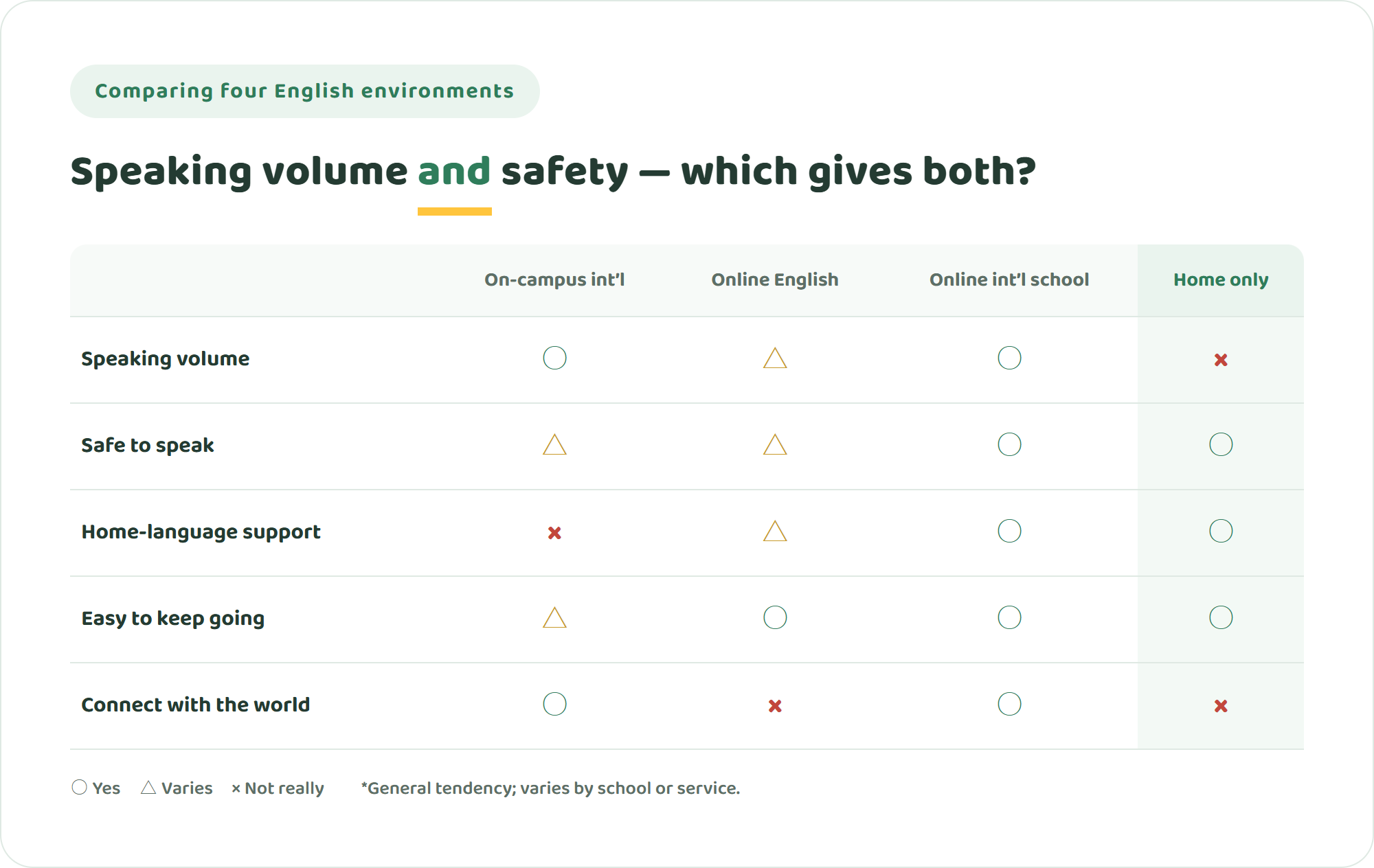
What the table shows: an on-campus international school is strong on speaking volume, but in a large class whether it’s safe to speak depends on the setting. Online English lessons are easy to start, yet differ in connection with the world and staying power. Home only can feel safe but the need to speak thins out. A small-group online international school tries to hold both the “need to speak” and “connection with the world” while keeping safety intact. What matters isn’t the price or the name, but whether the environment fits your child.

What if you don’t speak English yourself? Four situations, honestly
This is the question almost no prospectus answers, and it’s the reason parents across Asia search for it: can we do this if I can’t speak English? The honest answer is that a parent’s English makes life easier, but its absence is rarely a barrier — provided you look at the four situations separately, because they differ wildly in difficulty.
1. School emails, newsletters and admin
Day-to-day communication at most schools is written — email or a parent app. Interviews with families who are already doing this describe exactly that: because it’s written, translation tools handle it, and households where neither parent is a confident English speaker manage fine. In other words this is a logistics problem, not a language problem. Translate, share what matters with the family, and don’t let anything needing a reply pile up.
Check what the school itself offers, too. ISHCMC in Vietnam, for example, sets out multilingual communication for parents who don’t speak English as a first language — translated documents, translation built into the parent portal, and parent ambassadors who act as a bridge. Asking “how do you communicate with families who aren’t confident in English?” on a school visit tells you a great deal about the culture, not just the logistics.
2. Parent-teacher meetings and school events
This is the hard one, because it’s live and face to face. Three things genuinely work. First, ask in advance whether an interpreter may attend, or whether staff who share your language can sit in — many schools with a large community from one language background do have them. Second, write your questions out in English beforehand and bring the paper. Composing on the spot is what makes it hard; a sheet of paper makes the meeting work. Third, ask for anything you didn’t catch to be sent by email. Far from rude, teachers tend to welcome it — it creates a written record for both of you.
Be aware that some schools do run admissions interviews and paperwork in English only, and a few state that at least one parent should be able to communicate in English. This varies so much between schools that the only reliable move is to ask your shortlist directly.
3. Homework and schoolwork — accompany, don’t teach
“I can’t help with English homework” is a worry we hear constantly. But what’s being asked of you is not teaching — it’s accompanying. Schools and EAL specialists say the same thing repeatedly: parents needn’t be fluent; what helps is building understanding in the home language and giving the child chances to put their learning into their own words. Asking “what did you learn today?” and “what do you think that means?” in your own language does more than any worksheet. If the concept is understood, the English catches up. If English phrases are memorised over a concept that was never understood, neither survives. And rather than translating a word, explain what it refers to using examples from your family’s life — that’s what sticks.
4. Practical support from a parent who isn’t confident in English
You can build English into home life without speaking it. The trick is to stop being the teacher and let your child be the one who explains: one sentence in English about today’s lesson, reading a picture book aloud to you, a scheduled chance to talk with someone in English online. Being the listener is enough — and “thank you for teaching me” reliably increases how much a child speaks. One more technique EAL guidance recommends is recasting rather than correcting: if a child says “He go to shop,” reply naturally with “Yes, he went to the shop.” Correction closes a child’s mouth; a recast keeps the conversation going. Above all, don’t drop the home language — enriching a child’s world in it is not a subtraction from English.
How NGA learns — “English you use,” through small-group dialogue
NIJIN GLOBAL ACADEMY (NGA) is an online international school beyond the exam race, opening in September 2027. Rather than measuring English as a “subject” on a test, children pick it up as the language they use to talk with peers around the world.
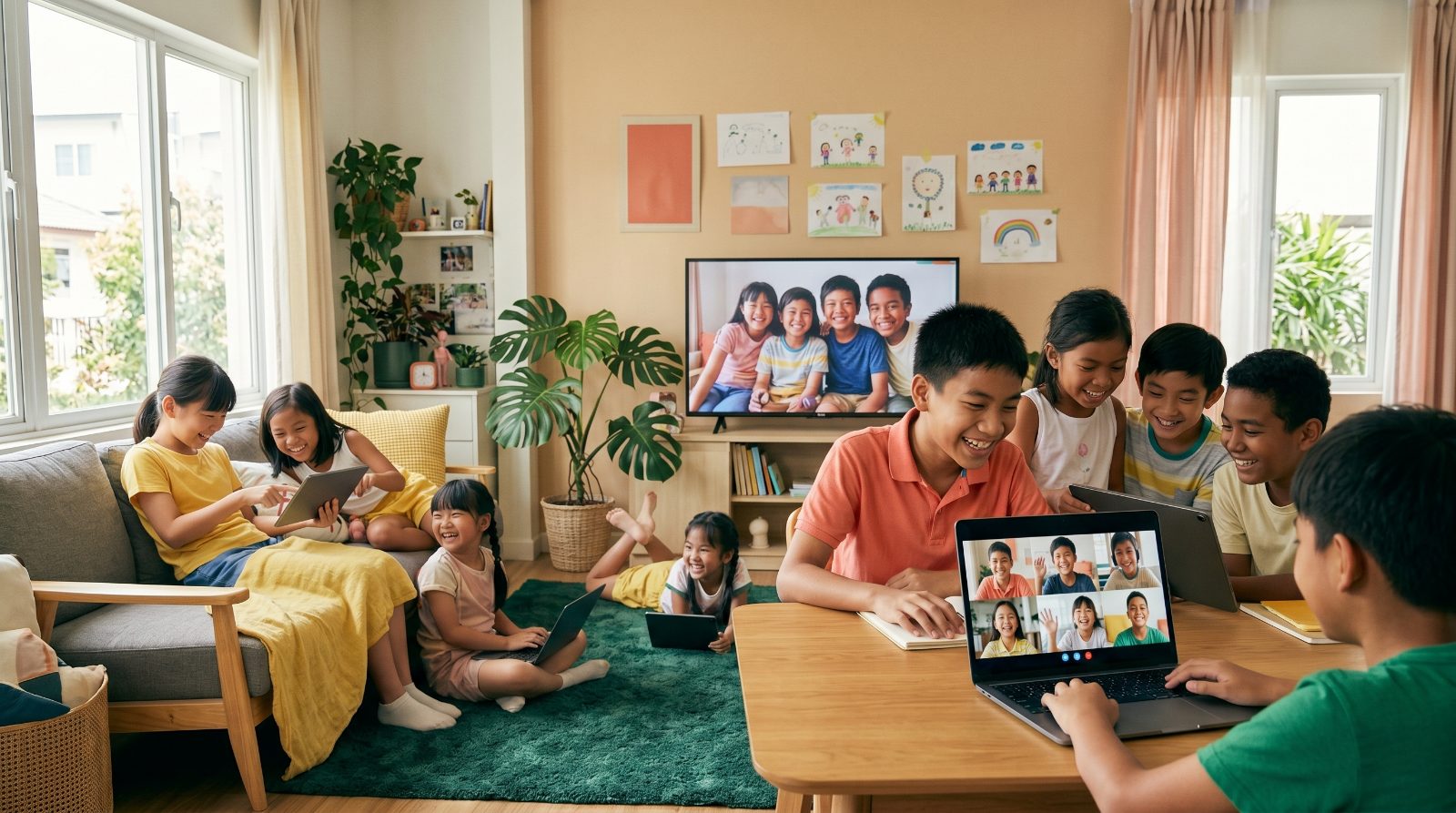
- Small-group dialogue at the core — the turn to speak comes to every child. With no “getting by without speaking,” speaking volume grows naturally.
- Safe to make mistakes — mistakes are part of learning. Not laughed at, not rushed. So a child dares to open their mouth.
- A bilingual mentor walking alongside in your home language — even a child new to English isn’t left behind, because they’re supported in Japanese. Building on safety, they move gradually into the English-speaking world.
“Could my child really do this?” — that worry is natural. But NIJIN Academy, the alternative school we run in Japan, already has over 900 children learning with us. Tuition is designed to be around one-fifth of an on-campus international school — and being able to keep going is one of the very conditions for English to grow. NGA is for children aged 6 to 18 across Asia and Oceania, wherever the family happens to live.
On the parent-English question specifically: because bilingual mentors accompany children in Japanese, communication with families can be completed in the home language. A parent’s English shouldn’t decide whether a child gets to learn — that’s part of why the school is designed this way.
Who it suits, and who it doesn’t — honestly
To be clear: because it’s online, it isn’t identical to an on-campus international school. Your child won’t run around a playground or share the air of the same room every day. And for families who want to maximise the sheer volume of English immersion, a local school or full-time on-campus international school may fit better in some cases. NGA is also still pre-launch, so our track record is genuinely still to come.
On the other hand, if your child “can’t speak up in a big group,” “can talk once they feel safe,” or “wants to talk with friends around the world,” a small-group online international school tends to fit very well. More than finding the “right” school, the lens that matters most is how you set up an environment where your child wants to use English, safely.
Don’t stop at enrolment — three ways to help at home
Finally, whatever environment you choose, there’s something you can do at home. Three small steps so you don’t “stop at enrolment.”
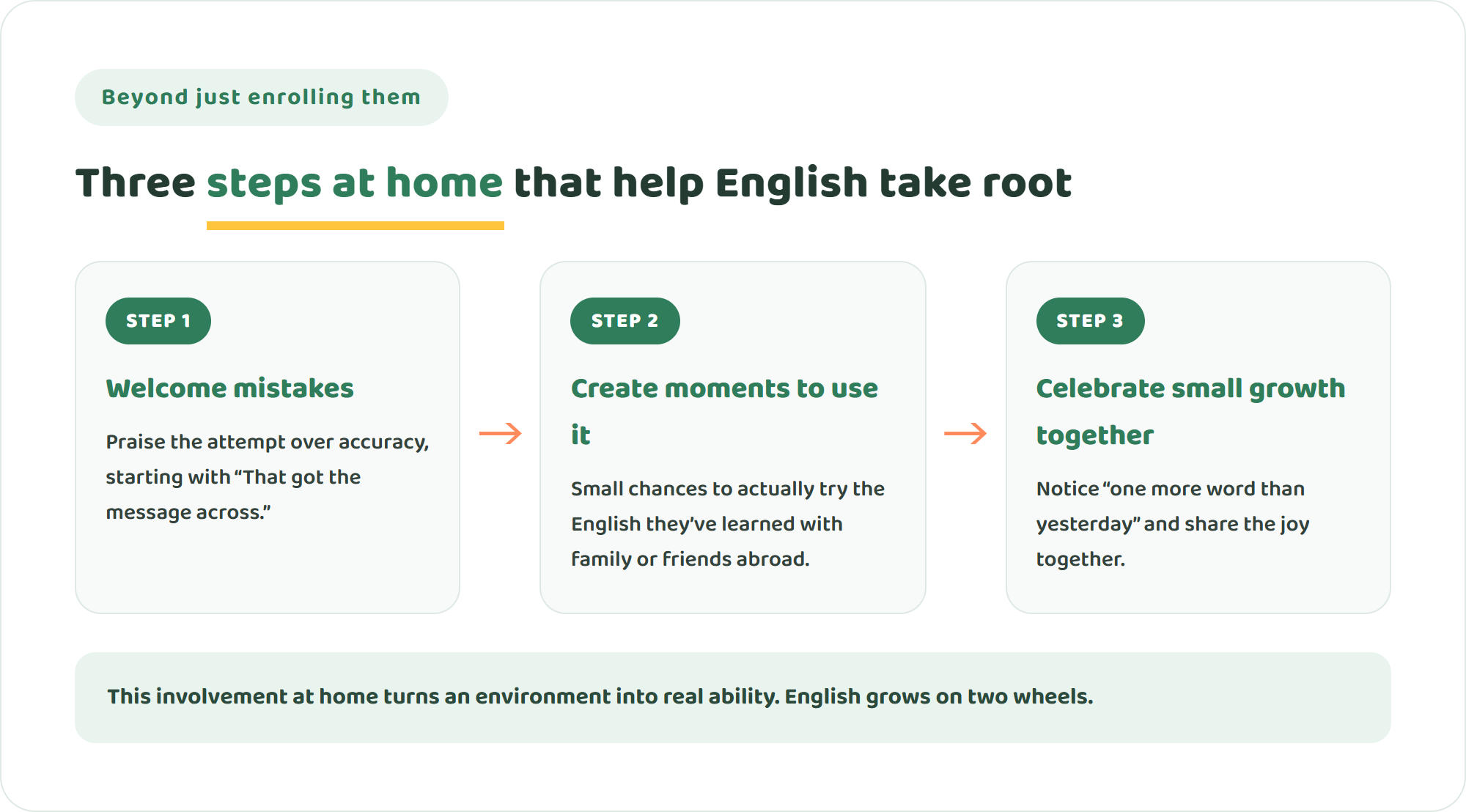
First, welcome mistakes. Praise the attempt over the accuracy: “That got the message across.” Next, create moments to use it — small chances to actually try the English they’ve learned with family or friends around the world. And celebrate small growth together: notice “one more word than yesterday” and share the joy. This is what turns an environment into real ability. English grows on two wheels — home and the place of learning.
Frequently asked questions
Do international schools guarantee that my child will become fluent in English?
No school can, and a school that promises it is overselling. Enrolment greatly raises the chances, but the outcome depends on how much English your child actually says out loud and how safe it feels to get things wrong. Look for an environment where both line up, and ask how the school creates speaking opportunities for a beginner.
What if my child speaks no English at all?
Younger children are generally admitted with little or no English, and many schools set no high bar at kindergarten or lower primary. The higher the year group, the more the curriculum assumes English, and the more EAL provision assumes a working base. The real question isn’t whether they’ll let you in — it’s how concretely you’ll be supported afterwards. Use the seven questions above.
How long does it take before English “sticks”?
Research generally indicates roughly one to three years for conversational fluency and around five to seven years for the academic language used to learn subjects, with longer often suggested where home-language literacy is weaker. These are broad indications with wide individual variation — but abandoning the “fluent in six months” expectation makes life easier for everyone.
What exactly are EAL and ESL support, and do they cost extra?
They’re umbrella terms for programmes that help children who don’t speak English as a first language access the curriculum — delivered by specialists inside lessons, in separate small groups, or via an intensive pre-mainstream programme. Fees are included in tuition at some schools and charged separately at others, and some schools limit how far up the school support continues. Ask for hours, group size, duration and cost specifically.
Can I support my child if I don’t speak English?
Yes. Use your home language to build understanding of what’s being studied, ask your child to explain their day back to you, keep reading together, and recast rather than correct. Schools consistently say parental interest and involvement matter more than parental fluency. For school communication, written channels plus translation tools cover most of what’s needed.
Will an English-only environment backfire?
Not inherently — but if understanding in the home language and conversation at home thin out at the same time, the stretch where both languages look half-formed can drag on. Research generally suggests children with a solid literacy base in their first language acquire academic language in a second one more readily. Increase English exposure, but don’t cut the time your child spends thinking deeply in their home language.
Is a school with many families from our own language background bad for English?
Not necessarily — such schools are often better set up to support anxious beginners and their parents. The ratio itself isn’t the issue; the issue is whether there’s a designed reason to use English. On a visit, look for whether every child speaks during lessons and whether small-group work exists, rather than counting nationalities.
On-campus or online international school — which grows English more?
Neither is simply “better”; it’s about what fits your child. A child who speaks up readily even in a big group may suit on-campus, while a child who speaks best in a safe small group may suit an online international school. What matters is choosing an environment where both speaking volume and safety line up.
What should we do if progress stalls after a year or two?
First separate “isn’t speaking” from “isn’t understanding” — fluent talk can hide gaps, and quiet children often understand more than they show. Ask the class teacher or EAL lead specifically where the difficulty sits across reading, writing, listening and speaking, and support the concepts at home in your own language. Changing schools is a decision worth making after that diagnosis, not before it.
Not “put them in and they’ll speak” — an environment where they want to.
Get them into an international school and the English will come — that hope isn’t wrong. But what truly matters is whether there’s an environment where your child feels safe and wants to use English. The environment is the trigger; what grows the language is the “need to use it” and “safety.” Families who hold this lens are strong, whichever school they choose.
And neither your child’s silence today nor your own hesitant English narrows what’s possible for them. The best thing a parent can do isn’t perfect English — it’s choosing a place where a child feels safe enough to speak, and keeping on asking, in whatever language you share, “what did you think?”
NIJIN GLOBAL ACADEMY opens in September 2027. We’ll share how our learning grows “English you use” through small-group dialogue, along with first-cohort enrolment news, straight to your inbox. A global education, within reach for your child.
Honest Answers to Your Worries — related reading
- Will My Child Lose Their Mother Tongue?
- The Honest Pros and Cons of International School
- Disadvantages of Bilingualism in Childhood: Myths vs Research
- Who Regrets International School — and Who Doesn’t
- International School Special Needs: What to Look For
- International School vs Local School: How to Decide
- Does International School Hurt Your Child’s Home Language?
- When Your Child Is Struggling at International School
- Is International School Worth It? What Happens to Graduates
- Should I Send My Child to International School?
- Transfer From a Local School to an International School
- Disadvantages of Early English Education: What Research Says
- What Happens to International School Graduates