Here is the short answer: international schools in Yokohama range from about JPY 0.6 million to JPY 3.44 million a year in tuition — more than a fivefold spread — so the fastest way to make progress is to decide whether you are researching one named school or a shortlist by criteria. This guide does both. It starts with a full, source-based profile of Yokohama International School (YIS) — fees, curriculum, admissions requirements, and how to read its reputation — and then compares seven real schools across the city by annual cost, first-year total, and location.
Along the way you will find area-by-area commute notes (Honmoku and Yamate, Yokohama Station, Tsuzuki and Midori), how preschools connect to elementary, when to transfer in, three ways to bring the cost down, and one option that removes the commute entirely.
Quick Answer: Your Options in Yokohama
If you only read one section, read this. Below are the schools covered in this guide, plus the online option — so you can see every route side by side before the details.
- Yokohama International School (YIS) — Honmoku, IB continuum, established 1924 — Ages: 3 (ELC) to 18 (Grade 12) / Fee guide: tuition approx. JPY 2.12M–3.44M a year plus a campus development fee of…
- Saint Maur International School — Yamate, the oldest school in Asia — Ages: 2.5 to 18 (Grade 12) / Fee guide: tuition approx. JPY 1.66M–3.63M a year across half-day Montessori to the upper…
- Horizon Japan International School — near Yokohama Station, IB plus Japanese — Ages: about 2.5–3 to 18 (Grade 12) / Fee guide: tuition approx. JPY 1.68M–3.04M a year plus a maintenance fee of approx. JPY…
- CGK International School — Kannai, growing from age 2 up to high school — Ages: 2 (preschool) through elementary Grade 5, then secondary / Fee guide: elementary tuition approx. JPY 2.11M a year plus facility fee approx. JPY…
- India International School in Japan (IISJ) — Midori Ward, the most affordable option — Ages: kindergarten through Grade 11 / Fee guide: tuition approx. JPY 600,000 a year (kindergarten–Grade 10) or approx. JPY…
- Deutsche Schule Tokyo Yokohama (DSTY) — Tsuzuki, German curriculum to the Abitur — Ages: 3 (kindergarten) to Grade 12 / Fee guide: kindergarten approx. JPY 1.87M–1.96M, Grades 1–4 approx. JPY 1.70M, Grades…
- Yokohama Yamate Chinese School — one minute from Ishikawacho Station — Ages: primary through lower secondary / Fee guide: tuition JPY 38,000 a month (primary) or JPY 40,000 (lower secondary), plus a…
- NIJIN GLOBAL ACADEMY (online) — Ages 6–18 / opening September 2027, currently taking opening-update registrations / fees around one-fifth of a typical campus international school / Japanese-language support. An option when commute or fees are the wall.
Yokohama International School (YIS): fees, curriculum, admissions and how to judge it
Most people who search for “Yokohama International School” are looking for one specific school: Yokohama International School, usually shortened to YIS. So let us start there, with what the school itself publishes — and then move on to how you decide whether it fits your family.
The basics: founded 1924, campus moved from Yamate to Honmoku
YIS was founded in 1924 and is one of the oldest international schools in Japan. It spent most of its history in Yamate-cho, Naka Ward, but ageing buildings and a growing roll led to a move: in 2022 the school opened a new campus in Kominato-cho, Naka Ward, in the Honmoku area. The campus was designed by the architect Kengo Kuma and sits on a site of more than 14,000 square metres, with an indoor pool, a large auditorium and an artificial-turf field.
This detail matters more than it sounds. Plenty of directory sites still list the old “258 Yamate-cho” address, so check the current location on the official site before you set out for a tour.
- Location: Kominato-cho, Naka Ward (Honmoku area), Yokohama
- Getting there: roughly an 8-minute bus ride from Yamate Station on the JR Negishi Line. Honmoku is well served by city buses from the Motomachi-Chukagai and Yokohama Station directions, and most families commute by bus
- Ages: 3 (Early Learning Centre) to 18 (Grade 12)
- Structure: ELC (3–5) / Elementary (Kindergarten–G5) / Middle (G6–8) / High (G9–12)
- School year: August to June
YIS tuition and fees (2026–2027, official): annual cost and first-year total
If you are searching for “Yokohama International School fees,” here is what the school publishes for 2026–2027, by grade band. One thing worth knowing: YIS bundles a lot into tuition. School-issued computers and tablets, most expeditions and field trips, and examination fees for the IB Diploma, ISA and PSAT (retakes excluded) are all stated as included.
| Grade band | Annual tuition | Campus development fee (annual) | First-year total (guide) |
|---|---|---|---|
| ELC half day (ages 3–5) | approx. JPY 2.12M | approx. JPY 399,000 | approx. JPY 4.05M |
| ELC full day (ages 3–5) | approx. JPY 2.61M | approx. JPY 399,000 | approx. JPY 4.54M |
| Kindergarten–Grade 5 | approx. JPY 3.21M | approx. JPY 399,000 | approx. JPY 5.14M |
| Grades 6–11 | approx. JPY 3.345M | approx. JPY 399,000 | approx. JPY 5.27M |
| Grade 12 | approx. JPY 3.44M | approx. JPY 399,000 | approx. JPY 5.37M |
The first-year totals add the JPY 50,000 application fee (non-refundable) and the registration fee of approximately JPY 1.48 million, a one-off, non-refundable payment due after an offer is accepted. That registration fee is the single biggest reason the first year jumps. From year two, you are back to tuition plus the campus development fee — around JPY 3.61 million a year for Kindergarten–Grade 5, for example.
Bus service, uniforms, cafeteria and some extracurricular activities are billed separately. Tuition is normally paid in two instalments, in July and December.
Figures are guides based on the 2026–2027 schedule published on the official site as of July 2026, and are subject to revision. Always confirm the latest on the official YIS Tuition & Fees page.
Curriculum: one IB pathway from age 3 to 18
YIS is an IB World School, and children can stay on a single pathway from the ELC at age 3 to graduation. The ELC is play-based, rooted in the IB Primary Years Programme and inspired by Reggio Emilia; Kindergarten to Grade 5 works through transdisciplinary PYP inquiry; Grades 6–8 follow the Middle Years Programme; and Grades 9–12 lead to the YIS Diploma, built from IB Diploma courses, external assessments and teacher-created coursework.
That last point is easy to misread. The high school is not designed so that every student takes the full IB Diploma — courses are selected student by student. If a full IB Diploma is central to your plan, confirm the course requirements before you apply. Teaching is in English, and Japanese and other mother tongues are offered as language subjects.
Admissions requirements: who is actually eligible
YIS welcomes students of all nationalities, but its published admissions policy sets clear eligibility conditions. Four are worth reading carefully if you are a family based in Japan.
- Japanese nationals: eligible if the child has been primarily educated in non-Japanese schools overseas, or at other accredited international schools in Japan
- Parent’s English: at least one residing parent must be fluent in speaking, reading and writing English
- Residence: while enrolled, the student must live with at least one parent within commuting distance of the school
- Two Japanese-citizen parents: a letter from the parents stating their reasons for applying to an international school is required
The process runs: create a portal account through the pre-application form, have eligibility reviewed, complete the full application and pay the JPY 50,000 non-refundable application fee, submit documents (passport copy, school reports and transcripts, teacher recommendations, medical certificate), receive the decision, accept the offer, then enrol and pay the registration fee. Applications for 2027–2028 open in early November 2026. Overseas applicants are considered on a rolling basis, but applying by early March (early February for high school) is advised for an August start.
How hard it is to get in depends heavily on the year group. The school profile describes admission as non-selective, yet in practice popular grades fill and waiting lists form — Grades 6–8 in particular are known for domestic transfer applicants waiting for a place. Check current deadlines on the official YIS Admissions pages.
Reading the reputation honestly: international schools have no hensachi
Japanese search results throw up phrases like “Yokohama International School hensachi” — the standardised deviation score used to rank Japanese schools. To be honest with you: hensachi does not exist for international schools. It measures a student’s relative position within the cohort sitting Japanese mock exams, and international schools do not sit those exams, so there is no basis for the calculation. Where comparison sites publish a number, it is an estimate, not an official figure.
What can you use instead? These five things actually tell you something.
- Published IB results: diploma pass rates and average scores, from the school profile or annual report
- University destinations: which countries and which types of institution graduates go to
- Depth of EAL support: how far the school will carry a child whose first language is not English — support usually thins out in the upper grades
- Places and waiting lists: whether your child’s year group actually has a seat. Ask the school directly; forums will not tell you
- Teacher retention and community feel: something you judge with your own eyes on a campus visit
Star ratings on review sites swing wildly depending on whether the reviewer is a returnee family, an expat posting, or a local family. Far more useful than any score: ask how the school will handle your child’s specific English level, age, and expected length of enrolment.
Why you want alternatives even if YIS is your first choice
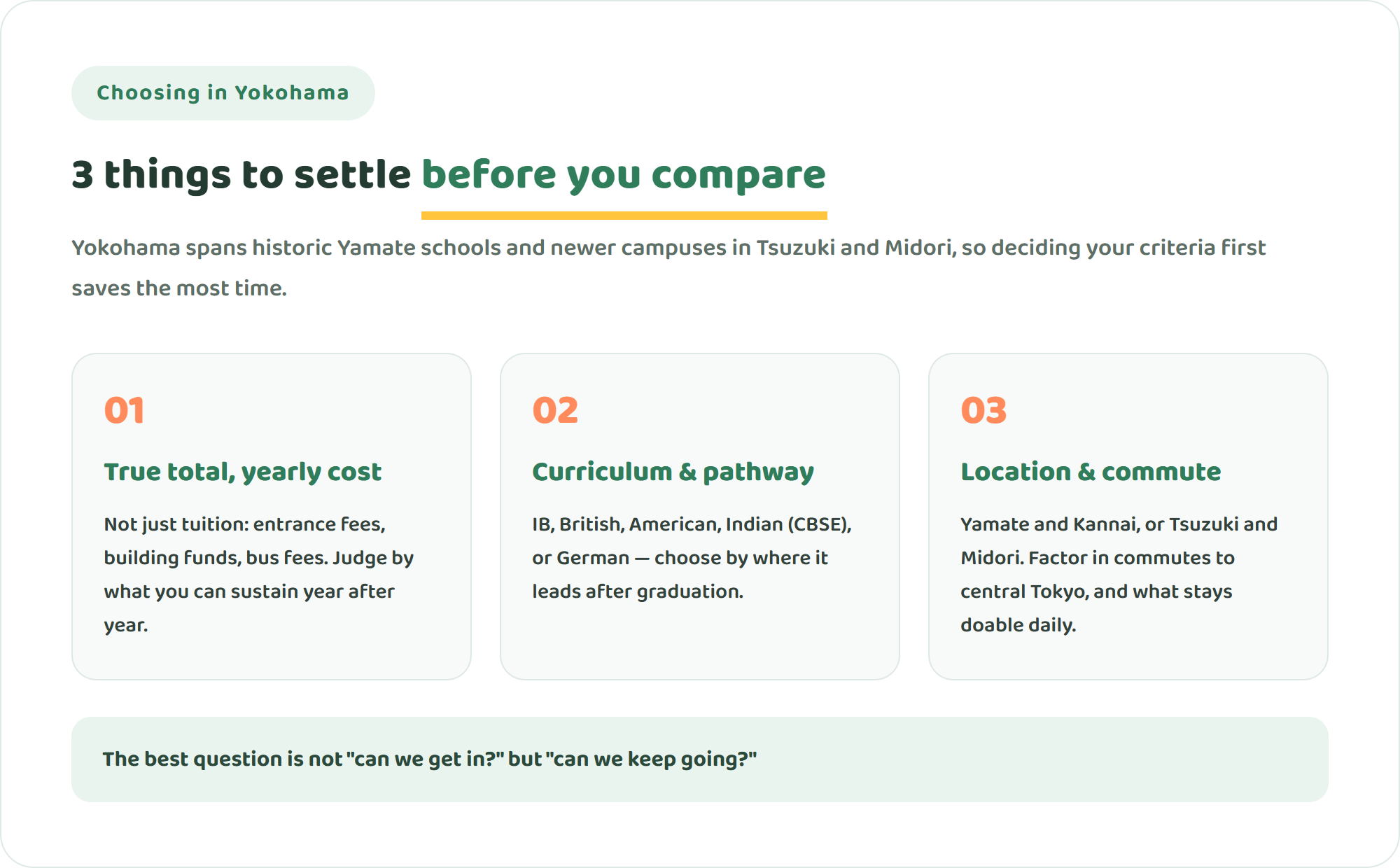
If your reaction so far has been “this looks like a good school, but a JPY 5 million first year and those eligibility rules…” — that is a healthy reaction. Across Yokohama, families rarely get stuck on school quality. They get stuck on four things: cost, eligibility, available places, and the commute.
Which is exactly why the families with the clearest first choice benefit most from holding two or three alternatives in reserve: one at a different price point, one with different admissions rules, one with an easier commute. The rest of this guide compares seven schools, YIS included, on the same measures.
International schools in Yokohama: the landscape and fee levels in 2026
Yokohama has been an international city since its port opened in 1859, and the Yamate and Honmoku districts still hold schools around a century old. In recent years campuses have spread to Kannai and Bashamichi, Minato Mirai, the Kohoku New Town area in Tsuzuki, and Midori Ward. There are dozens of English-medium preschools across the city, but only around ten full international schools running continuously from primary through high school.
For English-medium schools, annual tuition clusters between about JPY 2.12 million and JPY 3.44 million. Entrance fees, registration fees, facility levies and bus charges sit on top, so the first year typically runs 1.3 to 1.6 times the annual tuition. At the other end of the scale, the Indian CBSE school IISJ charges about JPY 0.6–0.7 million a year, the German school DSTY about JPY 1.70–1.96 million, and the Chinese-medium Yokohama Yamate Chinese School about JPY 0.46–0.48 million. Rather than assuming international schools in Yokohama are simply expensive, weigh curriculum and cost together.
The 7 best international schools in Yokohama: profiles, ages and annual fees
The seven schools below were chosen for a genuine spread of curricula, price points and locations. Each entry covers what the school is known for and the kind of family it suits. Fees are guides based on published information as of July 2026.
1. Yokohama International School (YIS) — Honmoku, IB continuum, established 1924
One of Japan’s flagship established schools, founded in 1924 and relocated in 2022 to a new campus in Honmoku (Kominato-cho, Naka Ward). Students learn on a continuous International Baccalaureate pathway from age 3 to 18, in a community drawing from more than 50 nationalities. Full fee and admissions detail is in the YIS section above.
- Curriculum: IB continuum (PYP / MYP / YIS Diploma with IB DP courses)
- Ages: 3 (ELC) to 18 (Grade 12)
- Area / nearest station: Naka Ward (Kominato-cho, Honmoku) / about 8 minutes by bus from Yamate Station, JR Negishi Line
- Fee guide: tuition approx. JPY 2.12M–3.44M a year plus a campus development fee of approx. JPY 399,000 (2026–2027, official); application fee JPY 50,000 and registration fee approx. JPY 1.48M are additional
- Best for: families who want one continuous IB pathway toward international university options
2. Saint Maur International School — Yamate, the oldest school in Asia
Established in 1872, Saint Maur is widely regarded as the oldest international school in Japan and Asia. This co-educational Catholic school on the Yamate hill (83 Yamate-cho, Naka Ward) spans Montessori in the early years, British-style IGCSE, and the IB and AP in the upper grades, in a notably small-scale, settled environment.
- Curriculum: Montessori / IPC / IGCSE / IB & AP
- Ages: 2.5 to 18 (Grade 12)
- Area / nearest station: Naka Ward (Yamate-cho) / Motomachi-Chukagai (Minatomirai Line), Ishikawacho (JR Negishi Line)
- Fee guide: tuition approx. JPY 1.66M–3.63M a year across half-day Montessori to the upper grades (2026/27, published information); application fee JPY 35,000 and registration fee approx. JPY 950,000 are additional
- Best for: families wanting a small, established setting that keeps multiple graduation pathways open
3. Horizon Japan International School — near Yokohama Station, IB plus Japanese
An IB World School in Ohno-cho, Kanagawa Ward, with a campus completed in 2019. Horizon blends the IB with Cambridge and Japanese curriculum elements, and hosts over 500 students from more than 50 nationalities. Its proximity to Yokohama Station makes it the easiest of the seven to reach from outside the city — and it is one of the few here with a sibling discount (20% for a second child, 30% for a third).
- Curriculum: IB (PYP / MYP / DP) blended with Cambridge and Japanese curriculum
- Ages: about 2.5–3 to 18 (Grade 12)
- Area / nearest station: Kanagawa Ward (Ohno-cho) / Yokohama Station (JR and private lines), Shin-Takashima, Kanagawa
- Fee guide: tuition approx. JPY 1.68M–3.04M a year plus a maintenance fee of approx. JPY 250,000 (2026–2027, official); application fee JPY 45,000, registration fee JPY 500,000 and building fund JPY 750,000 are additional. EAL support runs JPY 300,000–500,000 a year and the school bus JPY 215,000–300,000
- Best for: families who want the IB alongside strong Japanese language and culture
4. CGK International School — Kannai, growing from age 2 up to high school
An IB PYP authorised school and MYP candidate school based in Minaminaka-dori, Naka Ward, in the Kannai and Bashamichi area. It runs from a preschool at age 2 into elementary (Grades 1–5), opened a secondary division in April 2025, and plans a high school division for April 2028 — so the age-2-to-graduation pathway is still being built out. Inquiry-led learning and a genuinely central location are the draw.
- Curriculum: International Baccalaureate, IB PYP authorised (MYP candidate)
- Ages: 2 (preschool) through elementary Grade 5, then secondary
- Area / nearest station: Naka Ward (Minaminaka-dori) / Kannai (JR), Bashamichi (Minatomirai Line)
- Fee guide: elementary tuition approx. JPY 2.11M a year plus facility fee approx. JPY 158,400 (2027, official); application fee JPY 44,000 and entrance fee JPY 550,000 are additional. Morning-only school bus approx. JPY 224,400–250,800 a year
- Best for: families who want inquiry-based learning from the early years in the city centre
5. India International School in Japan (IISJ) — Midori Ward, the most affordable option
Located in Kirigaoka, Midori Ward, IISJ follows the Indian CBSE curriculum and is a MEXT-designated international school, with an IB Diploma option in the senior years. It is well regarded for maths and science, and at tuition in the JPY 600,000 range it is in a class of its own on cost within Yokohama.
- Curriculum: CBSE (Indian), with IB DP option in senior years; instruction in English
- Ages: kindergarten through Grade 11
- Area / nearest station: Midori Ward (Kirigaoka) / away from stations — mostly public bus or school bus
- Fee guide: tuition approx. JPY 600,000 a year (kindergarten–Grade 10) or approx. JPY 700,000 (Grade 11) (2026–2027, official); registration JPY 10,000, annual materials fee JPY 10,000 and uniform costs are additional. School bus approx. JPY 90,000–200,000 a year depending on area
- Best for: families wanting a maths- and science-strong English environment at a manageable cost
6. Deutsche Schule Tokyo Yokohama (DSTY) — Tsuzuki, German curriculum to the Abitur
In Chigasaki-minami, Tsuzuki Ward, DSTY is the oldest German school still operating in East Asia (opened 1904). It runs from kindergarten through the German International Abitur in a German-language, multilingual environment. Fees sit well below the English-medium IB schools, and buses run from central Tokyo.
- Curriculum: German curriculum (kindergarten to Abitur)
- Ages: 3 (kindergarten) to Grade 12
- Area / nearest station: Tsuzuki Ward (Chigasaki-minami) / Nakamachidai, municipal subway Blue Line
- Fee guide: kindergarten approx. JPY 1.87M–1.96M, Grades 1–4 approx. JPY 1.70M, Grades 5–12 approx. JPY 1.84M a year (2026/27, official); admission fee JPY 650,000 and service fee JPY 75,000 are additional. School bus approx. JPY 380,000 a year
- Best for: families with ties to the German-speaking world or seeking a German pathway
7. Yokohama Yamate Chinese School — one minute from Ishikawacho Station
In Yoshihama-cho, Naka Ward, this combined primary and lower-secondary school offers multicultural education built around the Chinese language, immersing children in Chinese, Japanese and English. Rooted in the history of Yokohama’s Chinatown, it sits about a minute’s walk from Ishikawacho Station and charges monthly tuition in the JPY 38,000–40,000 range — worth knowing as another kind of international education beyond the English-only route.
- Curriculum: Chinese-language-based multicultural education (primary and lower secondary; the group also runs Panda Kindergarten)
- Ages: primary through lower secondary
- Area / nearest station: Naka Ward (Yoshihama-cho) / Ishikawacho, JR Negishi Line, about 1 minute on foot
- Fee guide: tuition JPY 38,000 a month (primary) or JPY 40,000 (lower secondary), plus a JPY 5,000 monthly facility fee; entrance fee JPY 200,000 and examination fee JPY 25,000. The school gives a first-year total of about JPY 800,000 including materials and uniform. Entry involves an assessment, observed activities and a parent-and-child interview
- Best for: families with ties to the Chinese-speaking world or raising children multilingually
Note: fees and details reflect information publicly available as of July 2026. Entrance fees, facility fees, possible fee revisions, places, and admission requirements can change. Always confirm the latest figures on each school’s official website.
International schools in Yokohama: fee comparison table with first-year totals
Here are all seven schools side by side — curriculum, ages, annual tuition and an estimated first-year total including one-off entrance and registration fees. Use it to grasp the overall picture, then narrow to the two or three schools worth a closer look.
| School | Curriculum | Ages | Annual tuition guide | First-year total (guide) |
|---|---|---|---|---|
| Yokohama International (YIS) | IB continuum (PYP / MYP / DP courses) | 3–18 | approx. JPY 2.12M–3.44M | approx. JPY 4.05M–5.37M |
| Saint Maur | Montessori / IGCSE / IB & AP | 2.5–18 | approx. JPY 1.66M–3.63M | approx. JPY 2.65M–4.62M |
| Horizon Japan | IB + Cambridge + Japanese | 2.5–18 | approx. JPY 1.68M–3.04M | approx. JPY 3.12M–4.47M |
| CGK International | IB PYP authorised (MYP candidate) | 2 upward (secondary opening out) | approx. JPY 2.11M + facility fee ~158,400 | approx. JPY 2.86M |
| IISJ (Indian) | CBSE + IB DP (senior) | K–Grade 11 | approx. JPY 0.60M–0.70M | approx. JPY 0.65M–0.75M (bus extra) |
| Deutsche Schule (DSTY) | German (to Abitur) | 3–Grade 12 | approx. JPY 1.70M–1.96M | approx. JPY 2.43M–2.69M |
| Yokohama Yamate Chinese | Chinese-based multicultural | primary–lower secondary | approx. JPY 0.46M–0.48M + facility fee 60,000 | approx. JPY 0.80M |
Figures are guides based on publicly available information as of July 2026. First-year totals simply add tuition, annual levies, entrance or registration fees and application fees; uniforms, bus service and EAL charges are not included. Confirm the latest on each official site. For a full breakdown, see our guide to the real cost of international school tuition.
International schools in Yokohama by area: Honmoku and Yamate, Yokohama Station, Tsuzuki and Midori
In Yokohama, which area you commute to changes daily life more than almost anything else. It helps to think of the city in three broad zones, and to check the nearest station and journey for each school before you shortlist.
- Honmoku / Yamate / Motomachi / Kannai (Naka Ward): the historic core, where YIS (Kominato-cho), Saint Maur (Yamate-cho), CGK (Minaminaka-dori) and Yokohama Yamate Chinese School (Yoshihama-cho) cluster. Nearest stations are Ishikawacho and Yamate on the JR Negishi Line, Motomachi-Chukagai and Bashamichi on the Minatomirai Line, and Kannai on the JR — roughly 10 minutes from Yokohama Station and within an hour of Tokyo and Shinagawa. But note that Yamate sits on a hilly bluff, and YIS in Honmoku is a bus ride from the nearest station. Central does not automatically mean an easy commute.
- Yokohama Station / Kanagawa Ward: Horizon Japan is in Ohno-cho, Kanagawa Ward, close to Yokohama Station where the JR, Tokyu, Keikyu and Sotetsu lines converge — the best fit for families commuting from outside the city, and around 30 minutes from Kawasaki.
- Tsuzuki / Kohoku / Midori (suburban): DSTY is in Chigasaki-minami, Tsuzuki Ward, nearest to Nakamachidai on the municipal subway Blue Line. IISJ is in Kirigaoka, Midori Ward, a distance from any station, so most families use a public or school bus. Suburban campuses offer spacious, calm settings, but always confirm the commute — whether a bus runs, which areas it covers, and what it costs. DSTY’s bus is around JPY 380,000 a year and IISJ’s JPY 90,000–200,000 depending on area, so the gap is real money.
If nothing inside Yokohama fits, widening the search adds options quickly. Kawasaki is 20–30 minutes from Yokohama Station, and central Tokyo 30 minutes to an hour.
Choosing by age stage: from preschool into elementary, and when to transfer
The most common stumble in Yokohama is enrolling in a preschool that has no elementary school above it. Here is what to check at each stage.
Preschool (ages 2–5): check first whether there is an elementary school above it
Yokohama has dozens of English-medium preschools, and most of them end at age 5 or 6. If you want one continuous school, start with a school where the upper grades already exist — CGK (elementary and secondary now open), Saint Maur (Montessori through Grade 12), Horizon (EYP through Grade 12), or YIS (ELC through Grade 12).
Elementary (Grades 1–5): the widest choice, and the safest entry point
All seven schools take students at elementary level, at anything from about JPY 460,000 a year (Yokohama Yamate Chinese School) to about JPY 3.21 million (YIS). Most will accept a child whose English is still developing and bring them up through EAL support. This is where Yokohama offers the most room to manoeuvre.
Middle and high school (Grades 6–12): English and availability both tighten
From Grade 6, enough English to follow lessons becomes a precondition, and EAL support tends to thin out. These are also the year groups where popular schools fill and waiting lists form. Entering at IB Diploma level (Grades 11–12) brings strict course requirements, so realistically you want to be in by Grade 9 or 10.
Transfer timing: build the plan around an August start
Most international schools in Yokohama run an August–September school year, so applying or transferring at the start of a new school year is smoothest, with recruitment ramping up from the previous autumn through spring. YIS opens 2027–2028 applications in early November 2026, with a mid-February deadline for high school applicants living in Japan — deadlines differ by grade. DSTY, by contrast, sets no application deadline and accepts mid-year entry when places exist. For a school high on your list, start gathering information and booking visits a year ahead.
Three ways to bring the cost down — and one way to widen the field
If the fees put international school out of reach before you have even started, three levers genuinely move the number.
- Japan’s free early childhood education and care programme (up to JPY 37,000 a month): children aged 3–5 attending a preschool that qualifies as a certified-standard unlicensed childcare facility can receive up to JPY 37,000 a month, subject to a certification of childcare need. Some Yokohama preschools, CGK among them, state publicly that they qualify. That is roughly JPY 440,000 a year, so it is worth confirming with both the school and Yokohama City.
- Sibling discounts and means-tested reductions: Horizon discounts tuition 20% for a second child and 30% for a third; DSTY offers social-assistance reductions from the second year of enrolment for households with income up to JPY 7.5 million. Over several years and two children, these change the total by millions of yen.
- Look at a different curriculum family: IISJ (CBSE), DSTY (German) and Yokohama Yamate Chinese School sit at one third to one tenth of the English-medium IB schools. Ruling out everything that is not English-medium IB is what narrows most families’ options prematurely.
When none of that closes the gap, the remaining choices are to widen the commuting radius, or to remove the commute altogether. For a fuller picture of where the money goes, see our guide to the real cost of international school tuition.
How to choose the right fit for your family
When seven schools still feel like a lot, it helps to think in terms of school types. The chart below compares the historic Yamate and Honmoku schools, newer and more diverse schools, and online international schools across five honest criteria: affordability, ease of admission, a light commute, campus experience, and Japanese-language support.
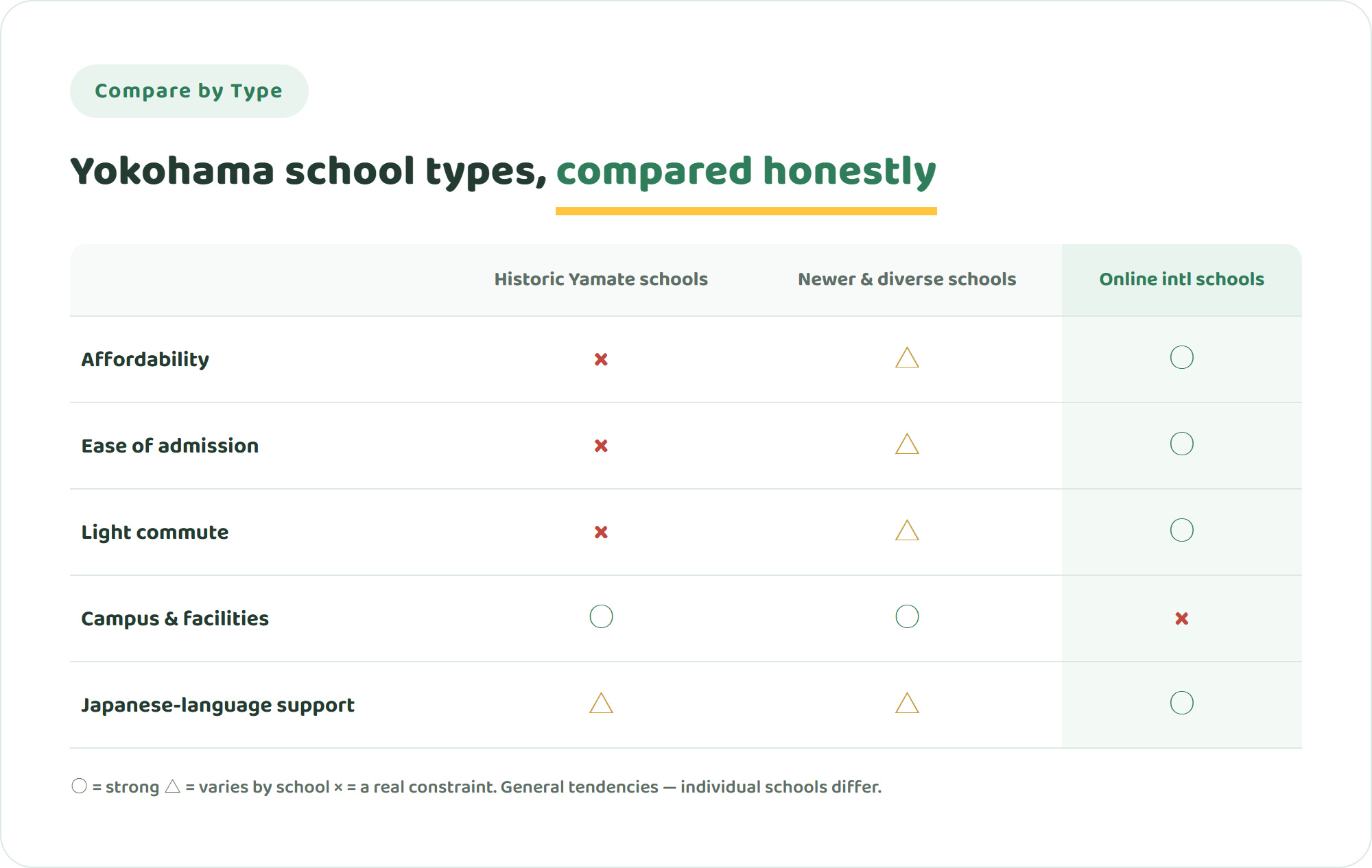
The key is deciding your priorities as a family in advance. If cost comes first, IISJ or Yokohama Yamate Chinese School stand out; if an international pathway matters most, an IB-continuum school like YIS or Saint Maur; if the commute is the constraint, Horizon; if you want inquiry-led learning from the early years, CGK. Fix one axis and the shortlist writes itself. And if you would first like to see how the learning itself works, see how learning works online →.
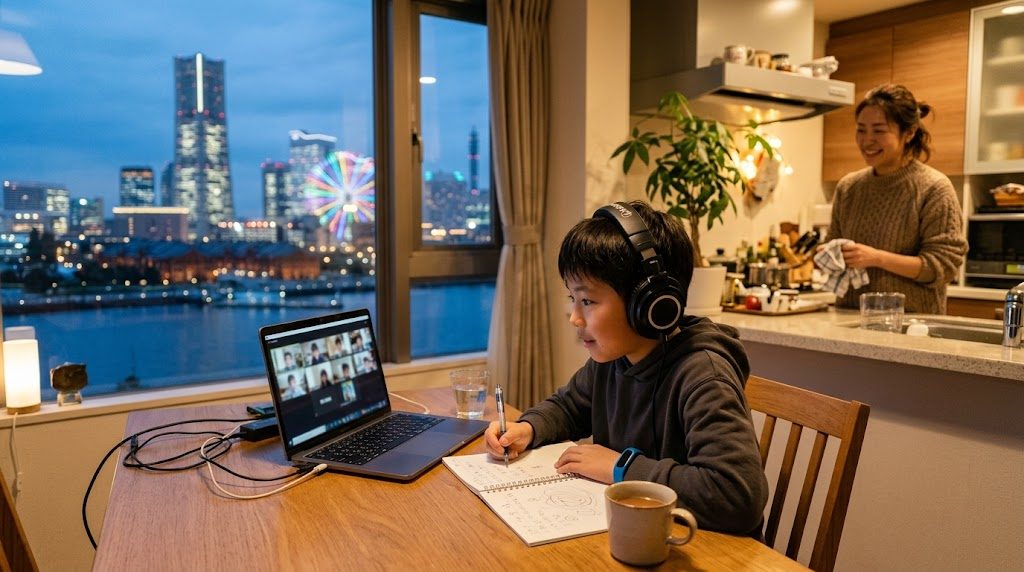
When fees or the commute are the barrier — an online eighth option
As you have seen, Yokohama’s international schools are demanding on both budget and commute. A first year above JPY 5 million, climbing the Yamate slopes every day, catching a bus out to Honmoku, or making a long trip into central Tokyo — many families quietly wonder whether that is sustainable for years. This is where we would like you to know about NIJIN GLOBAL ACADEMY (NGA), an online international school opening in September 2027.
NGA is operated by NIJIN Inc. in Japan. Its existing alternative school in Japan, NIJIN Academy, already enrols more than 1,000 students. Rather than ranking children by test scores, NGA centres on small-group dialogue and the belief that children should come to love themselves and the world. It aims to keep tuition at around one-fifth of a face-to-face international school, and welcomes children aged 6–18 across Asia and Oceania, wherever they live. It is designed so children can ease into English with Japanese-language support along the way.
To be honest, NGA has not opened yet, and its track record is still to be built. It cannot offer the same experience as a physical campus — a schoolyard to run in, friends met face to face. Even so, for families on the verge of giving up on an international education because of fees or the commute, we believe it can be a realistic eighth option.
Frequently asked questions about international schools in Yokohama
Q. Is “Yokohama International School” the name of one school?
Yes. It is a real school in Kominato-cho, Naka Ward, in the Honmoku area — an IB continuum school founded in 1924 that moved from Yamate-cho to its current campus in 2022. The phrase is also used loosely to mean international schools in Yokohama generally, which is why this guide covers both the school itself and a comparison of seven schools across the city.
Q. How much does Yokohama International School (YIS) cost?
For 2026–2027 the school publishes annual tuition of approximately JPY 2.12M–3.44M from ELC half day to Grade 12, plus a campus development fee of approximately JPY 399,000 a year. The first year also carries a JPY 50,000 application fee and a registration fee of approximately JPY 1.48M, so Kindergarten–Grade 5 comes to roughly JPY 5.14M in year one and about JPY 3.61M thereafter. Confirm current figures on the official site.
Q. Can Japanese nationals enrol at YIS?
Yes, subject to conditions. A Japanese national must have been primarily educated in non-Japanese schools overseas or at accredited international schools in Japan; at least one residing parent must be fluent in English; and the student must live with a parent within commuting distance. Where both parents are Japanese citizens, a letter explaining the reasons for applying is also required. If those conditions do not fit, schools such as Horizon, CGK and IISJ have different admissions policies.
Q. Do international schools in Yokohama have a hensachi ranking?
No. Hensachi reflects a student’s relative position among those sitting Japanese mock exams, which international school students do not take, so the metric does not apply. Numbers on comparison sites are estimates, not official. Judge instead on published IB results, university destinations, depth of EAL support, and whether a place is actually available.
Q. From what age can children start at international schools in Yokohama?
It varies. CGK starts at 2, Saint Maur at 2.5, Horizon and DSTY around 3, and YIS at 3 in its Early Learning Centre. Many also accept transfers into the elementary grades, so check each school’s age range — and whether the upper grades exist.
Q. Is Japanese-language support available?
Most schools offer EAL (English support) and Japanese lessons for children whose first language is not English, though the depth differs by school and it is sometimes charged separately (Horizon lists JPY 300,000–500,000 a year). If you want to keep Japanese-language learning too, consider schools like Horizon that weave in Japanese curriculum, or an online school built around Japanese-language support.
Q. How does the commute differ between Honmoku or Yamate and the suburbs?
The Yamate, Motomachi and Kannai area is easy to reach from central Yokohama via the Minatomirai and JR Negishi lines, though Yamate itself is a hilly bluff, and YIS in Honmoku is about 8 minutes by bus from Yamate Station. Suburban schools in Tsuzuki (DSTY at Nakamachidai) and Midori (IISJ in Kirigaoka) offer calmer settings but are often a distance from a station, so check whether a school bus runs, which areas it covers and what it costs. Horizon in Kanagawa Ward is close to Yokohama Station, which suits families commuting from outside the city.
Not “a school that will take us,” but “a place this child can keep going”
Choosing a school is not about rankings — and for international schools, the ranking metric families reach for does not even exist. What matters is whether your child can attend, feel secure, and grow there for years: a place to come to love themselves and the world. Yokohama offers a genuinely wide range, from the traditional schools of Yamate and Honmoku to newer IB campuses, German, Indian and Chinese-medium options, and online. Take your time, and stay honest about your family’s priorities. The right school for you and your child is out there.
To compare every option across the wider prefecture, see our guide to international schools in Kanagawa Prefecture, which covers schools outside this city and prefecture-wide fee ranges.
International Schools in Other Cities
- International Schools in Shinjuku: Fees
- International Schools in Karuizawa: All 4 Schools
- International Schools in Sapporo: Fees
- International Schools in Dubai: Fees
- International Schools in Meguro: All 8 Schools
- International Schools in Kobe: All 20 Schools
- International Schools in Taito, Tokyo
- International Schools in Tokyo
- International Schools in Toshima, Tokyo
- International Schools in Osaka
- International Schools in Nagoya: All 8 Schools
- International Schools in Fukuoka: Fees
- International Schools in Minato: Fees
- International Schools in Shibuya, Tokyo
- International Schools in Setagaya: All 14 Schools