If you have been searching for international schools in Melbourne and wondering why nothing looks like the international schools of Singapore, Tokyo or Bangkok — you are not imagining it. Melbourne has almost no “expat-style” international schools, because local schools already teach in English. What it has instead is arguably richer: more than 30 IB World Schools, genuine bilingual schools accredited by the German and French governments, and public schools that welcome students from over 40 nationalities. This guide explains that landscape honestly, then walks you through 7 recommended schools, realistic fee ranges, and a practical way to choose.
Whether you are a local family wanting a globally minded education, a relocating family comparing options, or a parent worried about fees, the right answer depends on your budget, your visa and your child. Read on with your own family in mind.
Quick Answer: Your Options in Melbourne
If you only read one section, read this. Below are the schools covered in this guide, plus the online option — so you can see every route side by side before the details.
- Wesley College — Ages — 3 to 18 (ELC to Year 12)
- St Leonard’s College — Ages — 3 to 18
- Ivanhoe Grammar School — Ages — 3 to 18
- Preshil – The Margaret Lyttle Memorial School — Ages — 3 to 18
- Deutsche Schule Melbourne — Ages — 5 to 12 (Foundation to Year 6)
- Auburn High School — Ages — 12 to 18 (Years 7–12)
- Glen Waverley Secondary College — Ages — 12 to 18 (Years 7–12; international intake year levels vary — confirm directly)
- NIJIN GLOBAL ACADEMY (online) — Ages 6–18 / opening September 2027, currently taking opening-update registrations / fees around one-fifth of a typical campus international school / Japanese-language support. An option when commute or fees are the wall.
International Schools in Melbourne: How the Landscape Really Works
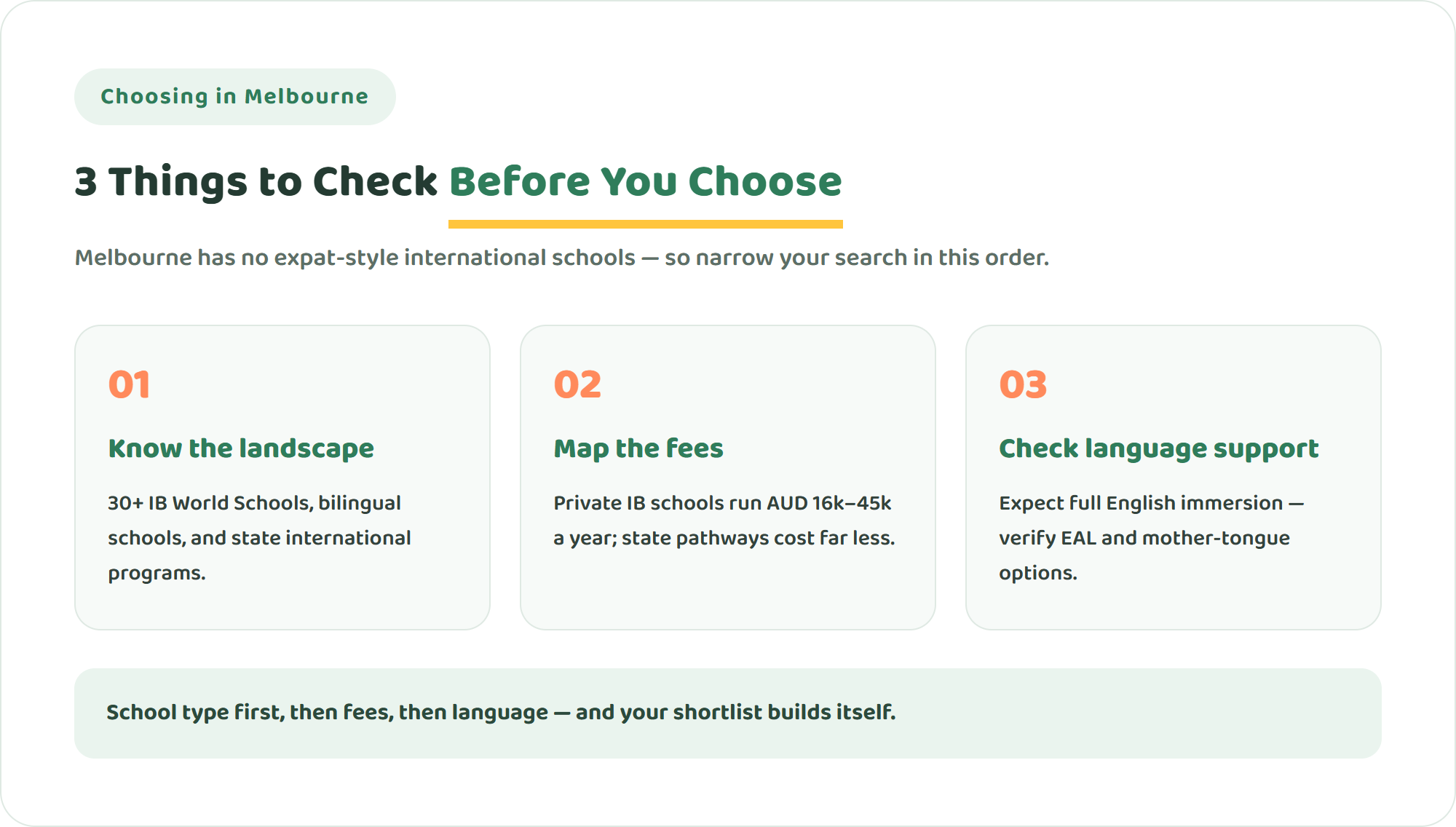
In most Asian cities, “international school” means a private school teaching foreign children in English. In Melbourne, English is the language of every school, so that market never developed. Instead, families looking for an international education choose between three pathways:
- IB World Schools — more than 30 schools across greater Melbourne offer International Baccalaureate programmes, from the Primary Years Programme through to the IB Diploma. Wesley College even offers the full IB continuum from early childhood to Year 12.
- Bilingual and national-curriculum schools — Deutsche Schule Melbourne (German government accredited) and Auburn High School’s French binational programme (accredited by the French Ministry of Education) deliver two curricula in two languages.
- Government schools’ International Student Program (ISP) — Victorian state schools enrol fee-paying international students under a state-wide scheme, and many are deeply multicultural communities in their own right.
Fees vary enormously by pathway. At private IB and independent schools, annual tuition typically runs from around AUD 16,000 to AUD 45,000 depending on the school and year level, before enrolment fees and levies. State schools cost far less: local resident families pay only modest contributions, and even international students pay a published state fee schedule (see Study Victoria) well below private rates. For a breakdown of what actually sits inside an international school bill, see our guide to international school tuition and hidden costs.
Note: all fees cited here are from publicly available information as of July 2026. Always confirm the latest figures on each school’s official website.
7 Best International Schools in Melbourne
Here are seven schools that together cover the full spread of Melbourne’s international education: IB continuum schools, progressive schools, bilingual schools and public international programs. None of them is “the best” for every family — the right school depends on your budget, your visa status and your child’s personality. All fees are indicative ranges.
1. Wesley College
Founded in 1866, Wesley is one of Melbourne’s most storied coeducational independent schools, with three campuses including St Kilda Road. It is the only school in Victoria offering the IB from early childhood right through to Year 12 (PYP, MYP and Diploma), alongside the VCE — giving students a genuine choice of pathways at the senior level. Official site
- Curriculum — IB continuum (PYP/MYP/DP) plus VCE
- Ages — 3 to 18 (ELC to Year 12)
- Indicative fees — around AUD 45,000 per year at Year 12 (2026 published fees; lower in earlier years; international fees differ — confirm directly)
- Best for — families who want the full IB continuum with the resources of a large, established school
2. St Leonard’s College
A coeducational independent school in bayside Brighton East, St Leonard’s blends the IB Primary Years Programme in its junior school with a senior-years choice between the IB Diploma and the VCE. It also has an established international student intake, all within a calm, beachside pocket of Melbourne. Official site
- Curriculum — IB PYP, then IBDP or VCE alongside the Australian Curriculum
- Ages — 3 to 18
- Indicative fees — around AUD 31,800 per year at Year 12 for domestic students (2026); international student fees are set separately and higher — confirm directly
- Best for — bayside families who want to keep both IB and VCE pathways open
3. Ivanhoe Grammar School
A coeducational independent school in Melbourne’s north-east with multiple campuses, Ivanhoe Grammar offers both the IB Diploma and the VCE and runs a well-organised international student program. Its fees start noticeably lower than the city’s most famous IB schools, making it a strong value option in the private IB tier. Official site
- Curriculum — Australian Curriculum plus IBDP/VCE
- Ages — 3 to 18
- Indicative fees — approximately AUD 16,800–35,300 per year depending on year level (2026 published fees; international rates differ — confirm directly)
- Best for — families balancing IB access against overall cost
4. Preshil – The Margaret Lyttle Memorial School
Australia’s oldest progressive school, founded in 1931 in Kew. There are no uniforms and no rankings; teachers are called by their first names — and yet the secondary school delivers the IB Middle Years and Diploma Programmes. It is a rare combination: a genuinely alternative philosophy with an internationally recognised qualification at the end. Official site
- Curriculum — progressive education with IB MYP and DP
- Ages — 3 to 18
- Indicative fees — around AUD 35,700 per year for Years 11–12 (2026 published fee schedule — confirm directly)
- Best for — families who value inquiry and wellbeing over competition, without giving up university pathways
5. Deutsche Schule Melbourne
A German-English bilingual primary school in North Fitzroy covering Foundation to Year 6, teaching the Victorian and German curricula in parallel and accredited by the German government. You do not need German heritage to enrol, and it remains one of the very few full-immersion bilingual primary options in the inner city. Official site
- Curriculum — dual Victorian and German curriculum, bilingual German-English
- Ages — 5 to 12 (Foundation to Year 6)
- Indicative fees — around AUD 16,200 per year plus one-off enrolment costs (published information — confirm directly)
- Best for — families wanting genuine bilingual immersion through the primary years
6. Auburn High School
A government secondary school in Hawthorn East with a twist: its French Binational Programme has been accredited by the French Ministry of Education since 2016, and the school is an AEFE partner school. Students follow the French national curriculum alongside the Victorian Curriculum, sit the Diplôme National du Brevet, and study Spanish as a second foreign language — at a fraction of private-school cost. Official site
- Curriculum — Victorian Curriculum plus accredited French national programme
- Ages — 12 to 18 (Years 7–12)
- Indicative fees — standard state-school contributions plus a program fee of about AUD 2,900 per year (2025 published figure); international students pay Victoria’s ISP fee schedule — confirm directly
- Best for — families seeking a rigorous international curriculum at public-school cost
7. Glen Waverley Secondary College
One of Victoria’s largest and most academically regarded government schools, in Melbourne’s south-east, and a flagship of the state’s International Student Program. Its community spans more than 40 nationalities and 50 languages — a reminder that in Melbourne, the truly “international” school is often the local public one. Official site
- Curriculum — Victorian Curriculum and VCE, with EAL support
- Ages — 12 to 18 (Years 7–12; international intake year levels vary — confirm directly)
- Indicative fees — international students pay the state-wide fee schedule published on Study Victoria (varies by application type); resident families pay only modest contributions
- Best for — families wanting a large, multicultural public school without private fees
Comparing Your Options: Which Type of Melbourne School Fits Your Family?
Zoom out from individual schools and three broad types emerge: private IB schools, state international programs, and — if commuting or fees are the real barrier — online international schools. Comparing them by what actually matters day to day makes the decision clearer.
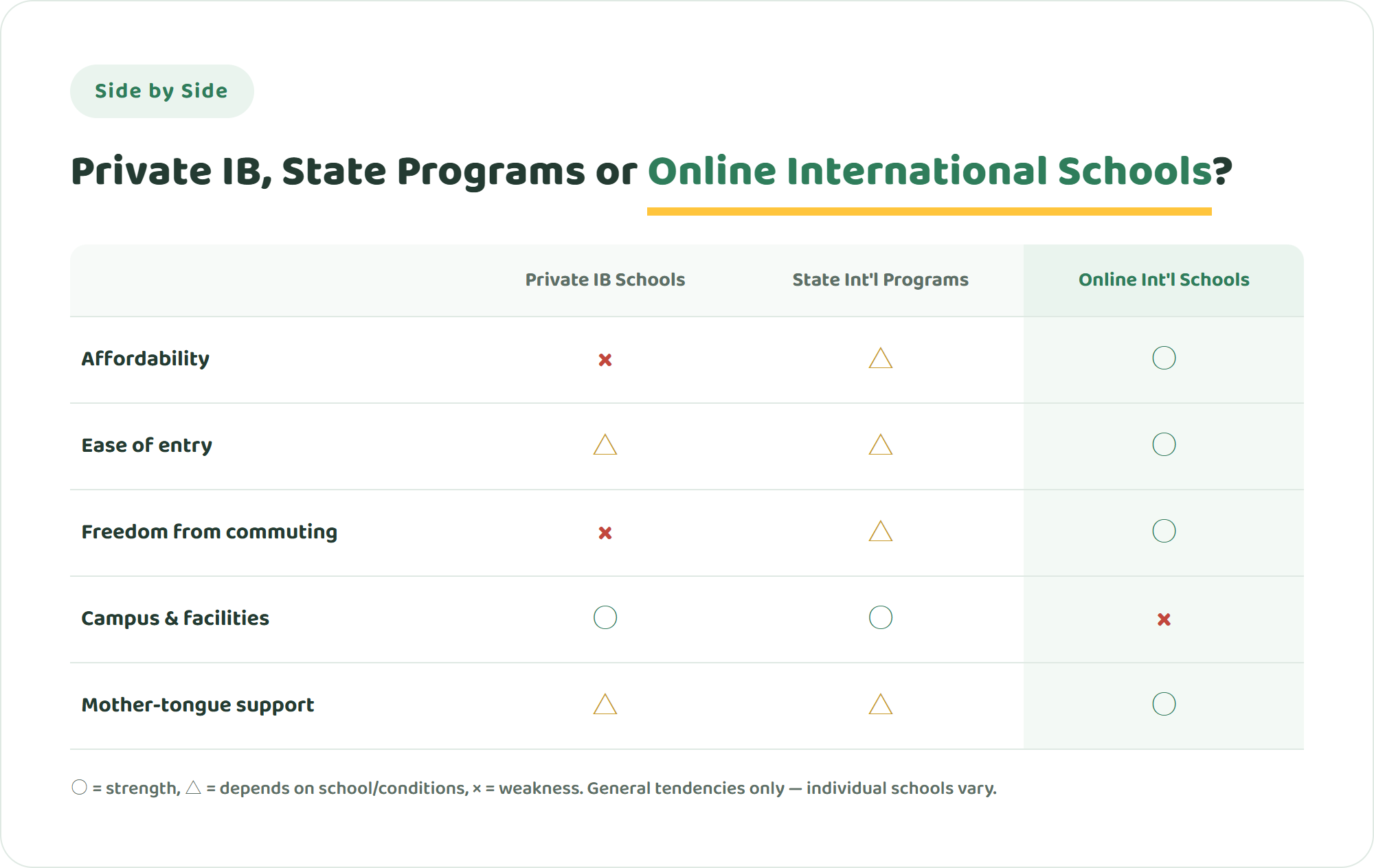
Private IB schools deliver global connection and superb facilities, at a cost of tens of thousands of dollars a year. State programs are far more affordable but come with zoning, capacity and visa conditions. Online international schools remove the commute and much of the cost, but cannot offer a physical campus. Decide what you can compromise on and what you cannot — that single conversation will shortlist your options faster than any ranking. Curious how learning actually works without a campus? See how learning works online →
If Fees or Distance Are the Barrier: an Online Eighth Option
Maybe you have read this far and thought: the IB schools are wonderful, but the fees are not sustainable for us. Or the schools you like are an hour’s drive away. Or your child needs a gentler, smaller environment than a 2,000-student campus. That is exactly the family we built 脱偏差値のオンラインインターナショナルスクール NIJIN GLOBAL ACADEMY (NGA) for.
NGA is an online international school opening in September 2027, run by NIJIN Inc. of Japan — whose alternative school in Japan, NIJIN Academy, already has more than 1,000 students. We do not rank children by test scores. Learning happens in small dialogue-centred groups, guided by one idea: helping children come to love themselves and the world. NGA serves ages 6 to 18 across Asia and Oceania, works from wherever you live, and is designed so children can grow into English step by step with Japanese-language support as a foundation. We aim to keep tuition at roughly one-fifth of a bricks-and-mortar international school.
To be fully honest: we have not opened yet, and our track record is still ahead of us. An online school is not the same experience as a leafy campus with playing fields. But if fees, distance or language are the walls between your child and an international education, NGA is worth comparing alongside the schools above.
Frequently Asked Questions
From what age can children start at international schools in Melbourne?
Most independent schools take children from around age 3 in their Early Learning Centres; government schools start at Foundation (age 5). If you are applying as an international student, note that some schools only accept certain year levels — always check the school’s international admissions page.
Is there support for children whose first language is not English?
Yes, but it is usually EAL (English as an Additional Language) support rather than mother-tongue teaching. Unlike expat-focused schools in Asia, Melbourne schools rarely offer dedicated Japanese or other first-language programs; many families combine school with weekend community language schools. If maintaining the home language matters most, an online international school can also fill that gap.
When is the best time to enrol or transfer?
The Australian school year runs from late January to December over four terms, so it is offset by half a year from Japan and much of Asia. Term boundaries are the smoothest entry points, and popular schools carry waitlists — enquire one to two years ahead where you can. Mid-term entry depends on the school.
Melbourne Doesn’t Lack International Schools — It Defines Them Differently.
The absence of Asia-style international schools in Melbourne is not a gap; it is a sign that the whole city is already multicultural. IB continuum schools, bilingual schools, public international programs, and now online schools — the shapes differ, but the choice is real. Take your time, weigh fees against what your child actually needs, and pick the one that your family can sustain with a smile.
NIJIN GLOBAL ACADEMY opens in September 2027. To hear how our small-group, affordable, globally connected learning works — and to be first in line for founding-cohort news — join our mailing list.
International Schools in Other Cities
- International Schools in Nagoya: All 8 Schools
- International Schools in Minato: Fees
- International Schools in Setagaya: All 14 Schools
- International Schools in Nakano, Tokyo
- International Schools in Tsukuba: Fees
- International Schools in Sendai: 7 Picks and Fees
- International Schools in Meguro: All 8 Schools
- International Schools in Musashino, Tokyo
- International Schools in Nerima, Tokyo
- International Schools in Sydney
- International Schools in Tokyo
- International Schools in Osaka
- International Schools in Singapore
- International Schools in Bangkok
- International Schools in Manila