“We put our child in an international school — but what happens after graduation? Will they really be okay?” If that question surfaces on a quiet evening, you’re not alone. You want your child to grow up fluent, globally minded, at home in the world. But then comes the harder question: “Can they get into a good university?” “Will this hurt their job prospects?” With few examples close to home, the worry only grows.
Here’s the first thing we want you to hear. International school graduates are not headed for a narrow future. In fact, stepping away from a single ranking on a test tends to open up a surprisingly wide range of paths. In this piece — honestly, without exaggeration — we’ll walk through the real picture of international school graduates and their university outcomes, for parents who worry about what comes next.

Where the “will they get into university?” fear really comes from
Much of the anxiety parents feel isn’t about a lack of options — it’s about a lack of information. The path from a mainstream high school to university is well-mapped: there are ranking scores, cut-off lines, and years of alumni results to point to. But when it comes to international school graduates and their university outcomes, there are fewer familiar examples nearby, and “I can’t see it” quietly turns into “it must be risky.”
Yet unseen is not the same as nonexistent. Universities at home and abroad have built many doors specifically for students who’ve learned internationally. The fear isn’t the absence of a path — it’s not yet holding the map. So let’s open that map together.
International school graduates don’t follow one single road
The paths that graduates of international schools take branch out in several directions at once. It isn’t a yes/no question of “university or not” — the very menu of options is different.
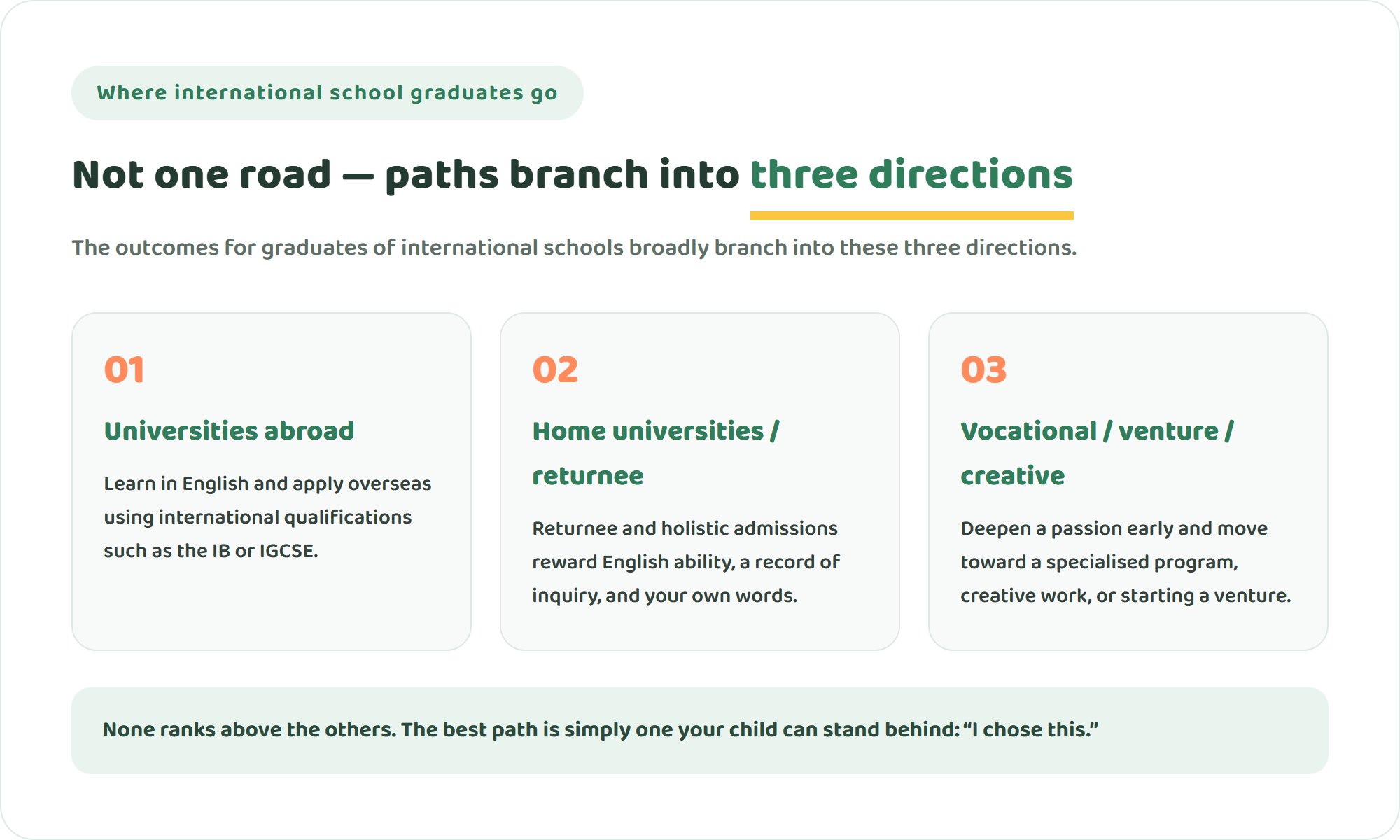
The first is universities abroad. A student who has learned in English and built up international qualifications such as the IB or IGCSE can use those credentials directly when applying overseas. The second is home-country universities, through returnee admissions or holistic (essay-and-interview based) admissions, where English ability, a record of inquiry, and the ability to speak in one’s own words carry weight. The third goes beyond university altogether — vocational, entrepreneurial, and creative paths, where a student who went deep into a passion early moves toward a specialised program, creative work, or even starting their own venture.
What matters is that none of these ranks above the others. The best outcome is simply a path your child can stand behind and say, “I chose this.” We’d love for you to receive the diversity of these options not as a worry, but as possibility.
Why so many doors open
So why does an international education connect to such a wide range of outcomes? There are three main reasons.
- The ability to learn in English — not just conversation, but thinking, researching and building an argument in English. This is a real asset both for universities abroad and for returnee admissions at home.
- International qualifications and a learning record — a record of learning such as the IB or IGCSE is commonly recognised in overseas university applications, widening the very range of “which universities can I apply to.”
- The ability to choose, and to speak in one’s own words — through inquiry-based learning, a student can explain “why this interests me.” This is exactly what holistic admissions and universities abroad most want to see.
Put the other way around: an education aimed only at pushing a test score higher rarely grows these strengths. The wide range of international school outcomes isn’t luck — it’s the natural result of nurturing the strengths that a score can’t measure.
See how learning works at NGA →
The reality of home-country admissions — what returnee and holistic routes look for
“Even so, we’d like our child to go to a university here.” Many parents feel this way, and there’s good news: for international school graduates, a home-country university is a genuinely realistic option. The key is knowing the doors that sit apart from the standard entrance exam.
Returnee admissions and holistic admissions ask less about a one-shot academic test and more about what a student has worked on and thought through. Proof of English ability, a theme they’ve explored, their own words in an interview or essay. In other words, they reward a different set of strengths than ranking-style assessment measures. Let’s lay out that difference in the table below.
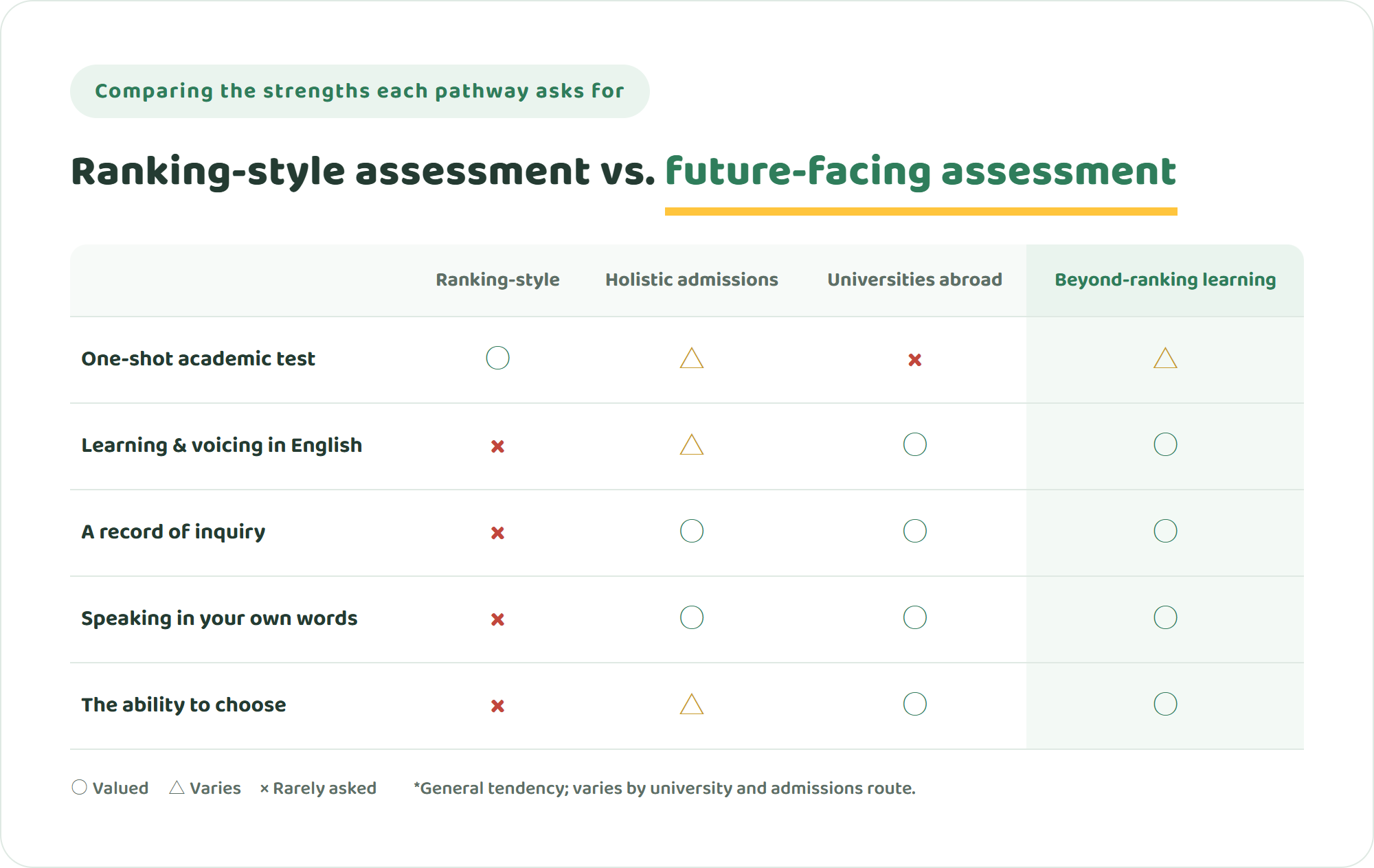
What the table reveals is that the strengths an international school nurtures overlap closely with future-facing assessment. A student who looks disadvantaged in a one-shot entrance exam can find that, by changing the door they enter, everything they’ve built becomes a strength. When thinking about outcomes, choosing “which arena you compete in” matters enormously.
A way of thinking about outcomes beyond a single ranking
By now, some readers may be wondering: “So which path is the right one?” Our answer is that not fixing on a single right answer is itself the way to think about outcomes today.
A ranking score is admittedly easy to read. But it’s also a system that “lines children up by one number.” At NIJIN GLOBAL ACADEMY (NGA), we stand for going beyond that exam race. Rather than ranking by test scores, we care about each child learning to love themselves and the world — and when things go wrong, solving it by changing the system rather than blaming the person. That value carries straight into how outcomes are chosen.
You don’t need to panic by comparing your child to others. What matters is growing your child’s own ability to say “this is what I want to choose.” With that ability, paths can always be found afterwards.

How an online international school grows these outcomes — where NGA fits
“I understand that many paths can open. But where do you learn so that actually happens?” As one answer, we’d offer the option of an online international school.
NGA is an online international school beyond the exam race, opening in September 2027. Learning in English with peers around the world, building up inquiry, growing the ability to speak in one’s own words — these are exactly the strengths that open the wide outcomes we described above. Tuition is around one-fifth of an on-campus international school, and being able to keep going supports outcome-building over the long term.
But let us be honest. We don’t promise “enrol here and your child will definitely get into University X.” Outcomes are something a child grows into. What we can offer is the foundation of strengths beneath them, and an adult who thinks through the path alongside your child. In fact, NIJIN Academy, the alternative school we run in Japan, already has over 1000 children learning with us. We’re now bringing that same learning online — in a form that connects all the way through to future outcomes.
An honest word on who it suits — and who it doesn’t
We won’t claim an online international school is ideal for every child. If your family especially values sitting side by side with classmates in the same physical room, an on-campus international or local school may fit better. And if you’d like the path laid out entirely “on rails,” an education that grows the ability to choose for oneself may feel like a detour at first.
On the other hand, if you want to expose your child to English and international learning, to grow the ability to think and choose rather than only score, and to stay connected to the world regardless of where you live — it tends to fit very well. What matters is less about finding the “right” school and more about how you set up an environment in which your child can carve out their own path with their own strengths.
Three steps to prepare for outcomes you won’t regret
Finally, here’s an order you can keep in mind at home to connect international learning to real outcomes. There’s no need to rush and do everything at once.
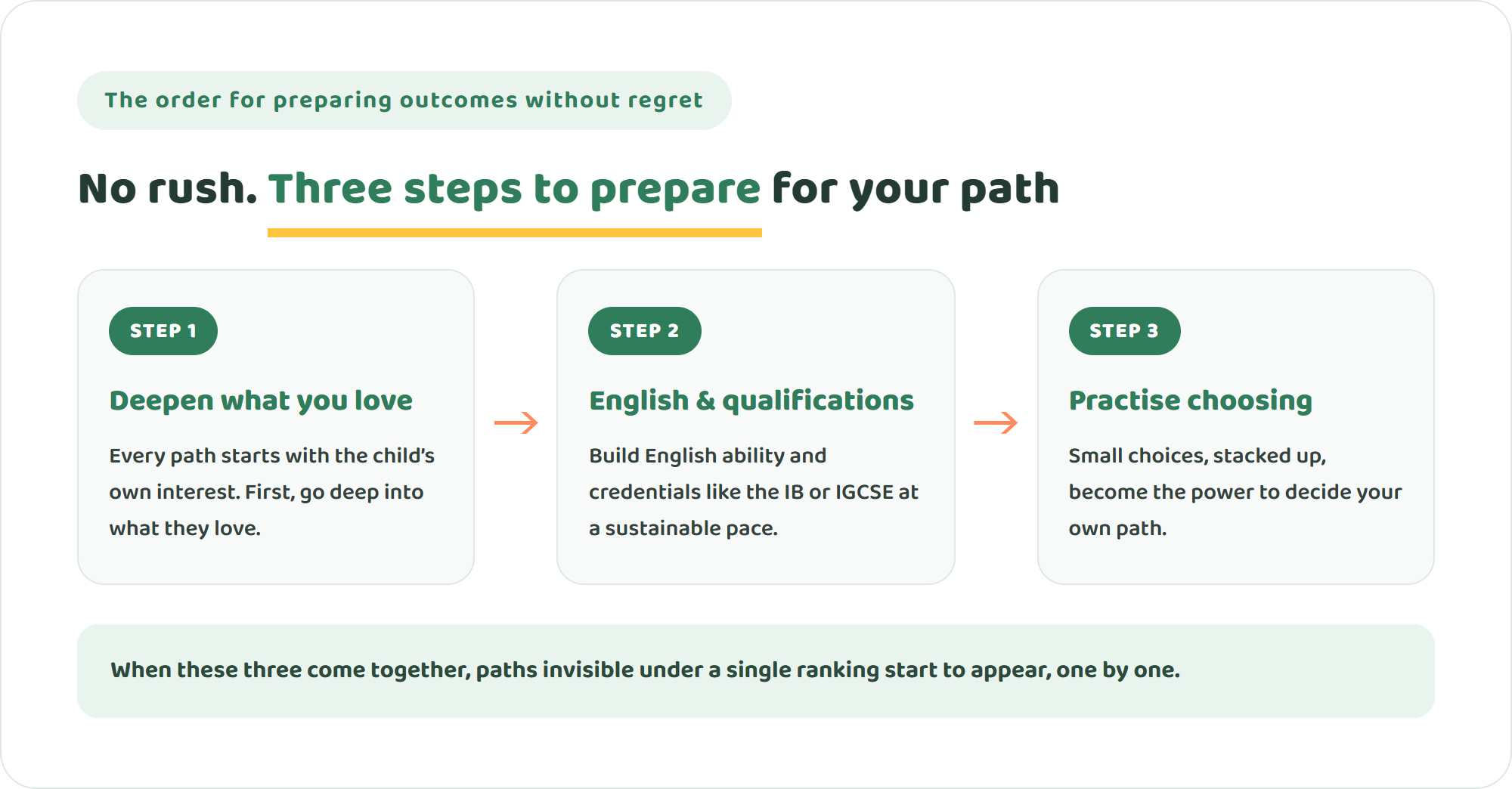
First, deepen what your child loves. The starting point of any path is always the child’s own interest. Next, build up English ability and international qualifications at a sustainable pace — this physically widens the range of options. And finally, practise choosing for oneself. Small choices, stacked up, become the larger power to decide one’s own path. When these three come together, paths invisible under a single ranking start to appear, one after another.
Frequently asked questions
Can international school graduates get into a home-country university?
Yes. There are doors such as returnee admissions and holistic (essay-and-interview based) admissions, which reward English ability, a record of inquiry, and the ability to speak in one’s own words. Because it’s a different arena from the standard entrance exam, the international learning a student has built up tends to become a direct strength.
Won’t an international education hurt job prospects?
If anything, the ability to think and communicate in English, and to choose and act for oneself, are exactly the strengths tomorrow’s world asks for. Outcomes extend beyond university to vocational, entrepreneurial and creative paths. Being able to hold options open, rather than narrowing to “one road,” is itself a source of real reassurance.
Can we aim for international outcomes even if English isn’t strong yet?
Yes. English is best grown gradually, not as a “subject” but as the language for connecting with the world. What matters is less today’s level and more the strengths you’ll build from here, and the willingness to choose for yourself. With an adult walking alongside, that very process grows your child’s outcomes.
Turning worry about outcomes into possibility.
The future of a child in an international school is far from narrow. Stepping away from a single ranking, the options — universities abroad, home-country universities, vocational routes, entrepreneurship, creative paths — actually widen. What’s needed is a learning foundation your child can use to choose that path with their own strengths.
NIJIN GLOBAL ACADEMY opens in September 2027. We’ll share how learning connects to a wide range of outcomes, along with first-cohort enrolment news, straight to your inbox. Let’s widen your child’s future options, together.
Get opening updates by email →
More on choosing an international education
- Affordable International Education for Your Child——How to keep costs down
- Positive School Refusal: Supporting a Child Who Learns Outside School——Practical support for families
- International School Fees in Asia by Country——An honest comparison, and the online third path
- Are There Subsidies for International Schools?——Realistic ways to lower the cost
- A Cheaper Alternative to a Singapore International School——Affordable online options
- Affordable International Schools in Bangkok——Fees, and an online alternative
- 10 Ways to Help Your Child Learn English at Home——What parents can do
- Online High School for Expat and Globally Mobile Families——Learning that moves with you
- How to Choose an International School——7 questions to ask before you enrol
- 6 International Qualifications You Can Earn Online——An honest guide