This guide lets you compare eight international schools in Nagoya and Aichi on the three things that actually decide it: annual fees, nearest station, and how far in age your child can keep learning in English. The short answer: fees run roughly ¥430,000 to ¥4.1 million a year, and only one school takes a child from early years through high school entirely in English. That single fact is what makes Nagoya different from Tokyo or Osaka. Below you’ll find first-year totals (not just tuition), the commute reality station by station, admissions and transfer timing, and the questions worth asking on a school tour — with the gaps stated as plainly as the strengths.
Quick Answer: Your Options in Nagoya
If you only read one section, read this. Below are the schools covered in this guide, plus the online option — so you can see every route side by side before the details.
- Nagoya International School (NIS) — Moriyama-ku, the full 3–18 continuum — Ages / location — 3–18 (ELC to G12), Nakashidami, Moriyama-ku, Nagoya / Fee guide — ¥2.19M–¥3.18M/year (2026-27 official), plus ¥250,000/year campus development…
- Enishi International School — Nishi-ku, 10 minutes from Nagoya Station — Ages / location — 1–18 (early learning to G12), Kikui, Nishi-ku, Nagoya / Fee guide — ¥1.27M–¥2.4M/year (2026-27 official; DP adds ¥150,000/year), plus ¥175,000…
- Nagoya International Junior and Senior High School (NUCB group) — Showa-ku, 7 min from Gokiso — Ages / location — 12–18 (junior and senior high), Showa-ku, Nagoya / Fee guide — 2025 figures: first-year total about ¥820,000 (general class) or ¥1.09M (IB…
- NUCB International College — Nisshin City, IB boarding — Ages / location — senior high years 1–3, Komenoki-cho Sangamine, Nisshin City, Aichi / Fee guide — roughly ¥3.5M–¥4.1M/year all-in (about ¥2.1M tuition plus about ¥1.4M…
- Aichi International School (NIPAIS) — Meito-ku, Hoshigaoka area — Ages / location — 3–12 (kindergarten to G6), Nijigaoka, Meito-ku, Nagoya / Fee guide — tuition about ¥1.089M/year (kindergarten) and ¥1.331M/year (elementary)…
- UPBEAT International School — three campuses across the city — Ages / location — 57 days to 12 years; Atsuta, Nakagawa and Tempaku wards, Nagoya / Fee guide — inquire directly (not publicly disclosed; confirm at a visit)
- Kinderkids International School, Nagoya — Showa-ku, 5 min from Irinaka — Ages / location — 6 months to age 6, Hiroji-cho, Showa-ku, Nagoya / Fee guide — about ¥69,000–¥71,000/month (roughly ¥830,000–¥850,000/year) plus ¥160,000…
- Sunnyside International School (Gifu) — about 20 minutes by train, plus a transfer — Ages / location — 3–12 (kindergarten and elementary divisions), Iwai, Gifu City / Fee guide — about ¥430,000–¥630,000/year (public database — confirm latest)
- NIJIN GLOBAL ACADEMY (online) — Ages 6–18 / opening September 2027, currently taking opening-update registrations / fees around one-fifth of a typical campus international school / Japanese-language support. An option when commute or fees are the wall.
New to the topic? Start with what an international school actually is — types, fees, admission requirements and how to choose. Searching more widely across the prefecture? See international schools in Aichi.
International schools in Nagoya: all 8 compared by fees, station and age range
Here is the whole landscape in one table — eight schools across Nagoya City and its commutable neighbours (Nisshin and Gifu), compared on annual fees, area and nearest station, curriculum, and the stage each serves. In Nagoya, the column that matters most is not the price ranking. It is how far, in age, a child can keep learning in English.
| School | Area / nearest station | Curriculum | Stage | Annual fee guide |
|---|---|---|---|---|
| Nagoya International School (NIS) | Nakashidami, Moriyama-ku / shuttle from JR Kozoji Stn + 5 city bus routes | IB (PYP/MYP/DP), all English | Early years–high (3–18) | approx. ¥2.19M–¥3.18M |
| Enishi International School | Kikui, Nishi-ku / about 10 min from Nagoya Station | IB (PYP/MYP/DP) | Early years–high (1–18) | approx. ¥1.27M–¥2.4M |
| Nagoya International Jr and Sr High (NUCB group) | Showa-ku / 7 min walk from Gokiso Stn (Tsurumai and Sakura-dori lines) | IB (MYP/DP) + Article One school | Junior–senior high (12–18) | approx. ¥600K–¥870K (year 2 on) |
| NUCB International College | Komenoki, Nisshin City / full boarding | IB DP, boarding, Article One school | Senior high (Yr 1–3) | approx. ¥3.5M–¥4.1M (incl. boarding) |
| Aichi International School (NIPAIS) | Nijigaoka, Meito-ku / Hoshigaoka Stn area (Higashiyama line) | WASC-accredited (KG–elem.) | Kindergarten–elementary (3–12) | approx. ¥1.09M–¥1.33M |
| UPBEAT International School | Atsuta-ku / Nakagawa-ku / Tempaku-ku (3 campuses) | IB PYP (inquiry-based) | Infant–elementary (57 days–12) | Inquire (not disclosed) |
| Kinderkids, Nagoya | Hiroji-cho, Showa-ku / 5 min walk from Irinaka Stn | English immersion (preschool/KG) | Early years (6 months–6) | approx. ¥830K–¥850K (¥69K/mo+) |
| Sunnyside International School | Iwai, Gifu City / ~20 min by train from Nagoya, plus local transfer | IB PYP (Article One school) | Kindergarten–elementary (3–12) | approx. ¥430K–¥630K |
Lined up this way, two things stand out. Fees span an enormous range — from about ¥430,000 to ¥4.1 million a year — and yet only four routes carry a student through to high school in English: NIS, Enishi, the IB stream at Nagoya International Jr and Sr High, and the boarding programme at NUCB International College. Most of the affordable options stop at elementary, and the onward pathway is something you plan separately.
Fees are estimates from official school sites and public databases as of July 2026, and vary by grade, year and additional charges (enrollment, facility, maintenance, bus). Always confirm the latest directly.
One correction worth knowing: the International Christian Academy of Nagoya (ICAN, Nagakute City) still appears on some school lists, but it closed in 2021 after opening in 1991. Check a school’s current operating status before shortlisting it.
What international schools in Nagoya cost — and the first-year total nobody quotes
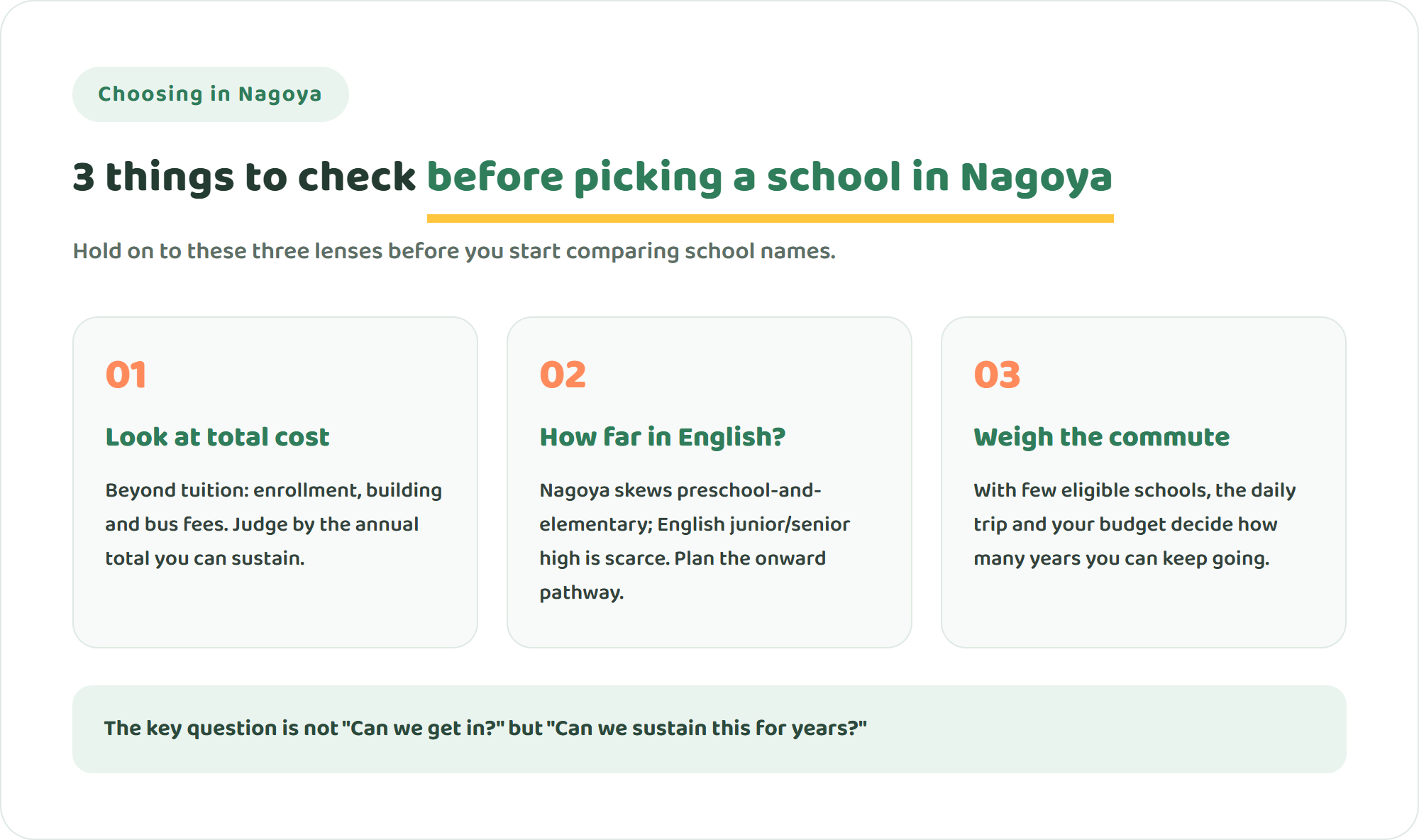
The most common budgeting mistake is planning around tuition alone. In Nagoya, enrollment fees, facility levies, annual maintenance charges and bus costs sit on top, and the first year often lands 30–50% above the headline tuition. Start with the ranges by stage:
- Preschool and early years — roughly ¥430,000–¥1.6M a year. This is where Nagoya has the most choice.
- Elementary (international) — roughly ¥1.33M–¥2.7M a year. The step up is steep.
- Junior and senior high (international) — roughly ¥2.3M–¥3.18M a year, or about ¥870,000 via an Article One school’s IB stream.
Now the number that actually leaves your account. Below are first-year totals, calculated from published 2026 figures (bus, uniform and materials excluded).
| School / stage | Tuition (yr) | One-time first-year costs | First-year total | Year 2 onward |
|---|---|---|---|---|
| NIS, early years (ELC) | ¥2.19M | ¥1M registration + ¥50K application | approx. ¥3.49M | approx. ¥2.44M |
| NIS, elementary (G1–5) | ¥2.70M | ¥1M registration + ¥50K application | approx. ¥4.00M | approx. ¥2.95M |
| Enishi, elementary (G1–5) | ¥2.05M | ¥250K enrollment + ¥350K building + ¥30K application | approx. ¥2.86M | approx. ¥2.23M |
| Aichi Int’l (NIPAIS), G1 | ¥1.33M | ¥33K application + ¥440K enrollment | approx. ¥2.13M | approx. ¥1.66M |
| Nagoya Int’l Jr High, IB stream (Yr 1) | ¥575K + ¥275K IB fee | ¥220K enrollment and other one-offs | approx. ¥1.09M | approx. ¥870K |
NIS elementary opens at roughly ¥4 million in year one; Enishi at about ¥2.86 million. That gap is why, in Nagoya, the first real hurdle is not getting in — it is staying in. By contrast, the Article One IB stream lands near ¥1.09 million, an order of magnitude apart. For how these line items stack up, see our breakdown of international school tuition costs. To compare against cities with deeper choice, see international schools in Osaka and international schools in Tokyo.
Can Nagoya’s free-preschool subsidy be used at an international school?
Sometimes — and the details decide it. Nagoya City subsidises fees at unlicensed childcare facilities up to ¥37,000 a month for children in the 3- to 5-year-old classes whose families hold a certified need for childcare (and who are not already using a licensed nursery, kindergarten or certified centre). For 0- to 2-year-old classes, the cap is ¥42,000 a month for residence-tax-exempt households. If a child is enrolled at a kindergarten whose extended-care hours fall below the standard (8 hours a day, 200 days a year), the combined cap is ¥11,300 a month.
The catch: eligibility applies only to facilities that meet the national standard and hold the corresponding certificate. So it is never “international schools are excluded” or “international schools qualify” — it varies facility by facility. Ask on your tour whether the school appears on Nagoya City’s list of eligible facilities. Over a year, it is a difference of up to roughly ¥444,000.
By age stage: how far in English can you actually go in Nagoya?
The defining feature of Nagoya is that the number of options collapses as your child gets older. Choosing only for the preschool years, without seeing this, is how families end up stuck.
- Ages 0–3 — plenty of choice. UPBEAT accepts children from 57 days old, Kinderkids from 6 months. Easy stage to find English exposure.
- Ages 3–6 (early years) — Nagoya’s deepest layer: NIS ELC, Enishi ELC, Aichi International’s kindergarten, plus many preschools clustered in Chikusa, Meito, Tempaku and Naka wards.
- Ages 6–12 (elementary) — it narrows sharply: NIS, Enishi, Aichi International (to G6), UPBEAT’s elementary division, and Sunnyside in Gifu. Costs jump here too.
- Ages 12–15 (junior high) — realistically NIS, Enishi, and the IB stream at Nagoya International Junior High.
- Ages 15–18 (senior high) — four routes: NIS, Enishi, the IBDP stream at Nagoya International Senior High, and boarding at NUCB International College. Of these, only NIS runs fully in English from early years straight through.
In short: in Nagoya you can choose freely at three, and barely at all at fifteen. Which is exactly why the entrance school and the exit route have to be designed together.
The 8 main international schools in Nagoya and Aichi, one by one
Now the schools themselves. This is not a ranking — the right answer changes with your child and your circumstances. Read with two questions in mind: how far in age can we go here, and can we realistically do this commute every morning?
1. Nagoya International School (NIS) — Moriyama-ku, the full 3–18 continuum
Founded in 1964 in Nakashidami, Moriyama-ku, NIS is Chubu’s flagship international school. Around 30 nationalities are represented, and it is essentially the only school in central Japan offering the full IB continuum — PYP, MYP and DP — entirely in English, from age 3 to 18. Accredited by CIS, WASC, IB and JCIS, with a strong record of graduates moving on to universities abroad. Transport runs on five school-bus routes circling the city (concentrated in Chikusa and Meito wards) plus a shuttle to and from JR Kozoji Station. Applications are accepted year-round, with entry possible each quarter subject to availability. If your plan is “English all the way through high school” in Nagoya, this is the benchmark.
- Curriculum — International Baccalaureate (PYP/MYP/DP), fully English-medium
- Ages / location — 3–18 (ELC to G12), Nakashidami, Moriyama-ku, Nagoya
- Getting there — five city bus routes plus a JR Kozoji Station shuttle (annual registration or per-ride tickets)
- Fee guide — ¥2.19M–¥3.18M/year (2026-27 official), plus ¥250,000/year campus development fee, ¥1M registration fee and ¥50,000 application fee
- Best for — families wanting an English IB pathway through high school, with room in the budget
2. Enishi International School — Nishi-ku, 10 minutes from Nagoya Station
An IB World School in Kikui, Nishi-ku, offering PYP, MYP and DP from early learning through high school. Its location roughly 10 minutes from Nagoya Station is a genuine advantage for dual-income and expat families. Newer than NIS, it is the other option aiming to carry students to secondary in English, with a bilingual design that values both Japanese and English. Note that English-language support, where needed, is charged separately (an EAL support fee of ¥300,000 a year), and siblings receive a 5% tuition discount.
- Curriculum — International Baccalaureate (PYP/MYP/DP)
- Ages / location — 1–18 (early learning to G12), Kikui, Nishi-ku, Nagoya
- Getting there — about 10 minutes from Nagoya Station; strong central access for a station-based commute
- Fee guide — ¥1.27M–¥2.4M/year (2026-27 official; DP adds ¥150,000/year), plus ¥175,000 annual maintenance, ¥250,000 enrollment, ¥350,000 building fee and ¥30,000 application fee
- Best for — families who want to keep Japanese support while continuing in English through secondary
3. Nagoya International Junior and Senior High School (NUCB group) — Showa-ku, 7 min from Gokiso
A private “Article One” school in Showa-ku affiliated with Nagoya University of Commerce and Business. Students earn a Japanese junior/senior high qualification while also pursuing the IB MYP and Diploma — a dual track. It sits a 7-minute walk from Gokiso Station (Tsurumai and Sakura-dori subway lines), about 15 minutes from Nagoya Station, easily the most commutable of Nagoya’s IB-linked schools. Because it is an Article One school, fees are in a different league. In Nagoya it is a rare landing spot for teens who want to keep a Japanese school record while engaging with English and the IB — though it differs in character from a fully English-medium international school.
- Curriculum — IB (MYP/DP) plus Japanese secondary curriculum (Article One school)
- Ages / location — 12–18 (junior and senior high), Showa-ku, Nagoya
- Getting there — 7 min walk from Gokiso Station; 2 min walk from the Shiozuke-dori 4-chome bus stop
- Fee guide — 2025 figures: first-year total about ¥820,000 (general class) or ¥1.09M (IB class); from year two about ¥600,000 / ¥870,000 (plus a ¥100,000 education levy on entering senior high)
- Best for — families wanting to keep a Japanese school record while taking on the IB from secondary
4. NUCB International College — Nisshin City, IB boarding
Opened in 2022 in Komenoki, Nisshin City, this is a full boarding international school — an Article One Japanese high school that teaches in English and offers the IB Diploma Programme. It runs a September intake and draws students from more than 20 countries. Boarding replaces the commute question entirely, and that is rather the point: it fills the hole that Nagoya’s day schools leave for families wanting an English-medium IB from high school. Merit-based tuition reductions are available.
- Curriculum — International Baccalaureate (DP), full boarding, Article One school
- Ages / location — senior high years 1–3, Komenoki-cho Sangamine, Nisshin City, Aichi
- Getting there — full boarding, meals included; residential rather than commuted
- Fee guide — roughly ¥3.5M–¥4.1M/year all-in (about ¥2.1M tuition plus about ¥1.4M boarding, meals included) plus around ¥500,000 admission. These are third-party estimates — confirm current figures with the school
- Best for — students ready to commit fully to the IB from high school, in a boarding setting
5. Aichi International School (NIPAIS) — Meito-ku, Hoshigaoka area
A WASC-accredited school in Nijigaoka, Meito-ku. The kindergarten (ages 3–5) runs on English immersion; the elementary division (G1–G6) is bilingual in Japanese and English, with distinctive touches such as ICT education and violin instruction. It belongs to the UNESCO Associated Schools network. The Hoshigaoka area on the Higashiyama subway line makes it convenient from Meito, Chikusa and Nagakute. Open campus tours run throughout the year, and trial enrollment for the 2027 intake is already open. The design serves the early and elementary years well — but, typical of Nagoya, the pathway beyond it is something you’ll need to plan separately.
- Curriculum — WASC-accredited, UNESCO Associated School (immersion in kindergarten, bilingual in elementary)
- Ages / location — 3–12 (kindergarten to G6), Nijigaoka, Meito-ku, Nagoya
- Getting there — Hoshigaoka Station area on the Higashiyama line; convenient from Meito, Chikusa and Nagakute
- Fee guide — tuition about ¥1.089M/year (kindergarten) and ¥1.331M/year (elementary), official. Add facility fees of about ¥207K–¥227K and other charges of about ¥88K–¥97K; enrollment fees run ¥55,000–¥440,000 depending on entry grade
- Best for — families wanting a solid English environment through elementary, with Japanese developing alongside
6. UPBEAT International School — three campuses across the city
An IB World School (PYP) with campuses in Atsuta-ku (Hachiban), Nakagawa-ku (Yoshimoto-cho) and Tempaku-ku (Shimadagaoka), plus a separate elementary division. The preschool accepts children from 57 days old to age 6, and elementary covers 6–12, with inquiry-based learning in a multinational setting at convenient city locations. A licensed nursery (Axia Kids) is attached for the youngest children. Fees are not published, so ask on a visit — but being able to pick the campus nearest home or work is a rare advantage in Nagoya.
- Curriculum — International Baccalaureate PYP (inquiry-based)
- Ages / location — 57 days to 12 years; Atsuta, Nakagawa and Tempaku wards, Nagoya
- Getting there — three city campuses plus an elementary division; choose by proximity
- Fee guide — inquire directly (not publicly disclosed; confirm at a visit)
- Best for — families seeking an accessible, multinational PYP setting from infancy through elementary
7. Kinderkids International School, Nagoya — Showa-ku, 5 min from Irinaka
An English-immersion preschool and kindergarten in Hiroji-cho, Showa-ku, a 5-minute walk from Irinaka Station and about 10 minutes from Yagoto Station, open from 7:45 to 19:00. It is run by a nationwide operator with a track record of introducing English to Japanese-speaking children and supporting beginners step by step. It answers a common need — an English-immersion setting in the early years, on an accessible monthly plan — with the understanding that families move on from elementary age. Other Kinderkids campuses operate elsewhere in the city, including Noritake Shinmachi.
- Curriculum — English-immersion preschool / kindergarten
- Ages / location — 6 months to age 6, Hiroji-cho, Showa-ku, Nagoya
- Getting there — 5 min walk from Irinaka Station; about 10 min from Yagoto Station
- Fee guide — about ¥69,000–¥71,000/month (roughly ¥830,000–¥850,000/year) plus ¥160,000 entrance fee (public information as of 2026 — confirm latest)
- Best for — families in southeastern Nagoya who want an English environment first, in the early years
8. Sunnyside International School (Gifu) — about 20 minutes by train, plus a transfer
Run by the Watanabe Gakuen educational corporation in Iwai, Gifu City, Sunnyside became Japan’s first PYP-authorized Article One school (in 2016), with a kindergarten division and an elementary division. It blends inquiry-based learning with Japanese culture and emotional development. It sits outside Nagoya City — roughly 20 minutes by train from Nagoya Station to Gifu Station, then a local transfer — which puts it within reach from Nagoya’s northwest (Nishi, Kita and Nakamura wards). It also sits at the affordable end, and as one of Chubu’s few PYP Article One schools it is worth knowing about.
- Curriculum — International Baccalaureate PYP (Article One school)
- Ages / location — 3–12 (kindergarten and elementary divisions), Iwai, Gifu City
- Getting there — about 20 min by JR or Meitetsu from Nagoya to Gifu, plus a local leg; realistic from the northwest
- Fee guide — about ¥430,000–¥630,000/year (public database — confirm latest)
- Best for — northwest-Nagoya families wanting an affordable PYP within a Japanese school record
By area and subway line: the commute reality for Nagoya’s international schools
Nagoya’s international schools cluster in the eastern and northern parts of the city, and most run school buses. Because it’s a daily reality, test “can we actually do this commute?” as early as you test the fees. Line by line:
- Moriyama and the northeast (NIS) — the largest campus, but well away from any subway station. The JR Chuo Line shuttle from Kozoji Station and five city bus routes concentrated in Chikusa and Meito wards are the lifeline. Your bus stop is effectively your nearest station, so confirm at shortlisting stage that a usable stop exists near home.
- Higashiyama line, Meito and Chikusa (Aichi International) — the Hoshigaoka area is the densest pocket of international-school demand in Nagoya, and preschools cluster around Kakuozan, Motoyama and Hoshigaoka too. Linimo and the Higashiyama line bring Nagakute and Fujigaoka within range.
- Tsurumai and Sakura-dori lines, Showa-ku (Nagoya International Jr and Sr High, Kinderkids) — 7 minutes’ walk from Gokiso, 5 from Irinaka: the closest-to-a-station group in the city. For teenagers, being able to travel independently matters more than it sounds.
- Nagoya Station and Nishi-ku (Enishi) / Atsuta, Nakagawa, Tempaku (UPBEAT) — Enishi about 10 minutes from the main station, UPBEAT across three campuses. This is the layer that suits dual-income families minimising drop-off time. Central sites can have limited outdoor space, so check the daily routine on a visit.
- Eastern suburbs (Nisshin, NUCB International College) and beyond (Gifu, Sunnyside) — boarding removes the commute question in Nisshin; Sunnyside is workable from Nagoya’s northwest. Widening the search beyond the city opens up IB-authorized options at lower cost.
Commute time feeds directly into how many years you can sustain a school. For younger children especially, more than an hour each way is a heavy load, and it reshapes the accompanying parent’s day too. Some schools add practical constraints on top — at NIS, for instance, children in Grade 3 and below must be met at the bus stop by a parent or accompanying adult, which matters for two working parents. The school you can reach comfortably every morning beats “the best school” when it comes to lasting. Bus coverage, times and fees change year to year, so ask your shortlist early.
From preschool to elementary: how families bridge the gap in Nagoya
The most overlooked question in Nagoya is what happens after the early years end. Aichi International runs to G6, Kinderkids to age 6, UPBEAT to elementary — every one of them stops somewhere. Three bridges are realistic:
- Route A: move up into an international elementary — NIS, Enishi, Aichi International, UPBEAT’s elementary division or Sunnyside. Expect the annual cost to jump, commonly by more than ¥1 million a year from kindergarten to elementary, and expect an English assessment at some schools.
- Route B: Japanese school plus English alongside (double schooling) — a local public or private school with English maintained after hours and at weekends. Cheaper, but your family owns the design of the English. We unpack it in the double-school approach.
- Route C: continue in English at an online international school — the practical answer when there is nothing English-medium within commuting distance. It is increasingly how families cover Nagoya’s post-elementary gap.
One more fact worth carrying. The International Christian Academy of Nagoya in Nagakute closed in 2021, thirty years after opening in 1991 — a school that had served pre-kindergarten through grade 12. Schools can and do close, which means planning on the assumption that a school will still exist in ten years carries risk. It still appears on some listings, so check current status before you shortlist.
Admission requirements, application timing and transfers in Nagoya
Most international schools in Nagoya run an August–September academic year, and the term boundary is the easiest point to enter (the Article One schools — Nagoya International Jr and Sr High and Sunnyside — follow Japan’s April start; NUCB International College takes a September intake). Some, like NIS, accept applications year-round with quarterly entry subject to availability. A rough preparation timeline:
- One year to six months ahead — attend information sessions and campus visits. Because eligible schools are few here, check waiting-list status the moment a school interests you. Some, like Aichi International, open trial enrollment for an intake two years out.
- What applications typically require — an application fee (¥50,000 at NIS, ¥30,000 at Enishi), past reports and grades, references or documents from the previous school in English, an interview, and an English assessment. Requirements tend to rise with grade level.
- Budget for English support before you apply — EAL/ESL support is charged separately at some schools. Enishi sets it at ¥300,000 a year, which is exactly the kind of line item that catches families out.
- Transferring in (from abroad or within Japan) — some schools accommodate transfers timed to a return posting. Prepare transcripts and English-language documents from the previous school early.
The thing to watch in Nagoya is that “a school you can get into” and “a school you can continue in, in English” don’t always line up. Entry may be easy at preschool or elementary, yet there is almost nowhere in the city to continue in English from junior high. Hold a map from “entry” to “graduation or next step” from the day you enroll. Capacity, conditions and required documents differ by year and school, so always confirm directly.
How much should you trust reviews? 7 questions to ask on a school tour
Because Nagoya has relatively few international schools, the online review pool is small — a handful of posts can shape a school’s whole reputation. A review is not a fact; it is one family’s experience, and staff and policy change from year to year. What you see yourself, and what you’re told directly, is worth far more. Ask these seven:
- 1. Teacher tenure and turnover — “How many teachers changed last year?” In a region with a small pool of qualified international teachers, this reveals a lot about stability.
- 2. Where leavers actually went, over the last three years — especially at schools that stop at elementary. Destinations tell you the truth about the onward pathway.
- 3. Class size and nationality mix — where the proportion of Japanese-speaking children is high, break times can default to Japanese. Ask for the numbers and watch a break.
- 4. English support: available, at what cost, for how long — is EAL/ESL an extra charge, and up to which grade?
- 5. How Japanese language and kokugo are handled — how many hours a week, and does it follow Japan’s national curriculum? This matters if plans change.
- 6. Total annual cost beyond tuition — buses, materials, trips, uniform, donations. The fastest version of this question: “What did a family in this grade actually pay last year?”
- 7. Accreditation renewal and school health — when are the IB or WASC cycles due, and is enrollment growing? Given ICAN’s closure, this is a fair question, not a rude one.
And then, look at the students. The children you pass in the corridor will tell you what kind of place it is more honestly than any brochure.
Three types compared: which shape fits your family in Nagoya?
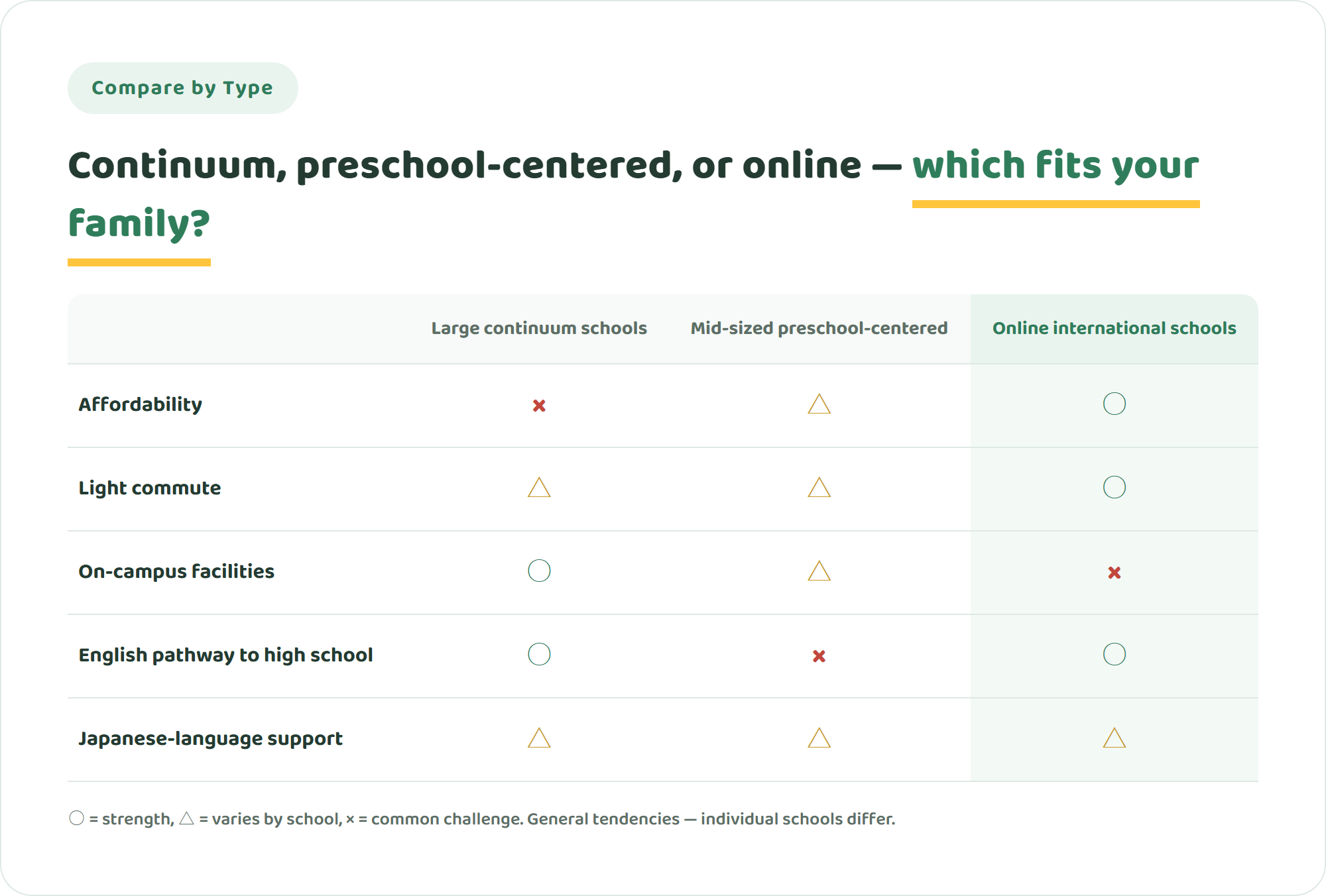
What these eight make clear is a Nagoya reality: your options narrow sharply depending on how far, in age, your child can keep learning in English. Let’s group the choices into three types — large continuum schools, mid-sized and preschool-centered schools, and online international schools — and compare them lens by lens.
As the table shows, on-campus grounds and facilities and a daily English-immersion environment are strengths of in-person schools, while affordability, a light commute, and freedom from where you live are strengths of online. What bites hardest in Nagoya is one question: after elementary, is there an English-medium junior or senior high within reach? Even after an English-rich early childhood, the onward options here are limited. Tuition is a decade-plus investment if it runs through high school — weigh commute, budget and your child’s temperament, and choose something you can sustain. To see how learning can connect to the world online, see how learning works online →.
When cost or commute is the wall — the online route from Nagoya
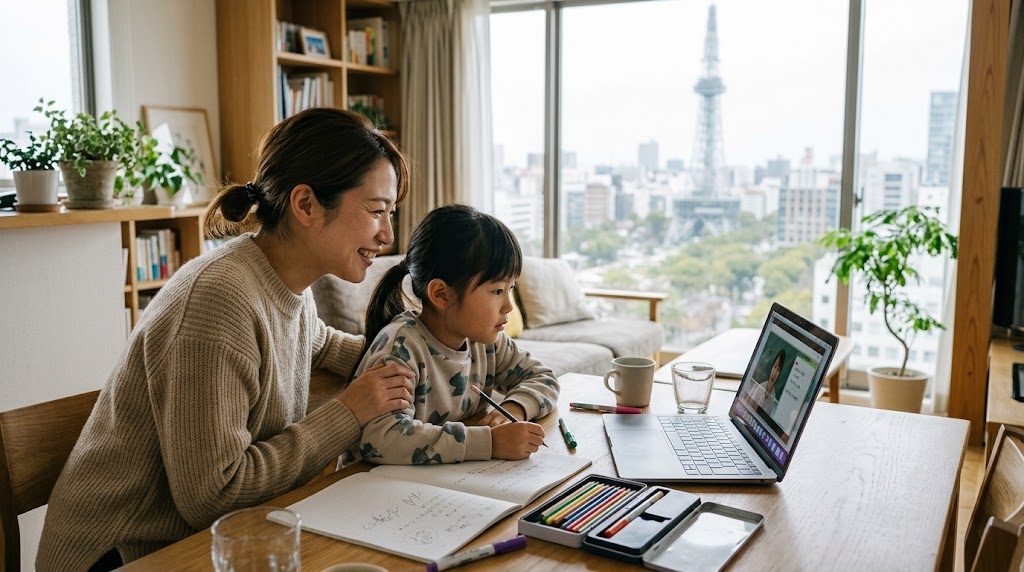
If, reading this, you felt “NIS is wonderful but ¥4 million in year one isn’t sustainable,” or “we can find an English preschool, but no English junior or senior high we can commute to” — that wall is very real in Nagoya and Chubu. In that case, in-person isn’t the only answer. We are NIJIN GLOBAL ACADEMY (NGA), an online international school opening in September 2027, operated by NIJIN Inc. Our alternative school in Japan, NIJIN Academy, already has more than 1,000 children enrolled.
NGA aims for learning that doesn’t rank children by test scores, and fees at roughly one-fifth of an in-person international school. It’s for ages 6–18 across Asia and Oceania — in the city or in a suburb with no English school within reach, your postcode doesn’t decide. It’s designed so children can start from a base of Japanese and grow into English gradually, so a beginner is fine. For families worried about maintaining Japanese, our sister service Tomodachi Japan (NIJIN’s online Japanese for children) is also worth a look. Honestly: NGA hasn’t opened yet, so our track record is still to come, and it isn’t the same as a campus with a schoolyard and science lab. Even so, against Nagoya’s real problem — the missing onward pathway — we believe it’s an option worth weighing.
Frequently asked questions about international schools in Nagoya
From what age can children enroll in international schools in Nagoya?
UPBEAT accepts children from 57 days old, Kinderkids from 6 months, Enishi from age 1, and NIS and Aichi International from age 3. Nagoya’s options are especially concentrated at the preschool-to-elementary stage. Entry or transfer from elementary grades is possible, though English requirements tend to rise with grade level. Capacity and admission conditions change year to year, so always confirm directly with each school.
Are there schools in Nagoya where children can study in English through high school?
For a full English-medium curriculum from early years through high school, Nagoya International School (NIS) is essentially the only option, with Enishi also running through to Grade 12. At the high-school stage there are two more routes: the IBDP stream at Nagoya International Senior High School (Showa-ku, an Article One school) and boarding at NUCB International College in Nisshin. Choices remain limited compared with Tokyo or Osaka, which is why it helps to plan the onward pathway from the elementary stage.
Are international schools in Nagoya cheaper than in Tokyo or Osaka?
The full-continuum NIS runs about ¥2.19M–¥3.18M a year, not dramatically different from comparable schools in Tokyo or Osaka. That said, Nagoya also offers affordable options in the ¥430,000–¥1.3 million range once you include preschool-to-elementary schools and nearby Article One schools such as Sunnyside. The catch: the cheaper the school, the more likely it’s limited to the early and elementary years — read price and stage together.
Can Nagoya’s free-preschool subsidy be applied to an international school?
Sometimes. Nagoya City subsidises unlicensed childcare fees up to ¥37,000 a month for 3–5 year-old classes where the family holds a certified need for childcare (¥42,000 for 0–2 year-old classes in residence-tax-exempt households). Eligibility applies only to facilities meeting the national standard and holding the certificate, so treatment varies school by school — including among international preschools. Ask whether the school appears on the city’s list of eligible facilities.
Can a complete beginner in English enroll in a Nagoya international school?
Early-years preschools and English-immersion schools (such as Kinderkids) are generally designed to support beginners step by step, so starting from zero is workable. Transferring in from the upper elementary grades and beyond usually assumes some English ability and takes preparation. Some schools, Enishi among them, charge separately for EAL support, so ask about both eligibility and cost on your visit.
When is the best time to transfer or enroll?
Most international schools start the year in August or September, and term boundaries are the easiest points to transfer (the Article One schools, Nagoya International Jr and Sr High and Sunnyside, follow Japan’s April start). NIS accepts applications year-round with quarterly entry subject to availability. Because eligible schools are few in Nagoya, once you have a target school it’s wise to ask about the waiting list early.
How should I research reviews and reputation for schools in Nagoya?
With so few schools, the online review pool is small, and judging from a handful of posts is risky. Five things asked directly on a tour — teacher turnover, where leavers went over the last three years, class size and nationality mix, total annual cost beyond tuition, and accreditation renewal status — will tell you far more than any review site.
Don’t let “because it’s Nagoya” be the reason you give up.
Nagoya and Aichi do offer several paths — the full continuum at NIS, an affordable IB stream a short walk from a subway station, an IB boarding school, accessible preschools, and now online. But the depth isn’t what Tokyo or Osaka offers, and the stretch after elementary especially takes planning. There’s no need to rush toward “the most famous school.” Weigh the total cost, the commute, your child’s temperament, and above all how many years you can sustain it — then choose, without hurry, the place where your child can most be themselves.
NIJIN GLOBAL ACADEMY opens in September 2027. We’ll share how the learning works — beyond test scores, affordable fees, small-group dialogue that connects to the world — and first-cohort admissions news, by email first.
To compare every option across the wider prefecture, see our guide to international schools in Aichi Prefecture, which covers schools outside this city and prefecture-wide fee ranges.
International Schools in Other Cities
- International Schools in Setagaya: All 14 Schools
- International Schools in Nakano, Tokyo
- International Schools in Tsukuba: Fees
- International Schools in Sendai: 7 Picks and Fees
- International Schools in Shinjuku: Fees
- International Schools in Karuizawa: All 4 Schools
- International Schools in Sapporo: Fees
- International Schools in Seoul
- International Schools in Shanghai
- International Schools in Tokyo
- International Schools in Osaka
- International Schools in Fukuoka: Fees
- International Schools in Yokohama: Full Comparison
- International Schools in Minato: Fees
- International Schools in Shibuya, Tokyo