If you have started researching international schools in Kuala Lumpur, you have probably discovered the same thing every parent does: there are far too many to keep straight, and the fees are all over the map. This guide is here to cut through the noise. Below you will find seven real, well-regarded international schools in KL, with their curriculum, age range, annual fee estimate, and neighbourhood laid out honestly. You will also get a clear picture of what fees actually cost, how to choose the right fit for your family, and one option many families overlook when commuting or budgets get in the way. By the end, your next step should feel a lot clearer.
Quick Answer: Your Options in Kuala Lumpur
If you only read one section, read this. Below are the schools covered in this guide, plus the online option — so you can see every route side by side before the details.
- The International School of Kuala Lumpur (ISKL) — Age range: 3 to 18 (Prep Reception to Grade 12) / Fee estimate: approx. RM69,500 to RM142,000 per year (plus one-time fees)
- The Alice Smith School — Age range: 3 to 18 / Fee estimate: approx. RM53,730 to RM117,360 per year
- Garden International School (GIS) — Age range: 3 to 18 / Fee estimate: approx. RM60,000 to RM125,000 per year
- Mont’Kiara International School (M’KIS) — Age range: 3 to 18 / Fee estimate: approx. RM42,500 to RM94,500 per year
- The British International School of Kuala Lumpur (BSKL) — Age range: 2 to 18 / Fee estimate: approx. RM56,395 to RM122,110 per year
- Fairview International School — Age range: 4 to 18 / Fee estimate: approx. RM25,000 to RM60,000 per year
- Global Indian International School (GIIS) — Age range: around 4 to 18 / Fee estimate: approx. RM13,900 to RM25,800 per year
- NIJIN GLOBAL ACADEMY (online) — Ages 6–18 / opening September 2027, currently taking opening-update registrations / fees around one-fifth of a typical campus international school / Japanese-language support. An option when commute or fees are the wall.
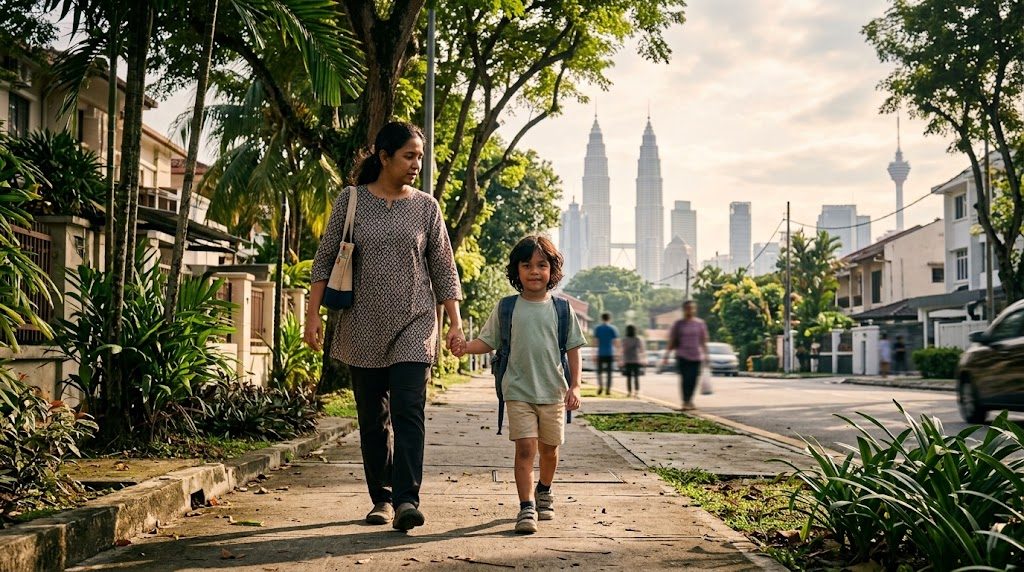
Can’t justify Kuala Lumpur international school fees?
Families in Kuala Lumpur often face the same wall: the school is right, the fee is not. NIJIN GLOBAL ACADEMY is an online international school with no campus — and no campus fees. Live, small-group lessons in English, at roughly one-fifth the cost of an in-person international school. It is built for children who are not yet fluent in English, so you do not need an English-speaking household to start.
🎁 Register and we will email you the school prospectus (English & Japanese) straight away — plus tuition and trial-class details before anyone else.
Free to join. Unsubscribe any time.
International schools in Kuala Lumpur: the landscape and fees
Kuala Lumpur is one of Southeast Asia’s most crowded markets for international schools. The greater KL area alone is home to roughly 100 to 120 schools, spanning British, American, IB (International Baccalaureate) and Indian (CBSE) curricula. Local demand is climbing too: national enrolment of Malaysian students reached about 88,900 in 2024, reportedly a rise of more than 30 percent in five years. That tells you the sector is trusted by expat and local families alike.
For many families, the natural first stop is Mont Kiara, an upscale, international neighbourhood with several top schools within easy reach, plus shops, restaurants and activities on the doorstep. But popularity has a cost. At sought-after schools such as Alice Smith, ISKL and Garden International, entry points like Year 1 and Year 7 frequently carry a waiting list, so a place is not always available when you need it.
Fees vary widely. Annual tuition runs from roughly RM20,000 to RM160,000 depending on the school and year group. Budget and Indian-curriculum options can start near RM14,000 a year, while the most established schools reach over RM140,000 at the top end. One more thing to plan for: since September 2025, a 6 percent Service Tax (SST) applies to annual fees above RM60,000 under Malaysian government policy. Registration fees, enrolment fees and deposits are often charged on top, so always compare the total cost, not just headline tuition.
7 best international schools in Kuala Lumpur
Here are seven KL schools chosen for their track record and for a healthy mix of curriculum and price. Fees are annual estimate ranges based on publicly available information around the 2026 school year; approximate figures only. Always confirm the exact, current amounts on each school’s official website.
1. The International School of Kuala Lumpur (ISKL)
Founded in 1965, ISKL is one of KL’s flagship schools, pairing an American standards-based education with the IB Diploma in the final years. Its expansive campus sits in Ampang.
- Curriculum: American plus IB Diploma (final years)
- Age range: 3 to 18 (Prep Reception to Grade 12)
- Fee estimate: approx. RM69,500 to RM142,000 per year (plus one-time fees)
- Best for: families with a generous budget who value US university pathways and a broad co-curricular programme.
2. The Alice Smith School
Established in 1946, Alice Smith is Malaysia’s oldest British international school. It runs two campuses, Primary at Jalan Bellamy and Secondary at Seri Kembangan, delivering a continuous British curriculum from IGCSE through A Level.
- Curriculum: British (IGCSE, A Level)
- Age range: 3 to 18
- Fee estimate: approx. RM53,730 to RM117,360 per year
- Best for: families drawn to a traditional British education and UK or European university destinations.
3. Garden International School (GIS)
Opened in 1951, this heritage school has its main campus in Mont Kiara, the neighbourhood most popular with expat and Japanese families. Built around a British curriculum, it is known for outstanding facilities, including an Olympic-sized pool.
- Curriculum: British (IGCSE, A Level)
- Age range: 3 to 18
- Fee estimate: approx. RM60,000 to RM125,000 per year
- Best for: Mont Kiara families who prioritise facilities and co-curricular breadth.
4. Mont’Kiara International School (M’KIS)
True to its name, M’KIS sits in the heart of Mont Kiara, offering a full IB continuum (PYP, MYP, DP) delivered with an American ethos. It is one of the more accessible price points among well-known schools.
- Curriculum: full IB (PYP/MYP/DP) with American approach
- Age range: 3 to 18
- Fee estimate: approx. RM42,500 to RM94,500 per year
- Best for: families in walking distance of Mont Kiara who want inquiry-based IB learning.
5. The British International School of Kuala Lumpur (BSKL)
Part of the global Nord Anglia group and located near Sri Hartamas, BSKL teaches the British curriculum before transitioning to the IB Diploma in the final two years. Students gain access to a global collaboration programme spanning 30-plus countries.
- Curriculum: British to IB Diploma
- Age range: 2 to 18
- Fee estimate: approx. RM56,395 to RM122,110 per year
- Best for: families who value a global network and modern facilities.
6. Fairview International School
Founded in 1978 and running several campuses across Malaysia, Fairview is a full IB school. Its main appeal is a continuous IB education from PYP to DP at a comparatively modest fee level.
- Curriculum: full IB (PYP/MYP/DP)
- Age range: 4 to 18
- Fee estimate: approx. RM25,000 to RM60,000 per year
- Best for: families who want a genuine IB pathway while keeping costs in check.
7. Global Indian International School (GIIS)
Located in Brickfields (Little India), GIIS is an Indian-curriculum international school built primarily around CBSE, with some of the most affordable fees in KL. Its multinational setting makes it a strong option for cost-conscious families.
- Curriculum: Indian CBSE (with Cambridge options available)
- Age range: around 4 to 18
- Fee estimate: approx. RM13,900 to RM25,800 per year
- Best for: families who put fees first while still wanting an English-medium environment.
Note: fee figures reflect publicly available information as of July 2026. Always confirm the total cost, including registration fees, enrolment fees and SST, and the latest terms on each school’s official website.
How to choose the right fit for your family
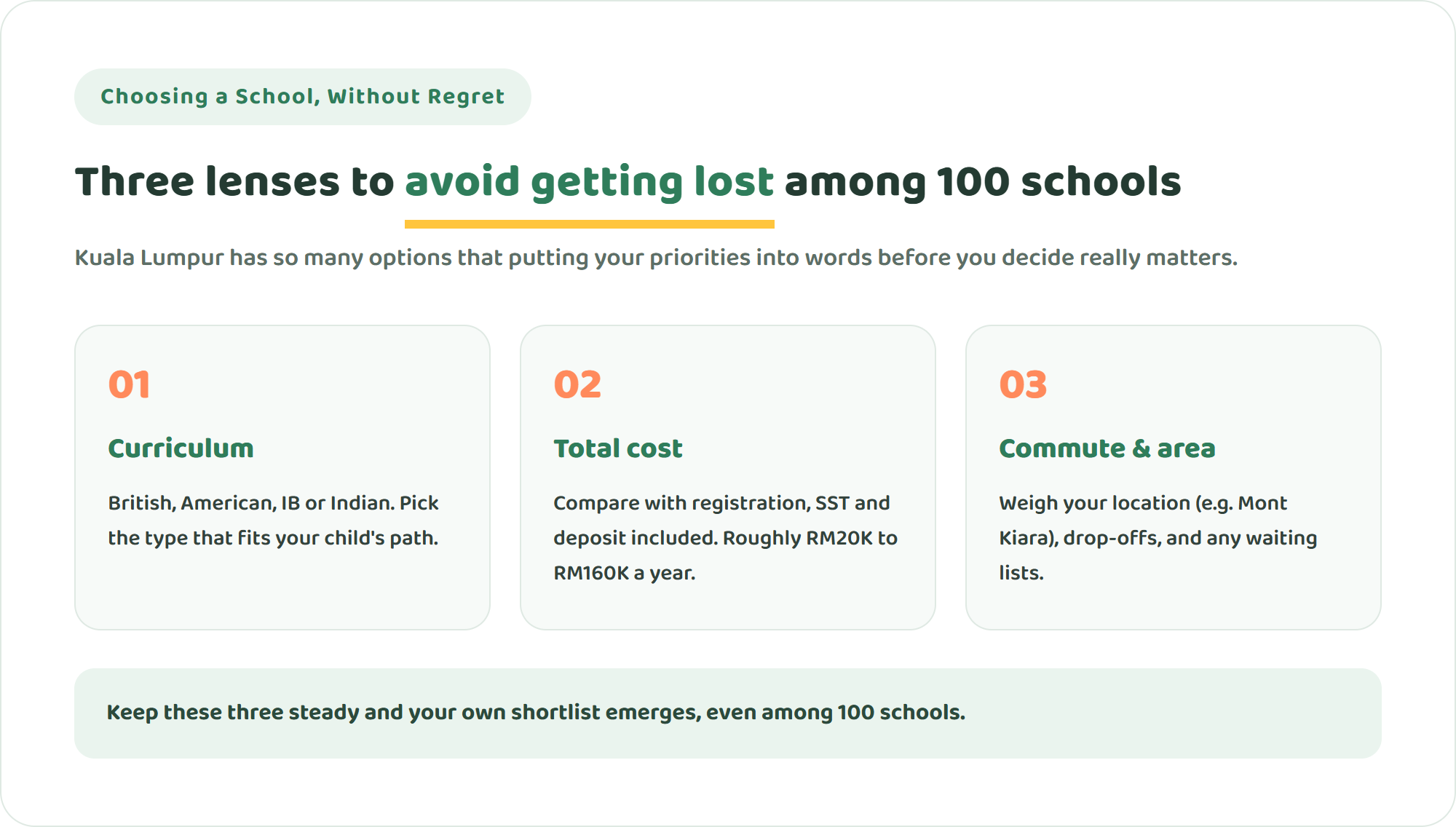
Line up all seven and one thing becomes obvious: “famous” or “cheapest” is not a strategy. What matters is putting your own priorities into words across several axes, affordability, ease of admission, commute, global connection, and support for your home language. If “within walking distance of Mont Kiara” is non-negotiable, the shortlist narrows quickly; if the goal is IB without breaking the bank, Fairview and M’KIS come into view. Choose on headline fees alone and registration costs, SST and daily drop-offs can make the reality harder than expected.
There is also the matter of capacity and waiting lists. Depending on the entry year and timing, your first-choice school may not have a place ready. For a closer look at what these fees really add up to, see our guide to the true cost of international school tuition. If you are weighing nearby cities too, our guides to international schools in Singapore and international schools in Bangkok are useful companions.
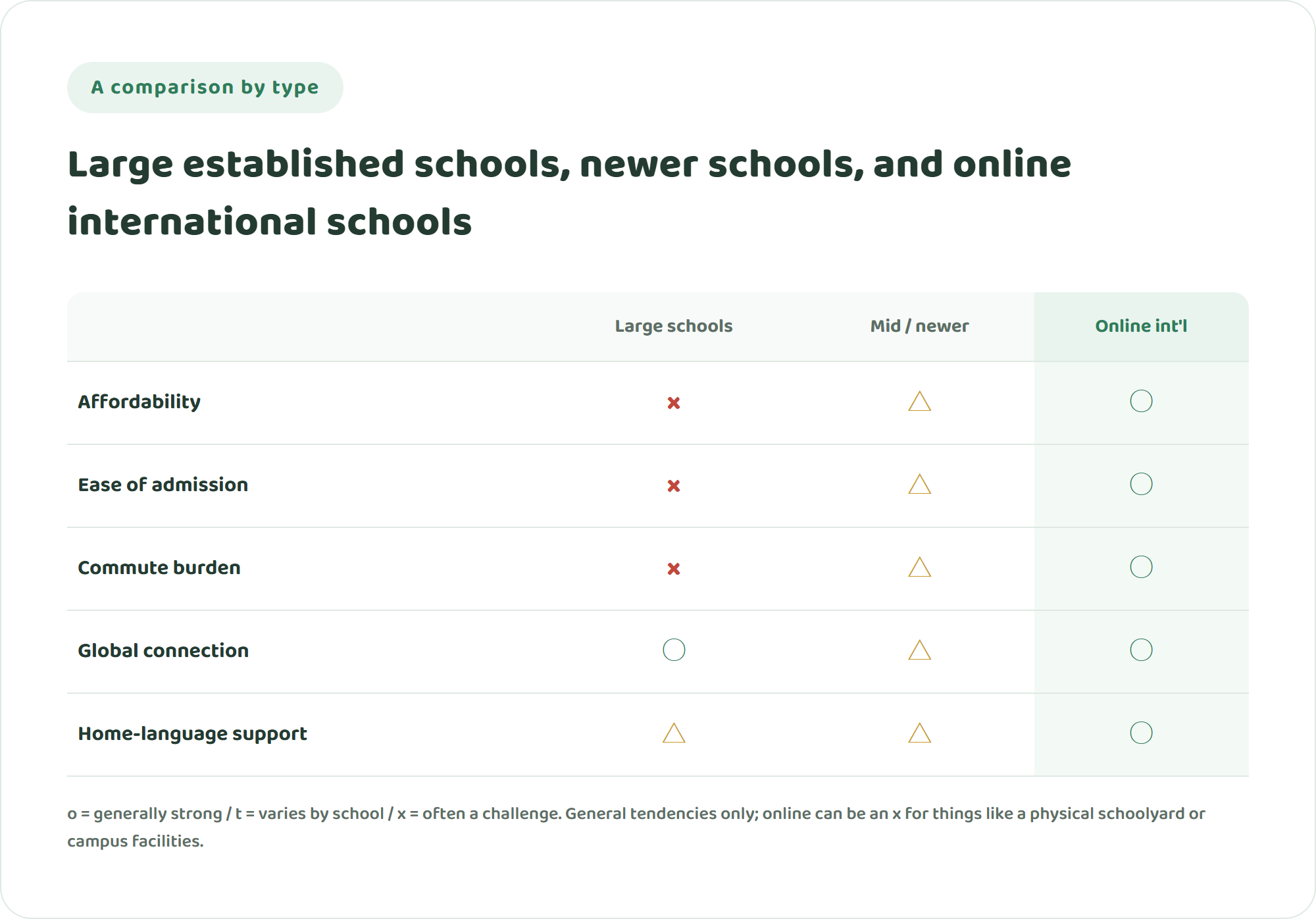
If comparing them leaves you thinking “an in-person school is appealing, but the fees and admission hurdles are steep,” remember that in-person is not the only path. Rethinking the shape of learning itself can open up the view. See how learning works online →

When fees or commuting are the barrier: an eighth option, online
After reviewing these seven schools, you may be thinking “the fees are high,” “the popular schools are hard to get into,” or “there is no school I like within reach.” For families in that position, we would like to offer an eighth option: 脱偏差値のオンラインインターナショナルスクール NIJIN GLOBAL ACADEMY (NGA).
NGA is an online international school scheduled to open in September 2027. It is being launched by NIJIN Inc. (Japan), which runs the alternative school “NIJIN Academy” with more than 1,000 students enrolled. The learning is dialogue-centred and taught in small groups, and it deliberately does not rank children by test scores, guided by the philosophy “come to love yourself and the world.” It is designed for children aged 6 to 18 across Asia and Oceania. Because it is not tied to a location, and because it is built to introduce English gradually with Japanese-language support in place, children can learn without a commute, whether you live in Mont Kiara or anywhere else. NGA aims to keep fees at roughly one-fifth of an in-person international school.
In the interest of honesty: NGA has not opened yet, and its track record is still to be built. It cannot replicate the fully in-person experience, running around a schoolyard or lingering with friends after class, in exactly the same way. Even so, we are preparing it in the belief that no family should have to give up on learning because fees or commuting stood in the way.
Frequently asked questions
Q. What age can children start?
Many international schools in Kuala Lumpur admit children from around age 3 (Early Years), and schools such as ISKL, Alice Smith, Garden and BSKL run all the way from early years to Year 13. NGA is for ages 6 to 18. Year-group cut-offs vary by school, so check availability for your child’s specific year with each school.
Q. My child’s English is limited. Is there language support?
Most in-person schools offer EAL (English as an Additional Language) support, though it can carry an extra fee. NGA is built to introduce English gradually with Japanese-language support in place, so a child who is still unsure in English can take that first step with confidence.
Q. Can we transfer mid-year?
Popular KL schools often have waiting lists at Year 1 and Year 7, and depending on the entry point and availability, a place may not be immediate. It is wise to confirm each school’s intake and timing early. Because NGA is online with no catchment area, it is easier to keep learning going even if your address changes.
The time you spend deciding is time spent on your child’s future
Pausing in front of 100-plus options is proof of how seriously you are weighing your child’s future. There is no single right answer. Start by comparing these seven schools through your own family’s priorities, and if it helps, quietly add the non-in-person path to your list as well. The right kind of learning for you and your child is out there to be found.
International Schools in Other Cities
- International Schools in Shinjuku: Fees
- International Schools in Karuizawa: All 4 Schools
- International Schools in Sapporo: Fees
- International Schools in Dubai: Fees
- International Schools in Meguro: All 8 Schools
- International Schools in Kobe: All 20 Schools
- International Schools in Katsushika, Tokyo
- International Schools in Singapore
- International Schools in Bangkok
- International Schools in Manila
- International Schools in Ho Chi Minh City
- International Schools in Tokyo
- International Schools in Osaka